







Abstract
1. Introduction
Advances in wireless sensor networks have enabled a wide range of application across many fields. Many of these applications have high quality of service (QoS) requirements in terms of security and reliability of data transmission.
Wireless sensor networks (WSNs) are characterized by severe resource constraints of sensor nodes, unreliable nature of the wireless links, dynamic changing in the size and density of the network, and the high risk of physical attacks to sensors. Many routing protocols have been proposed to overcome these constraints and improve the QoS in wireless networks. However, most of the existing protocols provide either secure [1] or QoS [2–5] routing. Few protocols have combined these two requirements [6–9].
Secure multipath routing protocols in WSNs can be divided into three categories based on the security-related operational objective [1]. The multipath routing protection only, the attack-specific, and the security operations support. The security-based multipath routing protection protocol is the interest of this paper in which the multipath routing is used to improve the security, increase reliability of data transmission, provide load balancing, and decrease the end-to-end delay.
A common approach to provide reliability in WSNs is to use forward error correction (FEC) technique as a replication mechanism in multipath routing to increase data transmission reliability, decrease energy consumption, and increase the network lifetime while avoiding the costly or impossible data retransmission due to the severe resource constraints of sensor nodes [10]. However, this approach required sending more data than necessary over the multipath in order to tolerate a certain number of path failures.
This paper was motivated mainly by the observations that most traditional encryption algorithms are complex and may introduce a severe delay in sensor nodes. For instance, the encryption time of each 128-bit block using the AES algorithm is about 1.8 ms on a MicaZ platform [11]. Our approach therefore proposes to encrypt only a certain fraction of the RS [12] codewords while the remaining portion is transmitted unprotected. Our scheme makes encryption feasible for energy-constrained and delay-sensitive applications while still maintaining a robust security protection.
Our major contributions in this paper are the following. First, we introduce a new mechanism for secure and reliable data transmission in WSNs multipath routing, derived from node-disjoint multipath and combined with source coding in order to enhance both security and reliability of data transmission in the network. Second, we define different levels of security requirements and depending on these requirements, a selective encryption scheme is introduced to encrypt selected number of coded fragments in order to enhance security and thereby reduce the time required for encryption. Finally, an allocation strategy that allocates fragments on paths is introduced to enhance both the security and probability of successful data delivery.
The remainder of this paper is organized as follows. In the next section, we review the related work on secure and reliable multipath routing protocols. The routing problem metrics are formulated in Section 3. Section 4 provides a detailed description of the proposed secure mechanism. In Section 5, we describe our methodology for evaluating the security and reliability. A detailed case study is presented with different required security levels and possible attack scenarios. The simulation model and the performance evaluation are presented. Finally, we conclude our work in Section 6.
2. Related Work
In the literature, encryption techniques have been developed for secure multipath routing protocols in WSNs. In [1], an extensive survey has been conducted on the current state of the art for secure multipath routing protocols. The security-related issues, threats, and attacks in WSNs and some of the solutions can be found in [13].
One of the possible solutions to support secure and reliable data transmission is to combine multipath routing protocols with secret sharing algorithm. In (
Other possible solutions to support secure and reliable data transmission is the combination of data encryption and FEC technique [8, 9]. The main concept of this combination is to encrypt the original data message, encode the encrypted message using FEC coding, and then route it to the destination. A secure, multiversion, multipath protocol, MVMP, is proposed in [9] to offer a secure and reliable data communication in WSNs. MVMP consists of four steps: divide the original data message into groups, encrypt each group using different cryptographic algorithms, code the encrypted packets using RS codes, and transmit the coded packets on multiple disjoint paths that are assumed to be established before the data transmission. The data packet can be compromised when certain amount of codewords over different paths are intercepted and all the encryption algorithms used for the transmission are known. Moreover, to reconstruct the original message, the attacker needs to make all possible packet combinations, which is a resource challenging task. Although MVMP protocol uses different cryptographic algorithms in order to enhance data transmission security; this strategy could be expensive in resource-constrained environments such as WSN.
In [15], a secure and reliable node-disjoint multipath routing protocol is proposed in order to minimize the worst case security risk and to maximize the packet delivery ratio under attacks. The multipath routing problem is modeled as an optimization problem and solved by a heuristic algorithm using game theory, and a routing solution is derived to achieve a tradeoff between route security and delivery ratio in worst scenarios. The protocol focuses on the worst case attack scenarios to achieve the design objective of providing the best security and/or delivery ratio. Although the protocol assumes using link reliability history in the computations, in WSN the sensors and the communication links change frequently and are time varying. This required a frequent update of the computation of paths to discover the most reliable and secure paths. Also, the protocol assumes that each node has a full knowledge of the whole network topology which is considered an expensive assumption in WSN.
An intrusion-fault tolerant routing scheme proposed in [16] offers a high level of reliability by a secure multipath routing construction topology and uses one-way hash chains to secure the construction of a multipath, many-to-one dissemination topology.
A secure and energy-efficient multipath routing protocol for wireless sensor networks is proposed in [17]. Disjoint and braided paths are constructed using a modification of the breadth first search algorithm. The sink executes the paths discovery, selection, and maintenance in a centralized way. The authors claim that network layer attacks such as Sinkhole and Wormhole are not related since routing paths are selected by the sink node and periodically changed to prolong the lifetime of the network. Also, the protocol addresses the replayed attack by having each packet identified by a unique sequence number to be transmitted only once. However, the protocol does not use any encryption and authentication mechanism to protect against a number of attacks; this means that an attacker can affect the paths construction process. Moreover, the sink needs to have information of the whole network topology which requires that each node sends its neighbors list to the sink, and this process consumes huge energy and introduces extra overhead.
Enhancing data security in ad hoc networks based on multipath routing is proposed in [18], which is designed on the multipath routing characteristics of ad hoc networks and uses a route selection based on the security costs without modifying the lower layer protocols. The authors claim that the proposed protocol can be combined with solutions which consider security aspects other than confidentiality to improve significantly the efficiency of security systems in ad hoc networks. The protocol in [18] is designed for an ad hoc network where the number of nodes in the network is considerably low and the capability of node is usually better than that of sensor networks. Thus, the protocol cannot directly fit the properties of sensor networks.
Our work differs from the above existing schemes by considering different levels of security requirements to encrypt limited number of packets contingent to these requirements in order to enhance data transmission security at lower cost than full packet encryption. The new mechanism proposed adapts to the resource constraints of WSNs by combining FEC technique and selective cryptographic algorithms to achieve secure and reliable data transmission in an energy-efficient way for WSNs. Unlike [9], the original message is split into packets that are first coded using RS codes. Then depending on the required security level, the selective encryption scheme is used to encrypt a selected number of coded fragments before being transmitted along different disjoint paths. Thus, the security can be achieved while respecting the resource constraints of WSNs.
3. QoS Routing Problem Formulation
3.1. Replication and Erasure Coding
Erasure coding has been used in distributed systems to achieve load balancing and fault tolerance, but recently [10] it has been used for WSNs as a replication mechanism in multipath routing to increase the data transmission reliability while decreasing energy consumption and increasing network lifetime. The advantage of using data replication is to avoid the costly or impossible data retransmission in WSNs due to the severe resource constraints of sensor nodes. RS code is the simplest and the widely used FEC codes for achieving reliable data transmission in networks.
In the network layer, we assume that there are totally

Example of data transmission using erasure coding [10]. Note that the data packet
3.2. Security
A path is compromised when one or more node in the path is compromised. In this paper, node-disjoint paths are used; vthus the probability of compromising of a single path is not correlated with the probability of compromising of other paths. We assume that the source node and the sink are trustworthy. The source node selects 

Note that the probability
The proposed mechanism uses RS coding to send the
(1) Allocate fragments on as many paths as possible in order to minimize the probability

Relationship between data packet compromising probability,
However, this strategy could be expensive in resources constraint networks like WSNs since it introduces a large storage and communication overhead. Moreover, fragments might be dropped on some paths due to the error-prone nature of sensor nodes and wireless links and to reconstruct the original data packet, a minimum of
(2) To achieve the highest security level, the allocated fragments on any path, 
(3) Minimize
3.3. Reliability
Multipath routing is one way of improving the reliability of data transmission by sending duplicated data via multiple paths. Thus, a packet is delivered to the destination even if some paths fail. The main drawbacks of the multipath routing are the higher energy consumption and the high probability of network congestion due to the increased number of messages which in turn impact the performance of the network. However, to improve the reliability of data transmission while respecting the network energy constraint, redundancy is applied using erasure coding on multipath routing. The idea is to send more fragments, 
3.4. Delay
The total path delay, 
Encryption block size varies between different encryption algorithms and may also vary within the same encryption algorithm while the unit-block encryption time can be measured on specific platforms. Thus, choosing the appropriate block size as well as the total amount of bits to be encrypted can affect the delay performance of the network. Therefore, in our proposed selective encryption approach, a minimum amount of data is selected for encryption contingent to the security requirements. In this way, encryption time is reduced due to the need to encrypt fewer packets. Also, the energy required to encrypt the extra packets is conserved while still maintaining the required security level.
4. Proposed Protocol
An on demand routing protocol [20] is used to build multiple disjoint paths using route request/reply phases. Each sensor node is assumed to update the local states of its one-hop neighbors by broadcasting a

Control messages format (a) route request message,
4.1. Next Node Selection
In order to achieve the shortest hop count from the current node to the sink, we assume that only the neighbors that are closer to the sink than the current node are added to the neighbor list as a candidate node. Since security is the essential metric in choosing different paths and to maximize the path security (Section 3), and to ensure constructing node-disjoint paths, each intermediate node selects one node as the next hop from its neighbor list to forward the
4.2. Number of Path Selection
The sink estimates the number of all available node-disjoint paths to the source from the number of the
Sort for for ( {
If( { number of paths to be used = break; } }
4.3. Security Mechanism
The following consecutive steps are involved in the routing mechanism to ensure the communication security level and are illustrated in Figure 4 [21].

Proposed security mechanism.
(1) Divide the original data message of size
(2) Encode each packet using RS codes to generate 
(3) Depending on the required security level, the number of fragments to be encrypted, 
As shown in Figure 4, for a low security requirement,
(4) Route all the fragments on the
(5) At the sink side, the encrypted fragments are decrypted first and then all the fragments are decoded to reconstruct the original data packet.
5. Evaluation Methodology
In this section, we precisely explain the security and reliability behaviors of the proposed mechanism. For security metric, we describe different scenarios to compromise the data packet, and for the reliability metric, we describe the failure models for which we evaluate the resiliency of our mechanisms.
5.1. Case Study
To help illustrate, we present an example on how the proposed mechanism functions with diverse security levels and attacker scenarios. Suppose we have a 9-byte data message to be transmitted to the sink. Let 

Scenario 1.
For low security requirement, 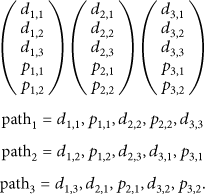
Scenario 2.
For moderate security requirement, 
Scenario 3.
For high security requirement, 
For all the above scenarios, an attacker needs to decode each codeword to be able to reconstruct the original data message and the allocation of fragments on the paths, allowing for resilience to a failure of one path, which can be any path, since the three data fragments for each codeword can be obtained from the other two paths.
5.2. Multipath Protocol Performance Evaluation
In this section, we evaluate the proposed mechanism using the same scenario presented in Section 5.1 and compare it with the protocols that used the (
Multipath routing protocols comparison.

Clearly, the number of encrypted packets in MVMP protocol is equal to the encrypted packet of our proposed protocol when the demanded security level is high. However, when the demanded security level is low, our proposed protocol encrypts only three packets while MVMP protocol has a fixed number of fifteen encrypted packets. Note that encrypted packets influence encryption time and energy consumption. We recognize that the encryption delay is related to the total amount of bits to be encrypted for each data packet (Section 3.4). Thus, the proposed security mechanism selects a minimum amount of data for encryption. In WSNs, if sensors run different encryption algorithms, like in MVMP protocol, it may lead to varying computational delays. For instance, the traditional RC4 algorithm takes 344
We have conducted an extensive simulation study using C++ to evaluate the performance of our protocol. We adapted the same codes used in our previously published works [20, 24]. These papers illustrated the validity and comparability of our implementation, in which the validation tests cover the basic functionality of the on-demand routing protocol in WSNs. In WSNs, the likelihood of finding node-disjoint paths increases at higher node densities [25]. Thus, in order to increase the probability of finding these paths to evaluate the performance of our proposed protocol, we consider a network where 100 to 500 nodes are randomly scattered in a field of 500 m × 500 m area. We assume that all sensor nodes are static after deployment with transmission range of 100 m. The simulation parameters that we use are as follows. Source nodes are picked randomly, at least two hops away from the sink, to transmit a data packet at fixed generation rate of 1 packet/sec. The simulation time is 750 sec.
We use two types of security scenarios in each simulation. In Scenario 1, each node is assumed equally likely to be compromised with probability,
Simulation parameters.

The proposed mechanism depends on the availability of finding multiple node-disjoint paths and to justify the possibility of finding these paths in WSNs, the security requirements are not considered in this step. Figure 5 shows the probability of finding the maximal number of node-disjoint paths between the source nodes and the sink. As the number of paths found in both scenarios is equal, we only report one result in Figure 5, and this indicates that the process of finding the maximum number of paths depends on the network topology only.

Probability of finding
Figures 6 and 7 illustrate the security performance and the number of used paths for various network sizes (500 and 300 nodes) as a function of the requested security. A message is compromised when at least

Security requirements

Security requirements (
In Figure 8, the number of encrypted fragments (

Percentage of encrypted fragments (
6. Conclusions
In this paper, we propose and evaluate a secure and reliable routing protocol for WSNs that is designed to handle the application security requirements and reliable data transmission using coding and selective encryption scheme. In the proposed protocol, RS code is used to provide reliability and security. The proposed routing protocol is based on the node-disjoint multipath established depending on the link security parameters. The sink node decides on the paths selection process in order to satisfy the application requirements and the number of these paths is determined to enhance the security. Thus, different number of paths can be used for different security requirements. A novel security mechanism is proposed to support secure data transmission while respecting the network restrictions in terms of energy. The protocol reduces the energy consumption at sensor nodes by moving the path selection process to the sink node. Moreover, reducing the number of encrypted packets based on the required level of security limits energy consumption. Using different paths for different security requirements to route data and permitting the sink to be responsible for the path selection process, attacks such as the Sinkhole and Wormhole are no longer related, where in a Sinkhole attack the attacker tries to attract the traffic of surrounding neighbors by making itself look attractive to the surrounding neighbors with respect to the routing metric, and in a Wormhole attack two or more attackers may establish better communication tunnels between them in the path.