The theories of elastic plates and Kirchhoff's sandwich plates are used to analyze the failure modes of the second order hierarchical corrugated truss structure, and a plate model is presented. Besides the six competing failure modes obtained in the literature using the elementary elastic beam theory, another five competing failure modes have been identified herein, including the plate buckling, infinitely wide plate buckling, sandwich plate buckling, infinitely wide sandwich plate buckling, and surface wrinkling. Expressions for the compressive collapse strengths of these modes are derived and used to construct collapse mechanism maps for second order trusses, which is effective for selecting the geometries of second order trusses. By comparing with the result of the finite element method (FEM) it is shown that the plate model has higher accuracy than the beam model, and the infinite wide plate model has the highest accuracy when the length-width ratio of the large struts is greater than 1.0. Finally, three optimization models are proposed. The performance of a second order hierarchical corrugated truss structure has been optimized, and the geometric parameters under the optimal performance can be obtained, which can provide a more convenient way to achieve a desired scheme for designers.
1. Introduction
The hierarchical structure has structural features that occur on different size scales [1]. Actually, there are numerous natural and man-made materials which exhibit structure on more than one length scale, such as the leaf of fern, polymers, and biological materials. Materials with structural hierarchy have significantly higher stiffness and strength to weight ratio than their nonhierarchical counterparts. Since the maximum stiffness to weight ratio of an isotropic two-phase material is set by the Hashin-Shtrikman (HS) [2] upper bound, more and more scholars were interested in the research on structural hierarchy [3–5]. For example, hierarchical cellular structures consist of self-similar structural units. Experimental research was performed on sandwich panels with honeycomb cores by Bhart et al. [6], and it is indicated that the compressive strength of second order panel was about six times greater than that of first order panel of equal mass. A similar experiment was demonstrated by Lakes [1] and found that the compressive strength of a second order hexagonal honeycomb was three to four times greater than a first order honeycomb of equal mass.
Hierarchical space structures were referred first in a short essay [7]. Dyson presented scaling arguments to the effect that very large structures could be constructed with low mass, and the stress of elastic buckling in hierarchical truss structures was analyzed later. However, there are few studies that compare the performance of space structures with hierarchy. And study in effective continuum or material perspective is much more prolific. For instance, Lake and Klang [8] looked at the efficiency of various space filling trusses. Murphey and Hinkle [9] investigated the performance trends in linear truss structures as a function of self-similar hierarchy order and of loading conditions. By an assumption of “continuum” model for the hierarchical cellular materials and truss-like structures at each length scale, Lakes and Murphey provided simple recursive expressions for the stiffness and strength of the hierarchical structures. In doing so, the short wavelength failure modes were neglected at the higher length scales, and they assumed macroscopic elastic or plastic buckling of the struts to be the only operative failure modes at each length scale. Although it has been predicted that the strength will increase with the increasing of structural hierarchy by the optimization performed, it is still hard for the widespread adoption of hierarchical materials because of the difficulties in their manufacture and higher costs and availability of very thin sheets of material.
Recently, various achievements in large-scale, ultra-light structures that can resist dynamic loading have been published, which stimulated a renewed interest in sandwich panels with hierarchical cellular cores. Because of the high in-plane stretching strength, prismatic sandwich core topologies (e.g., the corrugated or folded plate core) are applied in sandwich beams. Expected to delay the elastic buckling of the webs of these prismatic sandwich cores, the hierarchical construction is thus attractive for application in large sandwich structures. For instance, Deshpande and Fleck [10] promulgated the relation between the bending strength of sandwich beams and the shear and compressive strengths of the core, and Kooistra et al. [11] simplified the hierarchical cellular structures based on the elementary elastic beam theory and analyzed the transverse compression and shear collapse mechanisms and then obtained six competing failure modes. However, the theoretical prediction does not fit the experimental result well, which was explained by the authors that the measured strength is highly sensitive to manufacturing imperfections and is overpredicted by the analytical bifurcation calculations [11].
A full-scale finite element model was established by the authors based on the parameters of the test specimen in the literature. With the compression load, the finite element results (Figure 1(b)) show that the stress of the area where wrinkling occurs is significantly higher than the other parts, which agrees with the experimental phenomenon well. And more interesting, the stress distribution in this area is similar to the stress distribution characteristics of the plate. Therefore, we speculate that the plane stress assumption is not necessarily appropriate when the width b is not very small. And the impact of Poisson's ratio was ignored in the literature. That may cause the theoretical prediction really not to be in good agreement with the experimental results.
(a) Photographs showing the failure modes of second order corrugated cores [11]; (b) the stress distribution cloud image of FEM.
In this paper, the theories of elastic plates and Kirchhoff's sandwich plates, instead of the elementary elastic beam theory, are used to analyze the failure modes of the second order hierarchical corrugated truss structure. Expressions of the collapse strengths are employed to generate collapse mechanism maps for a second order corrugated sandwich core. Then the theoretical solutions obtained by the proposed formula were compared with the results of FEM, with high accuracy. Finally, the optimal designs by minimizing the relative low density for a certain failure mode and maximizing the collapse strength for a given relative density are obtained. And according to the magnitude of consequences caused by the failure, the expected sequence of the failure mode was defined, based on which an optimization problem is proposed from a practical perspective.
2. Failure Modes of the Second Order Corrugated Core
In this paper, we assume that corrugated cores are made of an elastic-ideally plastic material with a Young's modulus ES, Poisson's ratio ν, yield strength εY, and the width b (into the plane of the paper). Small struts with thickness t1 and length l1 are the units of the first order corrugated core at an angle θ1, and the large struts are comprised of face sheets with thickness t and length l and a first order corrugated core. A second order corrugated core has one level of the structural hierarchy; the small struts of the corrugated core are replaced by the large struts at an angle θ. It is illustrated in Figure 2. It is assumed that the large struts are pin-jointed with the face sheet and the small struts are fixed at the sheets of thickness t.
The hierarchical structures diagram and cell core structure (the large strut).
Based on the assumption that the macroscopic elastic or plastic buckling of the struts is the only operative failure modes and the width b of the corrugated core is sufficiently small for plane stress conditions, six competing failure modes can be obtained by elastic beam model. Expressions for the collapse strengths of the failure modes are as follows [11].
Plastic yielding of the larger struts is expressed by
Euler buckling of the larger struts is expressed by
Shear buckling of the larger struts is expressed by
Elastic wrinkling of the larger strut face sheets is expressed by
Yielding of the smaller struts is expressed by
Euler buckling of the smaller struts is expressed by
where σp is the effective transverse compressive strengths and σY is the yield strength of the material of the corrugated cores.
When the width b of the corrugated core is not small enough for plane stress conditions, the basic components should be considered as a plate or sandwich plate. Therefore, the theories of elastic plates and Kirchhoff's sandwich plates are introduced to analyze the failure modes of the second order hierarchical corrugated truss structure, and the length-width ratio and the width-thickness ratio are important parameters in the analysis.
2.1. Elastic Buckling of the Plates
For both the small struts and the face sheets of the large struts, the stability failure can be considered as buckling of rectangular thin plate, as shown in Figure 3, in which the sides of x = 0 and x = a are simply supported and the other two sides are free.
Sketch of an elastic plate under the in-plane compressive load.
When the in-plane compressive load Px is equal to the buckling critical load of the elastic plate, the differential equation of plate buckling is
Set the deflection surface function w to have the form as
By substituting the deflection surface function into (7), the solution can be expressed as
where , , λm = (mπ/a).
Because the boundary sides of y = ± b/2 are symmetric to y-axis, the deflection surface function can be simplified as
The critical buckling load is determined by the first order buckling (m = 1), and correspondingly, α and β can be written as
By substituting the deflection surface function into the boundary conditions, the transcendental equation of γ is obtained:
Equation (11) shows the relationship between the length-width ratio a/b and γ, and the critical load would be solved when a/b is given.
The plate can be simplified as an Euler beam when a ≫ b, and the critical load is expressed as
Otherwise, when b/a is not small enough, assume that the critical load of the plate has the same form of (13), and it can be written as
where E′ = E/(1 − ν2). Comparing (11) and (14), we can obtain
The relationship between a/b and γ is expressed in (12), and that of γ and E′/E is illustrated in (15). Therefore, the relationship between a/b and E′/E can be obtained. As shown in Figure 4, the left is the curve of E′/E − b/a and the right is E′/E − a/b, which are meeting at a/b = 1. The approximate values of γ2 would be obtained by (12) and 1 and 1/(1 − ν2) corresponded to the beam model and plate model, respectively. It is assumed that the relation between γ2 and length-width ratio is linear. Hence, the critical load of plate buckling will be expressed as
Diagram of the relationship between the length-width ratio and E′/E.
2.1.1. Buckling of the Small Struts
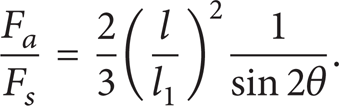
In this paper, the large struts of the second order corrugated core, which can be considered as sandwich columns with length l, are assumed to be fixed at the face sheets. Since the face sheets are very thin, the shear deformation of the face sheets is neglected. Based on the relation of internal force and transformation, the ratio of the axial force Fa to the shear force Fs in the sandwich columns of length l is given as
Because the selection of θ = θ1 = 45° is optimal from a practical perspective [11], (17b) was used for the subsequent calculation.
When the axial force of the small strut reaches the critical buckling load, this failure mode will occur and Px can be obtained by (14) or (16a) and (16b), where a = l1 and D = Et13/12(1 − ν2). The compressive strength of the second order corrugated core is then given by
2.1.2. Wrinkling of the Larger Strut Face Sheets
When the elastic wrinkling of the large strut face sheets occurs, it implies that the critical load is Px, where a = 2l1 cos w1 and D = Et3/12(1 − u2); then, the compressive strengths of the second order corrugated core are given by
2.2. Elastic Buckling of Infinitely Wide Plate
When the width b is large enough (b ≫ a), the plate can be considered as an infinitely wide plate. Hence the instability form is independent of the coordinate y, and the differential equation of the plate buckling equation (7) is simplified as
The buckling critical load is obtained as
Thus, the bulking of the smaller struts and elastic winkling of the larger strut face sheets can be solved by using the above solution of buckling of the infinitely wide plane.
2.2.1. Buckling of the Smaller Struts
Corresponding to the Euler buckling of the small struts, the critical load is Pcr, where s = l1 and T = t1; then, the compressive strengths of the second order corrugated core are
2.2.2. Elastic Wrinkling of the Larger Strut Face Sheets
Similarly, the critical load of elastic wrinkling is Pcr, where s = 2l1 cos θ1 and T = t; then, the compressive strengths of the second order corrugated core are
2.3. Buckling of Sandwich Plate
The larger strut can be considered as a sandwich plate, and the corrugated core is modeled as a “semirigid” inhomogeneous continuous material. For purpose of buckling analysis, it is equivalent to an orthotropic layer of uniform thickness by homogenization method [12]. As shown in Figure 5, it is a sandwich plate with triangle corrugated core, the sides of x = 0 and x = a are simply supported, and the other sides are free. When the in-plane load Px is equal to the critical buckling load of the sandwich plate, it is considered as failure.
Sketch of sandwich plate under the in-plane load.
Based on the Kirchhoff's sandwich plate theory, the equilibrium equations of the sandwich plate were simplified by replacing the two equations with two functions [13]. Thus, the stability of a sandwich plate was converted to find two functions w, f and the critical load Px [14] to satisfy the basic equations and boundary conditions.
Assume that the functions w and f have the forms as
And they satisfy the following basic differential equations:
where D is the bending stiffness of the sandwich plate, ; C is the shear stiffness, C = GC(t + l1sinθ1); and GC is the effective transverse shear modulus of the corrugated core, GC = Et1sin2θ1/2l1. Substituting w and f into the free boundary conditions, simultaneous equations for Ci (i = 1, 2, 3, 4) are obtained as
where , , B = δ2 + 2C/D(1 − ν), , A = − (2 − p/C)δ2, δ = mπ/a.
If there is a nonzero solution of (26), the determinant of the equation coefficients must be zero. Hence, the simplified transcendental equation for Px can be expressed as
Px would be solved when the geometric parameters are given, and the compressive strength of the second order corrugated core can be expressed as
2.4. Buckling of Infinitely Wide Sandwich Plate
When the width b is large enough (b ≫ a), the larger strut would be treated as a sandwich plate with infinite size. Hence the buckling mode is independent of the coordinate y, and the differential equation for buckling of sandwich plate is simplified as
The buckling critical load is obtained as
where δf = 2π2Df/l2C, δc = π2D/l2C, and subscript f or c represents the surface or the core of the sandwich panels. In engineering, the thickness of the surface sheet is relatively small (h + t ≈ h) and the shear stiffness of the surface sheet tends to be neglected (δf ≪ 1). Then the critical buckling load and the compressive strength of the second order corrugated core are simplified as
The failure modes discussed above are summarized in Table 1. It includes the gist of selecting calculation model, the failure mechanisms, and the fundamental solutions for failure modes.
Failure modes of the hierarchical structure with second order corrugated under compressive load.
Note: if a/b > 1 and t/b < 1/8 or a/b < 1 and t/a < 0.125, the elastic plate model should be chosen. And the struts can be treated as plates or sandwich plates with infinite size when b ≫ a. Otherwise, the elastic beam model will be selected.
3. Failure Mechanism Maps
In general, the operative failure mode is determined by the lowest failure strength, which can be obtained once the structural geometry parameters are given. Thus, the regimes of dominance of the failure modes described above can be illustrated in a failure mechanism map.
When the width b of the hierarchical corrugated core is sufficiently small for plane stress conditions, both large struts and small struts can be considered as elastic beam. Comparing the expressions of compressive strengths, the following conclusions are gained.
The plastic yielding of large struts does not occur when l1/l is less than ; otherwise, the Euler buckling of large struts does not occur.
The plastic yielding of small struts does not occur when l1/l is less than ; otherwise, the shear buckling of large struts does not occur.
Such a failure mechanism map was constructed when the parameters of θ, θ1, l1/l, εY were given. In Figure 6, the value range of the dimensionless ratio t/l and t1/l1 is 10−4 to 10−1, and θ1 = 45 deg, θ = 45 deg, and εY = 0.002. Based on the conclusions above, there is no Euler buckling of large struts in Figure 6(a) and no shear buckling in Figure 6(b). The regimes of dominance of the failure modes are marked along with contours of the boundary of operative failure modes. It is shown that wrinkling of the faces of the large struts and buckling of the small struts are the dominant failure modes for this choice of material properties. In addition, the superiority of wrinkling is more obvious along with the increase of l1/l. And with the increasing of t1/l1, the failure location is transferring to others from the small struts.
Failure mechanism map for second order corrugated core with θ = θ1 = 45°, εY = 0.002, based on theory of elastic beam. (a) l1/l = 0.01, 0.03, and 0.05 (b) l1/l = 0.08, 0.1, and 0.12.
When the width b is not small enough for plane stress conditions, the elementary component of the hierarchical corrugated truss core would be treated as an elastic plate or sandwich plate. Except the buckling of large struts, all the failure modes have the linear expressions for the compressive strengths. Similarly, the following conclusion is gained.
(3) There is a boundary value, . Plastic yielding of small struts does not occur when l1/l is less than the boundary value; otherwise, the shear buckling of large struts does not occur.
In Figure 7, θ1 = 45 deg, θ = 45 deg, and εY = 0.002, and the value range of the dimensionless ratio t/l and t1/l1 is also 10−4 to 10−1. According to conclusion (3), there is no plastic yielding of small struts in Figure 7. Wrinkling of the faces of the large struts and elastic buckling of the small struts are still the dominant failure modes. When the value of l1/l is less than the upper boundary, the superiority of wrinkling is more obvious with respect to the increasing of l1/l. Meanwhile, the area of plastic yielding and shear buckling of large struts is decreased sharply. Finally it is important to note that the buckling of large struts is not considered in Figure 7.
Failure mechanism map for second order corrugated core with θ = θ1 = 45°, εY = 0.002, based on theories of elastic plates and Kirchhoff's sandwich plates. (a) l1/l = 0.01, 0.03, and 0.05. (b) l1/l = 0.08, 0.1, and 0.12.
When the width b of the corrugated core is large enough, the elementary component of the hierarchical corrugated core would be treated as a plate or sandwich plate with infinite size. Corresponding to all failure modes, the compressive stresses have linear expressions. Similarly, the following conclusion is gained on the condition of conclusion (3).
(4) is a boundary value, and the plastic yielding of large struts does not occur when l1/l is less than the boundary value; otherwise, the buckling of sandwich plate does not occur.
Analogously, a failure mechanism map for second order corrugated core can be constructed when b is infinite. In Figure 8, θ1 = 45 deg, θ = 45 deg, and εY = 0.002. Features of Figure 8 are in accordance with the above conclusions (3) and (4). There is no plastic yielding of large struts in Figure 8(a) and no buckling of sandwich plate in Figure 8(b). Compared with Figure 7, because the buckling of large struts is included, the boundary between failure modes becomes more complicated, and the plastic yielding of large struts is substituted by the buckling of large struts. When the value of l1/l is less than the boundary value, the superiority of wrinkling and buckling of small struts is more obvious with respect to the increasing of l1/l. Meanwhile, the area of buckling and shear buckling of large struts is decreased sharply, respectively. However, when the value of l1/l is larger than the boundary value, the area distribution of the operative failure modes has only slight difference with the increase of l1/l.
Failure mechanism map for second order corrugated core with θ = θ1 = 45 deg, εY = 0.002, and b ≈ ∞, based on theories of elastic plates and Kirchhoff's sandwich plates. (a) l1/l = 0.01, 0.03, and 0.05; (b) l1/l = 0.08, 0.1, and 0.12.
4. Discussions
The results of failure modes, based on beam model, plate model, and infinite width plate model, are compared to illustrate the difference between these models. There are two contours obtained by beam model and plate model, in Figure 9 with l1/l = 0.02, εY = 0.002, and θ1 = θ = 45 deg. It is shown that the dominant failure modes and the variation trend of the operative failure modes are the same, and the area of stability failure corresponding to the plate model is reduced by considering Poisson's ratio. Figure 9(b) shows the difference of the failure mechanism maps caused by materials with different yield strain of εY. The area corresponding to the plastic yielding of the large struts decreases with the increasing of the yield strain. That means that the yielding failure mode becomes increasingly difficult to appear along with the increase of material strength.
A comparison of the failure mechanism maps for second order corrugated core (a) between different models and (b) between different materials with the plate model.
Furthermore, the contours of the nondimensional compressive strength and the relative density can be marked in the failure mechanism map. For example, for the beam model of l1/l = 0.02, εY = 0.002, and θ1 = θ = 45 deg, the nominal stress can be obtained from Figure 9(a), which is useful to get a suitable scheme for designers.
The above critical loads, solved by theoretical analysis with beam model, plate model, and infinite plate model, are compared with the result by the finite element method (FEM). The error comparison is shown in Figure 10, with the parameters of l1/l = 0.04, εY = 0.004, θ1 = 45 deg, θ = 45 deg, or θ = 60 deg, and the operative failure mode is wrinkling of the face sheet of the large struts. It shows clearly that the plate models (both plate model and infinitely wide plate model) have higher accuracy than the beam model when the ratio b/l is greater than 1 (the length-width ratio is b/2lcosθ). Because the effect of Poisson's ratio is not considered in the beam model, the compressive strength is underestimated in the buckling analysis. And the error of the three analysis models tends to be stable when the ratio b/l is greater than 3. The error of the plate model is less than 5% when θ = 45 deg and less than 7% when θ = 60 deg. Moreover, the plate model with infinite size has the best accuracy.
Error comparison of different models with l1/l = 0.04, εY = 0.004, θ1 = 45 deg; (a) θ = 45 deg and (b) θ = 60 deg.
5. Optimization Design of the Second Order Corrugated Core
In the previous sections, the failure mechanism maps of the second order corrugated core are obtained and discussed, including global or local failure modes. Among all the possible failure modes, do there exist any preferred failure modes with lower consequences? That is, can we design the structure so that it can have failure modes the designer expected? In this paper, the following three optimization problems are therefore proposed to optimize the structure with the expected failure modes.
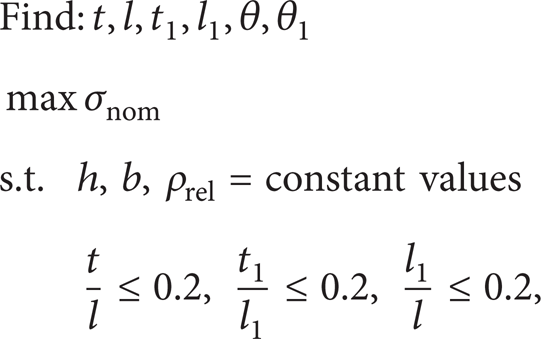
OPT-1. The geometry of the second order corrugated core is optimized to minimize the relative density at a certain failure mode, stated as
The local failure modes with lower consequences are preferred, such as the failure modes of small struts. Therefore, the focus of OPT-1 is to minimize the weight, subjected to a specific failure mode.
OPT-2. When the material is given, how to improve the stress level of structure is the designer's great concern. So, the second order corrugated core is to maximize the compressive strengths at a given relative density, written as
where ρrel = 4(t/l)(1/sin2θ) + 4(t1/l)(sinθ1/sin2θ1sin2θ) is the nondimensional relative density, σnom is the nondimensional failure strength, σnom = Pcr/A, Pcr is the critical load, and A is the compression area. In the optimization problems, the nondimensional ratios t/l, t1/l1, and l1/l are within the given range, and we take θ = θ1 = 45° as the optimal value from a practical perspective, suggested by Kooistra et al. [11], and εY = 0.002.
Generally, the global failure mode is supposed to be avoided as much as possible due to its serious consequences. Therefore, a multiprotection system can be built based on a given sequence of the failure modes, to minimize losses. So, the following optimization problem is proposed as OPT-3:
where S is a given sequence of the failure modes. First, the preference of failure modes should be identified according to their consequences. For example, loss of failure of small struts is low and can be defined as the first order failure (1st) and the wrinkling failure as the second order failure (2nd). Because the consequence of the global failure, including buckling of the sandwich plate and shear buckling, is serious, they are defined in the third order failure (3rd). Thus, failure sequence S (1st, 2nd, and 3rd) means the failure modes of 1st, 2nd, and 3rd occur in sequence as expectation. The other constraints mean the structure has a specified compressive strength and the calculation models are suitable for the analysis.
Table 2 shows the results of the above three optimization problems, in which, the wrinkling of the face sheets are selected as the constraint, ρnom = 0.01 (0.05 in OPT3), b = 152 mm, and θ = θ1 = 45 deg. (These parameters can be set according to demand. Herein, the parameter values are selected based on the experimental model and the research conclusion in literature [11].) The iteration history is shown in Figure 11.
The range of the design variable and the optimum results.
t (mm)
t1 (mm)
l (mm)
l1 (mm)
opt goal
Lower bound
0.5
0.5
300
10
Upper bound
10
10
1500
100
OPT-1
Initial value
1
1
1500
30
ρrel = 0.00759
Optimal value
0.5
0.5
1500
25.6
ρrel = 0.00228
OPT-2
Initial value
2.5
1.8
1500
10
σnom = 0.0032
Optimal value
3.3
0.63
1496.59
10
σnom = 0.0044
OPT-3
Initial value
10
2.25
750
10
ρrel = 0.067
Optimal value
2.4
0.94
1199.89
24.98
ρrel = 0.0102
Iteration history of OPT1, 2, and 3.
In this paper, the optimization process is conducted on the software platform Isight, and the NLPQL method was chosen as the optimization method. As shown in Figure 11, the values of objective function are all improved in OPT1∼3. Both in OPT1 and OPT3, the objective function is to minimize the relative density. Wrinkling of the large strut face sheet is selected as the certain failure mode in OPT1. Because the loss of the small struts is low, the failure modes of small struts are ignored. Thus, wrinkling of the large strut face sheet must occur first in OPT3. Therefore, the values of t and t1 should be small, while the value of l should be large, and l1 should be sufficiently large to avoid the overall buckling. OPT2 is to maximize the compression strength with given relative density. So, the value of l should be small and t should be large, to avoid buckling. The results in Table 2 are consistent with the above analysis.
6. Conclusions
The plate model, based on theories of elastic plates and Kirchhoff's sandwich plates, is used to analyze the failure modes of the second order hierarchical corrugated structure. Besides the six competing failure modes obtained in the literature, another five competing failure modes have been identified herein. The values of the length-width ratio and the width-thickness ratio are proposed for the model's calculation. Based on the operative failure modes, the failure mechanism maps are obtained and discussed, which are helpful for selecting the geometries of second order trusses. The comparison with the result of FEM shows that the plate model has higher accuracy than the beam model, because the effects of boundary conditions and Poisson's ratio are considered in the plate model. The infinite wide plate model has the highest accuracy when the ratio b/l1 is greater than 1.0. Finally, three optimization models are proposed, in which the performance of a second order hierarchical corrugated structure is optimized, and the geometric parameters under the optimal performance can be obtained, providing a more rational way to achieve a desired scheme for designers.
Conflict of Interests
The authors declare that there is no conflict of interests regarding the publication of this paper.
Footnotes
Acknowledgments
The supports of the National Basic Research Program of China (Grant nos. 2014CB046506 and 2014CB046803) and the National Natural Science Foundation of China (Grant nos. 91315301 and 11372061) are greatly appreciated.
References
1.
LakesR., “Materials with structural hierarchy,”Nature, vol. 361, no. 6412, pp. 511–515, 1993.
2.
HashinZ. and ShtrikmanS., “A variational approach to the theory of the elastic behaviour of multiphase materials,”Journal of the Mechanics and Physics of Solids, vol. 11, no. 2, pp. 127–140, 1963.
3.
NorrisA. N., “A differential scheme for the effective moduli of composites,”Mechanics of Materials, vol. 4, no. 1, pp. 1–16, 1985.
4.
MiltonG. W., “Modelling the properties of composites by laminates,” in Homogenization and Effective Moduli of Materials and Media, pp. 150–174, Springer, New York, NY, USA, 1986.
5.
FrancfortG. A. and MuratF., “Homogenization and optimal bounds in linear elasticity,”Archive for Rational Mechanics and Analysis, vol. 94, no. 4, pp. 307–334, 1986.
6.
BhartB. T.WangT. G., and GibsonL. J., “Microsandwich honeycomb,”SAMPE Journal, vol. 25, no. 3, pp. 43–46, 1989.
7.
CourantE., Perspectives in Modern Physics, Essays in Honor of Hans A. Bethe, 1966.
8.
LakeM. and KlangE., “Generation and comparison of globally isotropic space-filling truss structures,”AIAA Journal, vol. 30, no. 5, pp. 1416–1424, 1992.
9.
MurpheyT. W. and HinkleJ. D., “Some performance trends in hierarchical truss structures,” in Proceedings of the 44th AIAA/ASME/ASCE/AHS/ASC Structures, Structural Dynamics, and Materials Conference, pp. 4570–4584, Norfolk, Va, USA, April 2003.
10.
DeshpandeV. S. and FleckN. A., “Collapse of truss core sandwich beams in 3-point bending,”International Journal of Solids and Structures, vol. 38, no. 36–37, pp. 6275–6305, 2001.
11.
KooistraG. W.DeshpandeV., and WadleyH. N. G., “Hierarchical corrugated core sandwich panel concepts,”Journal of Applied Mechanics, Transactions ASME, vol. 74, no. 2, pp. 259–268, 2007.
12.
WuH., Strength Clculation Principle of Plywood, Laminated Board, and Overall Board, Defense industry press, Beijing, China, 1989.
13.
HuH., “One some problems of the antisymmetrical small deflection of isotropic sandwich plates,”Acta Mechanica Sinica, vol. 6, no. 1, pp. 53–60, 1963 (Chinese).
14.
Chinese Academy of Sciences, Bending Stability and Vibration of Laminated Plates and Shells, Science Press, Beijing, China, 1977.