







Abstract
1. Introduction
Decentralized state estimation is of great importance in studying WSNs. Against this background, this paper mainly discusses the decentralized state estimation of a Gaussian Markov stochastic process in WSNs. In general, a WSN is composed of a fusion center (FC) and lots of sensors. The computation capability and energy of these sensors are quite limited. Each one of them firstly acquires noisy measurements within its sensing range. Then the measurements will be transmitted to the FC which processes them with the KF to get the state estimation with minimum mean square error (MMSE). To save energy and the communication bandwidth, the measurements should be minimized through quantizing before the transmission. This is because the quantization helps to reduce the amount of bits and the energy consumption in transmission. Hence, the focus of the research is the decentralized state estimation with quantized measurements.
1.1. Related Work
To save energy and reduce bandwidth in WSNs, several decentralized state estimation approaches with quantized measurements were put forward in [1–5]. However, one disadvantage of these algorithms is that quantizing measurements directly may lead to different levels of accuracy. This means that when the measurement value is large, there appears large quantization noise.
In order to solve this problem, the KF for quantizing innovation at multiple levels was developed in [6]; an efficient quantization scheme was presented in [7, 8]; on the basis of the quantization scheme in [7, 8], the transmission strategy and the multilevel quantization state estimation were combined together in [9], leading to better performance and less bandwidth consumption.
However, on the one hand, these quantization schemes are theoretical ones which were put forward without considering the features of the practical low power consumption WSNs. So in this paper, a new quantization scheme is proposed on the basis of analyzing these features.
On the other hand, these decentralized state estimations in [6, 9] were derived by adopting the iterated conditional expectation method directly on the condition that the prior probability density function (pdf) of the state vector is Gaussian. However, these researches did not analyze the case of the posterior pdf of the state based on the quantized innovation. By contrast, this paper studies the situation of the posterior pdf explicitly to prepare for the further study of the state estimation with quantized innovation. It innovatively utilizes a new approach for the state estimation which is a new perspective for the decentralized state estimation. By taking all these factors into consideration, a novel multilevel quantized innovation KF algorithm is proposed on the basis of the new quantization scheme and the decentralized state estimation.
1.2. Contributions of This Paper
The main contributions of this paper are listed as follows:
It puts forward an efficient quantization scheme by flexibly utilizing different communication modes. This paper adopts the Bayesian method for the MQI-KF instead of the iterated conditional expectation method used in [6, 9]. It puts forward a decentralized state estimation algorithm based on the new quantization scheme and innovative KF.
Model and preliminary in WSNs are presented in Section 2. Section 3 introduces the details of MQI-KF. Performance analysis and experiments are explored in Sections 4 and 5, respectively. Finally, Section 6 concludes the research in this paper.
2. Model and Preliminary
This paper analyzes a discrete-time linear stochastic system in the WSN which consists of FC and 

In order to save communication bandwidth and energy, the 

The quantization schemes and transmission strategies in [6–9] are only applicable for the quantized innovation
The low energy consumption WSN designed for target tracking experiments is demonstrated in Figures 1 and 2. It is constructed on the basis of the universal network protocol IEEE 802.15.4 standard [10]. This protocol is widely acknowledged as a standard technology in the WSNs with low energy consumption [11]. Figure 3 shows the format of the data packet defined by this protocol. Two remarks are listed here for introducing the decentralized state estimation algorithm in Section 3.

The WSN for target tracking.

The components of the WSN.

The structure of data packet in IEEE 802.15.4.
Remark 1.
This paper utilizes the round-robin mode in the protocol to avoid jamming of FC's receiver, since this mode only allows the activated sensor to transmit data packet per time step. This means that the sensor index corresponds to the time step. For instance, at time step
Remark 2.
Two different modes can be adopted in the transmission of the data packet from the sensors to the FC, namely, broadcast communication and peer to peer communication. Which one to choose depends on the parameter in the MHR. With the same energy management mechanism in the PHR [10], the amounts of energy they consume are the same.
3. Kalman Filtering Based on Multilevel Quantized Innovation
In this section, firstly a more efficient quantization scheme is designed for normalized innovation; secondly, an innovative quantization KF is derived by adopting the Bayesian approach. Finally, a decentralized state estimation algorithm is developed based on this quantization scheme and the new quantization KF.
3.1. Quantization Scheme Design
To quantize the scalar innovation 

For the 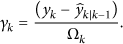
The quantization scheme is demonstrated as follows:
For example, when
It is obvious that more quantization levels contribute to more estimation accuracy. Thus, the performance of the quantization scheme proposed in this paper is better than the others, which will be seen in the performance analysis.
3.2. State Estimation by Adopting the Bayesian Approach
The state estimations in [6, 9] are based on the method of iterated conditional expectation, which can be expressed as follows:
Different from this method, this subsection studies the posterior probability density of the state
Naturally, adopting the Bayesian method, the

Proof.
See Appendix A.


Proof.
See Appendix B.
Beside, its conditional covariance matrix 

Proof.
See Appendix C.
The multilevel quantized innovation KF is demonstrated in (12), (13), (14), and (15). In this subsection, the posterior probability density
3.3. Algorithm
This subsection focuses on a new decentralized state estimation algorithm. It is proposed on the basis of the new quantization scheme, the multilevel quantized innovation KF, and transmission strategy in [9] (see the following).
Decentralized state estimation algorithm is as follows.
For


Both the broadcast and peer to peer communication modes are characteristics of the WSNs which are based on the IEEE 802.15.4. Therefore, the quantization scheme and the algorithm put forward on the basis of these modes are applicable in the majority of the actual WSNs which consume less energy.
4. Performance Analysis
In this section, the focus is the performance of the MQI-KF.
4.1. Optimal Thresholds of the Quantization Scheme
The error covariance matrix correction is computed by
4.2. Performance Analysis of the Quantization Scheme
The comparison of the performances of different quantization schemes are made on the condition that the transmission bandwidth is one bit. In this way, the comparison will not be affected by different transmission strategies.
The quantization scheme is regarded as an information source and quantized innovation 
Since the normalized innovation 
Therefore in the case of one-bit transmission bandwidth, the information entropies of MQI-KF and [6, 7, 9] can be seen in Table 1.
Information entropies.

From Table 1 we can see that, compared with quantization schemes in [6, 7, 9], the quantization scheme in this paper has greater information entropy. In other words, the quantized innovation of this quantization scheme contains more information. Thus, this scheme is more efficient because the number of its quantization levels is the biggest when the bandwidth is one bit.
4.3. Performance Analysis of the State Estimation Algorithm
The coefficient of the error covariance matrix correction 
Therefore, when the
Values of

According to Table 2, the algorithm put forward in this paper is the most accurate one.
5. Results of Simulation Experiments
In order to demonstrate the performance of the MQI-KF, two simulation experiments are performed. To evaluate the performances of the quantization schemes of MQI-KF and those in [6, 7, 9], the experiment is conducted with one-bit transmission bandwidth. The second experiment aims to evaluate the efficiency of MQI-KF, and the comparison is made on the basis of the same transmission bandwidth.
A simulation scenario for target tracking in the WSN is designed. The following items are detailed information about it:
The WSN consists of a FC and The single target in this region is regarded as a point object. The state of the target at time The time step of the FC is a constant (
This paper assumes that the target moves in the 2D Cartesian coordinate system, and the dynamic model is assumed as the constant acceleration (CA) model for the state vector.
For the 
5.1. Simulation without Considering the Transmission Strategy
Figures 4 and 5 show the root mean square error (RMSE) of the positions at the

RMSE of the positions along the

RMSE of the positions along the
5.2. Simulation with Transmission Strategy
Figures 6 and 7 show that the performance of the MQI-KF is obviously more accurate than those in [6, 7, 9], on the basis of the same two-bit transmission bandwidth. Besides, it is close to the standard KF (EKF) which is based on nonquantized measurements. This means that, using the same bandwidth, the MQI-KF has higher accuracy since it is based on efficient quantization scheme.

RMSE of the positions along the

RMSE of the positions along the
6. Conclusion
This paper studies an innovative decentralized state estimation algorithm MQI-KF. It is based on the quantization scheme proposed by considering the characteristics of the practical WSNs with low energy consumption. Through studying the posterior pdf, the decentralized KF is derived by adopting the Bayesian approach. On this basis, a comprehensive decentralized state estimation algorithm is put forward. The performance analysis and simulation experiments show that the MQI-KF is better than those in [6, 7, 9]. Moreover, the quantization scheme and algorithm proposed in this paper can be applied into most of the WSNs which cost less energy in practice.