We focus on the issue of energy and bandwidth limitations in Wireless Sensor Networks
(WSN). To tackle this issue, we propose the optimal energy allocation scheme and the optimal number of quantization bits by using alternating optimization method. Firstly, we determine the optimal energy allocation scheme which minimizes the reconstruction error on fusion center by keeping the number of quantization bits per sensor fixed. Secondly, we determine the optimal number of quantization bits per sensor such that the energy allocation scheme achieves the minimum reconstruction error. To find the optimal energy allocation scheme and the optimal number of quantization bits jointly, we propose an iterative algorithm. The results show that the proposed algorithms do not only achieve better results than equal energy allocation scheme but also produce reconstruction error close to that of un-quantized estimation. This paper also investigates the effects of sensor noise observation and propagation losses on the design of optimal energy allocation scheme. The optimal energy allocation scheme suggests the allocation of more energy to sensors with small variance noise of sensor observation.
1. Introduction
Wireless Sensor Networks (WSN) is one of the new technologies growing very rapidly in the last two decades. It happens because WSN is one of the solutions to challenging problems in various fields, such as environment, health, military, industrial, and residential applications. However, many technical problems have to be faced in developing WSN technology to a broader and better technology. The main challenges of WSN are the energy and bandwidth limitations, because in many instances sensor is powered by battery which has limited lifetime. In addition, communication equipments which are used to transmit data over the wireless networks have to consider the bandwidth availability and range of sensor [1].
Energy and bandwidth efficiency algorithms on WSN have been widely investigated. Various signal processing methods have been proposed [2]. Prior study of energy and bandwidth efficiency on WSN assumes that the distribution of sensor noise observation is known [3]. Unfortunately, characterizing the exact distribution of sensor noise from observation is impractical, especially for applications in a dynamic sensing environment [4].
The authors of [5] proposed a Universal Decentralized Estimation (UDES) that does not require the knowledge of sensor noise distributions. Based on this system, several algorithms to overcome energy and bandwidth limitations have been developed, such as [6, 7]. However, all of these works assume that each sensor transmits the quantized data to the fusion center without error. This is not very realistic because the links between the sensors and the FC are affected by attenuation and fading that can degrade estimation performance. In [8–11], the authors consider an imperfect channel modelled as a Binary Symmetric Channel (BSC) and an Additive White Gaussian Noise (AWGN) channel. However, the channels are not fading in either of the cases.
In contrast to the works which have been mentioned above, the main purpose of this paper is to optimize energy and bandwidth in distributed estimation system for WSN over a flat fading Rayleigh channel with path loss effects without prior knowledge of sensor noise distribution. Some additional details regarding the contributions of the paper are listed below:
we propose the optimal energy allocation scheme and the optimal number of quantization bits by using alternating optimization method. Firstly, we determine the optimal energy allocation scheme per sensor which minimizes the reconstruction error at fusion center by keeping the number of quantization bits fixed. Secondly, we determine the optimal number of quantization bits at sensor such that the optimal energy allocation scheme achieves the minimum reconstruction error at fusion center;
we present an iterative algorithm to find the optimal energy allocation scheme and the optimal number of quantization bits jointly;
this paper investigates the effect of the sensor noise observation, which has been not considered in previous efforts [6–11].
We formulate the optimal energy allocation scheme and the optimal number of quantization bits that can minimize the mean absolute reconstruction error at the fusion center as a convex optimization which results in a close form of each of them. The analytical form of the optimal number of quantization bits in a single sensor to a fusion center suggests that the optimal number can be found when the energy allocation for each bit is equal and produces the reconstruction error close to unquantized estimation. In the distributed estimation system, the optimal energy allocation scheme suggests the allocation of more energy to sensors with small variance noise of sensor observation.
This paper is organized as follows. Section 2 discusses the optimal energy allocation scheme and the optimal number of quantization bits on a simple network consisting of a sensor and fusion center. The optimal energy allocation scheme and the optimal number of quantization bits on distributed estimation system consists of a set of sensors and a fusion center which are analyzed in Section 3. Simulation results are then presented in Section 4 and our conclusions can be found in Section 5.
2. Single Sensor to Fusion Center
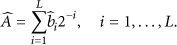
We analyze the system as depicted in Figure 1, where single sensor making observation on an unknown parameter θ. The observation is corrupted by noise and is described bywhere the noise n has zero mean and variance . Suppose is the signal range that sensor can observe, where W is a known parameter decided by the sensors dynamic range. The sensor observations are normalized in the range using linear transformation. The sensor quantizes the real valued measurement A to . The signal is quantized into L bits with uniform quantization so thatThe quantization bits are transmitted to fusion center over Rayleigh flat fading channel with path loss effect. At the fusion center the sensor observations are reconstructed as
Single sensor to fusion center.
In the following, we firstly focus to derive the optimal number of quantization bits if the energy allocation of sensor is fixed. Afterwards, we use the optimal number of quantization bits to determine the optimal energy allocation scheme in sensor by minimizing the reconstruction error.
2.1. Optimal Number of Quantization Bits for Equal Energy Allocation in Each Bit
A simple scenario is adopted where all quantization bits have equal energy allocation , . The total transmission energy of all bits is fixed to E. When using an L-bit quantizer, the energy per bit () depends on L since . The channel between sensor and fusion center is flat fading Rayleigh channel with the error probability in high SNR for BPSK modulation [12]:where and denotes noise power spectral density.
The reconstruction error in fusion center is defined as , written as follows:
By using triangle inequality, the limit absolute value of reconstruction error can be written as follows:
If we take the expectation of both sides of (6), we can obtainwhere = , so that
Based on (8), reconstruction error on fusion center can be minimized by determining the value of L which minimizes function. Hence, the optimal number of quantization bits is
In the first term of (9), decreases as L increases. The second term, , increases with increasing L. It shows that there is an optimal value of L. Therefore, the function which is the sum of two terms, will reach a minimum value. The values of L which minimize the function can be found by numerical method. Section 4 gives some examples of the optimal number of quantization bits .
2.2. Optimal Energy Allocation in Each Bit
In the previous subsection, the energy allocation for each bit is equal. However, each bit in (8) has a different weight. Therefore, we can optimize the energy allocation for each bit. When the total number of quantization bits L is fixed, the energy of each bit is , where is the proportion of energy of the ith bit from the total energy of sensor E. We can optimize by optimizing , with , . The error probability in (4) becomes and (9) becomes
In order to determine the mean absolute reconstruction error with respect to , we can formulate the optimization problem as follows:
Proposition 1.
(1) The objective function in (11) is a convex function.
(2) For a given L, (11) admits a unique solution that can minimize the objective function :where is a constant chosen such that can be fulfilled.
3. Distributed Estimation System: Multisensor to Fusion Center
The distributed estimation system assumed herein consists of a set of sensors and a fusion center with a star topology. This system is used to observe and estimate an unknown deterministic parameter θ as shown in Figure 2. Each sensor makes an observation which is corrupted by additive noise and described bywhere and W is sensor observation range that depends on sensor specification. The sensor noises are zero mean, spatially uncorrelated with variance . The sensor observations are normalized in the range [0,1] by using linear transformation. Sensor k quantizes its observation to the quantization bits and the quantization results are
Distributed estimation system: multisensor to fusion center.
Bits are sent to fusion center over the wireless channel, which is again modeled as a flat fading Rayleigh channel with error probability . The signal reconstruction at the fusion center is
The problem of interest is to design the optimal energy allocation scheme which minimizes the mean absolute reconstruction error when the number of quantization bits per sensor is fixed . Then, we determine the optimal number of quantization bits per sensor such that the energy allocation scheme achieves the minimum reconstruction error .
If the estimation error in fusion center is [13]and we have , then
If reconstruction error is defined as , then
We can minimize by minimizing . This is because for any bounded random variable with the pdf , we have . By noticing that is bounded, we can instead minimize , where the upper bound is written as
where is error probability of BPSK scheme in Rayleigh channels. Then, the reconstruction error can be written as
3.1. Energy Optimization for Equal Number of Bits per Sensor
We first consider here a simple situation where each sensor transmits an equal number of quantization bits . The total energy of all sensors is . Energy allocation for the kth sensor is , where is the energy proportion of kth sensor and the energy bit of kth sensor is . The error probability of Rayleigh channel with BPSK modulation (4) can be expressed as
Substituting (21) into (20), it can be obtained that
The optimal energy allocation scheme is the solution for optimization problem of :
(2) Each sensor transmits the same fixed number of bits L. The channels between sensor and fusion center are flat fading Rayleigh channels. These are influenced by path loss , where is the distance between the kth sensor and fusion center, and α is path loss exponent of the wireless channel [14]. Supposing BPSK modulation the optimization problem in (23) admits a unique solution that can minimize the objective function where is a constant chosen to enforce the constraint .
Optimal number of quantization bits can be found by numerical calculations, where the value is the solution of the following problemwhere is the optimal value of the objective function (23), if the number of quantization bits per sensor is L.
3.2. Optimal Energy Allocation Scheme for Different Number of Bits per Sensor
The kth sensor transmits quantization bits, . The optimal energy allocation scheme that can minimize the reconstruction error at the fusion center is the solution of the following optimization problem:
Given a set of , , the optimal solution of (26) is equal to (23). The problem of interest is to obtain the minimum value of with respect to and . Joint optimization of and can be done by the following iterative algorithm.
Algorithm 3 (iterative algorithm).
Consider the following.
The step l, with , finds as the optimal solution of (26).
Update ke based on iteration
Back to step .
If is convex and are fixed, then the problem in (26) is definitely convex. Therefore, the energy allocation can be found by numerical calculation. Step (1) of Algorithm 3 can be easily resolved. It can be proved that the objective function is always decreasing from one iteration to the next:
Simulation result shows that Algorithm 3 converges after 3-4 iterations. In Section 4, the approach to Algorithm 3 will be used to obtain the optimal values of and , .
4. Numerical Result
This section provides numerical examples to corroborate the analytical result derived in previous sections. Parameters that will be used in simulations are summarized in Table 1.
In the first system, a single sensor transmits its quantized observation to the fusion center over flat fading Rayleigh channels. In the equal energy allocation scheme, along with the increasing number of quantization bits, the reconstruction error will increase. This does not happen in the optimal scheme as shown in Figure 3. The explanation for this behaviour is that as L increases, the equal scheme increases the probability of error for all transmitted bits. The optimal scheme can be found by solving the convex optimization problem in (11) using the interior point method [15]. The result shows that the optimal scheme provides greater energy on a smaller bit index (Most Significant Bit) as shown in Figure 4. This is in agreement with that of [5].
Reconstruction error with equal energy allocation scheme among bits as in (8) and optimal energy allocation scheme among bits as in (11) for single sensor to FC over Rayleigh channel.
Optimal energy allocation scheme for single sensor to FC with .
4.2. Distributed Estimation System: Multisensor to Fusion Center
In the second system, suppose that sensors are deployed with variance noise of sensor observation denoted by (). The distances of the sensors to the fusion center (, ) are varied. The path loss exponent of wireless channel is assumed The quantized observations are transmitted over AWGN and Rayleigh channel. The total energy budget was set to .
By using the parameters in Table 1, Figure 5 shows the comparison between equal energy allocation scheme and optimal energy allocation scheme in (23) for distributed estimation system over AWGN and Rayleigh channels. This comparison is done for a variable number of bits L by defining a specific set of values for and . Both types of channels show the benefits of optimal energy allocation scheme. In Rayleigh channel, the optimal energy allocation scheme is effective to decrease the reconstruction error significantly. It is observed that the increasing number of quantization bits for each sensor decreases the reconstruction error to the floor. The optimal number of quantization bits in (25) ranges from 5 to 10. After the optimal number of quantization bits, the increasing number of quantization bits will not influence the reconstruction error at the fusion center.
Reconstruction error of objective function in (23) with equal and optimal energy allocation schemes in distributed estimation system over AWGN and Rayleigh fading channel, for , , , and , .
Figure 6 compares equal energy allocation scheme, optimal energy allocation scheme in (23), and joint optimization by using iterative algorithm method in (26). It shows that Algorithm 3 has the best performance. Simulation is done assuming the total number of quantization bits is equal in every sensor.
(a) Reconstruction error of objective function in (23) with equal energy allocation scheme among sensors. (b) Reconstruction error of objective function in (23) with optimal energy allocation scheme among sensors. (c) Reconstruction error of objective function in (26) with joint optimization using Algorithm 3. The link between sensors and fusion center are modelled as flat fading Rayleigh channel, for , , , and .
As explained in Section 3.2, we can find the optimal value of and , , jointly by using Algorithm 3. The resulting optimal energy allocation scheme and the optimal number of quantization bits per sensor are depicted in Figures 7 and 8. Figure 7 shows the optimal energy allocation scheme among sensors if we choose the optimal value of L in (25), . The appropriate optimal energy allocation scheme is the numerical solutions of the convex problem in (23). We also investigated the effect of variance noise of sensor toward the optimal energy allocation scheme. In case the distance between sensors and fusion center is equal, the optimal energy allocation scheme will allocate low energy to sensors which have high variance noise of sensor observation.
Optimal energy allocation scheme for , . Case 1: , , , , case 2: , , , and case 3: , , .
Optimal number of quantization bits per sensor: , Case 1: , , , , case 2: , , , and case 3: , , .
Figure 8 shows the optimal number of quantization bits per sensor based on iteration in (27). It shows that the sensors with high variance noise of sensor observation will allocate less number of quantization bits.
5. Conclusion
Energy and bandwidth are serious limitations for the wide development of WSN. This has motivated us to propose the optimal energy allocation scheme and the optimal number of quantization bits for WSN over Rayleigh fading channels with path loss effects. We introduce a concept of alternating optimization and iterative algorithm to facilitate the solution. We formulate the optimal energy allocation scheme and the optimal number of quantization bits as a convex optimization and present these closed form. We also have found the optimal number of quantization bits that can minimize reconstruction error when the energy allocation for each bit is equal. The optimal energy allocation scheme has allocated more energy for most significant bit. We observe that the optimal energy allocation scheme decreases the reconstruction error to the floor when the number of quantization bits increases. It is in contrast with the equal energy allocation scheme, because in this scheme, the increasing number of quantization bits increases the probability of error per bit transmitted.
In distributed estimation system, we have shown that the optimal energy allocation scheme per sensor depends on the number of quantization bits per sensor, path loss, and variance noise of sensor observation. The optimal number of quantization bits per sensor can be found with the help of our convex optimization formula. In Rayleigh channel, the optimal energy allocation scheme is effective to decrease the reconstruction error significantly. It is observed that the increasing number of quantization bits for each sensor decreases the reconstruction error to the floor. After the optimal number of quantization bits, the increasing number of quantization bits does not influence the reconstruction error at the fusion center. The optimal number of quantization bits produces reconstruction error close to that of unquantized estimation. The optimal energy allocation scheme suggests the allocation of more energy to sensors with small variance noise observation. Joint optimization using our iterative algorithm has the best estimation performance compared to equal and optimal energy allocation schemes, individually.
Footnotes
Notations
Conflict of Interests
The authors declare that there is no conflict of interests regarding the publication of this paper.
Acknowledgment
This work is part of research program funded by Graduate Research Grant no. 11588/PL4/PPK/LK/2013 from the Indonesian Ministry of National Education.
References
1.
AkyildizI. F.SuW.SankarasubramaniamY.CayirciE.Wireless sensor networks: a surveyComputer Networks200238439342210.1016/s1389-1286(01)00302-42-s2.0-0037086890
2.
LiuH.LiuG.LiuY.MoL.ChenH.Adaptive quantization for distributed estimation in energy-harvesting wireless sensor networks: a game-theoretic approachInternational Journal of Distributed Sensor Networks20142014921791810.1155/2014/217918
3.
LiJ.AlRegibG.Distributed estimation in energy-constrained wireless sensor networksIEEE Transactions on Signal Processing200957103746375810.1109/TSP.2009.2022874MR26831312-s2.0-70349640575
4.
NowakR.MitraU.WillettR.Estimating inhomogeneous fields using wireless sensor networksIEEE Journal on Selected Areas in Communications2004226999100610.1109/JSAC.2004.8308932-s2.0-4344639799
5.
LuoZ.-Q.XiaoJ.-J.Universal decentralized estimation in a bandwidth constrained sensor network4Proceedings of the IEEE International Conference on Acoustics, Speech, and Signal Processing2005iv/829iv/832
6.
XiaoJ.-J.CuiS.LuoZ.-Q.GoldsmithA. J.Linear coherent decentralized estimationIEEE Transactions on Signal Processing200856275777010.1109/TSP.2007.906762MR24455452-s2.0-39649108643
7.
NooriM.ArdakaniM.Energy efficiency of universal decentralized estimation in random sensor networksIEEE Transactions on Wireless Communications201110124023402810.1109/TWC.2011.100611.1020402-s2.0-84355166466
8.
LuoX.GiannakisG. B.Energy-constrained optimal quantization for wireless sensor networksEurasip Journal on Advances in Signal Processing2008200846293010.1155/2008/4629302-s2.0-41249103065
9.
LiuG.XuB.ChenH.Decentralized estimation over noisy channels in cluster-based wireless sensor networksInternational Journal of Communication Systems201225101313132910.1002/dac.13082-s2.0-84865541360
10.
TalaricoS.SchmidN. A.AlkhweldiM.ValentiM. C.Distributed estimation of a parametric field: algorithms and performance analysisIEEE Transactions on Signal Processing20146251041105310.1109/TSP.2013.2288684MR31681332-s2.0-84894529462
11.
TangM.BaiJ.LiJ.XinY.Distributed optimal power and rate control in wireless sensor networksThe Scientific World Journal20142014858085410.1155/2014/5808542-s2.0-84901791916