This paper analyzes the performance of cognitive multihop transmissions with wireless energy harvesting in a wireless sensor network. Data transmission between the source and the destination nodes is assumed to occur entirely via several clusters of decode-and-forward relays. The source node and relay nodes are assumed to have the ability to harvest energy from the surrounding signals and to use that harvested energy to forward the information to the next hop. Specifically, we derive an exact closed-form expression to determine throughput and outage probability of the cognitive multihop transmission as a function of an energy harvesting overhead and the interference power constraint at the primary receiver. We assume perfect channel state information at the receivers in order to evaluate the throughput and the outage probability of the cognitive multihop system with wireless energy harvesting.
1. Introduction
Recently, wireless energy harvesting has received a significant amount of attention since such technologies can prolong the lifetime of wireless networks under energy constraints [1–11]. Energy harvesting is a process by which energy is derived from external sources (e.g., wind, wave, solar, and thermal energy), captured, and stored for later use. In conventional energy-constrained wireless networks, the lifetime of a device is quite short and is limited by the capacity of the energy supply (e.g., batteries). On the other hand, wireless energy harvesting technologies have the potential to provide unlimited energy from the surrounding environment [1]. The explosive growth in data traffic generated by wireless equipment, such as mobile phones and base stations, will allow for energy to be extracted from ambient radiofrequency signals and then be deployed for other purposes. Recently, energy cooperation for wireless energy harvesting has been studied to improve the performance of such systems [2, 3].
In practice, it is not easy for the receiver of a wireless node to decode information and to harvest energy at the same time. Therefore, a receiver requires a mechanism in order to support both the information processing and energy harvesting [4, 5]. In [5], time switching and power splitting energy harvesting methods were introduced. Those methods were used to propose two amplify-and-forward relaying protocols, a time switching-based relaying (TSR) protocol and a power splitting-based relaying (PSR) protocol, to enable information decoding and energy harvesting at a relay [2]. In the TSR, the relay spends a fraction of time slots harvesting energy and the rest processing information, depending on the conditions of the channel. The PSR allows the relay to harvest energy from a portion of the power that has been received, whereas the remaining power is used to decode and transmit information. The TSR was demonstrated to be superior to PSR in the cases with high transmission rate, low signal-to-noise ratio (SNR), and low energy harvesting efficiency.
On the other hand, cognitive multihop transmission in a wireless sensor network has been considered as an effective means for achieving high spectrum utilization and wide coverage area with limited energy at the same time [12–16]. In [12], the authors analyzed the performance of cognitive multihop decode-and-forward relay networks with Rayleigh fading channels. The performance of the cognitive underlay multihop networks was analyzed in [13, 14]. Cognitive radio networks with multihop have been shown to outperform single hop communication and provide a promising method to efficiently transmit information in future networks. However, these studies have all considered cases with conventional equipment with batteries. We consider a more challenging scenario where each node does not have a battery and needs to harvest energy from the surrounding signals.
In this paper, we develop a wireless energy harvesting model for a cognitive wireless sensor network in the presence of cluster-based decode-and-forward relays. Note that, in a cognitive radio network, energy harvesting can be exploited by a cognitive (secondary) user as well as an incumbent (primary) user [11, 17]. We assume that the relays can harvest energy from their surroundings based on the TSR receiver architecture and they form several clusters to help data transmission from the source to the destination. Under the assumption, we derive exact expressions for the throughput and outage probability of cognitive multihop transmission by considering an energy harvesting overhead and the interference power constraint at the primary receivers. We provide numerical results that show that energy harvesting can be effectively used for cognitive multihop transmissions in wireless sensor networks.
The rest of this paper is organized as follows. Section 2 describes a wireless sensor network based on cognitive multihop transmission and explains how the relays can harvest energy from the surrounding signals. Analytical expression for the throughput and outage probability for cognitive multihop transmissions is derived in Section 3. In Section 4, numerical results are provided to verify the analysis and to evaluate the performance. Finally, the conclusion is presented in Section 5.
2. System Model
2.1. Cognitive Multihop Wireless Sensor Networks
As shown in Figure 1, we consider a cognitive cluster-based multihop wireless sensor network that operates as an underlay to a primary system. Between the source sensor node and the destination sensor node , there are clusters of relay sensor nodes which forms a K-hop relaying channel from the source to the destination. The kth cluster is assumed to be composed of relay nodes, , for . We consider only primary receivers, , , and assume that the primary transmitters are far away from the sensor nodes [15]. We also assume that there is no direct link between the source and the destination, so transmits data to with the help of the best relays, which are chosen to correspond with the cluster of relay nodes. For the selection of a relay in each cluster, we consider a partial relay selection scheme as in [15]. Accordingly, the selected relay in the kth cluster is found as
where denotes the channel coefficient between and and and .
A cognitive cluster-based multihop wireless sensor network.
We assume that the channel between any two transmit and receive nodes is modeled as an independent flat Rayleigh fading channel and that perfect channel state information (CSI) is available at the receiver. Each node is equipped with a single antenna and has a half-duplex radio, which implies that each hop in between and should happen in K separate time intervals. Let , , denote the channel coefficient of the link and let , , denote the channel coefficient of the link . Then, the corresponding channel power gains and will follow an exponential distribution with parameters and , respectively. Accordingly, the probability density functions (PDFs) of the random variables and are given as
where and . and denote the distance in and the distance between and , and β is the path-loss exponent. In a cognitive radio system, the secondary system accesses the spectrum with a simultaneous primary system. As the system under consideration is a cognitive radio system, the transmit power at the must be limited so as not to cause excessive interference to primary users. The received interference power at the primary receiver is assumed not to be greater than which is referred to as interference power constraint.
2.2. Energy Harvesting
We assume that the sensor nodes have no available energy to transmit information and the nodes have to harvest energy from the surrounding environment in order to be able to transmit or forward the signal to the destination. We consider a time switching receiver (TSR) protocol to harvest energy and to process information at [2], as depicted in Figure 2. Each node harvests energy for a fraction of each time slot. The remaining fraction of the time slot is subdivided into K phases of the same length for the K-hop relaying. The channel fading coefficients are assumed to remain constant during each time slot but change independently across time slots. In the first phase, broadcasts data signal to all the relays in the first cluster and each relay decodes the data. In the second phase, the selected relay forwards the decoded data to the relays in the second cluster. The process is repeated K times so that the data are delivered to the destination . We assume that all the relays can correctly decode the signal from a relay in the previous cluster.
The TSR protocol proposed to harvest energy and process information at the sensor nodes.
According to the availability of energy storage, energy harvesting can be categorized into two different modes of use [1, 18]. The first mode is a harvest-use (HU) mode where the harvested energy cannot be stored or depleted after each slot. The second mode is a harvest-store-use (HSU) mode where the harvested energy can be stored for later use. We assume that each sensor node adopts the HU mode for energy harvesting. This assumption is reasonable under the ground that sensor nodes will be equipped with inexpensive capacitors for energy storage. Therefore, for each time slot, energy harvesting is conducted at the beginning and the harvested energy is used to transmit data in the corresponding slot. (For simplicity, we omit the time slot index hereafter.) Energy harvested at the node can be expressed as follows (we assume that every relay in the kth cluster harvests the same amount of energy) [19]:
where is a function of the surrounding energy that is available during a period of time and it also depends on the energy conversion efficiency of the system [5] and T denotes a duration for a time slot. From the harvested energy in (3), a maximum transmit power at node for the time duration is computed as
2.3. Signal Model
In the kth phase of relaying, the signal received at each relay node is fully decoded and is then reencoded before being forwarded (decode-and-forward) to the next cluster or to destination. The signal that is received at the relay node or at destination is given as
where denotes the symbol transmitted from which is assumed to follow a Gaussian distribution as , denotes the transmit power of , and denotes the additive white Gaussian noise (AWGN) at . With the consideration on the interference power constraint at the s, is determined as
Hence, the instantaneous signal-to-noise ratio (SNR) at can be computed as [20]
It should be noted that the system model can easily be modified to a conventional noncognitive multihop transmission by releasing the interference constraints for the primary receivers as in [21]. Accordingly, if we let in (6) go to ∞, all the results derived in this paper will be applied to such a system.
3. Performance Analysis
In this section, we first derive the exact cumulative distribution function (CDF) and the PDF of the received SNR for each hop. Then, the throughput and the outage probability of the end-to-end link are derived.
Lemma 1.
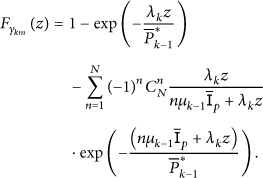
The CDF and the PDF of of the SNR at for the kth hop are, respectively, given in a closed form as
where , , , and .
Proof.
Let ; then the CDF of conditioned to X is obtained as
By averaging with respect to X, the CDF of is found as
In addition, the CDF and the PDF of X can be written as
respectively. Therefore, the CDF of in (11) can be rewritten as
Substituting (12) and (13) into (14), after some manipulation, we can derive as
Based on the relay selection strategy in (1), the CDF at for the kth hop can be derived as (8). Moreover, by taking the first derivative of , we obtain the PDF in (9).
3.1. Throughput Analysis
Before computing the throughput for the end-to-end link, we derive the ergodic capacity of each hop. We first rewrite the PDF in (9) in a more compact form as
where
Next, we express the product form of A and B in (17) in the following partial-fraction expansion:
where and .
Based on the PDF of in (9), the ergodic capacity for the kth hop can be computed as
In addition, we express the integrand in terms of the Meijer G-function [22, Equation (8.4.6.5)] as and express using the Maclaurin series expansion: . We also use [23, Equation (7.811.5)] and to obtain the ergodic capacity of the kth hop in (20), which appears in the following, where denotes the gamma function [23, Equation (8.8310)]:
Using in (20), the ergodic capacity C of the end-to-end link is given as
Furthermore, the total transmission time from the source to the destination is and we fixed the transmission time for each hop to , leading to the effective communication time of in each slot. If each node transmits at a fixed rate equal to the ergodic capacity in (20), then the throughput R of the end-to-end link is given as
To find the optimal value of α in order to maximize the throughput R, we consider an optimization problem as follows:
It is easy to verify that (23) is a concave function of α. Therefore, the optimal α can be obtained by taking the first derivative of the throughput in (22) with respect to α. However, a closed-form solution to (23) cannot be obtained. Nevertheless, the optimal α can be found through a numerical search.
3.2. Outage Probability Analysis
The outage probability of the end-to-end link in a multihop transmission is defined as the probability that the minimum SNR will fall below a given threshold ρ. Using the CDF in Lemma 1, can be obtained as
where and is a threshold for the transmission rate. Substituting (8) into (24), we have
4. Numerical Results
In this section, we evaluate the performance of cognitive multihop transmission analyzed in Section 3. We use the analytical expressions (20) and (25) for the throughput and the outage probability, respectively, to evaluate the system performance. In particular, we investigate the impact of the time fraction α for energy harvesting, the number of hops K, the number of relays in each cluster, and the impact of the primary users on the throughput and on the outage probability. We assume that the source , the relay , the destination , and the primary receivers s are located at , , , and , , respectively. Furthermore, the distance of every hop is assumed to be equal and the relays in each cluster are located at the same position. Accordingly, the distance between and is equal to . The path-loss exponent β is set to and is assumed to be equal to 1 for every k, unless stated otherwise. Every cluster is assumed to have the same number of relays; that is, , . Noise power , , is normalized to unity.
In Figure 3, we show the effect that the time fraction α for energy harvesting has on the throughput. Ns are assumed to be deployed at the same location . The number of s N, the number of hops K, and the number of relays in each cluster M are all set to . The throughput is found to increase as δ increases, since a larger δ will result in more energy harvested. As expected with (23), for each value of δ, there exists an optimal α that maximizes the throughput. Furthermore, the optimal α is found to decrease as δ increases. The reason for this can be explained as a trade-off between the duration of energy harvesting and that of the data transmission. A longer harvesting period will result in more energy accumulated, but less time is used to transmit data. Figure 3 also confirms that results of the simulation and the analytical results are in exact agreements.
Throughput versus α for dB, 0 dB, 5 dB, and 10 dB ( and ).
Figure 4 depicts the throughput versus α for various values of , when s are assumed to be located at . The throughput is found to increase as the number of relays M and/or the number of hops K increases, and the optimal α decreases as the number of hops K increases to compensate for the reduced transmission time for each hop. If we look at (4), as K increases with being constant, α needs to decrease in order to guarantee more time for data transmission.
Throughput versus α for , , , and ( dB, , and ).
Figure 5 depicts the outage probability versus the SNR for various values of K, when dB, , , , and . The outage probability is observed to decrease as the SNR γ increases, that is, as more energy is harvested. Also, the outage probability decreases as the number of hops K increases.
Outage probability versus SNR γ for , and 4 ( dB, , , , and ).
The effect of s on the outage probability is depicted in Figure 6, when , dB, dB, , , and . We see that the outage probability decreases as K increases. Moreover, for all cases where , the outage probability decreases as δ increases. However, the outage probability is found to saturate as δ becomes greater than 3 dB. This is because the transmit power in (6) has to satisfy the interference power constraint at s even though the energy harvested increases.
Outage probability versus δ for K = 1, 2, 3, and 4 (, dB, dB, , , and ).
5. Conclusion
In this paper, wireless energy harvesting has been investigated for a cognitive multihop wireless sensor network. Based on the TSR protocol for energy harvesting, we have established a time-division energy harvesting and relaying scheme for efficient multihop transmission. We have derived the CDF and PDF of the SNR for each hop, based on which an exact analytical expression for the throughput and for the outage probability has been derived for the end-to-end link. We have also provided numerical results that validate the analysis and show the performance. It has been shown that, in order to improve the performance in terms of the throughput and outage probability, it is necessary to distribute many relay nodes between the source and the destination so that sufficient energy can accumulate for use during data transmissions. The performance of the system can also be improved by increasing the number of relays for each cluster. Analyzing the PSR protocol instead of the TSR protocol for energy harvesting at the source and relay nodes is left for future work. In addition, comparisons between the TSR and PSR protocols in terms of the system performance will provide a better insight into wireless energy harvesting in a cognitive radio system. Another interesting future work is to consider an underlay cognitive radio system where the source and relay nodes of the secondary system will be able to harvest energy from the interference signal of the primary transmitter.
Footnotes
Conflict of Interests
The authors declare that there is no conflict of interests regarding the publication of this paper.
Acknowledgments
This work was supported in part by Basic Research Laboratories (BRL) through NRF grant funded by the MSIP (no. 2014044894) and in part by the Human Resources Development program of the Korea Institute of Energy Technology Evaluation and Planning (KETEP) grant funded by the Korea government Ministry of Trade,Industry & Energy (no. 20134010200570).
NasirA. A.ZhouX.DurraniS.KennedyR. A.Relaying protocols for wireless energy harvesting and information processingIEEE Transactions on Wireless Communications20131273622363610.1109/twc.2013.062413.1220422-s2.0-84881478956
3.
GurakanB.OzelO.YangJ.UlukusS.Energy cooperation in energy harvesting communicationsIEEE Transactions on Communications201361124884489810.1109/TCOMM.2013.110113.1301842-s2.0-84891626028
4.
LiuL.ZhangR.ChuaK.-C.Wireless information transfer with opportunistic energy harvestingIEEE Transactions on Wireless Communications201312128830010.1109/TWC.2012.113012.1205002-s2.0-84873092663
5.
ZhouX.ZhangR.HoC. K.Wireless information and power transfer: architecture design and rate-energy tradeoffIEEE Transactions on Communications201361114754476710.1109/tcomm.2013.13.1208552-s2.0-84890429378
6.
LuoS.ZhangR.LimT. J.Optimal save-then-transmit protocol for energy harvesting wireless transmittersIEEE Transactions on Wireless Communications20131231196120710.1109/twc.2013.012413.1204882-s2.0-84875628003
7.
HoC. K.ZhangR.Optimal energy allocation for wireless communications with energy harvesting constraintsIEEE Transactions on Signal Processing20126094808481810.1109/TSP.2012.2199984MR29605632-s2.0-84865230790
8.
FouladgarA. M.SimeoneO.On the transfer of information and energy in multi-user systemsIEEE Communications Letters201216111733173610.1109/LCOMM.2012.091212.1216602-s2.0-84870493126
9.
ZhangR.HoC. K.MIMO broadcasting for simultaneous wireless information and power transferIEEE Transactions on Wireless Communications20131251989200110.1109/twc.2013.031813.1202242-s2.0-84878659299
10.
RajeshR.SharmaV.ViswanathP.Capacity of fading Gaussian channel with an energy harvesting sensor nodeProceedings of the 54th IEEE Global Telecommunications Conference (GLOBECOM ′11)December 2011Houston, Tex, USA1610.1109/glocom.2011.61339012-s2.0-84857215626
11.
LeeS.ZhangR.HuangK.Opportunistic wireless energy harvesting in cognitive radio networksIEEE Transactions on Wireless Communications20131294788479910.1109/TWC.2013.072613.1303232-s2.0-84884979976
12.
BaoV. N. Q.ThanhT. T.NguyenT. D.VuT. D.Spectrum sharing-based multi-hop decode-and-forward relay networks under interference constraints: performance analysis and relay position optimizationJournal of Communications & Networks201315326627510.1109/jcn.2013.0000492-s2.0-84880853036
13.
BaoV. N. Q.DuongT. Q.TellamburaC.On the performance of cognitive underlay multihop networks with imperfect channel state informationIEEE Transactions on Communications201361124864487310.1109/TCOMM.2013.110413.1301672-s2.0-84891596077
14.
HyadiA.BenjillaliM.AlouiniM.-S.Da CostaD. B.Performance analysis of underlay cognitive multihop regenerative relaying systems with multiple primary receiversIEEE Transactions on Wireless Communications201312126418642910.1109/TWC.2013.110313.1306102-s2.0-84891561345
15.
ZhangX.XingJ.YanZ.GaoY.WangW.Cognitive multihop wireless sensor networks over nakagami-m fading channelsInternational Journal of Distributed Sensor Networks201420141110.1155/2014/630823
16.
VincentP. J.TummalaM.McEachenJ.A new method for distributing power usage across a sensor network2Proceedings of the 3rd Annual IEEE Communications Society on Sensor and Ad hoc Communications & Networks (SECON ′06)September 2006Reston, Va, USA51852610.1109/sahcn.2006.2885082-s2.0-44049092725
17.
ParkS.HongD.Achievable throughput of energy harvesting cognitive radio networksIEEE Transactions on Wireless Communications20141321010102210.1109/TWC.2013.121713.1308202-s2.0-84896388908
18.
RajeshR.SharmaV.ViswanathP.Information capacity of energy harvesting sensor nodesProceedings of the IEEE International Symposium on Information Theory (ISIT ′11)July 2011Saint Petersburg, Russia23632367
19.
KrikidisI.ZhengG.OtterstenB.Harvest-use cooperative networks with half/full-duplex relayingProceedings of the IEEE Wireless Communications and Networking Conference (WCNC ′13)April 2013Shanghai, China4256426010.1109/wcnc.2013.65552612-s2.0-84881565337
20.
BletsasA.ShinH.WinM. Z.Cooperative communications with outage-optimal opportunistic relayingIEEE Transactions on Wireless Communications2007693450346010.1109/TWC.2007.060200502-s2.0-35448931484
21.
DongC.YangL.-L.HanzoL.Performance analysis of multihop-diversity-aided multihop linksIEEE Transactions on Vehicular Technology20126162504251610.1109/tvt.2012.21963012-s2.0-84863978343
22.
PrudnikovA. P.BrychkovY. A.MarichevO. I.Integrals and Series: More Special Functions1990New York, NY, USAGordon & Breach Science
23.
GradshteynI. S.RyzhikI. M.Tables of Integrals, Series, and Products20077thSan Diego, Calif, USAAcademic PressMR2360010