







Abstract
1. Introduction
In the past decades, wireless sensor and ad hoc networks have attracted much attention and a lot of useful research works have been proposed [1–6]. Compared with traditional wireless sensor networks, in sparse social sensor networks (SSSNs), a contemporaneous path between the source and destination nodes may not exist within the given time [7]. Also, the packets generated in SSSNs are opportunistically forwarded to the destination.
In general, most of the existing forwarding algorithms assumed that the nodes are cooperative and willing to help others to forward packets. However, in the real application of SSSNs, nodes are rational, such as PeopleNet [8] and Pocket Switched Network [9]. Since nodes are rational, they would like to maximize their own utility instead of fulfilling network-wide criteria. This is the so-called selfish behavior in sparse social sensor networks. This widely prevalent selfish behavior results in serious performance degradation for SSSNs [10].
Selfish behaviors in mobile social networks can be classified into two categories: individual selfishness and social selfishness [11]. Most published results address the issue of individual selfishness [12, 13]. Nodes that seek individual selfishness want to get help from others but do not render help to others in order to maximize their own utilities. Existing algorithms focus on addressing the individual selfish behavior such as using reputation-based [14], credit-based [15, 16], or game theory-based [17] approaches to incentivize nodes to cooperate and forward packets for others. The core idea of these incentive mechanisms is to let the nodes know that if they are cooperative, they will enhance utility. Furthermore, the more help they give to others, the more utility they will obtain. It is easy to see that these incentive mechanisms are effective in avoiding individual selfishness. To mitigate the social selfish behavior, one may assume that the status of nodes is equal in social sensor networks. Obviously, this is an impossible assumption in the real world.
In more realistic social sensor networks, if nodes have to offer forwarding service for others, they prefer to serve those who have social relations (e.g., friendship [18], roommate) with them. The relations will be strengthened through helping each other. On the other hand, for the nodes without any relations, they prefer to ask influential (mighty) nodes to help them forward packets. Influential nodes are defined as nodes with more social relations. The above preferences constitute social selfishness.
In this paper, we propose to incentivize nodes to provide packet forwarding for others by introducing the concept of virtual bank, which takes charge to distribute rewards to participant nodes in the packet forwarding process. We refer to the reward as the virtual money and consider that every node in the SSSNs can be the source, destination, and relay node. There are two basic principles.
If a node helps others to forward packet to the destination successfully, it will receive the reward from the source nodes. All the nodes are trying to pursue the reward to ensure they have enough virtual money for paying the forwarding process.
In civilian application scenarios, all sensor nodes are autonomous and self-interested; they aim to maximize their own utility and minimize their own contributions. In such case, the sensor nodes are not willing to forward other sensors packets. Traditional sensor networks require all nodes to collaborate with each other and balance the resources among all nodes. However, sensor nodes are not interested in cooperation without incentive mechanism. Generally speaking, this model is called individual selfishness [19]. On the other hand, social selfishness is not totally contradictory to individual selfishness but is a generic extension to it. Social selfishness will affect sensor node behaviors. As a forwarding service provider, sensor node will refuse to offer the packet forwarding service for those who have no social relationship with it. Furthermore, when the resource of forwarding service provider node is limited, it will only forward the packets received from the sensor nodes with social relationship. Thus, in SSSN, the forwarding mechanism designing should fully consider the social selfishness.
However, social selfishness will have negative impact on SSSNs, as analyzed below. Typically, in order to guarantee the successful forwarding of a packet within a given time, nodes prefer to choose those having more social relations to request packet forwarding services. Owing to the critical gaps existing among social relations of different nodes, some nodes with more social relations will get more opportunities to help others, thus obtaining more rewards according to the incentive mechanism for individual selfishness. On the contrary, nodes, which have less social relations, will hardly get rewards and are eventually starved and cannot afford the cost for forwarding. We refer to those nodes falling into the poor status as poverty nodes. These poverty nodes, having been isolated in sparse social networks, will likely become malicious and try to sabotage the network. In this paper, these nodes are identified as the internal threats in social selfish SSSNs. To the best of our knowledge, this is the first paper to discuss the internal threats caused by social selfishness for SSSNs.
In this paper, when the network runs for a relatively long time, the network goes into the stable status. Two extreme categories of virtual money owing to sensor nodes would appear: poverty and richness. This is because the virtual money earning is related to the social relationship of nodes. If the sensor node has a more social relationship with others, it would have more opportunity to act as the service provider. Moreover, it provides more forwarding service for other nodes. It earns more virtual money. On the contrary, the node which has less opportunity to forward packet for other nodes has less virtual money. Meanwhile, it also has the desire to send packet to others; this means that it needs to pay the cost for packet forwarding. In such case, with time passing by, this kind of nodes has not enough virtual money for their own packet sending; no nodes will provide forwarding service for them. Since we assume all sensor nodes are rational and self-interested, the poverty nodes would like to find other ways to finish their own packet sending. Obviously, this behavior is trying to break the rule for packet forwarding of the network. Thus, the poverty nodes have a high potential to become the malicious nodes.
To mitigate such internal threats, we introduce the Gini coefficient [20], which has been used as a measure of inequality of income or wealth in the real world, to measure the social distribution for SSSNs. Based on the Gini coefficient, we adopt a taxation strategy to redistribute the social virtual money to prevent the emergence of the poverty nodes. Therefore, we can avoid internal threats, which are caused by social selfishness. Furthermore, we introduce a forwarding strategy, which is based on social relations of nodes. The main contributions of this paper include the following aspects.
Analyze personal selfishness and social selfishness. Pinpoint the problem caused by social selfishness and introduce the virtual bank. Identify internal threats caused by social selfishness. Propose a solution to mitigate internal threats.
The remainder of this paper is structured as follows. Section 2 presents the problem statement of this paper. Section 3 details the internal threats avoiding mechanism for social selfish SSSNs. Section 4 discusses the distributed calculation process of Gini coefficient and incentive mechanism. Section 5 introduces our forwarding strategy, and Section 6 presents and discusses simulation results. Section 7 concludes the paper along with future works.
2. Problem Statement
2.1. Network Model
In sparse social sensor networks, incentive mechanisms have been proposed to avoid the individual selfish behavior. In this paper, we propose to incentivize nodes to cooperate and willingly to help others forward packets by using the virtual money payment mode. In the initial phase, we let each node possess the same amount of virtual money. When the node asks others to forward its own packet to the destination, the node needs to pay the virtual money to the relay nodes that help it to forward the packet. To safeguard successful delivery of their own packets, all the nodes are trying to pursue the virtual money instead of pursuing selfishness. To ensure the virtual money could be distributed in time, we introduce the virtual bank to achieve this goal.
Tamper-proof device is installed in each sensor node to manage the virtual money account. In our work, we put our main focus on how to solve the social selfishness problems and design the taxation strategy on balancing the virtual money among all nodes. We use the same way as [21]. In [21] the self-generated and forwarding packets are passed to the tamper-proof device to decrease and increase the nodes virtual money account.
In this paper, we set and refer to some stationary nodes as base stations. The communication radius of a base station is larger than those of normal nodes. Any two adjacent base stations can communicate directly. All the base stations cover the entire network as shown in Figure 1. These base stations constitute the virtual bank. Furthermore, we assume these base stations can exchange their information in the real-time mode. The virtual bank maintains information of all the moving nodes belonging to the network, including node ID and the virtual bank account of each node. If some new nodes join the network, the virtual bank will distribute some initial virtual money into their accounts to ensure they can acquire the forwarding service from other nodes immediately. In Figure 1, node

Illustration for virtual bank.
In Figure 1, we can see that our proposed virtual bank is constituted by the fixed location base stations. All of these base stations cover the entire sparse sensor networks. In the initial phase, each sensor node is located in an exact location in the network where it is covered by at least one base station. This base station sends a special packet to the sensor node. This special packet contains the amount of virtual money and the amount of virtual money cannot be modified by the node; it is guaranteed by the tamper-proof device. When the packet receiving behavior is confirmed by the node, the base station notifies other base stations that this node has received the initial virtual money. In order to show the changing trend of virtual money for each individual sensor node and how the poverty nodes appear, we set the same amount of virtual money for every node in the networks.
2.2. Security Problem Caused by Internal Threats in Sparse Social Sensor Networks
By introducing the incentive mechanism of the virtual bank, individual selfishness could be avoided in the social sensor networks. However, as we have previously described, in a real application scenario, the social selfish behavior is more general and difficult to avoid. To the best of our knowledge, there are no existing research results that can avoid the social selfish behavior in SSSNs. In fact, we think there is no need to avoid social selfishness. In our work, we analyze the influence of social selfishness and try to minimize its influence. As for the existing incentive mechanism for individual selfishness, the general idea is to let the nodes know that the more work they do for others, the more payoff they will get from others. That is, the payment is proportional to their participation in forwarding others’ packets. On the other hand, source nodes prefer to choose relay nodes which have more social relations to forward their packets by virtue of social selfishness. Nodes, which have more social relations, have higher probability to encounter other nodes within their own social relation, and the higher encounter probability can reduce the delivery delay of packets. Therefore, we should encourage the social selfish behavior to enhance network performance. In such case, nodes, which have more social relations, will have higher opportunity to help others. Likewise, these nodes will get more social payoff (virtual money). On the contrary, nodes, which have less social relations, will have less opportunity to participate in the forwarding process. It is difficult for these nodes to get social payoff. The social relationships of nodes are shown in Figure 2. The necessary condition for successful packet transmission is payment. Nodes, which have less social relations, will likely become the poverty nodes, which will not be able to attract cooperation from other nodes. These nodes will eventually be isolated in social sensor networks.

Illustration for relationships of normal sensor nodes.
In this paper, we assume that all the sensor nodes are rational, self-interested, and selfish. Each node is trying to earn more virtual money and save its own limited resources. As we know, the individual selfish behavior could be avoided by using the incentive mechanism. As for the social behavior of each node, since it is caused by the social relationship of every node in the network, it means that, in the real world, social relationships always exist in our living society. People cannot be fully isolated by the social relationship. In this way, if the social relationship exists in the network, the social selfish behavior is hardly avoided. In our work, we put our main focus on how to minimize the influence of social selfishness for the sparse social sensor networks.
With respect to security in social selfish sensor networks, we may classify network threats into two categories: external threats and internal threats. Our work will focus on the internal threats, which are caused by social selfishness. Internal threats, referred to in this paper, are caused by internal nodes of the network. These nodes are normal and would like to serve for the network. However, due to their social relations, when they turn into the poverty nodes, some of them will become malicious nodes. Since these internal malicious nodes reside in the network, it is more difficult to detect their malicious behavior. To the best of our knowledge, this is the first paper to address internal threats caused by the incentive mechanism for individual selfishness in social selfish sensor networks.
3. Gini Coefficient and Taxation Strategy Based Internal Threats Avoiding Mechanism
3.1. Gini Coefficient and Stability of Social Sensor Networks
In order to mitigate internal threats caused by social selfishness, we need to solve the problem of uneven distribution of social wealth (virtual money). In this paper, we introduce the Gini coefficient to measure the social wealth distribution and use a taxation strategy to redistribute the social wealth for the network.
The Gini coefficient measures the degree of concentration (inequality) of a variable in a distribution of its elements. It compares the Lorenz curve of a ranked empirical distribution with the line of perfect equality. This line assumes that each element has the same contribution to the total summation of the values of a variable. The Gini coefficient can range from 0 to 1; it is sometimes multiplied by 100 to range between 0 and 100. A low Gini coefficient indicates a more equal distribution, with 0 corresponding to complete equality, while higher Gini coefficients indicate more unequal distribution, with 1 corresponding to complete inequality. To be validly computed, no negative goods can be distributed. That is, if the Gini coefficient is being used to describe household income inequality, then no household can have a negative income. When used as a measure of income inequality, the most unequal society will be one in which a single person receives 100% of the total income and the remaining people receive none (
Based on the above connotation of the Gini coefficient, it is easy to see that the Gini coefficient increases with the unevenness of the social distribution. In social sensor networks, the main reason for uneven social distribution is social selfishness. As we know, in the real human society, a high Gini coefficient implies that the society is in the unstable status; for example, criminal activities will occur frequently. This phenomenon of human society also exists in social sensor networks. In this paper, unstable social sensor networks imply that internal threats exist in the network. To avoid internal threats caused by uneven social distribution, we use the virtual bank to redistribute the social distribution through the taxation strategy. Furthermore, this strategy also reduces the Gini coefficient in social sensor networks.
3.2. Calculating Gini Coefficient for Sparse Social Sensor Networks
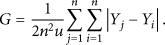
As mentioned above, we introduce the virtual bank to distribute the virtual money for the forwarding process. Since the virtual bank maintains IDs and accounts for all the nodes, we can use the virtual bank to calculate the Gini coefficient for the social sensor networks. The following is the calculation process of Gini coefficient.
We define the Gini coefficient, as shown in Figure 3, by the following equation:


Graphical representation of the Gini coefficient by Lorenz curve.
Here, 


3.3. Taxation Strategy Based Internal Threats Avoiding Mechanism
In this paper, the virtual bank calculates the Gini coefficient of the network periodically. Based on the different Gini coefficients, the virtual bank executes different taxation strategies for the nodes. We only focus on three intervals of the Gini coefficient value to measure and control the wealth distribution for social sensor networks. The three intervals are 0.2 to 0.3, 0.3 to 0.4, and 0.4 to 0.5. When the Gini coefficient value is within the interval of 0.2 to 0.3, the social distribution of the network is relatively even. In such case, the virtual bank executes the following taxation strategy. The virtual bank deducts 10% of forwarding payoff for all the nodes to ensure initial distribution for new joining nodes. When the Gini coefficient value falls into the interval between 0.3 and 0.4, the social distribution is becoming uneven. We need to redesign the taxation strategy. The virtual bank examines the account of all nodes and calculates the mean value of the virtual money. For nodes with virtual money above the mean value, the virtual bank deducts 15% of the forwarding payoff. The rest of the nodes keep the 10% taxation strategy. If the Gini coefficient value falls into the interval between 0.4 and 0.5, the virtual bank stops the levy tax from nodes with their virtual money less than the mean value. For nodes with their virtual money larger than the mean value, the virtual bank still levies 15% of their forwarding payoff as the tax. Furthermore, as known from the Pareto principle, the virtual bank levies the punitive tax for some special nodes. Through the Pareto principle, we know that 80% of the social wealth is owned by 20% of the population. Obviously, this principle also works in social selfish sensor networks. The special nodes levied by the punitive tax are the 20% nodes in SSSNs. The virtual bank levies 30% of their payoff as tax.
Meanwhile, the virtual bank always pays attention to the account of nodes with the less social relations. If the virtual bank notices that the virtual money of an account is not enough to pay for the forwarding cost, the virtual bank replenishes this account with the initial money from the taxation income, thus ensuring this node's survival in the network and preventing this node from becoming a malicious node.
4. Discussion for Distributed Calculation Process of Gini Coefficient and Incentive Mechanism
Gini coefficient is used to describe the distribution of currency in the society. It has great impact on redistribution regulation. However, it is inopportune to set a centralized real-time statistics, calculation, and broadcast system of Gini coefficient in social sensor networks. Hence, we propose a Gini coefficient approximate value calculation process of distributed incomplete information. Gini coefficient would be solved by every node. One node will ask for or provide the related information about Gini coefficient solving from/for another node when there is a communication link between these two nodes, which makes sure of the convergence of Gini coefficient from one node to the other one.
In the process of information exchange and convergence of Gini coefficient, one node cannot achieve the real-time information from other nodes because of the environmental and system constraints. Therefore, we provide the forecast of future property status when exchanging property status information. Node
Hence, every node could achieve approximate property status of other nodes which it needs when they need calculation of Gini coefficient at any time. One node can achieve much more accurate calculation results by using the information of other nodes in maximum possibility.
The derivation process of Gini coefficient is referred to in Section 3. We can get
Nodes in social sensor networks provide the service of forwarding and transmitting information for other nodes normally. Packet arriving at destination in effective time is more significant to a system than not arriving at destination in general routing protocol. Hence, one node can get more payoffs when they relay data successfully. This assumption is reasonable. However, nodes cannot confirm that when the data which it relays can be forwarded to the destination. In such case, the process of payment and settlement will start after the relay process is finished. Each node in social sensor networks keeps moving. If there is no centralized organization similar to bank to offer real-time transfer money, the worst condition is that forwarding node cannot meet the node which needs to pay utility to it. As for the nodes which help other nodes to forward packet, if they cannot get the payoff in time, it is not fair.
Under the premise that the node could control producing packet, we change the concept that packet has no value to one node. We think that when the packet is generated, the value has been inserted into the packet before it is forwarded. We take packet as futures. The value of packet increases every time it is relayed until this packet arrives at its destination. The value of one packet will become the largest when it arrives at its destination. When one node receives packet from other nodes, it should pay to other nodes. When one node relays packet to other nodes, other nodes will give payoff to it. Relay node will make a profit from the price difference between the profit of receiving and the profit of relaying when it relays packet successfully. The profit that one node could obtain is its reward. Let 

The process of transmitting packet is shown below.
Source node produces a packet with destination The node Node Node Node If node
In our payment scheme, each node will be paid after relaying packet while it needs to pay for the reasonable cost to its previous hop. A complete forwarding would not change its payoff no matter whether the packet which it relayed arrives at destination or not finally. Each relay node has the risk of not being able to recover its cost in the
Our scheme proposes a fair distributed payment mode. Hence, each relay node will be more efficient to provide service. Just as Adams Smith considered in his writing termed the wealth of the nations, all people are selfish and greedy. The free market will reduce the price and utilize this nature to benefit human being. Providing more products and services can get interests.
We assume each node is selfish and rational. Every node tries its best to achieve the largest profits. Nodes in social sensor networks have social nature. Every node has relationship with other nodes more or less. For example, every node has friends, partners, and family. Their behavior has social selfishness to some degree. They are willing to let their related node benefit rather than their unfamiliar node. We assume that every node could refuse to provide service for its unfamiliar node in a certain probability, that is, refuse to buy packets futures. The objectives of this assumption contain two aspects. One aspect is to reduce the transferring risk of relay node to reduce the lost profits of total group. The other aspect is keeping a certain amount of resources to provide more service to the nodes in its close social relationship group.
The assumption above makes sure that every node in the system creates wealth while providing more opportunities to its related node, which gives more advantages to the group. We give each node a real number
The third phase in step 2 of transmission process is modified as follows.
We set The remaining space is equal to the number of agreed packets. The first stochastic decision is to refuse to transmit packet. The currency could not pay for the next packet.
We assume there are six packets, denoted by
Selfish behavior will urge the node to accumulate wealth. Social relationship leads to group advantage. The ability difference between nodes will lead to uneven distribution of wealth. The currencies of one node will be less and less with the relay process. Some nodes may not afford currency
The currencies of node represent the ability to pay for service and assumption risk of this node. However, every node uses its currencies to represent the ratio of network resources which it can exhibit actually. The more currencies of one node are, the more network resources it can use in normal situation. The network resources are not unchanged all the time actually. When the abject poverty node appears and increases, the transmission power reduces and the network delay increases; the network resources are less than normal situation in this time. We consider the network resources as a function 
Here,
We propose a reasonable redistribution scheme. This scheme makes sure of keeping the number of abject poverty nodes under a low number under the premise of not losing fairness. Networks can still be stable in this scheme. Firstly, we consider the node whose currencies are lower than the average currencies of all nodes in the network which have no ability to increase its currencies to a certain extent. Therefore, we would not add this node as a currency producer into redistribution until this node has enough currencies. We divide the process of redistribution into two periods. The two periods are waiting period and adjustment period. We give a regulation. All nodes in network know this regulation.
The duration of adjustment period is the length of adjustment period. We consider the time of adjustment period The starting time of adjustment period is One node is in its waiting period when it has no effective starting information. Node in waiting period will calculate its Gini coefficient once after updating its currency state list. The node will produce starting information with time of this moment if its Gini coefficient is larger than the threshold. We call one node a rich node when its currencies are larger than the average currencies of the whole network. Rich node in its adjusting period has the responsibility of redistribution. Parts of its own currencies which exceed the average number of the whole network will be put into the fund pool for redistribution in a certain ratio
Every rich node will give The gift money supply of one rich node is no less than the money supply in its fund pool in this adjusting period. The money supply of rich node is less than average supply End of the adjusting period means that nodes in waiting period need no redistribution anymore.
When one rich node does not satisfy any one condition of the three conditions above, it refuses gift to nodes which it meets satisfying given condition. Then, the refusing nodes will write information below in their evaluation regional as evidence.
The refuse time. The starting time of this adjusting period. The property information of rich node. The property information of this refused node. The fund poor of rich node,
We stipulate that when one node meets the other one which the evaluation regional is not empty, it will copy the information in this evaluation regional to its own evaluation regional. That means the nongenerous behavior will be diffused rapidly. Every node that achieves this nongenerous information will turn nongenerous and will not participate in redistribution.
This is an infectious scheme of large dispersion repeated game. All nodes will be generous if the thresholds of Gini coefficient, redistribution rate
Rich nodes can occupy and use network resources in a long term. Every rich node may consider the average real value of its own long-term property. We take the average real value of the wealth status in infinite discrete time as a judgment basis. We call this average real value the average value function.
The average value function of any rich node which is nongenerous is

When one node is nongenerous, there exists a parameter 

When all of the rich nodes are generous, for all 
The necessary and sufficient conditions of initializing nongenerous behavior can be sufficiently curbed. For any rich node in the network, it should satisfy
This scheme effectively reduces the number of abject property nodes and improves the performance and the stability of network. Besides those, this scheme also takes the fair and the total average balance of payments into account. The property of rich node retaining will be no less than the property of nodes whose property is less than the original because of the redistribution. The work of each node will be expressed by the true real value of its property. Therefore, the scheme we proposed is a reasonable and fair solution scheme.
5. Enabling Secure Packet Forwarding by Using Internal Threats Avoiding Mechanism
In social selfish sensor networks, we think each node has its own social relations and maintains them in some way. In this paper, the forwarding strategy is based on social relations of nodes. Consider nodes moving in a specific field (e.g., campus of university). When two nodes encounter and they establish social relations with each other, they exchange the social relation map of their own. That is, after exchanging the social relations map with its social relations members, the node knows the social relations of its social relations members. Based on the social relations of nodes, we design the packet forwarding strategy. When a packet is generated by the source node, firstly, the source checks its own social relations map. If the destination is in its own social relations, the source delivers the packet to the destination directly. If not, it checks its social map. In the case that the destination is in the social relations of the social relations member of the source, the source requests the social relations member to forward the packet. If the source cannot find the destination within its social relations map, it asks the nodes which it encountered. In our forwarding strategy, the forwarding decision is a two-way process. Firstly, if social relations of the encountered node are more than those of the source, the source asks the encountered node to forward the packet. Secondly, the encountered node makes the final decision on whether it will forward the packet. Since too many nodes participate in the forwarding process, the payoff will be equally divided into several portions based on the limited buffer of each node. In such case, the encountered node may refuse to forward this packet, despite the fact that the destination is in its social relations map, because the packet needs to be forwarded by too many hops. As for the source node, if the encountered node refuses to forward, the forwarding decision will be executed again when it encounters other nodes. In the following paragraphs, we describe the detailed explanation of forwarding decision.
In this paper, the virtual money drives nodes to help others with forwarding packets. In such case, potential forwarding candidate needs to make the decision for whether to forward the packet, since the virtual money would be shared by the nodes which participate in the forwarding task. We formulate the decision making process as a linear programming model. This model not only can help the forwarding candidate nodes to make the final decision, but also can control the number of hops of the packet forwarding process.
For any two nodes between which a social relationship exists, their encounter opportunity is the random event. With time passing by, toward the two nodes linked by social relationship, the amount of encountering satisfies the following properties.
Within the different time interval, the amount of encountering is the independent random variables of each other. Within the same time interval, the probability law of the amount of encountering is the same. Within the finite time interval, the amount of encountering is terminable and, furthermore, in case the time interval
Therefore, we assume this event is the Poisson process where the intensity is 


We assume 


Based on the above expressions, we formulate the decision making process as a linear programming issue:

6. Simulation Results
6.1. Experiment Setup and Simulation Metrics
Our simulation is based on the MIT Reality trace [22]. The MIT trace consists of 97 students and staff which carry Nokia smartphone in the MIT campus over nine months. These smartphones run Bluetooth device discovery every five minutes and log more than 100 thousand contacts with each other. We use the contacts to perform trace-driven simulations. In the MIT Reality trace, the dataset not only logs the contacts, but also logs the phone calling history for all of the 97 phones. In our simulation, we assume that if any two nodes had phone calling history, they have social relations with each other. As we mentioned in the previous section, our forwarding strategy is based on social relations of nodes. Therefore, we use the phone calling history among the 97 nodes as the social relations.
In this section, each node generates one packet per day and assigns the destination within the 97 nodes randomly. The packet size is 20 KB and the TTL of packet is 100 days. Each node was given 10 units of virtual money, and one packet requires 1 unit for forwarding payment. The virtual bank exchanges accounts of nodes per day.
We use the following metrics to evaluate the internal threats. Firstly, we compare the Gini coefficient under the taxation strategy and nontaxation strategy, respectively. Secondly, we compare the payoff of the nodes under the taxation and nontaxation strategy, respectively. Simulation results show that the internal threats exist in social selfish sensor networks widely. By using the proposed Gini coefficient and taxation strategy, we can resolve the social selfish issues in sparse sensor networks.
6.2. Simulation Results
In Figure 4, we can see that, under the incentive mechanism for individual selfishness, if the taxation strategy is not applied for the social sensor networks, the Gini coefficient of network increases to a high level within a short time period. In the time interval of 30 days to 50 days, the increasing rate is higher. This is attributed to the fact that more packets are forwarded to the destination successfully. Also, more payoff of forwarding is distributed to the relay nodes. In the time interval of 50 to 100 days, the rate of increase of the Gini coefficient is becoming slower. This is because some nodes have no virtual money to pay, and they have been isolated. On the 70th day, the Gini coefficient has broken 0.4, and the social sensor networks are in the unstable state. The emergence of poverty nodes poses internal threats in the social sensor networks. When the taxation strategy is applied, the Gini coefficient also increases quickly for the first 40 days because the taxation strategy does not kick in when the Gini coefficient is below 0.2. When the Gini coefficient goes above 0.2, taxation strategies are executed. Since the taxation strategy redistributes the social wealth and replenishes the initial virtual money to poverty nodes, the gap between influential nodes and poor nodes is reduced. Therefore, the increment of Gini coefficient is controlled effectively.

Gini coefficient changing rate with the time passing by.
Figure 5 shows the virtual money of node accounts without a taxation strategy. We choose the mean value of the virtual money of the top 10 nodes and the bottom 10 nodes. We can see that the virtual money of the top 10 nodes increases quickly. Meanwhile, the virtual money of the bottom 10 nodes is quickly exhausted. At the 60th day, the mean value of the bottom 10 nodes becomes 0. This means these poverty nodes have no virtual money to pay and have thus been isolated by the network. Furthermore, the number of poverty nodes is kept growing. In such case, some of these nodes will likely become malicious nodes that threaten the social sensor networks. In Figure 6, since we adopt the taxation strategy for the network, we can see that the income payoff of influential nodes is controlled effectively. The poor nodes, being replenished with virtual money by the taxation strategy, are not isolated by the network. In such case, these lower income payoff nodes have no incentive to become malicious. From Figures 5 and 6, we can conclude that, by using the Gini coefficient and taxation strategy, we avoid the internal threats caused by the social selfish behavior.

Virtual money of nodes under the instance of without taxation strategy.

Virtual money of nodes under the instance of with taxation strategy.
7. Conclusion and Future Works
In this paper, we have studied the impact of individual and social selfish behaviors on sparse social sensor networks. With respect to individual selfishness, we propose to use the virtual bank and money to incentivize nodes to cooperate with each other. We have analyzed the impact of social selfishness on sensor networks. The analysis concludes that the incentive mechanism of individual selfishness potentially incites internal threats in social sensor networks. That is, some nodes have less social relations and thus hardly participate in the forwarding process. When these nodes cannot afford the forwarding cost, they will be isolated by the network and become malicious nodes. To mitigate internal threats, we measure the social wealth distribution of the social sensor networks by using the Gini coefficient and design the taxation strategy to redistribute the social wealth. Furthermore, we introduce our forwarding strategy based on the social relations of nodes.
In this paper, we assume nodes are rational and selfish in social selfish sensor networks. We also assume nodes are honest. That is, although nodes are selfish, they do not deceive others. However, in some real application scenarios, some nodes will deceive others to increase their own payoff. Our future works will consider and incorporate the cheating behavior into the social selfish behavior in sparse social sensor networks.