







Abstract
When reading about scientific topics, people often read texts that present evidence and arguments that are inconsistent with their previously held beliefs. For example, a student may read in an introductory psychology textbook that developmental twin studies indicate that homosexuality is partly determined by environmental influences (Lillienfeld, Lynn, Namy, & Woolf, 2014). If this student had believed that homosexuality was genetically determined, she may change her belief as a result of reading this information. Indeed, evidence suggests that belief change sometimes occurs as a consequence of reading scientific texts (Dole & Sinatra, 1998; Kardash & Scholes, 1995; Murphy, Long, Holleran, & Esterly, 2003; Murphy & Mason, 2006; Taylor & Kowalski, 2004). The primary goal of this research was to examine whether people demonstrate metacognitive awareness of belief change. This awareness was measured by examining the discrepancy between a person’s current belief, their previously reported belief and their recollection of that initial belief. Awareness of belief change is an under studied issue, but may be an important factor in people’s metacognitive understanding of their own comprehension. If people show little awareness of changes in their own beliefs, they may erroneously conclude that their beliefs are more fixed than they actually are, and consequently may be less willing to engage with information that is contrary to their beliefs.
In this research, beliefs are defined as a statement about the truth value of a proposition (Griffin & Ohlsson, 2001; Wolfe & Griffin, in press). Beliefs are distinguished from attitudes, which contain an affective component that describes how a person feels or whether they wish something to be true or not (Ajzen, 2001). For example, the student who believes homosexuality is genetically determined may or may not wish for that to be the case. Beliefs are also distinguished from knowledge in that we store propositional or perceptual representations about many things (Alexander, Schallert, & Hare, 1991), some of which we do not believe to be real (such as fictional characters). We also can understand claims, such as that vaccines cause autism, without believing them to be true. In the literature on conceptual change, misconceptions are beliefs under this definition (Sinatra & Broughton, 2011). For example, a belief that the earth is flat is a statement of truth value, regardless of the person’s attitude or whether that statement corresponds with scientific evidence. Some scientific topics, such as evolution, show varied beliefs among people despite broad scientific consensus (Sinatra, Southerland, McConaughy, & Demastes, 2003). Other scientific topics have varied beliefs and considerably less scientific consensus, such as effects of media violence on actual violence (Boxer, Groves, & Docherty, 2015; Ferguson, 2015). The current research addresses beliefs about contentious topics for which beliefs vary and that can be studied scientifically.
Belief change and awareness of belief change
Research on belief change after reading argumentative texts suggests that change is inconsistent and not fully understood. People do sometimes change beliefs after reading belief inconsistent texts (Kardash & Scholes, 1995; Murphy et al., 2003; Slusher & Anderson, 1996). In experiments where this has occurred, subjects report beliefs before and after they read a one-sided text that presents evidence and arguments relating to the topic. Other studies show no evidence of belief change (Nyhan, Reifler, Richey, & Freed, 2014; Prasad et al., 2009) and suggest that people engage in a variety of strategies to maintain their current beliefs (Chinn & Brewer, 1998; Lombardi, Nussbaum, & Sinatra, 2016). Thus, in order to assess metacognitive awareness of belief change, we needed to create an experimental situation in which at least some subjects would change beliefs in response to reading a text. To accomplish this, we identified factors in previous research that were associated with belief change. Low knowledge readers may be more likely than high knowledge readers to change beliefs (Nyhan, Reifler, & Ubel, 2013). Texts with causal explanations of phenomena lead to greater belief change than texts without causal explanations (Slusher & Anderson, 1996). Furthermore, Dole and Sinatra (1998) propose that belief change is more likely when readers are relatively uncommitted in terms of the strength of their belief. In the current research, subjects read about spanking effectiveness. This topic was chosen because the subject population (undergraduates) is typically unfamiliar with the research on spanking effectiveness, their beliefs on this topic are varied, and research based texts could be created for both sides of the issue. Moreover, we reasoned that the vast majority of the subjects that were tested did not have children of their own and therefore would hold relatively uncommitted views on the topic.
Experiments on belief change in science or social science domains do not address whether people are aware of their own belief change. One potential method for establishing awareness of belief change is to ask people if their beliefs changed after reading. This method has been used in some attitude change experiments (Corner, Whitmarsh, & Xenias, 2012; Lord, Ross, & Lepper, 1979; Miller, McHoskey, Bane, & Down, 1993; Munro & Ditto, 1997). However, a
Although metacognitive awareness of belief change has not been examined, there is extensive research in the area of comprehension monitoring (e.g., Maki, Shields, Wheeler, & Zacchilli, 2005; Wiley, Griffin, & Thiede, 2005). This research suggests that people often have a relatively poor awareness of the extent to which they understand expository texts (Maki et al., 2005; Thiede, Griffin, Wiley, & Anderson, 2010), as evidenced by generally low correlations between comprehension judgments and test performance. This literature also suggests that people do not have direct access to the quality of their memory representations (Dunlosky & Thiede, 2013). Instead, two types of mechanisms have been proposed that may underlie metacognitive judgments of comprehension. First, people may use available cues in memory such as retrieval fluency to make judgments of comprehension success. Benjamin, Bjork and Schwartz (1998) had subjects answer trivia questions, then rate the probability they could recall the answers on a later free recall test. Results showed that the faster subjects answered the trivia questions, the greater they rated their probability of correctly recalling the answer. Their actual recollection performance showed the opposite pattern; the answers that were later recalled the best were the ones that subjects recalled most slowly. These results suggest that retrieval fluency influenced judgments of memory, but those judgments were inaccurate when compared to actual memory performance. A second possible explanation that may account for this inaccuracy is that judgments are based on beliefs about cognitive processing (Mueller, Dunlosky, & Tauber, 2016). If people believe that a certain factor (such as familiarity of content or similarity between items) is related to comprehension success, then comprehension judgments will vary based on these beliefs.
Metacognitive awareness of attitude change
A number of researchers in social psychology have examined people’s awareness of attitude change about certain topics. These studies show evidence of a recollection bias such that following attitude change, recollection of previously held attitudes are biased toward the direction of current attitudes (Bem & McConnell, 1970; Goethals & Reckman, 1973; Levine, 1997; Levine, Lench, & Safer, 2009; Levine & Safer, 2002; Markus, 1986; McFarland & Ross, 1987; Ross, 1989). In a classic study involving attitude change, Goethals and Reckman (1973) examined high school students’ attitudes toward bussing to achieve racial integration. Students first reported their attitudes; some thought bussing should take place, whereas others thought the opposite. Students then participated in small group discussions with others who held the same attitude. In each group, one confederate argued strongly for the opposite of the group position. After the discussion, students tended to shift attitudes in the direction of the confederate’s argument position. The authors of the study found that recollections of students’ initial attitudes were more similar to their current attitudes than to their actual initial attitudes. Other examples of similarly biased recollection errors include dating satisfaction (McFarland & Ross, 1987) and political opinions (Markus, 1986). Taken together, these recollection errors about previous attitudes suggest poor metacognitive awareness of these changes.
Ross (1989) proposed a theory of recollection bias in which people hold implicit theories about the extent to which aspects of our selves change over time. First, current attitudes about the topic in question are considered. Second, an implicit theory about stability or change is applied to determine whether it is likely that previous attitudes were similar to the current one. According to the theory, recollections of previous attitudes are reconstructed based on the assumption that the previous attitude is likely to be similar or different to the current one. For example, Ross (1989) interpreted the Goethals and Reckman (1973) data by proposing that the students adopted a theory of stability. By assuming their attitudes were stable, the change in attitudes led to large recollection errors about their previous attitudes. Ross’ (1989) theory relates to the metacognition literature in that he proposes beliefs rather than retrieval fluency as the critical component to people’s reconstruction of their previous attitudes.
Research goals
Based on the literatures in comprehension monitoring and attitude change, we predict that when people change beliefs as a result of reading, they will display biased recollection of their initial beliefs. We propose that people form a mental representation of text information along with associated knowledge, inferences and any interpretations of text content (Kintsch, 1998). We contend that current beliefs are reported based on salient information at the time they are generated. Moreover, recollection of previous beliefs will also be generated based on currently available information, along with any beliefs or assumptions about whether belief change has occurred. Thus, we propose that belief change is typically inaccessible and not subject to metacognitive awareness. We hypothesize that following belief change, people will demonstrate poor recollection of their initial beliefs. We further hypothesize that the magnitude of people’s recollection errors will be mediated by their level of belief change.
In order to more fully understand metacognitive awareness of belief change, relationships are examined between recollection accuracy of initial beliefs, and processing and mental representation of the text information. Processing refers to the mental activities that readers engage in as they read, whereas the mental representation refers to the memory that readers form as a result of reading (Graesser, Millis, & Zwaan, 1997). To date, no experiments have examined the relationship between these factors and metacognitive awareness of belief or attitude change. Studies in the comprehension monitoring literature suggest that people who perform better on exams make more accurate exam predictions (Bol, Hacker, O’Shea, & Allen, 2005; Nietfeld, Cao, & Osborne, 2005). However, Maki et al. (2005) found no relationship between verbal ability and metacomprehension accuracy. In an attempt to shed further light on this mixed evidence, we included several measures that assessed subjects’ processing and memory of the text content.
Experiment 1
In Experiment 1, subjects read either a belief consistent or belief inconsistent text describing the scientific literature related to spanking effectiveness. Beliefs were collected in a prescreening questionnaire prior to the experimental session. Post-reading beliefs and belief recollections were collected at the end of the experimental session. Argument-focused processing was assessed with sentence-by-sentence reading times (Wolfe, Tanner, & Taylor, 2013) in order to determine the extent to which subjects sped up or slowed down reading as a function of the strength of the arguments in the text. The mental representation of text content was assessed with a sentence recognition task and a short answer task.
Method
Subjects
One hundred twenty eight subjects from a large Midwestern University in the United States participated in exchange for partial credit in an Introductory Psychology course. Subjects were selected from a pool of 548 who qualified based on their responses to an on-line prescreening test at the beginning of the semester (described below). Seventy two subjects believed that spanking was an effective means of discipline, whereas 56 believed that it was ineffective. The mean age of the subjects was 19.03 (standard deviation [
Materials
Two texts were created that present one-sided arguments regarding the scientific literature related to the effects of spanking as a means of discipline (see the online Supplemental Material for the texts). In the “Pro” text, evidence is presented suggesting that spanking is an effective means of discipline. One section of the Pro text discusses methodological flaws in the studies that suggest spanking is harmful. Other sections discuss data suggesting that the appropriate application of spanking results in increased child compliance, and the negative effects of Sweden’s national ban on spanking. In the “Con” text, one section discusses short-term effects of spanking, indicating that the data on short-term effectiveness are mixed and inconclusive. Another section discusses negative long-term outcomes associated with spanking, and outlines the criticisms of this research. The Con text also discusses Sweden’s spanking ban, suggesting that claims of increased adolescent violence following the ban are misleading and incorrect. See Table 1 for descriptive statistics.
Descriptive statistics for the Pro and Con texts.

Sentence recognition ratings are the mean (SD) ratings for the 10 sentences of each type that were used in the sentence recognition task. Ratings are on a 1-9 scale with large numbers indicating the sentences were rated as supporting/refuting the proposition that spanking is effective.
Prior knowledge of the scientific study of spanking was assessed with a 10-question multiple choice test. A short answer questionnaire with 10 questions was created for each text. Some of the questions could be answered with information directly in the texts, whereas other questions required inferences. One point was awarded for each correct response, and some questions have an open-ended number of possible responses, so the number of possible points on the short answer questionnaires was open ended.
Thirty sentences from each text (Pro and Con) were selected for the sentence recognition task based on the results of an earlier rating study. In the rating study, each subject rated sentences for either the Pro or Con text, and provided either support or refute ratings with respect to the proposition that spanking is effective. Ten subjects were in each of the four conditions. Support was defined as “to prove correct by evidence or argument”, while refute was defined as “to prove wrong by evidence or argument.” Each sentence appeared individually on the computer screen along with a 1-9 rating scale. In both cases, higher ratings corresponded to stronger support/refute. Subjects proceeded through the sentences of the assigned text at their own pace. The support or refute rating for a sentence is defined as the mean rating across the 10 subjects. To select sentences for the sentence recognition task, the 10 sentences that received the highest support ratings and the 10 with the highest refute ratings from each text were used. Ten sentences were also selected that had neutral scores on both support and refute ratings. Thus, a total of 30 sentences from the Pro and 30 from the Con text were selected (10 each of supporting, refuting and neutral from each text). Half the sentences were old and half new regardless of which text a subject read. Among the 60 total sentences, 20 sentences were supportive of the proposition, 20 refuted it and 20 were neutral. See Table 1 for the mean support and refute ratings, and the online Supplemental Material for the sentences used.
Procedure
Subjects’ reported their initial spanking beliefs as part of a prescreening survey they completed within the first 2 weeks of the semester. The online survey was self-paced, and contained unrelated questions pertaining to other experiments. Subjects reported their belief in the proposition that spanking is an effective way to discipline a child on a nine-point scale (1 = “completely disbelieve”, 5 = “unsure whether I believe this” and 9 = “completely believe.”) Subjects who responded 1-3 on the belief scale were classified as “disbelievers” and subjects who responded 7-9 were classified as “believers.” Subjects then completed a belief basis scale (Griffin, 2008) which measures subjects’ reasons for holding beliefs. Belief basis did not consistently predict any measures of interest, and therefore is not discussed further. Subjects also responded to questions about their level of knowledge regarding the scientific study of spanking, how important the issue was to them personally and how much they cared about the issue. Believers and disbelievers were invited by email to participate in the experiment.
The experiment took place 7-11 weeks after the prescreening. All parts of the experiment were run at computer terminals, with up to four subjects per session. Subjects began by completing the multiple choice, ‘scientific knowledge of spanking’ test. Both spanking texts (Pro and Con) defined spanking as “striking a child’s buttocks when he or she misbehaves.” Reading instructions stated that subjects would read a text presenting evidence on one side of the issue. Within believers and disbelievers, subjects were randomly assigned to read either the Pro or Con text. Thus, half the subjects read a belief consistent text and half read a belief inconsistent text. Subjects read the texts one sentence at a time in a moving window format. For each paragraph, all sentences except the sentence being read were obscured by dashes. Subjects were instructed to read each sentence until they understood it, then press the spacebar. At that point, the current sentence turned back into dashes and the next sentence turned from dashes to text. At the end of the text, subjects took a 5-min break.
Subjects then completed the sentence recognition task. All 60 sentences were presented one at a time, randomized for each subject. Instructions stated that subjects should decide if each sentence was presented word-for-word in the text they read. If so, they pressed a button labeled “old”, and if not, they pressed the “new” button. Following the recognition test, subjects completed the short answer test. Subjects were instructed to answer the questions in order and to type their answers directly into Microsoft Word. Next, subjects answered the post-reading belief questions. Subjects first reported their belief about whether spanking is an effective means of discipline (referred to as “post-reading belief”). This question was identical to the prescreening belief question and was presented by itself on an otherwise blank sheet of paper. After subjects responded, the experimenter collected the question and gave subjects another sheet of paper with the prescreening belief recollection question. On the same scale that was used previously, subjects were instructed to recall their response to this question at the beginning of the semester by circling the number that was “the same as your answer at the beginning of the semester.” Finally, subjects were debriefed and dismissed.
Results
Results address the questions that arise from the hypotheses stated earlier. Namely, when subjects experience belief change after reading a belief inconsistent scientific text, do they show poor recollection of their initial beliefs? Moreover, is the relationship between the belief consistency of the text read and belief recollection accuracy mediated by belief change? Finally, we examine whether belief recollection accuracy is related to processing or mental representation of the text.
Initial beliefs, text position and belief change
We examined initial and post-reading beliefs to establish that the texts elicited more belief change when they were belief inconsistent versus belief consistent. It was important to establish that belief change occurred among at least some of our subjects, and we sought to reduce the belief status and text position variables into two conditions that represented whether subjects read a belief consistent or inconsistent text. With this goal in mind, we conducted a mixed measures analysis of variance (ANOVA) with initial belief (believer vs disbeliever) and text position (pro vs con) as predictors of belief ratings (initial vs post-reading). To capture the belief strength of subjects, independent of whether they were believers or disbelievers, belief ratings for believers were reverse scored to align with disbelievers. As a result, this measure indicates more extreme beliefs at lower values and more moderate beliefs at higher values. The analysis showed that initial beliefs (
Based on the results of this analysis, we collapsed the belief status and text position variables into a single dichotomous variable that represented the
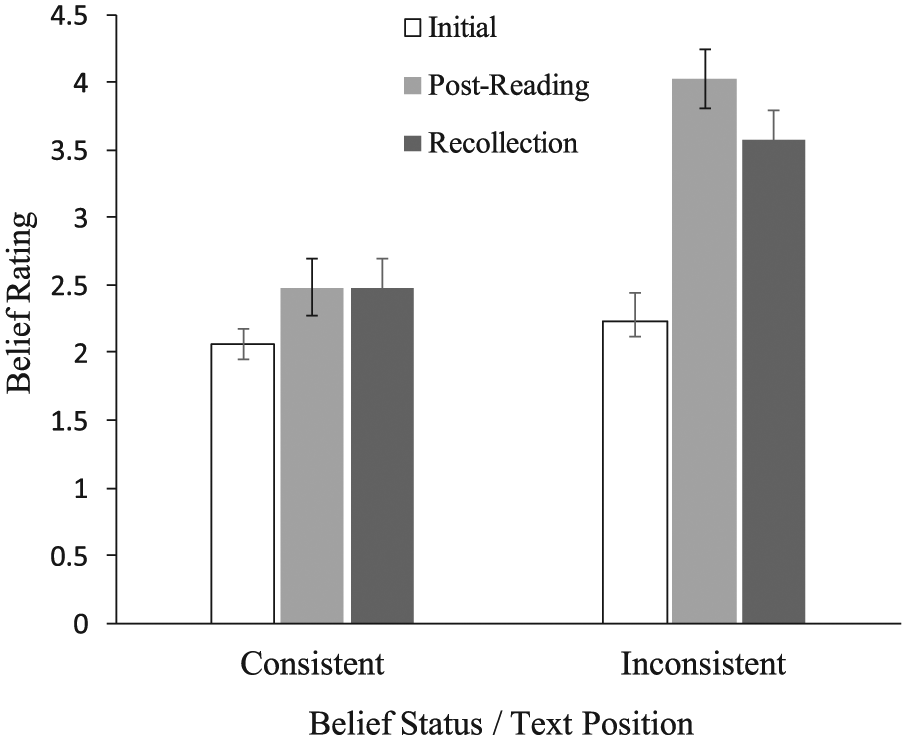
Initial and post-reading belief ratings, and recollection of initial belief ratings as a function of the consistency between belief status of the subject (believer/disbeliever) and position of the text read (pro/con) for Experiment 1. Error bars are SEMs.
Recollection accuracy
Recollection of initial beliefs are also shown in Figure 1. To assess if there were systematic differences in recollection accuracy as a function of text belief consistency, a mixed-effects ANOVA was conducted with initial beliefs and recollection of initial beliefs as the within subject variable, and text belief consistency as the between subject variable. Consistent with our hypothesis, this analysis revealed that recollections of initial beliefs were more moderate (
Sentence reading times
Sentence reading times were analyzed as a function of belief status and text position, and were correlated with measures of belief change and recollection accuracy. Belief change and recollection accuracy were calculated by subtracting subjects’ post-reading belief rating (or initial belief recollection) from their initial belief ratings. To analyze sentence reading times, the support and refute ratings for each text sentence from the rating study were used. Support and refute ratings across sentences were highly correlated for both the Pro,
Sentence recognition and short answer questions
For the sentence recognition test, each subject responded to 30 “old” sentences which were taken from the text they read and 30 “new” sentences that were taken from the text they did not read. In signal detection terms, “old” responses to previously read sentences are hits and “old” responses to new sentences are false alarms. Hit rate (HR) and false alarm rate (FAR) were combined to create a measure of accuracy in discriminating old from new sentences called d’ (Swets, 1986), which is calculated from the formula d′= Z(HR) – Z(FAR). A d′ of 0 represents chance performance at discriminating old from new sentences. d′ increases to the extent subjects are successful at responding “old” to sentences that were read and “new” to sentences that were not read. Prior knowledge and topic importance were uncorrelated with d′ and were therefore not included in further in analyses. Table 2 shows d′ means and correlations with belief change and recollection accuracy. There was no significant difference between d′ scores as a function of belief consistency (
Means (SD) for comprehension tasks and correlations with belief change and recollection accuracy. Significant relationships are denoted by * =

Subjects’ total score on the short answer test was examined as a function of belief consistency, and scores were correlated with belief change and recollection accuracy (see Table 2). There was no significant difference in short answer performance as a function of belief consistency (
Mediation analysis
Process modeling (Hayes, 2013) was used to test whether the relationship between belief consistency of the text read and recollection accuracy was mediated by belief change (see Figure 2). Model 4 (Hayes, 2013) was used with 1000 bootstrap samples. This model accounted for a significant amount of the variance,

Process model of direct and indirect (via Belief Change) effects of text consistency on recollection accuracy for Experiment 1.
Discussion
There were two primary findings in Experiment 1. In accordance with our hypothesis, subjects experienced belief change after they read texts that were inconsistent with their initial beliefs. These subjects made large recollection errors when attempting to recall the initial beliefs they held prior to reading belief inconsistent texts. Belief recollections were closer to current beliefs than they were to initial beliefs, which suggests that people have poor metacognitive awareness of changes in their beliefs. The results of the process model provides preliminary evidence indicating the mechanism by which exposure to belief inconsistent information influences recollection errors. Exposure to belief inconsistent information leads to belief change, which in turn predicts recollection accuracy. This mediational effect explains the majority of variance in recollection accuracy, while the direct effect of text belief consistency on recollection accuracy in the mediation model was not significant. We found no evidence to support the idea that processing or mental representation of the text content is related to awareness of belief change. Sentence reading time measures of argument-focused processing (Wolfe et al., 2013) showed no relationship with recollection accuracy. Sentence recognition accuracy and short answer question performance were unrelated to recollection accuracy and belief change.
Experiment 2
Experiment 2 represents an attempt to replicate and extend the results of Experiment 1. One shortcoming of Experiment 1 was that performance on the short answer questions was relatively poor, and may not have varied enough to capture the potential differences in comprehension. In order to address this possibility, we incorporated an evidence listing task in Experiment 2. In this task, subjects listed as many evidence statements as possible, both supporting and refuting the proposition that spanking is effective. The sentence-by-sentence reading time procedure was replaced by a more ecologically valid reading procedure. Subjects read a hard copy of their assigned text, and were instructed to use whatever comprehension methods they typically use in studying for an exam.
Methods
Subjects
One hundred seventeen subjects from a large Midwestern United States University participated in exchange for partial credit in an Introductory Psychology course. Subjects were selected from a pool of 491 and solicited using the same procedure as in Experiment 1. Seventy two believed spanking was an effective means of discipline, whereas 45 did not. The mean age of the subjects was 18.85 (
Materials
Materials were identical to Experiment 1 with the exception that the short answer questions were replaced by the evidence listing task.
Procedure
The prescreening procedure was the same as Experiment 1 and the experiment took place six to 10 weeks after the prescreening. As in Experiment 1, participants completed the prior knowledge procedure. Subjects read a hard copy of either the Pro or Con text, which was randomly assigned within spanking belief categories. Reading instructions were the same as Experiment 1 except for the moving window instructions. Subjects were also instructed that they could take notes or underline parts of the text if they wished. After reading, subjects completed two evidence listing tasks, one for supporting evidence and one for refuting evidence (counterbalanced for order). For each task, subjects received a sheet of paper with instructions to list as much supporting (refuting) evidence from the text as they could. Instructions stated that “The evidence you list could be either data that were presented, or arguments addressing spanking effectiveness that were supported by reasons.” A prompt stated “Spanking is an
Results
Results are organized in a manner similar to Experiment 1 and address the same questions. Namely, do subjects show poor recollection accuracy for initial beliefs following belief change, and if so, is the relationship between belief consistency of the text and recollection accuracy mediated by belief change? Moreover, do belief change and recollection accuracy relate to performance on the sentence recognition and evidence listing tasks?
Initial beliefs, text position and belief change
As in Experiment 1, an absolute measure of belief strength among subjects was calculated by reverse scoring belief ratings for believers in spanking as an effective form of discipline. Lower ratings indicate more extreme beliefs, whereas higher ratings indicate more moderate beliefs. See Figure 3 for means.

Initial and post-reading belief ratings, and recollection of initial belief ratings as a function of the consistency between belief status of the subject (believer/disbeliever) and position of the text read (pro/con) for Experiment 2. Error bars are SEMs.
We again examined beliefs as a function of belief status and text position to ensure that belief change was greater for subjects who read a belief inconsistent text compared to a belief consistent text. A mixed-effects ANOVA was conducted with belief status (believer vs disbeliever) and text position (pro vs con) as between subjects variables, and belief rating (initial vs post-reading) as a within subjects variable. This analysis showed that initial belief ratings (
As in Experiment 1, subjects were categorized as having read either a belief consistent or belief inconsistent spanking text (see Figure 3). A consistency (consistent vs inconsistent) x belief rating (initial vs post-reading) mixed-effects ANOVA revealed a main effect of consistency,
Recollection accuracy
Recollections of initial beliefs are shown in Figure 3. To assess if text belief consistency affected recollection accuracy, we conducted a mixed effects ANOVA. Initial beliefs and recollection of initial beliefs were analyzed as a within subjects variable, and belief consistency was a between subjects variable. Replicating the results of Experiment 1, there was a main effect of belief rating such that recollections of initial beliefs were more moderate (
Sentence recognition and evidence listing
Sentence recognition was analyzed in the same manner as Experiment 1 (see Table 2). There again was no significant difference in discrimination accuracy (d′) for subjects who read a belief consistent text compared to a belief inconsistent text (
Mediation analysis
As in Experiment 1, process modeling (Hayes, 2013) was used to examine whether the relationship between belief consistency of the text read and recollection accuracy was mediated by belief change. Belief change and recollection accuracy were calculated in the same way as Experiment 1. Model 4 (Hayes, 2013) was used with 1000 bootstrap samples. This model accounted for a significant amount of the variance,
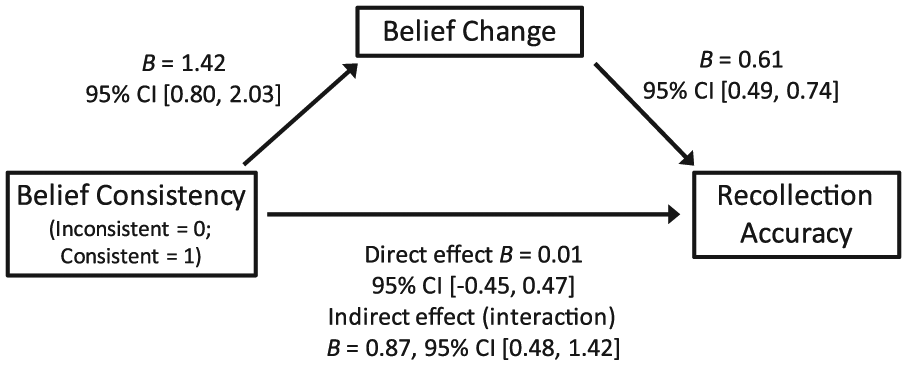
Process model of direct and indirect (via Belief Change) effects of text consistency on recollection accuracy for Experiment 2.
Discussion
The results of Experiment 2 show the same pattern of effects for belief change and recollection accuracy that were observed in Experiment 1. Subjects changed their beliefs in the direction of the text position, and recollection of their initial beliefs were more similar to post-reading beliefs than to initial beliefs. In particular, the relationship between the belief consistency of the text read and recollection accuracy was strongly mediated by belief change. Measures of recognition memory, as well as evidence and argument listing on both sides of the topic, did not predict either belief change or recollection accuracy.
General discussion
Across two experiments, people showed evidence of poor metacognitive awareness of belief change about a social science topic. Following belief change, recollections of initial beliefs were generally inaccurate and biased toward current beliefs. In mediation analyses in both experiments, results showed that the relationship between the belief consistency of the text read by a person and their accuracy at recollecting their initial belief was mediated by their level of belief change. These results suggest that recollections of previous beliefs are constructive, and influenced by the beliefs of the person at the time of the recollection. We propose that changes in beliefs do not tend to be monitored as they happen. Rather, we propose that people simply use salient information at the moment of recollection to try to reconstruct their previous beliefs.
The nature of these metacognitive errors mirror those found in attitude studies (Bem & McConnell, 1970; Goethals & Reckman, 1973; Levine, 1997; Levine & Safer, 2002; Markus, 1986). However, this is the first study to demonstrate poor metacognitive awareness of belief change. In both experiments, measures of processing (Experiment 1) and mental representation (Experiments 1 and 2) failed to predict the accuracy of belief recollections. Thus, the current studies failed to provide evidence for the idea that subjects who comprehend a text at a higher level are more aware of changes in their beliefs.
The fluency hypothesis from metacognitive monitoring research (Dunlosky & Thiede, 2013) provides a potential explanation for this metacognitive error. While people have beliefs about spanking effectiveness, they likely have little knowledge of the scientific research on this topic. Consequently, the beliefs reported in the prescreening may have been constructed from a memory representation that included general feelings about the topic or personal experiences. After reading, people’s memory representation was likely dominated by the text content and the beliefs that arose from their interpretation of the content (Kintsch, 1998). According to the fluency hypothesis, these beliefs then would have influenced the recollection of subjects’ initial beliefs. Two patterns in the observed results substantiate this interpretation. First, belief change was a strong mediator of the relationship between text belief consistency and recollection accuracy. This result suggests that the
Comprehension monitoring research suggests that when available cues provide a valid assessment of the mental representation, then judgments of comprehension are relatively accurate (Thiede, Anderson, & Therriault, 2003; Thiede et al., 2010; Wiley et al., 2005). These cues tend to be more accurate when they require subjects to make judgments about their understanding of the general meaning of a text rather than their superficial memory or sense of familiarity with the topic. However, recollection of previous beliefs is likely a more difficult task than judgments of comprehension. First, accurate metacognitive awareness of belief change requires a person to be aware not only of their current beliefs, but to accurately reconstruct a mental representation from a
Another potential interpretation of these results is that they arise from beliefs about belief change (Mueller et al., 2016; Ross, 1989). In particular, subjects may be acting according to Ross’ (1989) implicit theory of stability. According to this theory, people may assume that their beliefs about spanking effectiveness are stable. If so, the task of recollecting previous beliefs is one in which current beliefs are assessed and an assumption is made that previous beliefs must be similar. After belief change, people may assume that their current beliefs must be the same or similar as their previous beliefs. Fluency and beliefs about belief change are not mutually exclusive explanations for the results presented here, and so further exploration of the mechanisms underlying metacognitive awareness of belief change will be needed.
The current claim that people have poor metacognitive awareness of belief changes is also consistent with experiments in the attitude literature in which perceived attitude change fails to correspond with attitude change when it is assessed using pre and post measures (Corner et al., 2012; Miller et al., 1993; Munro & Ditto, 1997). These experiments were designed to address the phenomenon of attitude polarization (Lord et al., 1979), in which subjects read arguments on both sides of a controversial issue and reported more polarized attitudes than before reading. Evidence in support of attitude polarization is most commonly found when the dependent variable is perceived attitude change. However, when attitude change is measured by differences between pre and post ratings, the results do not tend to support attitude polarization. As we have argued, perceived change is a metacognitive measure, and is dependent on an accurate recollection of previous attitudes in order to be valid. Thus, it is possible that some attitude polarization findings may actually reflect poor metacognitive awareness of attitude change.
Relationships between comprehension, belief change and awareness of belief change
In this research, we also examined the memory representation that people formed as a result of comprehending information in a one-sided scientific text. No evidence was found to suggest that people differed in comprehension success as a function of whether they believed or did not believe the information they read. This finding is consistent with other research in which no belief-related differences in comprehension success were found (Bohn-Gettler & McCrudden, 2017; Wolfe et al., 2013). While some researchers have found evidence that people put more processing effort into belief inconsistent information (Edwards & Smith, 1996), the processing data from Experiment 1 contradicts this idea. Moreover, there was no evidence to indicate the existence of a relationship between comprehension success and either belief change or recollection accuracy. It is therefore left to future research to explore whether comprehension processes may relate to metacognitive awareness of belief change.
Conclusion
These experiments are the first to indicate that when people change their beliefs, they show biased memory for their previous beliefs. These results also suggest that people are unaware of these changes, which are primarily influenced by their beliefs at the moment they make this metacognitive judgment. An area where this bias is likely to emerge is in the domain of science text comprehension. Science educators, and authors who write about science for the general public, encourage people to change their beliefs to match the preponderance of evidence on a topic. However, the current evidence suggests that people may be less willing to meaningfully consider belief inconsistent material if they feel that their beliefs are unlikely to change as a consequence. Moreover, people who do meaningfully engage with such material may be unaware of the extent to which their beliefs are shaped by evidence they read. The present research indicates that an important component of overall science literacy may be to develop a more refined understanding of the extent to which evidence can potentially change people’s beliefs. As such, the practical consequences of this type of metacognitive error will be important to examine in future research.
Footnotes
Declaration of conflicting interests
Funding
References
Supplementary Material
Please find the following supplemental material available below.
For Open Access articles published under a Creative Commons License, all supplemental material carries the same license as the article it is associated with.
For non-Open Access articles published, all supplemental material carries a non-exclusive license, and permission requests for re-use of supplemental material or any part of supplemental material shall be sent directly to the copyright owner as specified in the copyright notice associated with the article.
