







Abstract
No sooner had anthropogenic global warming (AGW) been placed on the public agenda, perhaps most effectively by James Hansen’s 1988 congressional testimony, than an organized campaign to deny its reality and significance was launched. The early campaign was centered in corporate America, reflected by the Global Climate Coalition, but from the outset the conservative movement was heavily involved (McCright & Dunlap, 2000). The formation of the Intergovernmental Panel on Climate Change (IPCC) in 1988 and the emergence of the United Nations Framework Convention on Climate Change from the UN’s 1992 “Earth Summit” in Rio generated fears of international action to reduce carbon emissions from fossil fuels use, fears crystallized by the 1997 Kyoto Protocol. Consequently, corporate America (especially fossil fuels corporations worried about restrictions on their products) and the U.S. conservative movement (for which opposition to governmental regulations is foundational) joined forces in attacking the scientific evidence for AGW and thus the necessity of reducing carbon emissions—the goal of the Kyoto Protocol.
Both industry and the conservative movement learned during the Reagan administration that frontal attacks on environmental regulations could create a backlash among the public (Dunlap, 1987). Consequently, they gradually shifted to another strategy, promoting “environmental skepticism.” This strategy challenges the scientific evidence for environmental problems and therefore the need for regulations to protect environmental quality (Jacques, 2006; Jacques, Dunlap, & Freeman, 2008). Their major tactic was and continues to be manufacturing uncertainty (Michaels, 2008; Oreskes & Conway, 2010), constantly asserting that the evidence is not sufficient to warrant regulatory action. Historically these efforts focused on specific problems such as secondhand smoke, acid rain, and ozone depletion, but in the case of AGW they have ballooned into a full-scale assault on the multifaceted field of climate science, the IPCC, scientific organizations endorsing AGW, and even individual scientists (Powell, 2011; Weart, 2011).
With scientific evidence for AGW growing stronger and public awareness of global warming mounting (Nisbet & Meyers, 2007), in the late 1990s portions of corporate America—including some fossil fuels corporations—expressed acceptance both of the reality of AGW and necessity of reducing carbon emissions. Several corporations withdrew from the Global Climate Coalition (GCC), gradually leading to its demise in 2002, and it appeared that industry-funded attacks on the scientific evidence supporting AGW were subsiding (Dunlap & McCright, 2011). However, the conservative movement seemed dismayed by the corporate “sellout” and stepped up its already substantial efforts to deny the reality of climate change by attacking climate science and scientists (McCright & Dunlap, 2000, 2003). This transition is symbolized by the Cooler Heads Coalition, a coalition largely of conservative think tanks (CTTs) centered in the Competitive Enterprise Institute (CEI), emerging to fill the void created by the GCC. Similarly, the Heartland Institute, a small regional think tank in the 1990s, emerged as a leading force in climate change denial in the past decade (Pooley, 2010).
It now appears that CTTs such as CEI, the Heartland Institute, the CATO Institute, and the Marshall Institute are playing an ever more important role in efforts to deny AGW by attacking climate science. However, it must be noted that besides helping fund these think tanks, many corporations maintain ambivalent positions concerning the necessity of reducing carbon emissions (Union of Concerned Scientists, 2012). Furthermore, major corporate associations such as the U.S. Chamber of Commerce and the American Petroleum Institute continue to strongly oppose policies to reduce carbon emissions (Pooley, 2010). Still, although corporations can bring their enormous resources to bear in lobbying against legislation, the conservative movement (especially its think tanks) often takes the lead in manufacturing uncertainty over climate science. Indeed, CTTs offer the ideal vehicle for undermining the credibility of climate science and attacking climate scientists.
CTTs have long been recognized as the crucial organizational base of the conservative movement, functioning as core “social movement organizations” (Jacques et al., 2008). Typically treated by media as credible sources of objective information, CTTs have achieved the status of an “alternate academia,” and it is common to see their representatives interviewed along with or in lieu of leading academics and treated as independent experts on policy-relevant issues. They employ both in-house and commissioned personnel to produce a vast array of print material (from op-eds to policy briefs to magazine articles to books) as well as make media appearances, provide congressional testimony, give speeches, and so on to promote conservative positions on a wide range of policy issues including environmental protection (McCright & Dunlap, 2000, 2003). CTTs have been credited with having a major impact on U.S. politics and policy making (e.g., Stefanic & Delgado, 1996), influencing such aspects of American life as the conservative tilt of our judicial system (Teles, 2007), tax policies resulting in escalating inequality (Hacker & Pierson, 2007), and the fundamental framing of political debate (Smith, 2007).
It is little wonder then that CTTs have become central actors in climate change policy debates, especially by promoting denial of the reality and significance of AGW and thus the necessity of carbon emission reductions (Dunlap & McCright, 2011; Hoggan, 2009; Lahsen, 2008; McCright & Dunlap, 2000, 2003; Oreskes & Conway, 2010; Powell, 2011). The purpose of this article is to examine in detail one key tool CTTs use to sow skepticism toward AGW throughout the larger society: sponsoring books espousing climate change denial, including those by the small number of contrarian scientists who challenge mainstream climate science.
Books Challenging Climate Science
Although just one of many forms of media employed by CTTs, books are especially important for reaching the conservative movement’s core constituency, wider segments of the public, and critical sectors of society such as corporate, political, and media leaders. Books confer a sense of legitimacy on their authors and provide them an effective tool for combating the findings of climate scientists that are published primarily in scholarly, peer-reviewed journals—at least within the public and policy (as opposed to scientific) arenas. Authors of successful books critiquing climate science often come to be viewed as “climate experts,” regardless of their academic backgrounds or scientific credentials, and despite the fact that their books are seldom peer reviewed. They are interviewed on TV and radio, quoted by newspaper columnists, and cited by sympathetic politicians and corporate figures. Their books are frequently carried by major bookstore chains, where they are seen (even if not purchased) by a wide segment of the public, many receive enormous publicity on CTT websites and from conservative and skeptical bloggers, and some are carried by the Conservative Book Club. In short, books are a potent means for diffusing skepticism concerning AGW and the need to reduce carbon emissions. Given the critical role of CTTs in challenging climate science and policy making, and their proclivity for using books to promote their causes, we expect to find a strong link between CTTs and books espousing climate change denial.
In part this expectation is based on prior experience. In an earlier study of environmental skepticism writ large (Jacques et al., 2008), we examined 141 books espousing skepticism toward the scientific evidence for environmental problems of all types (including global warming) published through 2005, looking for evidence of linkages to CTTs. We found that 130, or 92%, of the books were linked to a CTT, either via publication by a CTT press or a verifiable connection between the author or editor and a CTT, or both. These links to highly influential and generally well-heeled CTTs challenge a common theme of the books—namely, that the authors or editors are little Davids battling the Goliath of environmental science.
The present study extends our earlier work by examining books espousing climate change denial per se published through 2010, including some examined in the prior study since they represent examples of environmental skepticism. Besides focusing on book connections to CTTs, we also examine the educational credentials and national backgrounds of their authors or editors. Given that climate change denial has become widespread within the United States and to some degree internationally, we pay particular attention to the role of CTTs in diffusing a skeptical view of climate change and climate science to a wider audience both within the United States and internationally.
The Study
Our data set consists of the population of English-language books assigned an International Standard Book Number (ISBN) that espouse various forms of climate change denial. 1 These books reject evidence that global warming is occurring, that human actions are the predominant cause of global warming, and/or that global warming will have negative impacts on human and natural systems. These arguments have been labeled trend, attribution, and impact denial (Rahmstorf, 2004). Books were included only if they take one or more of these positions challenging climate science, all of which are used to reject the necessity of carbon emission reductions. We located 108 books espousing one or more of these versions of climate change denial published through 2010, employing searches via online book stores, bibliographies in denial books, references in articles written by climate change skeptics, and several skeptic blogs that promote denial literature. Climate change denial books, especially those that were published by obscure presses or were self-published, can be difficult to locate, and we have possibly missed a few. However, we are confident that the 108 we analyze represent virtually all denial books in English, allowing us to generalize our findings with confidence.
We limit our analysis to first-edition books, ignoring the small number of second-edition volumes that came out in only slightly revised form. 2 The books are listed in the appendix (along with selected information we will shortly describe), grouped by their country of origin as determined via the lead author’s or editor’s apparent place of residence, and then arranged alphabetically by lead author or editor.
In addition to examining book links with CTTs—as done in our prior study—and location of lead author, we coded date of publication, the type of publisher employed, and information on the academic credentials (degrees and fields of study) of authors or editors. Our overall goal is to provide a good sense of the sources of these volumes—who is writing them and who is publishing them—paying special attention to the role of CTTs in the process. In the following sections we describe our coding decisions and thereby clarify information presented for each book in the appendix.
Results
We begin by charting the publication of these books over time, documenting the recent rapid increase in their numbers, and then highlight a significant new development—the growth of self-published books, often by laypersons denying AGW. We then examine the connections between CTTs and the books, noting how this connection differs for books issued by publishing houses and those that are self-published. We next examine the national origins of the books, showing how production of climate change denial volumes has spread from the United States to several other nations as denial has diffused internationally, noting the role of CTTs in this process. Then we turn to the academic and scientific credentials of the authors or editors of the books, highlighting trends over time and variation across nations. We end by commenting on how the publishing sources used by the denial authors enables most of them to avoid peer review.
Trends Over Time
As apparent in Figure 1, the first denial
volume, Sherwood Idso’s

Climate change denial books by year.
Many factors influence the writing and timing of books, and we can only speculate on the trend we
have just described. There is a slow growth in the number of books appearing before the December
1997 meeting on the Kyoto Protocol,
4
then a relatively stable period of modest production (from one to five books a year)
for the following decade, followed by the very rapid increase in the number of denial books per year
beginning in 2007. There are several factors that likely stimulated the accelerated production of
denial books starting in 2007: The release of Al
Gore’s (2006)
The rising salience of global warming in the eyes of the public and the growing pressure for ameliorative policy action stimulated those skeptical of AGW and opposed to carbon emission reduction policies to step up their efforts to deny the reality and seriousness of AGW. One manifestation of this increased sense of urgency is the accelerating appearance of books critiquing climate science, attacking Gore and climate scientists, and arguing against the need for carbon emission reductions. Other manifestations include conservative elites and media becoming major vehicles for climate change denial, making it a virtual litmus test for Republican political candidates and adding it to the “culture wars” (joining God, gays, guns, and abortion) in the eyes of conservative laypeople—particularly those attracted to the Tea Party (Hoffman, 2012; Leiserowitz, Maibach, Roser-Renouf, & Hmielowski, 2011; McCright & Dunlap, 2011).
Such diffusion of climate change denial from the core sectors of the conservative movement, especially think tanks, is reflected in an interesting development concerning the denial books: a rapid growth in self-published volumes. 5 Specifically, 33 of the books under examination were published by individuals on their own or via a “vanity press,” but 30 of them have appeared since 2000—with 26 coming out between 2007 and 2010! This development has influenced the relationship between denial books and CTTs, as we see next.
Book Ties With Conservative Think Tanks
Our examination of the links between the denial books and CTTs follows the procedure we used in our prior study of environmental skepticism (Jacques et al., 2008). Specifically, links were established in one of two ways: The author or editor was affiliated with a CTT or the book was published (or copublished) by a CTT press (often both). Author or editor affiliations with CTTs had to be empirically verifiable (typically from the CTT websites, where they were listed as board members, advisors, experts, etc.) and were not inferred. In choosing to err on the side of caution, we have possibly missed a few affiliations.
Table 1 shows the number of denial books linked to CTTs by decade (2000–2010 covers 11 years), as well by whether or not they were issued by a publisher or were self-published. To begin with, in the bottom of the third column we see that across all years 78 of the total 108 volumes, or 72%, have a verifiable link with a CTT. Although reflecting a strong link between CTTs and the denial volumes, this is noticeably lower than the 92% of books espousing environmental skepticism (which, again, includes some of the same books) published through 2005 found to have such a link in our prior study. However, the primary reasons for the lower percentage of climate change denial books being linked to CTTs are suggested by the trends over time as well as a comparison of the links for self-published books versus those issued by publishing houses. First, in the third column we can see that 100% of the denial books published in the 1980s and 95% published in the 1990s are linked to CTTs, whereas this is true of “only” 65% of those published since 2000. Second, the large decline in the percentage of CTT links since 2000 is primarily the result of the preponderance of self-published books appearing over the 11 years, as only one third of the 30 self-published books coming out since 2000 are linked to a CTT. In contrast, 83% of the books from publishing houses since 2000 have links to CTTs. More generally, in the bottom row we see that of the 75 denial books issued by a publishing house, 87% are linked to a CTT, whereas of the 33 self-published denial books, only 39% have such a link.
Conservative Think Tank Connections of Climate Change Denial Books—With Publishers, Self-Published, and Total—by Decade.
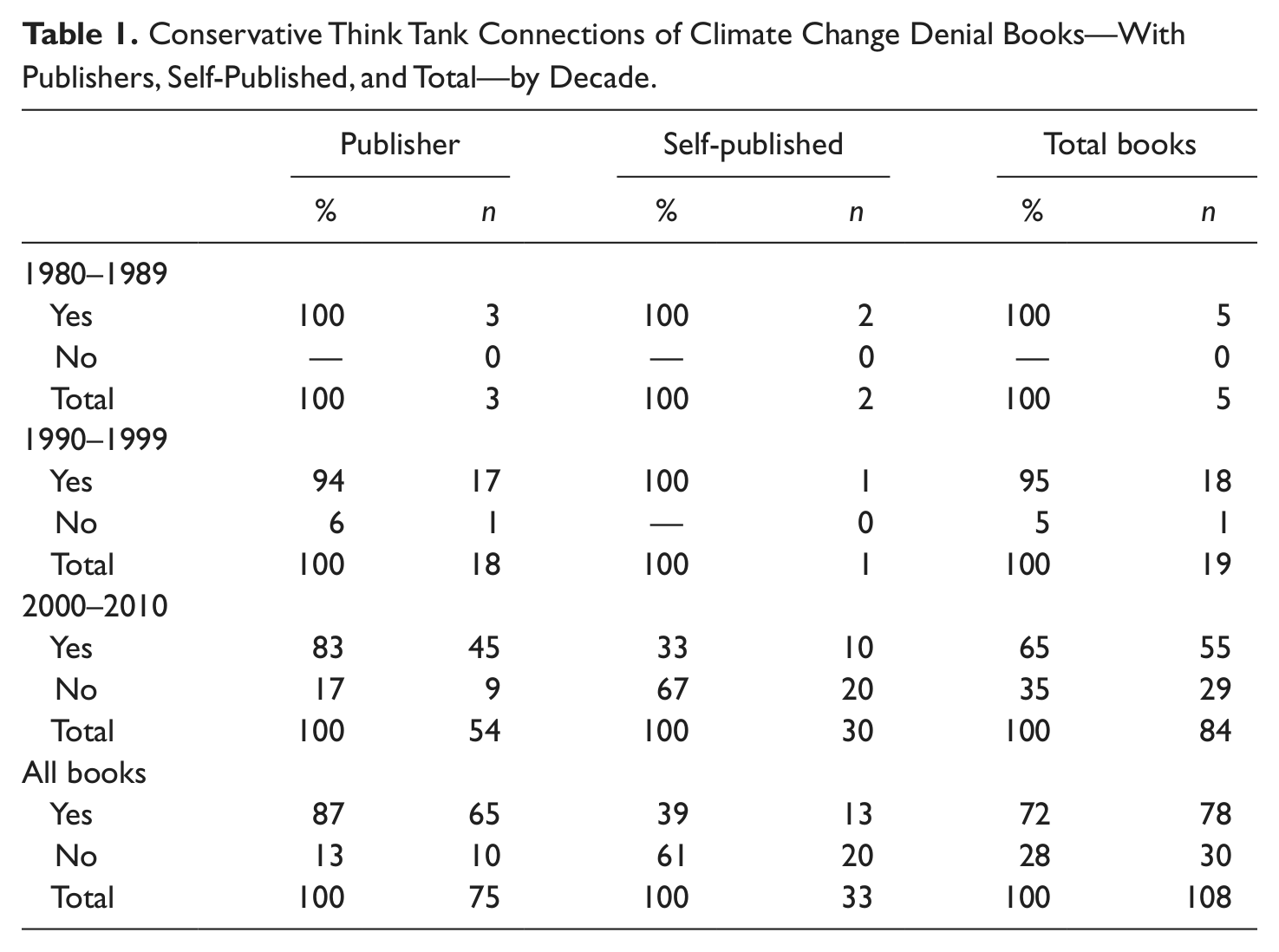
In recent years production of climate change denial books has “diffused” from CTTs to a broader segment of the conservative movement, just as endorsement of climate change denial has spread throughout most of the conservative sector of the public (McCright & Dunlap, 2011). Although the link between denial books issued by publishing houses and CTT presses (87%) is nearly as strong as the overall link found in our prior study of books espousing environmental skepticism, the link is much weaker for self-published denial books. This reflects the fact that many of the self-published books are written by laypeople, often without any scientific background whatsoever, who are clearly quite conservative and have presumably adopted climate change denial because it has become a core tenet of conservatism and is promoted by conservative media and elites.
Furthermore, it should be noted that nearly all of the authors or editors of the 108 books endorse a conservative ideology, confirming the strong link between conservatism and promotion of climate change denial emphasized by analysts of the denial campaign (Dunlap & McCright, 2011; Oreskes & Conway, 2010). Also, 17 of the 75 books issued by a publishing house, including the numerous CTT presses, are published by overtly conservative presses or conservative religious presses (as noted in the appendix), additional evidence of the strong link between conservatism and climate change denial.
Social movement organizations attempt to diffuse their views, both within the movement as well as throughout the larger society (Strang & Soule, 1998). As the core organizations of the conservative movement, CTTs have obviously been effective in spreading climate change denial throughout the movement, helped of course by conservative media and politicians, various Astroturf campaigns (that they helped establish), the Tea Party, and other elements of what has been termed the climate change “denial machine” (Dunlap & McCright, 2011). As noted above, one manifestation is the increasing number of self-published books by conservative individuals not directly linked to a CTT. The fact that these authors typically cite (and often rely heavily on) prior books with links to CTTs illustrates this successful diffusion.
There should be no doubt as to which set of books is most influential. At major bookstores you
are likely to find titles like
It is therefore clear that CTTs have played a central role in the explosion of books promoting climate change denial. Indeed, the CTTs that have played particularly prominent roles in attacking climate science in various ways are especially likely to publish (or copublish) the denial books, with the Cato Institute publishing five, the Heartland Institute publishing four, and the CEI, the Marshall Institute, the Hoover Institution, and the U.K. Institute for Economic Affairs each publishing three. These same CTTs are of course linked to far more of the titles via author or editor affiliations.
National Origins of Books
The denial of climate change has also diffused geographically, as in the past several years vigorous denial campaigns have developed in the United Kingdom, Canada, and Australia (Hamilton, 2007; Hoggan, 2009; Monbiot, 2007), and—to a lesser degree—in a number of other nations (Dunlap & McCright, 2011). This diffusion has been stimulated in part by the direct efforts of U.S.-based CTTs, which have sent representatives including contrarian scientists Fred Singer and Patrick Michaels to other nations to promote climate change denial and to network with other members of the denial community. 6 These efforts have succeeded particularly well in nations that have a recent history of staunch conservative governments, influential CTTs, and a strong fossil fuels sector—as do Canada, Australia, and the United Kingdom, along with the United States.
The results of the successful geographical diffusion of climate change denial are apparent in Table 2 and the appendix. The latter shows that 19 of the denial books have been authored (or in one case edited) by individuals residing in the United Kingdom, followed by 7 from Canada and 6 from Australia. Other nations from which these English-only books have sprung include Denmark, France, and Sweden, with two each, and the Czech Republic, Germany, New Zealand, and the Netherlands, with one each. 7 The results in Table 2 portray the pattern of diffusion by decade. In the 1980s, 80% of the denial books originated in the United States, and the United Kingdom was the only other nation with a single volume (contributing 20% of the small total of five). In the 1990s, the United States contributed 63% of the denial books, followed by the United Kingdom with 21%, whereas the other nine nations contributed 16%. Since 2000, 60% of the denial books have come from the United States, 17% from the United Kingdom, and 24% from the remaining nine nations. That 4 of every 10 denial books since 2000 have been produced by authors or editors outside of the United States is evidence of the success of the U.S. conservative movement in helping diffuse denial internationally.
Climate Change Denial Books by Nation by Decade and for All Years.

Rounding error.
The role of CTTs in diffusing climate change denial internationally is shown in Table 3. Here we see that (because of the
recent growth of self-published denial books in the United States) 65% of all denial books in the
United States have a link with a CTT, but the figure is much higher in the other nations. In fact,
79% of the books from the United Kingdom are connected to CTTs, and 87% of the books from the
various other nations are connected to CTTs. Thus, the pattern of strong connections between climate
change denial books coming out of other nations (the large majority of which were published since
2000) comes close to the earlier situation in the United States where all 4 of the denial books
published in the 1980s are linked to CTTs, and 11 of 12 published in the 1990s have such a link,
making 94% of the early (prior to 2000) U.S. books having a CTT connection. It is not surprising
that
Conservative Think Tank Connections of Climate Change Denial Books by Nation and for All Books.

Although there is considerable variation in the strength of the conservative movement across the nations being examined, especially in terms of support among the general public, as well as in the popularity and ease of putting out self-published books, it will nonetheless be interesting to see if the production of climate change denial books diffuses beyond CTTs in other nations to the degree that it has in the United States in the past decade.
Academic Credentials of Authors and Editors
Interests promoting environmental skepticism have long employed individuals with academic degrees in science—likely to be accepted as “experts” by the public, media, and policy makers—to attack scientific evidence suggesting the need for environmental regulations (Jacques et al., 2008; Michaels, 2008; Oreskes & Conway, 2010). In their efforts to manufacture uncertainty over climate science, both the fossil fuels industry (especially early on) and CTTs have enlisted the support of a small number of contrarian scientists to critique and attack both climate science and climate scientists. Although the contrarians portray themselves as a minority of truth seekers battling the large “climate establishment,” some of them have worked directly for the incredibly wealthy fossil fuels industry (including “front groups” it has set up, like the GCC) or well-funded CTTs. Patrick Michaels and Fred Singer are particularly notable in this regard (Hoggan, 2009; Powell, 2011).
One of the key features of the debate over climate change and especially the credibility of climate science is the asymmetry between the scientific credentials of mainstream climate scientists and their critics in the denial community, including the small number of contrarian scientists who critique and often attack mainstream climate science and scientists (Anderegg, Prall, Harold, & Schneider, 2010). A handful of contrarians have degrees in disciplines relevant to climate science, but others have PhDs in less germane natural science fields (e.g., soil science) that nonetheless—at least in the eyes of nonscientists—provide them with scientific credentials (Hoggan, 2009; Powell, 2011).
Because the use of apparent scientific expertise by those promoting climate change denial has played a vital role in the attacks on climate science (McCright & Dunlap, 2000, 2003; Powell, 2011), we examined the academic credentials of the authors or editors of the 108 denial books. Our aim is to provide a good sense of the contribution of contrarian scientists (who produce a wide range of material, from op-eds to policy briefs to an occasional journal article) to the denial volumes, as well as the backgrounds of the nonscientists who are also producing them. We coded each author or editor in terms of his or her highest academic degree and the field in which it was obtained. For present purposes we have separated the authors or editors into three categories: (a) those with PhDs in natural science (regardless of the field, thus including chemistry, geology, soil science, etc., as well as those more directly related to climate science), (b) those with other PhDs or equivalent degrees, 8 often in social science, and (c) those with less than a doctorate. Of the of 106 individuals who have authored or coauthored or edited or coedited one or more of the 108 denial books, 32 have a natural science PhD, 24 have a PhD in other fields, and 50 do not have doctorates.
We next assigned a code to each volume based on the highest or most relevant degree of
Climate Change Denial Books by Academic Degrees of Authors or Editors by Decade and for All Years.

Rounding error.
When it comes to putting out books, the denial community clearly relies on a wide range of contributors well beyond the small number of contrarian (natural) scientists in its ranks. Again, however, we can observe some degree of diffusion over time, as individuals with natural science doctorates were involved in producing 80% of the small number of books coming out in the 1980s (4 of 5) and 53% (10 of 19) in the 1990s, but only 33% (28 of 84) since 2000. Thus, the campaign to deny the significance of AGW relied heavily on contrarian scientists early on, to give it scientific credibility, but over time climate change denial has spread sufficiently throughout the conservative community that individuals without any scientific expertise now produce denial volumes.
Finally, just as we earlier noted variation in the degree to which denial books are linked to CTTs across nations, we also find national variation in the reliance on contrarian scientists. Table 5 shows that natural scientists are involved with nearly half (48%) of the denial volumes coming from the United States. In stark contrast, only 2 of the 19 denial books or just 11% coming out of the United Kingdom have natural scientists as authors or editors, whereas 35% of the denial books from the remaining nine countries are produced (or coproduced) by natural scientists. These patterns partially reflect temporal trends, since the natural scientists are most heavily involved in the denial books published before 2000, and the preponderance of non-U.S. books have come out since then.
Climate Change Denial Books by Author or Editor Degrees by Nation and for All Books.

Rounding error.
What these patterns suggest is that early on a small number of contrarian scientists, primarily located in the United States, played a critical role in planting and legitimating climate change denial within conservative circles. Highly influential scientists such as physicists Frederick Seitz, Robert Jastrow, and Robert Nierenberg of the Marshall Institute (Lahsen, 2008; Oreskes & Conway, 2010) and omnipresent Fred Singer and Patrick Michaels (Hoggan, 2009; Powell, 2011) worked diligently to criticize climate science and scientists and received a good deal of visibility (McCright & Dunlap, 2003). As denial evolved over time and spread throughout a larger segment of American society (particularly among conservatives) as well as to other nations, the seeds sown by the contrarians have germinated and a wide range of individuals without backgrounds in natural science and thus relevant credentials for evaluating climate science feel free to write books denying AGW—and often publish them on their own! Of course, the diffusion has been facilitated by powerful actors, first by the fossil fuels industry and then by the conservative movement, primarily via the latter’s influential think tanks.
The strong connection between contrarian scientists and CTTs is reflected in one additional finding. Of the 32 individuals with natural science PhDs in our study, 25 or 78% are connected to at least one CTT. In contrast, of the 50 individuals without a PhD, only 25 or 50% have a CTT connection, reflecting the fact that these people are often laypersons who are likely to self-publish their books. The strongest connection exists for the 24 individuals with nonscience PhDs, as 21 or 88% of them have links to one or more CTTs, where degrees in economics (8 individuals), politics (4 individuals), and law (3 individuals) confer plausible policy expertise.
Freedom From Peer Review and Its Implications
It is often noted that individuals promoting climate change denial, including the small number of
contrarian scientists, mainly criticize or “audit” the work of climate scientists (especially as
summarized by the IPCC), and only infrequently contribute to climate science themselves (e.g., Powell, 2011, chap. 3). Unlike mainstream
climate scientists, who publish primarily in peer-reviewed journals, these critics typically employ
a range of non-peer-reviewed outlets, ranging from blogs to the books we are examining. A large
majority—97 of the 108 books—are self-published (33), published by a CTT press (35), published by a
conservative (or conservative religious) press (17), or published by a popular press (12), and are
thus unlikely to have undergone peer review—particularly by individuals with expertise in climate
science. The remaining 11 books are issued by publishing houses that specialize in natural science
and may have been subject to peer review, but this is often not clear from the publishers’ websites.
Of interest, four volumes are issued by Multi-Science Publishing in the United Kingdom, which also
publishes
The general lack of peer review allows authors or editors of denial books to make inaccurate assertions that misrepresent the current state of climate science. Like the vast range of other non-peer-reviewed material produced by the denial community, book authors can make whatever claims they wish, no matter how scientifically unfounded. 11 In fact, the lack of peer review in the “denialosphere” (Pooley, 2010) means that denial claims are continually recycled, no matter how many times they are refuted by empirical test or shown to be logically untenable (Powell, 2011; Washington & Cook, 2011). Weart (2011, p. 48) terms them “zombie arguments” because they repeatedly rise from the grave.
Whereas scientific knowledge slowly but surely accumulates through testing, and then rejecting, modifying, and/or verifying hypotheses and theories, 12 the denial literature is cumulative in the literal sense. Regardless of how thoroughly discredited in the scientific literature, denialist claims (the recent warming trend reflects a natural cycle, is the result of solar activity, won’t produce harmful impacts, etc.) are retained and reused whenever convenient. Non-peer-reviewed books espousing climate change denial offer an ideal means of presenting these claims, accounting for the growing popularity of such books. Strikingly, many of these books not only provide fallacious critiques of climate science but also present an alternate reality in which global warming is a hoax created by a conspiracy of supposedly greedy scientists, liberal politicians, and environmentalists (McKewon, 2012).
The general lack of peer review for the denial books is a common feature of the vast body of literature produced by the climate change denial community, ranging from blogs to newspaper op-eds to policy briefs from CTTs. Not being subject to peer review allows authors or editors of denial books to make scientifically inaccurate and discredited claims that are often amplified in conservative media and the blogosphere, potentially reaching significant segments of the general public. Their false claims are also used by conservative politicians, who sometimes invite the authors to testify at congressional hearings (McCright & Dunlap, 2003) and thereby provide them a direct voice in the policy-making arena. Although mainstream scientists occasionally take the time to debunk some of the more visible denial volumes, the proliferation of such books makes it impossible for busy scientists to critically review most of them. Thus, denial books are likely to continue to multiply, and many will receive considerable attention from sympathetic and scientifically unsophisticated audiences (McKewon, 2012). They are clearly a vital weapon in the conservative movement’s war on climate science, and one of the key means by which it diffuses climate change denial throughout American society and into other nations.