







Abstract
The active drivers of migration have been extensively studied, yet less attention has been paid to the factors that
Understanding immobility is an especially apt challenge in the context of the modern United States. Long thought of as a “rootless society” (Fischer 2002) with high geographic mobility (Long 1991; Steinbeck 1939), the United States has arguably turned into a “rooted America” after a decades-long decline in migration rates (DeWaard et al. 2020; Frey 2009). The reality of low migration rates is clear, but explanations for current population immobility are less well-developed. Macro-economic studies have found that demographic and socioeconomic structures are not sufficient to explain observed levels of immobility, and neither are the business composition of labor markets nor properties of housing markets (Hyatt et al. 2018; Hyatt and Spletzer 2013; Molloy, Smith, and Wozniak 2011, 2017). A broader sociological view suggests the potential for cultural, political, and other social forces as possible explanatory factors (Gimpel and Hui 2015; Massey and Denton 1993; Stockdale and Haartsen 2018; Tiebout 1956). Moreover, the migration system has its own intrinsic feedback mechanisms that could endogenously sustain or undermine further migration (Bakewell 2014; de Haas 2010), which may also play a role in population immobility. Probing the combined influence of these myriad factors requires a
Broadly, extant research on drivers of U.S. migration and immobility shares two characteristics. First, most research examines migration from an economic perspective, assuming that most, if not all, migration is
A second dominant characteristic of the extant literature on U.S. migration treats migration as a feature of geographic areas, examining correlates between net migration rates into or out of states or counties and their demographic or economic characteristics. Although convenient, this practice of reducing the interconnected migration system into local features of areal units (geographic segments such as counties or states) introduces two limitations. First, by aggregating across origins and destinations for migrants emigrating from or immigrating into a given area, it obscures the
To advance our understanding of the social forces behind geographic immobility in the modern United States, we adopt a comprehensive theoretical framework incorporating geographic, demographic, economic, political, and social influences on migration and perform a systemic analysis of internal migration as an evolving valued network of migration flows.
2
Using valued temporal exponential-family random graph models (valued TERGMs), we analyze the network of intercounty migration flows in the United States from 2011 to 2015. We identify a pattern of
We also examine the relationship between internal and international migration flows, showing that, contrary to the balkanization thesis (Frey 1995a, 1995b), international migration into a county is positively associated with its overall domestic mobility and does not promote net outflows of residents. The model also identifies the internal dynamics of migration systems (de Haas 2010), including a suppression of what we dub “waypoint” flows (i.e., balanced in- and outflows of an areal unit) alongside strong patterns of reciprocity and perpetuation. Data availability limits our focus to population immobility in the 2010s, but the empirical evidence, together with our proposed theoretical and methodological frameworks, opens the door to unpack the long-term phenomenon of population immobility. This article thus joins the growing literature that grapples with mobility bias in migration studies (Schewel 2020), demonstrating how a comprehensive analytic framework and a systemic, network approach offer new insights about immobility, and more broadly, the dynamics of population movement among social and geographic spaces.
Theory
Existing literature defines immobility as “continuity in an individual’s place of residence over a period of time” (Schewel 2020:344). Because immobility is not only an individualistic phenomenon but also a population and social one, we offer a macrosociological definition of immobility: a lack of population exchange between localities. Drivers of immobility, in terms of this framework, are defined as factors that
Immobility is not merely the flip side of mobility; it carries its own sociocultural meanings. As the aspiration–ability model argues, migration requires both the aspiration to migrate and the ability to realize that aspiration (Carling and Schewel 2018). This means that immobility is not necessarily a passive outcome of simply staying in place, but can be a conscious choice to remain. In line with this view, recent literature has begun augmenting the widely discussed notion of “cultures of migration” with the notion of “cultures of staying” that facilitate and maintain immobility (Stockdale and Haartsen 2018). The level of population (im)mobility can affect the broader social norms of a society; a mobile society may have a prevailing nomadic culture, whereas the dominant culture of an immobile society may be sedentary (Bauman 2000; Mata-Codesal 2015).
Understanding immobility is especially relevant in the U.S. case. From the earliest observations of Tocqueville (1834) and Ravenstein (1885) to Steinbeck (1939), America has long been considered a “restless” or “rootless” society with high geographic mobility. Yet, after a decades-long decline in its migration rate, the contemporary United States has arguably become a “rooted” society with considerable population immobility. However, as Herting, Grusky, and Van Rompaey (1997:267) note, sociological research on U.S. mobility has “narrowed and now focused almost exclusively on mobility of a purely economic or occupational variety,” with much less focus on mobility across geographic space. Research in migration studies has historically focused on the social forces that lead to migration, but it has largely neglected the counter forces that
Culture and Politics of Immobility
Although the immobility of the U.S. population has received less sociological attention, economists and geographers have conducted empirical analyses on this matter (e.g., Cooke 2013; Jia et al. 2022; Kaplan and Schulhofer-Wohl 2017; Treyz et al. 1993). These studies have identified important connections between the labor market and migration rates, but their findings largely rely on the assumption that most, if not all, migration is
Thinking on internal migration is generally dominated by labor market considerations, but sociologists have given considerable attention to other factors when studying migration at smaller scales (e.g., across neighborhoods). For instance, research on residential segregation has long identified how people with different racial identities and political beliefs become segregated from each other (Bishop and Cushing 2009; Krysan and Crowder 2017; Massey and Denton 1993), including the accumulated influence of even relatively weak preferences for same-group interactions (Sakoda 1971; Schelling 1969); the latter can act as a powerful macro-level sorting force, even in the presence of economic or other factors (Butts 2007).
Much of this work focuses on racial segregation, but more recent work has also probed segregation along political or cultural axes. For instance, Brown and Enos (2021) found that a large proportion of U.S. adults live in neighborhoods where most residents share the same partisanship. Gimpel and Hui (2015) used a survey experiment to show that people more favorably evaluate properties in areas with predominantly co-partisan neighborhoods. Social cleavages might deter people from settling in places with distinct identities and beliefs, so the social gaps between rural and urban areas and among different parts of the continent (e.g., the South versus coastal regions) (Cramer 2016; Hochschild 2018) may also contribute to the inhibition of geographic movement. At another scale, in the context of international migration, migration studies have long stressed the roles of culture and politics in shaping population mobility (Castles, de Haas, and Miller 2013; Cohen and Sirkeci 2011; Jennissen 2007; Massey et al. 1999; Vögtle and Windzio 2022; Waldinger and Fitzgerald 2004). Following this thread, this article incorporates political, racial, and rural-urban structures in investigating U.S. immobility.
Systemic Theories of Migration
The second characteristic of the extant literature on U.S. immobility is that studies usually view migration as a feature of geographic areas. This approach examines the characteristics of an areal unit that influence its net immigration and emigration rates, such as percentages of current residents who are immigrants or emigrants. This is a marginal approach that sums up (i.e., marginalizes) migration flows from/to each areal unit across all destinations/origins to describe the overall mobility of each place. The marginal approach is empirically straightforward and has unquestionably contributed to our understanding of the driving forces of migration, by identifying the associations between demographic and economic features of an areal unit and the scale of its population inflows or outflows (e.g., Partridge et al. 2012; Treyz et al. 1993). Yet, migration—by definition, population moving from one place to another—is
Such systemic thinking has a long tradition in migration studies under the umbrella of migration systems theory (MST) (Bakewell 2014; Fawcett 1989; Kritz, Lim, and Zlotnik 1992; Mabogunje 1970; Massey et al. 1999). A comprehensive theory that concerns the complex interactions among various elements related to migration, such as flows of people, information, (formal and informal) institutions, and strategies (Bakewell 2014), MST identifies
Another critical implication from the interconnectivity feature of migration systems is the presence of internal dynamics of migration (Bakewell, Kubal, and Pereira 2016; de Haas 2010; Mabogunje 1970). As Mabogunje (1970:16) put it, the migration system is “a circular, interdependent, progressively complex, and self-modifying system in which the effect of changes in one part can be traced through the whole of the system.” Similarly, Fawcett (1989:673) argued that the migration systems framework “brings into focus the interconnectedness of the system, in which one part is sensitive to changes in other parts.” This means migration is not a pure product of exogenous social forces. It forms a system with endogenous processes, where one migration flow can promote or suppress another migration flow. For example, because migrants transmit information and social connections when they move, the migration flow from Arizona to Texas brings job information and personal contacts along, potentially inspiring migration in the opposite direction. Internal dynamics like this can lead to an endogenous accumulation of migration net of exogenous social and economic influences.
Migration Systems through a Network Lens
The insight of interconnectivity from MST resonates with that of social network analysis. Indeed, past research has used social network analysis to study migration systems (Charyyev and Gunes 2019; Desmarais and Cranmer 2012; DeWaard et al. 2020; DeWaard and Ha 2019; DeWaard, Kim, and Raymer 2012; Hauer 2017; Leal 2021; Liu, Andris, and Desmaris 2019; Nogle 1994; Vögtle and Windzio 2022; Windzio 2018; Windzio, Teney, and Lenkewitz 2019). This school of MST, which Bakewell (2014) calls the “abstract system,” interrogates macro-level migration patterns by analyzing migration networks consisting of localities (in network terms,
The network approach also examines the internal dynamics of migration systems, by studying the dependence structure among migration flows. The dependence structure identifies how migration flows are associated with each other, net of exogenous contexts such as the economic and political environments. Taking the example of reciprocity, the network approach measures whether, and to what extent, an increase of one migration flow (e.g., Los Angeles to Baltimore) is associated an increase in its opposite flow (Baltimore to Los Angeles), net of other factors. The dependence structure can go beyond a pair of places and describe how the whole network system of migration flows are interconnected, such as how the migration inflows of Denver are associated with its outflows, which in turn serve as the inflows of other places, such as Dallas or Atlanta. Figure 1 illustrates the network approach versus the marginal approach.

Schematic Illustration of the Marginal Approach versus the Network Approach
The network approach introduces unique perspectives overlooked by the marginal approach, but its insights have not yet been fully appreciated. One notable characteristic of prior research on migration networks is the focus on the “diversity” rather than the “intensity” of migration flows (DeWaard and Ha 2019; Leal 2021; Vögtle and Windzio 2022; Windzio 2018; Windzio et al. 2019). In other words, extant research examines the
Analyzing the “diversity” of migration flows offers useful knowledge about the migration system, but it ignores the rich information about variation in migration magnitudes. The intensity of migration flows is a critical question in understanding population immobility. In particular, DeWaard and colleagues (2020) find that the decline of U.S. migration is not due to a decline in the diversity of migration flows (the number of county pairs with population exchange), but a decline in the intensity of migration flows (their average count of migrants). Studying the intensity of migration flows requires describing migration networks in a valued form, where the edges are not binary but take quantitative values. Because the quantitative feature of migration intensity is critical in grappling with the question of population immobility, this article bridges migration systems theory and recent advances in statistical and computational methods for valued network analysis (Huang and Butts 2024; Krivitsky 2012). We formally theorize the relational linkages and internal dynamics in the expressions of valued networks, developing a roadmap to quantitatively describe and test the interconnectivity of population flows.
Regarding migration systems, new theoretical insights are needed for studies of immobility. MST is not an exception from the mobility bias critique of migration theories (Schewel 2020). As de Haas (2010) argues, MST has historically focused on migration-facilitating mechanisms that lead to the perpetuation of migration flows, but largely overlooked the migration-undermining mechanisms that lead to the decline of migration flows. Building on this critique, a line of theoretical and empirical research studies why some instances of pioneer migration drive the formation of migration systems while others do not, as well as the endogenous mechanisms that can undermine migration systems (Bakewell, de Haas, and Kubal 2012; Bakewell, Engbersen, et al. 2016; de Haas 2010). Bakewell, Engbersen, and colleagues (2016) go beyond the MST framework, as they incorporate scenarios where migration systems fail to form or perpetuate. Unquestionably, this is a promising direction to further the theorization of migration dynamics. Yet, for our focus on internal migration in the contemporary United States, the migration system has existed for generations and is unlikely to vanish in the near future. Therefore, the migration system is still a useful research subject and perspective, where we explore the social mechanisms that immobilize populations from migrating.
The network approach inspires us to consider population immobility from a relational perspective. We conceptualize the pattern of
Along with examining migration patterns via a hypothesis testing lens, we utilize “knockout experiments” to directly quantify the contribution of segregation and polarization to immobility. Originating in biomedical research, a knockout experiment probes the functional role of a system component by removing or inactivating it, comparing normal system behavior with behavior when the component is “knocked out” (Hall, Limaye, and Kulkarni 2009; Vogel 2007). In social sciences, knockout experiments are performed
Hypotheses
Relational Linkages: Political Segregation and Segmented Immobility
Decisions about migration, a behavior aimed at improving life chances (Jasso 2011), typically come out of a comparison between place of departure and place of destination. One critical dimension in migration decisions is the political environment of the origin and putative destination communities. Rising political polarization has divided Americans along party lines (Levendusky 2009); social cleavages by political ideology extend to a growing array of public opinions (Baldassarri and Gelman 2008; DellaPosta 2020) and lifestyles (DellaPosta, Shi, and Macy 2015) and have led to segregated social networks and tensions in relationships, including family interactions (Chen and Rohla 2018; DiPrete et al. 2011). This political alignment also happens across space, with distinct political consciousness across geographic regions, rural and urban lands, and local neighborhoods (Bishop and Cushing 2009; Cramer 2016; Hochschild 2018).
Recent spatial analysis on partisan isolation reveals that a large fraction of U.S. adults live in places where almost no one in their neighborhood votes in a manner opposed to their own (Brown and Enos 2021). This pattern is prevalent nationwide and is distinct from other types of segregation, such as across racial lines. This state of affairs is overtly recognized within U.S. political discourse, where media outlets routinely make distinctions between “red” (conservative) and “blue” (liberal) regions and ascribe (correctly or not) a large body of cultural and political traits to the regions and their inhabitants (Badger, Bui, and Katz 2018; Wallace and Karra 2020).
To the extent that individuals are likely to both affiliate with the political culture of their area and regard their opposites on the political spectrum with suspicion and even hostility (Iyengar et al. 2019; Iyengar, Sood, and Lelkes 2012), people may be unwilling to migrate between regions with differing political cultures. Even setting aside motivations arising from political culture, according to the public choice theory and the consumer-voter model, people should be more willing to migrate to regions whose governments most closely match their own policy preferences (Dye 1990; Tiebout 1956), with individuals from solidly “red” areas preferring to move to other “red” areas, and likewise for people from “blue” areas. Empirical analyses using various data and methods generally confirm the existence of migration preference toward co-partisanship (Gimpel and Hui 2015; Liu et al. 2019; Tam Cho, Gimpel, and Hui 2013), although with some counter evidence (Mummolo and Nall 2016). Together, this work motivates the following hypothesis:
The limited population exchange between geographic segments with dissimilar social environments, or what we call
Segmented immobility can also arise in more subtle ways: even if individuals do not avoid living with dissimilar others, they may exclude potential migration destinations that cannot offer the lifestyle and cultural consumption they are used to. Moving from Manhattan to rural Texas, the New Yorker would miss the coffee shop at the street corner, while a Texan migrating in reverse might feel nostalgia for the country music scene back home. Hence, migration between rural and urban areas, and across culturally different states, is likely to be disfavored. Racial demographics can also be a determinant of the cultural and economic conditions of a place; a racially diversified area not only offers a diversity of cultural affordances (e.g., as reflected by cuisines and music genres), but also provides vital economic opportunities and ethnic capital for ethnic minorities (Fernandez-Kelly 2008; Lee and Zhou 2017; Zhou 1992).
Similarly, migrants from rural counties might find themselves excluded from jobs in urban areas because these jobs demand skills hard to obtain in their rural hometown, potentially leading to circulation of poor rural migrants among non-metropolitan counties (Lichter, Parisi, and Taquino 2022). This suggests an economic dimension to segmented immobility, in which migration between dissimilar places is suppressed when these places have different economic structures, making it difficult for migrants to utilize human capital accumulated in their place of origin. As services, cultural activities, and modes of production become specialized to a local social ecology, individuals who adapted to producing and consuming within that ecology will find it increasingly difficult to utilize opportunities in ecologically distinct localities. These mechanisms lead to the following hypotheses:
The hypothesis of segmented immobility is based on the assumption that most residents and migrants identify with their current residence, or the place of departure. However, if we were to suppose that the majority of the migrating population moves to
Internal Dynamics: Reciprocity and Perpetuation
The network approach also brings the opportunity to formally examine the interrelationships among migration flows themselves, thereby revealing the internal dynamics of the migration system. This is particularly true for the valued network models used here, which allow us to examine quantitative questions that go beyond the simple presence or absence of migration. Here, we focus on several mechanisms motivated by prior theory on migration behavior at the micro level, which lead to hypotheses regarding interdependence among macroscopic migration flows.
We begin by considering the relationship between one migration flow (e.g., from Seattle to Austin) and its opposite flow (e.g., from Austin to Seattle). As the transnationalism school has argued in the context of international migration, migration is not a one-way process, but an enduring reciprocal exchange of people, goods, and cultures between sending and receiving countries (Schiller, Basch, and Blanc 1995; Waldinger 2013). These same mechanisms could also apply to movement within countries: in his classic work, Ravenstein (1885:187) documented the “universal existence” of “counter-currents of migration” between counties in the United Kingdom, where populations not only moved from agricultural areas to commercial and industrial areas, but each of these migration currents corresponded to a current running in the reverse direction. Considering that migration control policies suppress the circulation of international migrants between nation-states (Czaika and de Haas 2017; Massey, Durand, and Pren 2016), we expect even stronger reciprocity of migration flows in the context of internal migration in the United States, where there is no state control over migration. Reciprocity can arise from sharing exogenous properties of the bidirectional flow; for example, geographic proximity is a driver of reciprocal population exchange, as it facilitates migration in both directions. Nevertheless, we argue that reciprocity is also an internal dynamic of the migration flow system, such that net of exogenous factors, a larger migration flow in one direction is still associated with a larger migration flow in the opposite direction.
The endogenous, systemic pattern of reciprocity could result from at least two micro-mechanisms in the U.S. migration system. First, migration in one direction actively motivates the flow in the opposite direction. Migrants bring information and social connections from their origin to destination, inspiring and facilitating migration in the opposite direction. Second, return migrants participate in flows in both directions, contributing to the positive association between the pair of flows. For example, Spring and colleagues (2021) find family ties are a decisive factor for people separated from their spouses or cohabiting partners when deciding to return to their hometowns. Von Reichert, Cromartie, and Arthun (2014a, 2014b) show that migrants returning from urban to rural areas are mainly driven by social connections rather than economic opportunities, and they usually bring people in their family network along when they return. Given the plausibility of both mechanisms, we posit the following macro-level hypothesis:
An important feature underlying the macro-level pattern of reciprocity is the presence of (interpersonal) migrant networks that link persons in the sending and receiving regions, as literature on transnationalism points out (Lubbers, Verdery, and Molina 2020; Mouw et al. 2014; Verdery et al. 2018). Migrant networks, according to Massey and colleagues’ (1993:448) definition, “are sets of interpersonal ties that connect migrants, former migrants, and nonmigrants in origin and destination areas through ties of kinship, friendship, and shared community origin.” We have argued that, theoretically, migrant networks should contribute to the reciprocity of migration-flow networks via migrants bringing resources to destinations and triggering populations moving in the opposite direction, and by motivating return migrants moving between regions in both directions. Yet, reciprocity is not the only pattern that emerges from migrant networks. As the cumulative causation theory argues, the formation and development of migrant networks are a key contributor to the perpetuation of migration flows, which suggests inertia (i.e., a positive association) of the same migration flow over time (Massey 1990; Massey et al. 1993). Specifically, migrants not only bring information and social connections from their origin to their destination, triggering migration in reverse, but they also take resources from their destination back to their origin, by returning home or via communication with nonmigrants back home. This lowers the costs and potentially raises aspirations of migrating to the same destination, making future migration more likely (Garip 2008; Garip and Asad 2016; Liang and Chunyu 2013; Liang et al. 2008; Lu, Liang, and Chunyu 2013; Massey, Goldring, and Durand 1994; Palloni et al. 2001). Therefore, we hypothesize the perpetuation of migration flows in the system:
Waypoint Flows
We now turn to the internal dynamics at the level of triads, that is, among three localities (Davis and Leinhardt 1972). Specifically, we examine the

Waypoint Flows
Waypoint flows can arise from chain-like migration processes (Leal 2021), such as stepwise migration and relay migration. Stepwise migration refers to movements of migrants who pass through at least one waypoint before reaching their final destination (Conway 1980). Originally theorized in Ravenstein’s (1885) classic article, stepwise migration has been widely documented under various social contexts (Freier and Holloway 2019; Paul 2011, 2017; Riddell and Harvey 1972), including internal migration in the United States (DeWaard, Curtis, and Fussell 2016). Stepwise migration usually happens when the final destination is not directly reachable due to high financial burdens or hardship in acquiring visas for international migration. Migrants respond to this challenge by first migrating to waypoints that facilitate their accumulation of various kinds of capital before moving to their ultimate stop (Paul 2011).
Another migration process that gives rise to waypoints is relay migration, where the exodus of local residents leaves vacancies in the labor market that attract inflows of migrants (Durand and Massey 2010). Relay migration can also happen in the reverse order, where an influx of migrants triggers outflows of local residents (Leal 2021). The key difference between stepwise migration and relay migration is that the former is about the same migrant taking a multiple-step move, whereas the latter involves different populations participating in inflows and outflows of waypoints. 5 The two processes are not distinguishable in aggregate migration flows, but both reflect the interconnectedness of the migration system, where the change of one migration flow could alter another via their shared connection at the waypoint.
Existing literature has studied the migration processes that can generate waypoint flows, but less is known about their prevalence in migration systems. This knowledge gap drives us to further theorize chain-like migration processes by considering them against other migration processes. Because migration is an arduous undertaking with substantial risks, costs, and barriers (Carling and Schewel 2018; Liang et al. 2008; Schewel 2020), prolonging one-step migration into stepwise migration is not a desirable choice. Compared to international migration, internal migration in the United States is usually more affordable and less constrained by state regulations; an internal migrant in the United States is thus less likely to opt for stepwise migration than is a migrant from the Philippines who wishes to settle in Spain. Relay migration is not a universal pattern, either. It requires substantial inflows or outflows that can alter the local labor and housing market or socio-political contexts to trigger further migration flows. This means waypoint flows arising from relay migration are conditioned on uncommon incidents, such as major economic shocks or environmental disasters that bring mass population movements.
Moreover, a
Clearly, there are interesting and plausible hypotheses in both directions. For simplicity, we hypothesize a high-waypoint scenario, reflected by a balanced distribution of inflows and outflows:
The waypoint flow is a network structure related to but distinct from the transitive hierarchy studied in some international migration network research (Leal 2021; Windzio 2018). Both are triadic structures concerning migration flow among three places (
Internal Migratory Response to Immigration
Finally, this article considers the relationship between international migrant (i.e., immigrant) inflows and internal migrant flows in the United States. Debates about the effects of immigration on internal migration prompted much research in the 1990s, which provided insights about the demographic and economic influence of immigration, the structure of labor markets, and the social cohesion of U.S. society. Frey (1995a) hypothesized that immigration to the United States would lead to demographic balkanization, in which immigrant inflows trigger outflows of internal migrants and deter their inflows. Figure 3 depicts this hypothesis from the perspective of internal migration flows, where larger populations are expected to migrate from county A, which has high immigrant inflows, toward county B, which has low immigrant inflows, and a smaller population would leave county C, which has low immigrant inflows, toward county D, which has high immigrant inflows, net of other factors. Prior work suggests this mechanism leads to a “balkanized” regionalization of the United States, with immigrants and natives increasingly segregated in different regions. 7 Empirical findings were inconclusive about the relationship between internal and international migration flows, with some supporting evidence for Frey’s (1995a) hypothesis (Borjas 2006; Frey 1995a, 1995b; White and Liang 1998), and others finding opposing evidence (Card 2001; Kritz and Gurak 2001; Wright, Ellis, and Reibel 1997). We revisit this debate with new data about migration in the 2010s for all U.S. counties. Following Frey’s (1995a) proposal, we hypothesize the following, from the perspective of internal migration flows:

Hypothesized Relation between Internal and International Migration
Data And Methods
Valued TERGMs
We use valued temporal exponential-family random graph models (valued TERGMs) to study the intercounty migration-flow network within the United States. Exponential-family random graph models (ERGM) offer a flexible framework that describes the probability of observing certain network structures as a function of their nodes’ covariates, edges’ covariates, and the dependence structure among edges (Hunter et al. 2008; Wasserman and Pattison 1996). This empowers us to simultaneously model the characteristics of areal units (nodes’ covariates), the relational linkages (edges’ covariates), and the internal dynamics (dependence structure) hypothesized to characterize migration-flow networks.
Previous research has used ERGMs in a wide range of social network settings, including friendship networks in schools (Goodreau, Kitts, and Morris 2009; McFarland et al. 2014; McMillan 2019), inmate power relationships in prison (Kreager et al. 2017), collaboration networks in firms (Srivastava and Banaji 2011), online social networks (Lewis 2013, 2016; Wimmer and Lewis 2010), and various types of gang networks (Lewis and Papachristos 2019; Papachristos, Hureau, and Braga 2013; Smith and Papachristos 2016). Most studies model social relations as binary networks (i.e., encoding only whether or not relationships exist), but it is more accurate and informative to model migration-flow systems as valued networks, where edges represent the size of populations migrating between county pairs. Although valued ERGMs (VERGMs) are to date less well-studied than binary ERGMs, we use Krivitsky’s (2012) count-data ERGM framework to capture migration rates in a quantitative fashion. Our model also incorporates temporal effects (the perpetuation pattern), making it a valued temporal ERGM, or valued TERGM.
We detail the model setup, computation methods, and procedures in Part B of the online supplement. We also develop and report a model adequacy check for Valued ERGMs, detailed in Part D of the online supplement.
Knockout Experiments
Exploiting our ability to quantitatively model the magnitude of migration flows using VTERGMs, we perform
We perform our knockout experiments as follows. Starting with a VTERGM calibrated using empirical migration data, we compute the total expected number of intercounty migrants when either the political segmentation mechanism or all three segmentation mechanisms (jointly) are knocked out, and we compare this number with the observed migrant population size. The differences in total migrant population between these scenarios offer insight into the scale of mobility suppression from these segmentation mechanisms; that is, if we could “turn them off,” what would we expect to see? The counterfactual scenario was simulated by the Markov chain Monte Carlo (MCMC) algorithm based on the network model with zero coefficient values for the specified knockout social effects. 8 Because the network model specifies the dependence structure between migration flows, it accounts for both direct effects of the segmentation between each county pair on their own migration flows, and the indirect effect arising from the internal dynamics of migration systems that spillover from this exogenous effect. This knockout experiment thus offers a systemic depiction of the segmented immobility pattern.
Data
We analyze the intercounty migration flow data from the American Community Survey (ACS). As a political unit with reliable demographic and economic data, counties serve as a geographic area that effectively describe residents’ social contexts, such as political environments and rural versus urban centers (Lobao and Kelly 2019; Mueller and Gasteyer 2023; Schroeder and Pacas 2021). Movement across a county boundary is a frequently-used definition of internal migration in the literature (Brown and Bean 2016; DeWaard et al. 2020; Hauer 2017; Partridge et al. 2012). Administered by the U.S. Census Bureau, ACS surveys respondents’ location of residence one year ago and estimates the population size that migrated between each pair of counties each year. 9 Their released data report the average annual migrant counts in a five-year time window in order to have enough monthly samples for reliable estimation at the intercounty level. The outcome of interest is the count of migrant population flowing between 3,142 counties in the United States from 2011 to 2015.
The explanatory variables are from the 2010 U.S. Census and ACS 2006 to 2010. Specifically, the intercounty distance was calculated based on the 2010 Census by the National Bureau of Economic Research (2016). We use presidential election turnout in 2008 to indicate the political climate of each county (MIT Election Data and Science Lab 2018). Data sources for each covariate are listed in Part A of the online supplement.
Variables
Dependent edge variable
The model predicts the count of migrants moving between each directed pair of counties from 2011 to 2015 from the American Community Survey. Because the count-valued ERGM effectively operates through a logarithmic link (see Krivitsky 2012), we can directly predict untransformed migrant counts in the model.
Dissimilarity score for segmented immobility
The segmented immobility thesis contends that less migration happens between places with different political climates, levels of urbanization, and racial compositions. To test the hypotheses, we measure the dissimilarity within each pair of counties along these dimensions as edge covariates for migration flows. For difference in political climates, we follow Liu and colleagues (2019) and calculate the absolute difference in percentage of votes for the Democratic candidate in the 2008 presidential election, a behavioral measure of partisanship.
10
For levels of urbanization, we calculate the absolute difference in percentage of population residing in rural areas, a standard urbanization measurement reported in the 2010 Census. For racial/ethnic composition, we use the L1 Euclidean distance measure, or what is called the dissimilarity score in social segregation literature (Massey and Denton 1988). Formally, we describe the relationship between counties

where
Network covariates
We utilize the mutuality statistic in the
The model also includes the number of migrants in the past five-year window from 2006 to 2010 in log scale from ACS as an edgewise covariate, to account for the association of migration flows over time, utilizing the temporal feature of TERGMs. A positive coefficient for this term suggests the perpetuation of migration flows over time; a negative coefficient suggests negative dependence between past and present flows.
Waypoint flow is captured by summation of the volumetric flow for each county in the network. Intuitively similar to the notion of the flow volume “through” or “across” an areal unit in the field of fluid mechanics, the flow associated with a given unit is the minimum of its total inflows and total outflows. 12 A positive coefficient for the flow term indicates that the observed network has larger volumes of waypoint flows than would be expected given all other mechanisms and covariates specified in the model, suggesting a relatively equal distribution of in- and out-migration flows across counties; a negative coefficient would indicate otherwise.
To examine the relationship between internal and international migration flows, for each intercounty migration flow, the model measures its associations with the total immigrant inflows of its sending and receiving counties in the same time window (2011 to 2015). The international immigrant population is transformed by taking the natural logarithm.
Demographic covariates
The model also accounts for areal characteristics that might influence intercounty migration. These include demographic characteristics of the sending and receiving counties, from basic geo-demographic statistics to demographic compositions.
Classic models from spatial econometrics (i.e., the gravity model) suggest migration rates are positively associated with the population sizes of the sending and receiving regions, but negatively associated with their distance, with a general power law form (Boyle, Halfacree, and Robinson 2014; Poot et al. 2016; Zipf 1946, 1949). Such models can be expressed by a linear combination of population and distance in the log space. Formally,

where
For demographic composition, the model first considers the age structure of sending and receiving counties, as Kim and Cohen (2010) found that migrants are more likely to leave younger countries for older countries in the context of international migration. Using the 2010 Census, the potential support ratio (PSR) equals the ratio of population age 15 to 64 over the population age 65+, which is the inverse of the dependency ratio in demography literature; the higher the PSR, the younger the population.
Racial composition could also influence a population’s mobility, as extant literature has found different patterns of internal migration between racial groups (Crowder et al. 2012; Sharkey 2015). Hence, besides the dissimilarity of racial composition between counties, we also consider the racial composition of the sending county to account for different groups’ varying mobility, as measured by the proportion of each racial category in the population.
Economic covariates
Economic structures of origins and destinations could potentially influence their migration flows. Because renters, on average, are more mobile than house owners (Frey 2009; Molloy et al. 2011) even after controlling for demographic and socioeconomic factors (Jia et al. 2022), the model includes the percentages of housing units occupied by renters for both origin and destination, using 2010 Census data. The model also controls for the percentage of the population with a college degree using the 2006 to 2010 ACS. Human capital may offer greater ability and opportunities for migration, and previous analyses have found that populations with higher education attainments have higher migration rates in the United States (Frey 2009).
Neoclassical economic theory predicts that people migrate toward economic opportunities (Massey et al. 1993; Todaro 1976). The theory also predicts that regions with more economic opportunities will send more migrants, as their population has more capital to finance their migration (Massey and Espinosa 1997). We thus include the unemployment rate of the origin county, and the difference in the unemployment rate between the destination and origin counties. Based on neoclassical economic theory and the aspiration–ability model (Carling 2002), we hypothesize that more migration will come from counties with lower unemployment rates, given their population’s greater ability to move, and more migration will happen when the destination has lower unemployment rates than the origin, offering more economic opportunities and higher aspiration for migration. Similarly, the models incorporate the logarithm of median monthly housing costs of the origin county and the difference in log housing costs between the destination and origin counties.
Geographic covariates
Besides distance between counties, the model also controls for regional differences in mobility. Previous research has found that migration rates and their trends in different parts of the United States vary significantly (Frey 2009). We believe regional differences may not be fully explained by differences in social contexts indicated by the covariates above. We created dummy variables to indicate whether the origin and destination counties are in the West, the Midwest, or the South, with the Northeast as the reference group, based on the U.S. Census Bureau’s (2013) definitions.
Administrative boundaries are also likely to influence migration flows. Charyyev and Gunes (2019) found that, marginally speaking, the majority of intercounty migration in the United States happens within a state, and we further examine whether state boundaries influence migration flows after controlling for distance and dissimilarity between counties. Intrastate intercounty migration could be more prominent than cross-state migration because, compared to intrastate migration, cross-state migration creates extra burdens, ranging from adaptation to unfamiliar legal and cultural environments, to navigation of administrative procedures such as change in occupational licensing for workers in certain occupations (Johnson and Kleiner 2020). Yet, the opposite hypothesis is plausible under the consumer-voter model, which contends that people vote with their feet (Dye 1990; Tiebout 1956); as a means of pursuing favorable policies, cross-state migration is more effective if people migrate to seek lower tax rates or more welcoming policies and climates for immigrants (Preuhs 1999; Schildkraut et al. 2019). The model creates a dummy variable indicating whether the two counties are affiliated with the same state. A positive coefficient suggests intrastate intercounty migration is more prominent, and a negative coefficient suggests interstate migration is more prominent.
Variable setup
We report two models in the Results section. The first model contains every covariate except the rural dissimilarity score, which is included in the second model, the full model. Because the level of urbanization is strongly associated with political environment, comparison between the two models could reveal how much of the total effect of political dissimilarity might be explained by their difference in level of urbanization. Besides the sum term serving as an intercept, we add to the models a term that counts the number of nonzero dyads of the network to account for the zero-inflation of migration flow data (Krivitsky and Butts 2013). Its negative coefficients in Table 1 indicate the sparsity of a migration flow network, that is, a county pair is more likely to have no migrants moving between them, even after controlling for all the covariates in the model. Summaries of descriptive statistics and data sources are in Part A of the online supplement.
Valued TERGMs for Intercounty Migration Flows, 2011 to 2015

*
Results
Bivariate Analyses of Migration and Political Division
To explore the pattern of segmented immobility by political orientation, we first perform bivariate analyses between intercounty migration and political division, as depicted in Figure 4. We divide counties into two broad groups, Democratic counties and Republican counties. Democratic counties are counties where the Democratic candidate (Obama) received more votes than the Republican candidate (McCain) in the 2008 presidential election, and vice versa for the Republican counties.

Immobility from Political Division
The sociogram in Panel A of Figure 4 shows the magnitude of migration within and between Democratic and Republican counties, which is proportional to the width of edges. Migration flows within each group have thicker edges than flows between, suggesting that more migration happens from one Democratic county to another, or from one Republican county to another, than between a Democratic county and a Republican county. The spineplot in Panel B represents the magnitude of migration flow within and between groups by the area of each block. The shaded blocks are migration happening within Democratic or Republican county groups, suggesting again that more migration happens on either side of the party line than across it. The color of each block indicates whether the origin of the migration flow is from a Democratic (blue) county or a Republican (red) county (see the online version of the article for color figures). The spineplot indicates that only 31 percent of migrants moving into a Democratic county come from a Republican county, and just 44 percent of migrants moving into a Republican county come from a Democratic county.
Panel C of Figure 4 shows the relationship between the percentage of Democratic votes in the 2008 election and the composition of in-migrants and out-migrants for each county. The upper-left panel shows that the higher the Democratic vote in 2008, the larger the proportion of migrants coming from a Democratic county, and the smaller the proportion of migrants coming from a Republican county, as shown in the lower-left panel. Similarly, the right-hand column suggests that a larger share of 2008 Democratic votes within a county is associated with a larger proportion of out-migrants moving to a Democratic county, and a smaller proportion to a Republican county. Overall, the panels reveal a clear and strong pattern of political sorting, where fewer people migrate between counties with distinct political environments than between counties with similar political environments.
Segmented Immobility
The bivariate analysis suggests that intercounty migration is immobilized by political divisions in the United States. We further examine this using VTERGMs that incorporate demographic, economic, geographic, and political factors at the county and intercounty levels, together with explicit specifications of internal dynamics of migration systems. Table 1 displays the results. Model 1 suggests that, holding all other factors constant, a larger difference in political environments between counties predicts less migration between them. Because the political environment is associated with a county’s level of urbanization (Cramer 2016), Model 2 further includes the dissimilarity of urbanization between counties. From Model 1 to Model 2, the effect size of political dissimilarity becomes modestly smaller, suggesting the effect of political difference can be partly (but not completely) explained by the difference in level of urbanization. The smaller BIC of Model 2 further indicates that difference in the level of urbanization is effectively explaining the variation in the magnitude of migration flows. Nonetheless, in Model 2, larger political dissimilarity is still a statistically significant predictor of less migration between counties, offering empirical evidence for Hypothesis 1.1. Holding other factors constant, a pair of counties with a 10 percent larger difference in the 2008 voting outcome is expected to have 2.5 percent (i.e., [1−exp(−0.256×10%)]) fewer migrants than another county pair. Similar to political segmentation, Model 2 also reveals that larger differences in levels of urbanization and racial compositions of two counties predict fewer migrants moving between them, holding other factors constant, lending support for Hypotheses 1.2 and 1.3. The VTERGM results do suggest that migration is inhibited between places with dissimilar political contexts, levels of urbanization, and racial compositions.
To quantify the contribution of segmented effects to immobility, we perform knockout experiments to compute the total migrant population under counterfactual scenarios where these effects are inoperative, and compare that with the observed scenario. Table 2 shows that when the political segregation effects on migration flows are knocked out, the expected intercounty migrant population each year would increase by 788,661, which is 4.6 percent higher than the observed. With the absence of all three segmentation patterns, we would expect 26.6 percent more internal migrants in the United States, that is, 4.56 million more people moving from one county to another each year. 13
Migrant Population Sizes under Observed and Knockout Scenarios
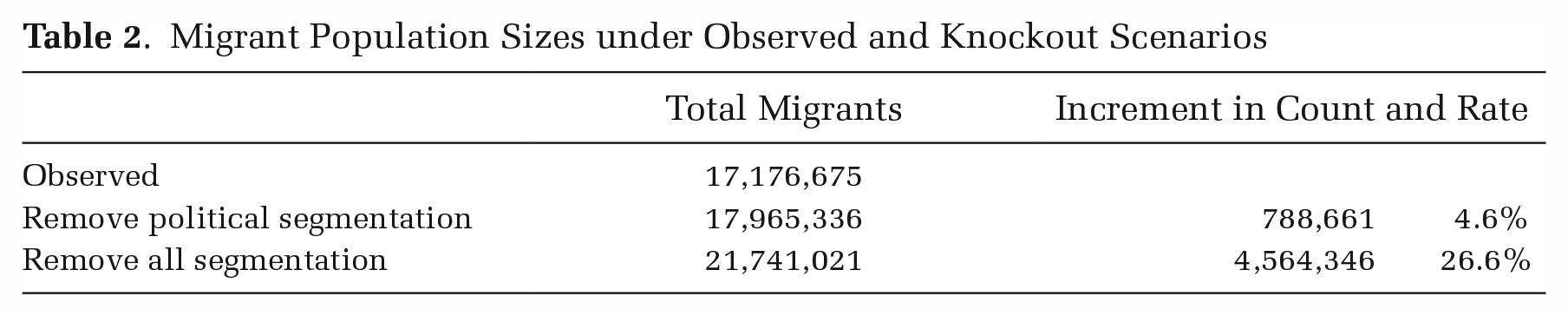
Results of the VTERGMs and knockout experiments suggest that segmented immobility serves as a critical and substantial social mechanism behind the immobility of contemporary U.S. society. These social mechanisms may be partly driven by economic forces (although supplementary analysis shows that dual labor and housing markets have little effect on the described segmentation pattern, see Part C of the online supplement); they may also reflect people’s preference for residing in culturally and politically familiar environments. This tendency not only implies social cleavages along party lines, between urban and rural lands, and across communities with varying racial demographics, but it could also contribute to growing geographic segmentation along those lines. As has been known since the classic works of Sakoda (1971) and Schelling (1969), even a small preference for homophily can lead to substantial segregation in residential settlement patterns (see also Fossett 2006).
Network Dynamics Influencing Migration Flows
The VTERGMs also consider the network patterns of the migration flow system. That all coefficients are significant in the
Model 2 also reveals that a larger migration flow during 2006 to 2010 is significantly associated with a larger migration flow during 2011 to 2015, even after holding all exogenous and endogenous factors constant. This confirms Hypothesis 2.2 regarding the perpetuation of the migration flow system, showing that migration-facilitating mechanisms offer the system its own momentum, promoting future migration net of exogenous factors such as a region’s demographic structures (de Haas 2010).
The significantly negative coefficient of the flow term indicates a lack of waypoint structures of intercounty migration, refuting Hypothesis 3. The negative waypoint flow effect implies that relatively little migration is proceeding in a chain-like manner, such as by stepwise or relay migration. After holding other factors constant, counties generally have an imbalance or inequality in the scales of their migration inflows and outflows, either sending many migrants but receiving few, or receiving many migrants but sending few. This may represent emergent attractiveness effects, in which in-migration makes a county seem more attractive to other possible migrants, and out-migration makes a county seem less attractive. It may also reflect unobserved heterogeneity in attractiveness arising from other factors; the specification of waypoint flows in the model thus controls for this possible source of autocorrelation, beyond its substantive interest.
Note that the inequality identified by a lack of waypoint flows in this intercounty migration network is different from the inequality captured by an abundance of transitive hierarchy in other cross-national migration networks (e.g., Leal 2021). Transitive hierarchy requires many waypoints serving as the “mildly structurally attractive position,” between the highly and the minimally “structurally attractive positions” (Leal 2021:1086). In the multilayer hierarchy of the global system, this implies countries are positioned in the core, the semi-periphery, or the periphery (Wallerstein 2011). In contrast, in this network with a lack of waypoint flows, there is an
The model also examines the relationship between internal and international migration. It shows that larger immigrant inflows from 2011 to 2015 are positively associated with larger intercounty inflows and outflows in the same period. This finding does not correspond to either side in the debate about internal migratory response to immigration, which contends that large immigrant inflows are either associated with small internal migrant inflow and large outflows, or not associated with internal migrant flows. Rather, the results suggest that counties with large immigrant inflows are active in
Demographic, Economic, and Geographic Determinants of Migration
Alongside segmented immobility and network patterns, the models also consider other factors that could influence intercounty migration. For demographic characteristics, Model 2 confirms findings from spatial econometrics (gravity) models that population sizes in both sending and receiving regions are positively associated with migrant flow (Boyle et al. 2014; Zipf 1946, 1949). A 10 percent increase in a destination’s population size is associated with a 3.4 percent (i.e., [1.10.351−1]) increase in the number of migrants, and a 10 percent increase in an origin’s population size is associated with a 3.6 percent (i.e., [1.10.373−1]) increase in the number of migrants, holding other factors constant. Population density has a significantly negative effect for the number of in-migrants and out-migrants, holding population size and other factors constant. One possible mechanism is that higher population density leads to larger shares of local connections for residents (Butts et al. 2012; Hipp et al. 2013; Thomas et al. 2022), where more job transitions and housing transactions can happen locally thanks to these connections, reducing migration across county borders.
With respect to demographic composition, larger migration flows are significantly more likely to be observed between counties with younger populations, in line with the migration schedule literature that finds younger adults are more mobile than older adults (Raymer and Rogers 2007; Rogers and Castro 1981). The model also shows that counties with larger shares of Hispanic population tend to send fewer migrants, but counties with larger shares of non-Hispanic Black, non-Hispanic Asian, and other races populations tend to send more intercounty migrants. These effects do not directly describe the mobility of each racial/ethnic population, as they are predicting the magnitude of migration flow for all racial and ethnic populations. Decomposing migration flows into migrants of each racial/ethnic population is necessary to reveal the variation of mobility between people with different racial/ethnic identities.
Economic covariates in Model 2 show that larger migration flows exist between counties with higher shares of renters and people with college degrees, consistent with previous literature that finds renters and people with higher education credentials are more mobile than their counterparts (Frey 2009). We also see that larger migration flows happen when the route offers greater declines in housing costs, indicating a tendency to move toward cheaper housing (Plantinga et al. 2013). Holding other factors constant, counties with lower housing costs have higher out-migration. This might be due to the better financial conditions renters have in low housing cost areas, enabling them to move and relocate. It is also compatible with previous findings that lower housing equity is associated with higher mobility rates (Coulson and Grieco 2013).
For unemployment rates, the model suggests the lower the unemployment rate at the origin, and the larger the decline in unemployment rate from origin to destination, the more intercounty migration. These results are compatible with the cost-benefit model of the neoclassical economic theory of migration, that populations move toward economic opportunities (Todaro 1976), and that more economic opportunities financing migration makes migration more likely to happen (Massey and Espinosa 1997). The relational approach used here enables empirical analysis of the aspiration–ability model (Carling 2002; Carling and Schewel 2018), revealing that both aspiration, as influenced by the relative economic conditions of origin and destination, and ability, as influenced by the economic conditions of the origin, matter to migration behaviors.
In terms of geographic factors, the model suggests a negative association between distance and number of migrants flowing between two counties, as the gravity model predicts (Zipf 1946, 1949). A 10 percent increase in the log distance between two counties is associated with a 5.6 percent (i.e., [1−1.1−0.568]) decrease in intercounty migration. Administrative boundaries also influence migration flows; migration flows within the same state are expected to be larger than those across states, holding other factors constant. Additionally, different U.S. regions have varying mobilities. The model indicates that compared to the Northeast, every other region receives and sends more intercounty migrants. This suggests the existence of some latent characteristics inhibiting the mobility of people in the Northeast, which deserves more examination in future work.
Finally, to check the model adequacy, we simulate networks based on Model 2 (the full model) in Table 1 using MCMC algorithms. We then calculate the total in-migrant and out-migrant count for each county, and compare the observed distribution with the simulated distribution. We find that the fitted model recapitulates the county-level migration data (see Part D of the online supplement). We also calculate the Pearson’s correlation between observed and simulated distributions, which are all above .95. We conclude that the model effectively reproduces the quantitative features of observed migration flow networks.
Discussion And Conclusions
This article offers a comprehensive analysis of the intercounty migration structure in the United States, encompassing not only economic, demographic, and geographic factors, but also political and cultural factors and internal dynamics of the migration system. Network models reveal a pattern of segmented immobility in the United States, in which less migration happens between counties with dissimilar political environments, levels of urbanization, and ethnic/racial compositions. Yet, we do not observe segmentation between internal migrants and international immigrants; rather, the model shows that counties active in receiving many international immigrants are active in sending and receiving many internal migrants as well. Our analysis also suggests the significance of internal dynamics of the migration flow system; we see strong patterns of reciprocity and perpetuation, along with a suppression of waypoint structure. These results lend empirical evidence to the systemic theory of migration (Bakewell 2014; de Haas 2010; Fawcett 1989; Mabogunje 1970), showing that population flows assemble an interdependent network system that carries its own momentum.
We identify segmentation as a critical mechanism behind population immobility in contemporary U.S. society, which could potentially have deterred millions of people from migrating each year, as suggested by the knockout experiments. This finding suggests a tendency for individuals to choose residency in localities that match their political affiliations and sociocultural attributes, which can lead to geographic segmentation between people with different political identities (Brown and Enos 2021) and increase the homogeneity of their social relations (DiPrete et al. 2011). Such sorting could reinforce political polarization (DellaPosta and Macy 2015) and also serve as a mechanism that maintains and even exacerbates residential segregation along other dimensions (Fossett 2006; Sakoda 1971; Schelling 1969). While classic analyses of segregation have focused on local communities within urban areas (Bishop and Cushing 2009), the effects seen here could potentially contribute to macro-level segmentation across the whole country (Liu et al. 2019). From a migration perspective, although internal migration in the United States does not involve international border-crossing or other forms of government restrictions (e.g., the household registration system in China,
Our analytic framework provides an example of structural and systemic analysis of mobility and immobility, broadly defined. The relational approach connects the perspectives of emigration and immigration to examine how characteristics of origin and destination
Our study enables a much richer examination of the mechanisms driving or inhibiting internal migration at a larger scale than what has been possible in extant literature, but it is not without its own limitations. First, as a macrosociological study about the “functioning of a social system” (Coleman 1986:1312), this article examines an aggregate-level social phenomenon, that is, population immobility. Analysis of the migration flow network facilitates a systemic understanding of migration and its relation to segmentation from a holistic viewpoint, but it does not directly describe the patterns of individual migration behavior. Although we can test for the structural signatures of such micro-level processes, unpacking those fine details requires information on decision-making and behavior patterns at the individual level. For example, distinguishing stepwise migration and relay migration requires data about the migration trajectories of individual migrants. Studies like this are hence complementary to micro-level analyses (both quantitative and qualitative) that could shed further light on processes at the individual and household levels (e.g., DeLuca, Wood, and Rosenblatt 2019; Fitchen 1994; Lichter et al. 2022; Quillian 2015). Another promising research direction is to pursue studies that directly bridge individual behaviors and aggregate social outcomes, which is still an open problem in sociology (Cetina and Cicourel 2014; Coleman 1986).
Second, because the American Community Survey did not start collecting data until 2005, our analysis only includes migration-flow networks for two time points (2006–2010 and 2011–2015). This data limitation prevents us from conducting dynamic analysis about changes in intercounty migration patterns throughout the past decades, and therefore, our findings do not speak directly to the reasons behind the long-term decline of migration. Yet, our identification of drivers, and especially inhibitors, behind migration flows could serve as a starting point for this inquiry. For example, because political division across geographic areas deters migration, future research might examine how the geography of politics and preferences regarding political homophily have changed over time, and how the evolution of political landscapes and polarization relates to the long-term decline of migration. Studies of the changing patterns of immigrant inflows and the relationship between internal and international migration flows can illuminate the change of population dynamics over time. Applying knockout experiments via network simulation to historical data about political climate and migration/immigration flows might be one approach to advance inquiry into the social forces behind the growing immobility in the United States. In addition, future research might benefit from exploring the changing balance of forces of the competing internal dynamics of the migration system over the past decades. Given that the VTERGM framework we use here is capable of handling networks with multiple time steps, our analytic framework could be used for dynamic analysis once migration-flow data for more time points become available.
In a similar vein, the time period we analyzed covers the Great Recession (Grusky, Western, and Wimer 2011). Despite our controls for various economic factors, some aspects of our findings may be particular to this period, as economic shocks can influence migration patterns (Monras 2018; cf. Molloy et al. 2011). Specifically, because economic recession can suppress migration, it is possible that fewer waypoint flows are a consequence of the period effect that temporarily suppresses stepwise migration. Nevertheless, the formal expressions of relational linkages and network patterns, and the modeling of migration-flow networks using ERGMs, are generally applicable to study migration flows of different periods and regions at different scales. Future research may compare analyses of relational and network patterns of migration flows in different times and space using similar frameworks; this work could reveal what patterns are context-specific in certain spatial-temporal settings, and which are generalizable to migration in other societies.
Another fruitful direction for future work is to complicate the analysis of internal dynamics of migration systems by examining the higher-order dependence structure of (valued) networks. One example is network transitivity, a structural feature associated with hierarchy within the migration system (Leal 2021). We do not find a strong transitive hierarchy in the U.S. internal migration system, as indicated by the lack of waypoint flows. 15 Nevertheless, transitivity is a theoretically-interesting dependence structure for the study of mobility networks, and it would ideally be examined in valued networks to consider the quantitative feature of migration flows. This requires theoretical and methodological developments in formal specification of dependence terms in the valued network setting, for example, clarifying the properties of different definitions of transitivity and their relationship to network degeneracy (Krivitsky 2012). It also demands further advancements in computational methods for valued network models to allow for evaluation of more complicated dependence structures in large networks.
Last but not least, as population immobility has become a long-term phenomenon in the United States, it poses important questions about its broader social implications. Future research could explore the relationship between geographic mobility and social mobility, and how divergent geographic mobility patterns across various social groups may influence their life chances and well-being. Furthermore, a lack of population exchange, especially between localities with different cultural and political climates, could have ramifications for social divisions in the country. Two decades ago, Putnam’s (2000)
In conclusion, grappling with the mobility bias in migration studies, this article utilizes migration systems theory and network methods to study the mechanisms behind population immobility in the United States. We identify segmentation as a significant feature of the U.S. migration landscape, which potentially immobilized millions of intercounty migrants each year in the 2010s. We demonstrated how network and simulation methods can contribute to a systemic understanding of mobility and population dynamics. We also call for more theoretical and empirical research about the interrelationships between migration, segregation, and polarization, and how they shape the foundation of social lives in the United States and beyond.
Supplemental Material
sj-pdf-1-asr-10.1177_00031224231212679 – Supplemental material for Rooted America: Immobility and Segregation of the Intercounty Migration Network
Supplemental material, sj-pdf-1-asr-10.1177_00031224231212679 for Rooted America: Immobility and Segregation of the Intercounty Migration Network by Peng Huang and Carter T. Butts in American Sociological Review
Footnotes
Funding
ORCID iDs

Data Note
.References
Supplementary Material
Please find the following supplemental material available below.
For Open Access articles published under a Creative Commons License, all supplemental material carries the same license as the article it is associated with.
For non-Open Access articles published, all supplemental material carries a non-exclusive license, and permission requests for re-use of supplemental material or any part of supplemental material shall be sent directly to the copyright owner as specified in the copyright notice associated with the article.
