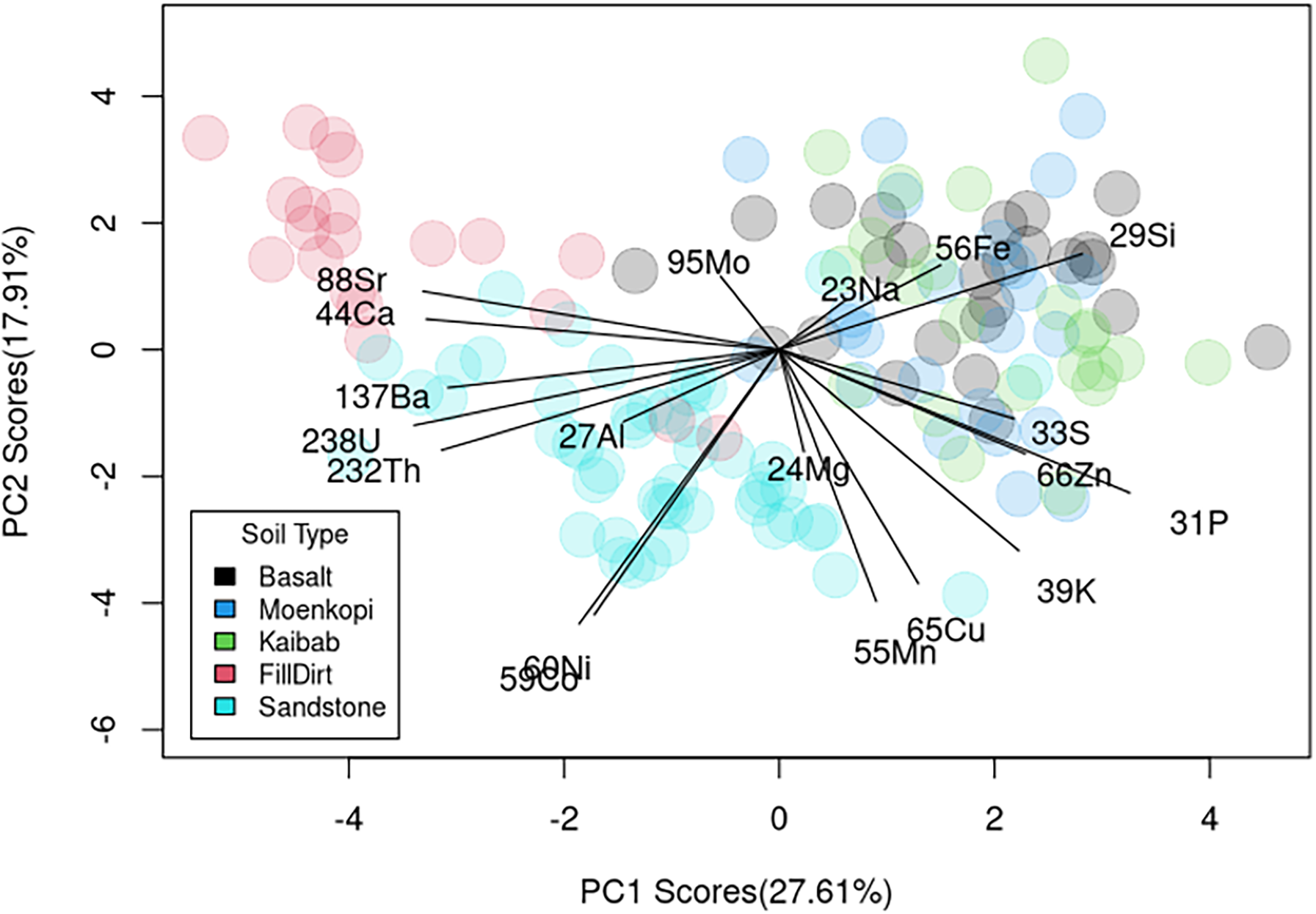
This study demonstrates the feasibility of determining soil provenance from tree ash composition using elemental analysis and chemometric techniques. To date, no published studies have applied chemometric approaches to classify ash for provenance determination following forest fires. In this work, Pinus ponderosa ash was analyzed to distinguish samples based on soil type and geographic location. Pinus ponderosa, a widely distributed pine species in the western United States where wildfires are prevalent, was selected as a model system. Needles were collected from trees grown in five distinct soil types across northern Arizona and Colorado, then dry-ashed under controlled conditions. Classification was performed using three preprocessing techniques and five machine learning algorithms, including hierarchical modeling structures to optimize separation. Partial least squares discriminant analysis (PLS-DA) following a Box-Cox transformation yielded the highest classification accuracy, achieving a prediction kappa value of 0.98 for soil type identification. However, classification performance decreased when distinguishing both soil type and geographic location, indicating that additional variability may influence predictive accuracy in broader applications. These findings highlight the potential of inductively coupled plasma mass spectrometry (ICP-MS) and machine learning for post-wildfire forensic analysis and environmental monitoring.
DonovanV.M.CrandallR.FillJ.WonkkaC.L.. “Increasing Large Wildfire in the Eastern United States”. Geophys. Res. Lett. 2023. 50(24): e2023GL107051. https://doi.org/10.1029/2023GL107051
2.
BoeschotenL.E.Sass-KlaassenU.VlamM.ComansR.J.N., et al. “Clay and Soil Organic Matter Drive Wood Multi-Elemental Composition of a Tropical Tree Species: Implications for Timber Tracing”. Sci. Total Environ. 2022. 849: 157877. https://doi.org/10.1016/j.scitotenv.2022.157877
3.
Sánchez-GarcíaC.SantínC.NerisJ.SigmundG., et al. “Chemical Characteristics of Wildfire Ash Across the Globe and Their Environmental and Socio-Economic Implications”. Environ. Int. 2023. 178: 108065. https://doi.org/10.1016/j.envint.2023.108065
4.
HagemanP.L.PlumleeG.S.MartinD.A.HoefenT.M., et al. “Leachate Geochemical Results for Ash and Burned Soil Samples from the October 2007 Southern California Wildfires”. U.S. Geological Survey Open-File Report 2008-1139. 2008. https://doi.org/10.3133/ofr20081139
5.
HoefenT.M.KokalyR.F.MartinD.A.RochesterC., et al. “Sample Collection of Ash and Burned Soils from the October 2007 Southern California Wildfires”. U.S. Geological Survey Open-File Report2009–1038. 2009. https://doi.org/10.3133/ofr20091038
6.
PausasJ.G.KeeleyJ.E.. “Wildfires as an Ecosystem Service”. Front. Ecol. Environ. 2019. 17(5): 289–295. https://doi.org/10.1002/FEE.2044
7.
BoeschotenL.E.Sass-KlaassenU.VlamM.ComansR.J.N., et al. “Clay and Soil Organic Matter Drive Wood Multi-Elemental Composition of a Tropical Tree Species: Implications for Timber Tracing”. Sci. Total Environ. 2022. 849: 157877. https://doi.org/10.1016/j.scitotenv.2022.157877
8.
RobinneF.-N.HallemaD.W.BladonK.D.FlanniganM.D., et al. “Scientists’ Warning on Extreme Wildfire Risks to Water Supply”. Hydrol. Process. 2021. 35(5): e14086. https://doi.org/10.1002/hyp.14086
9.
HarperA.R.SantinC.DoerrS.H.FroydC.A., et al. “Chemical Composition of Wildfire Ash Produced in Contrasting Ecosystems and Its Toxicity to Daphnia magna”. Int. J. Wildland Fire. 2019. 28(10): 726. https://doi.org/10.1071/WF18200
10.
BodiM.B.MartinD.A.BalfourV.N.SantínC., et al. “Wildland Fire Ash: Production, Composition and Eco-Hydro-Geomorphic Effects”. Earth Sci. Rev. 2014. 130: 103–127. https://doi.org/10.1016/j.earscirev.2013.12.007
MaitreJ.BouchardK.BédardL.P.. “Mineral Grains Recognition Using Computer Vision and Machine Learning”. Comput. Geosci. 2019. 130: 84–93. https://doi.org/10.1016/j.cageo.2019.05.009
13.
SaenzJ.A.LubbersN.UrbanN.M.. “Dimensionality-Reduction of Climate Data. Dimensionality-Reduction of Climate Data Using Deep Autoencoders”. ArXiv. 2018. https://doi.org/10.48550/arXiv.1809.00027
HaffeyC.SiskT.D.AllenC.D.ThodeA.E.MargolisE.Q.. “Limits to Ponderosa Pine Regeneration Following Large High-Severity Forest Fires in the United States Southwest”. Fire Ecol. 2018. 14(1). https://doi.org/10.4996/fireecology.140114316
17.
PadillaK.L.AndersonK.A.. “Trace Element Concentration in Tree-Rings Biomonitoring Centuries of Environmental Change”. Chemosphere. 2002. 49(6): 575–585. https://doi.org/10.1016/S0045-6535(02)00402-2
18.
NaraniS.S.SiddiquaS.PerumalP.. “Wood Fly Ash and Blast Furnace Slag Management by Alkali-Activation: Trace Elements Solidification and Composite Application”. J. Environ. Manag. 2024. 354: 120341. https://doi.org/10.1016/j.jenvman.2024.120341
19.
StilesW.. “The Functions of Trace Elements in Plants”. In: StilesW., editor. Trace Elements in Plants. Cambridge: Cambridge University Press, 2013. Pp. 143–179.
20.
R Core Team. “R: A Language and Environment for Statistical Computing”. https://www.r-project.org/ [accessed 30 June 2025].
21.
RStudio Team. “RStudio: Integrated Development for R”. https://posit.co/ [accessed 30 June 2025].
Mallikharjuna RaoK.SaikrishnaG.SupriyaK.. “Data Preprocessing Techniques: Emergence and Selection Towards Machine Learning Models: A Practical Review Using HPA Dataset”. Multimed. Tools Appl. 2023. 82(24): 37177–37196. https://doi.org/10.1007/s11042-023-15087-5
24.
CamposM.P.ReisM.S.. “Data Preprocessing for Multiblock Modelling: A Systematization with New Methods”. Chemom. Intell. Lab. Syst. 2020. 199: 103959. https://doi.org/10.1016/j.chemolab.2020.103959
25.
AristodimouA.DiavastosA.PattichisC.S.. “A Fast Supervised Density-Based Discretization Algorithm for Classification Tasks in the Medical Domain”. Health Inform. J. 2022. 28(1). https://doi.org/10.1177/14604582211065397
26.
SugiartoB.PrakasaE.WardoyoR.DamayantiR., et al. “Wood Identification Based on Histogram of Oriented Gradient (HOG) Feature and Support Vector Machine (SVM) Classifier”. In: 2017 2nd International conferences on Information Technology, Information Systems and Electrical Engineering (ICITISEE). IEEE. 2017. Pp 337–341. https://doi.org/10.1109/ICITISEE.2017.8285523
27.
SarkerI.H.. “Machine Learning: Algorithms, Real-World Applications and Research Directions”. SN Comput. Sci. 2021. 2(3): 160. https://doi.org/10.1007/s42979-021-00592-x
28.
FinchK.EspinozaE.JonesF.A.CronnR.. “Source Identification of Western Oregon Douglas-Fir Wood Cores Using Mass Spectrometry and Random Forest Classification”. Appl. Plant Sci. 2017. 5(5). https://doi.org/10.3732/apps.1600158
TieppoE.dos SantosR.R.BarddalJ.P.NievolaJ.C.. “Hierarchical Classification of Data Streams: A Systematic Literature Review”. Artif. Intell. Rev. 2022. 55(4): 3243–3282. https://doi.org/10.1007/s10462-021-10087-z
33.
SillaC.N.FreitasA.A.. “A Survey of Hierarchical Classification Across Different Application Domains”. Data Min. Knowl. Discov. 2011. 22(1–2): 31–72. https://doi.org/10.1007/s10618-010-0175-9
34.
DuarteB.P.M.AtkinsonA.C.OliveiraN.M.C.. “Using Hierarchical Information-Theoretic Criteria to Optimize Subsampling of Extensive Datasets”. Chemom. Intell. Lab. Syst. 2024. 245: 105067. https://doi.org/10.1016/j.chemolab.2024.105067
35.
GreenwellB.M.BoehmkeB.C.. “Variable Importance Plots: An Introduction to the VIP Package”. R J. 2020. 12(1): 343–366.
36.
KettererM.ReidL.T.Delgado CornelioM.F.JordanJ.A., et al. “Data for the Determination of Provenance Soil Type from ICP-MS Analyses of Pinus ponderosa Ash”. U.S. Geological Survey. 2025. https://doi.org/10.5066/P14F74ZA