







Abstract
In cross-sector partnerships (CSPs), organizations from the private, public, and/or civil society sectors join forces with the aim of collectively addressing societal concerns they cannot solve by themselves (Selsky & Parker, 2005; Waddock, 1989). The inclusion of multiple stakeholders is critical in order for such collaborations to be considered legitimate collective entities (Boström, 2006; Mena & Palazzo, 2012). However, the principle of inclusiveness often conflicts with the perceived administrative efficiency of such partnerships (Hong, 2015; Provan & Kenis, 2008). Realizing inclusiveness requires disproportionately greater effort and can therefore undercut efficiency. Any perception of
Prior work has acknowledged the presence of various paradoxical tensions in CSPs, including those between collaboration and competition (Stadtler, 2018) and between social and commercial outcomes (Sharma & Bansal, 2017), and the tensions faced by CSP convenors (van Hille et al., 2019). However, although previous work has highlighted certain aspects relevant to the inclusiveness–efficiency paradox (Huxham & Vangen, 2013; Ospina & Saz-Carranza, 2010; Saz-Carranza & Ospina, 2011), we lack a better understanding of how actors respond dynamically to this paradox over time. The current literature on the inclusiveness–efficiency paradox is not directly related to CSPs but more generally rooted in reflections on collaborative arrangements in public administration (Ospina & Saz-Carranza, 2010), focused primarily on how this paradox manifests itself in practice and the ways that actors can cope with it, for instance, through bridging and framing work (Saz-Carranza & Ospina, 2011). The fact that so little is known of how this paradox unfolds over time is remarkable given that CSPs usually run through a number of phases (Selsky & Parker, 2005), making insights into the dynamic nature of this paradox relevant. Partnerships need to be studied as relationships that undergo “dynamic evolution” (Austin, 2007, p. 57), all the more so because treating them as static can mislead CSP participants into thinking paradoxical tensions can somehow be resolved “once and for all.” Our research therefore explores the dynamic nature of the inclusiveness–efficiency paradox and the evolving nature of responses to this tension in the context of CSPs to address the following question:
We explored this question through a longitudinal case study of a CSP we call Climate Net in which actors from business, local government, and civil society collaborated to boost urban sustainability in a German municipality. The tension between inclusiveness and efficiency in the case of Climate Net was reinforced by the short-term nature of the collaboration, with the CSP participants especially conscious of the need to avoid wasting time while also concerned not to rush the collaboration and thus risk actors feeling excluded. Our findings show how the inclusiveness–efficiency paradox reemerged in a different guise within each phase of the partnership. In the CSP’s responses to the paradox, we identified three paradox management practices to help actors cope with the tension: (a) “customized inviting” (during the formation phase), (b) “sequential including” (during the preparation phase), and (c) “tailored instructing” (during the implementation phase).
Below, we discuss the theoretical implications of these findings in two interrelated ways. First, responding to a call to further explore paradox dynamics (Schad et al., 2016), we argue that the driving force behind the reoccurrence of the inclusiveness–efficiency paradox within Climate Net was the fact that the three paradox management practices accentuated various boundaries between the actor groups (i.e., demarcation lines for differentiation). Prior to introducing these management practices, Climate Net neglected these boundaries, which itself affected the emergence of paradoxical tensions. Accentuating the boundaries between actors was found in this case to be a constructive process that “deparadoxified” (Luhmann, 1988) the tensions within each phase. As Climate Net moved onto each phase, new boundaries between the groups became relevant as different operational contexts emerged. The CSP’s inability to satisfy all sides of these boundaries, in turn, gave rise to new manifestations of the inclusiveness–efficiency paradox. We therefore theorize paradox management as a form of “boundary work” (Langley et al., 2019), using this concept to discuss paradox dynamics within CSPs—a topic largely neglected in the partnership literature on paradox (Sharma & Bansal, 2017; Stadtler & Van Wassenhove, 2016).
Second, our study contributes to the literature on boundary work in the context of CSPs (Quick & Feldman, 2014; Ybema et al., 2012). To date, this literature has discussed how collaboration is enabled through conscious efforts to minimize boundaries between different actors, including downplaying differences between actors from different sectors. Our study complements these insights by showing that collaboration among actor groups can also be enabled by “playing up” relevant differences. Looking beyond our specific case, we think it is worth exploring how playing down and playing up differences among actor groups may go hand in hand, especially in situations in which CSPs face paradoxical demands and where playing up differences can help to deparadoxify. In this way, we also contribute practical insights into possible ways of how societally relevant CSPs can avoid failure and achieve their aims.
The remainder of this article is organized as follows. The next section reviews prior research on collaborative paradoxes in the context of CSPs. The subsequent section on methods discusses our research setting, our approach to data collection, and our data analysis strategy. We then present our “Findings” section, following the inclusiveness–efficiency paradox over the three phases of the collaborative process within Climate Net. This is followed by the “Discussion” section, which outlines our theoretical contribution and theoretically frames our results in the context of the literatures on paradox and boundary work in CSPs. The “Conclusion” section includes suggestions for future research.
Theoretical Background
CSPs enable actors to pool their resources (Selsky & Parker, 2005), to create dialogues across organizational boundaries (Austin & Seitanidi, 2012), and to share risks among partners (Clarke & MacDonald, 2019). In this way, such partnerships are said to achieve collaborative advantage (Huxham & Vangen, 1996), enabling them to fill regulatory gaps (Fransen & Kolk, 2007) and deliver social value (Le Ber & Branzei, 2010). CSPs typically operate on the premise of being inclusive, allowing relevant stakeholders to participate in decision-making processes (Mena & Palazzo, 2012). On the one hand, including a variety of stakeholders provides CSPs with the capacity to adopt multiple perspectives, thereby contributing to more sustainable solutions while also increasing the amount of available resources. The inclusion of a greater variety of actors in the collaborative process further enables CSPs to be perceived as legitimate entities, as higher levels of inclusiveness enhance the potential for democratic decision-making and thus input legitimacy (Boström, 2006; Young, 2000). On the other hand, although inclusiveness provides CSPs with a license to operate, it can simultaneously undermine their perceived efficiency, as the involvement of a wider range of stakeholders in decision-making processes tends to make these processes more time-consuming and resource-intensive (Provan & Kenis, 2008). This becomes especially problematic in CSPs due to the diversity of actors involved (Gray & Purdy, 2018). Efficiency generally implies “producing desired results with little or no waste” (Merriam Webster, 2020) and it is clear that different actor groups tend to have different notions of efficiency based on this general understanding. When CSP participants perceive their efforts to be wasted, they are likely to doubt the value of the partnership. Efforts to ensure high levels of inclusiveness can thus create situations in which although all participants are somehow included in decision-making processes, some may perceive this as wasted effort.
Because inclusiveness and efficiency constitute two demands that seem “logical in isolation but absurd and irrational when appearing simultaneously” (Lewis, 2000, p. 760), we portray this tension as a collaborative paradox. Such paradoxes and the tensions they imply have been observed, for example, in Corporate Social Responsibility (CSR) and sustainability issues (Hahn et al., 2015, 2018), where CSPs are common. The paradox literature distinguishes between defensive and active responses to paradox. Defensive responses such as splitting or regressing provide short-term relief but do not enable organizations to cope with paradox on a long-term basis (Smith & Lewis, 2011), whereas active responses such as strategies of acceptance, confrontation, and transcendence enable organizations to acknowledge paradox as a natural part of organizing (Jarzabkowski et al., 2013; Lewis, 2000; Lüscher & Lewis, 2008).
Scholars have identified a variety of active responses in the context of CSPs: For example, studies have shown the impact of training, mentoring and partnership rules (Stadtler & Van Wassenhove, 2016), and partnership design (Stadtler, 2018) to cope with competing demands. Other studies have focused on the role of particular actors in coping with paradoxical tensions, including network leaders (Ospina & Saz-Carranza, 2010), CSP convenors (van Hille et al., 2019), and the staff of network administrative organizations (Saz-Carranza & Ospina, 2011). Finally, in a study on the social–commercial paradox, Sharma and Bansal (2017) have emphasized the importance of managerial cognition in enabling paradoxes to be framed as socially constructed and malleable issues rather than objective and fixed predicaments, thereby making it possible for CSPs to develop integrative solutions to such paradoxes. This socially constructed nature of paradoxes and response strategies has thus been highlighted by the relevant literature (Jarzabkowski & Lé, 2017).
Work on the inclusiveness–efficiency paradox remains rather limited. Provan and Kenis (2008) have elaborated on this tension in the context of network governance, describing it as one of the prevalent tensions inherent in governing whole networks. The body of work developed by Huxham and Vangen (2004, 2013), which revolves around the difficulty of achieving collaborative advantage rather than collaborative inertia, theoretically comes very close to the inclusiveness–efficiency tension. On the basis of insights gathered through action research, these authors focus on capturing the complexity in collaboration and providing conceptual handles to actors involved in collaborative situations. Finally, Saz-Carranza and Ospina (2011) have discussed the tension between unity and diversity in network governance, highlighting a number of aspects relevant to the discussion of inclusiveness and efficiency (e.g., the necessity of bridging and framing work).
Despite these theoretical advances, we know little about how the inclusiveness–efficiency paradox manifests itself over time within CSPs. This is an important gap, as scholars have repeatedly emphasized that CSPs consist of different phases ranging from activities related to partnership formation and preparation to implementation tasks (Selsky & Parker, 2005). This observation is consistent with seminal work on multiparty collaboration that distinguishes between phases in the collaborative process such as problem-setting, direction-setting, and implementation (Gray, 1989). Studies have shown how these phases are characterized by differences in the relationship quality between partners (Austin & Seitanidi, 2012), differences in the prevalence of goals and tasks (Clarke & Fuller, 2010), and multiple understandings of the issue at hand (Klitsie et al., 2018). These studies further demonstrate that the phases of collaboration are interrelated and require varying organizing approaches (Gray, 1985). For these reasons, it is essential to assess the dynamics of the inclusiveness–efficiency paradox more closely. As yet, it remains unclear whether this paradox can be addressed in such a way that no further tensions occur or whether it needs to be addressed in different ways according to the different phases of a partnership. Our study therefore aims to complement existing work by studying how actors manage the inclusiveness–efficiency paradox throughout the different phases of a CSP.
Empirical Approach and Method
Case Setting
Our research comprises a single case study that is appropriate for answering “how” questions as they allow to collect rich and in-depth data as well as close observation of the phenomenon of interest (Yin, 2018). Purposeful sampling was undertaken to identify a cross-sectoral collaboration that aimed at inclusiveness. The collaboration selected, referred to here as “Climate Net” for purposes of anonymity, was a CSP set up to address urban sustainability in a large German city and operated from May 2017 to July 2018. Climate Net explicitly aimed at a representative inclusion of stakeholders (in this case, actors from civil society, business, and local government) in its decision-making processes and implementation. In line with the relevant literature, we understand inclusiveness to mean the involvement of stakeholders who are affected by and representative for an issue at stake (Mena & Palazzo, 2012; Risse, 2004). Although it is difficult to achieve full inclusiveness in practice (Gilbert & Rasche, 2007) especially when considering power differences among actors (Mena & Palazzo, 2012), Climate Net’s mission statement explicitly emphasized the need for a tripartite approach involving local citizens (represented through civil society organizations), businesses, and local government actors.
Unlike some other CSPs, Climate Net’s duration was fixed from the start and fairly short as such. The existing literature distinguishes between short-term (project-based) partnerships and long-term (more strategic) initiatives (Selsky & Parker, 2005); however, partnerships with a shorter duration have rarely been discussed. One exception is Branzei and Le Ber’s (2014) review of partnerships, which reveals the heterogeneity of CSPs and also finds that temporary collaborations for disaster relief and emergency response often have a shorter duration (Cozzolino, 2012). Other types of short-term partnerships have rarely been part of the debate, however, and thus our case provides an original and timely setting for studying the inclusiveness–efficiency paradox. The case is additionally relevant given that demands for efficiency are usually higher in partnerships of short duration, as concrete results of the collaboration are expected within a shorter period of time. At the same time, demands for inclusiveness tend to be high when organizing for sustainability via partnerships, as the inclusion of state and nonstate actors into decision-making processes requires high levels of legitimacy (Mena & Palazzo, 2012). Hence, our case could be expected to display high and competing demands for both efficiency and inclusiveness. We thus deemed Climate Net to represent a revelatory case (Yin, 2018) to study the inclusiveness–efficiency paradox.
CSPs are increasingly seen as a fruitful way to tackle issues of urban sustainability, in accordance with growing awareness that addressing urban sustainability challenges requires the cooperation of various stakeholders (Zeemering, 2014). The German city in our case faced a number of environmental problems, including rising levels of pollution, decreasing green spaces, and low levels of public awareness about climate change. Climate Net’s mission was to collectively develop and implement a sustainability plan that consisted of various climate projects, including the construction of cycling routes, educational gardening projects for children, and citywide tree-planting projects. As all these projects were aimed at addressing climate change at local level, the inclusion of multiple stakeholders reflected the aim of the city administration to move from top-down governance to a more participative and inclusive model of urban governance.
Climate Net was composed of 17 actors from the public, private, and civil society sectors. The city administration viewed collaboration with firms and the civic community as the most effective way to tackle environmental problems, especially in light of the failure of previous attempts to address urban sustainability that had not included these stakeholder groups. The firms involved in the partnership consisted of several large organizations, including a multinational automotive manufacturer and the city’s Chamber of Commerce, as well as a number of smaller businesses, including one start-up. The individuals representing these firms were typically actors operating in departments involved in community work (e.g., CSR departments). The civil society actors in the partnership included representatives from the city’s voluntary association and citizens association as well as private citizens. As the voluntary association and the citizens association were rather small, the chairs of these associations were involved in the partnership. Finally, the governmental actors included employees of the city administration, the district mayor, and a social worker. Although Climate Net was coordinated by governmental actors, these actors were also operationally involved in the CSP (e.g., within the different climate projects). Table 1 gives a detailed overview of all actor groups.
Interviews With Actors in Climate Net.

The city administration predefined three phases for Climate Net: (a) a formation phase (3 months), (b) a preparation phase (3 months), and (c) an implementation phase (6 months). Although the official selection of actors only started in the formation phase, some actors who worked closely with the city administration (e.g., the district mayor) had already been approached prior to the start of Climate Net (i.e., in the partnership’s nascent stages). In the first two phases, Climate Net organized itself mainly via face-to-face meetings among various participants. During the implementation phase, in which various small-scale climate projects were carried out in the city, Climate Net was assisted by volunteers recruited from the firms involved in the partnership.
Data Sources
Our goal was to capture the ways in which Climate Net managed the tension between inclusiveness and efficiency. We gathered data in real time from October 2017 to July 2018. Our study draws on semi-structured interviews, nonparticipatory observations, and documentary evidence (Patton, 2014). In total, we conducted 17 semi-structured interviews with all of Climate Net’s various stakeholder groups, allowing us to gain a broad overview of perspectives (see the appendix for an interview guide with exemplary questions). We started these interviews at the end of the formation phase when the partnership was about to become fully set up. The first interviews were conducted with the employees of the city administration and the civil society actors who were involved in the partner selection process. After these initial conversations, further interviews with actors from the other stakeholder groups were added to our data set. The interviews were broadly structured around questions aimed at helping us understand the collaborative context, including, for example, how often the actors met, how they divided their tasks, and how they experienced and coped with relevant tensions. Each interview was specifically adapted to the role of the interviewee and we encouraged the interviewees to talk freely about their own experience of the collaboration. The interviews lasted between 45 and 60 minutes and all were audio-recorded and transcribed.
A second source of data for our study consists of nonparticipant observations (Patton, 2014) made during three network meetings held by Climate Net: two meetings in the preparation phase and one meeting held during the implementation of the sustainability plan, each lasting between 1 and 3 hours. In addition, the first author was present during the closure event held to celebrate the completion of the partnership. During these meetings and events, some 50 pages of fieldnotes were taken, including reflections on the general atmosphere of the meetings and notes on what was said and done. Finally, we analyzed a variety of partnership documents to better understand the case setting and to triangulate the data obtained from our interviews and observations. These documents included around 100 pages of background information on the partnership (e.g., a draft of the partnership concept), 50 pages of information related to meetings (e.g., minutes of steering meetings, minutes of project group meetings, and meeting agendas), two PowerPoint presentations, and five press releases. The vast majority of the analyzed documents were nonpublic and were obtained from the voluntary association in charge of the partnership’s administrative tasks.
Our research design inevitably has certain limitations. First, while Climate Net constitutes a telling example of a CSP aiming for inclusiveness, it is only a single case and thus limits the generalizability of our findings (Patton, 2014). Second, although we interviewed all the stakeholder groups in Climate Net, our absolute number of interviews is relatively low. Notwithstanding this limitation, by the time we were approaching the end of the series of interviews, we noticed that no more new ideas and themes were being added to our data set, indicating that we had reached thematic saturation (Guest et al., 2006). Moreover, we substantiated and triangulated our interview data as much as possible with the analyzed documents and the data collected through the nonparticipatory observations. This process also served to prevent any occurrence of retrospective bias in our data. Finally, it is important to acknowledge that Climate Net was a partnership with a short duration of collaboration. Although numerous CSPs operate under such a time-limited model (Juriado & Gustafsson, 2007; Waddock & Post, 1995), this may limit the applicability of our results to open-ended or long-term CSPs (see also our discussion in the “Conclusion” section).
Data Analysis
Our approach to data analysis was abductive, with data and theory examined in tandem (Alvesson & Kärreman, 2007; Mantere & Ketokivi, 2013). In coding our data, we followed a three-step process moving from raw data to theoretical interpretation of the data (Gioia et al., 2013). In the first step, we engaged in open coding to understand the collaborative nature of Climate Net, focusing particularly on any data passages in which the CSP participants were torn between including all the partnership’s stakeholders versus collaborating more efficiently. We focused in particular on those passages that highlighted differences between the actors in Climate Net. Finally, we sought out passages that showed how the different actor groups responded in practice to the competing demands of efficiency and inclusion. From these passages, we created a set of first-order codes that were close to the raw data and mostly in vivo. During this first step of coding, we noticed how the inclusiveness–efficiency tension manifested itself differently in the three partnership phases of formation, planning, and implementation. These phases were not analytically derived from the data but had been defined by the city administration in advance and thus gave a certain structure to the collaboration. As the process of analysis progressed, we noticed not only that the paradox unfolded in a different manner in each of the phases but also that each phase was characterized by different mechanisms of paradox management.
In the second step, we aggregated our first-order codes into second-order themes, thus allowing for a more theoretical interpretation of these codes. Switching back and forth between the literature and our data, we started to frame the differences between the actors as “boundaries.” We used the term
In the final step of data analysis, we formed abstract theoretical categories from the second-order themes. Drawing on the paradox literature, we aggregated the tensions arising from the dual aims of inclusiveness and efficiency in a category called the “inclusiveness–efficiency paradox.” While the literature on organizational networks had already sensitized us to this tension (Provan & Kenis, 2008), it became increasingly clear in the process of coding our data that this was indeed a paradoxical tension, as it proved to be not only contradictory but also interrelated and persistent (Lewis, 2000; Poole & Van de Ven, 1989). Interrelatedness became visible when in each phase the actors referred to the need for both inclusiveness and efficiency for the partnership while at the same time feeling torn between its competing objectives. Our longitudinal analysis also enabled us to detect the persistence of the tension (Jarzabkowski et al., 2019) as it resurfaced throughout the entire partnership in spite of all the efforts of the CSP members.
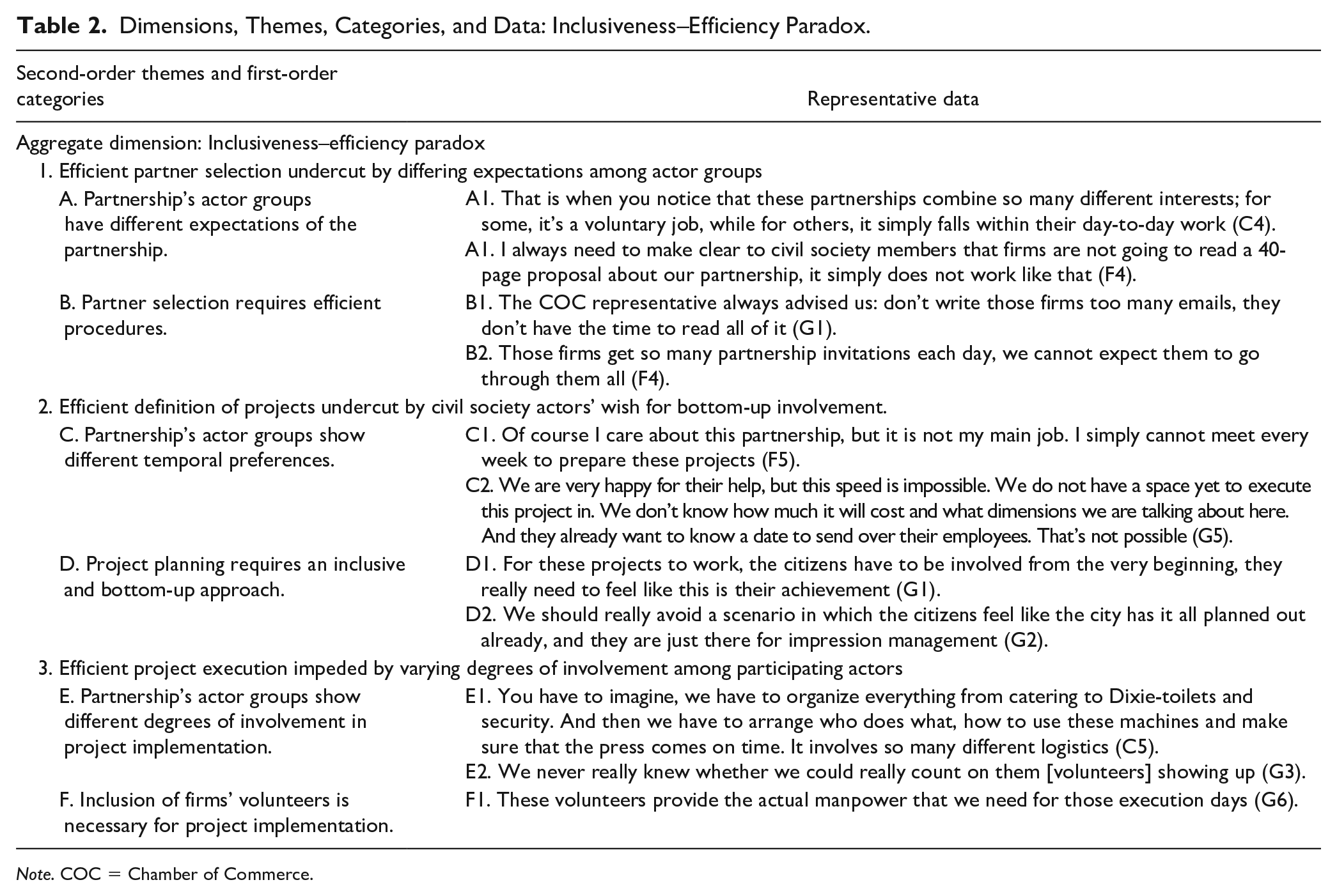
To better understand the actors’ responses to the paradox, we moved beyond the paradox literature and progressively came to think of these practices as boundary work (Langley et al., 2019), as the responses we observed essentially constituted means of accentuating demarcations between the civil society/governmental actors and the firms involved in the CSP. Boundary work has hardly featured in the paradox literature to date, but we argue that viewing responses in this way provides conceptual clarity in theorizing paradox management practices. Our emerging data structure is shown in Figure 1, whereas Tables 2 to 4 give examples of evidence for the first-order codes.

Data structure.
Dimensions, Themes, Categories, and Data: Inclusiveness–Efficiency Paradox.
Dimensions, Themes, Categories, and Data: Boundaries.

Dimensions, Themes, Categories, and Data: Boundary Work.

Findings
Our findings reveal how the inclusiveness–efficiency paradox manifested itself in different ways throughout Climate Net’s collaborative phases. While inclusiveness was critical for Climate Net, in each phase, there was a risk that if some actors withdrew due to efficiency concerns, then the CSP as a whole would be perceived as less legitimate in terms of inclusiveness and might even be terminated or seen as unsuccessful. Below, we outline the manifestation of the paradox in the different phases and the accompanying paradox management practices that enabled Climate Net to address the paradoxical tension, albeit without eliminating it entirely.
Formation Phase: Varying Value Propositions Make Partner Selection Inefficient
During the formation phase, Climate Net was not yet completely set up and the selection of actors still had to be finalized. The inclusiveness–efficiency paradox manifested itself in this phase through the fact that civil society actors were actively included in the partner-selection process, which slowed down the selection process and impeded its efficiency from the point of view of the other actors. Climate Net was initiated by the city administration, which aimed at designing and executing a community-based sustainability plan by involving relevant actors from civil society and the private sector. The keenness of the city administration to realize an inclusive and bottom-up approach was evident from their explanations of the partnership in which they repeatedly referred back to terms such as “collective impact” and “a collective impact approach” as important drivers of Climate Net. It was clear they wanted to ensure the involvement of civil society actors in the process of selecting firms for the partnership.
The inclusion of civil society actors in the selection turned out to be challenging, however, as the different stakeholder groups in Climate Net had different expectations of the partnership. While the civil society actors and the city administration highlighted environmental problem-solving through inclusive decision-making as the main value of the collaboration, the firms were more interested in exploring the economic rationale underlying community engagement. For example, the first brochure designed by Climate Net stated the following mission for the partnership: “Improving the livelihood of local citizens through collaboration between civil society, local businesses and the city administration” (Document 1). These varying value propositions (e.g., in actors’ expectations vis-à-vis the partnership) hampered the efficiency of the partner-selection process by rendering the selection process more time-consuming. The community coordinator described this situation as follows: When I started the project I’d already been warned by my predecessors that it would be difficult to attract firms. They told me it was not only hard to find them but also to motivate them and to find the right explanation to make them see the value of joining. It can be hard to explain the idea behind community engagement—they [firms] often think we are proposing internships or something. . . (G1)
The civil society actors and the governmental actors also faced difficulties in efficiently identifying and contacting the firms they wanted to join. One of the city administration delegates highlighted the time-intensive nature of the process as follows: “Catching the interest of the companies, that was definitely the biggest challenge. Often, they just don’t respond when you don’t know them personally” (G2). Finally, efficiency was threatened as some of Climate Net’s members began to feel demotivated when the firms they targeted did not respond to their particular value proposition of civil society inclusion, with some firms viewing the partnership as merely a “marketing stunt” (C2).
The task of inviting partners revealed a boundary between civil society/governmental actors and business representatives, given their diverging expectations. At first, actors in the partnership neglected this boundary; they believed that Climate Net could be inclusive regardless of partners’ diverging expectations. Initially, the governmental actors sent out the same invitation letter and proposal document to the firms and the civil society actors. This invitation emphasized the benefits of community engagement in general and did not account for actors’ specific expectations. The firms perceived this proposal as “overly detailed” (F2) and therefore did not engage much. Neglecting the boundary resulted in the paradoxical tension becoming salient. Climate Net realized it was not possible to have an inclusive partner-selection process in a context where the efficiency of this very process was undermined by diverging expectations. Nevertheless, both inclusiveness and efficiency were necessary to realize the selection process. The partnership had to cope with this paradox somehow and eventually did so through a solution proposed by the representative of the city’s Chamber of Commerce (COC) who joined Climate Net in these early days. He was not surprised that the city administration had struggled to include the private sector in an efficient manner, given that the project was being shaped by civil society actors at the same time: “Obviously you want many firms involved, but for them it’s just not the most important thing on their agenda. They have no time to read a 30-page proposal on community engagement” (F4). To speed up the partner-selection process, the COC representative proposed an invitation strategy that we refer to as “customized inviting.” Rather than sending out the city administration’s elaborate invitation proposal that assumed all participants shared the same expectations, he started approaching firms with highly customized arguments that emphasized the partnership’s potential economic value for the firms. As he explained, I put in a lot of effort to find economic arguments to make these firms see the benefits of joining this project. With some firms that I know are interested in joining but have trouble seeing the value, I really do my research and try to find out why they should be involved, mostly from an economic point of view. For company X for example, I know they have trouble finding interns, so I highlighted the opportunities of cooperating with schools in this partnership. For others, it might be the employees they can attract by designing a greener district or the visibility it creates for them in the region. But you have to come up with something that makes them see the value of joining. (F4)
This tactic resulted in achieving greater inclusiveness as it led to four firms joining the partnership: an automobile manufacturing company, a property management agency, an agriculture start-up, and a networking agency. At the same time, it also improved efficiency both in the sense of not wasting time on finding partners and in avoiding having to deal with conflicts and feelings of frustration later on. Although all actors were attracted by the CSP as such, the civil society actors had started to have doubts about the viability of the project and the firms’ motivation while the firms needed reassurance that the project would also serve their specific needs.
Preparation Phase: Varying Working Speeds Impede Efficient Project Planning
Once the formation of Climate Net was complete, a new challenge arose with regard to how to collectively develop a community sustainability plan consisting of a number of small-scale climate projects. The idea behind these projects was that the three actor groups, but especially the actors from civil society and the private sector, would work together to tackle climate change at local level. The preparation phase was to be used to develop concrete ideas for these projects and to plan for their implementation. Examples of these projects included the construction of cycling paths, an educational gardening project for children, and a citywide tree-planting project. Each project was to include at least one actor from each of the three stakeholder groups.
The inclusiveness–efficiency paradox emerged again in this preparation phase, this time in a different form. While each of the stakeholder groups was to be included, the groups had different expectations about the pace at which the project planning should be undertaken. In particular, the businesses worried about the efficiency of this phase, sensing time was being wasted, while the actors from civil society needed more time or wanted to discuss matters in greater detail. The citizens association made it clear they wanted to involve civil society as early as possible. For instance, the association’s chairman stated: “This is a bottom up project; we need to see and hear as many civil society actors as possible” (C2). This was exactly what the city administration was aiming at with Climate Net, because, for them, inclusiveness in the CSP was not just seen as a means of achieving greater sustainability but also as a desirable end in itself. What the city administration had neglected, however, was that involving civil society actors came with a more time-consuming meeting culture compared with the other groups. As the community coordinator (G1) observed, “They tend to discuss every little detail until they are back at the start and cannot decide what to do. And then they plan to schedule a new meeting to discuss it once more. It is an endless process.” This inclusive but time-consuming meeting culture was not what the firms had in mind in joining the partnership. They were worried about efficiency because they did not think extensive discussions were necessary or adding significant value to the projects. The following vignette illustrates this tension in the context of the “kick-off” meeting, which was the first time that all actor groups met to discuss the development of the climate projects: The room is filled with city administration actors, civil society organizations, and two firm representatives. Laura, a member of the voluntary association who is in charge of organizing this particular meeting, asks everyone to sit down. After a short introduction of Climate Net and its aims, Laura invites the other actors, who are sitting in the rows in front of her, to join the discussion on the development of the climate project. Without hesitation, a representative from the automotive manufacturer, Mark, gets up and proudly announces that he has secured his firm’s part of the funding for Climate Net. He also announces that, if all goes well, the money should arrive in a few weeks already, but in order for that to happen he would need to send headquarters a project proposal. He looks around the room and asks the other actors present who could send that to him. At first, there is a moment of silence, then one of the civil society actors gets up and explains that this is not the idea of the partnership. She explains that there are no concrete projects or budgets yet, and the funding would be coming much too early. A confirming mumbling comes from the others. Mark looks around the room again and explains the amount of effort he has put into securing this funding, and how it is not a given to receive funding this quickly. Again there is silence, until the community coordinator gets up and mentions how “she will look into it.” As soon as the meeting is over, Mark storms off.
As shown by this vignette, the civil society actors and the city administration were shocked and “overruled” (C1) by the speed with which Mark engaged in project planning, whereas Mark was clearly irritated by the working pace of the other actors. These different understandings undermined the efficiency of the preparation phase for two reasons: first, because they made the preparations more complex and time-consuming and, second, because the speed and determination with which the firms engaged in the preparations made the civil society actors feel they were being dominated. As one of the civil society actors remarked, “Once they [the firms] come in, they dominate the project. They have all the money, you know, so they can tell everyone where to go and what to do” (C2). This threatened the partnership, as the civil society actors felt less ownership and hence became demotivated. As the community coordinator noted, “It’s really important that we make sure the citizens feel like it is still their project and their ideas that are being developed here—otherwise we lose them” (G1).
These differing preferences with regard to the pace of project preparation constituted another boundary between the actor groups: Firms preferred swift execution, whereas the civil society actors and the local government preferred a more time-intensive planning process. Again, the actors in the partnership initially neglected this boundary by attempting to reconcile these two very different ideas about the pace of the project. This neglect manifested itself in the belief that the meetings for project preparation were organized for all actors collectively (e.g., the kick-off meeting), which made it impossible to account for different pace preferences. This in turn gave rise to another paradoxical tension: Climate Net realized it was not possible to have an inclusive and bottom-up planning process in a context where the efficiency of this very process was undermined by different preferences for the pace of planning and execution. To cope with the resurfaced inclusiveness–efficiency paradox, Climate Net engaged in what we have termed
In response to this dilemma, the COC representative proposed that the first opportunity to brainstorm the climate projects should be given to the civil society actors, followed by the city’s district mayor and, finally, the firms. This tactic of sequentially including actors in the idea-generation process did not correspond to Climate Net’s initial plan and was perceived as controversial by participants. The city administration particularly objected to the proposal as it was keen to pursue a trisectoral approach and thus saw the proposal as a threat to the inclusive nature of the partnership. The district mayor questioned the proposal: “How can we realize a trisectoral collaboration if we don’t involve all the sectors at the same time?” (G6). Eventually, however, the city administration gave in and agreed to the sequential approach. This was ultimately because their experience during the formation phase had made them realize that the COC representative was the most promising gateway they had to ensure the involvement of the private sector.
To implement the sequential approach, Climate Net invited all of the civil society actors to a large brainstorming session. This meeting, which lasted more than 3 hours, was intentionally planned to be the longest meeting hosted by Climate Net to make sure the civil society actors’ desire for inclusion was attended. As the community coordinator explained, We really gave the civil society actors the room to write down their needs, the things that currently bother them, their perfect future scenarios and so on. All ideas were welcome. And then we started talking about how we could get there, and how we could go about tackling these problems together. (G1)
The result of this meeting was an extensive document detailing no less than 80 ideas for possible climate projects. To ensure a sense of inclusiveness, all of the ideas that arose in the meeting were collected without any preselection. The document thus included a wide variety of suggestions for a more sustainable city, ranging from “building more cycling routes” to “arranging breakfast opportunities for senior citizens” (Document 2). These ideas were subsequently discussed with the district mayor to assess their feasibility, leading to the compilation of a shortlist of eight ideas. It was only after this process that Climate Net invited the firms they believed might be interested in joining the projects. Although the firms might reasonably have been expected to feel excluded by this strategy because they were invited last, the opposite proved to be the case. As one business representative declared, “I was very happy that these climate projects were developed to such a large extent already” (F2).
In the remainder of the idea-generation phase, Climate Net further developed the eight selected climate projects. This was considered a success by all parties and consequently convinced those who had originally been concerned about the adoption of the sequential inclusion approach. After Climate Net had finished developing the projects, the sequential including practice was praised by the city administration as one of the keys to successful trisectoral collaboration. As the community coordinator said, “I had never thought this would work. Admittedly I was scared at first that the firms would feel excluded, but it worked really well” (G1). As in the formation phase, it was the acceptance of basic differences between civil society actors and firms rather than efforts to deny or eliminate these differences that proved key in enabling the successful completion of the preparation phase.
Implementation Phase: Varying Degrees of Involvement Threaten Project Execution
In the implementation phase, volunteers from the participating companies assisted Climate Net in carrying out the eight climate projects. The inclusiveness–efficiency paradox manifested itself again in this phase due to the contrasting preferences of the different actors regarding levels of engagement. The civil society actors and local government were actively involved in project execution while the firms’ volunteers could only dedicate a limited amount of time to the projects, which in turn undermined project efficiency. This discrepancy led to frustration and a feeling of coordination fatigue on the part of the civil society actors and the city administration. One of the civil society actors declared, “I would definitely say that it was an overload of logistics” (C5). The governmental actors perceived the situation in a similar vein: Well, they [firm volunteers] show up, take a lot of pictures to show all the great work they do. And it’s great—don’t get me wrong. But it’s nothing compared to the coordinating work that needs to happen. There has to be someone during the day with a very concrete to-do list, with background knowledge. And then they want food and coffee, so there needs to be someone taking care of that. So that’s why I say the help is great, but it’s nothing compared to our coordination efforts. (G5)
These contrasting degrees of involvement in different projects threatened the efficiency of the project implementation in a number of ways. For example, some actors who were only infrequently involved inevitably missed out on important information. In addition to the complex logistics involved in the projects, moreover, most of the projects also required expert knowledge. For example, one of the projects pertained to the construction of a large green zone in the middle of the district that involved the planting of a number of heavy trees, thus requiring not only adequate manpower but also knowledge about how and where to plant these trees most appropriately. The volunteering employees from the private sector neither had the expertise nor the skills needed to plant the trees, however, which resulted in severe frustration among other Climate Net actors. The following excerpt from our fieldnotes taken during a meeting between the first author and a member of the city administration shows this tension: I visit Karen, who is in charge of the tree-planting project, in her office. After talking about the project for a while, she turns to her computer and shows me several satellite images that she had studied over the past weeks to determine where to plant the trees. It is clear that she approaches the project very professionally and is excited about it. After we finish looking at the satellite images she sighs and says: “Yes, well now I somehow have to get the meaning of these images across to the volunteers.”
As this fieldnote illustrates, the civil society actors and the city administration became frustrated by the lack of involvement of the firms in the climate projects. Frustration was especially evident with regard to the firms’ lack of relevant expertise: “This is a tree planting project, and they send us over volunteers from their legal department,” complained one of the participants (G3), “What good does that do?” The businesses saw the situation differently, however, with one representative (F1) stating, “For us and our employees these three days a year are great and we like doing it, but I can’t give my employees time off to prepare for very specific tasks months in advance.” Another business representative objected to the way the civil society actors would schedule meetings “at any time of the day” (F6) that were simply not feasible for him to attend.
The project implementation task thus incorporated another boundary, with the civil society and government actors desiring high levels of engagement by all participants while the businesses desired to keep engagement limited to reduce time being wasted by their volunteers. The partnership again first neglected this boundary in its efforts to engage everyone in all activities. For instance, it engaged the company volunteers in time-intensive coordination tasks. This created a situation in which civil society and governmental actors felt being “put on hold” (G3) by the firm volunteers. Neglecting this boundary gave rise to a new version of the inclusiveness–efficiency paradox: Climate Net realized that it was not possible to have inclusive project implementation as well as efficient execution in a context where participants had different preferences for the level of engagement. Involving the volunteers from the firms meant losing efficiency but was needed to maintain inclusiveness.
In an effort to address this paradoxical situation, a member of the city administration urged Climate Net to prepare climate project implementation manuals with tailored instructions for each volunteer, giving comprehensive and detailed guidance so as to enable any volunteer to participate in the climate project as seamlessly as possible and without the need for further coordination. “Upon arrival we always received this information manual that specified exactly what I was supposed to do for that day,” commented one of the volunteers (F2), “so I knew ‘this is my job.’” Providing such tailored instructions for volunteers ensured they could be included in implementing the projects in a manner perceived as efficient by all the CSP participants while at the same time making them feel they were being included in a larger whole, especially as they received highly customized rather than merely generic manuals. The COC representative, who also supported the creation of these manuals, realized the importance of not losing the volunteers in this phase while at the same time keeping the rest of the partnership motivated. As he explained, We always have to ask ourselves, “What world does this actor belong to and how can I make this compatible to my own world?” In my opinion, it is a given that people have different values, backgrounds and so on, you just have to be smart and see what the common denominator is. (F4)
In conclusion, we witnessed how the inclusiveness–efficiency paradox reemerged in different forms and how the partnership tried to respond to the paradox through three practices: customized inviting, sequential including, and tailored instructing (i.e., the development of manuals for the business participants on climate project implementation). Figure 2 summarizes these findings.

Boundary work and the inclusiveness–efficiency paradox in climate net.
Discussion
Boundary Work as a Driver of the Dynamic Nature of Paradox Management in CSPs
Although the paradox management practices undertaken by Climate Net proved effective in responding to paradoxical tensions, our findings show that these practices never provided a permanent solution, as the underlying paradox reemerged in a different guise within each phase of the partnership (depending on the tasks being carried out). Responding to a call to further explore paradox dynamics (Schad et al., 2016), our case illustrates how this paradox can resurface even when actors have found a suitable response to it in a previous phase. Our findings thus unfold the dynamic interplay between the inclusiveness–efficiency paradox, the practices of paradox management, and the different phases of a CSP. While paradox theory has explored the co-evolution of different (Jarzabkowski et al., 2013) and intertwined paradoxes (Sheep et al., 2017), we show the co-evolution of the
A key question arising from this observation concerns the driving force behind the reoccurrence of the inclusiveness–efficiency paradox within the CSP. We argue that the nature of the three paradox management practices described above played a key role in this reoccurrence. These practices allowed Climate Net’s actors to accentuate the boundaries inherent in the CSP’s task environment and thereby “deparadoxified” (Luhmann, 1988) the situation by opening up room for effective responses. In each phase, the relevant boundary only caused a paradoxical tension for as long as the partnership neglected its presence. The three paradox management practices engaged in by Climate Net accentuated the boundaries in a constructive way, with open acknowledgment of boundaries serving as a springboard for the development of effective responses to the paradox. As the CSP moved to the next phase, a new operational context emerged, which brought to the fore a new boundary between actors. The CSP again first neglected the presence of this boundary, which resulted in the inclusiveness–efficiency paradox becoming salient once more later on.
On this basis, we theorize the paradox management practices observed in Climate Net as instances of boundary work in the sense of purposeful individual and collective efforts to influence the boundaries affecting groups, occupations, and organizations (Langley et al., 2019). Boundaries can be understood as demarcation lines that differentiate actors and organizations and their practices (Hernes, 2004). As such, boundaries may reside in differences in knowledge (Kellogg et al., 2006), differences in temporal structures (Stjerne & Svejenova, 2016), in varying identities comprised of contrasting values and norms (Santos & Eisenhardt, 2005), and in physical/spatial distance (Hernes, 2004). Our case highlights how the three identified paradox management practices accentuated boundaries in such a way as to facilitate the development of various effective response mechanisms to the paradox. Customized inviting in the formation phase accentuated actors’ diverging expectations, highlighting the economic arguments for the partnership to the firms and thus reframing their expectations vis-à-vis the CSP. Sequential including in the preparation phase accentuated temporal differences, enabling the civil society actors to engage in detailed and time-consuming meetings to prepare the project while the firms were only brought on board later to finalize these projects and move swiftly toward their implementation. Tailored instructing in the implementation phase accentuated engagement differences by providing differentiated tasks and guidelines for the volunteers from the firms, thereby distancing them from the work of project coordination.
Figure 3 conceptualizes the relationship between boundaries, boundary work, and paradox as discussed throughout this case. First, actors faced a boundary that originated from the task environment that they were confronted with. For instance, during the selection of partners (formation phase), actors realized that they have different expectations vis-à-vis the partnership. Yet, actors neglected this boundary in their effort to satisfy the expectations and preferences of all participants. The neglect of the boundary created a context in which inclusiveness and efficiency became competing yet essential demands and thus gave room for the paradox to emerge. For instance, actors’ insistence on fulfilling their own expectations during the formation phase created a context in which inclusive partner selection could not be achieved without undermining the efficiency of this very process. As the paradox impeded further action, participants started to revisit the boundary and realized that by accentuating the differences among them, the paradox could be constructively addressed. This boundary work implied to recognize what separated the actors and fuelled a discussion about how to best cope with these differences. The accentuated boundary created a context in which both inclusiveness and efficiency could be addressed. For instance, once actors accepted the existence of different engagement preferences through tailored instructing (implementation phase), the CSP managed to include the firm-level volunteers within the projects without undermining efficiency.

Boundaries, boundary work, and paradox.
In no phase of the partnership did boundary work fully resolve the inclusiveness–efficiency paradox, although it did provide short-term relief (Jarzabkowski et al., 2013) by managing to separate both poles of the paradox in such a way that the actors were able to continue carrying out the activities related to the CSP. In particular, Climate Net’s boundary work reconciled the different actors’ ideas of inclusiveness and efficiency by working with and confronting differences rather than seeking to eliminate them, thereby enabling the CSP to “move on” and become operational again. Boundary work only suppressed the paradox and thus created the foundations for the paradox to reemerge in a new form in the next phase of the partnership. Once the CSP was confronted with new tasks, shifting from motivating and selecting partners in the formation phase, for example, to defining common projects in the preparation phase, the boundary that had been most salient in the prior phase became less relevant and a new boundary came to the fore. The relief offered by boundary work in one phase was therefore the seed for the reemergence of the paradox in another phase, as it helped the partnership to reach a state where new tasks became relevant.
Playing Up Boundaries as a Type of Collaborative Boundary Work
A number of different types of boundary work have been identified and emphasized in the literature to date (for a recent review, see Langley et al., 2019). One important type is collaborative boundary work, which focuses on practices that develop and sustain collaboration between actors and organizations through negotiating, aligning, or playing down relevant boundaries. A study by Ybema and colleagues (2012), for example, showed how a Dutch NGO deliberately played down differences with non-Western partners to enable strategic collaboration, whereas Quick and Feldman (2014) have shown how the managers of a community organization found ways to divert attention from key differences among different actor groups. In sum, these studies demonstrate how deliberately minimizing distinctions is used to enable collaboration. Our study complements these insights, showing how collaboration among actor groups can also be enabled by deliberately playing
Our proposition that emphasizing differences between actors can serve to enable collaboration in partnerships may initially seem counterintuitive, especially as pragmatically blurring differences can help build feelings of shared identity (Pouthier, 2017). However, our study shows that playing up boundaries can indeed serve to facilitate collaboration by revealing and confronting a key paradox, in this case that of inclusiveness and efficiency. The accentuation of boundaries in Climate Net thus helped to deparadoxify the relationship between the actors in the partnership. On this basis, we propose that the creation and maintenance of boundaries may help CSPs to foster collaboration in situations where paradoxical tensions would otherwise impede action.
Our study was limited to studying a single paradoxical tension in a CSP and we could not observe how actors deliberately played down differences. The initial neglect of the boundaries observed in our case was an ad hoc reaction rather than a strategic response. However, given that prior studies have argued that deliberately minimizing differences enables collaboration (Quick & Feldman, 2014; Ybema et al., 2012), it seems reasonable to assume that practices of playing up and playing down boundaries co-exist within CSPs. For instance, boundaries may be played up when operational problems need to be solved (e.g., by sequencing participants’ contributions) but purposefully played down in situations where a CSP’s identity needs to move beyond “us versus them” toward “we” (Meier, 2015). Combining the practices of playing down and playing up boundaries has also been observed in the literature on coopetition as a mechanism for handling the paradox of simultaneous cooperation and competition (e.g., the practices of “selecting” and “bridging” described in Castaldo et al., 2010). This further supports the thesis that playing up boundaries can serve to complement the more conventional option of playing them down.
Conclusion
This article has presented a case study of a CSP in the context of urban sustainability, showing how the partnership managed the inclusiveness–efficiency paradox through the three practices of “customized inviting,” “sequential including,” and “tailored instructing.” Our findings offer two key theoretical contributions. First, they contribute toward a better understanding of the dynamic nature of paradoxes in CSPs. We argue that the driving force behind the reoccurrence of the inclusiveness–efficiency paradox within Climate Net constituted different irreconcilable boundaries between actors that they addressed through various practices of boundary work. While such boundary work served to respond to the situation, however, the paradox resurfaced as certain boundaries became more or less relevant in different phases. Second, we show that collaboration among different actor groups can be enabled by playing up differences among groups rather than trying to minimize them.
Our study suggests various avenues for future research on CSPs and paradox management. Two implications for research seem especially worth highlighting. First, our findings are based on a case study of a small-scale CSP with a short duration. Future research should reflect on whether (and if so, how) our observed paradoxical dynamics also hold true in the case of long-term partnerships. It is possible that the inclusiveness–efficiency dynamics play out in a different way when a partnership exists for a longer period of time. For instance, actors may be able to create higher levels of trust as a result of more long-term interactions, which in turn influences how well actors work together and hence affects the efficiency of core processes as well as the participants’ sense of inclusiveness. Dynamic views of trust development support this notion, as research points to mutual knowledge and identification processes in partnerships over time (Möllering, 2013). Hence, it is possible that achieving efficiency and inclusiveness is more problematic when a CSP is under pressure to fulfill complex expectations within a short timeframe (as exemplified by the behavior of actors in our case study) while the paradox is equally relevant, but playing out in different ways, when there is more time for the relationship to develop. Comparative studies of different CSPs (e.g., short term vs. long term) seem particularly worthwhile in this light.
A second area of further research concerns the interplay of playing up and playing down boundaries in the context of CSPs. Our study has shown how boundary work accentuated demarcations into a collaboration and thereby enabled partners to carry out their work. However, we believe that the playing up and playing down of boundaries go hand-in-hand within CSPs. Future research should clarify the relationship between those collaborative practices aimed at diminishing boundaries among actors and those aimed at accentuating boundaries. For instance, it would be interesting to study the following questions: Do playing up and playing down practices exist at the same time within CSPs or do they appear sequentially? Which functions of boundary work practices serve to play up differences (e.g., by addressing the paradox)? Which functions of boundary work practices serve to play down differences (e.g., by enabling trust)? How do these two types of boundary work interact with each other throughout the phases of a partnership? These questions are particularly interesting against the background of recent research showing that actors from different societal domains increasingly join CSPs for similar reasons (Ordonez-Ponce et al., 2021). We believe that studying these questions will help advance the scholarly discourse on CSPs.
Our study broadens the views of researchers and practitioners alike with regard to the dynamic evolution of paradoxes in CSPs and the need to develop differentiated responses that might serve to move partnerships forward, albeit without expecting to eliminate tensions altogether. This makes for a less static and more realistic approach that can help CSPs fulfill their important purposes.
Footnotes
Declaration of Conflicting Interests
Funding
ORCID iD
