







Abstract
Introduction
Since 1989, interventions following ethnic conflict have increasingly been based on what has been called the ‘liberal peace’, anchored on democratic governance, civil society (CS) and a free market (Richmond, 2008). CS, conceptualized as an intermediary space between citizens and government, populated by organizations enabling representation of citizens’ interests and discussion of public issues, has been increasingly seen as vital to peace and democracy (Kaldor, 2003; Putnam, 1992). This has led to the rise of ‘CS building’ in international policy on democratization and peacebuilding as a way to reform state–society relations and foster responsive and legitimate institutions that can effectively deal with conflict (Cousens et al., 2001; Woodward, 2007).
However, ‘CS-building’ programmes have been critiqued for focusing on ‘professional’ non-governmental organizations (NGOs) while overlooking grassroots institutions, religious organizations, trade unions, community organizations, traditional leadership institutions and informal networks (Howell and Pearce, 2001; Kostovicova, 2010). Bias in favour of ‘apolitical’, professional NGOs is seen to have reduced CS to a technical exercise (Fagan, 2005; Pouligny, 2005), focused on organizations rendering services rather than fostering society–state relations (Verkoren and Van Leeuwen, 2012).
In essence, these debates centre on the legitimacy of CS organizations (CSOs). Critics of post-war ‘CS building’ emphasize the weak connection between foreign-supported organizations and local constituencies. Many CSOs have been created in response to available donor funding but with little local backing. Conversely, groups formed by citizens uniting for social or political change either receive little assistance, or ‘NGO-ize’ to become eligible for donor funding at the cost of growing distance from their constituency (Bebbington et al., 2008; Heideman, 2013; Hilhorst, 2003; Kostovicova, 2010).
Indeed, earlier research suggests that CSOs possessing what we call high donor legitimacy – access to support due to compliance with donors’ norms and standards – often accompanies low local legitimacy, meaning support and confidence by local constituents and societies (Grødeland, 2006; Pickering, 2006; Verkoren and Van Leeuwen, 2014). International organizations engaged in peacebuilding have been encouraged to incorporate local understandings of legitimacy throughout their operations (Williams and Mengistu, 2015). However, there is little research attempting to analyse local legitimacy and how it develops. This is surprising given the shift in peace literature away from interventions and their (lack of) results and towards the ‘local turn’ (e.g. Mac Ginty and Richmond, 2013).
Our investigation is based on in-depth empirical research in the ethnically divided, post-war society of Bosnia-Herzegovina, the site of a major peacebuilding intervention since 1995, with the highest value per capita of post-conflict aid anywhere in the world (Zürcher, 2011). Whilst peacebuilding in Bosnia has been the subject of extensive research (e.g. Belloni, 2001; Chandler, 2006; Fagan, 2005; Mac Ginty, 2011), the role and legitimacy of local CSOs has not been a subject of systematic analysis.
We hypothesize that in ethnically divided societies such as Bosnia-Herzegovina, CSO legitimacy cannot be considered without factoring in ethnicity and identity politics. Locally grounded CSOs may be disregarded by foreign donors because they are often mono-ethnic, leading donors to dismiss them as exclusive and polarizing (Verkoren and Van Leeuwen, 2014). However, mono-ethnic CSOs may have more local legitimacy because they can better represent constituents, with whom they share a similar culture, history and political framing. Peacebuilding scholarship could thus benefit from empirical testing of assumptions regarding mono-ethnic CSOs and their relationship to ‘CS building’ and peace.
In this light, we investigate the legitimacy of a sample of Bosnian CSOs using triangulation of multiple methods. We are particularly interested in two questions: firstly, what is the relationship between local and donor legitimacy? And secondly, what is the relationship between CSO legitimacy and ethnicness? Regarding the first, although our findings support the idea that donor and local legitimacy rarely go together – for which we offer a number of novel explanations – the combination does occur. We devote considerable space in our analysis to the interesting category of organizations enjoying both local and donor support. Secondly, we find the relationship between ethnicness and legitimacy to be much more ambiguous than expected.
Civil society organization legitimacy and peace interventions
Understanding legitimacy and legitimation
Organizational legitimacy has been most prominent in the neo-institutionalism school, according to which legitimacy derives from an organization’s environment (Brinkerhoff, 2005: 5). As this environment is socially constructed (Lister, 2003), we may define organizational legitimacy as ‘a generalized perception or assumption that the actions of an entity are desirable, proper, or appropriate within some socially constructed system of norms, values, beliefs and definitions’ (Suchman, 1995: 574). Although legitimacy is thus perceived and subjective, its consequences are tangible, generating material and other resources and affecting the functioning of organizations. To understand how legitimacy arises one needs to study the
According to the literature, legitimacy for these subjects can have instrumental and normative dimensions. The
The
Complicating the normative dimension, conformity with dominant discourses has implications for legitimacy. Legitimacy can be a mechanism through which discourses shape organizational practices; activities that conform to hegemonic discourses are rewarded with organizational legitimacy, while contrary activities are sanctioned with illegitimacy (Lister, 2001). Indeed, in divided societies hosting peacebuilding interventions, CSO legitimacy is situated within the political projects of both interveners and local actors. The most prominent political projects – or hegemonic discourses - in this context are the liberal peace and ethnonationalism.
Table 1 summarizes sources of legitimacy mentioned often in the literature on legitimacy and CSOs.
Dimensions and sources of civil society organization legitimacy.

Legitimacy and ethnicness 2
A highly relevant, but little studied question regarding the legitimacy of CSOs in divided societies concerns its relationship to ethnic identity. As mentioned earlier, mono-ethnic groups tend to possess lower donor legitimacy than multi-ethnic groups. However, the reverse may be true for local legitimacy: CSOs and CSO leaders belonging to the same ethnic group as their constituencies may have high legitimacy based on the sources ‘representation of constituencies’ and ‘conformity to dominant discourses’ (e.g. Belloni, 2009; Orjuela, 2010).
Two strands of relevant literature exist on the positioning of CS within ethnically divided societies. The first concerns bonding and bridging social capital, and the second centres on dimensions of ‘inclusivity’ and ‘civilness’. Each framework links the ethnicness of CSOs to their impact on social relations in the divided society. Social capital refers to ties and trust among people resulting from their organizational involvement and has become an influential concept to explain macro-level characteristics of governance, institutional performance and economic development (Putnam, 1992). Bonding social capital consisting of ties
In Putnam’s own work (2000, 2007), however, bonding and bridging social capital are not inversely correlated. In fact, Putnam suggests that bonding social capital may be a prerequisite to bridging social capital; only once people are comfortable being organized within their own identity group, can they become active in the wider society. This idea is supported by research on migrant communities in Western Europe (Fennema and Tillie, 1999).
The second approach to CSO ethnicness focuses directly on societal division and how CSOs relate to it. Belloni’s (2008) analysis categorizes post-war CS into three types: groups defending and promoting the politics of inclusion and civic principles; ‘uncivil’ and criminal groups; and those only engaged in legal behaviour but nonetheless divisive for society. 3 The framework thus analyses CSOs based on the normative criteria of ‘inclusivity’ vis-à-vis the ethnic division and ‘civilness’, meaning whether organizations accept or condone ‘uncivil’ means. The literature on divided societies often sees the first category, inclusive and civic groups, as weaker than those advocating for division, because CS is as divided as political society and there are strong interests to maintain the divided status quo (Belloni, 2008; Bojicic-Dzelilovic, 2006; Fisher, 2003; Orjuela, 2010).
Research in this tradition has tended to focus on extreme cases, analysing a few influential but polarizing ethnic CSOs (e.g. Belloni, 2009; Paffenholz, 2010; Richmond, 2006), not on the more numerous and diverse organizations occupying the middle ground. 4 Our case study, presented below, will add nuance to the debate on CS, ethnicness and division and illustrate the often blurry boundary between ethnic and non-ethnic organizations.
Bringing the theory together
What does this existing theory on organizational legitimacy and the positionality of CSOs within divided societies tell us regarding our research questions? Firstly, it has made clear that to understand legitimacy, we need to focus on the perceptions of legitimating actors in the organization’s environment. Since we are interested in the relationship between local and donor legitimacy (our first research question), we consider both local and donor actors. To guide this analysis we have identified two dimensions of CSO legitimacy – instrumental and normative – as well as several sources within each dimension. We shall return to these dimensions and sources in the empirical analysis.
Secondly, we have hypothesized that in divided societies, ethnicness is potentially an important intervening variable in explaining the lack of convergence between local and donor legitimacy. Whereas donors are reluctant to support ethnic CSOs (perhaps influenced by the work of Varshney, Belloni and others), ethnicness may contribute to local legitimacy. Regarding the relationship between local CSO legitimacy and ethnicness (our second research question), existing frameworks are either inconclusive (with scholars in disagreement on the relationship between bonding and bridging social capital) or insufficiently nuanced (with the work on divisiveness and ‘civilness’ of CSOs ignoring the middle ground of hard-to-categorize organizations). Here, we hope our empirical analysis can help to further develop the theory.
Methodology
As mentioned above, our inquiry largely aims at theory development rather than theory testing. It followed an actor-centred approach, consistent with a constructivist orientation, which primarily considers individual intention, perception and agency (Long, 2001). It used triangulation (Flick, 2009: 65) of methods, including semi-structured interviews, document analysis, process tracing and a survey of constituencies. Three focus areas of youth, women and social welfare 5 were chosen, since they are objects of international CS-building efforts and also have potential local constituencies (Belloni and Hemmer, 2010; Sali-Terzić, 2001). These groups are viewed both by local and international actors as disadvantaged in patronage-based post-conflict power structures and also as potential cross-cutting cleavages, that is, identities whose common interests are conceptualized to be able to overcome ethnic division (Reilly, 2001).
The research questions on the relationship between CSO legitimacy and ethnicness and between local and donor legitimacy informed our selection criteria for case study CSOs, using theoretical sampling (Flick, 2009), as reflected in Table 2. We aim to elaborate these relationships by selecting similar organizations with variations of legitimacy and ethnicness.
Case study civil society organization (CSO) sample selection grid.

Table 2 represents the expectation that CSOs with low local and low donor legitimacy were both unusual and not of interest for the inquiry and, in fact, none were identified. In addition, there were no examples found with high donor legitimacy, low local legitimacy and high ethnicness.
CSOs were assigned to these categories based on semi-structured interviews with 27 key informants, and analysis of the indicators of legitimacy in Table 3. The key informants were selected to represent diverse and significant organizational perspectives regarding local and donor legitimacy. 6 Key informants were asked ‘which organizations that are working on youth (later for each other area of focus) have high and low legitimacy?’, 7 and to describe the reasons for forming this opinion (declared sources of legitimacy). Next, indicators of legitimacy (see Table 3) were used to confirm the assessments. We particularly see the relatively objective indicators for constituency support as confirming the legitimacy or lack thereof for parts of the population, that is, becoming a member, providing financial support and/or volunteering are actions taken by the population that indicate legitimacy. This approach is best suited for determining ‘narrow but strong’ legitimacy for a core group of constituents – people who interact with the organization – than a more ‘broad but weak’ legitimacy for the population as a whole. Where the key informants or indicators disagreed, preference was given to CSOs with consistent indications regarding their legitimacy. Typical cases for each of the theoretical categories were in this way selected by triangulation of different sources.
Indicators of legitimacy.
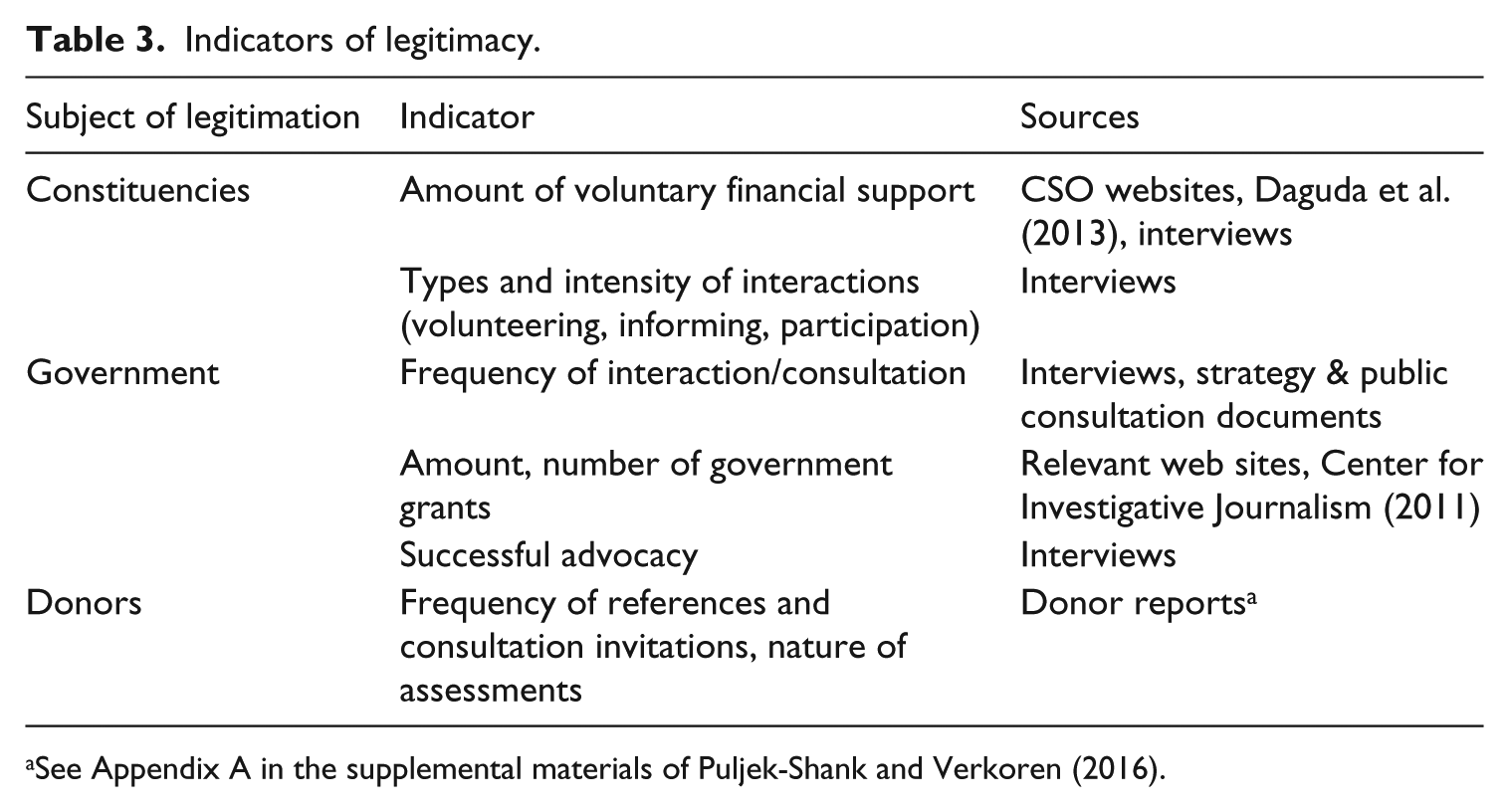
See Appendix A in the supplemental materials of Puljek-Shank and Verkoren (2016).
In total, 23 CSOs were selected for initial interviews, the topics of which were the organization’s activities and goals, indicators of legitimacy (types and sizes of constituency, sources of funding) and understandings of the CSO’s own legitimacy. We chose two CSOs from each of the five categories in Table 2 guided by equal representation of each focus area and three major urban areas of Sarajevo, Banja Luka and Mostar, making a total of 10 case study CSOs.
Next, each case study organization was researched in more depth by following four research steps. Firstly, information on the CSO and its own understanding of its legitimacy was gathered via staff interviews. Secondly, a multi-year initiative of each CSO was researched using process tracing to follow interactions with government, beneficiaries and other CSOs. Process tracing involved interviews with state and other CS actors and a relevant internal and public document review, allowing access to the perspectives of subjects of legitimation. All interviews were analysed in Atlas.ti software using open coding schemes based on the theoretical dimensions and sources of legitimacy (Flick, 2009). The salience of these sources was analysed based on frequency of mention and expressions of high salience. Thirdly, interactions between the case study CSOs and constituencies, political actors, citizens and donors were observed through participant observations of 16 events. 8 Finally, constituency construction of legitimacy was assessed by a survey of 50 randomly selected members and/or participants 9 from each of five CSOs, one per category. Salience was assessed based on the Spearman rank correlation coefficient (ρ) between legitimacy assessments and ratings for 16 statements derived from the sources of CSO legitimacy in Table 1. 10
Multiple CSOs within each urban area and diversity of context regarding local political and ethnic dynamics strengthen the generalizability of the findings, although a limitation is that population surveys have found variability between urban and rural settings regarding CSO participation rates (22.3% versus 14.6%, respectively) (UNDP, 2009: 62). A further limitation is that a population survey was not conducted. The study rather focuses on CSO legitimacy as perceived and understood by those who interact with them – constituencies, government and donors. This approach avoids the problem that quantitative legitimacy ratings are considered to depend on how well the respondent knows the CSO and, as a result, reliable measurements via surveys have only been possible for a few, well-known CSOs (e.g. Seibert, 2013).
Legitimacy and ethnicness of civil society organizations in Bosnia-Herzegovina
Background and previous research
Before the 1992–1995 war, Bosnia-Herzegovina possessed many mostly amateur community organizations (often sports and cultural organizations) that were, however, largely controlled by the Communist Party. In addition, elected neighbourhood organizations (
Only a few studies exist regarding local opinions on CSOs in Bosnia-Herzegovina. Their findings suggest a preference by citizens for organizations offering direct ‘help’ as social services and humanitarian aid (Grødeland, 2006; Pickering, 2006). On the other hand, mass mobilization and ‘political activities’ are seen negatively (Helms, 2014), probably because politics itself is tainted by conflict and corruption. These studies are based on interviews with CSO participants and on focus groups’ impressions of all CSOs and articulate why donor support fosters low local support. Accordingly, they support the view that organizations with local legitimacy are not the same as those considered legitimate by donors. 11 Our research offers a more in-depth view of our case study CSOs and relies on a wider diversity of informants both in- and outside of these organizations. Whilst it further explains and nuances the earlier conclusions, it also offers new data on the sources of legitimacy for local citizens and characteristics of the CSOs considered to be legitimate.
Local and donor legitimacy
In line with earlier research (Belloni, 2001; Pickering, 2006; Sali-Terzić, 2001; Verkoren and Van Leeuwen, 2014), we have found few CSOs with both high local and high donor legitimacy. However, this combination does exist and the possibility thus cannot be a priori excluded. These cases are so rare, our results suggest, because many local actors view donor support with suspicion. Local respondents referred to ‘foreign mercenaries’ and ‘money laundering’ to describe donor-funded CSOs. 12 Although this discourse was heard particularly from ethnonationalist opponents of liberal discourses, its frequency also demonstrates popular mistrust regarding who benefits from donor programmes. According to one interviewee, ‘the dominant opinion [is] that the nongovernmental sector, frequently financed from outside, and that a large part of the money that comes to Bosnia-Herzegovina overflows into those nongovernmental organizations from which it is withdrawn and returns outside the country’ (interview Čehajić, 17 April 2013). In addition, few organizations combine local and donor legitimacy because local and donor actors emphasize different sources of legitimacy. This point is elaborated in the section below. The next section zooms in on the few CSOs that do have both local and donor legitimacy, identifying common factors that may explain this extraordinary situation.
Local and donor legitimacy constructs
What sources of legitimacy do different subjects of legitimation apply in explaining why CSOs are more or less legitimate? In the “CSO Legitimacy and Peace Interventions” section, we distinguished between instrumental and normative dimensions of legitimacy, and separated each dimension into several sources of legitimacy. For local actors (government staff, staff of other organizations and constituents), the most salient instrumental sources of legitimacy were performance (‘competence and capacity’, ‘meeting basic needs’) and ‘representation’ (‘establishing social rights’). The most salient normative sources were ‘clear mission and vision’ (‘principledness and consistency’) and ‘doing the right things’ (‘working for a common rather than a personal good’). 13 For donors, the most salient instrumental sources were ‘performance’ (‘effectiveness’, ‘oriented towards citizens’) and in the normative dimension, ‘mission and vision’ (‘values’, ‘political understanding of CS’, ‘cooperation with other CSOs’). We will next elaborate how these constructs contribute to different assessments of the legitimacy of a CSO by donors and local populations.
Local subjects of legitimation frequently described CSOs with high local legitimacy as those that focus on ‘solving concrete problems’ and addressing ‘everyday needs’. This includes both an instrumental component (the outcomes of problems being solved) as well as an implicit normative component (whose problems and which problems). Although donor representatives similarly included ‘oriented toward citizens’ and ‘articulation of problems and solutions’ as sources of legitimacy, locals’ reference to ‘solving concrete problems’ was also a critique of the liberal projects and discourses of CSOs with high donor legitimacy. Those were seen to promote vague grand norms rather than helping constituencies in their everyday struggles. In addition, for local actors, ‘gender equality’, ‘human rights’, ‘Roma rights’ and ‘LGBT rights’ were described as discourses that certain CSOs master and that provide donor legitimacy and resources. Low local legitimacy for CSOs applying such discourses coincided with negative instrumental assessments of their results and negative normative assessments of their financial interest and integrity (‘foreign mercenaries’ and ‘money laundering’, presented earlier). 14
That local actors consider donor-promoted values as insufficiently concrete vis-à-vis everyday problems is illustrated regarding gender equality, a norm promoted by some CSOs with high donor legitimacy. Several local interviewees supported the idea of gender equality, but felt that donor-supported organizations were insufficiently concrete and did not help individual women. ‘We don’t say “now women should be in politics” but rather a woman has been pushed out because she didn’t listen to the orders of her supervisors’ (interview Čehajić, 17 April 2013). As put by a journalist:
Every year there’s an action about [getting] more women in politics … Will there be more? Because their action isn’t directed so that it really profiles women in politics, protects them, motivates them to be politically strong, they’re doing a project. (Interview Rudić, 14 September 2012).
A second challenge to a focus on ‘gender equality’ was its perceived lower priority in relation to other societal issues. As posed by an alternative media writer:
In a society in which nationalism is growing, sometimes even fascism, social exclusion of those who are different, and you are concerned with gender balance as the most important question in the world. It is important, but practically in this society it’s only one of the questions that are problematic. If in the education system [there is] production of nationalism then it is surely more important to be concerned with that? (Interview Trifunović, 8 April 2012)
For the speaker, the political struggle against ethnonationalism and its perpetuation through the educational system is more important than a narrow concern with gender quotas. In discussing exclusion of families of the developmentally disabled in CSO government interactions, a CSO staff person commented, ‘before every important change of policy by the premier, government, elections - regardless, the government held conversations with its social partners which includes youth, pensioners, students, veterans, military wartime handicapped,
Although patriarchy may explain why this normative project was most often critiqued, the broader delegitimation of initiatives and CSOs applying rights-based discourses points to an explanation why CSOs rarely have both donor and local legitimacy. Local actors often strongly critiqued the perceived lack of results of CS-building efforts and by extension the CSOs that are their most visible representation. This may help to explain why donor-supported CSOs cannot attract support even by ‘moderate and liberal elements of society’ (Ker-Lindsay, 2013: 261).
Civil society organizations combining high local and high donor legitimacy
The presence of CSOs with both donor and local legitimacy, although rare, demonstrates the possibility of diverse CSO approaches within donor and local actor frameworks. We begin by describing an example before reflecting on their common characteristics. The Sarajevo CSO KULT was first mentioned by a municipal official who praised how it had provided assistance in his initiative to convene institutions and CSOs to create a municipal strategy to address youth education, employment and recreation (interview Pršeš, 30 August 2012). The official highlighted that the nature of this assistance was in partnership rather than funds. KULT is a professionalized and large organization by Bosnian standards, occupying a spacious house in the Sarajevo outskirts of Ilidza. It emerged from student organizing and frustrations with the politicized student union. In addition to working across the Federation and state levels, KULT operates a youth centre with classes in a local municipal building. At a KULT-organized conference of youth organizations and local officials, staff person Muamer Logo legitimated KULT by reference to the critiques of the short-term nature of donor projects, calling on participants to, ‘use the word project less’ and articulating the lasting character of KULT’s work. KULT claimed to have helped pass a Federation Law on Youth that enables youth CSOs to form a municipal youth council, while others also recognized their contribution. In the words of KULT founder Jasmin Bešić, ‘only youth know what they need’. The salience of this ‘representation’ claim as a legitimacy source was demonstrated when subjects of legitimation frequently referenced their important role in convening and training the youth councils as a reason for KULT’s legitimacy. In addition, KULT was mentioned by multiple donor representatives as having high legitimacy because of credibility within the Brussels European Union (EU) offices, and a combination of local-level and advocacy programmes (interviews Sijerčić 11 October 2012, Hodžić, 20 September 2012). A case study youth CSO also affirmed KULT as a ‘substantive’ organization whose training assisted their advocacy efforts (interview Čomaga and Bahtijarević, 16 November 2012).
The nine CSOs selected based on multiple indicators of both local and donor legitimacy may provide a valid basis for drawing some preliminary conclusions. Despite heterogeneous locations and focus, they had three common characteristics. Each engaged in ‘solving concrete problems’ (largely but not exclusively service provision) sustained over at least five years. Secondly, they engaged in advocacy focused on institutional change. Finally, all offered geographically local programmes, that is, focused on a particular municipal area and offering – in all but one case – a physical space regularly accessible to constituents (see Appendix B in the supplemental materials of Puljek-Shank and Verkoren (2016) for supporting data). ‘Solving concrete problems’, advocacy and geographically local activities reflect oft-mentioned sources of local legitimacy with instrumental (‘performance’, ‘representation’) and normative (‘doing the right things’, ‘mission and vision’) dimensions.
An additional finding regarding the case study CSOs with local and donor legitimacy is that two appeared to function as intermediaries between donors and local actors; they had sufficient donor legitimacy and funds, yet could partner with organizations with high local but low donor legitimacy. These intermediaries could successfully navigate an environment dominated by powerful donor and local actors in order to achieve support from both, despite often divergent notions of instrumental and normative legitimacy. A characteristic of these intermediaries was ‘ambiguous ethnicness’, manifested as a lack of overt ethnic identifications (terminology, symbols), activities limited to ethnoterritorial divisions and an absence of anti-nationalist discourse. The Banja Luka CSO ‘Hi Neighbor’ is an example of this. Its ambiguous positionality as non-ethnic but also not anti-nationalist working in the Republika Srpska (RS) facilitates interactions with school officials who rely on nationalist political support and with local parents’ committees in donor-funded child protection efforts. The intermediaries, in addition to high donor legitimacy, demonstrated legitimacy for some nationalist political actors. ‘Ambiguous ethnicness’ is discussed in more depth in the following section.
To conclude this section, many local actors mistrust donor-supported CSOs due to negative instrumental assessments of their results (not connected to everyday struggles) as well as negative normative assessments of their priorities and the CSOs themselves (financial interest and lack of integrity). In contrast, CSOs with both local and donor legitimacy evinced the combination of ‘solving concrete problems’, advocacy and geographically local programmes. Some of these organizations acted skilfully as go-betweens between donor and local actors, navigating different discourses and views of legitimacy, which was aided by ‘ambiguous ethnicness’.
CSO legitimacy and ethnicness
The research question on the relationship between CSO legitimacy and ethnicness was reflected in the selection of high local legitimacy CSOs with high ethnicness or low ethnicness. Operationalization of ethnicness, however, required addressing the link between CSOs and populations divided into territories with dominant ethnic majorities 15 following wartime ethnic cleansing and ongoing ethnoterritorialism (Toal and Dahlman, 2011). Only one of the 23 potential case study CSOs indicated to have high local legitimacy by key informants self-declared as mono-ethnic, even though key informants considered an additional three of them as such. This established that self-identification did not suffice to determine a CSO’s ethnic profile. We earlier distinguished between bonding and bridging social capital (intra- and inter-ethnic ties) on the one hand, and ‘inclusiveness’ as a value on the other. Bonding and bridging social capital can be observed from the ethnic identification of those with whom an organization interacts. We operationalized inclusiveness as a more subjective indicator of how the organization is seen to be positioned – both by its own members and by others – vis-à-vis societal division. Here, what matters is whether an organization advocates inclusiveness and civic principles and whether its constituents perceive it as doing so. We operationalized ethnicness accordingly based on both social capital indicators (the ethnic composition of a CSO’s (claimed) constituency, staff and their area of work) and inclusiveness indicators (ethnonationalist versus liberal citizenship ideology, self-identification via ethnic terms and symbols and perception as mono-ethnic).
These indicators did not establish a clear picture (exclusive and bonding versus inclusive and bridging) for most CSOs. Instead, organizations scored differently on different indicators. In particular, organizations’ social capital indicators were not consistent with their own and others’ perceptions of their inclusiveness. For example, organizations gave formal statements of inclusivity, but in interviews, participant observation and the constituency survey references were made to ethnonationalist political projects and symbols. Many CSOs demonstrated some evidence of ethnicness based on bonding social capital without being explicitly ethnic. Organizational ethnicness is much more complex than the literature suggests.
The relationship between ethnicness and local legitimacy was similarly complicated. We found no clear correlation between high ethnicness and high local legitimacy. Two of eight CSOs with high local legitimacy had consistently low ethnicness. They had multi-ethnic constituencies and staff, worked in multi-ethnic territories and were inclusive and civic in their ideology, self-identification and use of symbols, and perceptions of subjects of legitimation. To be locally legitimate in a divided society, then, an organization does not have to be ethnically based. The remaining six CSOs with local legitimacy evinced ‘ambiguous ethnicness’, having some but not all of the ethnicness indicators. Regarding organizations with donor legitimacy, expectations were confirmed in that none had high ethnicness but some did demonstrate ‘ambiguous ethnicness’. Ethnic ambiguity also featured in the small but interesting sample of CSOs discussed earlier with both local and donor legitimacy. In the remainder of this section we shall elaborate on this largely unexplored category of organizations.
In a divided society, CSOs may be mono-ethnic not by persuasion but in practice, simply because of the segregated context. Several CSOs work in territories with one predominant ethnic majority and our research did not indicate frequent interactions with members and beneficiaries across the ethnic divide (‘bridging social capital’). Many of these ‘ethnic-in-practice’ CSOs, particularly (but not only) in the RS, declare themselves as ‘non-ethnic’. These ‘ethnic-in-practice’ CSOs in the RS tended to enjoy legitimacy in the eyes of RS functionaries, as they received government funding and were included in RS government consultations.
‘Hi Neighbor’ from Banja Luka, for example, focuses on children’s rights and youth activities. It demonstrates low ethnicness through universalist rights-based advocacy, lack of ethnic symbols and not declaring its beneficiaries in ethnic terms. However, it demonstrates evidence of ethnicness in that the area of direct activities is the Serb-majority RS (Report for 2013, 2013), while its mission statement refers ambiguously to working in ‘our country’. In addition, its advocacy primarily targets RS institutions. An initiative to advocate adoption of the Lanzarote Convention on Child Protection focuses on RS law and regulations, while Tuzla partner ‘Zemlja djece’ similarly engaged in the Federation. These pragmatic choices demonstrate how ‘Hi Neighbor’ employs ‘ambiguous ethnicness’ in the legitimation process.
Another example comes from the divided Federation city of Mostar. Mostar was bitterly contested and heavily damaged during the war and, despite a period of international administration and extensive peacebuilding efforts, remains socially segregated with separate institutions and spaces (Hromadžić, 2008). Located in majority-Bošnjak East Mostar, the CSO B&H Woman gives the impression of an activist organization with posters informing victims of domestic violence prominently displayed towards the street. B&H Woman has legitimacy for the police and municipal government, which provides small but ongoing funding for their domestic violence shelter. The CSO includes women regardless of ethnicity and works in areas with Croat and Serb majorities, but eased acceptance in these areas at times by not explicitly referencing their role. 16 Consistent with ethnic territorial divisions and unlike any other city, there are two women’s shelters, one in West Mostar run by Catholic (and by association, Croat) Caritas, the other in East Mostar run by B&H Woman. 17 Local populations and beneficiaries can thus perceive the CSO as ethnic. Ethnoterritorial division thus influences perceptions of ethnicness despite non-nationalist ideologies and expressed liberal norms.
So far, we have discussed differences between social capital criteria (intra- and inter-group ties) and perceptions of inclusiveness. Perceptions themselves can also differ: an organization can be perceived to be mono-ethnic whilst considering itself to be inclusive. This is demonstrated by the CSO Nahla. A first impression of its multi-storey building in the urban Otoka neighbourhood of Sarajevo is shaped by a prominent Islamic architecture-inspired logo and the steady stream of some of its 5000 dues-paying female members, many with headscarves, heading to exercise, language and Islamic classes or psychological counselling. In both public perception and key informant interviews, the association with Islam implies that Nahla is Bošnjak. Founder and director Sehija Dedović, however, emphasized that an organizational norm is to not focus on being Bošnjak and that, ‘in each of our programs there are women that are not Muslims … from 10 there are at least two if not more’ (interview Dedović, 2 April 2013). The prominent use of Muslim terminology and Muslim courses, supporting and apparently benefitting from the perception of being Bošnjak, coexists with a mission statement that supports the liberal ‘principles of freedom of thought, conscience, and faith in modern civil society’.
How do we explain that the majority of high local legitimacy organizations, in addition to some with both local and donor legitimacy, are ‘ambiguously ethnic’? We find that legitimate organizations are those best able to manoeuvre in ethnically divided societies and political systems, and adaptive use of ‘ambiguous ethnicness’ enables them to do so. In our discussion of legitimacy sources, ‘positionality in relation to dominant discourses’ was identified as a source of normative legitimacy. ‘Ambiguous ethnicness’ offers benefits to CSOs vis-à-vis this positionality, as it enables them to fit themselves into different and even competing discourses where beneficial. Thus, none of the high donor legitimacy case study organizations used ethnic labels or symbols, enabling conformity to de-ethnicized liberal donor discourses. In addition, most CSOs considered legitimate by government actors refrained from public anti-nationalist self-identification, enabling conformity to dominant ethnonationalist discourses. In addition, in the constituency surveys ‘opposition to nationalism’ was moderately salient for CSO legitimacy (ρ = 0.39), meaning that this positionality is relevant but is not a major source of legitimacy for constituencies.
To conclude this section, CSO ethnicness is more ambiguous than implied by theories that characterize CSOs as either bonding or bridging social capital (Putnam, 2000; Varshney, 2002) and either ‘for the politics of inclusion and civic principles’ or ‘using legal means but divisive’ (Belloni, 2008). As it turns out, many organizations are somewhere in between these extremes. Moreover, contrary to expectations we did not find a clear correlation between high ethnicness and high local legitimacy or between low ethnicness and high donor legitimacy. Instead, what matters for legitimacy is the ability of CSOs to skilfully interact with ethnically divided constituencies and political structures.
Conclusion
Although CS strengthening is central to peacebuilding policies for divided, post-war societies, its implementation has been criticized for creating internationalized organizations without local backing that cannot fulfil the roles theoretically attributed to CS, such as representing citizens’ interests. This article has focused on CSO legitimacy, exploring why legitimacy for donors rarely accompanies legitimacy for local actors. In divided societies like Bosnia, we have hypothesized, an organization’s orientation to competing ethnonationalist projects is relevant in explaining legitimacy. Whilst donors shy away from mono-ethnic organizations, seen as unconducive to peacebuilding, ethnicness may provide local legitimacy.
Our findings regarding the relationship between local and donor legitimacy support previous research that few CSOs have both high local and high donor legitimacy. One explanation is that local and donor actors apply different norms when assessing legitimacy. Another explanation why high donor legitimacy CSOs have low local legitimacy is mistrust of international normative frameworks and perceived lack of concrete results. However, a few CSOs enjoy both types of legitimacy. These were characterized by a focus on ‘solving concrete problems’, advocacy and geographically local activities that were tangible for beneficiaries. Some of them functioned as intermediaries between donor and local actors and discourses and an ambiguous relation to ethnicity helped them in doing so.
The findings regarding CSOs’ ethnicness nuance research characterizing organizations as exhibiting either bonding or bridging social capital or as either inclusive or divisive. Instead, many organizations relate to ethnonationalism in nuanced, complex and ambiguous ways. What appears to matter for local legitimacy is not ethnicness per se, but skillful interaction with ethnically divided constituencies and political structures.
This analysis has contributed to the ‘local turn’ in peacebuilding research by offering rare empirical data on the relationship between CSOs and their subjects of legitimation. It has elaborated the connection between CS and divided societies, nuancing existing ideas about organizations being either conducive or detrimental to peaceful relations. Our findings offer entry points for donors seeking to support locally legitimate organizations, rather than reinforcing gaps between donor-supported CSOs and groups with local backing. If low local legitimacy limits organizations’ contributions to building peace, donors need a better understanding of how legitimacy arises. Our findings suggest that local subjects of legitimation are wary of discourses on rights and citizenship and instead seek organizations that can ‘solve concrete problems’. Local constituents do not expect CSOs to only engage in apolitical service delivery, however, as locally legitimate organizations also engage in advocacy. Rather, it is necessary to translate grand projects into concrete and tangible activities on the ground. Finally, donors would benefit from better understanding the ‘ambiguous ethnicness’ of their recipients and a less dichotomous view of divided societies based on ‘bad’ ethnic/’good’ non-ethnic divisions.