







Abstract
Keywords
Introduction
Open government data initiatives (OGDIs) are often intended to achieve a variety of objectives, including enhanced transparency, participation and collaboration (Alexopoulos et al., 2013; Attard et al., 2016; Kassen, 2013), as well as the stimulation of innovation and economic value (Zeleti et al., 2016). To realise this, open government data (OGD) are published on the Internet by governments or publicly funded research organisations and can be reused by the public (Alexopoulos et al., 2013; Jetzek, 2015; Linders, 2013; Meijer et al., 2012). These efforts, however, are criticised for a number of reasons, including not taking the user’s point of view into account (Zuiderwijk, 2015) and a lack of convincing evidence regarding the impact and value created by OGDIs (Davies, 2013; Jetzek, 2015).
Considerable amounts of effort and money have been devoted to attaining the objectives of OGDIs (e.g. The Economist, 2013; The World Bank, 2013). Governments have high expectations regarding the achievement of such objectives (Kroes, 2011). Some OGDIs have successfully achieved their objectives (e.g. Attard et al., 2015; Evans and Campos, 2013), meaning that these initiatives have resulted in benefits that are related to the intended objectives. For example, when a particular OGDI aimed to increase governmental transparency, this OGDI actually managed to attain the benefit of increased governmental transparency. However, many OGDIs seem to have only partially achieved their objectives, or have not done so at all. An example of the latter is Kenya’s national OGDI, where the objective of data reuse was not achieved as the number of users remained stagnant and then decreased substantially (Brown, 2013). In addition, for many other OGDIs, it is not clear whether they have resulted in the delivery of the intended benefits.
Furthermore, while OGDIs are sometimes evaluated individually (e.g. Lee, 2014) or through larger projects (e.g. Kim et al., 2009), these evaluations usually evaluate all initiatives against the same criteria without looking at the intended objectives set by the OGDI (Susha et al., 2015) or without taking the particular context into account (Janowski, 2015). Moreover, evaluations of OGDIs are often carried out at a country or national level, whereas OGDIs may also be organised at the international or local level. It is thus unclear whether OGDIs at different government levels have achieved their objectives and delivered the benefits they intend to deliver.
We used a globally distributed survey to collect data on 156 OGDIs in 61 countries all over the world, and then investigated the relationship between the objectives of OGDIs at different government levels and the benefits delivered. As we could not directly measure the attainment of each objective, we compared the objective of each initiative to one or more related delivered benefits. For instance, when the objective was ‘Increased transparency within the government and/or its legislation’, the achievement of this objective was established by analysing the extent to which the benefit ‘Increased transparency’ had been delivered (see later). Documents like PDFs and initiatives that provide only processed rather than raw data (such as participation, petition and complaint initiatives) were outside the scope of this study.
Research background
The aim of our literature review was not to obtain a complete overview of all possible OGDI objectives as these might be considerably different. Instead, the aim was to gather background information concerning the main objectives mentioned in prominent and easily accessible OGD policies and in the literature. The following keywords were used in various combinations to find literature relevant to this research: ‘open data’, ‘open government data’, ‘public sector information’, ‘benefit’, ‘objective’, ‘aim’ and ‘goal’. We searched for papers in the Scopus, ACM Digital Library and Google Scholar databases. Scopus includes Elsevier (ScienceDirect), Springer, Taylor & Francis, Wiley Blackwell, Institute of Electrical and Electronics Engineers (IEEE), Sage, Emerald and many other sources. As suggested by Webster and Watson (2002), the citations in the identified articles were also examined to find additional relevant literature and to enrich the literature base. This search resulted in a rich collection of articles, which were categorised into clusters of OGDI objectives and OGDI benefits. Policy documents were searched for using Google and the websites of national governments.
Objectives of OGDIs
The US, the UK and many European countries have explicit and easily accessible policies concerning OGD. Together with the literature, these policies show that major objectives of OGDIs include increasing transparency and accountability, stimulating innovation, improving and supporting decision-making, stimulating data reuse, counteracting corruption, and providing new services and products (see Table 1). These objectives can be broken down further into their various components. For example, innovation can be related only to business developments or to public services (Jetzek et al., 2013; Schillemans et al., 2013). The objective of data reuse can be focused on various fields of government, such as the environmental sector, and can be in various forms, for example, for predictions or validations of policies (Cowan et al., 2015; Jocelyn et al., 2014). There are many objectives and some of them overlap and are interdependent, for instance, creating smarter cities may be done by stimulating innovation.
Objectives of open government data initiatives as mentioned in the literature and policy documents.

Benefits delivered by OGDIs
OGD policies and the literature also describe the benefits that OGDIs can deliver. They include increased transparency, increased public engagement, increased collaboration, economic growth and easier discovery of data (see Table 2). Table 2 shows that many benefits may be delivered in different categories, including political and societal benefits, economic benefits, and technical and operational benefits.
Benefits delivered by open government data initiatives as mentioned in the literature and policy documents.

Research design
Questionnaire
A questionnaire was created containing the following sections: an introduction; a description of the open government initiative (including its objectives); the technologies and functionalities used in the initiative; the benefits delivered by the initiative; the initiative’s development and user barriers; and the demographics of the person completing the questionnaire (see Appendix 1, available online). The literature mentioned earlier was studied to obtain insight into the state of the art in open government research and to ensure that the questionnaire covered the topics mentioned in the literature. The questionnaire was tested by seven master’s students in domains related to open government. This resulted in changes to some questions in order to make them clearer and less ambiguous. Moreover, the labels of the five-point Likert scale were made clearer and some questions were made more concise. Then, a second round of testing took place involving eight people, of whom six were working or studying in the field of open government. No more changes were made since the testers did not have any further comments on the survey.
Data collection
Accessing data from all over the world is a challenging task. A free, massive open online course (MOOC) on ‘Open Government’ followed by participants from all over the world enabled the distribution of a worldwide survey. The five-week MOOC was taught by Delft University of Technology in the spring of 2016 and was provided through the EdX platform. The number of enrolments for the course varied between 3082 (at the start, on 14 March 2016) and 3607 (at the end, on 26 April 2016). Data on the participants’ backgrounds are presented later. In total, 153 countries were represented by the course participants.
Data were collected at the level of initiatives. One important assumption was that the data we collected about the OGDIs reflect the actual initiatives rather than the opinions of the people providing the data. In the questionnaire, each respondent provided information concerning the way he or she understood the OGDI. The majority of the respondents (57%) were involved in the OGDI that they assessed.
A stepwise filtration of the OGDIs was done based on the questionnaire data (see Figure 1). First, the complete data set consisted of 263 survey entries containing cases that qualified as OGDIs according to the respondents. Incomplete responses were removed from our sample, leaving 251 OGDIs. The initiatives that contained incorrect information or were related to non-existent initiatives were then removed, which resulted in 182 initiatives. Incorrect information concerned, for instance, PDF files about open data in general, links to initiatives with no relation to OGD or simple visualisation platforms or government web pages. The existence of the initiatives was checked by reviewing every website link of the given initiative. If this website link was a dead link or no link to an OGDI was provided, the data entry was rejected. Finally, from the 182 remaining initiatives, 168 responses concerning 156 OGDIs from 61 countries that fitted our definition of OGDIs were selected (for the overview, see Appendix 2, available online). This last step was done as follows. If the respondents indicated that the objective of the initiative was either the release of government data to the public as OGD or the use of OGD by the public (e.g. by citizens or journalists), the initiative was included in our selection. Furthermore, if the respondents referred to OGD later on in the survey and OGD appeared to be an important aspect of the initiative, we also included the initiative in our sample.

The selection of OGDIs for this study.
Relating OGDI objectives to delivered benefits
The achievement of the objectives was measured by investigating the delivered benefits (as indicators) (see Figure 2).

The way that objectives and benefits of OGDIs are related to each other in this study.
To measure whether the level of delivered benefits was significantly different for the OGDIs with and without a certain objective, a Mann–Whitney test was conducted (Mann and Whitney, 1947). The test was appropriate since the survey produced one independent categorical variable with two categories (whether a certain OGDI had a certain objective: yes or no) and one continuous dependent variable (the extent to which the benefit had been delivered). The Mann–Whitney test is the non-parametric equivalent of the independent t-test (Field, 2009: 540), and it had to be used since the sample did not meet the assumptions for parametric tests (i.e. the data were not normally distributed).
Data preparation
A reliability analysis was conducted to examine whether the independent variables consistently reflected the constructs that they were measuring (Field, 2009). For instance, we measured whether the objective ‘Create openness’ (the construct) had been attained by creating a scale of three benefits, namely, easier access to data, easier discovery of data and the ability to reuse data. The reliability analysis tested whether the three benefits consistently reflected the objective. Table 3 shows the reliability analysis results derived from Cronbach’s alpha test (Cronbach and Meehl, 1955).
Reliability analysis of benefits for specific objectives (Cronbach’s alpha test).

Murphy and Davidshofer (1988) state that alpha values below 0.6 are unacceptable, values of 0.7 are low, values between 0.8 and 0.9 are moderate to high, and values around 0.9 are high; however, according to others, a lower acceptance boundary can be adopted (Nunnally, 1967), namely, that alpha values of between 0.5 and 0.6 may still be acceptable. Except for one value, all values were moderate (.781) to high (.886). Cronbach’s alpha value for the construct ‘Use of OGD by the public’ was lower (.606), yet not unacceptable. Thus, the created scales of the objectives could be used for further analysis.
Respondents’ demographics and description of the OGDIs
Respondents’ demographics
Information concerning the respondents is presented in Table 4. Table 4 shows that most respondents work in the service sector (62.4%) or in the commerce sector (23.7%). Most have a master’s degree (42.6%) or a bachelor’s degree (28.4%). The majority (39.4%) have more than 10 years of experience in their field. Although most (57.4%) of the respondents are involved in OGDIs at least to a certain extent, a large proportion (42.6%) are not involved at all. The majority (94.6%) of all respondents trusted the government at least to a certain extent.

The relation between the objectives and the delivered benefits of OGDIs.
Participants’ demographics.

Description of the OGDIs
The OGDIs that were assessed via the questionnaire were implemented in a total of 61 countries. The countries mentioned most often were the US, Brazil and the Netherlands (implementing 21%, 11% and 8% of the OGDIs, respectively). Table 5 presents the global distribution of the OGDIs. The table shows that most OGDIs (29%) are in the Anglo cluster, mainly including initiatives from the US; a large percentage (27%) are in the Latin American cluster, particularly consisting of initiatives from Brazil.

The OGDIs in our sample are at national, international, local and regional levels. Table 6 shows the distribution of the levels at which the OGDIs are represented. In terms of percentages of the total number of cases, 35% of the initiatives are at the national level and 25% are at the local administrative level. Only 7% are international OGDIs.
OGDI characteristics (out of total number of 168 OGDI responses studied).
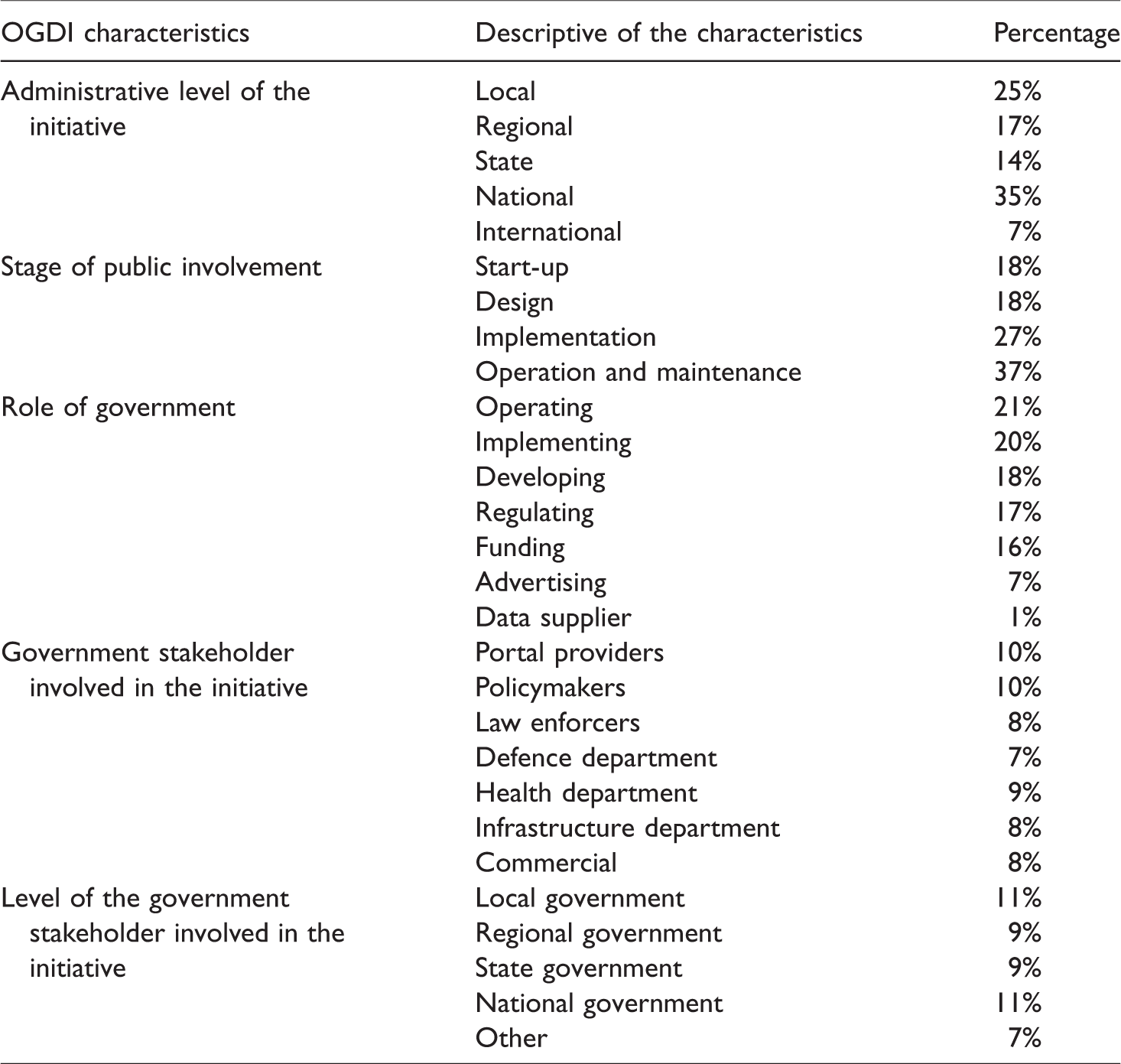
Public stakeholders are involved in the OGDIs of our sample in four different phases: the start-up phase, the design phase, the implementation phase and the operation and maintenance phase. As shown in Table 6, most are engaged in the operation and maintenance phase (37%), followed by some involvement in the implementation phase (27%) and equally low involvement in the start-up (18%) and design phases (18%). Like the public stakeholders, most of the government’s involvement is in the operation phase (21%) and the implementation phase (20%).
Findings and discussion on the attainment of OGDI objectives
Objectives of OGDIs
The second section of the article showed the diversity of OGDI objectives. The comprehensive list of OGDI objectives from the second section has been condensed into the objectives shown in Table 7. This table shows the number and percentage of OGDIs in our selection of 156 OGDIs that aimed at achieving a particular objective. The four major objectives were: create openness (62.8%), increase transparency (55.2%), engage government with citizens (50%) and use of OGD by the public (48.3%). Note that one OGDI can have multiple objectives and therefore the percentages do not add up to 100%.
Objectives of OGDIs.

Delivered benefits
After providing information concerning the objectives of the OGDI they selected, respondents were asked to answer questions about the benefits that the OGDI had delivered. The benefits were divided into political and societal benefits, economic benefits, and operational and technical benefits. Table 8 shows all the benefits that were presented to the respondents and the number and percentage of initiatives that delivered the specific benefit out of the total number of OGDIs given.
Benefits delivered by the OGDIs.
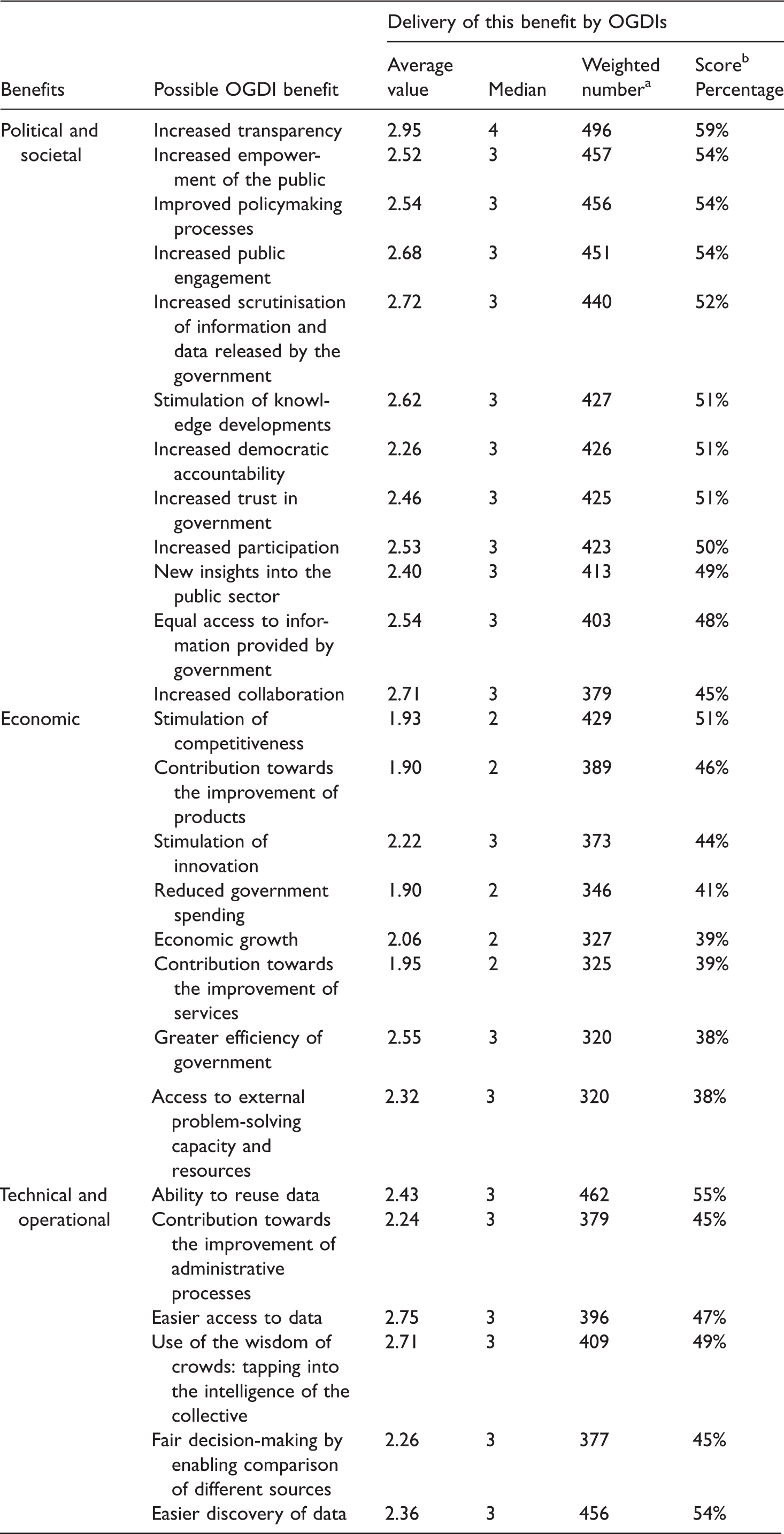
Notes: aHere, the weighted number refers to the benefit extent (measured on an ordinal scale from 1 to 5) multiplied by the number of OGDIs in which it is delivered. bThis represents a score for the number of cases in which the given benefit was fully delivered. The maximum weighted number for each benefit is 840, namely, a score of 5 on the ordinal scale times 168 OGDI responses if the benefit was delivered fully in each of the OGDIs. The score is calculated by dividing the weighted number by the extent to which the benefit was fully delivered (the ordinal scale times the number of case responses; thus, 5 times 168).
The results of our survey show that the benefits delivered by the OGDIs are most often operational and technical benefits, followed by economic benefits and, lastly, societal benefits. The societal benefits might be harder to measure objectively and this might be why they were reported least. Moreover, the societal benefits are highly interconnected. Political and societal benefits like increasing transparency (58%) and the scrutinisation of information and data released by the government (51.5%) are almost equally delivered, followed by many others like participation (49.5%), trust (49.7%) and collaboration (44.3%). Economic benefits are mainly delivered in the form of contribution towards the improvement of services (45.5%) and greater efficiency of government due to public input (37.4%). The operational and technical benefits are delivered by easier access and discovery to data and the ability to reuse the data in most of the OGDIs. One should keep in mind that these results are subjective and depend on the viewpoint and opinion of the participants.
The benefits that were most often delivered were ‘Increased transparency’ (58% of the OGDIs yielded this benefit), ‘Ability to reuse data’ (54%), ‘Increased empowerment of the public’ (54%), ‘Improved policymaking processes’ (53%) and ‘Contribution towards the improvement of administrative processes’ (53%). None of these most-delivered benefits were economic benefits. Benefits that were delivered least by the OGDIs were ‘Greater efficiency of government’ (37%) and ‘Access to external problem-solving capacity and resources’ (37%), although a relatively high percentage of the OGDIs were still found to deliver these benefits and the percentage of the least-delivered benefits do not differ that much from the percentage of the most-delivered benefits.
Delivered benefits in relation to the OGDI objectives
The achievement of objectives was measured by investigating the delivered benefits (as indicators) (see earlier). Some objectives were related to multiple benefits, as can be seen in Table 9, but the relations of every objective with a benefit were checked individually. The median ranged from 1 to 5: 1 = ‘not attained at all’, 2 = ‘attained to a small extent’, 3 = ‘attained’, 4 = ‘attained to a large extent’ and 5 = ‘fully attained’.
Comparison of the level of benefits delivered by OGDIs with and without a certain related objective.

Notes: *
Table 9 provides the results of the Mann–Whitney test and the medians of the compared groups (i.e. whether the OGDI had a certain objective or not). Surprisingly, this test shows that the extent to which the benefits of OGDIs are delivered is not statistically different for OGDIs that have a related objective compared to those that do not have this objective. For example, the extent to which the benefit ‘Easier access to data’ was delivered was not significantly different for OGDIs aiming to create openness (
We examined whether we could find any patterns in the attainment of the objectives for different types of OGDIs. After we made a distinction between OGDIs at a state or national level (e.g. the USA’s
2
and Bulgaria’s
3
open data initiatives) and OGDIs at a local or regional level (e.g. open data from Buenos Aires in Argentina
4
), we found a substantial difference in the results (see Table 10). The general trend was that the benefits delivered by state- and national-level OGDIs are affected more by a related objective compared to local- and regional-level OGDIs. Thus, the relation between the objectives and the benefits is stronger for state and national OGDIs (see Figure 4). For example, the benefit ‘Easier discovery of data’ appears to be significantly affected by the objective ‘Create openness’ for OGDIs at the national and state level (
Comparison of the level of benefits delivered by OGDIs at local or regional and national or state levels.


The relationship between the objectives and the benefits delivered by OGDIs at different levels.
However, in some cases, the opposite trend was found, that is, a higher value of
We found that OGDIs from certain countries more often have benefits that match the objectives. For instance, there are more often matching benefits and objectives for Brazil (13.5%), the US (13.5%), Europe-wide OGDIs (6.13%), Greece, Spain, the Netherlands and India (5% each). However, this result is probably the effect of a higher number of participants from these countries, increasing the chance of having an OGDI where the objectives and benefits match, in relation to a lower number of OGDIs reported for the other countries. In addition, there is relatively more often a match between objectives and benefits for OGDIs where the public is involved in the implementation and operation phase than for OGDIs where the public is involved in the start-up or design phase, although this finding is not statistically significant. In more developed OGDIs, the stakeholders may have a more realistic view on which objectives can realistically be attained.
Discussion
Causes for the mismatch between objectives and benefits
Our study revealed that an OGDI having a certain objective did not significantly influence whether the benefits related to that objective were delivered. There is a mismatch between the benefits delivered and the objectives set. Examples of OGDIs in which there is a mismatch include the Greek e-Trikala OGDI (which aimed to create openness but instead used the wisdom of crowds) and the Diavgeia Transparency Programme (which aimed to increase democratic accountability but instead increased transparency). An explanation for this mismatch might be that the objectives are not focused on the situation at hand. Politicians and policymakers might not set objectives that take into account the context and societal problems that can be addressed by opening up the data. OGDI objectives are often generic, focusing on objectives like transparency, participation (Alexopoulos et al., 2013; Attard et al., 2016; Kassen, 2013) and economic value (Zeleti et al., 2016). This makes it difficult for practitioners to know exactly what should be done to achieve the objectives.
Furthermore, there are many assumptions and conditions underlying the benefits. For instance, to reuse data, a certain data user may need to acquire data-analysis skills, which requires specific training programmes (Zuiderwijk et al., 2015). When trying to achieve the OGDI objectives, the background of the data user is often not taken into account. In several cases, there was a narrow view on transparency, where transparency mainly referred to the visualisation or merely the opening of data. For instance, in one of the OGDIs, merely the ability to open up the emails of politicians was considered as transparency, whereas further content analysis of these emails was not considered.
Another possible explanation for the mismatch between the benefits delivered and the objectives set is that OGDIs might not be focused on achieving their objectives and may be based on copying other initiatives. We argue that the context and societal problems that OGDIs address should be better taken into account in OGDIs, and the assumptions and conditions for achieving OGDI objectives should be made explicit in open data policies. The objectives set in the start-up and design phases should be reviewed critically when OGDIs develop further. Objectives may need to be adjusted in the implementation and operation phases to ensure that there is a better match between set objectives and delivered benefits.
According to the literature, objectives should ideally be formulated according to ‘SMART’ principles (Doran, 1981). This means that they should be ‘Specific’ (What should the OGDI achieve?), ‘Measurable’ (How will we know that this has been achieved?), ‘Assignable’ (Who will do what to attain the objective?), ‘Realistic’ (What can realistically be achieved?) and ‘Time-related’ (When will this be achieved?) (Doran, 1981). Some of the examined OGDIs seem to be described more according to the SMART principles (e.g. the OGDI objectives of the Open Government Partnership of the US are specifically presented according to the SMART principles 5 ) than others (e.g. for the OGDI of Punjab government public schools of India, the objectives are not specific 6 ). Our research also suggests that OGDI objectives should be presented according to the SMART principles in order to obtain a more realistic understanding of the potential benefits that can be attained.
Study limitations
When interpreting the results of this study, one should take into account that we could not directly measure the fulfilment of each objective. We therefore compared the objective of each initiative to one or more related benefits delivered by the initiative. It is difficult to measure the attainment of some objectives since they consist of several sub-dimensions. It is therefore possible that the delivered benefits that we examined do not completely measure the objective of the OGDI.
Moreover, an important assumption in our study was that the data we collected reflect the actual initiatives rather than the opinions of the people providing the data. It is unclear to what extent the respondents have sufficient knowledge of the OGDIs to provide the correct information. However, we had reason to believe that at least most of the respondents were knowledgeable as they were participating in a MOOC on Open Government, the majority of the respondents (57%) were involved in OGDIs in general and 75% of them had at least three years of experience in the field (see earlier).
Furthermore, we do not claim that the 156 OGDIs in our sample are representative of the objectives of all OGDIs worldwide. One should keep in mind the context in which the objectives were collected. Most OGDIs were provided by respondents from the US, Brazil, the Netherlands and Spain. In addition, many of the studied objectives and benefits are influenced by other factors that we did not study. For example, increasing trust is not just influenced by OGDIs; it may also be affected by other developments and events, such as scandals and the corruption of politicians and the culture in a country. One should be aware that the studied factors are interrelated and complex.
Finally, we do not have information concerning when the OGDIs were launched. Some may have been launched only recently, and it may be too soon to establish whether their objectives have been achieved. For instance, it can take many years to increase trust in the government or increase government accountability. These limitations need to be taken into account in the interpretation of our results, and we recommend their further study in future research.
Conclusions
This study contributes to existing research by providing insight into the desired objectives of OGDIs and the extent to which these objectives are attained. Using data from 168 responses on 156 OGDIs worldwide, we found that certain objectives are more common than others. The most common objective is to ‘create openness’ (63% of the OGDIs), followed by the objective to ‘increase transparency within the government and/or its legislation’ (55%), to ‘engage with citizens through social media channels’ (50%), and the ‘use of OGD by the public (e.g. by citizens or journalists)’ (48%). The objectives in the categories ‘other’ (9%), ‘develop freedom of information legislation’ (19%) and ‘increase trust in the government’ (22%) were less prominent. Our survey showed that the OGDIs we studied mostly delivered operational and technical benefits, followed by economic benefits and, lastly, societal benefits. The main benefits delivered were increased transparency (58% of the OGDIs yielded this benefit) and the ability to reuse data (54%).
Our study shows that the benefits delivered are often in areas other than those in which the OGDIs’ objectives lie. This indicates that whether a benefit (e.g. increased openness, trust in the government or innovation by companies) is delivered is not significantly affected by having an objective related to that benefit, suggesting a mismatch between the two. This finding suggests that OGDIs might not be focused on achieving their objectives, but might be mimicking other initiatives. This has important implications as considerable amounts of money and effort are devoted to achieving these objectives, and this has not clearly resulted in the delivery of the related benefits. However, our study also shows that many OGDIs do deliver various benefits, although they do not seem to be closely related to the objectives of the OGDI. When we distinguished between OGDIs at different governmental levels (e.g. national and local), the analyses showed that the objectives of state- and national-level OGDIs are more often achieved compared to those of local- and regional-level OGDIs.
Further research should investigate why the objectives of state- and national-level OGDIs are more often achieved and whether the effects of local- and regional-level OGDIs can be improved by learning from other OGDIs. Practitioners should avoid copying each other’s initiatives and take into account the objectives, the context and the societal values that need to be delivered. OGDIs do not always deliver the expected benefits and the benefits may be in areas other than the intended ones. Future research should include an in-depth examination of how OGDIs can more effectively deliver the desired benefits.
Supplemental Material
RAS739115 Appendix 1 - Supplemental material for Investigating the attainment of open government data objectives: is there a mismatch between objectives and results?
Supplemental material, RAS739115 Appendix 1 for Investigating the attainment of open government data objectives: is there a mismatch between objectives and results? by Anneke Zuiderwijk, Rhythima Shinde and Marijn Janssen in International Review of Administrative Sciences
Supplemental Material
RAS739115 Appendix 2 - Supplemental material for Investigating the attainment of open government data objectives: is there a mismatch between objectives and results?
Supplemental material, RAS739115 Appendix 2 for Investigating the attainment of open government data objectives: is there a mismatch between objectives and results? by Anneke Zuiderwijk, Rhythima Shinde and Marijn Janssen in International Review of Administrative Sciences
Footnotes
Acknowledgement
 ). The authors would like to thank their colleagues on this project for their input to this article,although the views expressed are the views of the authors and not necessarily of the project.
Notes
References
Supplementary Material
Please find the following supplemental material available below.
For Open Access articles published under a Creative Commons License, all supplemental material carries the same license as the article it is associated with.
For non-Open Access articles published, all supplemental material carries a non-exclusive license, and permission requests for re-use of supplemental material or any part of supplemental material shall be sent directly to the copyright owner as specified in the copyright notice associated with the article.
