







Abstract
Introduction
In the aftermath of the 9/11 attacks, US President George W. Bush, US Secretary of State John Kerry, British Prime Minister Tony Blair, along with other prominent politicians, policymakers, and commentators explicitly linked terrorism to poverty (Bush 2002; Easterly 2016; Krueger 2007; Sterman 2015). However, cross-country research has produced ambiguous and sometimes contradictory evidence for a potentially negative relationship between income and terrorism (Abadie 2006; Azam and Thelen 2008; Walsh and Piazza 2010). 1 Yet, despite the inconclusive evidence, the hypothesis linking poverty to terrorism remains one of the most common myths related to terrorism (Gaibulloev and Sandler 2022).
This paper makes two contributions. First, we introduce a basic theoretical framework to provide a structured way of thinking about potential links between a polity’s income level and the degree of terrorism it experiences. Our assumptions are informed by the existing descriptive evidence that has motivated prior studies. In particular, we aim to understand at which combination of GDP/capita and grievances (broadly defined) at the personal and societal level an individual turns to terrorism. Our framework is able to accommodate different perspectives of the existing literature and produces competing hypotheses about how income levels inform a polity’s degree of terrorism. The main propositions suggest an inverted U-shape under certain assumptions (see also Freytag et al., 2011; De la Calle and Sánchez-Cuenca, 2012), while the poverty-highlighting ‘Bush Hypothesis’ emerges under other assumptions. 2 Finally, our theoretical framework suggests society-level grievances moderate the peak of the income-terrorism link.
Second, in order to test these hypotheses, we construct a novel database of terrorism at the
Our empirical approach matches subnational (regional) data on GDP/capita (from Gennaioli et al. 2014) with subnational data on terror attacks (from START 2017b) for 1527 regions in 75 countries between 1970 and 2014. These sample countries are statistically representative of the global relationship between income and terrorism. Our unit of analysis constitutes the second-largest administrative unit in the respective nation, i.e., a federal state, county, or province, depending on the country. Our main specifications hold constant potential confounders associated with (i) population size, (ii) regions hosting a country’s capital city, (iii) oil production, as well as (iv) region- and period-fixed effects. Region-fixed effects prove particularly powerful in accounting for unobservable time-invariant differences across regions, such as geographical attributes that often correlate with terrorist activity (e.g., mountainous terrain or ruggedness) and unique histories of ethnic and religious conflict or colonization experiences. These fixed effects also reasonably control for those environmental and societal aspects that only change slowly over time within a region, such as fractionalization and polarization along ethnic or religious dimensions.
The empirical results lend firm support to our theoretical proposition suggesting an inverted U-shaped pattern between income levels and terrorism. This finding is consistent with the cross-country evidence documented by Freytag et al. (2011), De la Calle and Sánchez-Cuenca, 2012, and Enders and Hoover (2012) who posit low-income polities lack the resources and potential gains to invite terrorism, while high-income polities can afford effective counterterrorism measures and offer substantial opportunity costs to prospective terrorists. Our findings suggest that, as incomes in poor regions increase, terrorism becomes substantially more likely until an estimated peak of approximately US$12,800 (in constant 2005 PPP US$). In our sample, 63 percent of all observations would fall below that threshold. Above that, higher income levels would be associated with a decline in terrorism. Importantly, we find this inverted U-shaped pattern for domestic and transnational terrorism alike.
Finally, we consider potential heterogeneity along perpetrator ideology. Illustrating the generality of our findings, the inverted U-shape independently emerges for all identifiable ideologies with (i) Islamist, (ii) left-wing, (iii) right-wing, (iv) separatist, and (v) other religious groups. The consistency with which this pattern emerges across regions around the world for over 45 years suggests a systematic inverted U-shape link between income and terrorism that transcends time, ideology, and space. Interestingly, religious terrorism peaks at income levels that are lower than those for left-or right-wing terrorism – a relationship that was proposed by Enders et al. (2016) but, to our knowledge, has remained untested since.
Overall, our study contributes to a wider understanding of terrorism determinants, while particularly informing the debate on the link between income and terrorism (e.g., see Gaibulloev and Sandler 2022). Beyond terrorism, this paper also informs the literature on how GDP/capita can affect non-economic variables, as well as the benefits and costs associated with that development process (e.g., see Bloom and Canning 2000; Gürlük 2009; Friedman 2010). Our results confirm prior findings in suggesting raising income levels in poor polities might be accompanied by elevated chances of experiencing terrorism. Finally, this paper introduces a panel dataset connecting income and terrorism at the subnational level, which we hope encourages future research into terrorism-related dynamics at a disaggregated level.
Related Literature
The political and scholarly debate that followed 9/11 inextricably linked poverty to terrorism (Haggar 2021; Odede 2015; Pilgrim 2015). The underlying hypothesis is grounded in existing work on civil conflict (Abadie 2006), civil war (Collier and Hoeffler 2004; Miguel et al. 2004), and political coups (Alesina et al. 1996). As another form of political violence, terrorism has been suggested to follow a similar logic: Poverty is accompanied by grievances that can motivate terrorism (Piazza 2007).
Overview of the Quantitative Literature Linking GDP/Capita to Terrorism (Based on Gosling 2017).
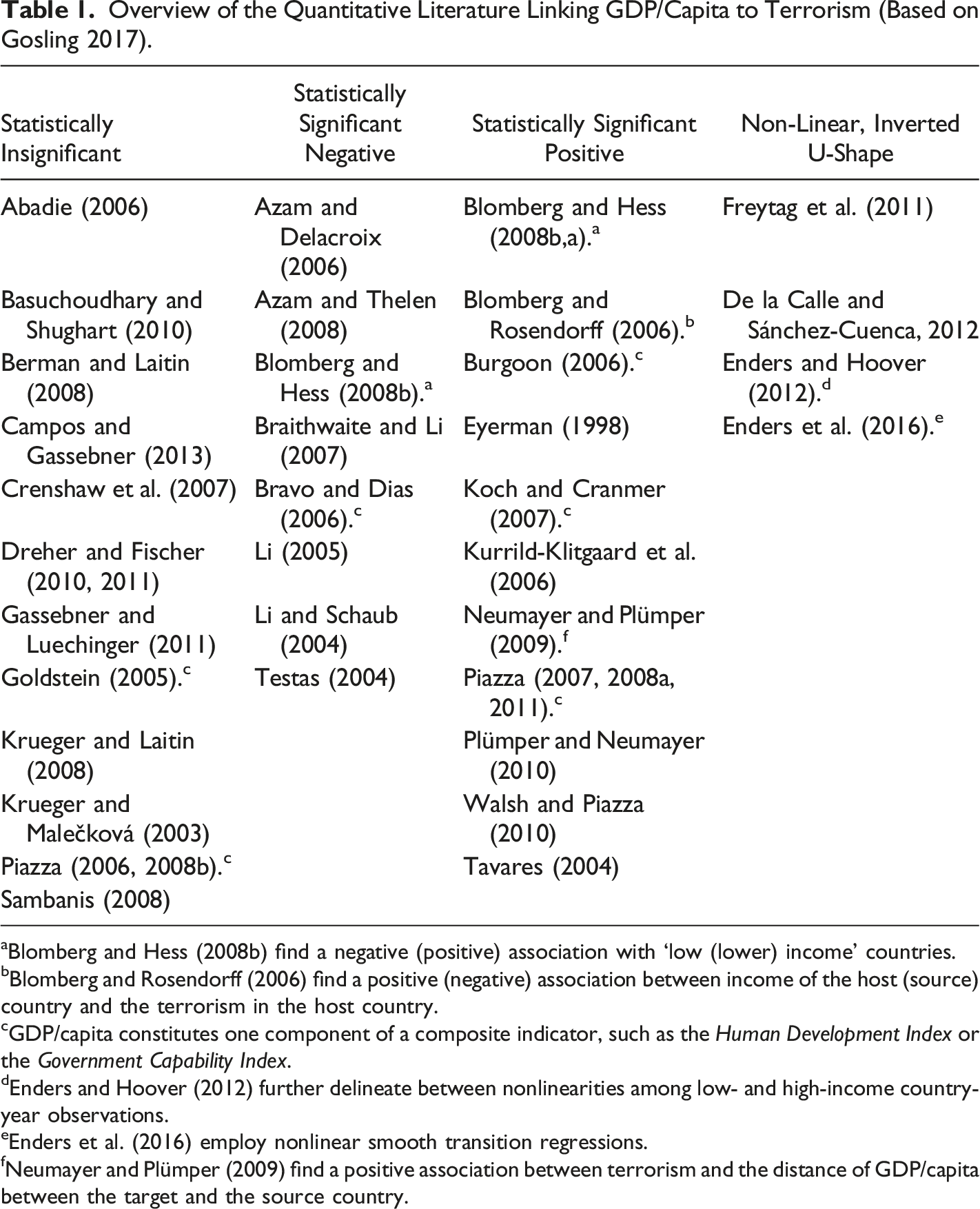
aBlomberg and Hess (2008b) find a negative (positive) association with ‘low (lower) income’ countries.
bBlomberg and Rosendorff (2006) find a positive (negative) association between income of the host (source) country and the terrorism in the host country.
cGDP/capita constitutes one component of a composite indicator, such as the
dEnders and Hoover (2012) further delineate between nonlinearities among low- and high-income country-year observations.
eEnders et al. (2016) employ nonlinear smooth transition regressions.
fNeumayer and Plümper (2009) find a positive association between terrorism and the distance of GDP/capita between the target and the source country.
Theoretically, the inconclusive link between income and terrorism may be owed to an incomplete functional form that conceals nonlinearities (Enders and Hoover 2012; Enders et al. 2016). While low-income polities do not offer sufficient human and monetary resources to support terrorism, high-income societies may be able to employ effective counterterrorism strategies (Enders et al. 2016; Lai 2007). From a sociological perspective, Maslow’s (1943) hierarchy of needs implies political and societal prospects only gain relevance once basic physiological needs are met. Thus, ideological and political considerations may not constitute primary objectives in impoverished societies, i.e., political violence in the form of terrorism could play less of a role. At the other end of the income spectrum, economic grievances are less likely to arise in richer countries where governments can usually leverage substantial funds to address concerns of their citizenry (Lai 2007).
Consequently, ceteris paribus, terrorism, whether domestic or transnational, may peak at medium incomes. A handful of cross-country studies support this perspective (De la Calle and Sánchez-Cuenca 2012; Freytag et al. 2011; Lai 2007). Further, Enders et al. (2016) suggest the peak of terrorism may have changed over time, owing to the shift from left-wing ideologies, which were concentrated in relatively wealthy countries, to religious fundamentalists that predominantly live in the developing world. What has remained elusive, aside from consistent empirical evidence, is a basic theoretical framework to formalize the income-terrorism relationship.
Theoretical Framework
In the following, we formulate a simple framework relating GDP/capita to terrorism. Our framework should be viewed as
Basic Assumptions and Utilities
Suppose polity
In addition to
Every individual 
The agent compares 
Terrorism in Society
Individual 
The share of terrorists in polity 
Throughout our theoretical illustration, we posit that a higher share of terrorists in society translates to a higher degree of terrorism. Naturally, this ignores degrees of terrorists (e.g., some individuals may become influential leaders), but it simplifies the analysis and allows for basic deductions pertaining to the role of income. 5
Equation (4) clearly allows for two basic deductions. First, terrorism is more likely if individuals hold more pronounced anti-regime views,
Linking Income and Terrorism
For the role of income, equations (3) and (4) highlight the importance of
Scenario I: The inverted U shape
For the first scenario, assume returns from terrorism increase as the polity becomes richer, i.e.,
Further, assume the returns to engaging in terrorism increase at a decreasing rate with income such that
In this scenario, the left-hand side of equation (3) first rises sharply at low income levels but later flattens out as income levels increase. However, the right-hand side rises linearly with income. Under reasonable assumptions about the distribution of
Consider the simple example of Relationship between polity 
Now consider the three marked income levels of
As income levels rise in a polity, the degree of terrorism first increases and then decreases after passing a certain threshold level of income, everything else equal.
Scenario II: The ‘bush hypothesis’
Our framework also lends itself to illustrating what we label the ‘Bush Hypothesis’ – the idea that terrorism is inherently a poverty-related issue. To yield that result, we only need to impose
From equation (3), it is then straightforward to observe higher incomes are associated with less terrorism, everything else equal, as the left-hand side decreases and the right-hand side increases with
This allows us to formulate an alternative hypothesis with:
As income levels rise in a polity, the degree of terrorism consistently decreases, everything else equal.
Grievances and the income-terrorism link
Neither
We illustrate this in Figure 2, where we return to the inverted U-shaped pattern derived in Scenario I: The inverted U shape. Consider three levels of polity-level grievances, such that Change in the benefits and costs of terrorism in response to changes in polity-level grievances, 
As a consequence, we derive our third and final hypothesis related to polity-level grievances:
The relationship between income and terrorism exhibits heterogeneity along the level of societal grievances. If the income-terrorism nexus follows an inverted U shape, then terrorism peaks at a higher income level if anti-regime attitudes are more pronounced. Our theoretical framework allows for additional scenarios (e.g., considering
Data
Subnational Income Levels
Summary Statistics for main variables at the subnational (regional) level for 1527 regions (

Consistent with the literature, we calculate the natural logarithm of GDP/capita (e.g., see Freytag et al. 2011, Enders and Hoover 2012, Enders et al. 2016; Krieger and Meierrieks, 2019). Alternatively, using GDP/capita levels (sans logarithm) produces consistent results (see Table A5). To allow for nonlinearities, we follow Enders and Hoover (2012) to incorporate a squared term of that variable.
Figure 3 visualizes the global coverage of our sample. African regions remain under-represented and notable omissions including Iraq and Afghanistan – two of the countries most affected by terrorism. As such selection issues may threaten the generalizability of our findings, we carefully compare global country-level results for all years with those from studying our sample countries and years. These estimations produce consistent coefficients, suggesting our results are unlikely to suffer from systematic selection issues (see Table A3). Regional sample coverage (source: Gennaioli et al., 2014).
Subnational Terrorism
For data on terrorism, we access the well-known
Our main dependent variable measures the number of terror attacks, which constitutes the most commonly employed measure in the literature. Additional estimations distinguish between domestic and transnational attacks.
10
Figure 4 plots GDP/capita against the number of terror attacks. Panel A considers all terrorist attacks, while Panels B and C distinguish between domestic and transnational terrorism. Although these graphs do not incorporate potentially confounding factors yet, they do imply a nonlinear relationship between regional income and terrorism in the form of an inverted U-shape. Subnational GDP/capita and terror attacks, displayed by kernel-weighted local polynomial smoothing along with 95 percent confidence intervals. Panel A: GDP/capita and terror attacks, Panel B: GDP/capita and domestic terror attacks, Panel C: GDP/capita and transnational terror attacks.
Potential Confounders
Our estimations include a list of region-level covariates that may independently be associated with terrorism and income levels. Following the literature, we incorporate population size, oil production (to control for resource-curse-related dynamics; see Tavares 2004; Sambanis 2008), and a binary indicator for hosting the nation’s capital (because of a potential concentration of cultural, political, and religious targets). 11 As the data on educational attainment feature a number of missing values in our sample period, we do not include that variable in our main regressions. Nevertheless, incorporating educational attainment produces consistent results for that limited sample (see Table A5). Finally, accounting for lagged terror attacks also leaves our main conclusions unchanged (see Table A5).
A major advantage of our subnational data structure comes from combining within-country variation in terrorism and income with the panel dimension of repeated information for each region. Our data allow us to account for region-fixed effects to hold constant time-invariant region-specific particularities. This accounts for prevalent correlates of terrorism, such as geography and terrain, unique historical features pertaining to civil conflict, colonization, and other aspects, as well as long-term cultural, economic, and political artefacts. Year-fixed effects absorb all time-specific global developments that may independently correlate with terrorism.
Empirical Strategy
Main Specification
Our main empirical strategy employs a negative binomial regression model in line with the associated literature because the dependent variable constitutes a non-negative count variable and exhibits overdispersion (Gaibulloev et al. 2017; Piazza 2013; Walsh and Piazza 2010; Young and Dugan 2011; Young and Findley 2011). For region 
Potential Sources of Endogeneity
Endogeneity pertaining to reverse causality and omitted variables remains a threat to identifying causal relationship in the associated literature. First, reverse causality implies regions (or countries) may become poorer
Second, theoretically, omitted variables could still influence both regional income levels and terrorism. We control for a list of notable confounders in our main specifications, and additional robustness tests incorporate educational attainment levels, yielding consistent results (see Table A5). As discussed, region-fixed effects account for any statistical variation in terrorism owed to time-invariant cultural, ethnic, language, or religious heterogeneity at the
Similarly, geographical characteristics within a country often vary, and any potential association between poverty and terrorism may differ along such dimensions. For instance, Colombia’s more hospitable regions happen to be wealthier (e.g., Cundinamarca with Bogotá or Antioquía with Medellín) than the difficult-to-access rainforest. Region-fixed effects capture such heterogeneity. Further, if a region differs systematically from the country average in, say, the de facto implementation of law and order, region-fixed effects account for these differences. Finally, region-fixed effects also implicitly account for
Nevertheless, it is important to note which factors our analyses are unable to account for. In particular, unobservable aspects that inform terrorism and
Regional Income and Terrorism
Main Results
Main Results, Predicting Terror Attacks for Region

aControl variables include the logarithm of population size, a binary indicator for the location of the capital city, and the natural logarithm of oil produced.
bThe decline in the number of observations in columns (4)–(6) stems from the introduction of region-fixed effects, where regions with no terror attacks are dropped automatically.
∗
However, upon allowing for nonlinearity in column (2), that conclusion changes, suggesting an inverted U-shape in line with
Columns (3) and (4) first add the covariates introduced in equation (5) and time-period-fixed effects, before also accounting for region-fixed effects. The inverted U-shape persists, while the suggested peak rises to US$12,763. This value roughly corresponds to regions such as Quintana Roo (Mexico) in 1980 or Kaliningrad (Russia) in 2010. It is important to highlight that the specification in column (4) exploits within-region variation only, i.e., we only compare the same region to itself at different income levels. Thus, the derived coefficients do not rely on any cross-regional differences, not even within the same country. A corollary of that statistical artefact is that a low-income region is suggested to experience rising likelihoods of terrorism as its own GDP/capita levels increase; but as soon as GDP/capita levels surpass the peak, terrorism diminishes, everything else equal.
Columns (5) and (6) delineate between domestic and transnational terrorism, acknowledging the often-proposed distinction between these types of terrorism and their underlying dynamics (Enders and Hoover 2012; Enders et al. 2016). Results are fully consistent: In both cases, we derive statistical significance at the one percent level for both coefficients of interest, as well as the signs suggested by Visualizing regression results from columns (4)–(6) of Table 3. GDP/capita and terrorism, GDP/capita and domestic terror attacks, GDP/capita and transnational terror attacks.
Figure 5 visualizes the suggested relationships from columns (4)–(6). The inverted U-shapes are comparable for domestic and transnational terrorism, which implies a universal nonlinearity of the relationship between income and terrorism, supporting
Robustness Checks
We conduct a series of alternative specifications to test the validity of these results. In particular, we implement alternative estimation techniques and measures of terrorism by (i) calculating bootstrapped standard errors, (ii) applying Poisson and Ordinary Least Square (OLS) methods, (iii) considering alternative measures of terrorism with attacks per
Table A5 documents regression results from (i) considering levels of GDP/capita (i.e., not applying the natural logarithm), (ii) controlling for years of educational attainment at the regional level, (iii) controlling for terror attacks in the past 5 years, (iv) using an alternative time frame for our outcome variable (from
Terror Group Ideologies
Distinguishing by Group Ideology, Predicting the Number of Terror Attacks for Subnational Region

aControl variables include the logarithm of population size, a binary indicator for the location of the capital city, and the natural logarithm of oil produced.
∗
Notably, the corresponding peaks differ in terms of magnitude, although moderately. This finding supports the theoretical proposition that peaks in terrorism can differ by perpetrator ideology (e.g., Enders et al. 2016): The peak of terrorism associated with Islamist and other religious ideologies occur at income levels that are lower than those for left-wing or right-wing ideologies. In light of our theoretical framework, this finding is consistent with the notion that polity-level grievances may be stronger in regions hosting left- or right-wing terrorism than in regions hosting Islamist terrorists.
This result is in line with evidence from the
Conclusion
This paper first introduces a basic theoretical framework to formalize potential relationships between income levels and terrorism. Taking a parsimonious approach, the framework is able to generate the main competing hypotheses of the associated literature. In addition, the framework yields a hypothesis pertaining to the role of society-level grievances in the income-terrorism nexus.
Second, we construct a region-level database, mapping terror attacks to income levels and other covariates at the subnational level. This allows us to study panel data for 1527 subnational entities from 1970 to 2014, exploring the validity of our theoretical hypotheses. Most importantly, all results firmly support an inverted U shape in linking income levels to terrorism. This result prevails when accounting for a comprehensive set of covariates, as well as region- and year-fixed effects; when delineating between domestic and transnational terrorism; and even when distinguishing between terror group ideology. Contrary to the post-9/11 claims of poverty being a monotonically positive predictor of terrorism, these results suggest poverty alleviation could imply
Naturally, we advise some caution in a potentially causal interpretation of these findings since, similar to most of the cross-country literature, our analysis is not able to
In sum, the fact that the inverted U-shape emerges in virtually all settings provides what we believe to be the strongest empirical evidence to date for a systematic, universal link between income levels and terrorism. In terms of concrete policy takeaways, the most explicit conclusion from our analyses cautions societies to anticipate a
Supplemental Material
Supplemental Material - Income and Terrorism: Insights From Subnational Data
Supplemental Material for Income and Terrorism: Insights From Subnational Datas by Michael Jetter, Rafat Mahmood, and David Stadelmann in Journal of Conflict Resolution
Supplemental Material
Supplemental Material - Income and Terrorism: Insights From Subnational Data
Supplemental Material for Income and Terrorism: Insights From Subnational Datas by Michael Jetter, Rafat Mahmood, and David Stadelmann in Journal of Conflict Resolution
Footnotes
Acknowledgements
Declaration of Conflicting Interests
Funding
ORCID iDs

Supplemental Material
Notes
References
Supplementary Material
Please find the following supplemental material available below.
For Open Access articles published under a Creative Commons License, all supplemental material carries the same license as the article it is associated with.
For non-Open Access articles published, all supplemental material carries a non-exclusive license, and permission requests for re-use of supplemental material or any part of supplemental material shall be sent directly to the copyright owner as specified in the copyright notice associated with the article.
