







Abstract
Terrorism doesn’t work. Or at least, that is the conclusion drawn from comparing the stated demands of terrorist organizations to the outcomes of their violent campaigns: those demands are almost never met (Abrahms 2006, 2012; Chenoweth and Stephan 2011; Crenshaw 2011; Cronin 2009; English 2016; Fortna 2015; Jones and Libicki 2008; Krause 2013). In case after case, many terrorists end up dead or imprisoned, their organizations are rendered unable or unwilling to sustain a campaign of violence, and their manifestos are reduced to hopeless wish lists.
Why would any organization engage in an activity with such high costs to its membership and such a low chance of success? Perhaps terrorists mistakenly believe they have a high probability of success or that even failure will be divinely rewarded (Crenshaw 2011, Ch 5). Maybe terrorists seek social solidarity (Abrahms 2008) or organizational survival (Fortna 2015; Krause 2013) over political goals. Or they might simply be irrational owing to the pathology of groupthink (Tsintsadze-Maass and Maass 2014) or to principal-agent problems that lead the rank-and-file of militant organizations to attack civilians (Abrahms and Potter 2015). And yet terrorists are apparently quite rational and strategic in their preparation of attacks and how they manage their organization (Berman 2011; Conrad and Spaniel 2021; Gibilisco 2023; Pape 2006; Shapiro and Siegel 2012; Spaniel 2018). Why do people irrationally choose to become terrorists but then conduct terrorism in a rational manner?
We present a different solution to this puzzle: under certain conditions, terrorism works, but for its supporters, who compensate the terrorists for their low chance of success and use them as a tool to coerce a government. We conceptualize a terrorist organization as an agent, working at the behest of a base of supporters, who are not themselves members of the terrorist organization, that forms the principal. These supporters provide the resources the terrorist organization needs to carry out its campaign. Even if their own goals are quite moderate, they might still rationally support terrorism, and may even prefer to support terrorists with remarkably extreme goals.
We analyze a game-theoretic model in which the support base and the targeted government implicitly bargain over the policies set by the government on which they disagree. The support base can choose to offer support to the terrorist organization, thereby enabling and motivating it to conduct attacks against the government. These attacks might result in the overthrow of the government and its replacement by the terrorist organization, but even if they do not, they impose costs on the government, as well as the terrorists and the supporters. The targeted government therefore anticipates this possibility in setting its policies.
Individuals join the terrorist organization and conduct attacks because their efforts are materially and socially rewarded by the organization’s supporters. Those with the most radical views, or the most tolerance for violence, are more likely to join and choose to fight even if the chance of victory is low. But these and others will also be motivated by the prospect of money and status provided by the base of supporters. This rationalizes participating in terrorism.
Supporters contribute to the terrorist organization to encourage it to conduct attacks when they anticipate this will lead to concessions from the government. They avoid the danger and cost of doing the fighting themselves, but nonetheless can use their support of the terrorist organization to exert leverage on the government. We show that supporters can rationally do so even in situations where their own policy goals are closer to the government’s than to the terrorist organization’s, as seems plausible given the extreme goals of most terrorist organizations. Such moderate supporters may even prefer to support a more extreme organization, because it can be motivated at a lower cost in support.
If the targeted government makes changes to its policy, it does so not to pacify the terrorist organization, but to placate its supporters. By giving them at least some of what they want, the government can cause them to lessen or end their support for the terrorist organization’s violence, undermining the organization’s ability to conduct attacks and making it easier for the government to suppress terrorism.
In effect, the support base employs the terrorist organization as an instrument of coercion, much as a government utilizes its military. In this view, whether the terrorists achieve their stated goals is a potentially misleading answer to the question of whether terrorism works, in much the same way as whether an infantry division achieves its objectives would not necessarily tell us whether war works. Instead, this view would have us ask whether the supporters of the terrorist organization achieve their goals, something that might happen even if the terrorists themselves are decisively defeated.
If our theory is right, then terrorism works for its supporters, in that it sometimes brings desired concessions from the government, but not for the actual terrorists, who are merely the instrument for bringing those concessions about. The participation of the terrorists is rationalized by the support they receive, and this support is in turn rationalized by the anticipated concessions from the government. It works only
To illustrate and test our theory, we examine the campaigns of Hamas and the Provisional Irish Republican Army, which most scholars assess as cases of terrorism not working, because neither group achieved its stated goals. We determine each group’s goals, identify its primary supporters and characterize their preferred policies, investigate the policy concessions plausibly made by the targeted governments at least partly in response to the campaigns, and assess whether and how support for terrorism and the occurrence of attacks changed after those concessions. We find evidence consistent with our theory. Supporters preferred outcomes different from the status quo, but far more moderate than those desired by each group. Terrorism worked for these supporters, in that each government at times changed its policies in ways favorable to the supporters, who then reduced their support for terrorism. This loss of support coincided with dramatic reductions in violence. Moreover, supporters’ reasoning for their altered support for terrorism corresponds quite closely to the workings of our theory. They believed that their group’s violence had coerced the government into making policy concessions, and understood that once concessions were made, violence had to be curtailed to keep them.
Our study focuses on the support base for a terrorist organization. By contrast, much of the existing scholarship on terrorism focuses on the terrorist organization itself. As recent examples, Schram (2019, 2021b); Spaniel (2018) consider terrorist leaders’ selection and management of recruits and the effects these have on the resulting violence. Conrad and Spaniel (2021) analyzes how competition can lead to escalating violence as groups try to “outbid” one another. Di Lonardo and Dragu (2021); Gibilisco (2023); Spaniel (2019) study how a government’s uncertainty about a terrorist organization affects both sides’ strategies. In the context of civil war, Fortna, Lotito and Rubin (2018); Heger (2015); Stanton (2013) argue that rebel organizations that rely on a domestic constituency for support are constrained in their use of terrorism, which they assume would alienate that constituency. We extend their reasoning by allowing supporters to strategically support or oppose terrorism, showing that this may enable them to coerce the government.
Analyzing terrorism from the perspective of the terrorist organization is a natural approach that has yielded many important insights. Our contribution here is to demonstrate that augmenting this with an analysis of terrorism from the perspective of its supporters can offer a potential resolution to the puzzle of why terrorism happens if it rarely works. This shift in perspective also generates new conjectures about the causes, conduct, motives, combatting, and termination of terrorism, which we present in the concluding section.
Our perspective has more in common with the literature on foreign sponsorship of terrorism (or rebellion), which views the militant organization as an agent and the foreign state as the principal. Byman and Kreps (2010); Salehyan (2010); Salehyan, Gleditsch and Cunningham (2011) treat sponsorship as a substitute for war between the foreign sponsor and the targeted government. Qiu (2022); Schram (2021a) formalize mechanisms wherein sponsorship weakens the target government relative to the sponsor by forcing the target to focus military resources on the militant organization rather than the sponsor. We develop a different rationale for supporting terrorism: to coerce the government into changing its policy, rather than to shift the balance of power or substitute for war. In our theory, supporting terrorism is more akin to economic sanctions than to arming or war.
We are not the first to argue that terrorism can work in the sense of achieving political goals. In a highly influential study, Pape (2003, 2006) argues that specifically suicide terrorism does work about half the time. This conclusion has been critiqued as deriving from a too-forgiving standard of efficacy, in which any substantial policy change by the target government in the terrorists’ preferred direction counts as success, even if policy overall remains quite far from the terrorists’ stated goals (Abrahms 2005; Crenshaw 2007; Moghadam 2006). Pape (2003, 349) argued for this standard on the grounds that “terrorists’ political aims […] are often more mainstream than observers realize,” because either the terrorists state “unrealistic goals” but actually hold more reasonable ones or the terrorists’ community actually subscribes to their stated goals. Our theory offers an alternative way to reconcile terrorists’ extreme stated goals with the modest policy concessions governments sometimes make and subsequent reductions in terrorism: even if terrorists are sincere in their expressed objectives and cannot be appeased with modest concessions, their supporters can, and the withdrawal of support that attends those concessions reduces the resources available for continuing violence.
Theory
A government (
The support base represents any actor who could provide support for the terrorist organization, including residents of
Support (
We also assume that an unsupported terrorist campaign is hopeless for
This implies that
Attacks impose costs not only on the targeted government, but also on the terrorists, who must bear the risk of imprisonment, injury, or death as the government conducts counter-terrorism. Supporters may also suffer, whether due to collateral damage from the terrorist attacks and government responses or due to deliberate punishment by the government. Domestic supporters might be identified and imprisoned or exposed to indiscriminate retaliation; foreign sponsors might be subjected to economic or military sanctions. Attacks might also result in the decisive defeat of the government, with the terrorists usurping the power to set policy, but we make no assumption about the likelihood of this: it might be high, low, or even close to zero. This allows the model to explain, rather than presume, the empirical observation that terrorists almost never achieve their goals.
By contrast, we assume that the government cannot achieve a decisive victory, eliminating any possibility of future attacks regardless of policy. This seems empirically plausible: even if a terrorist organization suffers a crushing defeat, its supporters could reconstitute it or shift their contributions to a different organization. A government could only prevent this with something like mass killing of the population from which support derives, decisive military defeat of a foreign sponsor, or proficient interdiction of support, which may be infeasible. That said, we show in the online appendix that qualitatively similar results obtain if we incorporate this possibility, though under more stringent conditions.
In our model, each actor knows the interests of the others, and understands how support affects the terrorists’ chance of victory. The government also observes how much supporters contribute to the terrorists. Consequently, neither support nor terrorist attacks will happen on the equilibrium path. Because
That said, these features are obviously unrealistic. Terrorists, their supporters, and the government’s counter-terrorist agents all depend for their lives on operating in secrecy from one another, so each actor is surely prone to uncertainty about the others’ preferences, capabilities, and actions. We show in the online appendix that incorporating uncertainty into our model can lead to both support and attacks happening on the equilibrium path, but also that the qualitative conclusions about when supporters can coerce the government remain the same.
Finally, in our model, the only means supporters have for influencing the government’s choice of policy is by supporting a terrorist organization. This ignores the possibilities that domestic supporters might instead use electoral competition or nonviolent resistance, and that foreign state sponsors might instead employ economic sanctions or inter-state violence, to affect policy. Our theory thus implicitly assumes a situation in which supporters view these other means as either infeasible or less cost-effective than supporting a terrorist organization. We set these aside in order to focus on the role of support for terrorism.
Analysis
There are two possible strategies by which
We begin by specifying when
We call supporting
Thus, when the weapon of the strong is employed, it should involve a deeply-supported, relatively moderate militant organization with a serious chance of defeating the government and implementing a new policy that supporters strongly favor. This accords well with what scholars normally think of as a popular rebellion in the context of a civil war, but it does not suit what we conventionally think of as a terrorist campaign, wherein a relatively extreme militant organization with more limited popularity and support faces a government it is very unlikely to defeat. 2
Our assumption is that
Surprisingly,

This is a weapon of the weak because it is far less severe for the government to be attacked temporarily than to be subjected to a militant campaign that will last until it is overthrown, as in the weapon of the strong. But we will also see that, when this equilibrium obtains, the actors and their behavior correspond closely with the notion of terrorism as a weapon of the weak, and this milder threat is still enough to extract a policy concession so that terrorism works, for its supporters. Importantly, our claim is not that the militant organization itself is weak, but that the
We start by explaining the three conditions that must be met for this threat to coerce
We highlight the implications of these results, beginning with the scope conditions for the weapon of the weak.
As Figure 1 illustrates, if the government is too capable at protecting itself and its constituents from the attacks of even a supported Scope conditions for the weapon of the weak to work. (Parameter values are 
The only possible upside of using the weapon of the strong is that
This in turn eases the constraint
Remarkably, the weapon of the weak may be viable even if
Figures 2 and 3 illustrate these two mechanisms. In Figure 2, as A more extreme A more extreme 

In Figure 3, there is a ceiling to
Even when the weapon of the weak works, it may not coerce the government into giving the supporters everything they want. This is because a larger concession renders the conditions for the weapon of the weak to work more stringent. As the concession gets larger, the punishment for the government of reneging on the policy concession is no more severe for it to suffer, nor any cheaper for supporters to impose, but the government’s temptation to renege gets stronger. Thus, the weapon of the weak might only work to secure a concession that is less than the supporters’ ideal
This observation implies that, if we are to evaluate whether terrorism works from supporters’ rather than terrorists’ perspective, we may also need to re-consider how we measure
Combining the previous observations, the weapon of the weak should involve limited support for a possibly quite extreme militant organization that may have little chance of actually defeating the government, and if it did, might impose a policy that supporters actually dislike. This is a good fit for what scholars normally think of as a terrorist campaign. The terrorists fight, even if their chance of success is low, because they enjoy the support they receive and because they will accept even a small chance of radically changing policy to suit their extreme ideal. Supporters contribute to the terrorist organization, and may prefer that it be quite extreme, not necessarily because they support its goals—which they may view as even worse than the government’s—but because they expect this to lead to a policy concession from the government. And the government makes a modest policy concession that is enough to placate the supporters, who will halt their support and thereby reduce the terrorists’ attacks. Indeed, the government and supporters share an interest that the concession should be no more than the supporters favor—any more would make both worse off—and thus potentially far more modest than the change the terrorists seek.
This observation suggests a different way to think about the distinction between terrorism and rebellion. Scholars usually do so from the point of view of the armed organization. For example, Fortna (2015, 522) defines terrorist organizations as rebel groups “who employ a systematic campaign of indiscriminate violence against public civilian targets to influence a wider audience. The ultimate aim of this type of violence is to coerce the government to make political concessions, up to and including conceding outright defeat.” In our theory, too, the armed organization aims to coerce or outright defeat the government. However, its
Evidence
We proceed to test four predictions of our theory. The policy changes desired by potential supporters should be much more moderate than those demanded by the terrorist organization. Government concessions should be aimed at placating supporters rather than the terrorist organization. Concessions should lower support for attacks, and subsequently also the level of violence. We also investigate whether supporters conceived of the interaction in terms of our theory’s mechanism. Did they see the attacks as necessary to extract concessions? Once concessions were made, did they believe attacks must cease in order to retain those concessions?
Because supporters are usually careful to hide their support for a terrorist organization and the reasons for this, it is hard to measure supporters’ desired policy changes, their level of support, and how this changes over time. We resort to “looking under the lamppost,” examining two cases for which the available information allows a relatively thorough evaluation of our predictions: Hamas and the IRA. Polling over time of the populations from which most support for each group is drawn enables us to measure supporters’ preferences and, indirectly, their degree of support. While we cannot directly measure the provision of recruits, funds, shelter, and secrecy, we assume that changes in this support are proxied by changes in public approval of each terrorist organization’s violence. The more of the relevant constituency that expresses support for violence, the easier it should be for the terrorist organization to recruit members and raise funds from, hide within, and avoid being informed upon by this constituency, and use this support to conduct attacks.
In focusing only on testing our predictions, our evaluation of each terrorist campaign is intentionally narrow. We acknowledge that neither group always acts in line with its supporters’ preferences: each has carried out unpopular attacks intended to spoil peace agreements. This “agency loss” is an important part of the cost for their supporters. We also make no claim about whether either campaign has been objectively or normatively “good” for the Palestinian or Northern Ireland’s people. We also ignore the division of the government side between moderates and extremes and the role of outside actors like the United States in pressuring governments to make concessions and terrorist organizations to stop fighting. We attempt only to ascertain whether concessions correspond to lowered support for and occurrence of violence
Hamas
Hamas has pursued a violent campaign against the government of Israel and its citizens. Its long-standing goal, which is unmet and seems quite improbable, is to overthrow the government of Israel and replace it with an Islamist government with sovereignty over both Israel and the Palestinian territories (Hamas 1988). Its support is drawn primarily from the population of the Palestinian territories. Arab states in the region have provided various forms of support, but most experts agree that Hamas should be regarded as a predominantly Palestinian organization focused on its local constituency. We focus on the period from 1993 to 2006, which (as we will explain) features two separate phases of concessions from Israel as well as one in which concessions were not made, in order to test our theory against the resulting variation.
Both its Palestinian and its Arab state supporters clearly prefer more moderate changes to the status quo than does Hamas. 5 Public opinion polling of Palestinians consistently indicates they seek only an end to Israel’s occupation and settlements, compensation for refugees from Israel’s founding, a capital at East Jerusalem, and non-demilitarized statehood. 6 Even during the worst violence of the Second Intifada, 76 percent of Palestinians most preferred a two-state solution or mutually-agreed one-state solution, and only 21 percent preferred Palestinian rule over both peoples. 7 Throughout the Second Intifada, 70–80 percent would support reconciliation between Israelis and Palestinians if a peace settlement were reached. 8 At least since 1996, the Arab states have unanimously endorsed the same preferred outcome as the Palestinians. 9 Thus, neither of Hamas’s most important bases of support appears to seek an overthrow of the government of Israel.
Moreover, as far as the Palestinians are concerned, Islamism is also not a popular goal. Only 20 percent thought safeguarding religion was the most important Palestinian national interest, against 50 percent who thought it was ending the Israeli occupation. 10 When asked what sort of state they would like to have, 64 percent chose a secular autocracy or democracy and only 25 percent chose theocracy or “an Islamic system”. 11 Finally, in the crucial elections of January 2006, in which Hamas first won a national majority, self-described religious voters supported it over Fateh by only 52 to 40, suggesting that support for Hamas is not particularly driven by a desire for theocracy. 12
Israel has not adopted the policies sought by most Palestinians and Arab states, but it has occasionally made substantial changes in its policies toward the Palestinians. The 1990s peace process yielded several agreements with concessions by Israel, and the 2005 “disengagement” featured unilateral concessions by Israel (though they were not presented as such). 13 Our theory predicts that these concessions should resemble the goals of Hamas’s supporters, not those of Hamas itself. As concessions are announced and implemented, support for negotiations should rise, support for violence against Israel should decline, and violence itself should decrease. By contrast, the period between the peace process and disengagement should see reduced support for negotiation and increased support for violence and violence occurring.
Consistent with the theory, these concessions were all clearly aimed at the preferences of the Palestinian public and Arab states, and a far cry from Hamas’s goals. The peace process agreements dealt with establishment of self-government in the Palestinian territories, withdrawal of Israeli occupation, and timetables for negotiations over settlements, Jerusalem, refugees, security, and borders. The policies associated with disengagement included Israel’s withdrawal of military forces and dismantlement of all settlements in the Gaza Strip, as well as a few in the West Bank, and a similar disengagement from a large portion of the West Bank that was adopted as government policy but never implemented. No concession was made regarding territory traditionally regarded as part of Israel; none broached a unitary state for the two peoples, with most of the peace process agreements instead codifying mutual recognition of political rights and peaceful co-existence; and agreements spoke not of Islamist governance, but of democratization. The Palestinian public viewed them all very favorably, with 65 percent approving of the Gaza-Jericho Agreement of May 1994, 14 72 percent approving of the Oslo II Accord of September 1995, 15 and 73 percent approving of the plan for withdrawing from the Gaza Strip. 16
Palestinian Support for Attacks and Violence and Level of Violence.
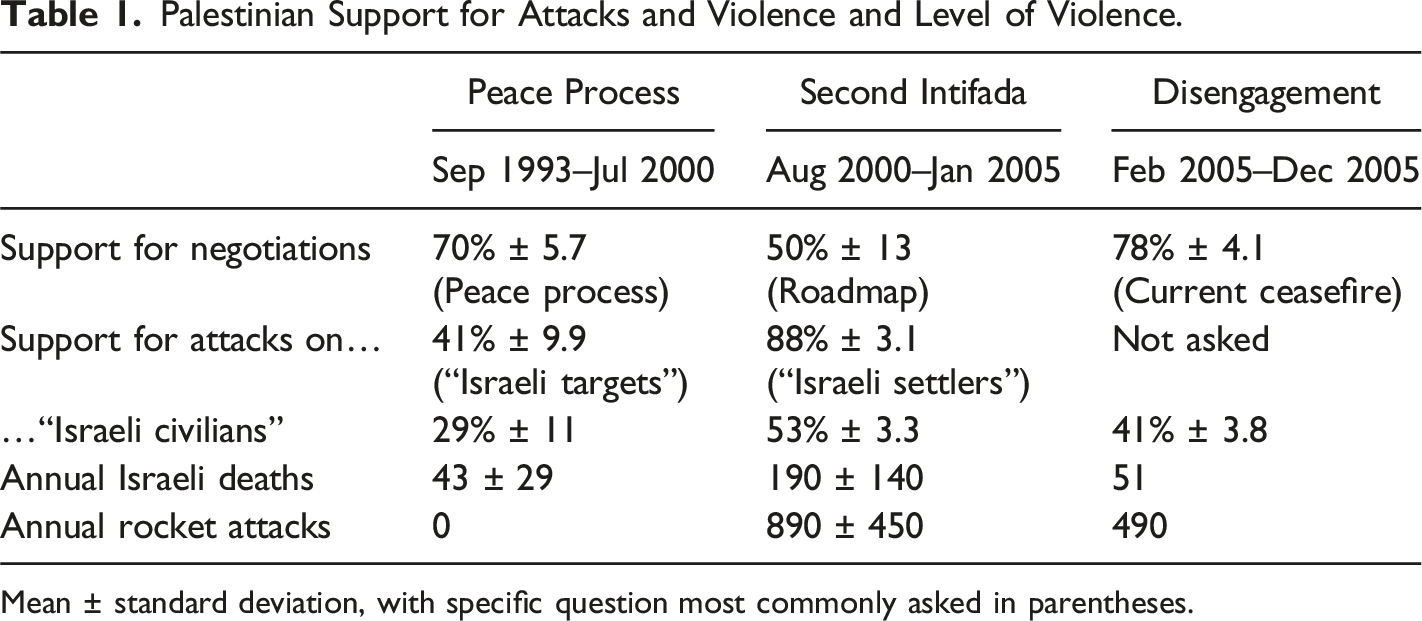
Mean ± standard deviation, with specific question most commonly asked in parentheses.
We have shown that the concessions offered and the levels of support for violence and of observed violence are consistent with the theory. However, one might still ask whether the principal in this case—primarily, the Palestinian public—actually views the relationship between terrorist violence and policy concessions in the way our model describes. The available polling evidence strongly suggests that it does.
Palestinians clearly believed that attacks brought concessions from Israel that would otherwise not be forthcoming. During the latter, less productive half of the peace process, support for the process remained high but support for attacks fluctuated, rising when implementation halted and falling when it resumed. This is not only our interpretation: the Palestinian Center for Policy and Survey Research’s own commentary on these results held that “consistent support for the peace process and the fluctuation in the support for violence point to the possible conclusion that many Palestinians view the latter as a means of moving the former forward and not as an alternative to it.” 19 Just after the failure of the Camp David summit, 60 percent would support “violent Israeli-Palestinian confrontations” if no permanent settlement was achieved by the agreed deadline, and 57 percent “believe that such confrontations […] would achieve Palestinian rights in a way that the negotiations could not.” 20 By July 2001, when the peace process had clearly disintegrated, 71 percent “believe[d] that a return to armed confrontations will achieve Palestinian rights in a way that the negotiations can not.” In every poll from 2001 through 2006, around 67 percent “believe[d] that the armed confrontations so far have achieved Palestinian rights in a way that negotiations could not.” During disengagement, around 75 percent consistently viewed Israel’s withdrawal from the Gaza Strip “as a victory for the Palestinian armed resistance against Israel.” 21 Asked to select “the single most important factor in the Israeli decision to withdraw from the Gaza Strip,” 57 percent selected “attacks by Palestinian resistance.” 22
Palestinians also recognized that, once concessions were made, further attacks might lead Israel to retract them and so should be stopped. Late in the earlier, more productive half of the peace process, 75 percent of Palestinians believed that “the continuation of [terrorist] attacks may impede the peace process,” and 59 percent supported “the Palestinian Authority taking measures to prevent them,” even though 74 percent believed those measures “may lead to internal Palestinian conflict.”
23
When the proposal for disengagement from Gaza was first publicly aired, a plurality of 41 percent believed it would lead to fewer attacks from Gaza.
24
Over this period, 60–70 percent consistently opposed further attacks from the Gaza Strip so long as Israel’s disengagement from it was complete.
25
Before the withdrawal was completed, 60 percent opposed the collection of arms from militants in Gaza, but after, 60–70 percent
Altogether, we view the evidence in this case as supportive of our theory. Palestinians saw Hamas’s violence as a means to coerce concessions from Israel, and modulated their support for violence, and thereby the intensity of violence that occurred, according to Israel’s grant or refusal of those concessions. Although Israel’s concessions were only part of what Palestinians sought, and have not been permanently implemented, they were clearly intended to satisfy Palestinians, not Hamas itself.
IRA
The Provisional IRA pursued a violent campaign against the British government and its local agents and allies within Northern Ireland in order to protect the Catholic population and then pursue independence. It failed to achieve its goal of securing the complete independence of Northern Ireland from the United Kingdom and reunification with the rest of Ireland (Horgan and Taylor 1997). Its support came primarily from Catholics residing in Northern Ireland (NIC, for short), with recruits overwhelmingly from Northern Ireland and only marginally from the Republic of Ireland (Gill and Horgan 2013; Moloney 2003; White 1997), and modest funds from the Irish diaspora (Carswell 2015; Jones 1987).
Northern Ireland’s Catholics preferred more moderate changes to the status quo. 28 Although a bare majority thought “the long-term future of Northern Ireland should be for it” to “Unify with the rest of Ireland,” 29 about two-thirds believed the UK should have at least a little say in how Northern Ireland was run, 30 and less than a quarter disagreed that “Northern Ireland should remain part of the UK as long as most of its people want it to do so”, 31 effectively consenting to remaining in the UK since a large majority of Northern Ireland’s overall population supported this. Asked to indicate whether each of a series of potential elements in a peace agreement were “essential,” British withdrawal from Northern Ireland (a key to the IRA’s goal of reunification) was deemed so by only 46 percent of respondents, making it the ninth most essential element of 16. More widely viewed as essential were more limited changes such as including a bill of rights guaranteeing equality for all (78 percent) and cultural protection (67 percent), police reform (70 percent), disbanding militant organizations (67 percent), returning the British army to its barracks (61 percent), and politics without a sectarian division (59 percent) (Irwin 1998). After the Good Friday Agreement (GFA) was announced, there was typically not majority support for eventual reunification with Ireland. 32 Even among those who did support reunification, at least 90 percent could live with the status quo “if the majority of people in Northern Ireland never voted” for reunification. 33
The GFA was explicitly designed to bring the violence in Northern Ireland to an end and featured several concessions from the UK government and its Loyalist allies in Northern Ireland to Catholics. 34 Indeed, its provisions address all of the elements that a majority of Northern Irish Catholics deemed essential. It guarantees that “the power of the sovereign government with jurisdiction there shall be exercised with rigorous impartiality […] and founded on the principles of […] equality of […] rights, of freedom from discrimination […] of both communities.” It provides for police reform, the decommissioning of militant organizations, and the normalization of security arrangements (i.e., returning the British army to its barracks). It provides for the devolution of power to a local legislature and executive to ensure autonomy from the UK.
However, the GFA also entailed an explicit recognition that Northern Ireland was part of the UK, and would remain so until majorities in both Northern Ireland and the Republic of Ireland voted otherwise. It thus rejected the main demand of the IRA, for reunification of all of Ireland, while still giving the support base of the IRA much of what it wanted. Unsurprisingly, “almost all [Northern Ireland] Catholics voted for the Agreement” in the referendum held to ratify it (Hayes and McAllister 2001b). This in spite of the fact that, after the agreement was made, less than a quarter of NIC viewed it as benefiting nationalists (supporters of reunification) more than unionists (supporters of remaining in the UK), 35 even as more than three-quarters continued to view it as “basically right.” 36
As our theory would predict, support for violence and the level of violence crashed in the wake of the agreement. Polls on support for violence are sparse and indirect, owing to the sensitivity of asking whether respondents supported illegal violence. But 46 percent of NIC agreed in 1978—the last year before the GFA that a relevant question was asked—that the “IRA are basically patriots and idealists” (Hayes and McAllister, 2001a). Just after the GFA was signed, when its success was not yet assured, only a quarter of NIC expressed “any sympathy with the reasons for violence” by the IRA, with around 70 percent expressing no sympathy. 37 Tellingly, only as the GFA was successfully implemented and violence diminished almost to nothing, so that respondents presumably treated this question as retrospective, did a substantially higher 31–42 percent express sympathy for past violence. 38 The level of violence fell drastically after the GFA. From the late 1970s to 1993, before the first IRA ceasefire in 1994, annual killings by Republican paramilitaries ranged from 38 to 102, with an average of around 60. From 1999 onward, after the GFA, the range and average both fell into single digits. 39
Finally, there is also some evidence that NIC viewed the relationship between terrorist violence and policy concessions in the way our model prescribes. In the wake of the GFA, more than three-quarters believed the chances for peace were better than 5 years previously, with only 1–2 percent thinking the chances were worse. 40 Moreover, the GFA was seen as crucial to peace: in 2001 when IRA violence had already dropped to single digits, 86 percent of NIC believed that if the agreement “remains in place,” the level of violence would decrease or stay the same, while 67 percent believed violence would increase if the GFA were ended. 41 After the GFA was agreed, almost three-quarters of NIC supported at least some decommissioning of paramilitary weapons before the autonomous Northern Ireland government was put in place, but almost two-thirds nonetheless opposed total decommissioning, suggesting an understanding that the IRA’s arms provided leverage to ensure that agreed concessions were implemented. 42
NIC also appear to have understood that once concessions had been realized, the violence had to stop to keep them. In 1999, two-thirds agreed they were “angry at the paramilitaries for blocking progress on the” GFA and three times as many NIC chose decommissioning as the most important political issue facing the Northern Ireland Assembly as chose “bringing about a united Ireland.” 43
Conclusion
Conceptualizing a terrorist organization as an instrument of coercion for its supporters, akin to the role a military plays for a state, yields several implications for understanding terrorism.
First, our study suggests that terrorism can work for its supporters, in the sense of helping them to exert leverage over a government whose present policies they do not like. Popular constituencies that do not control a state cannot rely on a military to defend their interests or coerce an opponent, and may find non-violent resistance or a mass uprising too costly or too unlikely to succeed to be worthwhile. Foreign states may similarly see the virtue of supplementing these instruments. Supporting a terrorist organization offers a means of coercing a government to change its policy that is, by comparison, relatively cheap and safe for supporters. Though Pape (2003) is surely right that terrorism’s coercive power has serious limits, it can still bring modest changes to policy that supporters desire and which may be worth the costs of supporting and enduring a terrorist campaign.
To understand the causes of terrorism, it may therefore be profitable to focus more on what leads a set of possible constituents to conclude that supporting a terrorist organization is worthwhile, and less on what causes individuals to form or join a terrorist group or what that group says or does. Consider an analogy to interstate war and arming: scholars studying their causes typically focus on the political actors that employ militaries—the governments—rather than the militaries themselves. Governments build and employ militaries in order to defend their interests from perceived threats, and shrink or disband them when that need diminishes. Why someone joins the army, how it is organized, how it interacts with the air force or navy, and whether it joins a battle are only relevant to explaining why war or arming occurs to the extent that they shape the government’s use of the military as a coercive instrument. Similarly, why individuals become terrorists, how groups function, how they interact with other groups in a terrorist campaign, and whether they carry out an attack may have limited relevance to explaining why terrorist groups form or whether terrorism occurs. The proper unit of analysis for investigating terrorism’s causes, then, might be a particular support base, not a particular terrorist organization.
Terrorism may also work, though in a very different sense, for the terrorists themselves. Although individual members of a terrorist organization may vary in how they weigh commitment to the stated goals against other interests, participating in terrorism that is well-supported offers clear benefits. In this respect, too, a terrorist organization may be analogous to a military, and members may join to receive a similar combination of pay, status, camaraderie, and service. Militaries find it easy to attract recruits and secure generous budgets in times when support for their efforts is strong, and so it may be with terrorist organizations. This suggests that, to understand the formation of, recruitment into, and capabilities of terrorist organizations, it may be valuable to analyze whether and how much support an organization receives from outside in addition to studying who joins it.
In our theory, neither supporters nor the terrorists themselves need be irrational. Of course, having joined the group, it may be rational for individual recruits and for the group itself to inculcate fervent commitment to the cause, to cultivate an objectively-implausible belief in its probability of success, to shed certain moral qualms, and to form intense attachments to other members. These are core elements of the culture in many militaries precisely because they make for better soldiers who are more likely to win. But, for both militaries and terrorist organizations, they do not imply that joining up, supporting, or deploying the organization are anything other than strategically rational acts.
None of this should be taken to deny the possibility that individual terrorists, or a terrorist organization as a whole, may act in ways that deviate from the interests of either the organization or its base of supporters. Soldiers and armies do not necessarily follow orders and may betray their commanders, but these principal-agent issues are not particularly relevant for understanding why militaries exist or what causes their employment. Inducing a military to stop fighting an enemy or to restrain itself may be easier than getting a terrorist organization to do the same given the stronger apparatus of control available to a state. But these features are not central to understanding why war or terrorism occurs or why it ends.
Focusing on the support base rather than the group also casts a different light on the study of counterterrorism. A belligerent state that kills or captures the leadership of an enemy infantry division, or even devastates the entire division in battle, has achieved a substantial tactical success, but of course the war may not be over, since officers can be replaced and new divisions can be raised. Similarly, if a targeted government kills or captures a terrorist group’s leaders, or even if it wipes out its membership, the terrorist campaign may not end. New individuals willing to engage in terrorism can be found, new groups formed, and new attacks conducted so long as the support base remains committed to the campaign. Thus it may be more profitable to focus on explaining the success or failure of a terrorist campaign—characterized by support from a common base—rather than the success or failure of a particular terrorist organization.
Similarly, it may be useful to study how terrorist
Supplemental Material
Supplemental Material - Terrorism Works, for its Supporters
Supplemental Material for Terrorism Works, for its Supporters by Andrew J. Coe, Peter Schram, and Heesun Yoo in Journal of Conflict Resolution
Footnotes
Acknowledgments
Declaration of Conflicting Interests
Funding
ORCID iD

Data Availability Statement
Supplemental Material
Notes
References
Supplementary Material
Please find the following supplemental material available below.
For Open Access articles published under a Creative Commons License, all supplemental material carries the same license as the article it is associated with.
For non-Open Access articles published, all supplemental material carries a non-exclusive license, and permission requests for re-use of supplemental material or any part of supplemental material shall be sent directly to the copyright owner as specified in the copyright notice associated with the article.
