







Abstract
Keywords
We have access to decades of research on change methods, yet we are still struggling with identifying the recipe for successful change. Unfortunately, [the] level of change success has been consistent for several years. In fact, Virtually every organization we interviewed indicated they were undergoing, or had recently undergone, an organizational change. However, half of board members said that their change process did not go well. Most pointed to a failure to adequately sell the need to change course or the lack of an effective change management model. (Murphy 2022)
In attempting to answer this question, scholarly work has largely invoked dynamic capabilities theory (Eisenhardt and Martin 2000), which argues that high-performing organizations in dynamic environments possess higher-order capabilities that enable them to adapt to or even create market change (see Morgan, Slotegraaf, and Feng 2022). Considering the central role of marketing organizations in identifying the need (or opportunity) for a strategic change and implementing an appropriate response (Moorman and Day 2016), and that of marketing capabilities in ensuring that organizations cope with changing market conditions (Barrales-Molina, Martínez-López, and Gázquez-Abad 2014), research has used a plethora of dynamic marketing capabilities to capture an organization’s ability to change. The most commonly used constructs are strategic flexibility (e.g., Grewal and Tansuhaj 2001), marketing agility (e.g., Kalaignanam et al. 2021), adaptiveness (e.g., Homburg, Workman, and Jensen 2002), and market orientation and responsiveness (e.g., Homburg, Grozdanovic, and Klarmann 2007). However, while these constructs are useful in measuring the “what” aspects of change decisions (e.g., redeploy resources, respond to changes in customer needs and competitors’ actions) and the strategic actions for moving from A to B (e.g., Wei, Samiee, and Lee 2014), they are unable to explicate the “how” activities required to accomplish strategic changes effectively. This is a clear shortcoming, as most managers can decide “what to change” but are less sure on “how to do it” for effective implementation of strategic changes (Rowland, Thorley, and Brauckmann 2023).
Heeding calls to prioritize research that develops knowledge on how marketing organizations can organize for the ever-increasing need for change (Marketing Science Institute 2020), we address this gap by developing and validating a measurement scale for capturing strategic change capability (SCC) in marketing organizations. We conceptualize SCC as a dynamic marketing capability that enables firms to enact marketing-related strategic changes to manage their competitive standing in light of new threats and opportunities by establishing the business case for change, preparing employees for accepting change, setting up the organization for implementing change, institutionalizing behaviors that support change implementation, and using feedback mechanisms to assess and adjust change plans when necessary. Compared with more internally focused organizational changes (e.g., digital transformation), marketing-related strategic changes create unique challenges for organizations as they require undertaking customer-facing and competitor-related actions and balancing these with an internal change management focus (Abernethy, Dekker, and Grafton 2021).
Addressing these challenges, the proposed conceptualization and operationalization of SCC as a dynamic marketing capability augments knowledge in the strategic marketing literature in three ways. First, the proposed SCC scale uses a more integrative approach to managing strategic change. We demonstrate that a synergy of strategic decision-making, execution, and employee management activities is necessary to carry out successful strategic changes. This is a step forward from prior research, which has predominantly focused on understanding how the attitudes and actions of individual actors (e.g., employees and midlevel managers) facilitate (or hinder) the change process (e.g., Sarin, Challagalla, and Kohli 2012). Relatedly, whereas research has typically examined change initiation and implementation phenomena independently (see Müller and Kunisch 2018), our study sheds light on the marketing capabilities and underlying activities deployed at three stages of strategic change (i.e., prechange, initial implementation, and postimplementation) that complement one another in yielding desirable performance outcomes.
Second, this study offers a psychometrically sound and parsimonious SCC scale that explains market and financial performance beyond the predictive power of established dynamic marketing capabilities (e.g., strategic flexibility and agility). To that end, we provide guidelines on how scholars can apply the SCC scale in a complementary manner with established dynamic marketing capabilities to gain a more holistic understanding of an organization’s ability to change.
Third, the proposed SCC scale explains not only the successful implementation of different types of marketing-related strategic changes (e.g., changes in the range of products/services, areas or methods of distribution, and/or markets targeted) but also the organizational learning resulting from the implementation of such strategic changes. As such, SCC is a useful tool for both understanding how organizations can achieve further growth and improving the skills required to implement strategic changes more effectively in the future. To that end, we propose an SCC index that practitioners can use to assess ex ante the change capability of their organizations before initiating a change and to review ex post how well they have implemented a strategic change.
Background
Strategic Marketing and Organizational Change
Organizational change refers to differences occurring over time in one or more dimensions of an organization; it is a broad phenomenon encompassing structural changes, cultural shifts, and process and system modifications (Müller and Kunisch 2018). Strategic marketing changes, more specifically, are changes that can affect a firm's competitive standing and alignment with the external environment; they involve critical market-repositioning choices intended to increase competitive advantage or respond to market dynamics (Abernethy, Dekker, and Grafton 2021). What differentiates strategic marketing changes from broader organizational changes is a distinct focus on customer-facing and competitor-related actions (current and forward-looking). Organizational changes usually encompass internal adjustments (e.g., modification of operational processes) to facilitate and support initiated strategic changes (Herrmann and Nadkarni 2014; Morgan et al. 2019). Thus, while organizational changes necessitate a focus on employee management activities (e.g., Shin, Taylor, and Seo 2012), marketing-related strategic changes are boundary-spanning processes (Day 1994) requiring emphasis on both internally focused change management and externally oriented strategic decision-making and execution activities.
Dynamic Marketing Capabilities
Research on dynamic capabilities offers a useful theoretical perspective on strategic change; these capabilities enable organizations to deal with change and achieve enhanced performance in changing business environments (Teece 2007). To capture strategic change phenomena, scholars have tested a plethora of dynamic capabilities (see Laaksonen and Peltoniemi 2018). The most widely used constructs focusing on marketing-related strategic changes are strategic flexibility (e.g., Grewal and Tansuhaj 2001), marketing agility (e.g., Khan 2020), adaptation/adaptiveness (e.g., Homburg, Workman, and Jensen 2002), and market orientation and responsiveness (e.g., Homburg, Grozdanovic, and Klarmann 2007). Table 1 presents key definitions and operationalizations of these four constructs and outlines similarities and differences. 1
Most Commonly Used Dynamic Marketing Capabilities.

“Strategic flexibility” refers to the ability to manage macroenvironmental risks and effectively deal with market threats and opportunities (Grewal and Tansuhaj 2001). Measures of strategic flexibility include aspects such as a firm's ability to maximize available strategic options, build excess resources, and redeploy resources to support intended strategies amid environmental change (Zhou and Wu 2010). In essence, strategic flexibility measures the inherent flexibility of a firm and captures its ability to be proactive (e.g., create real options within strategic plans) when market changes occur (Claussen, Essling, and Peukert 2018).
“Marketing agility” refers to the ability to rapidly iterate between making sense of the market and executing marketing decisions to adapt (Kalaignanam et al. 2021). Research (e.g., Khan 2020; Zhou, Mavondo, and Saunders 2019) operationalizes it as the organizational ability to sense and respond to market threats and opportunities effectively (e.g., without losing sales), speedily (e.g., faster than competitors), and flexibly (e.g., by redeploying current resources). Marketing agility, with its distinct focus on speed and iteration, best explains a firm's ability to react to black swan events and emergent contingencies in a timely manner (Van Oosterhout, Waarts, and Van Hillegersberg 2006).
“Adaptation/adaptiveness” mostly pertains to how well organizations change their strategic marketing activities to achieve realignment with the external environment, meet changing customer needs, and respond to competitors’ actions (Homburg, Workman, and Jensen 2002; Walker and Ruekert 1987). It can help assess firm performance (relative to competitors) in terms of achieving strategic fit with the external environment (Morgan et al. 2003).
“Market orientation and responsiveness” capture activities required to identify the need (or opportunity) to initiate a strategic change (i.e., market intelligence generation and dissemination), attentiveness to expressed or latent customers’ needs and preferences, and efforts to counter competitors’ actions (Jaworski and Kohli 1993; Wei, Samiee, and Lee 2014). Market orientation and responsiveness can best help understand whether a firm's strategic marketing actions are rooted in customer- or competitor-related information.
The Gap: A New Construct for SCC in Marketing Organizations
Existing dynamic marketing capabilities (see Table 1) provide different explanations for why some firms have a greater ability to change than others. For instance, market orientation suggests that organizations need to thoroughly ground their strategic change decisions in market intelligence, whereas marketing agility emphasizes the ability to refine marketing decisions on the spot (Kalaignanam et al. 2021). By contrast, the notion of strategic flexibility is linked to planning and suggests the deployment of alternative strategic options when or as particular market opportunities or threats arise (Slotegraaf and Dickson 2004). Adaptiveness differs from other capabilities given its sharp focus on measuring the effectiveness of strategic change (Morgan et al. 2003).
These established constructs and their operationalizations focus on the “what” aspects of strategic change decisions and emphasize the strategic actions when moving from A to B; nonetheless, they are not equipped to explain “how to change” marketing activities to help firms enact strategic changes successfully (Abernethy, Dekker, and Grafton 2021). For example, although prior research has shown that effective rewards (Sarin, Challagalla, and Kohli 2012) and employee participation (Ye, Marinova, and Singh 2007) are critical for implementing strategic changes, none of the existing dynamic marketing capabilities capture such activities.
Given the common occurrence of failed and/or underperforming strategic change initiatives (see Keller, Meaney, and Pung 2021; White et al. 2023), we argue that there is a significant gap in understanding of the marketing capabilities and underlying activities that enable effective implementation of strategic change. To address this gap, we develop a new measurement scale that robustly captures SCC in marketing organizations. 2
Scale Development Process
Our research approach draws on methodological recommendations (Churchill 1979; Gerbing and Anderson 1988) and prior scale development research in strategic marketing (e.g., De Luca et al. 2021; Homburg and Tischer 2023). Table 2 outlines the scale development process adopted, and Table W1 in Web Appendix A showcases the rigor of our approach.
Scale Development Process.

Building on interviews with senior marketing managers and business consultants, we first defined and conceptualized SCC, laying the foundation for generating an initial pool of measurement items (Study 1a). We then conducted an evaluation study with academic experts to assess the conceptualization of SCC and the face validity of the generated items (Study 1b). This was followed by four quantitative studies: scale purification (Study 2), validation of the purified scale (Study 3), nomological validation (Study 4a), discriminant and predictive validation against related constructs (Study 4b), and scale generalizability (Study 5).
Study 1a: Conceptualization of SCC and Item Generation
Research Method
To conceptualize SCC and develop an initial pool of measurement items, we adopted the grounded theory approach (Glaser and Strauss 1967). This approach enables us to (1) gain a better understanding of the context and the settings within which strategic change takes place (Malshe and Sohi 2009), (2) understand how strategic change occurs in marketing organizations without being biased by existing research findings (Strauss and Corbin 1998), and (3) generate theory around a central theme (Creswell 2007): in our case, SCC.
Sampling and Data Collection
In line with the tenets of grounded theory and other studies in strategic marketing (e.g., Malshe and Sohi 2009), we pursued theoretical sampling. Data come from semistructured interviews with 26 key informants. As strategic changes are typically led by top-level managers and/or consultants (Kunisch et al. 2017), we recruited 13 top-level marketing managers and 13 consultants with a mean experience in change projects of 20.5 and 19.5 years, respectively, from a wide range of industries. The interviews lasted between 45 and 70 minutes. Table W2 in Web Appendix A outlines the profile of the key informants. A constant interplay between data collection and analysis ensured that the emerging theory was thoroughly grounded in the data (Strauss and Corbin 1998). We began with a relatively small data set and, as new findings emerged, conducted additional interviews to validate them (Malshe and Sohi 2009). We reached theoretical saturation by the 26th interview (Strauss and Corbin 1998).
To analyze the data, we used open, axial, and selective coding (Challagalla, Murtha, and Jaworski 2014; Ulaga and Reinartz 2011). First, we employed open coding and created a comprehensive set of first-order codes based on the language used by key informants to describe activities required to effectively enact strategic change (Gioia, Corley, and Hamilton 2013). We stopped this process when no new meaningful codes that fit with the already identified codes could be generated. Second, we applied axial coding to identify patterns among codes and thereby move from mere descriptions of strategic change activities to more abstract and theoretically meaningful categories that represent the components of SCC. We constantly compared the first-order codes with each other to identify similarities and/or differences that could distill them into categories (Homburg, Theel, and Hohenberg 2020). In this way, we developed an initial coding scheme that specifies the components of SCC, their definitions, and lower-level manifestations; the representative interviewee quotes helped clarify their meaning and content. Finally, data analysis became more theoretically selective to build parsimonious theory (i.e., selective coding). After developing an initial set of categories, we compared them using rules of internal homogeneity (i.e., coherence of codes within a category) and external heterogeneity (i.e., minimal overlap between categories) (Patton 1990). This process led us to exclude some codes from the analysis, merge some categories into more abstract ones, and split some categories into separate ones. 3 Table W3 in Web Appendix A presents the final coding scheme.
Next, we generated measures for the five dimensions of SCC by relying on their first-order manifestations and the corresponding interviewee quotes (e.g., Schaarschmidt, Walsh, and Evanschitzky 2022). More specifically, we transformed each first-order code into one item by adopting the language that key informants used in the interviews. We also ensured that the item wording complied with typical measures in marketing capabilities research (e.g., Morgan, Katsikeas, and Vorhies 2012). To ensure the quality of the generated items, we followed a rigorous three-step procedure. First, we generated an initial, comprehensive list of items for measuring each dimension of SCC (Churchill 1979). Second, three academic experts evaluated the items for face validity and proposed changes. Third, we discussed changes to items until consensus was reached. This process generated 41 candidate items for measuring the five dimensions of SCC (see Table W3 in Web Appendix A).
Conceptualization of SCC
The interview data suggest that SCC is a multidimensional construct that captures prechange, initial implementation, and postimplementation stages of a strategic change. More specifically, SCC comprises five first-order dimensions: establishing the business case for change, preparing employees for change, setting up the organization for implementing change, institutionalizing change, and assessing and adjusting implementation. 4 The five dimensions of SCC reflect an underlying capability, and thus we treat SCC as a second-order reflective construct (see Diamantopoulos and Siguaw 2006). Table 3 highlights the breadth and depth of marketing activities captured by SCC.
SCC Dimensions and Fit with Extant Marketing Research.

Prechange
The prechange stage of SCC includes activities performed at the initial stages of a strategic change to establish the business case and prepare employees for change. “Establishing the business case for change” refers to the ability to initiate strategic changes against a backdrop of internal and external pressures. Marketers need to not only address marketplace conditions but also manage internal dynamics, such as pressures from the CEO, when deciding to initiate a strategic change. Thus, it requires carrying out activities (e.g., cost–benefit analyses, feasibility studies, and change impact assessments) to establish a clear rationale for and assess the viability of a strategic change and to develop a roadmap to guide strategic change efforts. Interviewees consistently highlighted the key role of marketing teams in identifying the need for change, as they are uniquely positioned at the interface of firms and their markets: I think, where you have teams that are connected to your customers closely you are getting a continual gauge as to what's going on in the marketplace, because of what your clients are asking for, and because of how often you win work and how often you lose work because of pricing, or technology, or offer. So, whilst as an organization and as a business unit we’ve been through various strategic reviews, the warning sign comes from conversations with clients and visibility of the market in which we operate. (Interviewee 18, global strategy and transformation director) The marketing and product team is responsible [for] taking a look at this; defining which changes are required. … So, normally I am the decision-maker, but I am completely open and receptive for any comment or change request coming from any side of the business to be honest. … The first thing that I will take a look at is to see like what would be the benefit if we do that—if we follow that change—or what will be the downsides or the repercussions if we just keep doing things as we’ve been doing them in the past, you know, if we don’t follow that change. So, that will help us make a “go/no-go” decision for that need for change. (Interviewee 15, head of marketing) The hardest part of change is alignment. … You would, first of all, want to drive alignment, wouldn’t you? So, let's say I think that here is a big area we need to change. Certainly, I would want to try and get alignment with the rest of my management team; making sure we’re as one when deciding to address that change. (Interviewee 19, chief marketing officer) If the chief executive is not happy, this is not happening; let's break it. (Interviewee 26, vice president of business and marketing) You need to understand where you want to get to. So, what's the end point of the change? How do you know what is success? What is success going to look like? … Starting down a change plan but not knowing what the end point—well, how do you know when you get there? How do you know when you’ve done what you need to do? So, fundamentally what's the end goal? I’ve got to achieve X of this, or Y of that. Making sure you’ve got specific, measurable, achievable, and realistic goals. (Interviewee 9, managing director of consulting) You want to define very clearly what the outcomes are. What are the principles that you’re following and what are the outcomes? What does good look like if the change is completed on time, in budget? What happens? That should be very clear, because you want to prove your case but also cascade that down the team. (Interviewee 24, head of strategy and partnerships) At the moment we’re going through this transformation where 55,000 people are impacted, and one of the many things that I do for a day job is run the corporate communications. There's a huge job to be done in terms of messaging, giving context, helping people understand why we’ve got to change. (Interviewee 19, chief marketing officer) You have a vision, which is absolutely key, but everybody has got to understand that vision and get behind it, and a lot of it is down to internal communication. Keep driving that message, keep communicating why that change is important, keep reinforcing that message internally. … I’m sick of hearing the sound of my own voice talking to different people about why this change is so important and where the market is heading. You’ve got to be able to differentiate yourselves internally to get people behind that change, and you’ve got to set up the marketing behind that. You’ve got to align your salesforce who are the people that are out there pushing a new message to the market. For me personally, my experience it's making sure that people are along for the ride, and they understand what's in it and they feel that they’d be listened to. So again, a lot of what I call syndication or telegraphing of an idea before starting the change … you have to telegraph the reason why the change happens, but then you have to work at the individual level to understand concerns and needs. (Interviewee 24, head of strategy and partnerships) It's not just explaining, but also motivating and inspiring people to embrace change. You know, taking people on the journey from “I don’t understand it” or “I’m skeptical” to “I understand it” to “I’m contributing to the change” to “I am part of the change” to “I am the change.”
Initial implementation
The initial implementation stage of SCC involves setting up the organization for implementing and institutionalizing change; this enables marketing managers to translate change plans into action and foster behaviors that support change implementation. While marketing strategy implementation typically involves the choice of appropriate marketing tactics and resource deployment, our fieldwork reveals significant emphasis on the marketing operations that underlie change implementation (Moorman and Day 2016; Morgan et al. 2019).
“Setting up the organization for implementing change” refers to the ability to assemble detailed actions that specify how a strategic marketing change will be executed. It involves breaking down a change initiative into short-term milestones and tactics and clarifying the roles and responsibilities of those involved in the change. Interviewees 15 and 21, respectively, noted: We define what are the steps and the process that we will need to follow in order to get to that end state of change, but we break the activities in the smallest but meaningful pieces as possible, so that we can have minor milestones within the project. (Interviewee 15, head of marketing) You have to say … we need this from you and this from you, and this is the expected resource time and effort you need to put in if this project is going to succeed basically. (Interviewee 21, head of project, change and business management) In most of my big change programs … I tend to have somebody who owns that change that we’re trying to implement at a very high level, and then populate a kind of governance structure around it, which is having a few, but enough of the right senior people to govern the change process. (Interviewee 19, chief marketing officer) You need to be able to track what you’re doing and how you’re performing all the way through the change program. So, it's very important to establish those monitoring systems up front so then you can have instant feedback. (Interviewee 16, head of U.K. transformation and continuous improvement)
“Institutionalizing change,” another facet of initial implementation, pertains to the ability to deploy systems that reward and reinforce behaviors that support the implementation of a strategic change initiative. Similar to Moorman and Day's (2016) observation that marketing organizations facilitate marketing strategy implementation by activating pertinent individual behaviors, Interviewee 6 (change management consultant) noted: My experience of difficulties in implementing change [has] almost entirely to do with behavioral change. People don’t change their behavior unless they are persuaded to. So, I think where change happens successfully, it happens because an organization knows how to incentivize its people. If [employees] are part of the change program team, which has to be part of their role now, then they’re going to be concerned enough to know that they’re going to be performance-managed on the outcome of the project. (Interviewee 1, change management consultant)
Second, a strategic change may be institutionalized more implicitly by giving employees the autonomy to make day-to-day decisions on their own during the implementation of change (Interviewee 25) and publicly recognizing those who contribute to its success (Interviewee 20). I’m a big believer [of] ownership. So, I’m not micromanaging everything. I like to give [employees] the freedom to do things their way and to show me what they are capable of doing. (Interviewee 25, vice president of business and marketing) I think it's recognizing the early adopters … recognizing those who are adopting the behaviors, role modeling, and helping their colleagues out. (Interviewee 20, senior change manager)
Postimplementation
The element “assessing and adjusting implementation” of the postimplementation stage of SCC captures the ability to use feedback mechanisms to amend change plans when necessary. While internally focused functions (e.g., accounting) can also play a role in assessing and adjusting change implementation, marketing organizations are well-attuned to linking strategic change actions (i.e., customer-facing and competitor-related actions) to firm performance (Moorman and Rust 1999). Interviewees 3 and 10, respectively, noted: Monitoring could be done by an analyst, you know, who's there doing a spreadsheet and going, “Oh look, we’re in trouble.” So, you should not be doing just the monitoring but also interpolating the data and overlaying against what you do. Not just looking at the data but also understand what it means for your strategy. Playing it back over and overlaying your own value proposition. (Interviewee 3, senior change management consultant) Achieving a milestone should not be the be all and end all. It should be outcome based. So, are we seeing the impact in the market? … You should be measuring outputs rather than some of the stuff that project management methodology teach, which is measure inputs. (Interviewee 10, associate director of consulting) Ensure that you do not follow the plan because it was the plan. I think that's the point. Have the ability to course-correct, to try things out and then if they don’t work, adjust so that you ensure that your final deliverable meets your needs or solves the problem that you were trying to solve. (Interviewee 13, associate director) You’ve got to be looking at the data points to validate your direction of travel, and then you’ve got to be able to surface that with the right people at the right time. When we close an activity in whatever change we’re doing, we take that time to sit down, review and analyze. Did we follow through in the change process? If we didn’t, why was that? Why we didn’t deliver the results that we were expecting? And being completely honest. What can we learn from this? Are we doing the right thing? We look at the timing plan and the dependencies … we look at the financials … we look at the key change deliverables and check that we’re on track to do them. But we’re getting feedback from people, not just on the board, but the level below the board, who are probably closer to the action to check what they are saying.
SCC: A New Dynamic Marketing Capability
Building on the theoretical foundations of dynamic capabilities (e.g., Eisenhardt and Martin 2000; Homburg and Tischer 2023; Wielgos, Homburg, and Kuehnl 2021), we identify SSC as an organizational-level dynamic marketing capability (Morgan, Slotegraaf, and Feng 2022) for two reasons. First, SCC is based on five specific and identifiable first-order dimensions that exhibit commonalities across firms but are idiosyncratic in the details. As Interviewees 10 and 14, respectively, noted: [Here,] everybody is part of the same company with a common goal. [The company], obviously, is using a lot of different contractors and different parties that got their own vested interest. That's a very different proposition than managing people who are all part of the same company. But the overriding principles are the same. … I think the principles apply regardless, sometimes the scale of that will change, but to call something successful change, you have to have those in place. (Interviewee 10, associate director of consulting) Although the changes have been different, the method of going about it is the same. I guess you need to have the same thought process. … And I think that's quite similar across any organization. … And it's quite interesting. As we’ve been talking, there are a lot of similarities. I haven’t really thought of it in those terms, but kind of what I am trying to do right now with [my company],which seems really big, is no different [than] what I’ve done previously. It's just taking longer because of the size of the organization and the number of people that you got to get across. (Interviewee 14, sales director)
Thus, we posit that SCC differs from established dynamic marketing capability constructs; as Table 4 shows, existing capabilities capture elements mostly in the prechange and initial implementation stages. For example, strategic flexibility involves the development of available strategic options in the prechange stage (Grewal and Tansuhaj 2001) and the redeployment of organizational resources in the initial implementation stage (Zhou and Wu 2010). Marketing agility focuses on a firm's ability to notice and interpret unexpected or ambiguous market signals (Zhou, Mavondo, and Saunders 2019) (i.e., prechange activities) and on the swift and effective execution of strategic marketing decisions related to initial implementation elements to adapt to the market (Kalaignanam et al. 2021).
Comparing SCC with Related Dynamic Marketing Capability Constructs.

Market orientation in the prechange stage emphasizes generating and disseminating market intelligence (Jaworski and Kohli 1993) and involves change implementation by gauging market responsiveness (e.g., fulfilling changing customers’ needs and countering competitors’ actions) (Homburg, Grozdanovic, and Klarmann 2007). Adaptiveness focuses on the postimplementation performance outcomes of a strategic change in terms of achieving strategic fit with the external environment better than competitors (Morgan et al. 2003). To our knowledge, SCC is the only dynamic marketing capability that comprises a unique constellation of elements in the prechange, initial implementation, and postimplementation stages and provides a comprehensive account of the marketing capabilities and underlying activities required to implement strategic changes effectively.
Study 1b: Expert Evaluation
Sampling and Data Collection
After generating measurement items for the five dimensions of SCC, we conducted an expert evaluation study involving eight senior academics with expertise in strategic marketing to validate and/or adjust the conceptualization of SCC and assess the face validity of the items. We used a structured online questionnaire as the study instrument.
In the first part, we presented the conceptualization of SCC to the experts, including definitions of SCC and its five dimensions as emerged from Study 1a. We then asked them to evaluate on a seven-point scale (1 = “strongly disagree,” and 7 = “strongly agree”) whether each dimension is reflective of SCC. Open-ended questions helped gather comments about our definitions and the dimensionality of SCC. In the second part, we randomly provided the experts with the 41 items and asked them to indicate which dimension they believed each item was designed to measure. The informants could sort each item in more than one dimension, and they could select the option “this item is not related to any of the dimensions.” This option enabled us to identify problematic items (subject to exclusion from the SCC scale).
Results
The expert panel identified no major issues with the conceptualization of SCC; the mean levels of agreement for the dimensions we identified in Study 1a as being reflective of SCC were considerably high, while the corresponding standard deviations were low (Mbusiness case = 6.00, SDbusiness case = 1.07; Mpreparation = 6.50, SDpreparation = .76; Morganizational setup = 6.38, SDorganizational setup = .74; Minstitutionalization = 5.75, SDinstitutionalization = 1.04; Massessment/adjustment = 6.50, SDassessment/adjustment = .53).
However, the expert panel suggested that 14 of our initial 41 items did not contribute to the assessment of SCC. First, we excluded nine items given disagreement among the experts about the best-fitting dimension; agreement among experts was sufficient when (1) five (62.5%) or more experts indicated that an item belonged to “dimension X” and (2) no more than three experts (37.5%) suggested that this item belonged to another dimension. Second, we excluded five additional items because more than 62.5% of the experts classified them in different dimensions than they were designed to measure. No item was deemed irrelevant by more than one expert. Thus, we retained a set of 27 items and subjected them to further scale validation.
Study 2: Scale Purification and Initial Validation
Sampling and Data Collection
To assess the psychometric properties of SCC and purify the scale (Churchill 1979), we conducted a quantitative survey with top-level marketing managers who have a key role in initiating and implementing strategic changes (Heyden et al. 2017) and are knowledgeable to report on issues pertaining to their firms’ capabilities (e.g., Vorhies and Morgan 2005). The informants needed to have at least ten years’ overall working experience and at least five years’ tenure in their current firm. Senior managers with these characteristics possess a good understanding of their firms’ internal policies, processes, and strategy-related issues, thereby reducing the effect of key informant bias (Homburg et al. 2012).
The research setting of Study 2 was firms operating in the United Kingdom; the significant environmental turmoil spurred by Brexit, in combination with the outbreak of COVID-19, made this country a highly suitable context for examining strategic change. We adopted a random multi-industry research design (i.e., services, manufacturing, and retail/wholesale sectors) to ensure variability and generalizability of the findings. We excluded firms with fewer than ten employees from our sampling frame because they are less likely to have established processes for implementing strategic changes (Hultman, Robson, and Katsikeas 2009). The level of analysis was the strategic business unit; if a firm had no different units, we focused on the entire firm (Homburg, Artz, and Wieseke 2012).
Data collection occurred in partnership with a market research company. We administered an online survey and received 199 complete responses out of 616 eligible key informants invited to take part in the study (32.3% response rate). To validate the quality of our data, we undertook a post hoc check of informant competency (see Kumar, Stern, and Anderson 1993), which comprised three questions about respondents’ involvement in, responsibility for, and knowledge of strategic change design and implementation issues in their organization as well as questions about their understanding of the survey and confidence in their responses (Morgan, Kaleka, and Katsikeas 2004). Respondents rated each question on a seven-point Likert scale (1 = “very low,” and 7 = “very high”). We excluded nine cases that had scores of 4 or below on one or more of these questions. The mean score for informant quality in the final sample (N = 190) was 6.36. Table W4 in Web Appendix A provides the descriptive characteristics of our Study 2 sample.
Analysis and Results
For initial scale validation (see Gerbing and Hamilton 1996), we subjected the SCC scale to exploratory factor analysis using maximum likelihood extraction and promax rotation. 6 Of the 27 items, 3 did not meet established psychometric criteria; that is, 2 items had factor loadings lower than .4, and 1 item loaded significantly on more than one factor. As these 3 items were not highly important for face validity, we excluded them from the SCC scale. All other items loaded significantly on the dimensions they intended to measure. The resultant factorial structure accounts for 60.1% of the variance (see Table W5 in Web Appendix A). The first-order measures show good levels of internal consistency (αbusiness case = .81, αemployee preparation = .79, αorganizational setup = .84, αinstitutionalization = .79, αassessment/adjustment = .83, all corrected item-to-total correlations exceed the .5 threshold; Hair et al. 1998).
Study 3: Scale Validation
Sampling and Data Collection
To validate the purified SCC scale with new data (Churchill 1979), we adopted the same research context and sampling frame as in Study 2. We again partnered with a market research company to administer an online survey. We received 200 complete responses of 612 eligible key informants invited to take part in the survey (32.7% response rate). Using the same post hoc informant competency checks as in Study 2, we excluded four cases because they did not meet minimum thresholds. The mean score for informant quality in the final sample (N = 196) was 6.08 on a seven-point Likert scale. Table W6 in Web Appendix A presents the descriptive characteristics of our Study 3 sample.
Analysis and Results
We conducted a confirmatory factor analysis (CFA) to validate the dimensionality of the SCC scale and to assess its discriminant and convergent validity. We dropped 4 of the remaining 24 items because they did not load strongly (<.5) on their respective constructs and were deemed not highly important for face validity. Table 5 presents the final 20-item scale and provides a summary of the CFA results for the SCC scale across all studies.
Final SCC Scale and Second-Order CFA Results.
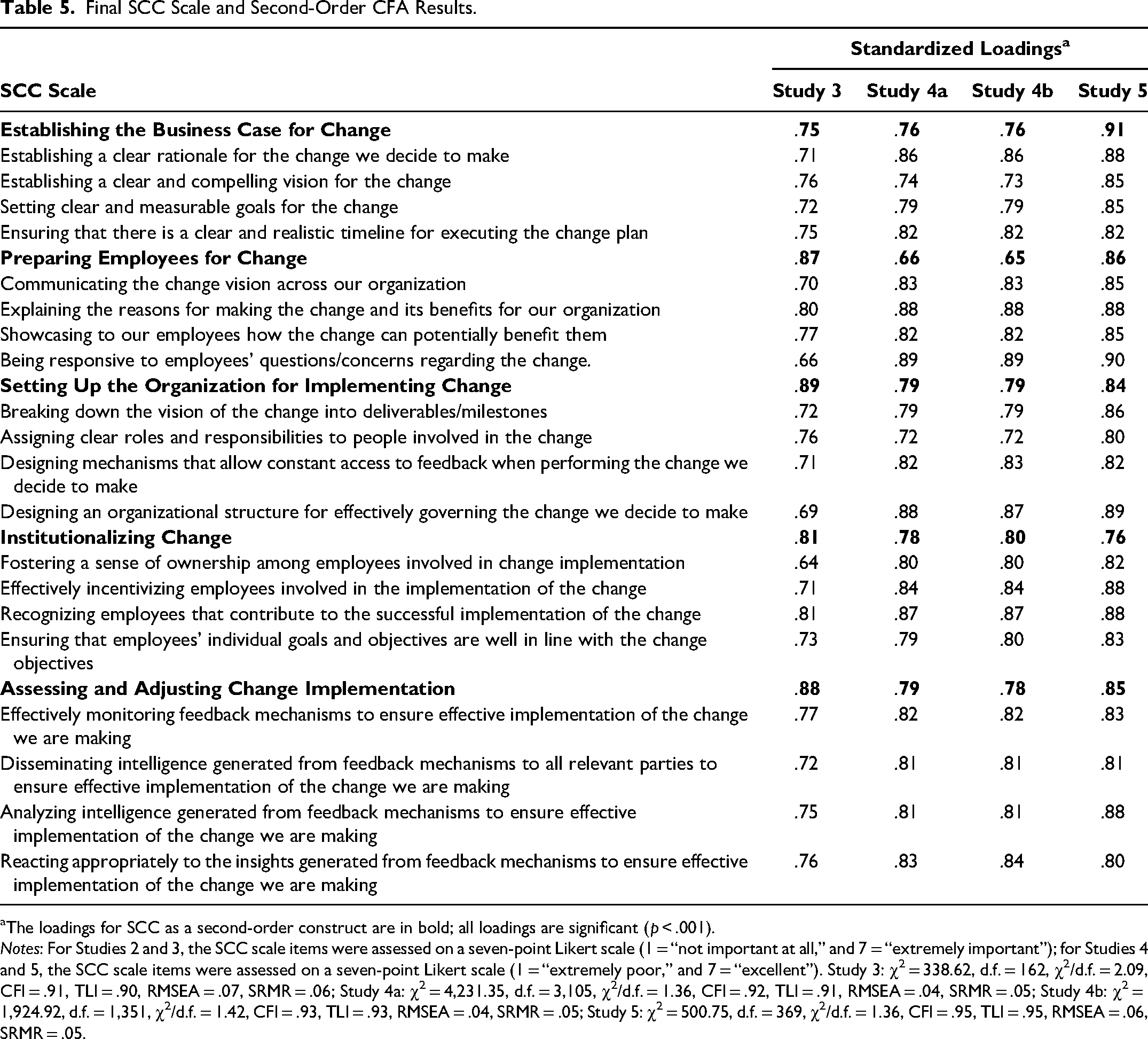
The loadings for SCC as a second-order construct are in bold; all loadings are significant (
The final 20-item model fits the data reasonably well (χ2 = 338.62, d.f. = 162, χ2/d.f. = 2.09; CFI = .91; TLI = .90; RMSEA = .07; SRMR = .06; Hu and Bentler 1999). All indicators load significantly (>.6) on the SCC dimensions they intended to measure, demonstrating high convergent validity. Composite reliability (CR) and average variance extracted (AVE) values exceed .8 and .5, respectively, for all first-order constructs (Hair et al. 1998). As initial evidence of discriminant validity, we found no squared correlations among the dimensions of SCC that exceed the value of any AVE (Fornell and Larcker 1981). The results also provide initial evidence for the reflective nature of the SCC construct, as its five dimensions are highly correlated (r > .4,
Studies 4a and 4b: Nomological and Predictive Validity
Sampling and Data Collection
The sampling frame for Studies 4a (nomological validity) and 4b (predictive validity) included senior marketing managers in medium to large marketing organizations with at least ten years’ working experience and a minimum of five years’ tenure in their current firm. As in Studies 2 and 3, we adopted a random multi-industry research design and collected data from two countries (United Kingdom and United States) to increase the generalizability of our findings. 7 We again partnered with a market research company to administer an online survey. We received 264 complete responses of 695 eligible key informants (38% response rate). We excluded 12 cases from the analysis because they failed our post hoc informant-quality test (the same as in Studies 2 and 3). The mean score for informant quality in the final sample (N = 252) was 6.40. Table W9 in Web Appendix A provides the descriptive characteristics of our sample for Studies 4a and 4b, and Web Appendix B (Section B1) shows the measures we took to confirm the absence of common method variance.
Study 4a: Nomological Validity
The main purpose of Study 4a was to assess nomological validity of the SCC scale; that is, whether SCC is associated with a set of theoretically justified antecedents and consequences. 8 We drew from the formative work of Moorman and Day (2016) to identify the nomological network in which SCC may be embedded (see Figure 1). Moorman and Day identify four marketing organization–related elements (i.e., capabilities, culture, configuration/structure, and human capital) that influence the activities through which organizations design, implement, and assess marketing strategy, thereby affecting performance outcomes.

Nomological Network of SCC.
Measurement proxies and validation
We adopted established scales to operationalize centralization, formalization, and specialization (Olson, Slater, and Hult 2005); architectural marketing capabilities, a second-order construct consisting of marketing planning, market information acquisition, interpretation, and dissemination capabilities (Morgan, Katsikeas, and Vorhies 2012); proactive and reactive cultural orientation (Narver, Slater, and MacLachlan 2004); market and financial performance (Vorhies and Morgan 2005); and the control variable competitive intensity (Jaworski and Kohli 1993). We provide a complete list of the items and the second-order CFA results for assessing the validity of the measures in Table W10 in Web Appendix A.
The CFA model fits the data reasonably well (χ2 = 4,231.35, d.f. = 3,105, χ2/d.f. = 1.36; CFI = .92; TLI = .91; RMSEA = .04; SRMR = .05); all indicators exhibit large (>.6) and significant (
We found no squared correlations among constructs that exceed the value of any AVE, which indicates evidence of discriminant validity (Fornell and Larcker 1981). In addition, we assessed the discriminant validity of our two second-order constructs (SCC and architectural marketing capabilities) by conducting chi-square difference tests (Anderson and Gerbing 1988). By comparing chi-square statistics in two measurement models in which the covariance between SCC and architectural marketing capabilities was allowed to vary (χ2 = 871, d.f. = 584) and the covariance was constrained to one (χ2 = 981.13, d.f. = 585), we identified a substantial chi-square difference (Δχ2 = 110.13, Δd.f. = 1), which suggests that SCC and architectural marketing capabilities are distinct constructs. We repeated the process for each pair of constructs included in the nomological model. The chi-square differences were significant for all pairs of comparison, confirming discriminant validity.
Analysis and results
We employed structural equation modeling using maximum likelihood estimates to assess the relationships proposed in the nomological network of SCC. The resulting model fits the data reasonably well (χ2 = 4,808.10, d.f. = 3,545, χ2/d.f. = 1.36; CFI = .91; TLI = .90; RMSEA = .04; SRMR = .05). Regarding the influence of a marketing organization's structural elements on SCC, the results suggest that centralization (β = −.20, t = −2.83,
Regarding the impact of a marketing organization's cultural orientation on SCC, we find that while reactive orientation (i.e., focusing on expressed customer needs) is positively related to SCC (β = .13, t = 1.73,
In addition, we find that architectural marketing capabilities (β = .18, t = 2.12,
Regarding performance outcomes, we find that SCC is positively related to both market (β = .43, t = 5.76,
Table 6 provides the standardized regression weights, t-values, and significance levels for the paths included in the nomological validity test. In summary, the results of Study 4a confirm the nomological validity of SCC.
Nomological Validity Test (Study 4a).

Study 4b: Predictive Validity
The purpose of Study 4b was to assess the discriminant validity and predictive power of SCC against other commonly used constructs such as strategic flexibility, agility, adaptiveness, and responsiveness (e.g., Böttger et al. 2017). 11 Compared with these established constructs, we argue that SCC captures more comprehensively the marketing capabilities and underlying activities required to ensure that strategic changes yield desired outcomes. We therefore expect SCC to be sufficiently different from (discriminant validity) and predict key performance outcomes better than (predictive validity) existing dynamic marketing capabilities constructs.
Measurement proxies and validation
We used established measures to operationalize strategic flexibility (Zhou and Wu 2010), agility (Tallon and Pinsonneault 2011), adaptiveness (Homburg, Workman, and Jensen 2002), and responsiveness (Jaworski and Kohli 1993). We used the same scale anchors for the established measures and SCC to elicit similar cognitive response tendencies (Simmering et al. 2015) and thus more effectively evaluate discriminant validity issues. Measures of performance outcomes are the same as in Study 4a. Table W12 in Web Appendix A provides further details on the operationalization of the study constructs and second-order CFA results to assess the validity of the measures. The CFA model fits the data well (χ2 = 1,924.92, d.f. = 1,351, χ2/d.f. = 1.42; CFI = .93; TLI = .93; RMSEA = .04; SRMR = .05), and as in Study 4a, we confirmed convergent validity and found that all first-order constructs demonstrate good levels of internal consistency. To establish discriminant validity, we used chi-square difference tests (Anderson and Gerbing 1988) and compared the squared correlations among the first-order constructs and AVE values (Fornell and Larcker 1981). No issues arose, confirming the distinctiveness of SCC. Table W13 in Web Appendix A includes descriptive statistics and correlation coefficients for Study 4b.
Analysis and results
To assess the predictive validity of the SCC scale, we employed hierarchical regression analyses (see Table 7). Given that the purpose of Study 4b is to assess whether the proposed new scale can explain variance in performance outcomes beyond the predictive power of established constructs, for each dependent variable (i.e., market and financial performance) we first specified a regression model that included only the established construct (Step 1) and then added the construct of SCC (Step 2) (Böttger et al. 2017). To avoid multicollinearity issues that may emerge by simultaneously analyzing similar constructs, we conducted separate hierarchical regression analyses for each pair of SCC-related construct comparisons. The inclusion of SCC improved predictive power (R2) in all instances. As Table 7 shows, the SCC scale can significantly improve predictive power of (1) market performance over strategic flexibility (R2Step 1 = .02; R2Step 2 = .18), agility (R2Step 1 = .07; R2Step 2 = .20), adaptiveness (R2Step 1 = .11; R2Step 2 = .23), and responsiveness (R2Step 1 = .03; R2Step 2 = .19) and (2) financial performance over strategic flexibility (R2Step 1 = .05; R2Step 2 = .17), agility (R2Step 1 = .06; R2Step 2 = .18), adaptiveness (R2Step 1 = .15; R2Step 2 = .24), and responsiveness (R2Step 1 = .05; R2Step 2 = .18). These results confirm the predictive validity of the proposed SCC scale.
Hierarchical Regression Analysis (Study 4b).

*
Study 5: Scale Generalizability
Sampling and Data Collection
The purpose of Study 5 was to establish the relevance of the SCC scale for different types of strategic marketing change. We adopted the same research context and sampling frame as in Study 4. For Study 5, however, we employed quota sampling to ensure we had sufficient cases for each type of change. Data came from a professional market research company that administered the survey online. We received 100 complete responses of 300 eligible key informants (33.3% response rate). All key informants met the required thresholds for key informant quality (mean informant quality = 6.45). Table W14 in Web Appendix A presents the descriptive characteristics of our sample for Study 5, and Web Appendix B (Section B1) shows the measures we took to confirm the absence of common method variance.
Drawing on the critical incident technique (Bitner, Booms, and Tetreault 1990), we asked key informants to reflect on the most recent strategic marketing change they implemented. In line with prior research (e.g., Labianca et al. 2001), we used a five-year time frame to gauge strategic change; this time frame is “long enough to capture shifts in strategy but brief enough to reflect accurately the actions of those in charge” (Wiersema 1992, p. 81). Therefore, we specified that the change should have been implemented within the last five years so that informants would have a clear picture of its performance outcomes.
Measurement Proxies and Validation
We a priori specified five categories of strategic marketing change on which informants might reflect: (1) entries/exits in international markets, (2) change in the range of products/services offered, (3) change in the area of distribution, (4) change in the method of distribution, and (5) change in the target market (Abernethy, Dekker, and Grafton 2021). After describing the changes, we asked informants to evaluate (1) how successful the change was (scale adapted from Noble and Mokwa [1999]), (2) whether the implemented change created opportunities for organizational learning (scale adapted from Menon et al. [1999]), and (3) how well their organizations performed across the SCC scale during this implemented change. Table W15 in Web Appendix A provides further details on the operationalization of the study constructs and the second-order CFA results to assess the validity of the measures.
The second-order CFA model exhibits a close fit to the data (χ2 = 500.75, d.f. = 369, χ2/d.f. = 1.36; CFI = .95; TLI = .95; RMSEA = .06; SRMR = .05), and all indicators exhibit high (>.6) standardized factor loadings, confirming convergent validity. The study constructs also show good levels of internal consistency; for all measures, Cronbach's alpha, corrected item-to-total correlations, CR values, and AVE values are well above recommended thresholds. The first-order constructs passed Fornell and Larcker's (1981) test, and chi-square difference tests confirmed discriminant validity for SCC as a higher-order construct, as in Studies 4a and 4b (Anderson and Gerbing 1988). Table W16 in Web Appendix A lists descriptive statistics and correlation coefficients for all study constructs.
Analysis and Results
We conducted split-group regression analyses to evaluate how the SCC scale explains key performance outcomes under different types of strategic marketing change (see Table 8). The results suggest that SCC is positively associated with change implementation success (β1A = .49, t = 2.36; β2A = .81, t = 5.87; β3A = .75, t = 4.79; β4A = .69, t = 4.06; β5A = .77, t = 5.20) and organizational learning (β1B = .64, t = 3.48; β2B = .58, t = 2.99; β3B = .72, t = 4.35; β4B = .85, t = 6.73; β5B = .74, t = 4.64) across all types of strategic change; SCC also explains a significant amount of variance (R2). Thus, we conclude that SCC is a practically relevant tool for assessing a marketing organization’s ability to attain desired strategic change outcomes regardless of the strategic change it faces.
Split-Group Regression Analyses (Study 5).

*
Discussion
Theoretical Contributions
This study contributes to existing research on dynamic marketing capabilities and strategic change management in three main ways. First, we advance a more integrative approach to managing strategic change. While prior research has predominantly argued for the importance of managing employee reactions effectively to enact strategic marketing changes (e.g., Sarin, Challagalla, and Kohli 2012), our study shows that a combination of strategic decision-making, execution, and employee management activities leads to successful strategic changes. Relatedly, despite notable exceptions (e.g., Herrmann and Nadkarni 2014), the change initiation and implementation literature streams have progressed along distinct paths. Whereas some scholars (e.g., Gioia and Chittipeddi 1991) have focused on identifying factors such as sensemaking and sensegiving practices that influence change initiation, others (e.g., Hayati, Atefi, and Ahearne 2018) have emphasized factors that facilitate or impede change implementation, such as leadership style. Yet, our study suggests that change initiation and implementation are intertwined phenomena. Specifically, we demonstrate that the five dimensions of SCC spanning the prechange, initial implementation, and postimplementation stages of a strategic change complement one another in determining the performance outcomes of the change.
Second, the proposed SCC scale adds to the predictive power of market and financial performance outcomes beyond established constructs. Thus, we argue that SCC can be usefully combined with established dynamic marketing capability constructs (i.e., strategic flexibility, agility, market orientation, and adaptiveness) to gain a more holistic understanding of strategic change and, as such, explain why some organizations are better equipped to perform strategic change than others (see Figure 2). In the prechange stage, established constructs can help measure a firm's ability to be proactive (generation of firm-specific options in strategic flexibility; Grewal and Tansuhaj 2001) and/or reactive (market intelligence generation and dissemination aspects of market orientation; Jaworski and Kohli 1993) when deciding to initiate a strategic change. Agility adds one more dimension: The ability to be quick and nimble when identifying a need (or opportunity) for change (Kalaignanam et al. 2021). SCC complements these constructs by unpacking whether a firm has appropriate mechanisms in place to ensure that strategic change decisions (either proactive or reactive) are rational and feasible and that employees are ready for change. At initial implementation, established constructs are pertinent to gauge whether firms are able to redeploy resources to support intended strategies (strategic flexibility; Zhou and Wu 2010) and to change marketing decisions according to the market intelligence generated prechange (responsiveness aspect of market orientation and adaptive execution aspect of marketing agility; Jaworski and Kohli 1993; Kalaignanam et al. 2021). Adding to these constructs, SCC helps judge how successful organizations are in translating strategic change decisions into a detailed set of operational actions and in institutionalizing organizational behaviors required to support change implementation. At postimplementation, SCC captures an organization’s ability to monitor change implementation and take corrective action if necessary. To complement these insights, adaptiveness toward the end of a change process can help measure firm performance (relative to competitors) in terms of achieving better fit with the external environment as the result of a fully implemented strategic change (Morgan et al. 2003).

Complementing Established Dynamic Marketing Capabilities with SCC.
Third, we demonstrate that the proposed SCC scale explains implementation success across an array of strategic change initiatives, including entries/exits in international markets, changes in the range of products/services offered, changes in the area of distribution, changes in the method of distribution, and changes in the target market. This implies that dynamic capabilities comprise a set of best practices that exhibit significant commonalities in their deployment, although they can be idiosyncratic in their details (Eisenhardt and Martin 2000). As such, while scholars have resorted to using context-specific measures of dynamic capabilities (see Laaksonen and Peltoniemi 2018), the SCC scale takes an important step toward establishing a more standardized tool for measuring a firm’s ability to manage strategic changes for desirable performance outcomes. Our study further demonstrates that SCC explains a significant amount of variance in organizational learning resulting from the implementation of different types of strategic change. This finding extends prior research suggesting that experiential learning occurring in particular contexts is not transferrable to different contexts (e.g., Muehlfeld, Rao Sahib, and Van Witteloostuijn 2012).
Managerial Implications
Considering the high failure rates of change initiatives (Argenti et al. 2021; White et al. 2023), this study offers practitioners a useful tool for assessing and improving a firm’s capacity to accomplish strategic changes in an era characterized by constant change. To that end, we develop an SCC index (see Web Appendix C) based on five imperatives (i.e., dimensions of SCC) that, we argue, can help organizations successfully undertake strategic marketing changes.
First, to apply the SCC index, managers need to respond to the questions presented in Web Appendix C, rating each on a six-point scale (0 = “strongly disagree,” and 5 = “strongly agree”). Answering Version A of the index can help managers determine how well their firms might perform each of the activities before carrying out a strategic change (i.e., ex ante change capability assessment). This type of self-assessment is critical, as strategic changes are high-stakes prospects fraught with risk; deciding to initiate a strategic change, without having the ability to implement it effectively, can prove more costly than maintaining the status quo (Herrmann and Nadkarni 2014). Alternatively, answering Version B of the index can help managers assess how well they have performed on each one of the activities after completing a strategic change (i.e., ex post change capability review). This type of self-assessment fosters organizational learning and enables firms to improve the skills needed to implement strategic changes more effectively in the future (Morgan 2012).
Second, managers need to calculate a summative score for the five imperatives; each score will range from 0 to 20, based on four questions per imperative. These scores will provide a good understanding of organizational strengths and weaknesses across each aspect of strategic change. The total SCC score (ranging from 0 to 100) can then be calculated by summing the five imperative scores.
Third, the total score can help determine a firm's SCC status (red: SCC ≤ 60; amber: 60 < SCC < 80; green: SCC ≥ 80). A red status indicates that an organization is not ready for change and that major improvements are required first to successfully undertake a strategic change. An amber status suggests that an organization has the potential to successfully undertake strategic change but may not thrive; improvements are still required to excel. In the case of a red or amber status, we suggest that managers perform a gap analysis to identify potential deficits in their organization’s SCC and take corrective action (e.g., identifying the root causes behind low scores across the different questions and imperatives of the SCC index). Table 9 provides guidance on how organizations can increase their SCC if the outcome of their self-assessment is red or amber. Finally, a green status indicates that an organization is in a favorable position to successfully undertake strategic change.
Actionable Recommendations for Increasing SCC.

Limitations and Future Research Directions
This study is not without limitations. Although we followed established methodological practices for selecting appropriate and knowledgeable key informants, informant bias is still a possibility. Future studies might therefore consider collecting data from multiple informants per organization. Moreover, while we included a wide range of industry sectors and firm characteristics in all our studies, we developed and validated the SCC scale in a Western country context (United Kingdom and United States). Thus, assessing SCC in different national contexts would also be valuable. In this vein, the SCC scale was developed and validated within the context of marketing-related strategic change, but it would also be valuable to evaluate the scale's applicability to different types of organizational change.
Furthermore, given the limitations of self-reported measures (Vermunt 2020), future research could combine the SCC scale with secondary data (e.g., announcements of strategic changes and information on whether they are completed successfully matched with time-lagged, objective performance data) or assess SCC using econometric techniques for measuring firm-specific capabilities (Dutta, Narasimhan, and Rajiv 2005). Longitudinal research would also help explicate how the five dimensions of SCC occur over time and interplay with one another. Finally, although the proposed conceptualization of SCC is a useful addition to organizational-level dynamic capabilities for enacting strategic change, exploring individual, group-level, and interorganizational marketing capabilities (see Morgan, Slotegraaf, and Feng 2022), which are required for effective implementation of strategic change, is equally important.
Supplemental Material
sj-pdf-1-jmx-10.1177_00222429251333771 - Supplemental material for Strategic Change Capability in Marketing Organizations: Conceptualization, Scale Development, and Validation
Supplemental material, sj-pdf-1-jmx-10.1177_00222429251333771 for Strategic Change Capability in Marketing Organizations: Conceptualization, Scale Development, and Validation by Georgios S. Bekos, Simos Chari, Matti Jaakkola and Heiner Evanschitzky in Journal of Marketing
Footnotes
Coeditor
Vanitha Swaminathan
Associate Editor
Christian Homburg
Declaration of Conflicting Interests
The author(s) declared no potential conflicts of interest with respect to the research, authorship, and/or publication of this article.
Funding
The author(s) received no financial support for the research, authorship, and/or publication of this article.

Notes
References
Supplementary Material
Please find the following supplemental material available below.
For Open Access articles published under a Creative Commons License, all supplemental material carries the same license as the article it is associated with.
For non-Open Access articles published, all supplemental material carries a non-exclusive license, and permission requests for re-use of supplemental material or any part of supplemental material shall be sent directly to the copyright owner as specified in the copyright notice associated with the article.
