







Abstract
Organizing retail assortments to meet consumers’ shopping needs on the path to purchase is of utmost importance for both online and brick-and-mortar retailers (Information Resources Inc. 2015). Retailers typically organize the product categories in their assortments using a substitute-based (Diehl, Van Herpen, and Lamberton 2015) or taxonomic (Chernev 2003) approach, such that they group those products that share attributes or physical characteristics. For example, most grocery retailers organize product categories as “meat,” “dairy,” “frozen,” and “beverages,” and clothing retailers often use groups such as “jackets,” “shirts,” and “accessories” to organize their assortments. An alternative way to organize assortments is a complement-based approach, such that the product categories are grouped according to a particular consumption goal or context of use (Diehl, Van Herpen, and Lamberton 2015). This organization method also has been referred to as goal-derived (Chernev 2003; Ratneshwar et al. 2001), consumption constellation–based (Englis and Solomon 1996), or shopping mission–based (Sarantopoulos et al. 2016). Examples of retailers using complement-based assortment organizations include IKEA (“bedroom,” “living room,” “kitchen”), Mango (“office wear,” “wedding & parties,” “sportswear”), and Marks & Spencer (“breakfast,” “lunchtime meal,” “barbeque”).
Current managerial practices for organizing assortments mainly rely on the idea that grouping categories according to physical characteristics, or substitutes, makes it easier for consumers to search for and find the products they want. Yet recent managerial literature has questioned this approach, because placing products with their complements may expose consumers to more relevant categories and thus lead to more impulse and unplanned purchases (Nielsen 2016). Limited academic research has investigated the impact of such complement-based assortments. Diehl, Van Herpen, and Lamberton’s (2015) initial study of complement-based assortments suggests that they are perceived as more effortful but also more attractive than substitute-based ones. They focus on store perceptions and preferences; no research has explored the impact of the assortment organization on purchase behavior. In addressing this research gap, we also help answer a critical managerial question for retailers by examining how a complement-based assortment organization determines consumer purchases and expenditures.
Arranging products using a complement-based assortment organization helps consumers think about what they need to fulfill a goal. Because consumers are exposed to more products alongside their complements, this assortment organization should sensitize shoppers to other options (Huh, Vosgerau, and Morewedge 2016) as well as convey meaningful cues about when and in which contexts other products can or should be used (Englis and Solomon 1996). Complement-based organization makes it easier for consumers to visualize the consumption experience, and it reminds consumers of other potentially needed or desirable products. For example, a consumer hosting a barbeque, shopping in a store with a complement-based assortment organization, may recall the need for paper plates—a necessary product that easily could be forgotten in a store arranged in a substitute-based organization—and feel prompted to buy watermelon—something that the consumer did not plan to purchase but that would be a great addition to the barbeque. Thus, a complement-based assortment organization could evoke increased purchases and expenditures, relative to the more commonly used substitute-based assortment organization. We expect this effect to occur because it helps consumers visualize the consumption experience in which they will consume the complementary products together.
This effect is only plausible if consumers have not already visualized the consumption experience. We therefore test two moderators of the effect of assortment organization on purchases. If consumers are highly involved with the shopping task or enter a store with a specific shopping goal, they may not need the external cues provided by a complement-based organization. For example, if a consumer is already thinking carefully about the barbeque scheduled for that same evening, this shopper probably is already visualizing all necessary and desirable items, because involvement with the shopping process increases elaboration (Celsi and Olson 1988; Petty, Cacioppo, and Schumann 1983) and mental imaging (Roggeveen et al. 2015; Sengupta, Goodstein, and Boninger 1997; Shiv and Huber 2000). In such a situation, a complement-based assortment may be less likely to increase sales relative to a substitute-based assortment organization. In a similar manner, consumers who enter the store with specific lists of needed items likely have already visualized what they need, so their focus while in the store is on fulfilling their goal, not considering peripheral information (Fujita, Gollwitzer, and Oettingen 2007). In this case too, a complement-based assortment is less likely to result in enhanced sales relative to the substitute-based assortment organization.
To test this theorizing, we conduct four studies: two field experiments, a virtual reality experiment, and a lab experiment (for an overview, see Figure 1). Study 1 is a field experiment, conducted in collaboration with a large grocery retailer, to compare longitudinal sales trends across two similar stores after one of them shifted from a substitute-based to a complement-based assortment organization. The complement-based assortment organization leads to increased purchases and expenditures. In Study 2, we use a lab experiment to shed light on the proposed mechanism in a more controlled setting and clarify why it might lead to enhanced sales. The results show that ease of visualization mediates the impact of complement-based assortment organizations on purchase consideration set size. Study 3 investigates the moderating impact of involvement with a field study. Finally, Study 4 explores the moderating impact of goal specificity using a virtual reality experiment. We conclude with a discussion of the theoretical and managerial implications as well as directions for further research.

Overview of research.
This research contributes to existing literature and managerial practice in several ways. We examine the assortment organization across multiple product categories, with a unique focus on the behavioral implications of complement-based organizations. Research on multiple product category assortments is rare; prior studies have addressed only attitudinal outcomes and rely on artificial store settings (Diehl, Van Herpen, and Lamberton 2015). Our findings, gathered from extensive field data together with virtual reality and lab experiments, provide novel insights about how assortment organizations define consumers’ purchases and expenditures. This approach also answers recent calls for more behavioral field experiments in marketing research (Gneezy 2017; Sudhir 2016). Furthermore, we extend existing literature pertaining to cross-stimuli sensitization (Huh, Vosgerau, and Morewedge 2016) and unplanned consideration (Hui et al. 2013).
In turn, we demonstrate that arranging product assortments using a complement-based organization increases consumers’ ability to visualize the consumption experience, which results in increased sales. The assortment organizations of online stores can be easily modified, but rearranging physical stores would involve substantial financial and human resource commitments as well as disruptions to store operations. Thus, brick-and-mortar retailers might consider alternative ways to help consumers visualize their consumption. For example, by illustrating product complementarity and highlighting actual consumption experiences in their in-store signage and out-of-store communications, retailers could increase consumers’ involvement in the shopping routines; by providing shopping lists based on specific shopping goals, retailers also might be able to enhance sales without having to devote significant resources to revamping their stores to display complement-based assortments.
Theoretical Background
Extant academic research on assortment organizations has predominantly focused on their perceptual consequences within a single product category (Table 1). For example, an organized (vs. random) assortment improves consumers’ perceptions of variety (Hoch, Bradlow, and Wansink 1999; Kahn and Wansink 2004), as do categories organized by brand versus flavor (Morales et al. 2005). Research that deals with consumer satisfaction suggests that for consumers with high knowledge, an unexpected organization (e.g., nationality-based restaurant menu: Mexican, Italian, Chinese) evokes greater shopping satisfaction than does an expected organization (e.g., type-based restaurant menu: soups, sandwiches, salads) (Poynor and Wood 2010). Prior research also notes the impact of organizing products within a category (e.g., tea) by attributes (e.g., black, green, rooibos) versus benefits (e.g., energy boost, stress relief, weight loss) and indicates that consumers are more (less) satisfied with their choice when they choose from a benefit-based (attribute-based) organization (Lamberton and Diehl 2013).
Previous Research on Assortment Organization.

Diehl, Van Herpen, and Lamberton (2015) move beyond a single product category to examine how the organization of multiple categories influences store preferences. Consumers perceive shopping in a store with a complement-based assortment organization as more effortful than shopping in one with a substitute-based assortment organization but also as more attractive. In addition, consumers with a hedonic (utilitarian) focus prefer to return to a store organized by complements (substitutes) for future purchases. Their study thus sheds light on how the assortment organization affects store perceptions and preference. However, beyond that single contribution, no research has detailed how multiple categories influence store preferences. For this article, we examine specifically how the arrangement of multiple product categories, as complements or substitutes, affects actual purchase behavior.
Behavioral Effects of Complement-Based Assortment Organizations
A complement-based assortment organization groups different products that provide greater utility when consumed together than when consumed separately. In contrast, a substitute-based assortment organization groups different products that share the same attributes or physical characteristics, such that they are exchangeable by virtue of being replaceable. A complement-based assortment organization likely facilitates the conversion of unplanned considerations into purchases. Research on cross-stimulus sensitization (Groves and Thompson 1970; McSweeney and Swindell 1999) has shown that exposure to a stimulus can sensitize consumers to other stimuli. For example, taking or anticipating a beach vacation increases how much the person desires to drink margaritas or listen to surf music (Huh, Vosgerau, and Morewedge 2016). Cross-stimulus sensitization is selective; it only sensitizes consumers to complementary items. Huh, Vosgerau, and Morewedge (2016) report that consumers are more sensitized to grape jelly after consuming—or imagining consuming—peanut butter (a complement) rather than strawberry jelly (a closer substitute, but not a complement).
Previous research provides support for cross-stimulus sensitization in store environments, too. Hui et al. (2013) find that a shopper who plans to buy category A is more likely to consider buying an unplanned category B if category B has complementary characteristics to those of category A. Using in-store video tracking technology and latent category map analysis, they find that shoppers who were planning to buy cheese exhibit a higher propensity to consider an unplanned purchase of complementary products such as dip, fresh meat, and drinks. However, their findings suggest that unplanned consideration does not correlate with actual purchase patterns. In turn, Hui et al. suggest that consumers need a “small nudge,” such as a coupon promoting complementary products, to convert their consideration into purchases. Building on these findings, we suggest that exposing consumers to product options alongside their complements represents a nudge for the conversion of unplanned considerations into purchases, because it helps consumers visualize using the products together.
Complement-based assortment organizations also can convey meaningful cues about the usage contexts for products (Englis and Solomon 1996). Presenting a product category alongside its complements (e.g., sandwiches surrounded by chips, desserts, and beverages; a sofa surrounded by a coffee table and armchairs) is a more vivid representation of the actual consumption or use process. Vividness theory (Nisbett and Ross 1980) suggests that when people encounter vivid information, they produce more images in their minds and imagine the consumption (Nowlis, Mandel, and McCabe 2004; Roggeveen et al. 2015). Vividness refers to a sense of being physically proximal, temporally proximal, or emotionally appealing (Nisbett and Ross 1980). It helps people visualize future outcomes (Shiv and Huber 2000) and imagine how much they will enjoy a product once they get it (Nowlis, Mandel, and McCabe 2004). A complement-based assortment organization thus might increase unplanned consideration by making nonfocal products more relevant to consumers (Diehl, Van Herpen, and Lamberton 2015) and increasing their anticipated utility (Moe 2003; Nedungadi 1990) because it enables consumers to visualize the products being used together. In complement-based assortments, complementary products, by definition, are physically proximal, yet the favorable downstream effect of complementarity (i.e., ease of visualization of consumption) is independent of this physical proximity. Rather, ease of visualization might be brought about by using other retail mix elements to help consumers “see” an end result, such as advertising or in-store signage. Accordingly, we expect that when they encounter items organized in a complement-based way, consumers visualize experiencing the products and consider products that are complementary to the focal item, which leads to increased purchases.
On the flip side of H2’s prediction that the effects of assortment organization on consumer purchases and expenditures are driven by the ease of visualization of the consumption process, in situations in which consumers do not need the assortment organization to help them visualize the consumption experience, we predict that the impact of assortment organization on consumer purchases and expenditures becomes attenuated. We consider two such situations: when consumers are highly involved or when they possess specific shopping goals.
Moderating Role of Involvement
As we have noted, complement-based assortments should make it easier for consumers to visualize using different products, but in some situations, they may not need external cues to imagine these combinations of products. When consumers are highly involved, reflecting “the level of personal relevance that a product or purchase decision has for a consumer” (Zaichkowsky 1985, p. 342) or the “subjective belief of the importance of a task or of the goal about which the task is being undertaken” (Mantel and Kardes 1999, p. 338), they are more motivated to process information thoroughly and expend more cognitive effort on the shopping task (Chuang 2013). Highly involved consumers therefore elaborate more on potential benefits and visualize using the products (Roggeveen et al. 2015). In turn, we expect that highly involved consumers already have visualized what products will work well together; they may not require an external cue from the complement-based assortment organization to nudge them to purchase complementary products, because they already are likely to purchase them. In contrast, less involved consumers might not consider which products work well together, so they require the nudge provided by the complement-based assortment organization before they will purchase complementary products. We predict the following:
Moderating Role of Shopping Goal Specificity
Another situation in which a consumer may not need an external cue is when (s)he has a specific shopping goal in mind. Consumers frequently formulate their shopping goals before they visit the store (Bell, Corsten, and Knox 2011), which requires them to visualize what they need and set specific shopping tasks. In line with Wright and Kacmar (1994, p. 243), we define goal specificity as a measure of the “ambiguity or diffuseness in the exact level of performance desired.” Specific goals define a desired end-state objective (e.g., lose six pounds, pay off $500 of debt); nonspecific goals do not (e.g., lose as much weight as possible, pay off as much debt as possible). Wright and Kacmar (1994) show that people are more committed to assigned goals when they are specific rather than nonspecific. Accordingly, when consumers visit a store with a less specific shopping goal (e.g., buy food for dinner), they are more likely to deliberate about different product options, be open-minded, and have a wider breadth of attention (Fujita, Gollwitzer, and Oettingen 2007). Contrarily, in situations when consumers have carried out some or all of their purchase decision process before visiting the store (e.g., buy products to make lasagna for dinner), they are more likely to be focused on implementing their goal (Lee and Ariely 2006) and have a narrow breadth of attention (Fujita, Gollwitzer, and Oettingen 2007). Thus, in conditions of high goal specificity, consumers are less likely to attend to or process the surroundings near a target item, reducing the likelihood of cross-stimulus sensitization induced by a complement-based assortment organization (Huh, Vosgerau, and Morewedge 2016). Consumers with these specific goals are in a shopping stage that is characterized by goal determinism and action tenacity (Lee and Ariely 2006). As a result, we expect a moderating effect of goal specificity on the impact of the assortment organization on purchases.
To explore our hypotheses, we conduct four experiments. Study 1 is a field study to test H1, and Study 2 uses a lab experiment to examine H2. In Study 3, we investigate H3 in a real-world setting. Finally, Study 4 uses a virtual store setting to explore H4.
Study 1: Effects of Complement-Based Assortment Organizations on Purchases
To test the proposed main behavioral effect of a complement-based assortment organization (H1), we conduct Study 1 in the real-world setting of two stores of a
With this approach, we can control for preintervention differences in the dependent measures between the treatment and control stores and also accommodate changes across time that are not due to the manipulation. Both the treatment and control stores represent the same firm and feature similar floor space, assortments, number of staff, and customer socioeconomic properties. We confirmed with management that no servicescape features—location of checkout counters, interior decorating, cleanliness, store ambience, noise, or lighting—were altered during the experimental period in either store. The pricing, product mix, advertising, and promotion decisions (and thus any variations therein) take place at the firm level and were identical across all stores of the retail chain, so the presence of a comparable, concurrent control store in our analysis adds further legitimacy to our results by limiting possible history threats or risks of unanticipated confounds (Shadish, Cook, and Campbell 2002).
Products Included in the Complement-Based Assortment Organization
To determine which items to place together in the complement-based assortment organization, we analyzed sales affinities in data gathered from the treatment store from January 1, 2012, to May 31, 2013, reflecting 412,786 shopping trips. This analysis focused on food, household cleaning, and personal hygiene items, which spanned 75 categories (e.g., cereals, carbonated drinks, detergents). We binary coded all categories (1 if purchased, 0 otherwise) to use as clustering input variables, then split the shopping trips into training (60%) and test (40%) sets. Using a centroid-based partitioning cluster analysis (Leisch 2006), we derived clusters of complementary products by segmenting trips by the categories they feature. We determined the optimal number of clusters using both visual methods (Leisch 2010) and sales data from the control store to check the robustness of the solution. Both analyses yielded the same eight clusters. Web Appendix A details the participation probabilities per cluster for the 30 most popular categories.
To better understand and interpret these results, we conducted discussions with consumers in a series of focus groups. As a warm-up exercise, the consumers first considered a stack of 75 index cards, listing each of the categories employed in the cluster analysis (one category per index card) and reflected on the role of these categories for their everyday consumption. The consumers then were presented with and asked to label the eight category groups that emerged from the cluster analysis. After exchanging viewpoints and reconciling any disagreements, consumers interpreted the eight clusters as follows: breakfast (e.g., milk, juice, coffee, cereal, yogurt, eggs), main course (e.g., produce, fresh meat, pasta, canned food, rice), baking/dessert (e.g., cake mix, baking powder, chocolate chips), snack/candy (e.g., carbonated drinks, chocolate, chips, cookies, nuts), sandwich/deli (e.g., bakery, cheese, deli meats), cleaning supplies (e.g., household cleaning, detergents, dish washing), health/beauty (e.g., shampoo, bar soap, oral care), and stockpiling (which included many categories fairly uniformly). These results informed the relocation of product categories in the store in the operationalization of the complement-based assortment organization (Figure 2).

Study 1: Relocation of product categories in the store.
Method
To account for seasonality effects, we analyzed all trip-level purchases from January 1, 2013, to December 31, 2014 (105 weeks), or 579,756 shopping trips for the treatment store and 532,896 for the control store. The store-level relocation of product categories lasted two weeks.
We use four measures to estimate in-store purchases, representing both the number of purchases and monetary expenditures. Purchases reflect three measures/levels: the number of items, number of SKUs, and number of categories per transaction. Web Appendices B and C provide example operationalizations of these three purchase measures. Categories represent the superordinate level, which can include different SKUs, and SKUs in turn can include different items. For example, a basket containing products from the milk category might feature different milk brands or package sizes (SKUs) and multiple items of each SKU. We measure expenditures as the amount in U.S. dollars spent per transaction.
Results
In the overall ordinary least squares (OLS) regression model, with a time series specification that predicts purchases, for intervention status j, store k, and week t, we determine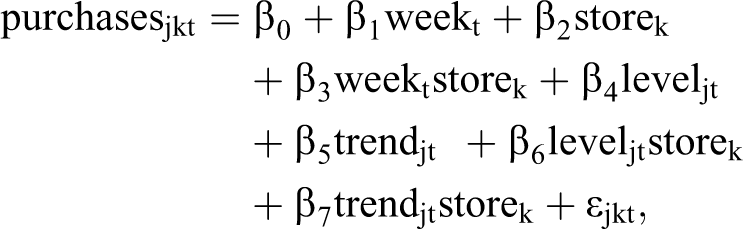
where j = 1 for a complement-based assortment organization and 0 for a substitute-based organization; k = 1 for the treatment store and 0 for the control store; t = 1, 2,…, 105 for the week in the data (spanning 77 weeks before and 28 weeks after the manipulation); and ε is the error term. For each outcome measure (i.e., items, SKUs, categories, and expenditures), we estimate the model coefficients with OLS to check for the presence of autocorrelation (Table 2).
Study 1 Regression Analysis Results.

***
We observe exponential decay in the autocorrelation function plots for all four purchase measures and then use the partial autocorrelation plots to identify the order of the autoregressive models (Brockwell and Davis 2016). We notice a significant lag of one week for the items, SKUs, and expenditures measures and a significant lag of two weeks for the categories measure (Web Appendix D). These results indicate autoregressive processes at one significant lag underlying the items, SKU, and expenditures series and a second-order autoregressive process underlying the category series. Autoregressive models are a natural choice when a series contains components that can store quantities (e.g., utility) from one observation period to the next. That is, for the item, SKU, and expenditure series, the value at weekt can be predicted from linear combinations of weekt−1, subject to random shocks; for the category series, the value at weekt can be predicted from linear combinations of weekt−1 and weekt−2, subject to random shocks. We interpret the higher-order autoregressive process for the category, compared with the other series, as evidence of a slower movement of consumption utility at higher levels of the merchandise continuum. Next, we ran autoregressive models with generalized least squares (GLS) to fit the model parameters by maximizing the log-likelihood (see Table 2).
Impact on number of purchases
The results reveal a significant existing level difference between the treatment and control stores (item: β2 = .86; t = 5.66,

Study 1: Interrupted time-series analysis results for purchases.
Impact on expenditures
The results reveal a significant existing level difference between the treatment and control store in expenditures (β2 = 4.98; t = 24.61,
Discussion
With field data collected using an interrupted time-series analysis with a comparable and concurrent control group, we find support for H1 across four dependent measures—item, SKU, category, and expenditure. The complement-based assortment organization increases purchases compared with a substitute-based assortment organization, in both merchandise and monetary terms. In particular, despite a significant baseline difference between the treatment and control stores, we find a significant difference in level change—that is, the change exerted by the relocation—of the mean value of purchases (across all four measures) between the intervention and control groups. Indicating the importance of considering multiple empirical measures of purchase impact, we find sustained increases of 9% in gross U.S. dollars and 28% in the number of unique categories. The external validity of this field study makes our findings credible, yet it is impossible to control for everything in the field. To achieve more precise control of the extraneous and independent variables, we conducted a laboratory experiment to shed new light on the proposed mechanism.
Study 2: Ease of Visualization of the Consumption Process
With Study 2, we aim to replicate the effects of the complement-based assortment organization in a more controlled setting and clarify why it might lead to enhanced sales. Study 2 provides evidence that ease of visualization mediates the effect of the complement-based assortment organization on purchases (H2) and also rules out an alternative explanation for the Study 1 results, namely, that they could be due to differences in the number of product categories present, rather than the complementary nature of the products. In Study 2, we expose participants to the same number of products and categories in both assortment organizations.
Method
Assortment organization (substitute-based vs. complement-based) was manipulated between-subjects using a six-page online catalog with 36 home furnishing options. These options were organized by complements (Figure 4, Panel A) or substitutes (Figure 4, Panel B). The 112 Amazon Mechanical Turk workers (Mage = 35.52 years; range = 22–67 years; 40% female) we recruited had to imagine that they were about to move into a new apartment that they needed to furnish. They found a catalog from a retailer that offers items they think might look nice in their new home, so while viewing the catalog, they were to think about what they might want to buy. While browsing the catalog pages, participants could click on any items they liked. The measure of consideration set size reflected how many items participants clicked on while browsing the catalog pages.

Study 2: Examples of stimuli pages.
After the participants had finished browsing the catalog, we measured ease of visualization with nine-point items (α = .90). Participants indicated the extent to which they agreed with the statements, “I could easily imagine how the pieces shown on each page would look in a house,” “I could visualize how the items shown would fit together in a house,” “I could visualize how the items shown on each page would look in a house,” “I could easily imagine how this furniture would look in a house,” “Showing the grouping of items made it easy for me to visualize how they would look in a house,” and “I could easily picture these items in a house” (1 = “strongly disagree,” and 9 = “strongly agree”). Finally, the participants reported demographic information and completed a manipulation check of the assortment organization by responding to the statement, “The items on each page in this catalog are arranged by placing them next to…” (1 = “substitute [similar] products,” and 9 = “complementary [different, but related] products”).
Results
The assortment manipulation worked as intended. Participants in the complement-based condition perceived that the items were arranged by placing them next to complementary products, more so than did participants in the substitute-based condition (Mcomplement = 7.02, Msubstitute = 4.39; F(1, 111) = 32.735,
We conducted an independent-samples t-test to compare the consideration set sizes in the complement-based and substitute-based assortment organization conditions. The results reveal a significant difference (Mcomplement = 13.70, Msubstitute = 11.55; t(110) = −2.06,

Study 2: Effects of assortment organization on consideration set size and ease of visualization.
Finally, we conducted a regression analysis to investigate our prediction that the ease of visualization mediates the effect of the assortment organization on consideration set size. The results indicate that assortment organization is a significant predictor of ease of visualization (β = .601, t = 2.05,
Discussion
The results of Study 2 demonstrate that assortment organizations featuring products alongside their complements increase consumers’ consideration sets, an effect that is mediated by the ease of visualization, in support of H2. In addition, Study 2 reveals the impacts of complement-based assortment organizations in a controlled setting, which helps rule out the notion that mere exposure to a greater number of products might drive the effects of complement-based assortment organizations on purchases.
Study 3: Moderating Effect of Shopping Involvement
In Study 3, we examine our proposition in H3 that complement-based assortment organizations versus substitute-based assortment organizations result in increased purchases and expenditures by less involved consumers, but not by more involved consumers. We run another field experiment using the treatment store from Study 1.
Method
We applied a between-subjects manipulation of assortment organization (complement-based vs. substitute-based) and measured shopping task involvement by interviewing consumers before they entered the store. The substitute-based assortment organization study took place three months prior to the shift to the complement-based assortment organization (week 15), and then we assessed the complement-based assortment organization three months following the change (week 42). To control for potential variation between the pretest and posttest experimental periods, we analyzed historical data, provided by the retailer, from both the focal store and a similar store for the year (i.e., 52 weeks) before the experimental period. The results confirm that the pretest and posttest weeks (weeks 15 and 42, respectively) are comparable in the average number of purchases and expenditures. Thus, we can rule out potential seasonality effects between the pretest and posttest periods.
We randomly intercepted and interviewed 237 consumers as they entered and exited the store. To qualify, upon entering the store, consumers had to confirm that they normally do their own shopping. Then we elicited their task involvement using three nine-point items (α = .94), adapted from decision involvement literature (Forrest and Feldman 2000; Johar 1995; Zaichkowsky 1985). Participants rated how important the decision about which products to buy would be during that shopping trip (“not at all important–very important”), how much thought it would require (“little thought–a lot of thought”), and if there would be a lot at stake if they chose the wrong products (“little to lose–a lot to lose”). After having completed their shopping, including payment, these customers provided their register receipts as they exited the store. From the receipts we extracted four measures: total number of unique items, number of SKUs, number of categories, and the amount spent per transaction. Finally, these participants completed an assortment organization manipulation check that asked them to rate the statement, “The products in this store are located alongside…” (1 = “substitute [similar] products,” and 9 = “complementary [different, but related] products”).
Results
The manipulation of the assortment organization worked as intended. In the substitute-based condition, participants noted that the products were located alongside substitutes, more so than those in the complement-based condition (Msubstitute = 3.19, Mcomplement = 4.73; F(1, 235) = 59.77,
We regressed assortment organization, shopping involvement, and their interaction on the three operationalizations of purchases (number of items, SKUs, and categories purchased) and expenditures; the full models are significant (item: R2 = .09; F(3, 233) = 7.43,
To decompose these interactions, we used the Johnson–Neyman (JN) technique (i.e., floodlight analyses per Spiller et al. [2013]) to identify the range of involvement for which the simple effect of organization assortment was significant. This analysis revealed that as involvement increases the effect of assortment organization diminishes (see Figure 6). Complement-based organization results in greater outcome variables than substitute-based organizations for respondents with involvement score lower than six on a nine-point scale. In particular, the JN point for involvement (above which the effect becomes insignificant) is 6.58 for items (βJN = 1.42, t(233) = 1.96,

Study 3: JN analyses for the assortment organization × shopping involvement interaction.
Discussion
The effects of shifting from a substitute-based organization to a complement-based assortment organization depend on consumers’ involvement with the shopping task, in support of our prediction (H3). When consumers are less involved with the shopping task, the effects of a complement-based (compared to substitute-based) assortment organization are more pronounced. These effects are manifest across the three purchase measures (items, SKUs, and categories) and expenditures. At low and moderate customer involvement levels, a complement-based assortment organization prompts an increase in all measures compared to a substitute-based organization. At higher involvement levels, consumers in the complement-based and substitute-based organizations behave similarly. Importantly, the results demonstrate that the impact of complement-based assortment organization is robust across all level of involvement.
Study 4: Moderating Impact of Shopping Goal Specificity
In Study 4, we examine H4, that is, our proposition that the effect of a complement-based assortment organization decreases with shopping goal specificity. Study 3 confirms that the impact of a complement-based organization compared to a substitute-based organization is less pronounced when consumers, due to their high involvement, do not need to be reminded of potentially desirable products; with Study 4, we further validate the theoretical mechanism by showing that that the effect of a complement-based organization also is less pronounced when consumers have a specific goal in mind and do not need to be reminded of potentially desirable products. This experiment uses a realistically sized (300 inch, 3840 × 2160 resolution screen) three-dimensional virtual store simulation, with the store from Study 1 as a template (Web Appendix E).
Method
We adopted a 2 (assortment organization: substitute-based vs. complement-based) × 2 (shopping goal: specific vs. nonspecific) between-subjects design. We implemented two versions of the virtual store simulation. Consistent with Study 1, in the substitute-based condition, the product categories were organized in groups such as fresh food, frozen food, bakery, and drinks, whereas the complement-based condition organized them into groups such as breakfast, dessert, and snack.
The 160 participants, from a consumer panel maintained by the retailer, received a store voucher as a reward for their participation. They were randomly assigned to one of the four conditions. In the specific shopping goal condition, they imagined that they had to buy specific items they had written down on a shopping list; we provided an indicative shopping list that featured frequently purchased items (according to a pretest). In the nonspecific goal condition, we asked participants to imagine they had to buy some items for a weekly fill-in shopping trip, without providing them with any list. Participants could purchase as many products as they wanted and take as much time as they deemed appropriate. The participants dictated their preferred in-store navigation maneuvers (including which items to pick up) to an operator, which eliminated any noisy variance due to the varying equipment-handling skills of participants.
Due to the artificial nature of the study setting (i.e., no checkout in the virtual store), we could not evaluate monetary outcomes (i.e., expenditures). However, we recorded the number of unique items and unique categories selected by each participant during the shopping task through passive observation (SKUs were not elicited). Participants also indicated the organization of products in the store (1 = “by their physical characteristics,” and 7 = “by consumption occasions”) and the goal of their trip (1 = “general fill in trip,” and 7 = “buy items from a list”), as manipulation check items. Finally, we measured perceived shopping involvement and their familiarity with the experimental store (1 = “not familiar at all,” and 7 = “very familiar”), as control variables.
Results
The manipulations all worked as intended. A 2 (assortment organization: substitute-based vs. complement-based) × 2 (shopping goal specificity: nonspecific vs. specific) between-subjects analysis of variance (ANOVA) on perceived assortment organization reveals a significant main effect (Mcomplement = 4.97, Msubstitute = 3.24; F(1, 156) = 51.87,
Next, we conducted a 2 (assortment organization: substitute-based vs. complement-based) × 2 (shopping goal specificity: nonspecific vs. specific) between-subjects ANOVA on the number of items and number of categories. The results reveal main effects of assortment organization (item: Mcomplement = 11.55, Msubstitute = 9.14; F(1, 156) = 63.03,

Study 4: Effects of assortment organization and shopping goals.
Discussion
The results of Study 4 affirm that the effect of the assortment organization on purchases is moderated by consumers’ shopping goals (H4). By experimentally manipulating goal specificity, we show that when consumers have less specific goals, a complement-based assortment organization increases purchases, relative to a substitute-based one, measured as both items and categories. Even though the effect of a complement-based assortment organization diminishes when shoppers have specific goals, consumers still purchase more items and categories than they do in a substitute-based assortment organization.
General Discussion
Complement-based assortment organizations are growing in popularity as retailers seek to increase the relevance and convenience of their offerings for consumers. Recent research has indicated that such organizations are perceived as more effortful but more attractive (Diehl, Van Herpen, and Lamberton 2015), though the effect of complement-based assortment organizations on in-store purchase behavior has remained unclear. With four studies, we investigate whether and in which conditions these complement-based (cf. substitute-based) assortment organizations exert positive impacts on purchase behavior. Table 3 features an overview of our four studies and main findings.
Summary of Studies and Results.

aPredicted values in Study 3 are obtained by evaluating the regression functions at the JN − 1 SD (low) and JN + 1 SD (high) involvement levels.
Using field data and an interrupted time-series analysis with a comparable, concurrent control group, Study 1 examines longitudinal sales changes and reveals a significant, sizable increase in weekly average purchases for a complement-based, compared with a substitute-based, assortment organization, across four measures. We also compare the sales performance of the treatment store that shifted to a complement-based assortment organization against the predicted sales it would have achieved if it had kept a substitute-based assortment organization, to ensure the results were not driven by a novelty effect. Study 2 specifies the mechanism for these effects in a laboratory setting, demonstrating that the ease of visualizing the consumption process mediates the impact of the assortment organization on purchases. By controlling the number of products and categories across conditions, this study also rules out the possibility that the effects could be driven by differences in the actual number of products or categories shown. Next, Studies 3 and 4 examine the predicted moderating factors: involvement and goal specificity. Both of these factors are expected to affect the amount of visualization the consumption experience independent of the assortment organization. With Study 3, a field study, we measure shoppers’ involvement, three months prior to and three months after the store changed from a substitute-based to a complement-based assortment organization, then investigate sales to these shoppers in terms of items, SKUs, categories, and expenditures. The findings demonstrate that the impact of the complement-based assortment organization decreases among highly involved consumers. Finally, Study 4 uses a virtual reality experiment to explore the moderating impact of shopping goal specificity on consumer purchases, revealing that a specific shopping goal reduces the beneficial lift due to a complement-based assortment organization. Even shoppers with a specific goal still purchase more in the complement-based assortment organization than the substitute-based assortment organization, however. These findings speak to the robust impact of arranging items in complementary fashion.
Theoretical Implications
This research contributes to extant literature in several ways. First, we extend assortment organization literature by investigating whether, when, and why a complement-based assortment organization affects consumers’ purchase behavior. Prior research has focused primarily on substitute-based assortment organizations and aimed to determine how organizing product options within a category (e.g., by brand, by attribute) affects consumers’ perceptions of variety (Kahn and Wansink 2004), learning and satisfaction (Poynor and Wood 2010), substitutability (Lamberton and Diehl 2013), or unrelated decisions (Ülkümen, Chakravarti, and Morwitz 2010). We instead address the behavioral consequences of complement-based assortment organizations, focusing on the shopping trip that takes place after consumers have entered the store.
Second, for shopper marketing research, we extend a literature stream that examines consumption-related antecedents of in-store purchasing, such as shopping orientation (Büttner, Florack, and Göritz 2013) or point in the shopping journey (e.g., store entrance vs. interior) (Dhar, Huber, and Khan 2007; Lee and Ariely 2006). Building on studies that acknowledge the effects of external marketing cues on consumers’ cognitive processes (Lamberton and Diehl 2013; Soman and Zhao 2011; White, MacDonnell, and Dahl 2011), we demonstrate that exposure to complement-based assortment organizations shifts consumers’ purchasing, because they view the products as complements and find it easy to visualize using them together.
Third, we expand on prior in-store behavior literature that indicates that organizing products according to complementary options seems more effortful (Diehl, Van Herpen, and Lamberton 2015). Processing such effortful external marketing cues can lead to deeper information processing and increased mental imaging (Motyka et al. 2016). In turn, placing complementary products together can provide the required “nudge” that leads to purchase, because it helps consumers visualize the products being used together.
Fourth, we demonstrate that both shopping task involvement and specificity can moderate the impact of the assortment organization. Highly involved consumers, who are more likely to attend to and comprehend information about a shopping situation and produce more elaborate meaning and inferences about it (Celsi and Olson 1988), do not require the nudge provided by the complement-based assortment organization. These highly involved consumers are more likely to visualize the consumption of complementary items even without the complement-based organization. Consumers who have specific shopping goals also appear less open to the nudge provided by the assortment organization. These consumers likely have visualized the consumption experience when creating their specific goal, and in the store, they focus on achieving that goal (Lee and Ariely 2006), which narrows their breadth of attention (Fujita, Gollwitzer, and Oettingen 2007) and reduces the impact of the assortment organization.
Fifth, prior studies have noted the effects of store-level remodeling (Brüggen, Foubert, and Gremler 2011; Dagger and Danaher 2014); we provide the first assessment of a store-level, complement-based (cf. substitute-based) assortment organization on purchases, which is a measure of great interest to retailers and consumer packaged goods manufacturers. We merge distinct streams of store remodeling research with assortment organization theory (Diehl, Van Herpen, and Lamberton 2015; Kahn and Wansink 2004; Lam and Mukherjee 2005; Lamberton and Diehl 2013; Poynor and Wood 2010) and show that assortment organization can be an important parameter that should inform store remodeling choices.
Managerial Implications
Our findings provide several notable insights for marketing practitioners. Critically, the assortment organization has a significant effect on purchase behavior. To derive our conclusions, we assessed the results according to four measures (number of items, number of categories, number of SKUs, and expenditures), based on the aggregate of unique items in the retail transactions. These are managerially relevant, intuitive, and objective metrics. Compared with store-level weekly aggregates of transaction expenditures (e.g., gross revenue), they safeguard better against variations in pricing when it comes to store performance monitoring (Bell and Lattin 1998). Retailers should adopt such measurement approaches more widely. Specifically, in Study 1, we compared longitudinal sales trends across two stores that were similar, prior to one of them shifting from a substitute-based to a complement-based assortment organization. In the 20th week after the change from a substitute-based to a complement-based assortment organization, average weekly purchases were 2.27 items greater than would have been expected had the assortment organization not changed, representing a 17.18% increase on an item level. On the SKU and category levels, we also find increases. On average, 2.05 more SKUs were purchased, and 1.97 more categories, representing increases of 20.02% and 28.04%, respectively. A consumer’s average weekly purchases also were $3.62 more than what would have been expected had the assortment organization not changed. This 9.03% increase implies substantial profit for retailers.
Furthermore, this research demonstrates the robust impact of a complement-based assortment organization, across grocery and furniture retail settings; these findings also could be relevant to other products. For example, financial services providers that use substitute-based assortment organizations (e.g., loans, insurance, credit cards, tax planning, wills/trusts) could switch to complement-based organization including categories such as “Going to university,” “Getting married,” “Buying a car,” “Having a baby” or “Just retired.” The moderating conditions also help specify the types of retailers for which complement-based organizations may be particularly impactful. That is, our findings suggest that the impact of the organization is contingent on whether consumers need help remembering what they need or are open to being told what might be desirable, such that it is more pronounced when shopping involvement or shopping goal specificity is low. Complement-based assortment organizations have positive impacts when consumers need some ideas or guidance about how to achieve their shopping goal, which likely occurs when the retailer sells goods that people rarely buy, that change frequently, or that are unfamiliar to consumers (e.g., high-end consumer electronics retailers). Even in high-involvement or high-specificity contexts, marketers still can target complement-based assortment organization to the consumer segments that are less involved or have less specific shopping goals.
Our findings also suggest that ease of visualization drives the effects of the assortment organization. A complement-based organization is easy to implement online and even could be targeted to particular consumer segments. In contrast, rearranging physical stores involves significant investments, so brick-and-mortar retailers might consider other ways to help consumers visualize the consumption process. For example, they might issue preprinted shopping lists on the basis of specific shopping goals, like “cheat sheets” that give consumers a ready-made checklist for the items needed to reach a goal. They also could display photos of actual consumption experiences or use in-store signage to highlight product complementarity. By increasing the ease of visualization, retailers likely can increase their sales without having to go through the labor and expense of changing their layouts.
Limitations and Further Research
This research tests the impact of different assortment organizations in retail stores, namely, complement-based or substitute-based assortment organizations. The studies in the grocery setting (Studies 1, 3, and 4) affirm the external validity of the findings for a grocery retailer, and Study 2 offers stronger internal validity. However, only Study 2 does not take place in a physical grocery setting (i.e., online furniture store). Further research should test the impact of these assortment organizations in other types of physical stores (e.g., clothing retailers) and across a wider variety of online stores. There are opportunities in both physical and online realms for multiple types of assortment organizations, whether maintained in parallel or by placing categories in multiple locations. For example, a grocery retailer might maintain a display near the front of the store to serve shoppers’ “quick lunch” goals, while still offering the same products on other shelves according to its general substitute-based assortment organization. Further research could investigate how stores with such a hybrid layout influence consumer behaviors.
A complement-based assortment organization also might affect sales by increasing the number of shopping visits, if customers come back more often after they find the new format appealing. Our data set consists of anonymous transactions, with no customer identifiers, so we cannot test this assertion empirically. Further research could investigate how complement-based assortments influence store patronage by using consumer panel data.
Finally, researchers might investigate shopping goals with mixed abstraction levels, such as when a consumer has a nonspecific shopping goal for part of the shopping trip (e.g., shopping for a baby’s birthday party) but a specific goal for the remainder (e.g., need for infant formula and diapers). Understanding how a cross-category, rather than a within-category, approach might inform and influence other important retail management decisions, such as the design of consumer communications or in-store promotions, is another area ripe for investigation. Moreover, further research could examine the behavioral consequences when shopping goals correspond with, or are discrepant from, the complementary sets that appear in complement-based assortment organizations.
Supplemental Material
Supplemental Material, jmr.17.0305-web_appendices - The Impact of a Complement-Based Assortment Organization on Purchases
Supplemental Material, jmr.17.0305-web_appendices for The Impact of a Complement-Based Assortment Organization on Purchases by Panagiotis Sarantopoulos, Aristeidis Theotokis, Katerina Pramatari and Anne L. Roggeveen in Journal of Marketing Research
Footnotes
Acknowledgments
Associate Editor
Declaration of Conflicting Interests
Funding
ORCID iD

References
Supplementary Material
Please find the following supplemental material available below.
For Open Access articles published under a Creative Commons License, all supplemental material carries the same license as the article it is associated with.
For non-Open Access articles published, all supplemental material carries a non-exclusive license, and permission requests for re-use of supplemental material or any part of supplemental material shall be sent directly to the copyright owner as specified in the copyright notice associated with the article.
