







Abstract
How does foreign support for rebel groups during civil war affect rebels’ relations with local civilians? A growing body of work examines the effects of foreign intervention on conflict duration, intensity, and outcomes, as well as on combatants’ use of violence against civilians (e.g. Balch-Lindsay, Enterline & Joyce, 2008; Cunningham, 2010; Salehyan, Gleditsch & Cunningham, 2011; Sullivan & Karreth, 2015; Sawyer, Cunningham & Reed, 2017; Fortna, Lotito & Rubin, 2018). However, the ways in which foreign intervention affects rebel groups’ local organization, civilian administration, and governance has received little scholarly attention. If external aid to the rebels can increase their fighting capacity, how might it alter their behavior as
The literature on rebel governance largely focuses on the domestic politics of rebel rule and has not systematically examined how external sponsorship affects rebel incentives to govern. If rebel groups seek formal state power and control over citizens and often have strong incentives to serve as ‘governors’ (Mampilly, 2011; Arjona, 2016), how does the influx of foreign weapons or troops alter their political calculus? Scholarship on foreign interventions in civil wars and work on rebel governance have largely developed in parallel; we have little understanding of how external support shapes rebel rule across conflicts.
In this article, we examine whether and how various types of foreign support for rebel groups affect their incentives and ability to engage in one aspect of civilian governance: social service provision. We develop two competing logics. The first draws on the notion of rebel governance as
Which logic prevails, we argue, depends on the
Understanding the factors that affect rebel governance of civilians is important, not least because in some contexts rebel groups are the only actors providing welfare services during conflict. While anarchy reigned in some territories in the Syrian Civil War, for instance, in others the Kurdish rebels or Islamic State militants became de facto governing authorities after they wrested control from regime forces. These armed groups implemented their own versions of social order and service delivery to local residents (Saleh, 2017; Robinson et al., 2017). Rebel governance of civilians may also alter civilian loyalties, impacting conflict dynamics (Kalyvas, 2006). Rebels’ wartime institution-building efforts can affect post-conflict political development by providing rebel groups with experience in civilian administration and governance (Weinstein, 2007; Podder, 2014; Huang, 2016b; Lyons, 2016; Dresden, 2017) and shaping postwar norms of interpersonal trust (Kubota, 2018). More generally, the near ubiquity of external intervention in civil wars (Regan, 2002) reinforces the importance of understanding how specific types of intervention affect armed groups’ behavior. This study suggests that aid intended as
Rebel governance of civilians
Building on the notion popularized by Tilly (1990) that wars can catalyze competitive state-building, and Olson’s (1993) concept of the stationary bandit who chooses to provide protection to civilians in exchange for their taxes, recent scholarship recognizes rebel governance as a central feature of many civil wars. Arjona, Kasfir & Mampilly (2015: 3) define rebel governance as ‘the set of actions insurgents engage in to regulate the social, political, and economic life of non-combatants during war’. To varying degrees of functionality and effectiveness, rebel groups such as Sri Lanka’s Liberation Tigers of Tamil Eelam (LTTE), Nepal’s Maoists, Ethiopia’s Tigray People’s Liberation Front (TPLF), and many others established institutions such as schools, health clinics, tax systems, radio programs, community defense forces, local-level legislatures, courts, and laws during armed conflict. Studies concur in conceptualizing rebel governance as a wartime system of mutual dependence – an informal and implicit social contract – between the rebel rulers and the ruled: rebel groups establish order and security and provide social services to local populations in order to present themselves as powerful and credible alternatives to state authority; in turn, rebel groups rely on civilians to offer their loyalty and support as well as war-fighting resources such as funding, food, weapons, shelter, fighters, and intelligence (Wickham-Crowley, 1993; Weinstein, 2007; Beardsley & McQuinn, 2009; Mampilly, 2011; Arjona, 2016; Huang, 2016b; Stewart, 2018). By creating wartime order and governance, the rebels aim to not only legitimate their political claims against the state, but also obtain local support and resources and motivate more voluntary civilian compliance (Arjona, 2016: 9). 1
Not all rebel organizations pursue extensive governance, however, and existing research suggests two broad and related factors drive rebels to do so. The first is the need for domestic and international support for their cause. Rebel groups vary in their need to secure support and recognition from their internal and external constituents (Stanton, 2016; Jo, 2015; Lasley & Thyne, 2015; Fazal, 2018). Organizations that seek to signal local control, exert political authority over a population, extract material resources from civilians, and prevent defection often create governance and service institutions in part as a way to meet those goals (Weinstein, 2007; Mampilly, 2011; Arjona, 2016; Huang, 2016b; Malejacq, 2017). In particular, secessionist groups, aware that they will be unable to achieve independent statehood without widespread international support (Coggins, 2014) and eager to convince their domestic constituents of their political competence, are often more compelled than non-secessionist groups to engage in civilian governance (Mampilly, 2011; Florea, 2017; Stewart, 2018). 2
Second, rebel groups are unlikely to engage in extensive governance unless they have attained a sufficient degree of organizational sophistication and capacity. Wartime ‘state-building’ through the provision of alternative governance is a complex and onerous project. Indeed, studies find that militarily stronger rebel groups are more likely to organize popular elections, implement judicial processes, and conduct international diplomacy, which are arguably among the more sophisticated rebel governance activities (Cunningham, Huang & Sawyer, 2020; Loyle, 2020; Huang, 2016a). In tandem with military strength, robust rebel governance reflects significant organizational coherence and capacity, since governance and social service delivery require functional differentiation and clear lines of command and control within the organization (Beardsley & McQuinn, 2009; Heger & Jung, 2017).
External support and rebel social service provision: Two logics
How, then, does rebel receipt of external support affect their incentives and ability to provide wartime social services? In this section, we build on existing studies to derive two competing logics.
Mutual dependence argument
The first plausible effect of foreign support to rebels is that it reduces the rebels’ need to depend on local civilians for support. When rebels have war-fighting resources provided to them externally, the mutuality inherent in the logic of rebel governance weakens: civilians continue to need protection, order, and services in their midst, but rebels are able to meet many of their own needs without recourse to civilian inputs. This logic is based on an understanding of rebel governance as a system of mutual dependence between rebels and civilians (Wickham-Crowley, 1993) – what we call the
Capacity argument
The second logic is that foreign sponsorship
To sum the two logics, rebel groups with external support are less beholden to civilians and thus may be less
The two logics and types of external support
Which of these competing logics prevails, we argue, depends on the
When external sponsors provide material support –
Importantly, the receipt of foreign funds, weapons, or training does not supplant the rebels’ need for other wartime inputs such as intelligence, recruits, and civilian compliance. Weapons, money, and training are thus not substitutes for civilian support, but rather are complements to it. For instance, the FMLN’s ability to obtain food, fighters, and especially intelligence about Salvadoran government forces from local civilians was critical to the group’s military successes, its receipt of weapons support from Cuba and Nicaragua notwithstanding (Wood, 2003: 121). Likewise, despite significant provisions of weapons and training from the Indian military (Bose, 2002: 633), Sri Lanka’s Tamil Tigers ‘have realized that the people will be beholden to those that take care of them. In an effort to capture that community support, the Tamil Tigers have ensured that the communities in LTTE-controlled provinces perceive health and social services as coming from the LTTE itself’ (Flanigan, 2008: 504). Angola’s UNITA rebels, for their part, made sure that their
In contrast, and consistent with the mutual dependence argument, we propose that direct combat support weakens rebels’ incentives to provide social services. The direct intervention of foreign forces is often a game-changer that greatly increases the odds of rebel military victory over the regime, with or without popular support (Akcinaroglu, 2012; Balch-Lindsay, Enterline & Joyce, 2008; Gent, 2008; Sullivan & Karreth, 2015; Acosta, 2014; Grauer & Tierney, 2018). External states that intervene with their own military forces do so to pursue their own agendas; they are often motivated by enmity toward the sitting government rather than by any real affinity for the rebel cause (Salehyan, Gleditsch & Cunningham, 2011: 712; Maoz & San-Akca, 2012). Regardless of their motives, they seek to minimize their costs. 4 This means foreign interveners typically seek a quick military victory in order to avoid getting mired in an intractable war. Although some foreign sponsors may have long-term interests in promoting local governance, they will rarely have the patience, cost-tolerance, or foresight to invest in rebel governance while their troops are engaged in combat with the incumbent regime (Sullivan, 2012). For example, when the United States partnered with the Northern Alliance (the United Islamic Front for Salvation of Afghanistan) to topple the Taliban regime in Afghanistan in 2001, it used air strikes and special forces troops to support indigenous opposition forces on the ground and accomplished the mission within a matter of weeks. In a pattern typical of foreign interventions in support of armed opposition movements, it largely ignored governance issues (Sullivan, 2012). US forces turned their attention to local governance only after the resurgence of al Qaeda and Taliban forces compelled it to develop a counterinsurgency strategy to sustain the new Karzai government (Jones, 2008).
For rebel groups, direct foreign intervention presents a major opportunity to make battlefield gains and drive the war toward rebel victory. While foreign troop support can boost rebel capacity for governance, the rare prospect of swift military gains should galvanize the rebels to focus on defeating government forces, thus shortening their time horizons and making social service provision less pressing, even burdensome (Reno, 2011: 122; Arjona, 2016: ch. 3; Stewart, 2019).
Indeed, large-scale direct military intervention may even make local inputs largely superfluous, as it did from the outset of the ADFL rebellion in the First Congo War, where rebel leader Laurent-Désiré Kabila ‘relied more on his foreign backers than he did on domestic support’ (Dunn, 2002: 60). If the rebels have remaining needs for civilian inputs, they may find it more efficient to acquire them through coercion (Salehyan, Siroky & Wood, 2014: 637). Coercive means can backfire if the rebels have a need to elicit greater civilian support, but the infusion of foreign combat forces can minimize such needs in the short term. For example, in the Sierra Leonean civil war against the RUF, Charles Taylor was a major sponsor of the rebel group, contributing ‘some of his toughest troops’ from the National Patriotic Front of Liberia (NPFL) to fight alongside the RUF and continuing his support for the RUF once he became Liberian president (Keen, 2005: 37, 253). Although RUF forces appear to have built some rudimentary educational and health services, they largely focused on hit-and-run attacks rather than on setting down roots in a community; they ‘were “mobile” rather than “stationary” bandits, with relatively little incentive to care for a geographical constituency’ (Keen, 2005: 43). Consequently, and consistent with our theory’s expectations, the organization relied heavily on coercion to gain supporters and perpetrated rampant abuses, including extreme atrocities, against the very civilians it claimed to represent (Keen, 2005: 40–43).
To sum, we expect financing, weapons, and training to complement rather than substitute for local civilian support. When external actors provide material support or training to rebel groups, it strengthens their ability to engage in governance projects as well as their fighting capacity.
In contrast, we expect combat support to weaken rebels’ implicit social contract with civilians, leading to decreased incentives to provide social services.
Research design
We test our hypotheses using cross-sectional time-series data on external aid to rebel groups and rebel group social service provision in civil wars that began between 1946 and 2004. The unit of analysis is the rebel group in each year of a conflict (group-year). We use the Rebel Governance Dataset (RGD) (Huang, 2016b) for data on social service provision by rebel groups. Data on external assistance provided to rebel groups are from the State-NonState Armed Groups Cooperation (NAGs) dataset (San-Akca, 2015). Because these two data sources have different units of analysis and somewhat different inclusion criteria for armed groups, we collected additional data to combine the two datasets as detailed below.
The primary threat to our ability to identify a causal effect of external support is that foreign support is not randomly assigned to opposition groups. The groups that receive external assistance are likely to be systematically different from the groups that do not receive any assistance. If these differences are also determinants of social service provision, it will be difficult to determine whether any observed differences between rebel groups are due to the external support they received or to pre-existing differences. In addition, we are concerned about the possibility of reverse causality. It could be that rebel service provision attracts (or repels) external support, rather than support enabling (or deterring) service provision as our hypotheses anticipate.
We adopt several strategies to mitigate these threats. First, we use coarsened exact matching (CEM) to reduce the imbalance between treatment (supported rebels) and control (unsupported rebels) groups before analysis (Iacus, King & Porro, 2017). Our matching equation includes variables that (1) have been identified in previous research as possible determinants of external support for rebel groups, (2) are plausibly related to rebel service provision, and (3) are not themselves consequences of external support (King, 2010; Stuart, 2010). The aim is to use the matching variables – ethnic conflict, communist ideology, and Cold War conflict year – to create treatment and control groups that are as similar as possible on potentially confounding variables so that our estimates of the effects of external support are unbiased. Although matching on observables cannot eliminate the possibility of selection bias, matching on observed variables also matches on unobserved factors to the extent that those variables are correlated with observed covariates (Stuart, 2010: 3). If there are, for example, unobserved characteristics of rebel groups that affect both external support and service provision, omitting them from the model will not bias the coefficient estimates on external support unless those characteristics are uncorrelated with all of the matching variables.
To address concerns about the endogeneity of external support, we estimate all models with measures of external support prior to the measure of social service provision. As an additional step, we replicate the analyses with a sample restricted to observations in which a rebel group was not providing social services in the prior year. These models allow us to test whether support provided by foreign states increases the odds that a rebel group will begin providing social services after receiving the assistance.
Dependent variable: Rebel service provision
Our measure of rebel social service provision comes from the Rebel Governance Dataset (RGD) (Huang, 2016b), which contains conflict-level data on governance institutions formed by armed opposition groups in all major civil wars that ended between 1950 and 2006. We create a binary variable for rebel social service provision that takes the value of 1 if the rebel organization maintained its own education or healthcare services in a given year by expanding the RGD in two ways.
First, we extend the coding of education and healthcare provision to the primary rebel group in armed conflicts that appear in the UCDP/PRIO Armed Conflict Database (ACD), but not in the RGD dataset, to match the source of our key independent variables. The RGD is based on the Doyle & Sambanis (2006) list of conflicts in which there were 1,000 total deaths within three years of conflict onset. Our independent variables on external support are drawn from the State-Nonstate Armed Group Cooperation (NAG) dataset, based on the UCDP/PRIO ACD (v 4-2014a), which identifies conflicts that resulted in at least 25 battle-deaths a year (Gleditsch et al., 2002; Themnér & Wallensteen, 2014). To avoid the possibility of bias introduced by including many observations for conflicts with multiple rebel groups, and to make coding of the dependent variable more tractable, we include annual observations for just one government–opposition dyad per conflict. 5
Second, for every group coded as providing social services, we conducted additional research to determine Armed groups and social service provision, 1946–2003
Figure 1 displays the number of armed groups engaged in an active conflict and the proportion of those groups that provided civilian social services across time. The cast of rebel groups that provided social services is diverse. UNITA claimed to have established 22 secondary schools and built six central hospitals in southern Angola, in addition to regional hospitals and clinics in its operational areas (James, 1992: 98). The Darul Islam movement in Indonesia established schools and hospitals as well as ‘an academy of literacy science’. To stock the latter, rebel troops ‘ransacked the library of Jajene, where 2,500 titles were reported to have disappeared’ (Van Dijk, 1981: 194). The Fretilin of East Timor built health clinics, in addition to manufacturing pills from medicinal plants (Taylor, 1999: 81).
Key independent variables: Financing, weapons, training, troops
We use the NAGs dataset (San-Akca, 2015) for measures of external support to rebel groups between 1940 and 2010. The NAG-year dataset contains information on external state provision of nine specific types of aid in each year that a rebel group was active. 7 We use these data to create several different measures of external support. Our first set of variables consists of dichotomous indicators that the rebel group received training, weapons and logistics, financing, or troop support. To address endogeneity concerns, we measure external support in the year prior to the observation of our dependent variable.
A second set of measures attempts to incorporate information about the level of support the rebel group received. We expect the effects of aid to be cumulative and to persist for some time even after support is withdrawn. Arms transferred to an opposition group will continue to function, and rebel fighters that receive training can continue to use the skills they develop, for years after the sponsor has ceased providing support. Ideally, we would have data on the value of weapons transferred to a group over time, or the number of rebel fighters trained by foreign troops. As these data are not available, we use the number of years that a group has been receiving support and the number of states providing assistance as proxies for the scale of aid a group has received. First, we create variables that range from 0 to 2 based on the number of providers of each type of assistance. Because there are two or fewer providers in 97% of our observation years, we record a 2 if the opposition received assistance from two or more foreign states. We then create backward-moving averages by summing the number of foreign governments that provided each type of support in each of the three years prior to our observation year and dividing by three. The variable is 0 when there were no external providers of a particular type of assistance in the preceding three years. If two or more states assisted the group in each of the preceding three years, the variable is coded as 2. If only one state provided weapons for one year of this period, the variable would equal 0.33. 8
We use this ordinal measure as a way to capture the magnitude and consistency of external support. If financing, weapons, combat support, or training increase an armed group’s capacity to provide social services, the effects should be cumulative and increasing in the duration of that support. Likewise, larger-scale support should correspondingly diminish rebels’ need to draw on civilian inputs. To ensure our results are not driven by a particular measure, we test models with dichotomous measures of support and discrete variables that separate years of support (consistency) from number of supporters in the Online appendix.
Potentially confounding variables
Several characteristics of rebel groups are likely to influence both the support they receive from foreign governments and their propensity to provide social services. As discussed above, current literature suggests that territorial control and secessionist aims increase a group’s ability and motivation to engage in public goods provision (Mampilly, 2011; Stewart, 2018; Florea, 2017; Wood, 2010). We estimate models with dichotomous variables indicating whether the armed group controlled territory (
Descriptive statistics
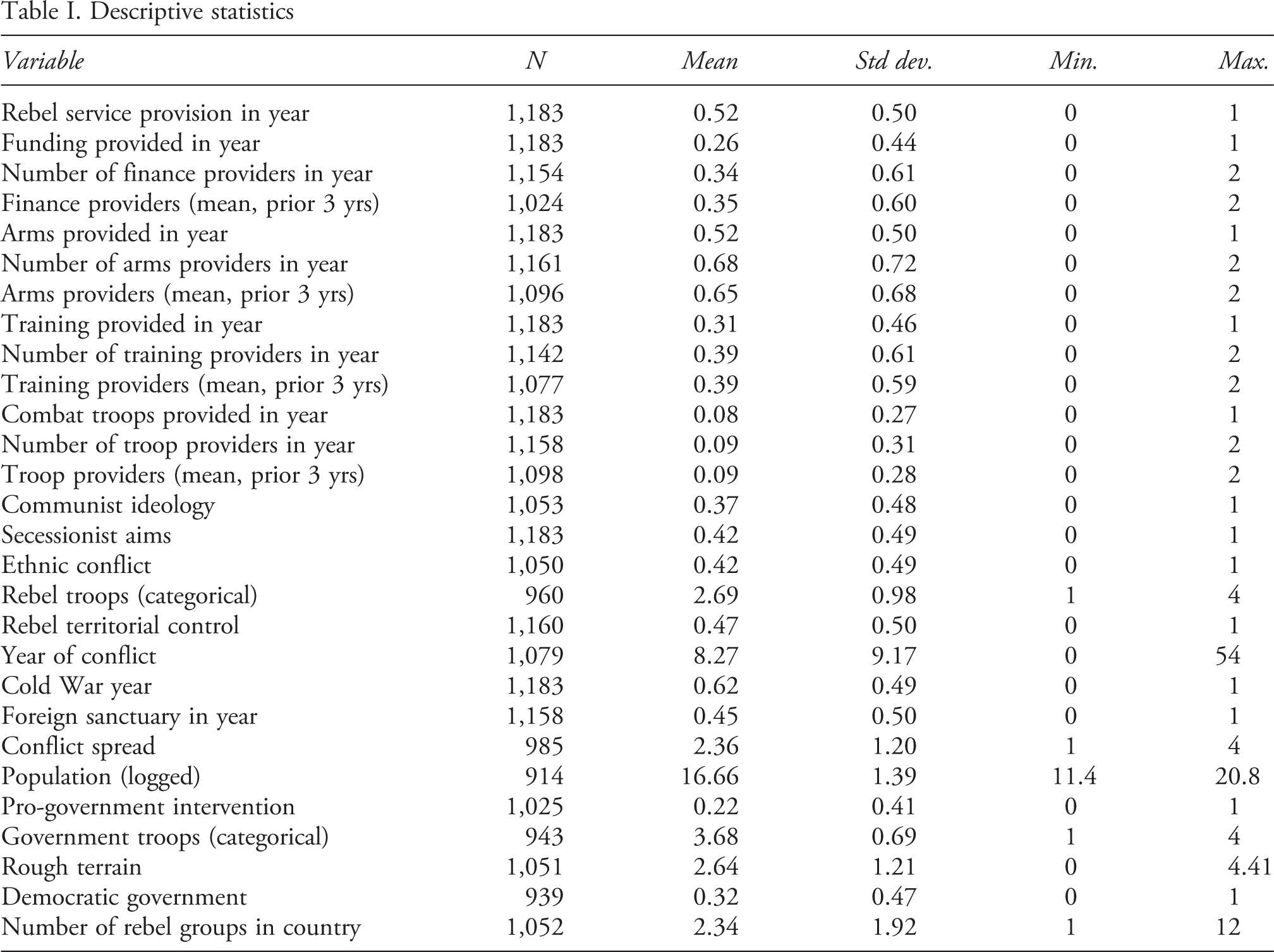
Coarsened exact matching results

Several additional control variables are included in models estimated to assess the robustness of our results. Table A5 in the Online appendix displays results from models estimated with controls for rebels’ access to sanctuary on foreign territory (
Results
External assistance and rebel service provision

Probit regression models with CEM matched data. Robust standard errors clustered by armed group in parentheses. *
Model 3.1 in Table III is a baseline model of rebel service provision with unmatched data. Models 3.2 through 3.4 use CEM matched samples to estimate the effects of external sponsorship on the likelihood that a rebel group will provide social services to civilians. The key independent variables are moving averages of the number of foreign governments that supplied financing, weapons, training, or direct troop support over the past three years. The effect of each type of assistance is estimated in a separate model because we are only able to match on one treatment variable at a time and because forms of assistance are highly correlated. In the Online appendix, we report results from models estimating the effects of arms transfers while controlling for the direct intervention of combat troops. All standard error estimates are clustered on the armed group and we include a cubic polynomial temporal approximation of conflict duration to account for temporal dependence.
The coefficients on financing, weapons, and training are all positive and statistically significant, suggesting that rebel groups are significantly more likely to provide social services if an external sponsor has provided them with one of these types of support. In contrast, direct intervention by another state has no effect on service provision. To get a better sense of the substantive effects of foreign assistance we generate predicted probabilities holding all but our variables of interest constant at their mean values. For the ‘average’ armed group-year, the probability that a rebel group will provide social services increases from approximately 45% if it receives no external funding, to 70% with one consistent foreign funder, and over 85% if at least two states provided consistent funding over the prior three years.
9
The substantive effect of
In the Online appendix, we explore the robustness of these results to different measures of our key independent variables. In Tables A2 and A3, we report the results of models estimated with a dichotomous indicator that the rebel group received weapons or training from a foreign state in the prior year; a categorical measure of the consistency of material support provided over the past three years; and a categorical measure of the number of external states providing either weapons or training. All of these measures have a positive, statistically significant effect on rebel service provision. Of note, both the number of providers and the consistency of support condition the impact of arms transfers, while only consistency appears to affect the impact of training.
The effects of the control variables in our model are largely as expected. Larger rebel groups and groups that control territory are significantly more likely to provide education or healthcare services. To illustrate the combined impact of territorial control and external arms Probability of social service provision
Opposition groups that espouse a communist or Marxist ideology are also significantly more likely to provide social services to the civilian populations. In fact, communist ideology is one of the strongest predictors of service provision even after controlling for Cold War years. Contrary to our expectations, there is no evidence that rebel groups mobilized on the basis of ethnic identity or groups with secessionist aims are any more likely to provide social services to civilian populations. While several studies maintain that rebels with secessionist ambitions are more motivated to provide governance (Mampilly, 2011; Florea, 2017; Stewart, 2018), in our data, secessionist and non-secessionist groups provide health and education services at roughly the same rate. The link between secessionist groups and rebel governance is a relatively new area of research; it is possible that the effect depends on the type of rebel governance examined or other contextual factors. We hope to explore these issues in future research.
As noted above, the most significant threat to the internal validity of our results is endogeneity – the possibility that rebel service provision attracts external providers of material support, rather than this support enabling service provision as Hypothesis 1 anticipates. To address this threat, we have used measures of external support in years prior to the observation of our dependent variable. As an additional step, we replicate our analyses using Markov transition models to estimate the effect of receiving aid on the onset of service provision. 10 We do this by restricting the sample to observations in which the rebels were not delivering social services in the prior year. Table A4 in the Online appendix reports the results.
Although we lose almost two-thirds of our cases by restricting the sample to rebel groups that were not engaged in social service provision at
In the Online appendix, we report the results of additional robustness checks including models estimated with additional control variables (e.g. pro-government intervention, rebel sanctuary, and conflict with multiple rebel groups). None of the results cause us to question our core findings.
Conclusion
This article examined how different forms of external support to rebel groups affect rebel service provision. Our results show that direct military intervention on behalf of an armed opposition group has no effect on a group’s propensity to create welfare institutions. However, when external states increase a rebel group’s capacity by providing funding, weapons, or training, the group is significantly more likely to invest in social service provision. This finding challenges the notion that rebel groups that have access to external resources become less reliant on local civilians for support and therefore have less incentive to cultivate a reciprocal relationship with them. While receiving funds, arms, and training can increase a group’s fighting capacity, rebels still need civilians to provide them with shelter, intelligence, protection, and recruits. In fact, receiving weapons, capital, or military training may actually increase rebels’ demand for recruits. Although increased firepower and combat skill could encourage rebel groups to fulfill their remaining needs through violent coercion, our results suggest that increased military capacity may instead translate into increased capacity to bolster civilian governance and provide social services.
Considered in conjunction with existing research, our findings have complex but important implications about external interventions in civil wars. Studies suggest that militarily strong rebel organizations are less likely to inflict violence on civilians, more likely to engage in wartime state-building, and better prepared for postwar politics (e.g. Wood, 2010; Wood, Kathman & Gent, 2012; Weinstein, 2005; Lyons, 2016). External states, by providing resources such as weapons and training, can significantly boost rebel military capabilities and thereby contribute to the generation of these ostensibly positive outcomes. However, studies also show that external intervention can prolong civil wars by propping up otherwise weak rebel groups, make war termination more elusive by increasing the number of actors that must be placated at the negotiating table, create moral hazards for aspiring rebel groups, and potentially corrode rebel groups’ interest in local governance if interveners engage in direct combat on the rebels’ behalf (Elbadawi & Sambanis, 2000; Cunningham, 2010; Kuperman, 2008).
These multifarious impacts can be readily observed in the ongoing war in Syria, where the survival and internal operations of various rebel groups could not be explained apart from the foreign military interventions that have artificially sustained them in the face of massive military onslaughts by regime security forces, and where military support by various foreign powers for both the state and the rebels have ensured a protracted war with extremely high civilian casualties. Studies thus collectively illuminate the difficult tensions that inherently underlie foreign interventions in civil wars. This study brings the study of external support and its effects to a more granular level by developing different causal logics for different types of military support. Future research should further examine the impacts of different types of external support, as well as seek to explain whether and why different sources of rebels’ material inputs – civilian taxes, natural resources, foreign support, and others – generate different local-level effects.
Footnotes
Replication data
 .
.Acknowledgments
Funding
ORCID iD