







Abstract
Introduction
Schools are under increasing pressure to adapt to rapid changes in society (De Jong et al., 2022). Thus, school leaders are expected to innovate their vision and practices to maintain school quality (Serdyukov, 2017), while it is broadly agreed that the quality of leadership matters in determining school development (Leithwood et al., 2020). In his theoretical work, Anderson (2017) argues that transformational leadership, the most effective form of leadership (Le & Lei, 2019), is essential for school innovations to succeed. The main premise of transformational leadership is the leader’s ability to empower and support teachers as partners in the process of decision-making for innovation within the school (Leithwood et al., 1999). Transformational leadership consists of three dimensions: vision, individualized consideration, and intellectual stimulation (Geijsel et al., 2001). Of these, Bush (2018) suggests that transformational vision is the central construct, as it is necessary to first determine the vision of the organization and its responsibilities (Day, 2011; Leithwood et al., 1996).
Studies have shown that transformational leadership that promotes shared vision building through the intellectual stimulation of teachers’ individualized and meaningful pedagogical views in schools positively affects teacher motivation, self-efficacy, professional learning, and agency (Eres, 2011; Geijsel et al., 2003; Harris, 2004; Leithwood & Sun, 2012; Li & Liu, 2022; Polatcan et al., 2021). More specifically, transformational leadership practices seem to promote teachers’ professional agency in the enhancement of student learning through the introduction of educational innovations, the creation of the conditions that support teachers’ capacity to teach, and the facilitation of teachers’ professional learning in teacher–student interactions (Borko, 2004; Lieberman & Pointer Mace, 2008; Porter et al., 2010). Prior studies suggest that teachers’ professional agency in the classroom consists of three interrelated components: motivation, self-efficacy beliefs about learning, and active strategies for facilitating learning in the classroom (Pyhältö et al., 2015; Toom et al., 2017). Nevertheless, there is insufficient evidence in the literature on the relationship between transformational leadership practices and teachers’ professional agency as an integrative concept, especially in the Chinese educational context (Li, 2022). In addition, there is a lack of empirical studies on the relationship between teachers’ professional agency and school size. Therefore, this study aims to advance understanding of the interrelationship between teachers’ perceived professional agency in the classroom, the visionary aspect of transformational leadership (transformational vision), and school size.
Literature Review
Early Career Teachers’ Professional Agency in the Classroom
Research suggests that teachers’ professional agency is a central determinant of professional and school development (Eteläpelto et al., 2015; Imants & Van der Wal, 2020). In this study, early career teachers’ professional agency in the classroom refers to their ability to prepare the way for managing new learning intentionally and actively in the classroom (Pyhältö et al., 2015; Soini et al., 2016b). In this approach, learning (viewed through a socio-constructivist lens) is thus the object of teachers’ professional agency (Edwards, 2005). However, engaging in intentional and continuous learning is challenging for teachers, and studies have indicated that they rarely use their professional community or students as resources for learning (Pyhältö et al., 2015; Soini et al., 2016b). Thus, teachers’ active professional learning cannot be taken for granted (Darling-Hammond, 2008). Instead, it is necessary for teachers to engage in intentional and collaborative efforts to learn to focus on their everyday school practices (Pyhältö et al., 2015; Soini et al., 2016b). Previous studies have shown that becoming an agent in learning entails not only teachers’ motivation to learn and self-efficacy about learning but also intentional acts to facilitate learning (Edwards, 2005; Sachs, 2000; Van Eekelen et al., 2006; Wheatley, 2005). Thus, the integrative concept of professional agency, consisting of the interrelated elements of teachers’ motivation (“I want”), self-efficacy (“I am able”) and abilities to promote new learning (“I can and do”), is required to understand the complexity of teacher learning (Pyhältö et al., 2015; Vermunt & Endedijk, 2011).
The classroom and professional community provide the central learning contexts for teachers to enact their professional agency for learning. In this article, we focus on the specific context of classroom, where teachers primarily learn in their everyday practice. Teachers’ professional agency in the classroom is embedded in classroom interactions between teachers and students (Edwards, 2005). In the classroom, teachers learn by experimenting with new teaching methods and building reciprocal and collaborative environments and reflecting on their pedagogical practices (de Vries et al., 2013; Hoekstra et al., 2009; Sancar et al., 2021). Accordingly, the three interrelated elements of teachers’ professional agency (i.e., teachers’ motivation, self-efficacy beliefs and intentional activities to manage new learning) are ingrained in two modes, each of which performs its function in teachers’ active learning in the classroom: collaborative learning environment and transformative practice (CLE), and reflection in classroom (REF) (Soini et al., 2016b).
Reflection in classroom refers to teachers’ motivation and confidence to identify, consider and assess classroom interactions to enhance teaching and learning practices (Eraut, 1995; Naidoo & Kirch, 2016). Early career teachers tend to learn in a variety of ways, for example, by experimenting with new teaching methods and equipment, reflecting on their teaching practices, and gathering ideas from colleagues (de Vries et al., 2013; Heikonen et al., 2020; Hoekstra et al., 2009). It has been found that reflection is a core mode of early career teachers’ professional agency in classroom interactions (Heikonen et al., 2020; Kwakman, 2003). Reflection enables early career teachers to consider and analyze observations, apply the teaching practices they have observed to the enhancement of teaching, and integrate theory and practice actively and deliberately (Girvan et al., 2016; Korthagen et al., 2006). Furthermore, early career teachers with the capacity to reflect are more aware of students’ feedback and needs and are also more likely to adapt the learning environment accordingly (Claessens et al., 2016)
In order to gain a sense of professional agency, early career teachers are required to construct collaborative and reciprocal environments by actively adopting transformative teaching practices (Järvelä et al., 2010). This requires that early career teachers consider pupils as crucial resources and take pupils’ needs into account in the collaborative learning process (Edwards & D’Arcy, 2004; Kwakman, 2003). This also calls for the ability to create and maintain a good learning atmosphere and functional teacher–student relationships (Greathouse et al., 2019; Martin & Dowson, 2009). However, building a collaborative environment is challenging, especially for early career teachers. For example, it has been found that early career teachers struggle to use pupils as resources for considering student needs in pedagogical practices (McCormack et al., 2006). To overcome these challenges during the first years of the teaching profession, early career teachers need support from figures such as school leaders to improve their capacity to teach and build a collaborative learning environment in the classroom. Principals who exhibit transformational leadership behaviors, particularly when they have developed a clear and shared vision with teachers, encourage teachers’ reflection and improvement and motivate teachers to reflect on both personal and joint goals, which in turn contributes to school innovation and educational changes (Anderson, 2017; Eyal & Roth, 2011; Jurasaite-Harbison, 2009).
Teachers’ agentic involvement in learning in the classroom largely depends on school conditions (Pietarinen et al., 2016). Researchers agree that school size, a crucial structural characteristic of schools, plays an important role in teachers’ engagement in active learning at work (Bakkenes et al., 2006). Small schools offer greater opportunities for face-to-face communication and interactions compared with large schools, they are inclined to promote a stronger identification within the school (Avalos-Bevan & Bascopé, 2017; Stoll et al., 2006). In the classroom context, small schools provide teachers with more chances to know their students well (Leithwood & Jantzi, 2009), which might help them reflect on and adapt their teaching to meet students’ needs and construct a positive teacher–student relationship. Moreover, some scholars have suggested that teachers in small schools enjoy greater job satisfaction (Leithwood & Jantzi, 2009; Saloviita & Pakarinen, 2021). Such teachers tend to share and collaborate within their workplace and therefore assume greater responsibility for student learning (Lee & Loeb, 2000). Thus, it seems that the evidence favors small schools, with some researchers suggesting that “small is better” (Louis et al., 1996). Nevertheless, some research has found a nonsignificant relationship between school size and teachers’ work (Duncan & Noonan, 2007).
Early Career Teachers’ Perceptions of Transformational Vision and Their Professional Agency in the Classroom
Transformational leadership is widely considered a central determinant of school improvement (Leithwood & Sun, 2012). Burns (1978) first developed the concept of transformational leadership, which aims to foster ability development and a higher level of personal commitment to the goals of organizations, leading to increased effort and productivity. In turn, Leithwood (1992) adapted the model of transformational leadership to an educational setting. Studies on transformational leadership in an educational context have identified three core components of transformational leadership in schools: vision, individualized consideration, and intellectual stimulation (Geijsel et al., 2001). Within these dimensions, vision is the core quality of transformational leadership (Roueche et al., 2014), as transformational vision building can inspire teachers to introduce educational innovations, develop themselves, and view the results of innovations with an increased sense of confidence. Transformational vision entails inspiring teachers to be engaged in their work by developing, identifying, and articulating a particular vision (Leithwood et al., 1996; Voelkel, 2022). It has been suggested that vision exists when it is shared between school leaders and teachers (Kantabutra & Avery, 2002). Thus, vision is considered to connect teachers’ day-to-day activities with a larger purpose rather than simply being a “statement” far removed from teachers’ actual teaching practices (Geijsel et al., 2001; Høstrup & Andersen, 2022).
Transformational vision (TV) has been shown to exert direct and indirect effects on teachers’ professional agency (Polatcan et al., 2021). School principals’ effective practices provide a climate that supports teachers’ teaching and learning ability. According to Porter et al. (2010), such a climate consists of six elements: high-quality student learning, a rigorous curriculum, quality instruction, a culture of learning and professional behavior, connections to external communities, and performance accountability. Previous studies have found these elements are associated with increased teacher agency to apply new instructional strategies, promote teacher professional development, and gain greater commitment to school improvement and pupil outcomes (Bronkhorst et al., 2011; Christ et al., 2003; Eteläpelto et al., 2015; Hallinger & Murphy, 1986; Huffman, 2003; Ylimaki, 2006). Other researchers have found that the dimensions of transformational leadership (i.e., vision, intellectual stimulation, and individualized consideration) indirectly influence teacher agency through teacher self-efficacy (Polatcan et al., 2021) and reflection (Hilal et al., 2022). A recent study by Polatcan et al. (2021) found that transformational leadership directly impacted teacher agency. Transformational leadership has also been shown to contribute directly to teacher efficacy and learning (Beverborg et al., 2015; Luyten & Bazo, 2019). Furthermore, the leadership literature recognizes that the vision-building dimension of transformational leadership seems to contain the greatest potential to influence teachers’ professional agency (Geijsel et al., 2003). For example, several studies have found that school principals with an inspiring vision improve teacher agency (Hallinger et al., 2019; Leithwood et al., 1999; Litz & Scott, 2017). As principals’ capacity to foster transformational vision building in their own school provides opportunities for teachers to engage in agentic actions by continuously sharing ideas and responsibilities on building and developing school vision, this inspires their personal and professional learning and development and increases confidence in their ability to achieve the desired results.
Several studies have shown that the cultural context plays an important role in investigating school leadership (e.g., Walker & Qian, 2015). Chinese culture is traditionally characterized by high power distance (Hallinger, 2004). Thus, principals exercise a high level of power and are less likely to involve teachers in decision-making (Hallinger, 2004). However, the Ministry of Education of China has recently published national professional standards for primary and junior secondary school principals (Ministry of Education of the People’s Republic of China [MoE], 2013) requiring principals to involve teachers more in decision-making in school and provide a higher degree of autonomy (Haiyan et al., 2017). Moreover, relevant research conducted in the Chinese context has found that transformational vision building positively affects teacher learning, self-efficacy, and motivation (Hallinger & Lu, 2014; Li & Liu, 2022; Zheng et al., 2017). To sum up, earlier research has indicated the connections between transformational leadership and teachers’ professional agency, but has not yet explored this in greater detail or within the classroom regarding teacher learning. The importance of analyzing separate effects of transformational leadership dimensions (Geijsel et al., 2003) on professional agency in the classroom has also been called for, as well as the role of initiating and identifying a vision in transformational leadership (e.g., Schildkamp et al., 2019). The present study tackles these challenges by focusing on the specific contribution of principals’ efforts in building a shared vision to Chinese early career teachers’ professional agency in the classroom.
Aim of the Study
This study aims to contribute to a better understanding of how school size and early career teachers’ perceptions of principals’ transformational leadership vision are associated with and influence these teachers’ professional agency in the classroom. Based on earlier research, the following hypotheses were tested (see Figure 1):

Hypothesized Model of the Interrelations Between Early Career Teachers’ Sense of Professional Agency in the Classroom (CLE and REF), Transformational Vision (TV), and School Size
Methods
Chinese Primary and Junior Secondary School Teachers
In China, publicly funded compulsory education includes primary (Grades 1–6) and junior secondary school (Grades 7–9). Primary school teachers typically work in primary school (pupils aged 6–11 years). Junior secondary school teachers typically teach in junior secondary school (pupils aged 12–14 years). Teacher candidates are required to pass a national teacher qualification examination to obtain either a primary school or junior secondary school teaching certificate to teach in these schools (You et al., 2022). Unlike most other countries, teachers usually teach one subject in China, irrespective of the grade in question (Yang, 2009). In primary and secondary schools, subject-based teaching research groups (jiaoyanzu), which are groups of teachers focused on teaching and research (Bush & Haiyan, 2000), are used to cultivate professional development, especially among early career teachers (Ke et al., 2019). The status of Chinese teachers is relatively high, and teaching is a respected profession (Wu, 2019). The relationship between principals and teachers in China has traditionally been hierarchical and characterized by deference to status, rank, and authority (Shengnan & Hallinger, 2021). However, according to recent national professional standards for primary and junior secondary school principals (MoE, 2013), teachers are expected to be engaged more in school decision-making and employ a higher degree of autonomy (Haiyan et al., 2017).
Participants
A total of 779 Chinese early career primary and junior secondary school teachers participated in the study, and the data were collected in spring 2021. A nonprobability sampling method was used. The participants were reached to answer the online survey with the help of teachers, researchers, and teacher educators who work in various universities and schools in China to answer or disseminate the online questionnaires. The respondents were selected based on the maximum working experience of 5 years, according to the definition of early career teachers from Lavigne (2014). This is because the initial years of teaching is a significant phase for teachers’ professional growth and is considered to have long-term impacts on teacher effectiveness, job satisfaction, and career length (Hulme & Wood, 2022; McCormack et al., 2006). The sample included early career teachers in 19 provinces and four municipalities in China, the majority of them (
Measures
Two scales measuring early career teachers’ self-perception of (a) professional agency in the classroom (ten items) and (b) transformational vision (nine items) were used in this study. The scales, items, and Cronbach’s alphas are shown in Table 1.
The Scales and Items Exploring Early Career Teachers’ Sense of Professional Agency in the Classroom and Transformational Vision.

The item scale:
According to our knowledge, until quite recently there existed no well-researched diagnostic instrument for analyzing teachers’ professional agency in the specific context of classroom. Therefore, in line with the research evidence on teachers’ professional agency presented above, the professional agency in the classroom scale (Pyhältö et al., 2015; Soini et al., 2016b) was developed to measure the integrated elements of early career teachers’ sense of professional agency, including teachers’ motivation to continuously learn, self-efficacy beliefs related to learning and intentional activities to manage learning in the classroom (Edwards, 2005; Sachs, 2000; Turnbull, 2005). The scale consists of two factors: collaborative environment and transformative practice (CLE) (six items) and reflection in classroom (REF) (four items). Collaborative learning and transformative practice measures early career teachers’ capacity to build functional interaction and constructive atmosphere with pupils and adapt the learning environment to support all pupils. Reflection in classroom measures teachers’ capability to observe and analyze their pedagogical practices and teaching situations. The scale has been validated in prior studies (Soini et al., 2016b). In turn, the transformational vision scale consists of nine items and measures the extent to which early career teachers feel involved in the development of the school’s educational vision (Geijsel, 2001). More specifically, transformational vision measures early career teachers’ perception concerning their principals’ leadership capacity to sustain shared vision building and encourage teachers to consider their educational practice and school join goals critically. The measurement validation for Chinese teachers included the following steps: (a) translation of the items from English to Chinese by the Chinese researchers and adjustment to the Chinese context; (b) back-translation of items and discussion of the translation with the research team members who had originally developed the scales (E et al., submitted). The Chinese version of the early career teachers’ professional agency scale was validated in our previous study (E et al., submitted). The Chinese version of the transformational vision scale was translated in the same way and was first used in this study.
All the items were rated on a 7-point Likert-type scale, ranging from 1 (
Data Analyses
The descriptive statistics and Cronbach’s alphas of the scales were estimated with SPSS 28.0. Confirmatory factor analysis (CFA) was used to analyze the construct validity of the scales and to statistically examine the extent to which the hypothesized model was consistent with the empirical data (Muthén & Muthén, 1998–2015). Structural equation modeling (SEM) was used to test the hypothesized model. The Mplus statistical package (version 8.4; Muthén & Muthén, 1998–2015) was used to perform the analyses. The parameters of the model were estimated with an MLR procedure. This procedure produces maximum likelihood estimates with standard errors and χ2 test statistics, which are robust to nonnormality (Muthén & Muthén, 1998–2015). The goodness-of-fit of the estimated standardized model was assessed by the χ2 test, comparative fit index (CFI), Tucker–Lewis Index (TLI), root mean square error of approximation (RMSEA), and standardized root mean square error of approximation (SRMR). The goodness-of-fit of the hypothesized model, χ2(161): 501.93,

Standardized Model: χ2(161, N = 779): 501.93, p < .001; RMSEA = .05 (90% C.I. = .05–.06); CFI/TLI = .96/.95; SRMR = .03; p level < .05.
Results
The study aimed to analyze the relationship between early career teachers’ professional agency in the classroom, their perception of transformational leadership vision and school size. The mean values, standard deviation, minimum and maximum values, and alphas for components of early career teachers’ professional agency in the classroom and their perceptions of principals’ transformational vision-building ability are presented in Table 2. The results indicated that all bivariate correlations between the components were statistically significant and in the expected direction. In addition, the reliability measures of the developed subscales were also sufficient (α = .86–.96).
Mean Values, Standard Deviations, Minimum and Maximum, and Correlations Between All Factors of the Scales.
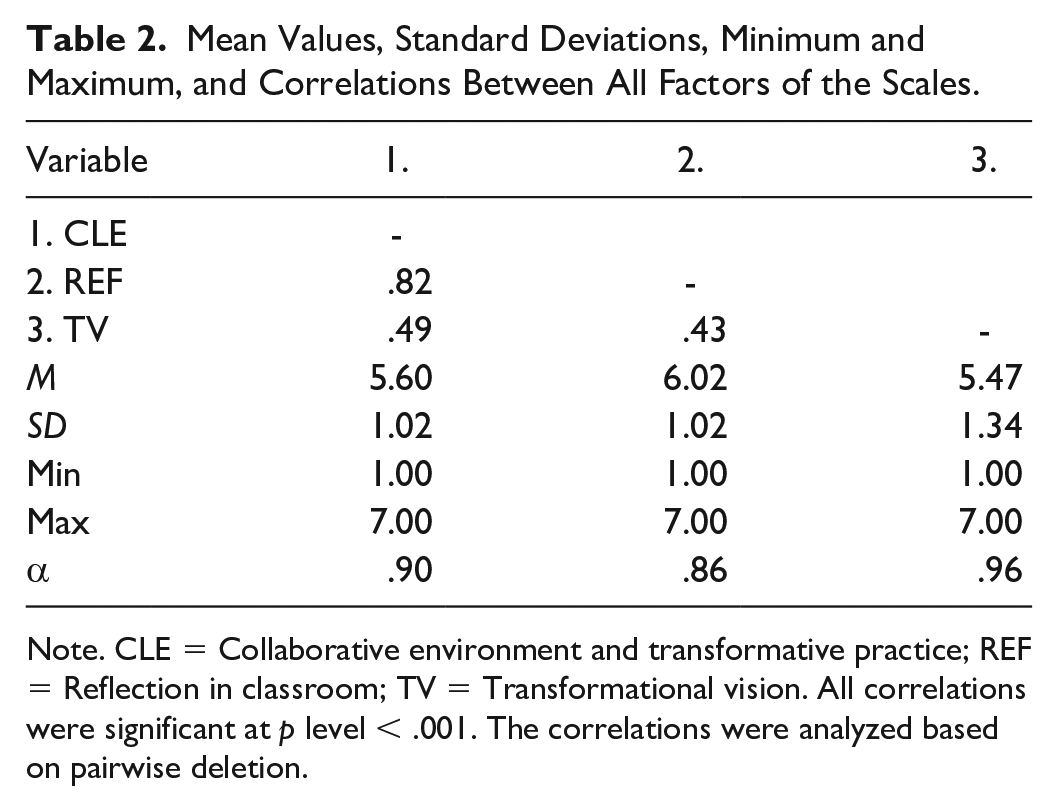
Note. CLE = Collaborative environment and transformative practice; REF = Reflection in classroom; TV = Transformational vision. All correlations were significant at
Chinese early career teachers perceived that their professional agency in the classroom was relatively high in terms of the two components of professional agency examined (Mean[min-max] = 5.60–6.02). As shown in Table 2, early career teachers were highly motivated to reflect on pedagogical practices and to develop teaching competence in the classroom (REF,
Interrelations Between Early Career Teachers’ Sense of Professional Agency in the Classroom and Perceived Principals’ Capacity to Transform the School Vision
Our model (see Figure 2) confirmed the hypothesis (H1) that early career teachers’ perceptions of the leadership capacity to sustain shared transformational vision building in their own school contribute to their sense of professional agency, especially in the classroom. More specifically, the results showed that early career teachers’ perceptions of transformational vision behaviors were the significant determinant (β = .54) of their efforts to construct collaborative learning in the classroom and deploy adaptive teaching methods (CLE). In other words, the more teachers felt that the principal paid attention to their pedagogical thinking and practices and expected them to consider joint educational goals and strategies in the school, the more teachers reported a capacity to adaptively regulate and construct engaging and supportive classroom interactions (CLE). Furthermore, school size also contributed to teachers’ reported capacity to build a collaborative and reciprocal environment and transform educational practice, but the effect size is rather small (β = .07). Accordingly, school size and teachers’ perceptions of leadership behaviors in transformational vision building together explained their sense of professional agency in the classroom in terms of collaborative environment and transformative practice (CLE) during the first 5 years of their teaching (
Interrelations Between Early Career Teachers’ Sense of Professional Agency in the Classroom and School Size
Our model partly confirmed the hypothesis (H2) that school size was associated with teachers’ perceived professional agency in the classroom. The results revealed a relatively small but statistically significant relationship between teachers’ professional agency in terms of collaborative environment and transformative practice (CLE) and school size (β = .07). To be more specific, teachers in small schools reported slightly greater capacity for active learning in interacting with students and transforming teaching practices (CLE) than their counterparts in large schools. However, adaptive reflection was not significantly different for teachers working in small or large schools. In total, school size and teachers’ perceptions of principals’ ability to orchestrate shared and transformational vision building in their own school explained 30% of the variation in early career teachers’ sense of professional agency in the classroom in terms of collaborative environment and transformative practice.
Discussion
Methodological Reflection and Directions for Future Studies
First, the data of the current study were collected from 779 Chinese early career teachers with a non-probability sampling method—most of them teach in Jilin province (81.1%). Thus, the study sample may be biased and unrepresentative of all Chinese early career teachers. Second, the scales used to collect the data have been translated from English, and while they were subject to an extremely rigorous and careful translation process, it is possible that some items failed to capture the core meaning of the original scales. Moreover, although the factor analysis and reliability analysis showed that the scales were valid and reliable, further construct validation in the context of China and other countries is required; thus, extra caution is also necessary when interpreting the results. Third, the findings of this study were based on self-report data that only covered early career teachers’ perception of professional agency and leadership vision and which did not reveal teachers’ actual capacity to manifest professional agency or leaders’ real transformational leadership capacities. Fourth, the research employed a cross-sectional design; hence, more longitudinal research is required to reveal the associations between the variables. Despite these limitations, the present study contributes significantly to the field by exploring teachers’ professional agency in the classroom in a new context (i.e., China) and providing novel empirical results on the interplay between early career teachers’ professional agency, transformational leadership vision, and school size.
The present study applied a survey design to provide a better understanding of the relationship between early career teachers’ professional agency, school size, and perceptions of transformational leadership vision. Future researchers could use qualitative methods (i.e., interview or observation) to provide a detailed, in-depth overview of the complex nature of teachers’ professional agency, principals’ transformational leadership vision and the interrelations between them in the Chinese context. Furthermore, our study includes only the dimension of transformational leadership vision as a variable to predict teachers’ professional agency in the classroom. Therefore, future studies should investigate how other dimensions of transformational leadership, including individualized consideration and intellectual stimulation, influence teacher agency. Similarly, our research did not reveal the associations between transformational leadership and teachers’ professional agency in the professional community, which is a crucial learning environment for teachers; therefore, more studies are required in this under-researched area.
Findings in the Light of the Previous Literature
The results showed that the Chinese early career teachers in our study had already obtained a relatively strong sense of professional agency during the initial years of their teaching career. This is in line with our previous findings on Finnish early career teachers’ professional agency (cf. E et al., 2022; Heikonen et al., 2017), although the structure of the scale has been slightly adapted to the Chinese context. Chinese early career teachers had a slightly higher level of building a collaborative learning environment and displaying transformative practice and a lower level of reflection in the classroom than Finnish early career teachers (Heikonen et al., 2017). Moreover, Chinese early career teachers also perceived the visionary aspect of their school principal’s transformational leadership practices as high. A possible explanation for these findings is that, since the education and teacher education reform, teachers are expected to become curriculum developers, active implementers and facilitators of pupil learning (Lee et al., 2013); at the same time, school principals are expected to engage teachers in the decision-making process (Haiyan et al., 2017). To help meet the new expectations, the central government has initiated national professional training for principals and teachers (Ye et al., 2019; Zheng et al., 2013). Previous studies have shown that principals and teachers consider professional development training to be useful for their professional learning and development (Jiang et al., 2018; Zhou, 2014). Thus, although traditional values tend to be hierarchical, it is still possible for principals to practice transformational leadership and support the development of teachers’ professional agency.
In addition, the findings demonstrated a positive correlation between Chinese early career teachers’ sense of professional agency and reported transformational leadership practices used by school principals to sustain shared transformational vision building in their schools. This means that when teachers observe their principal’s ability to enable shared transformational vision building practices, their own capacity to manage new learning actively in the classroom tends to be greater. The results were consistent with studies which have found that transformational leadership vision directly impacts teachers’ professional agency (Polatcan et al., 2021). This finding is similar to other results in the Chinese context showing the positive effects of transformational leadership, including the visionary aspect, on teachers’ self-efficacy, commitment, motivation, work engagement, and teaching innovation (Dou et al., 2017; Li, 2022; Li & Liu, 2022). More specifically, it seems that early career teachers’ perceptions of transformational leadership vision are a significant determinant of both their capacity to build a collaborative environment and display transformative practice (CLE) and to reflect on interactive and relational instructions in the classroom (REF). Teachers in the early phase of their careers are more likely to experience difficulties in classroom management and learn from interactions with their pupils (Edwards, 2005; Le Maistre & Paré, 2010; Voss et al., 2017). This requires that principals support early career teachers by using transformational leadership practices that promote shared vision building through the introduction of innovational education practices and the promotion of teachers’ professional learning. Thus, teachers might be more willing to internalize the school goals as their personal goals and may be more motivated, confident and competent in their abilities to achieve the school’s shared vision (Thoonen et al., 2011, 2012), which, in turn, might help them become more open to new ideas, transform teaching practices to meet pupils’ needs and reflect on their teaching theories and practices (Van Eekelen et al., 2006; Wheatley, 2005).
The findings also implied that school size partly influences early career teachers’ sense of professional agency: teachers in small schools are more likely to possess a higher sense of professional agency than teachers in large schools. This seems to be in line with some relevant previous studies suggesting that small schools are positively associated with higher levels of teacher commitment, efficacy, job satisfaction and active professional learning (Bakkenes et al., 2006; Lee & Loeb, 2000; Saloviita & Pakarinen, 2021). However, the effects of school size are found in early career teachers’ professional agency only in terms of building a collaborative environment but not in terms of reflection in the classroom. One reason for this might be that small schools tend to provide a more manageable and engaging work environment for both teachers and students. Furthermore, they often provide better support for communication, interaction, and collaboration between teachers and students (Stoll et al., 2006; Vangrieken et al., 2015). However, some aspects of large schools can hamper cohesive social and academic relationships (Louis et al., 1996). Furthermore, building a reciprocal and collaborative environment is an interpersonal activity entailing more communication and interaction between teachers and students in the classroom, while reflecting on pedagogical practices is a more intrapersonal form of action.
Practical Implications
The results demonstrated that principals’ transformational leadership vision exerts a positive impact on early career teachers’ sense of professional agency in the classroom. Accordingly, the findings suggest that strengthening principals’ capacity to build such a vision could serve to support teachers’ professional agency. In practice, this means employing leadership education that enables principals to become aware of the significance of transformational leadership, reflect on their leadership practices, and improve those practices by initiating and involving early career teachers in the process of vision-building, and, even further, by showing respect for such teachers’ emotions and stimulating them to engage in professional learning (Thoonen et al., 2011). This would be extremely helpful for Chinese principals, as research has shown that they often fail to fully realize the impact of their actions on teachers’ abilities (Hallinger & Liu, 2016). In addition, research has also underlined the importance of networking and collegial consulting, suggesting that the learning community is helpful for principals’ professional development (Daniëls et al., 2019). Thus, it would be necessary to provide principals with instructions on the best ways to interact with other stakeholders in the community and to learn how to use that community as a resource for their learning. Previous studies have shown that Chinese principals’ perception of transformational leadership could be related to Chinese culture (Crede et al., 2019; Walker & Qian, 2015); thus, leadership training and instructions could be designed to suit Chinese principals and the educational context.
The results indicated that school size also matters for teachers’ professional agency, especially regarding their active learning when interacting with students and transforming teaching practices. It might be less challenging for early career teachers working in small schools to develop their professional agency because of the more opportunities for communication and interactions as a teacher community. However, school size is only a small proportion of all other variables (i.e., transformational leadership practices) making important contributions to teachers’ professional agency in the present study (e.g., Fackler & Malmberg, 2016). However, it has been suggested that larger schools may be able to support organizational learning among teachers better due to greater resources regarding teachers’ varied expertise (Louis & Murphy, 2017). Thus, it would be important to improve the culture, environment, and interpersonal relationships in large schools (Louis & Lee, 2016) instead of focusing merely on structural attributes such as school size and number of pupils. Simultaneously, large schools could design and implement initiatives to enhance interactions and communication between teachers and students (Li et al., 2022).
Conclusion
This study examined early career teachers’ sense of professional agency and its associations with transformational vision and school size. The results indicated that early career teachers’ perception of principals’ ability to enable transformational vision promoted their professional agency in the classroom including both collaborative environment and transformative practice and reflection in classroom. The results further showed that early career teachers reported a higher level of professional agency in building a collaborative environment and displaying transformative practice in small schools compared with their colleagues in big schools. The results suggest that investing in cultivating principals’ transformational vision through leadership education and learning community may enhance teacher agency in the classroom. In addition, by improving school culture and climate and organizing activities for communication, early career teachers might be better equipped to build an interactive relationship with pupils and adapt teaching to meet pupil learning needs.
This study contributes to the research on teacher agency by providing empirical evidence of Chinese early career teachers’ professional agency through a valid survey instrument adapted especially to the Chinese context (e.g., Soini et al., 2016b). Moreover, the results shed light on the relationship between Chinese early career teachers’ professional agency in the classroom, transformational vision, and school size. Our results are in line with prior studies conducted in other socio-cultural contexts that have emphasized the role of transformational leadership and school size in teachers’ professional agency (e.g., Bakkenes et al., 2006; Polatcan et al., 2021). Transformational leadership practice seems to be the central resource for facilitating early career teachers’ professional agency, and thus, it is reasonable to invest in it. The results confirm and complement the understanding of the significance of transformational vision on early career teachers’ professional agency (Cochran-Smith et al., 2022; Shengnan & Hallinger, 2021).
Footnotes
Declaration of conflicting interests
Funding
ORCID iD
