







Abstract
Introduction
On March 23, 2023, an active shooter event took place at the Covenant School in Nashville, Tennessee. The attacker killed six people in 17 min. The police were alerted within 3 min and arrived at the scene 10 min later, successfully stopping the killing in 3 min. This example of a terrible attack on innocent civilians shows that active shooter events unfold within a small timeframe, where seconds can mean the difference between life and death. An active shooter event/incident or active killer event/incident is one of the most challenging situations for law enforcement to deal with. The U.S. Department of Homeland Security (2008) defines active shooter as “an individual actively engaged in killing or attempting to kill people in a confined and populated area”. The event is often very short and can be over within 10–15 min (U.S. Department of Homeland Security, 2008). Active shooter events are dangerous for both the victims and the police (Blair and Duron, 2022). The most dangerous situation for police officers during active shooter events is when they are called to a “job” without further information about what they are about to face. Blair and Duron (2022) define this kind situations as an “ambush”, where the police risk being shot as a result of lack of information about the situation. For police officers, the second greatest danger or risk of being shot is during active shooter events, when they move outdoors into open space, either on the way to the building where the shooting is taking place or from the patrol car, or if the open space is the area of the shooting. The shooter has the advantage of being able to use cover and the element of surprise. Even if there is a risk of being shot indoors as well, the police are rarely killed inside (Blair and Duron, 2022). Situation awareness, as a concept, has been studied in a police context, and it has been identified as one of many key tools for police officers to handle various tactical interventions while also balancing the use of force in the current situation (Andersen and Gustafsberg, 2016; Huhta, 2023; Huhta et al., 2023). Based on the findings of Blair and Duron (2022), we argue that situation awareness could minimize the risk of being shot or to better identify the risk areas during active shooter events. Given that success during active shooter events for the police is time-dependent, situation awareness—understanding what is happening, where the shooting is taking place, and identifying risk areas—plays a crucial role in guiding tactical interventions. However, it is worth noting that literature on situation awareness in the context of active shooter events remains limited. Since the shooting at Columbine High School in 1999, the approach to handling active shooter events in schools has evolved. Prior to Columbine, the standard procedure dictated that the first police unit at the scene would secure the area and await the arrival of a specialized unit. As active shooter events are very rapid and extremely deadly for the victims, this approach is no longer recommended. Today the standard procedure is to engage as quickly as possible, which means that it is important to stop the killing as soon as possible and not wait for a special weapon and tactics (SWAT) unit to arrive (Martaindale and Blair, 2019). However, the standard police approach during regular tactical interventions is to be more non-confrontational, and avoid direct confrontation with suspects, especially if there is a risk of escalating the situation. In cases where the situation is perceived as very dangerous it is common (as was the case for active shooter events even before Columbine) that the first officers on the scene wait for specially trained tactical officers (Hansson and Borglund, 2024; Martaindale et al., 2023; Phillips, 2020). But during an active shooter event intervention, all police officers must transition into a more assertive tactical approach, to stop the ongoing violence and save lives. The transition between different states of action has not been thoroughly studied in the context of active shooter events. Therefore, the purpose of this research is twofold. First, it aims to understand and investigate how situation awareness can be understood in active shooter events, and what challenges are associated with establishing situation awareness in police tactical interventions during active shooter events. Second, it aims to further elaborate how liminality can be understood in the context of police officers transitioning between a less-confrontational approach and a more confrontational approach in their tactics.
Active shooter events and problem area description
According to the FBI, an active shooter event is
This research focuses on one type of active shooter event namely the “school shootings”, which is an active shooting in an educational environment. During the active shooter event that took place at the Covenant School in Nashville, Tennessee, the police acted according to procedure, i.e., aiming to put an immediate stop to the killings and not wait for backup or special units. Ten minutes after the first call to 911, the police entered the building, and after 14 min the threat was neutralized by a team of five officers (Yan, 2023). There was another, more debated police intervention during an active shooter event at a school, on 24 May, 2022, in Uvalde, TX. The police received the 911 call at 11:30 a.m. about an armed person and gunshots three minutes before the suspect entered the school building in Uvalde at Robb Elementary school. Two minutes following the entry, at 11:35 a.m., seven police officers, two armed with rifles, also entered the school through the same entrance as the suspect. At that time the suspect had already fired 100 rounds at students and teachers in two classrooms. At 11:36 a.m., another four police officers enter the school through two different entrances. At 12:10 p.m. the US Marshals arrive at scene, and five minutes later, at 12:15 p.m., the US Border Patrol Tactical Unit arrive. At 12:50 p.m. the US Border Patrol breach the classroom where the suspect is and ends the killing of students and teachers. In total, 376 police officers responded to the call at the Robb Elementary School (Stengle and Bleiberg, 2022). This paper will not analyze the difference in action between these two tragic active shooter incidents, rather, these two incidents represent two different approaches, where in the Nashville case the new standard is followed, i.e., to intervene as soon as possible and end the killing, while the Uvalde incident represents a situation where specific circumstances caused a delay in stopping the suspect. Afterwards, the police were criticized for being too passive, as well as for their late response in Uvalde, which became the focus in the aftermath. Phillips (2020) presents a nuanced approach to the differences in roles police officers have during active shooter events. There is a tension between, e.g., citizens’ expectations of how the police should act and how the police officers see their role. By applying the terror management theory, Phillips (2024) presents an explanation to why it is not obvious that police officers would react as recommended, which is what happened in Nashville. Phillips (2024) argues that training for active shooter scenarios represents the most effective and enduring strategy for enhancing life-saving interventions by police. In both the shooting in Nashville (Yan, 2023) and the shooting in Uvalde (Stengle and Bleiberg, 2022), the numbers shot exceeded the average shots fired during active shooter events compared to the analysis carried out by Blair et al. (2021).
Situation awareness
Situation awareness is a term often related to various forms of operational work. Endsley et al. (2003) describe Situation Awareness (SA) as understanding the current situation and what information means now and in the future. In the SA, it is implicit to understand what information is important to act on and do something about. The definition of situation awareness according to Endsley (1988) is
SA has, according to Endsley (1988), three levels, where the first level is perception of the elements in the situation. During perception the available elements are perceived by the senses, i.e., what we see, hear, feel, smell and taste. The next step in SA is comprehension of the information received by the senses. The comprehension creates a meaning of the data in relation to the goal in the situation. The comprehension phase is followed by a projection of future status, i.e., how the perceived elements will behave and act. SA is dependent on time and is affected by the stress levels of the individual. According to Endsley et al. (2003), working memory together with mental models play an important role in both the comprehension and projection of future status. Mental models help to bring order to the data that have been perceived. To say that mental models are about experience would be an oversimplification, but mental models are dependent on experience. Huhta (2023) shows that experienced police officers reached a much higher level of SA compared to more novice police officers.
SA is applicable in many domains, but in police work, situation awareness has been identified by Huhta et al. (2023: 539) as the “most important skill required by police to effectively assess and respond to encounters including critical incidents.” SA is, according to Huhta et al. (2023), something that guides police officers in tactical decisions. During tactical interventions experienced police officers were more aware of the surroundings, better at identifying dangerous objects and profiling the suspect. (Huhta et al., 2023). From a theoretical perspective, this is not surprising, as mental models, memory, schemata and scripts are obviously related to experience (See e.g., in Endsley et al., 2003). Experienced police officers have also been identified as making better tactical decisions, even under pressure. Success partly depends on their ability to look at their ability to identify what is most relevant (Murray et al., 2023).
SA performance and/or capacity to increase SA can be trained. A Norwegian study used shooting simulators in training and showed that training increased SA, as well as police officers making more accurate decisions regarding when to shoot and when not to shoot. Their stress levels also decreased after training (Saus et al., 2006). In the context of first responders’ situation awareness research, much attention is given to strategies for effectively disseminating situation awareness among various actors (see e.g., Seppänen et al., 2013; and also Seppänen and Virrantaus, 2015), and in recent research, there has been a growing interest in leveraging technology to improve situation awareness. The design challenges associated with this endeavor span a wide range of criteria, as discussed by Endsley et al. (2003). Luokkala and Virrantaus (2014) also address how to design information systems, and they conclude that developing information systems for SA is not a task without complexity.
Research method
The data and findings in this paper are based on a qualitative research effort (Myers, 2009; Myers and Avison, 2002) carried out by two researchers. Both researchers have nearly 20 years of experience as sworn police officers before transitioning fully into academia. The two researchers have extensive practical experience with weapons and tactics, one of the two researchers from a regional SWAT team and as a teacher at a police academy, and the other from several years of working as an operator at the national counter terrorist unit, and later on as a weapon instructor in the police.
The long-term goal of the research is to develop technology that could enhance the police officers’ action during an active shooter event. The first phase of the research is rather explorative and about understanding how the police officers act during an active shooter event, as well as understanding the challenges of police tactic decisions. In this article we have collected data from large exercises. This data collection method is best explained as ethnographical field studies (Van Maanen, 2011), where the data presented in the paper should be seen as tales from the field (Van Maanen, 1988).
Data and analysis
Data have been collected during police exercises targeting active shooter events. The first exercise was a large full-scale collaborative active shooter event exercise in Jämtland County in Sweden in May 2022. A total of 15 police officers participated in the exercise (3 patrol units, 1 swat team, 1 commanding unit). The aim of the exercise was to train police, fire department and medical collaboration during an ongoing active shooter event. The scenario was a school where two suspects had started to injure students with a sword/long knife and a handgun. The first responders at the scene were the firefighters because the first alarm that came to the dispatch central was about a car on fire outside a school. When the firefighters came to the school, they found a car that was on fire right by the entrance of the school and the car had crashed into the school building. The firefighters found a wounded person lying just inside the entrance of the school (Figure 1) and then alerted the police. The idea of the exercise was to train a realistic active shooter event in Jämtland County, where 2–3 police units could respond within 15 min, A figurant in exercise one masked as knife/sword wounded.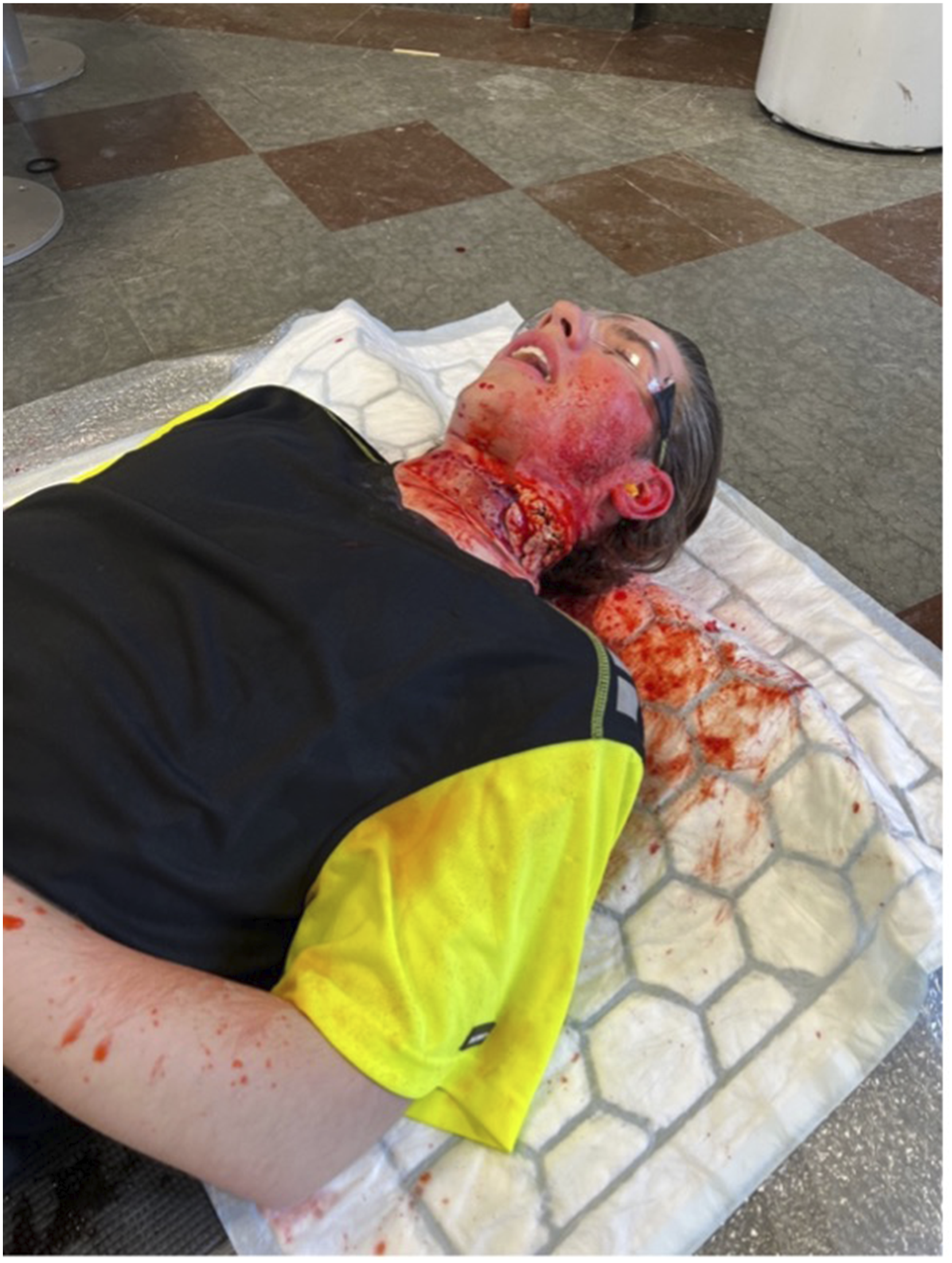
The
The exercise started as a call to the police units about an emergency at a school in Umeå where fights had broken out. When the first unit arrived, they heard gunshots and, upon entering the hallway, they should find a seriously wounded person, and an ongoing deadly knife attack 30 m down the corridor. For the officers the exercise included the following: 1. Understand the situation, i.e., that it is an active shooter event, and report it to the dispatch central; 2. Act according to the defined tactical method, to stop the ongoing situation as quickly as possible; 3. Save lives if possible; 4. Secure the school – make it “safe enough” for medical staff to enter. The exercise ended with an after-action review with all five groups.
In both exercises the number of attackers were two, out of which one attacker was armed with a knife only, and the other with a pistol. During the six exercises, all police officers and the armed suspects used weapons with Simunition 1 (Fx) to be able to work with as realistic engagement as possible. All involved in the exercise used the protection required for using Simunition. In the following we refer to the above exercise as exercise one, and exercise two. Where needed for exercise two, we also refer to repetition one, two, three, four, and five.
Researcher involvement
The data was collected in different ways during these two exercises. During exercise one, one of the researchers followed the police action wearing a blue and yellow vest, both indoors in the school, but also at the command post outside the building. The researcher also participated in the after-action review with the police. Only observation notes were taken during exercise one. Interviews were made with the police officers responsible for the exercise but not with any of the 15 officers who participated.
During exercise two, the same scenario was repeated five times, each with a new group of police officers. Data collection was done differently each time. During each repetition at least one of the researchers followed the police officers’ movement and action in the school as observers from a short distance, wearing a blue and yellow vest with the writing “police training”. In two of the repetitions, one of the researchers was given the chance to act as a police officer, working together with the police officers that were training, and was placed in a unit with one of the 5–6 officers. This was possible because of the researcher’s experience from police work. Finally, in the last repetition, one of the researchers acted as one of the assaulters to gain this perspective as well. The researcher participated in the after-action reviews with the police when the researcher had taken the role as a police officer. The after-action review was guided by a recording from the intervention that served as basis for the discussion of what happened.
What about liminality?
Arnold van Gennep introduced the concept of liminality in “Les rites de passage” (later translated into English) in 1909 (Gennep, 1960). Van Gennep (Gennep, 1960) used the concept to understand and present what happens during the rituals in the passage between two states. Today liminality is widely used in organizational studies (Söderlund and Borg, 2018; Tempest and Starkey, 2004). According to Thomassen, 2014, Van Gennep’s (Gennep, 1960) concept liminality departed from the Latin
According to Söderlund and Borg (2018), the use of liminality as concept has greatly increased in recent years. In their review (Söderlund and Borg, 2018) of how liminality has been used, three separate themes are found: Theme 1: Liminality as process, when individuals or organization carry out the passage. Theme 2: Liminality as position, when individuals and organization are on the “threshold” they manage this position. Theme 3: Liminality as place, where the ritual of passage is a spatial form of passage. Liminality is often used to further elaborate and understand the “betwixt and between”. Garsten (1999) presents an example focusing on temporary workers and their passage. Liminality has also been used in studies on learning on both individual and organizational level (Tempest and Starkey, 2004), where liminality was both negative and positive through new positive learning outcomes.
Results
The police officers that participated in these six exercises were all patrolling officers, and they participated in the exercise as part of their regular tactical training. A Swedish police officer is armed with a 9 mm pistol, and in some police vehicles the officers have an option to access a Heckler and Koch MP5 9 mm, with an Aimpoint (red dot sight) as support weapon. In the police car they have access to a ballistic helmet and a plate carrier with ceramic plates. Together with the worn body armor, this provides effective protection against torso shots.
Arriving at scene
In an exercise, all police officers have some awareness of what is about to transpire, even if they are not aware of the details. In all exercises it was rather obvious that the officers understood that something bad was happening in the school building, but what kind of assault was not clear. In all exercises the first police (exercise 2–6) and firefighter (exercise 1) that arrived at the scene noticed a severely injured person when they entered the school building, but they did not receive any further information. During exercise 1 they entered through a large and almost silent hallway. The first police unit had difficulties deciding what area to prioritize, and they started their search on the ground floor. Later, when police unit no. 2 arrived at the scene, they did not know what areas were secure and/or searched so they started to search the same areas. After searching one corridor of lecture rooms the second unit was told to search on level 2 instead. During exercise 2–6, the officers also entered a large hallway, in a way that prevented them from seeing the corridor, which was a logical starting point for their search. When the officers entered the building an extremely loud alarm was sounding, which made it difficult to hear sounds that were not distinct.
In exercise 2–6 none of the police officers were equipped with helmet and plate carrier, but during 2 scenarios the police used their support weapon. During the after-action review the units that did not use the support weapon explained that it was because they were uncertain of the situation. None of the officers in exercise 2–6 could explain why helmet and plate carriers were not used. In exercise 1 all officers were equipped with helmet and plate carrier. If they had the option of using a support weapon, it was used. In exercise 1 the alarm call was about a car that had crashed into the school, and the fire department that was the first to arrive at the school then passed on the information that it was an active shooter situation. In exercise 2–6 the call was about a disturbance, which provided the police officers with enough information to understand the situation before acting.
Understanding the situation
Even if the police did understand that there was something going on at the school, because there were injured people close to the entrance of the building, it was not until they saw either one of the attackers or met one of the victims who could explain what happened that they fully understood the situation. In all exercises there was a situation where the attacker fired several shots in a corridor on another level. The shots were impossible to miss, but it was not easy to locate the position of the shooter. In none of the exercises did the shots affect the speed or action of the officers. During the after-action review the main argument was that the place from where the shots were fired was difficult to locate and they still had areas to pass that had not been searched.
In exercise 2–6 the officers noticed some turbulence 30 m in front of them, but because of the loud alarm they did not hear the screaming of the victim.
The injured received no attention until the assaulter had been neutralized. As wounds and casualties were simulated it was difficult to discuss if the officers understood the severity in the wounds.
In exercise 2–6 a loud noises from internal speakers made it difficult for the police officers to notice calls on the radio and to communicate using the radio. In exercise 1, the biggest challenge was to share and describe the location of the police officers when they confronted the first and second suspect. To explain a location in an unfamiliar environment affected by stress turned out to be challenging. In exercise 1, police units arrived at different points in time, which made information sharing critical.
Risk assessment
Swedish police tactics are guided by several tactical principles, including minimizing exposure to risk and avoiding passing areas that have not been searched. In a situation where the police officers understand that there is an ongoing attack somewhere in the building, they must decide whether to deviate from these routines.
For all officers in exercise 1–6, one difficult task was to balance speed and searching the rooms. They acted in two ways during the exercises. Either the officers searched every room they passed carefully and had one officer securing the unsearched areas in front of them or the first officers skipped the search while the 2–4 officers behind the first officer carried out the search.
The standard procedure is to focus on stopping the ongoing killing. This requires a quick risk assessment when the police officers encounter someone in the building: is this an assaulter or a victim? One way of doing this is to look at the hands, if there is no gun, there is less of a risk. During the after-action review it was clear that much of the risk assessment was related to understanding what was going on. Was it one, two or more suspects? Where were the suspects? What kind of weapon did the suspects have? Questions like this were raised as motivation and argument for the actions taken. None of the police officers referred to the lower risk of being ambushed when they were indoors, or the possibility that it is rarely more than 2 suspects.
Confrontation
In all exercises the scenario was designed to end when the police officers reached the second floor or the second corridor. In both exercises the police officers were presented with a dilemma, where the suspect was first visible through an open classroom door, and later went into the classroom. It was unclear whether there were victims in the classroom or not, and the police officers needed to decide immediately to either enter the room and confront the suspect, or use some form of search method as e.g., peek or push (see e.g.Blair et al., 2019) with the aim to better understand the situation in the classroom, without taking too many risks. In an active shooter event, the goal is to stop the shooter and therefore a more offensive action is required. In the Swedish basic police tactics (Hansson and Borglund, 2024), the confrontational approach is not the standard procedure, it is rather based on de-escalating and a less confrontational approach. However, during a suspected active shooter event, it is important to stop the ongoing killing. For the police officers participating in the exercises, this situation was the most challenging. The solution was often a bad version of either a direct room entry, or a systematic room search. No one entered a room directly. Most of the police officers did a systematic search of the room, but when they saw the suspect, they did not take direct action and confront the suspect. Instead, they took a step back before deciding to become confrontative.
Identification
During the exercises there were several victims running towards the police screaming. It was obviously difficult for the officers to decide how to deal with them. Some officers let them continue to run and some forced the victims to stop and lay down, in one situation a victim running was interpreted as a threat and was shot in the leg.
In the exercise not all police officers were in uniform, yet there was no risk of being unable to distinguish one person from another. But in a real situation this could be a challenge, especially when the sound in the building made it difficult to hear the radio.
Discussion
Information need
Information is a critical component in high-stake situations like law enforcement interventions during active shootings. Effective gathering, interpretation, and use of information can be the difference between successfully managing an incident and failing to do so. However, it is important to note that the information available during these events is often incomplete, fragmented, or even misleading. Therefore, law enforcement personnel must possess the skills to assess the reliability and relevance of the information they receive. Situation awareness, as presented by Endsley (Endsley, 1995), focuses on a problem where the challenge was rather that available information was extensive, which made selecting and identifying relevant information the core problem. Arriving to the scene based on a call about a disturbance and loud shouting that turned out to be an active shooter event can result in danger, and in a worst-case scenario, injured or killed officers. The highest risk of being shot and/or killed during an active shooter situation is when arriving at the scene without information about what actually triggered the first alarm call, something Blair and Duron (2022) calls an “ambush”.
Experience and mental models
In the six exercises presented above, the lack of experience and knowledge about the situation contributed to the challenge of comprehending and interpreting available information. Mental models and memory play significant roles in how individuals perceive and process information. Since the situation of an active shooter event was entirely new to the officers involved, they lacked mental models or previous experiences to draw upon, which made it difficult to grasp the situation. This absence of familiarity with similar situations likely impacted their ability to accurately comprehend the unfolding events and anticipate future developments. Much of memory and mental models are shaped by previous experiences (Endsley et al., 2003), which is what the training aims to provide the police officers with. The question is to what extent this can be provided by a single exercise.
The mental model that the officers have is often the opposite of what is needed in active shooter situations, where action is needed. Officers who are conditioned to prioritize de-escalation over engagement may struggle to shift to a more risk-taking and offensive approach in these scenarios.
Right design of scenario?
Experience (Huhta, 2023; Huhta et al., 2023) and mental models (Endsley et al., 2003) are factors that increase situation awareness capacity. However, the scenario in the six studied exercises was quite complex, and the design of the scenario was not based on statistics or research (as e.g., Blair et al., 2021; Blair and Schwieit, 2014; Martaindale and Blair, 2019). In addition, the scenarios used in the studied exercises did not involve the risk officers faced when entering the scene (Blair and Duron, 2022). In an active shooter event, success is about stopping the killing as soon as possible. In a larger and more complex scenario, it can be challenging to make the exercises a positive experience, as the scenario was too advanced for, e.g., four officers. We argue that in police training and in police tactics it is necessary to discuss what is better in the long term, to train simpler scenarios where the officers can receive a positive response after success or to train complex scenarios where the outcome is difficult to foresee and what constitutes success is not obvious. The two extremes are not mutually exclusive but there is a need to relate the design of scenarios and exercises to what the learning ambition is. According to Huhta (2023) police education training is a positive way to increase situation awareness performance.
Moreover, managing stressors is crucial in maintaining effective situation awareness and decision-making capabilities during high-pressure situations. Stress can impair cognitive functions, such as attention, memory, and judgment, making it more difficult for individuals to process information accurately. In the scenario described, the heightened stress levels likely contributed to the police officers having difficulties maintaining situation awareness and making informed decisions.
Liminality and the transition into confrontation with suspect
According the Swedish police general tactical explanation model (GTEM), a non-confrontative approach and minimizing risks are what is taught (Hansson and Borglund, 2024). During an active shooter event the standard procedure is to be offensive, and confrontation is needed. This also means that police officers will expose themselves to greater risks to save lives. In the limited tactical training regular police officers receive during a year, this passage can be seen as liminality (Söderlund and Borg, 2018; Thomassen, 2014). In Figure 2 the movement from state 1, i.e., the non-confrontational, de-escalating, risk minimizing police officers should move to state 2, i.e., offensive, risk taking and confrontational. During the studied exercises we noted that very few of the officers managed this passage. They maintained a very secure, non-confrontational and risk minimizing approach even if they were fully aware that they should act differently. This passage is probably something that needs to be trained more, and it is important to make the police officers aware of the two different logics that exist in State one, and State two (see Figure 2). The passage from State 1 to State 2 (Söderlund and Borg, 2018).
The understanding of the situation due to both lack of information, and likely also personal memories and mental models that made situation awareness problematic, made the police officers stay in the liminal phase between the states. This made the interventions not confrontational and more risk-taking which not is the planned action during active shooter events, where the officer should be confrontative, and the speed of the officers will reduce risk. The officers took greater risks, but there was a lack of both speed and confrontation. As presented above the mental models of the police officers have its origin in tactical intervention where de-escalation is the priority and confrontation should be avoided. To shift to a more engaged and confrontational intervention approach can be challenging due to the lack of experience.
According to Söderlund and Borg (2018) it is of interest to understand the individual liminal phase, which in this case is when the officers understand that it is more than a disturbance. There must be a quick passage into a speedier police intervention. In this research the police officers are unlikely to have fully reached the next state, which was affected by how the situation was interpreted, i.e., the Situation Awareness. But Söderlund and Borg (2018) also discuss the organizational liminality, i.e., where the organization itself transitions from one state to another. For police officers it is important that the dispatch central also understands the situation, and to provide support and action the dispatch central should also be in the same state as the officers. This is an area in need of further study. However, according to van Gennep (Gennep, 1960), the liminal phase is made easier if experienced people are present.
Concluding remarks – Lessons learned
In this study we have studied how situation awareness can be understood during active shooter events. We observed six simulation exercises and consider some of the findings important for further investigation.
Situation awareness depends on available information, and for police officers, an active shooter event is likely to provide limited information. Therefore, competence in analyzing even limited information is important, and together with experience and memory, better analyzes can be done, and ideally also projections of future situations. Experience and existing mental models positively affect the ability to understand the situation but also how to analyze the limited information available. To better understand the active shooter phenomenon, there is information found in literature that can be used to create a common mental model, which is needed for shared situation awareness (Steen-Tveit and Munkvold, 2021). Based on the review of relevant research and statistics from active shooter events one must question if too complex scenarios during exercises are counterproductive. A more careful design of the scenario based on research and statistics is recommended. The final finding is the liminality, which is the passage between two states. For Swedish police officers risk minimization, de-escalation and a non-confrontational approach is standard during police interventions. Time is on the police’s side, but during active shooter events the police needs to take more risks, be confrontational to stop the killing. This passage between the two states needs to be trained. The competence and the skills in situation awareness activate when the passage needs to be done.
Lastly, we also conclude that during training exercises, focus should not only be on tactical skills, the importance of information management and stress management techniques should also be highlighted. Additionally, ongoing debriefings and reviews of past incidents can provide valuable learning opportunities and help officers refine their decision-making processes for future situations, but also theoretical learning about the characteristics of active shooter events could strengthen the mental models and so the ability to understand the situation.
Footnotes
Declaration of conflicting interests
Funding
Ethical statement
ORCID iDs
