







Abstract
Parliamentary democracy is often defined as a system that requires ‘government to be appointed, supported and, as the case may be, dismissed, by parliamentary vote’ (Sartori, 1997: 101). However, as early as the 1970s, and more so in the 2000s, scholars have pointed to the vote of no-confidence as the core feature of a parliamentary system, and not to government investiture by parliament (Bergman et al., 2003; Hazan and Rasch, 2022; Laver, 2006; Rasch et al., 2015; Steffani, 1979). That is, while in some parliamentary systems governments may form without the active support of parliament – this is known as negative parliamentarism – no parliamentary system exists where the government can survive against the will of parliament.
When studying the relationship between the government and the parliament, whose confidence the government needs in order to survive, one must consider the role of those in the parliament who do not support the government – and even actively oppose it, criticise its actions and seek to replace it – namely, the parliamentary opposition. The existence of elected representatives who oppose the government is as much a hallmark of modern parliamentary democracy as the accountability of government to parliament (Dahl, 1966b; Maeda, 2015). Thus, one should study the vote of no-confidence concerning not only how it affects government termination but also how it influences the behaviour of the parliamentary opposition. In this article, we argue that higher restrictiveness in the vote of no-confidence – that is, greater obstacles to government termination – leads the opposition to prefer more cooperative behaviour vis-à-vis the government rather than more conflictual attempts to bring it down.
The lacuna we aim to fill has to do with two related and under-studied subjects. The first is parliamentary opposition – which, Dahl (1966b: xviii) argued, is ‘very nearly the most distinctive characteristic of democracy itself’. For decades, scholars have lamented the understudied state of opposition research (Andeweg, 2013; Blondel, 1997; Dahl, 1966a; Helms, 2008), and only recently have comparative studies on oppositions and the determinants of their behaviour been published (e.g. Louwerse et al., 2017; Maeda, 2015; Seeberg, 2020). The second is the confidence relationship between the government and the parliament, exhibited by the existence of the vote of no-confidence – which has received little scholarly attention.
1
As Schleiter (2020: 303, emphasis in original) recently concluded, ‘… the literature up to this point has not adequately captured how political
The vote of no-confidence has thus far been absent from works that conceptualise the opposition’s influence on parliamentary policy-making (Powell, 2000; Strøm, 1990), or that map the various institutional tools at the opposition’s disposal, such as Garritzmann (2017) and Wegmann (2022). Williams’ (2011, 2016) works on the opposition’s use of the vote of no-confidence present a singular exception and a crucial step forward in understanding the effect of parliamentarism’s core feature on the opposition’s strategic behaviour. However, Williams did not explore the variation between types of votes of no-confidence, a variation which we argue matters greatly. Williams also studied the opposition’s actual use of the vote of no-confidence. In contrast, we argue that the main power of the vote of no-confidence is in the potential, or threat, of its application. Based on this perspective, as we explain below, analysing only submitted no-confidence motions misses the bigger picture, which is its effect on government–opposition relations during daily parliamentary work.
Research on the vote of no-confidence is timely because one of the main trends identified in the institutional evolution of parliamentary democracies is towards making it procedurally costlier for parliament to terminate the government (Cheibub and Rasch, 2022). We see this in the adoption of restrictions on proposing a vote of no-confidence, such as requiring a minimum number of legislators to initiate a proposal (in Sweden, at least 10% of parliamentarians must back the proposal), on the frequency of proposals (in Spain, if the vote is not passed its signatories may not submit another during the session), in the larger majorities necessary (the move to absolute majorities in Greece and Portugal), and in the adoption of the constructive vote of no-confidence (in Belgium and Israel, but also discussed in Canada, the Czech Republic, India, Ireland, Italy and New Zealand) (Constitution Review Group 1996; Improta, 2021; Just, 2015; McLeay, 2011; Pehl, 2016; Piersig, 2016).
The vote of no-confidence might not be perceived as a tool designed for and primarily used by the opposition because the standard case in parliamentary democracies is that government is supported by a majority in the parliament (or by a minority government with regular outside support). In other words, a vote of no-confidence triggered by the opposition might be perceived as ineffectual as long as the government’s majority holds. But this is not the case for at least two main reasons. First, the type of vote of no-confidence matters. For example, in a regular (simple majority) vote of no-confidence the government’s majority could become a minority if it cannot successfully mobilise for such a vote – that is, active support from within the government is not necessarily required. Second, as we argue later, sometimes raising a vote of no-confidence is not meant to bring down the government but to elicit policy concessions from it or to signal to voters that the government is incompetent. This usage of the vote of no-confidence is both more common than government termination and it can change the dynamics between government and opposition. In short, the principal research question we address is worth being studied because we can expect the type of vote of no-confidence to have an effect on government–opposition relations during the entire tenure of a government and despite the governmental majority.
Therefore, we have chosen to focus on the variation in the rules regulating the vote of no-confidence and how these rules influence the overall behaviour of the parliamentary opposition. We empirically test our argument by analysing the effect of the vote of no-confidence on government–opposition relations as manifested in legislative voting, relying on a dataset comprising the behaviour of 59 opposition parties in 16 countries. Our analysis shows that greater restrictions on the initiating
Parliamentary Opposition, Party Goals and the Vote of No-Confidence
Political parties have three main goals that they pursue to varying extents: office gains (executive portfolios); increasing their electorate (votes); and advancing policy (influence on agenda-setting and legislation) (Müller and Strøm, 1999). As with all parties, opposition parties vary – between countries and political cultures, as well as within them – in their preference for office-seeking, vote-seeking or policy-seeking strategies, which is manifested
Confrontation is indeed engrained in the parliamentary opposition’s
In established parliamentary democracies, votes of no-confidence are rare, and those that pass are extremely rare. Only around 3%–5% of votes of no-confidence in advanced parliamentary democracies actually result in the termination of governments, indicating that government termination is not the end goal of most votes of no-confidence (Hazan, 2014; Williams, 2011). Vote-seeking, like office-seeking, usually entails a confrontational strategy on the opposition’s side, the difference is that the goal is long-term (the next election) rather than immediate. While opposition parties do engage in vote-seeking submission of no-confidence motions, such behaviour is also quite rare (Williams, 2011).
Pursuing a policy-seeking strategy is different, because it will – in most cases – require the opposition to cooperate with the government. By cooperating with the government, an opposition party may be able to influence legislative and policy outputs in a way beneficial to it and its voters. However, opposition parties are less capable of claiming credit for policy outputs than government parties, and risk losing votes when appearing ‘too similar’ to the government (Ganghof and Bräuninger, 2006). Therefore, in forming their strategies, opposition parties usually must choose between confrontation and cooperation.
Previous studies have acknowledged the importance of institutions, especially the parliamentary committee system, in influencing the strategies of the opposition (Maeda, 2015; Strøm, 1990). Similarly, we argue that the vote of no-confidence has an effect on the strategies of the opposition in parliamentary democracies. Indeed, the opposition is almost never in a position to topple a majority-supported government. But because some votes of no-confidence
The Vote of No-Confidence and the Opposition’s Goals
When considering the effect of a vote of no-confidence on the behaviour of the opposition, the main issue is its
We argue that the degree of restrictiveness of the vote of no-confidence enables or inhibits the opposition in achieving its more adversarial goals of office- and vote-seeking (government termination now or at the next election), and it impacts how opposition parties pursue their less conflictual policy-seeking goals during a government’s tenure – thereby influencing government–opposition relations during the entire government’s tenure in office. In this section, we aim to show how restrictiveness of the vote of no-confidence limits the opposition’s ability to use it for both office- and vote-seeking purposes, thereby influencing its decision to prioritise a policy-seeking cooperative strategy vis-à-vis the government.
Office-Seeking and Vote-Seeking Use of the Vote of No-Confidence: Confrontational Relations
Opposition parties do sometimes try – and in rare cases succeed – to employ the vote of no-confidence to terminate the government. In such cases, restrictions on the initiating stage of the vote of no-confidence can raise obstacles. For example, if the initiating threshold requires more legislators than the number of seats that some of the opposition parties have, then there is a need for multiparty coordination even before a motion is tabled.
It is much more challenging for the opposition to use the vote of no-confidence to terminate the government when it faces restrictiveness at the voting stage. If we assume a majority government, 3 the success of a vote of no-confidence depends not only on the opposition but also on some legislators from parties that are in the government itself. As restrictiveness in the voting stage increases, so does the need for strategic coordination. If an absolute majority is required to pass the vote of no-confidence, then the dissenting coalition faction must not only abstain but actively support the motion; and a constructive vote of no-confidence requires that all the supporting parties not only reject the status-quo (each in favour of its own desired outcome) but prefer a common, specific, concrete alternative government constellation.
Overall, then, restrictiveness in the vote of no-confidence hinders the opposition’s ability to terminate the government, not only by imposing higher thresholds on submitting and passing votes of no-confidence, but also by necessitating greater coordination within the opposition and between it and coalition factions, and by limiting the range of common goals these players must agree on. Indeed, previous studies (e.g. Damgaard, 2008; Rubabshi-Shitrit and Hasson, 2022) have shown that higher restrictiveness correlates with governments that are more durable. We believe that opposition parties will consider the durability of the government, as it is expressed by the restrictiveness in the vote of no-confidence, when deciding how best to engage with the government in their parliamentary activity.
Opposition parties can also use the vote of no-confidence to focus media attention on their criticism of the government and promote an alternative agenda, with the goal of improving their future electoral fortunes (Williams, 2011). This vote-seeking strategy is, similar to office-seeking, both confrontational in nature and rare in occurrence. Initiating stage restrictions can hinder a strategy of submitting multiple and frequent votes of no-confidence simply to use the allocated floor time to attack the government and promote a vote-seeking agenda, limiting the ability of the opposition to time votes of no-confidence as reactions to electorally relevant events. Restrictions on the voting stage further limit the utility of votes of no-confidence for vote-seeking purposes by diminishing the probability that a motion can present a
Such limitations should not only affect the actual use of the vote of no-confidence in terms of observable submissions of motions – indeed, the number of votes of no-confidence is significantly higher in countries with a regular vote of no-confidence than in those with a constructive mechanism (Hazan, 2014) – but also the opposition parties’ choice of strategies as they pertain to legislative behaviour. Opposition parties regularly need to decide how to engage with the government and how to react to its agenda. They incorporate into their decisions, among other considerations, the institutional tools at their disposal. We contend that the vote of no-confidence is one of these institutional tools. We expand on its effect on the opposition parties’ strategies in the following section.
Policy-Seeking Behaviour and the Restrictiveness of the Vote of No-Confidence: Cooperative Relations
Policy-seeking behaviour by opposition parties may take many forms. In parliamentary systems, the opposition may raise its own issues and initiatives through debates, parliamentary questions, and public criticism (e.g. Green-Pedersen and Mortensen, 2010; Seeberg, 2020). However, in terms of decision-making and policy enactment, the governing party or coalition is the primary agenda-setter (Bräuninger and Debus, 2009). The opposition’s strategy can therefore be mainly understood in terms of its reaction to the government’s agenda, specifically – as we explain below – to what extent does it seek to confront the government or to cooperate with it.
While confrontation is usually the primary mode of operation, government–opposition relations are in no way depleted of agreements (Andeweg, 2013; Hix and Noury, 2016; King, 1976). Apart from the policy-driven question of whether it can agree with a certain government proposal, an opposition party may benefit in different ways from either supporting or opposing a government bill. A confrontational strategy helps the opposition to signal to voters its critical view of the government and distinguish itself from it (Ganghof and Bräuninger, 2006; Louwerse and Otjes, 2019; Tuttnauer and Wegmann, 2023). A cooperative strategy, on the other hand, may help it in gaining policy-related achievements for which it can claim credit (Mújica and Sánchez-Cuenca, 2006). Over a complete parliamentary term, an opposition party’s tendency to prefer one route over the other – either confronting the government or cooperating with it – hinges on various party- and context-related factors. In principle, the better it is poised to replace the government, the more likely an opposition party is to prefer a confrontational strategy (Tuttnauer, 2018). Conversely, although in some specific situations, the opposition may use strategic conflict to draw the governing coalition closer to its ideal point (Dewan and Spirling, 2011), opposition parties that are less focussed on vote-seeking but rather seek policy gains more prominently tend to behave in a more cooperative manner (Schwalbach, 2022).
How could the vote of no-confidence influence the opposition’s inclination towards confrontation or cooperation? One possibility builds on the notion that opposition parties, especially facing the prospect of a long time in the opposition, become more policy-focussed, wanting to ‘… see success and not only defeats’ (Steinack 2011: 19). From this perspective, in cases of high restrictiveness in the vote of no-confidence, opposition parties will acknowledge that they have little chance of terminating the government during the current parliamentary term. For example, if a regular majority vote of no-confidence requires the governing majority to show up to defeat each motion (since the minority opposition can be a voting plurality) and therefore may be at some point be caught by surprise and toppled by the opposition, under greater restrictive absolute majority no-confidence rules a cohesive majority government can go about its business without participating in the vote at all. Similarly, a constructive vote of no-confidence reduces the probability that the opposition and a sufficient splinter of the coalition could coalesce around an alternative government, necessary for overthrowing the current one. Even if one considers no-confidence motions as futile under any no-confidence restrictiveness, governments protected by highly restrictive no-confidence do tend to enjoy longer terms (Improta, 2022; Rubabshi-Shitrit and Hasson, 2022). Hence, facing high restrictiveness of the vote of no-confidence, the opposition may lean more towards cooperation with the government in the hope of achieving at least some policy benefits during the parliamentary term, rather than focussing on vote- or office-seeking confrontational behaviour based on the hope of a prompt government collapse.
A contrasting view purports that the product of low restrictiveness could be stronger leverage by the opposition, leading to less conflict and more cooperation, bargaining, and pre-emptive adjustments by the government. In comparison, the stricter the restrictions on the vote of no-confidence, the less leverage the opposition has, which may lead the government to promote more contentious policies and stick to its own policy preferences. For example, a high initiating threshold makes a vote of no-confidence available only for coordinated groups of opposition parties that share policy goals, reducing the recurrence of such votes that the opposition can use to extract policy concessions from the government. A cooperative policy-seeking strategy thus relies heavily on the leverage of the opposition vis-à-vis the government, which is in turn influenced by the features of the vote of no-confidence – how easy it is to call for a vote, and how credible the threat is by what is usually a parliamentary minority. This line of argument – that stronger leverage on the part of the opposition will lead to less conflict – is similar to that regarding institutional determinants of the opposition’s influence on decision-making (such as opposition veto power in second chambers, Hohendorf et al., 2021). 4
In this study, we follow others (e.g. Louwerse et al., 2017; Tuttnauer and Wegmann, 2023) in assessing government–opposition relations as it is manifested in legislative voting behaviour, that is, how parties vote on the various bills and decisions in the plenum, and particularly the degree to which it is defined by conflict or cooperation between the government and the opposition parties. A higher frequency of legislative voting conflict between the opposition and the government can be explained as the adoption of office- and/or vote-seeking behaviour, which highlights the differences between opposition and government. Conversely, a lower frequency of conflict in legislative voting indicates that the opposition treats legislative votes primarily as a policy-seeking strategy (Ganghof and Bräuninger, 2006). This inclination is apparent even when the tendency for a policy-seeking emphasis is not based on the opposition parties’ approach to parliamentary voting
We can thus assess how the vote of no-confidence affects the opposition’s adoption of policy-seeking behaviour by measuring the extent to which opposition parties tend towards conflict or agreement with the government in their legislative voting. Importantly, in analysing parliamentary votes of all kinds, and not only votes of no-confidence, we avoid focussing only on instances where the mechanism was actually used and can thus also study the effect of its potential use on government–opposition relations in general.
We can now articulate four hypotheses that we test in our empirical exploration. The question is whether greater restrictiveness in the vote of no-confidence will be associated with more policy-seeking, cooperative behaviour or with more vote-seeking, conflictual behaviour. We raise two pairs of competing hypotheses. The first pair does not distinguish substantively between the two stages of the vote of no-confidence and therefore presumes an additive effect, whereby the influence of restrictiveness in each stage is independent of restrictiveness in the other stage.
Hypothesis 1: independent effect
H1a. Conflict between opposition parties and the government will be
H1b. Conflict between opposition parties and the government will be
The second, and more likely hypothesis in our view, expects an interactive effect. We contend that the two stages of restrictiveness have distinguishable yet interdependent effects. Permissive initiating requirements alone still allow the opposition to use the vote of no-confidence threat frequently, but coupled with strong voting restrictions the vote of no-confidence gives the opposition little credibility in challenging the government. Similarly, permissive voting requirements may help the opposition get the government’s attention, or at least use the mechanism credibly for vote-seeking purposes, but not if initiating restrictions hinders it from using the mechanism in the first place. Therefore, we expect that the effect of restrictiveness on opposition strategies will be manifest only when restrictiveness is high (or low) in both stages, suggesting an interactive causal dynamic (Keele and Stevenson, 2021).
Hypothesis 2: interactive effect
H2a. Conflict between opposition parties and the government will be
H2b. Conflict between opposition parties and the government will be
A caveat before we assess our hypotheses. Our argument is that the rules for votes of no-confidence matter because opposition parties consider the durability of the government (which we claim is partly shaped by the rules of votes of no-confidence) when they select their parliamentary strategies. This does not mean that other factors, more political than institutional such as the cohesiveness and size of the government’s majority, do not interact with the rules for votes of no-confidence in determining the overall vulnerability of the government. In other words, some governments will have a very strong majority and feel quite invulnerable, but the type of vote of no-confidence can undermine that feeling because the opposition could be the voting plurality in a regular simple majority vote of no-confidence. Even a weak minority government, which should constantly feel vulnerable, could be stabilised if the opposition is bilateral and there is a constructive vote of no-confidence. Importantly, while the size of the effect of the vote of no-confidence may vary between different government types, the direction of the effect should not.
We do not make the claim that only institutions matter. Indeed, as we describe below, we include several contextual control variables in our analysis, both at the party and the cabinet level. Rather, we argue that institutions can not only interact with other factors but even off-set the political context, and as such they should be part of any general analysis of government–opposition relations. However, theoretically expounding on this interaction is beyond the scope of this article, and empirically testing it requires a larger dataset in terms of the number of distinct cabinets as it entails (at least) a triple interaction. Our goal here is to point out that without including the type of vote of no-confidence as an important institutional variable any analysis of government–opposition relations will be partial, at best.
Data and Methods
While the optimal research design would take advantage of institutional changes within countries, comparing the behaviour of the opposition in the same parliament under differing vote of no-confidence rules, there are simply not enough such real-world cases. Moreover, in the very few cases of major vote of no-confidence rule changes (e.g. Belgium and Israel’s moves from regular to constructive no-confidence), other rules and institutions changed simultaneously, making it impossible to isolate the effect of the vote of no-confidence rule change. Therefore, in the following analysis, we test our hypotheses on a cross-national comparative dataset. Our estimation strategy uses a multivariate regression analysis. Therefore, while we cannot irrefutably demonstrate a causal mechanism, 5 we can control for the main institutional and systemic factors – such as other relevant parliamentary rules, the structure of party competition, and the government’s characteristics – that may be correlated with both our dependent variable and main independent variables. Importantly, as we elaborate below, we are able to include controls that account for all other parliamentary institutions that pertain to the opposition’s policy-making powers. We also use several measures to control for between-country difference in which types of votes are recorded and the extent to which politicians’ initiative and coordination is needed to record a vote.
We analyse the degree of conflict in government–opposition relations by looking at parliamentary voting, as did several studies before us (e.g. De Giorgi and Marangoni, 2015; Hix and Noury, 2016; Louwerse et al., 2017). We repeat and build on Tuttnauer’s (2018) analysis, which in turn builds on a dataset by Coman (2015), of opposition parties’ conflict vis-à-vis the government in legislative votes, 6 using a similar cross-sectional dataset. However, we exclude from the data Switzerland (which is not parliamentary) and Latvia (for which data on no-confidence was missing) and instead include Portugal (De Giorgi and Dias, 2019) and Spain. Our dataset thus consists of 59 opposition parties in 16 European countries: Austria, Belgium, Denmark, Estonia, Finland, France, Germany, Greece, Ireland, Poland, Portugal, Slovakia, Slovenia, Spain, Sweden and the United Kingdom.
While data availability has been a main determinant of the case selection, the resulting dataset includes systems with substantial variation on various institutional and systemic factors (e.g. federalism, party system type, age of democracy, and democratic model) as well as on the dependent variable. Most of the parliamentary terms are taken from the 2000s, except for Germany (1996–1997) and Spain (2011–2015). Table 1 summarises the cases with their values for our independent and control variables.
Case Selection Description.

MWC: minimum winning coalition; PPOP: policy-making power of opposition players.
Denmark’s government was officially a minority cabinet, but with a constant support agreement with the DF, and therefore treated as a minimum-winning coalition.
Dependent Variable – Conflict Rate
We define conflict between an opposition party and a government party as occurring when the government votes in favour of a motion and the opposition against it, or vice versa. Both opposition parties and government parties were overwhelmingly cohesive in our data, as is usual in parliamentary systems. Therefore, to establish the position of a party in opposition or in government on a vote, it is sufficient to round the mean position of its members participating in the vote. 7
Due to limitations of the data, we choose not to analyse it at the vote level.
8
We also do not aggregate to the system level but rather to the opposition party level, although we are mainly interested in system-level factors (the restrictiveness in the vote of no-confidence), to account for various other determinants of conflict which vary by party. Therefore, our dependent variable,
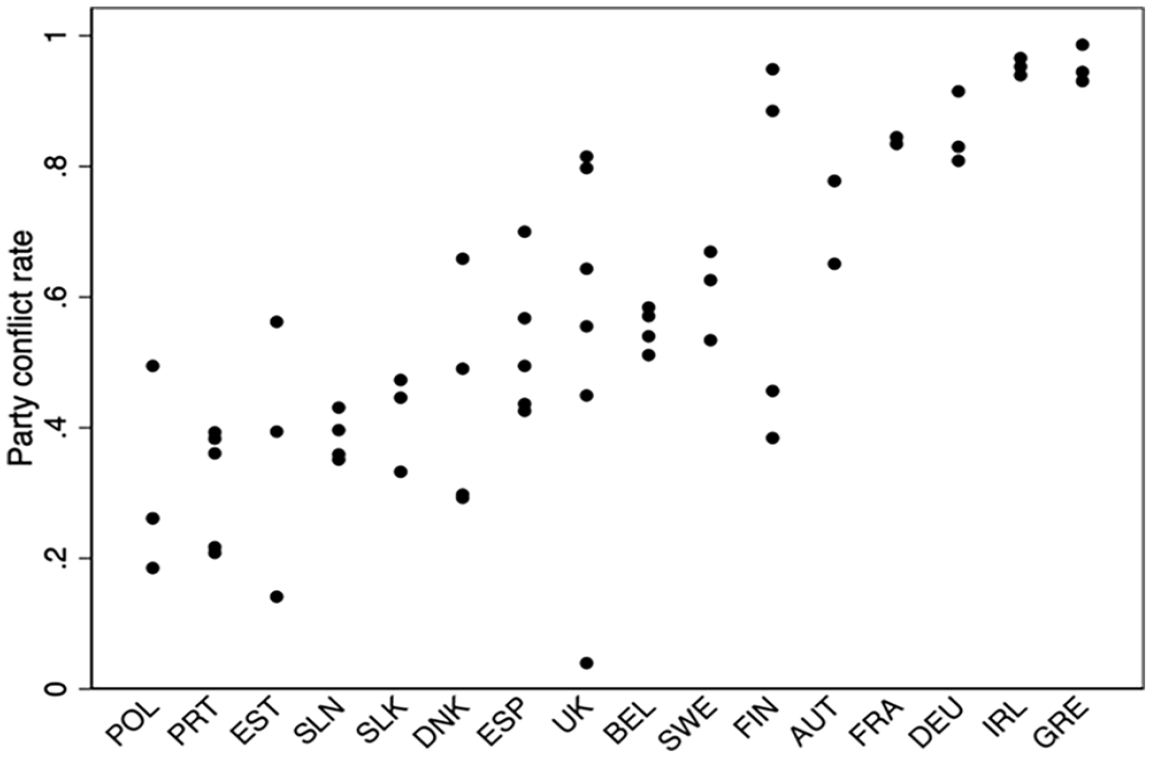
Opposition Party Conflict Rates in 16 Countries.
Independent variables
To test our hypotheses, we use Lento and Hazan’s (2022) framework for assessing the restrictiveness of the two stages of the vote of no-confidence – initiating and voting (see Appendix A of the Supplementary Information).
Figure 2 shows the placement of the 16 countries in our analysis on both stages (for the scoring data see Table 1, and in more detail in Table A1 of the Supplementary Information). The score that a country receives at each stage is a combination of all three components, ranging from 0 to 5. While the countries’ placements on both dimensions correlate (
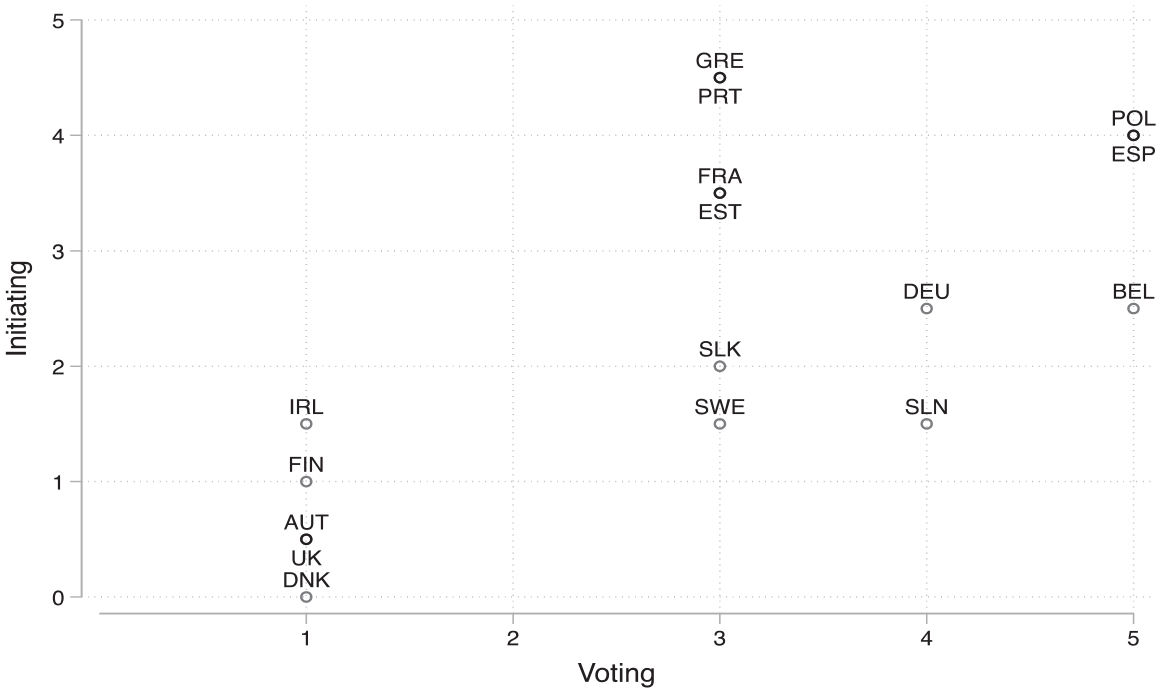
Two Stages of Restrictiveness in the Vote of No-Confidence.
Control Variables
We include various party-level control variables to account for findings that large opposition parties are more confrontational, that government experience has an effect which is conditional on party size, that ideological distance from the government is positively correlated with conflict, and so does being on the same ideological side of the government (Tuttnauer, 2018). Therefore, we include: party seat-share; government experience (calculated as the number of days that the party was in government, divided by the days in which it was represented in parliament); ideological distance between the party and the (size-weighted) government mean position on a 0–10 left-right scale; and a dummy for parties on the same ideological side as the government (i.e. if both the opposition party’s position on the left-right scale and the government’s size-weighted mean position on the same scale are below/above 5 which is at the middle of the scale). All needed data are taken from Parlgov.org (Döring and Manow, 2019).
At the government level, we include a measure of the ideological range of the government as well as a dummy for surplus governments. Surplus coalitions and coalitions with a wide ideological range might be expected to promote a less controversial agenda, leading to fewer conflicts between them and the opposition. 11
At the system level, our most important control is Wegmann’s (2022) intricate Policy-making Power of Opposition Players (PPOP) index.
12
While previous measures (e.g. Powell, 2000; Strøm, 1990) rely solely on features of the committee system, PPOP includes all of the important rules controlling the opposition’s influence over parliamentary policy-making: bill introduction, agenda-setting, committee structure, committee procedures, amendments, referendums and executive veto. Importantly, however, PPOP does
We further control for the openness of competition (Mair, 1996), which represents the extent to which opposition and coalition parties have previously been coalition partners or are likely to cooperate in future cabinets. It is calculated by counting the distinct number of coalition compositions in the preceding 10 years and dividing by 10. We also control for the importance of the parliament as the main political arena, in a measure that combines a binary component for whether the country is a federation or not with an upper-house power index inspired by Coakley (2014). The outcome variable is transposed to range between 0 (low-importance parliament) and 1 (high-importance parliament).
Finally, we must account for the fact that while some parliaments record all votes while others only record roll-call votes. Therefore, for some countries, we probably include more technical, uncontroversial votes than for others. We account for this by including the recording threshold, which is the share of parliament members needed to call for a recorded or roll-call vote; 13 and, following Coman (2015), the log of vote frequency – the number of recorded votes taken in a year.
Results
To facilitate the interpretation of the results we estimate multilevel linear regression models, with parties nested in countries. Using fractional logit regression, which more accurately fits the nature of the dependent variable but is less straightforward to interpret, yields similar results (see Table A4 of the Supplementary Information). We estimate three models, as shown in Table 2. Model 1 excludes our restrictiveness measures and serves as a baseline model.
Effect of Restrictiveness in the Vote of No-Confidence on Conflict.

PPOP: policy-making power of opposition players; AIC: Akaike Information Criteria; BIC: Bayesian Information Criteria.
Multilevel linear regression with parties (observations) nested in countries (groups). Standard errors are in parentheses.
Model 2 introduces the two restrictiveness measures for the two stages in the vote of no-confidence – initiating and voting – additively. The two coefficients are weak and statistically insignificant, and have almost no impact on the model as a whole, as highlighted by the AIC and BIC values. 14 Therefore, H1a and H1b cannot be affirmed.
However, when we introduce an interaction term between the two stages of the vote of no-confidence, in Model 3, it is significant and negative. Moreover, Model 3 yields substantively more explanatory power than Models 1 and 2. One should interpret the constitutive terms’ significant and positive signs with caution. 15 To better understand what the effect of the interaction is along the two axes (in Figure 1), we follow Brambor et al. (2006) in using a graphical analysis. Since we employ an interactive model for a causal interaction analysis, we treat the interaction as symmetric: both variables are seen as intervening with each other’s relationship with the dependent variable (Keele and Stevenson, 2021). We therefore graphically analyse the marginal effects of both.
In the two panels of Figure 3, we plot the effect of an increase in one restrictiveness stage in the vote of no-confidence on the conflict rate, conditional upon the various values of the other stage. We should keep in mind the empirical pattern in our data, shown in Figure 1, where there is little variation in the low end of each stage. Therefore, a positive effect of higher restrictiveness in only one stage of the vote of no-confidence is mostly a hypothetical option. The more relevant question pertains to the effect of high versus medium levels of restrictiveness.

Average Marginal Effects of Restrictiveness in the Vote of No-Confidence.
When the values of restrictiveness in one stage are high, the effect of the other stage becomes negative. This is true for the effect of initiating restrictions (Panel A) when voting is at 4 or above (applicable to 20 parties in five countries in our data), and for the effect of voting restrictions (Panel B) when initiating is at 3 or higher (applicable to 22 parties in six countries in our data). This finding implies that when the restrictiveness of the vote of no-confidence insulates the government from both the submission of votes of no-confidence and their successful passage, the opposition is less confrontational vis-à-vis the government. We can therefore conclude that Hypothesis H2a holds (and H2b refuted) for a move from moderate to restrictive votes of no-confidence, in a range applicable to a considerable section of our research population. That is, the two stages do not affect conflict additively and independently of each other. Rather, their effect is interactive and manifests itself only when restrictiveness is either low or high in both stages of the vote of no-confidence simultaneously.
To further explore the nature and size of this relationship, let us look at a hypothetical opposition party in a system with medium levels of restrictiveness, such as in Slovakia (initiating = 2, voting = 3), and set all other independent variables to their observed values. Such a party is expected, according to Model 3, to confront the government with 69% of its votes. If we increase the restrictiveness on only one of the stages of the vote of no-confidence by two units, the party’s conflict rate is expected to change only slightly, to 63%, and the difference is insignificant. However, if we increase restrictiveness on both stages by two units, now corresponding to the most restrictive systems in our data (Spain and Poland, see Figure 2), the expected conflict rate drops to 27%, a significant effect and about seven times stronger than that of each of the stages of the vote of no-confidence alone. Figure 4 summarises the various scenarios. This is further proof that an additive, unidimensional measure of the restrictiveness of the vote of no-confidence is ill-suited to uncover the effect we study here, and that an interactive multidimensional perspective is needed.

Counterfactual Conflict Rates.
Robustness Tests
As mentioned above, we repeated the main analyses as well as all robustness tests using a fractional logit regression rather than OLS, which yields the same results (Table A4 of the Supplementary Information).
Since the country scores for the initiating and voting stages are correlated, including both in the regression models may have introduced multicollinearity to a degree that can shed doubt on our results (VIF values of 4.62 and 6.62 for initiating and voting, respectively). We therefore ran the same models using orthogonalised versions of the two variables, which enables us to eliminate any multicollinearity between the two-stage variables and reducing their VIF values substantially (2.37 and 2.17, respectively). The results hold (see Table A5 of the Supplementary Information).
A key limitation of our cross-section dataset is that it captures only a ‘snapshot’ from each country. However, since we are mainly interested in institutional rules that are time-invariant within each country (with the exception of Belgium), adding longer periods per country would not increase the variance in our independent variables of interest. Nonetheless, to ensure our results are not driven by the country-period choice, we estimated Model 3 in Table 2 with different time frames for Germany, which is the only case whose period lies in the 1990s. We used three alternatives: the whole 1994–1997 parliamentary period instead of 1996–1997 originally used; the 2002–2005 period with the left-leaning SPD-Greens government; and the 2009–2013 period with the right-leaning CDU/CSU-FDP government. Our results hold in all three alternatives (Table A6 of the Supplementary Information).
Finally, we tested the results’ sensitivity to excluding individual countries, running Models 2 and 3 while removing one country from the analysis in each run. The results largely hold: the additive model (Model 2) returns significant coefficients for the stage variables only once – when excluding Slovenia from the analysis. More importantly, the interaction term in Model 3 fails to achieve statistical significance only once – when excluding Germany – and the direction of the effects is maintained throughout. While this result may shake one’s confidence in the findings, it should be mentioned that Germany is not an outlier in any of the institutional or country-level variables, and that our results are robust to replacing the German time period in the original dataset with other time frames. It is therefore unlikely that our results are driven substantively by the inclusion of Germany.
Conclusion
Parliamentary democracy is founded on the premise that no government can survive against the will of parliament, making the vote of no-confidence – the mechanism by which the parliament can terminate a government – the core feature of parliamentary systems. The parliamentary opposition, in itself a hallmark of modern democracy, plays a crucial role in keeping the government accountable to parliament, and through it to the public, via the (potential) use of the vote of no-confidence. However, notwithstanding its importance to parliamentary democracy, our understanding of the vote of no-confidence and its use by the parliamentary opposition in pursuit of adversarial or consensual behaviour is lacking.
In this article, we conceptualise the impact of the vote of no-confidence on the strategies of the opposition via the severity of restrictions placed on the two different stages of the vote of no-confidence: initiating and voting. Selecting between office- and vote-seeking conflictual behaviour or policy-seeking cooperative goals is a strategic choice made by the opposition, and we theorise that the particular strategy is chosen taking into account the restrictiveness in both stages of the vote of no-confidence. The use of votes of no-confidence purely for conflictual office- and vote-seeking goals is only a (small) minority of the empirical cases, making our analysis of cooperative policy-seeking opposition strategies critical for understanding government–opposition dynamics throughout the parliamentary term.
We analyse the degree of conflict in legislative voting as a manifestation of government–opposition relations, and the degree to which opposition parties prioritise policy-seeking cooperative goals. We find that higher restrictiveness in the vote of no-confidence is associated with less conflictual and more cooperative opposition behaviour, but only when restrictiveness applies in
Two specific directions for future research may be mentioned. One would be to more fully conceptualise and test the ways in which the vote of no-confidence, as an institution, interacts in its impact on government–opposition relations with other, contextual, factors such as the government majority status. A second direction would be to further break down Lento and Hazan’s (2022) indices to evaluate whether any of their components is especially responsible for the patterns found here. Answering both of these questions requires larger datasets including more cabinet terms and, preferably, more countries.
Our findings have implications for scholars of parliamentary behaviour and executive-legislative relations. They highlight the importance of conceptually delineating the details of the confidence relationship between the government and parliament for the behaviour of the opposition. Institutions matter, and institutional hurdles can incentivise the opposition to pursue certain behavioural strategies. Therefore, while the constitutional aim of the vote of no-confidence, and contemporary debates regarding reforming it in several countries, pertains to the government and its durability, we posit that its effect is far wider and deeper, affecting the relationship between government and opposition during the entire parliamentary term. Such wider ramifications deserve greater attention from both scholars and policymakers.
Supplemental Material
sj-docx-1-psx-10.1177_00323217231168765 – Supplemental material for Government–Opposition Relations and the Vote of No-Confidence
Supplemental material, sj-docx-1-psx-10.1177_00323217231168765 for Government–Opposition Relations and the Vote of No-Confidence by Or Tuttnauer and Reuven Y Hazan in Political Studies
Footnotes
Declaration of Conflicting Interests
Funding
ORCID iD

Supplementary Information
Author Biographies
References
Supplementary Material
Please find the following supplemental material available below.
For Open Access articles published under a Creative Commons License, all supplemental material carries the same license as the article it is associated with.
For non-Open Access articles published, all supplemental material carries a non-exclusive license, and permission requests for re-use of supplemental material or any part of supplemental material shall be sent directly to the copyright owner as specified in the copyright notice associated with the article.
