







Abstract
This article revisits and revises the arguments of an article published in 2008: Fred Block, “Swimming against the Current: The Rise of a Hidden Developmental State in the United States.” 1 That article argued that while the United States had officially rejected “industrial policy” and any attempt to use the government to pick private sector winners, the reality was that the country had embraced an extremely sophisticated and decentralized set of innovation policies that worked to move new technologies from the laboratory to the commercial space. This set of policies was highly decentralized, spread out across dozens of government agencies, and mostly invisible to the electorate. It was this invisibility that was captured in the phrase—hidden developmental state.
This article revisits the topic and asks what has happened in the intervening decade and a half. Is the developmental state still there? Is it still hidden or has it become more visible? What impact have the administrations of Obama, Trump, and Biden had on its operations? Revisiting these questions is important because the network of developmental state policies has grown considerably over these fifteen years in terms of the number of people and organizations involved in them, the size of federal expenditures, and their importance for economic development at the state and local level. Yet despite this growth, this developmental apparatus is still rarely acknowledged in public debates or in journalism. Even in academia, the community of innovation scholars who analyze these policies is relatively small and marginal in most disciplines. Up to now, the developmental state remains essentially hidden when it comes to debates in the United States about economic and social policy. This continued obscurity could ultimately make this developmental state unsustainable, which would have serious economic consequences for the United States.
However, there are indications that things might be changing. The four large spending bills passed in the first two years of the Biden administration—the American Rescue Plan Act, the Bipartisan Infrastructure Bill, the Chips and Science Bill, and the Inflation Reduction Act—represent the largest expansion of the federal government's role in the economy since the New Deal. These legislative initiatives will pour tens of billions of dollars into the nation's innovation efforts. To be sure, it will take years for these funds to be spent and to assess their effectiveness in reshaping the nation's economy. Nevertheless, we will show that these initiatives build on elaborate institutional networks at the state and local level that have grown up over two, three, or four decades.
These legislative initiatives might actually have played a role in the Democratic Party's relatively successful results in the 2022 midterm election for House and Senate seats. Incumbent Democrats campaigned on the passage of the Chips and Science Bill and the Inflation Reduction Act. In a speech in Syracuse, New York, on October 27, President Biden broke new ground in acknowledging the economic importance of government investment: I’ve asked CEOs, including Micron and CEOs in many other countries, the following question. . . . When the United States government decides to invest considerable resources in a new industry that we need to build up for our national security and economic wellbeing, does that encourage or discourage companies from getting in the game? The overwhelming answer is it encourages them to get in the game. Federal investment attracts private sector investment, particularly in those things we need badly.
2
The growing importance of the developmental state fits with the vision of a postindustrial economy that was elaborated by Daniel Bell and others as far back as the 1960s. Bell's argument was that scientific advance was rapidly becoming the key productive force in the economy and this would require significant shifts in the organization of society from that of the industrial era. In fact, the developmental state can be understood as the infusion program that Bell proposed in his 1973 book: What are the processes whereby discoveries in the laboratory may be transferred more readily into prototypes and production? In part this is an information problem, and it raises the question, for example, of the responsibility of the federal government in establishing a comprehensive technology “infusion” program which goes beyond the mere publication of technological findings to an active encouragement of its use by industry.
3
The article's argument will be developed in six parts. The first section reviews the concept of a network developmental state and explains how the process of innovation has changed over the last half century. The second describes the key features of this newly emerging innovation system. The third attempts to catalog the key changes that have happened at the federal level over the last fifteen years, looking specifically at the impact of the Obama, Trump, and Biden presidencies. The fourth looks at the thickening of networks at the state and local level that have emerged in response to federal efforts. The fifth assesses the strengths and weaknesses of this system as it currently stands. The sixth is a conclusion.
The Developmental Network State and the Transformation of Innovation
The concept of the Developmental Network State (DNS) was first elaborated by Sean O’Riain in his work explaining the success of Ireland in the 1990s in building a significant group of firms in computer software founded by Irish entrepreneurs. 4 Building on Peter Evans’s pioneering work on embedded autonomy, 5 O’Riain focused on the role of a group of government agencies that nurtured and supported these startup firms so that they were able to expand both output and employment. O’Riain contrasted this developmental model with what he labeled the Developmental Bureaucratic States (DBS) that were seen as responsible for the rapid economic growth in Japan and South Korea. In those cases, powerful government ministries used a variety of incentives to persuade existing firms to make very substantial new investments in productive capacity to facilitate expanded output, much of which was targeted at export markets.
O’Riain viewed both the DBS and the DNS as forms of industrial policy, but they used different methods and were responsive to different challenges. The DBS could be effective when nations were seeking to catch up with the leading producers of existing products. However, the DBS was unlikely to be successful when the challenge was to produce cutting-edge products that were not previously available. The bureaucrats were unlikely to know enough about different technologies to make intelligent guesses about where to invest. Moreover, established firms would also be reluctant to take on the risks of developing cutting-edge products.
Success in developing innovative products requires government initiatives that are more decentralized and flexible than the DBS. Government officials need the embedded autonomy that Evans described; they have to be linked to the community of technologists in order to understand different initiatives and be able to evaluate their probability of success. They cannot just work with established firms; they need to work with university-based technologists and with newly created firms. Finally, these government officials have to do more than just administer grants, loans, or other incentives; they have to become informal advisors to the initiatives they are funding.
The concept of the DNS made sense of the experiences in multiple countries with computer technology and biotechnology. Both of these industries are marked by continuous innovation and highly specialized forms of expertise. In the United States, Israel, Ireland, Taiwan, and several other countries, government officials—often located in small and obscure government agencies—have been able to foster very substantial economic development by providing both financial support and other forms of assistance to new and existing firms. 6
As the 2008 article argued, in the United States, the pioneering agency was the Defense Advanced Research Projects Agency (DARPA) that was created by the Eisenhower administration as part of the response to the Soviet launch of the first man-made satellite—Sputnik—in 1957. The agency was staffed with program officers drawn from university-based scientists and engineers who were given an unusual level of discretion in making grants. DARPA's most consequential success story was its investments in computers and the development of computer science in the 1960s. These investments underpinned the rapid development of Silicon Valley in the 1970s and 1980s. DARPA linked computer science departments at universities together through the ARPANET, which would ultimately be spun off and evolve into the internet. 7
DARPA's success created powerful momentum within the federal government to imitate its example. Particularly in the 1970s and 1980s, both Congress and the White House pursued a wide range of initiatives designed to create productive linkages among government agencies, scientists, and engineers working in both government laboratories and university, and both new and established business firms. 8 At the time of the 2008 article, the scale of DNS programs was already very significant. Government outlays for research and development (R&D) were $124 billion in 2008, with more than half of that going to the Pentagon and other national security agencies. The Small Business Innovation Research program (SBIR) that provides support for small technology firms allocated more than $2 billion in 2008—more support for early-stage firms than what was offered by the venture capital industry. 9
Many things have changed since 2008. The DNS has extended its reach beyond a few high-tech sectors of the economy. It has become relevant and central to a far broader cross-section of industries because ever widening parts of the economy are now marked by continuous innovation and highly specialized forms of expertise. Some of this is driven by climate change and the necessity of reducing greenhouse gas emissions. Some of it is driven by advances in nanotechnology and materials science that has made possible the development of whole new materials with new properties. Some of it is driven by the ongoing advances in computing power that make possible intensification of automation as well as more sophisticated analyses of the properties of existing products.
In short, technologically based innovation has become ubiquitous across much of the economy. We can see this clearly with a relatively humble example—the helmet worn by football players. The first helmets in the 1920s and 1930s had been made of leather. The plastic helmet was introduced in 1939 and for seventy years was only incrementally improved with more padding and more complex face guards. In fact, the same firms dominated the industry for most of that period. Things started to change, however, in 2007 when it became known that football players were being diagnosed with chronic traumatic encephalopathy—a degenerative brain disease—resulting from repeated concussions.
Change, however, was not immediate. The NFL and the Players Association began a testing program in 2015 to identify how helmets protected against head injury. In 2019, the league launched a helmet challenge. In the first stage of the competition, firms were invited to enter prototypes for improved helmets. In the second stage, $1.37 million was allocated to thirteen teams whose prototypes proved particularly promising. In the third stage, announced in October 2021, $1.5 million was allocated to three of the teams with the most promising entries. The three teams will use the award funds to move toward mass production of new helmets, so they can be put into use by the league's teams as quickly as possible.
Unlike many prize competitions, the idea in the helmet challenge was that there would be close collaboration between the competing teams and groups of experts assembled by the NFL.
The challenge was kicked off at a three-day symposium attended by three hundred technologists in November 2019, held at the America Makes Institute in Youngstown, Ohio. America Makes is a government-funded advanced manufacturing institute focused on 3D printing or additive manufacturing. 10
The NFL recognized that producing a significantly improved football helmet requires combining expertise in neuroscience, mechanical engineering, materials science, sophisticated computer modeling, and probably several other disciplines. The participants at the initial symposium were given access to a finite element model—a system of differential equations—that showed how four existing helmets respond to different types of impact. The teams that had a chance at winning the competition would need to provide a similar finite element model of their own helmet to show how it outperforms other helmets. 11
As it happened, each of the three winning teams was itself a consortium that combined academic researchers with businesses. One winner was a Montreal-based collaboration called Kollide that brought together researchers from the engineering school at the University of Quebec with four firms with expertise in simulation, design, 3D printing, and software developed for three-dimensional body scans. A second winner was a startup firm in Denver, Impressio, that was created in a partnership with the University of Denver. The third was a firm called Xenith, founded in 2006 that was already a helmet provider for the NFL. For its new helmet entry, Xenith worked in collaboration with RHEON Labs in London, a startup firm that has developed a unique polymer, BASF, a major German chemical firm, and researchers at the University of Waterloo in Canada.
In a word, developing an improved football helmet is typical of contemporary innovation across many industries; it requires the participation of entities with five, six, or even more types of scientific or engineering expertise. Moreover, the example also points to the danger to long-established firms. Their failure to innovate can lead to their sudden loss of markets that they have dominated for more than fifty years. To be sure, the case is atypical in that the dollar amounts that the NFL has spent are comparatively modest. Many of the other contemporary technology challenges require billions of dollars of investment in both R&D and in production facilities. This is true of the development of new generations of computer chips, advanced batteries for vehicles, new composite materials for construction, new vaccines and other biopharmaceuticals, and more sophisticated systems for 3D printing as an industrial tool.
In all of these cases, there is the need for multiple types of scientific and engineering expertise and very large investments.
The Trump administration's rapid development of the mRNA vaccines against COVID-19 through Operation Warp Speed was another public-private collaboration that is typical of larger DNS projects. However, the speed would not have been possible without many years of previous federal support for R&D efforts. It has been estimated that between 2000 and 2019, the National Institutes of Health (NIH) spent $950 million on research grants for mRNA vaccines and another $500 million on lipid nanoparticles—the delivery mechanism for the vaccine. 12 DARPA between 2011 and 2020 invested another $400 million on developing new vaccine technologies. 13 This included about $21 million in 2013 directly to Moderna—one of the two firms that developed the mRNA COVID vaccine. Pfizer's COVID success was largely due to its partnership with the German firm BioNTech. The latter firm benefited from employing Katalin Kariko since 2013. She is the scientist credited with the major breakthrough in 2005 that opened the path to mRNA vaccines. Her pioneering work with Drew Weissman had been supported by NIH and by the Small Business Innovation Research program. 14
Key Features of This New Innovation Reality
Complexity, Collaboration, and the Replacement of the Corporate Laboratory
There are three key trends that developmental network programs have both facilitated and played a role in addressing: mounting scientific complexity, the increasing importance of small startup firms, and the need to address network failures. In doing so, these programs, we argue, are increasingly aimed at fostering interactive innovation ecosystems.
Growing technological complexity means that innovation frequently requires collaborations that bring together people with multiple types of scientific or engineering expertise. Even the largest business firms cannot justify hiring scientists and engineers in that many different disciplines. Very few people want to be the one neuroscientist or organic chemist who works in a lab where most of the people are engineers or physicists. Moreover, it is very hard for somebody trained in a different discipline to evaluate the performance of that one neuroscientist. Finally, if you are working on a football helmet, you cannot just plug in anybody trained in neuroscience; it has to be a neuroscientist who is interested in engaging in a cooperative project and mutual learning with people with expertise in materials science and bioengineering.
This is precisely why corporate laboratories have receded in importance in the current innovation system. Interorganizational collaborations have become the standard way of doing this work. By far the dominant form this takes is for businesses to work in collaboration with publicly funded institutions—government laboratories, universities, and specialized institutes created to foster these kinds of collaborations among multiple parties. The big Department of Energy (DOE) laboratories that grew out of the Manhattan Project have loomed particularly large in the innovation system in recent decades. Facilities such as Oak Ridge, Lawrence Berkeley, and Sandia have scientists and engineers on their staff from a wide range of different disciplines who are accustomed to working in multidisciplinary teams. This makes it relatively easy for firms with only one or two scientific specialties on their staffs to negotiate a Cooperative Research and Development Agreement with one of these laboratories to create a full multidisciplinary team that could work on an innovation project. 15
In earlier research, Block and Keller showed that the DOE laboratories were credited with a large portion of the innovations that were designated by
Researchers at the DOE laboratories have other demands on their time, and Congress has been reluctant to authorize significant growth in the size of their scientific labor force. 18 Policymakers have sought to expand the supply of technologists who can work with businesses in two ways. The first is to increase the involvement with industry of the three hundred other federal laboratories. While some of these laboratories are highly specialized, with only one type of scientist, others employ scientists from a broad range of fields. Moreover, when one of these laboratories discovers a technology that might be of use to industry, its technologists can help the private firm to assemble a multidisciplinary team by drawing on scientists at other labs or at universities.
The second response, however, has been for the government to fund the creation of research centers or institutes that focus on a very specific technology. The directors of these research organizations then do the work of assembling the kind of multidisciplinary team needed to make further progress in developing that technology. They recruit industry partners with the idea that most of the research collaborators they need would be available in that one place.
This option has been particularly attractive to policymakers because in contrast to the federal laboratories, the government's budgetary commitment to such research organizations can be limited to five or ten years. If the effort proves unsuccessful, shutting it down does not create political problems from angry federal employees or contractors. Moreover, it is relatively easy to set up these organizations with a requirement that either private sector firms or state and local entities participate in their funding. This means that limited federal R&D funds can be leveraged to fund more of these research institutes.
The initial model for these centers was created by the National Science Foundation in the 1970s. They provided funding for Industry-University Collaborative Research Centers (IUCRCs). 19 Productive senior scientists who have developed a promising new technology can apply for funding to create a research center to work on commercializing that technology. The winning directors would then recruit industry participants who would pay dues to support the research at the center. Dues-paying firms could send their scientists or engineers to work at the center, where work would proceed on two tracks. There would be generic research shared by all participants as well as a proprietary track where individual firms helped to fund research for which they would retain any newly created intellectual property. This model has been extremely successful, with many centers continuing after NSF funding was phased out.
The IUCRC model has been replicated within NSF and by other government agencies that have created their own networks of funded research centers on university campuses. However, IUCRCs also face limitations of scale. The core team is limited to scientists who are already on the payroll at that university. Moreover, even today, the NSF funding for one of these centers is just $150,000 a year for the first five years, with more money coming in as businesses pay dues. But an increasing number of IUCRCs are now collaborations that bring together two or three universities to widen the number of specialists who are already on the payroll. But even with that adaptation, it can still be difficult to assemble a large enough multidisciplinary team or to have the flexibility to respond to new possibilities.
The response of policymakers has been to scale up the size of the new research centers or institutes that they fund. NSF began in 1985 to create Engineering Research Centers (ERCs) that are also required to recruit dues-paying industry partners. 20 However, the funding for ERCs is now between $3 million and $4 million per year. In 1994, NSF started a program to establish Materials Science and Engineering Centers that operate in a similar way and receive funding between $1.5 and $3.5 million per year. 21 We will see later that both the Obama administration and the Biden administration greatly accelerated this process of creating networks of new, large research centers that are usually structured as public-private collaborations.
The Importance of Startup Firms
As we saw in the NFL helmet challenge, startup firms are a key element of this new innovation system. There are multiple reasons for this. Most importantly, established corporations tend to be fairly conservative in considering the possibilities of new technologies. Technologists at the Xerox PARC Lab in Palo Alto developed the Alto workstation in 1973 that had many of the features that would ultimately be part of the personal computer. However, they were unable to persuade higher-level managers at Xerox that there would be a significant enough market for this product. 22 Young entrepreneurs such as Steve Jobs and Bill Gates visited the Xerox PARC Lab and moved swiftly to show that the Xerox managers were wrong. 23 More recently, it took Elon Musk's mass production of the Tesla to persuade the major automobile companies to make major investments in producing all-electric vehicles.
But even when established firms are interested in developing innovative products, their organizational logic limits them to a handful of new product launches in any given year. A team working on an innovative project for a few years often faces the frustrating reality that their innovation did not make the cut. For this reason, potential innovators are now less likely to go to work for a big firm and more likely to go to an early-stage firm where there is a better chance that their idea might ultimately get to the market. It is also common that when an individual working at an established firm has an idea for a new product, he or she will quit and create a startup firm.
Since it can often take five to ten years to transform an idea into an actual commercial product, it often requires the single-minded determination of a founding technologist to overcome the barriers—both technological and economic—to a successful product launch. For this reason, universities have allowed their scientists and engineers to retain their academic positions while also launching startups. And with greater frequency, universities will make investments in the most promising of these startups. A number of the federal laboratories have also created entrepreneurial leave programs that include health care coverage and the ability to return to their technologists who take the risk of creating a startup firm. 24
Similarly, when technology transfer officials at a university or a federal lab discover that one of their scientists has patented an innovation with considerable commercial potential, they are likely to try to license the technology to the handful of big firms that are operating in that particular field. But when those efforts fail, their next move would likely be to look for a local entrepreneur who might be interested in creating a new firm around that technology.
The critical importance of startups is recognized by the federal government in a variety of programs. The most important is the Small Business Innovation Research (SBIR) program that was launched in the late 1970s and has been renewed and repeatedly expanded by the Congress every five years. 25 The program provides funding in two phases to small business firms that have an idea for a commercial product. In phase 1, grants can be as much as $225,000 for six to twelve months. If the firm is able to develop its concepts in that period, it can apply for a phase 2 grant that could be as high as $1.8 million to fund two years of product development. Over its lifetime, SBIR has made more than 180,000 awards.
It is common for startup firms to approach “angel investors” or venture capitalists and be told that they should go first to the SBIR program. 26 Success in getting a phase 2 grant provides a certain amount of credibility for startup firms, and the two years of funding often facilitates some significant progress in getting closer to a commercial product. The program operates as a kind of screening mechanism, so that private investors can avoid investing resources in firms that have not been able to pass this test.
It is often the case, however, that even after completing a phase 2 SBIR grant, a startup might still be some years away from developing a commercial product. In recognition of this, a number of government agencies have provided additional contracts or grants to SBIR firms. These are referred to as SBIR phase 3 even though they do not count as part of SBIR funding. In 2019, the SBIR annual report indicated that phase 3 awards to SBIR firms were on the order of $1.2 billion, with the largest outlays coming from the Department of Defense. 27 However, this figure requires two qualifications. First, reporting on phase 3 grants or contracts is not complete across the federal system. Second, an old SBIR phase 2 award from 1999 might still be resulting in substantial government procurement in 2019. The point, however, is that phase 3 awards represent a substantial continuing flow of resources to firms that had once been startups.
Other government programs often divide funds among both established firms and startups. The Clinton administration launched a research collaboration with the big three auto manufacturers that was called the Partnership for a New Generation of Vehicles. The goal was to create vehicles that would triple the fuel efficiency of existing models. While the companies developed concept cars that met the goal, there was little impact on the models available to the public. 28 The Obama administration learned from this failure. When they launched the American Recovery and Reinvestment Act in 2009, they also provided funds to the established automobile companies to develop electric vehicles. However, they also funded several startups including Tesla with the hope that the competition from the new firms would force the big three to move more swiftly toward mass production of electric cars.
Finally, as we also saw in the case of the football helmet, some of these small firms have very narrow and specific competencies and are comfortable working in a niche with limited growth opportunities. This, also, is a feature of the new innovation landscape. These technologists feel comfortable working in a small firm with little hierarchy where they get to work on a succession of interesting projects. Feldman and colleagues have recently shown that some of the firms that repeatedly win SBIR awards have been highly productive in generating multiple innovations. 29
The Issue of Network Failure
As Andrew Schrank and Josh Whitford have argued, the pervasive problem in this new innovation system is the difficulty of finding appropriate partners. 30 Whether we are talking about a giant corporation or the CEO of a new startup, they need to find partners with complementary skills at multiple different stages. Partners are needed to transform an idea into a new product as well as to overcome the obstacles to producing the product at a reasonable price point. However, with the proliferation of research scientists and small firms, it is not simple to find these partners; the search process can be both time consuming and costly.
Moreover, when one finds partners, there are still two significant dangers. First, the partners might not be trustworthy; they might try to take advantage by charging too much for their services or by stealing valuable intellectual property. Second, the partners might be trustworthy, but they might still lack the competence to complete the necessary tasks. Either of these problems can derail an innovative development.
This helps to explain why the public sector plays such an important role in the current innovation system. Government officials from the program officers in the SBIR program or other government R&D programs or tech transfer officials at government laboratories or universities often use their knowledge to help innovators connect with the partners that they need. Moreover, research institutes and centers become loci for effective networking. The firms that are affiliates of one of the government-funded institutes, for example, might already include an optimal partner for another member firm. Alternatively, the scientists and engineers working at the institute might be able to connect a member firm to a researcher at a different facility who has the precise expertise that they need. Finally, initiatives at the state and local level, as we shall see, have become increasingly important in providing startup firms with both the support services and the network connections that they need.
The involvement of the public sector can also work to discourage opportunistic behavior, including the theft of intellectual property. Each of the military services runs its own SBIR programs that often connect winning firms to the large defense contractors who produce tanks, battleships, or fighter aircraft. If one of these larger firms tries to steal the idea of the SBIR firm without compensation, the military services use the SBIR application as proof of ownership and they discipline the larger firm appropriately.
Public officials are often in a position to evaluate the competence of potential partners. When a new private sector partner is being added to a research collaboration at a federal laboratory, for example, the government scientists and engineers will quickly be able to tell if the new partner has the competence that has been claimed. Similarly, validation by a government office, such as that received by an SBIR awardee, can be evidence of competence. Finally, public agencies can develop training programs that raise the skill level of network participants, making it easier to find competent partners.
An Innovation Ecosystem
The danger of network failure helps to explain why practitioners increasingly focus on the metaphor of “building an innovation ecosystem” in a particular location. 31 In nature, a healthy ecosystem requires a wide variety of different life forms whose complex interdependence makes possible the successful exploitation of resources such as sunlight, water, and minerals. By analogy, a healthy innovation ecosystem requires a certain degree of cooperation among a variety of institutions that include universities, colleges, government laboratories, other research entities, various levels of government, small firms, large firms, and financial entities, as well as bridging institutions that facilitate some degree of coordination. As in nature, there is also direct competition among some of the species, including predation. However, in healthy systems, there are also constraints so that predation does not destroy entire species.
In an innovation ecosystem, there is ongoing production of new innovations, the continuous birth of new firms, and cooperation with various larger firms both nearby and distant. The aspiration is to accumulate a wide enough range of competencies, so that the region could bounce back from shocks such as the sudden loss of markets for previously successful products. But this means that within the system, there has to be continuous experimentation with new ideas and continuous efforts to overcome a technological barrier.
As we have seen, this requires that scientists, engineers, and entrepreneurs find the best network partners possible. It follows that the innovation ecosystem needs a dense network that includes many people who have a wide range of different personal connections. If, for example, a tech transfer official at a government laboratory or a university is looking for a local entrepreneur to build a firm around a breakthrough innovation, he or she has five or six people to call who, in turn, are connected to multiple potential candidates.
In addition to density, the ecosystem needs a coordinating mechanism. This is usually a bridging institution that brings together many of the key participants—educational institutions, federal laboratories, governments, firms, and sometimes labor unions. 32 The bridging institution performs several functions. It is usually the entity that applies to the federal government for various grants, including those that involve the creation of a new research institute. The bridging institution can help facilitate the creation of some of the public goods that are needed by the ecosystem. With new technologies, there is often a need for training programs to provide both managers and employees with the necessary skills. This often involves developing new curricula at universities and community colleges to deliver the necessary instruction. Bridging institutions can also facilitate network participants engaging in the construction of a roadmap of how the new technology might evolve over the next five years. While such mapping exercises are imperfect and often in need of revision, they can be extremely helpful as both firms and research institutions struggle to figure out how to plan their own deployment of resources over time. The bridging institutions can also facilitate investments in the infrastructure that the network needs. For example, governments often fund the creation of test beds that allow network participants to evaluate how well their innovation meets certain standards.
Finally, the bridging institution creates a context where bad behavior by network participants becomes quickly known to others. This kind of transparency within the network helps to discourage predatory behavior and exposes actors who claim more competence than they actually have. At the same time, knowledge of positive achievements is also quickly diffused, which can mean that network participants spend less time pursuing technological dead ends.
The project of creating healthy innovation ecosystems has generated a new approach to regional growth called technology-based economic development. 33 For many years, the focus of most state and local economic development officials has been on enticing big corporations to locate headquarters or production facilities in their jurisdiction. Billions of dollars of tax breaks and other incentives have been doled out to bring in a facility that might employ 1,000 to 10,000 employees. In recent decades, however, these strategies have experienced diminishing returns as big corporations have downsized or moved production overseas.
The logic of technology-based economic development is different from that earlier economic development strategy since the focus is much more on economic value added than on rapid employment growth. For example, even if a region becomes a hub for some type of advanced manufacturing, in many cases, the production facilities will be highly automated and provide only a few hundred jobs and it might take a decade before the new industry adds a thousand jobs. 34 However, success in creating an innovation ecosystem creates a number of flows that strengthen the regional economy. One element is the increased flows of R&D dollars that come into the research institutes to support well-compensated researchers and technicians. The other is the high value added per production worker that is characteristic of advanced manufacturing. It is not uncommon in advanced manufacturing for each worker to account for $400,000 or $500,000 of value added per year. Together, these two flows provide resources that increase demand for other goods and services in the regional economy.
Key Changes over the Last Fifteen Years
During the administration of George W. Bush (2001–9), the hidden developmental state remained well hidden. Bush gave in to right-wing pressure and ended the Advanced Technology Program under the National Institute for Standards and Technology. The program had been subject to consistent attack because it provided government resources to large firms who were supposed to be able to solve their own technological problems. 35 Bush also zeroed out other technology programs in his proposed budgets, but in most cases, congressional committees continued the funding. 36
Less visibly, however, the Bush administration recognized the dependence of the private sector on federal R&D spending. At one point, the White House website even bragged about the importance of government-funded innovations for the development of Apple's iPod. 37 The president also signed in 2007 the America Competes Act that provided additional resources to some of the key agencies involved in technology development. Bush's chief science advisor, John Marburger, pushed for the development of a science of science policy. 38 Marburger was interested in developing metrics that would help the government target its R&D spending more effectively. This initiative helped to overcome the organization of technology policy into separate, and often antagonistic, silos that had kept people from different agencies from sharing information and finding ways to collaborate.
Obama Administration, 2009–17
When the Obama administration entered in 2009, they built on this effort and sought to create greater cooperation among the different agencies involved with innovation. Moreover, since the new administration started at a moment when the world economy was in freefall as a consequence of the global financial crisis, it had some room to maneuver in formulating new innovation policies. Obama's first chief of staff, Rahm Emanuel, famously argued that they should not let a crisis go to waste. They quickly proposed a large stimulus bill designed to accomplish some of their ambitious agenda, including accelerating the transition away from fossil fuels.
In fact, the present authors organized a public event in Washington, DC, on December 1, 2008, under the auspices of the Economic Policy Institute and the University of California Washington Center in which a series of speakers argued that the best path for the new administration was to focus the stimulus bill on R&D spending and on efforts to bring new technologies online. 39 The argument was that such spending would create needed demand in the short term and would significantly expand the nation's productive capacity over the longer term. We employed the new word “stim-novation” to capture the combined effects of such a policy.
The term did not catch on, 40 but the Obama administration did include substantial increases in R&D spending in the American Recovery and Reinvestment Act (ARRA). While many of the infrastructure projects that were funded in the ARRA might not be launched for another year, money given to agencies for R&D could be put to work quite quickly. In some cases, agencies were able to immediately authorize funding for projects that had been denied because the available budgetary resources had been exhausted.
Even more importantly, the Obama administration sought to make the hidden developmental state visible. They did this particularly around clean energy technologies. One provision of the ARRA provided the DOE with $6 billion for loan guarantees to implement a previously authorized lending program that had not been utilized by the Bush administration. The guarantee amount would support $60 billion in lending by private lenders who could count on the US government to pay if the loan went into default. 41
The administration argued that we needed to end our dependence on oil from the Middle East by accelerating our transition to electric cars, solar power, wind power, biofuels, and greater energy efficiency. However, it made no sense to replace dependence on the Middle East for oil with dependence on South Korea for advanced batteries or on China for solar panels. To make this happen, the government would guarantee billions of dollars of loans to produce batteries, electric cars, and advanced solar panels. It was this program that provided critical funds for Tesla, highly controversial funds for the failed solar firm Solyndra, and billions for utility-scale solar projects. According to a 2015 Government Accountability Office (GAO) report, there were thirty-four loans totaling $28 billion for thirty different projects. Most of the projects were successfully completed, but five including loans to two solar firms (including Solyndra) and to two advanced automotive projects defaulted. The GAO calculates that the total estimated cost of the loans to the federal government, including defaults and administrative expenses, is likely to be $2.21 billion. 42
The Obama administration also departed from earlier practices by involving itself directly with manufacturing. In 1990, Craig Fields, then head of DARPA, had been fired by George H. W. Bush because he tried to involve the agency in helping firms to mass-produce flat panel displays. Assisting firms at the manufacturing stage was seen as largely illegitimate unless they were the small firms being helped by the Manufacturing Extension Partnership.
However, the Obama administration targeted funding directly at the manufacturing process. This was the case with Tesla and Solyndra, but there were also substantial loans to Ford and Nissan. The DOE loaned Nissan $1.4 billion to retool a plant in Tennessee to produce both Nissan's pioneering all-electric vehicle and the electric battery packs for the car. Moreover, DOE also made substantial grants to other firms to help with the production of electric batteries. Some of these firms failed, but others have continued and have ramped up production, although usually there have been changes of ownership through mergers or buyouts.
Obama's Department of Energy also launched a flotilla of major research centers that were designed to be the locus of important energy innovations. In 2009, the DOE created Energy Frontier Research Centers with $2 to $4 million worth of funding for four years with the possibility of renewal. 43 There are now forty-one centers based either at universities or government laboratories with enough resources to hire technologists with very specific expertise. While these centers are not required to recruit industry partners, many of them do, and a number of them have successfully spun out startup firms to work on new technologies that they have developed. The DOE has also funded several Energy Innovation Hubs that are even larger.
When Republicans regained control of Congress in 2010, they quickly reined in the administration's ambitious innovation policy agenda. When the funds in the ARRA were exhausted, the administration had limited ability to support some of the firms that had received loans or grants in 2009–10. The consequence was a fairly severe shake-out among younger clean energy and renewable firms. Some went bankrupt, and some moved to China or made deals with other foreign firms. Nevertheless, the initiatives in the ARRA were successful in shifting the cost curves for a number of clean energy technologies. A DOE report from 2016 showed dramatic cost declines for several technologies. The price for wind power dropped from 7 cents per kilowatt-hour (kWh) in 2009 to 2 cents in 2016, and for solar power the drop was from 10 cents per kWh in 2010 to below 5 cents in 2015. Prices for light bulbs made with light emitting diodes (LEDs), which use a fraction of the electricity and have longer lives, dropped 94 percent between 2008 and 2016. The cost of electric batteries for automobiles dropped from $1,000 per kWh in 2009 to a little over $200 per kWh in 2015. 44
Moreover, President Obama's Council of Advisors on Science and Technology formulated a new approach to technology policy based on the successes and failures of the ARRA. In 2011, they proposed the creation of a network of forty-four advanced manufacturing institutes, each of which focused on the challenges of a particular technology. Each institute, funded jointly by the federal government and partners from industry as well as state and local government, would be a hub for solving the problems connected either to a new manufacturing technology or the challenges of mass producing a new type of product. 45 The federal contribution for each institute was around $70 million over five years, with a requirement for matching funds from industry and public sector partners. 46 A part of the design of these institutes was that they would also help galvanize economic development and job creation in the region surrounding their headquarters location.
This initiative was obviously a bridge too far for congressional Republicans. However, the administration was able to launch the first advanced manufacturing institute in 2012 with funds that had already been allocated to the Pentagon. This was the America Makes institute focused on 3D printing that figures in the NFL helmet challenge. A prolonged budget impasse in 2014 was finally broken in December with the last-minute passage of a bill referred to as the CRomnibus because it provided funding for the government in 2015 and included a variety of other provisions. Since the bill had to pass to avoid a government shutdown, the leadership of both parties were able to include items that might not otherwise be supported by their respective caucuses. Among these was the authorization to create thirteen more advanced manufacturing institutes. The Chamber of Commerce endorsed the proposal, making it easier for conservative Republicans to acquiesce.
The Obama administration tried to publicize the creation of these institutes, but national media has generally ignored them. As of October 2022, the
In sum, the Obama administration made a series of significant enhancements to the DNS, but the president never used his considerable oratorical skills to give a public face to these efforts. He never gave a name to these new forms of public-private collaboration that were becoming ever more central to the economy. In fact, one of his efforts to explain the importance of government spending was a huge rhetorical failure. In a campaign appearance in 2012, Obama referenced the dependence of entrepreneurs on government by saying that somebody helped to create this unbelievable American system that we have that allowed you to thrive. Somebody invested in roads and bridges. If you've got a business, you didn't build that.
49
The Trump Administration
At the beginning of his administration, Trump appointed Mick Mulvaney, a Republican congressman from South Carolina, as head of the Office of Management and Budget. As a founding member of the Freedom Caucus in the House, Mulvaney was hostile to the “big government” technology programs, and his initial budget submissions proposed radical cuts to these efforts. The budget contemplated the elimination of the Manufacturing Extension Partnership and the Advanced Research Projects Agency at the DOE, an 11 percent cut to the NSF budget, and a sharp reduction in the amount allocated to the Commerce Department to coordinate the advanced manufacturing institutes. Overall, it would have cut nondefense R&D expenditures by 10 percent. 50
The Congress, however, largely ignored these proposed cuts and continued to fund nondefense R&D at previous levels. This pattern continued with subsequent Trump budgets serving as signals to “small government” Republicans of the administration's devotion to that faith. However, in its practices, the administration came to embrace the developmental state in many respects. An October 2018 report from the administration's National Science and Technology Council,
The lack of alignment between the administration's budget proposals and its actual policies is unsurprising given the president's inattention to the details of policy. However, one way to understand this is through the evolution of Rick Perry, Trump's secretary of energy. In the 2012 presidential campaign, Perry had famously called for the elimination of the DOE and two other cabinet agencies. However, on a visit to Oak Ridge National Laboratory in 2017, Perry acknowledged his conversion: During a stop in Hardin Valley on Monday afternoon, Perry acknowledged he's learned a lot since the 2012 campaign, including in his visit to Oak Ridge and at DOE headquarters in Washington, D.C., and in trips to Idaho National Laboratory and the Waste Isolation Pilot Plant in southeast New Mexico.
He suggested he might not be the only one unaware of some of the innovations that have roots in or are developed in places like Oak Ridge, innovations like gene therapy, supercomputing, and 3D printing. The American public may also not be aware of how that “cutting-edge” technology can be used to create jobs and wealth, Perry said.
“Those are things I readily admit I didn’t know five years ago,” Perry said after operating a 3D-printed excavator and test-driving a printed utility vehicle—and learning about other innovations such as supercomputers at Oak Ridge National Laboratory and composite work at its Manufacturing Demonstration Facility in Hardin Valley on Monday afternoon. “There are a lot of things that have surprised me.” 52
Biden Administration
The Biden administration approached innovation policy with no ambivalence; it was determined to extend and expand the initiatives of the Obama administration. It relaunched the use of the Economic Development Administration (EDA) within the Department of Commerce as a mechanism to encourage localities and regions to start creating bridging institutions that would bring together government laboratories, universities, state and local governments, and businesses. The EDA channels various government grants from different agencies to those places that were making progress in creating the kind of coordinating structures that are vital for the emergence of an innovation ecosystem. The more progress a locality was making, the larger the grants for which it would be eligible.
A division of EDA called the Office of Innovation and Entrepreneurship had been created in the reauthorization of the America Competes Act in 2010. This office had been organizing a Regional Innovation Strategies Program since 2014 that provided about $10 million per year to support building innovation capacity at the local level. Most grants went to universities or economic development agencies to support their efforts to help startup firms. Now renamed as Build to Scale, this entity distributes $36 million per year in support of technology-based economic development.
The new administration quickly launched three new initiatives to extend and deepen the developmental state. With funds authorized by the American Rescue Plan that was passed in March 2021, the administration launched the Build Back Better Regional Challenge administered by the EDA. Some twenty-one local coalitions have been awarded between $25 and $75 million to be expended over four years that could fund a research center designed to foster the development of new industries. 53 The explicit idea is to create more local innovation ecosystems. The National Science Foundation issued a call in 2022 for the creation of Regional Innovation Engines that would be funded at $16 million per year for ten years. Each engine would mobilize a coalition effort to help develop a regional innovation ecosystem that would foster economic growth and job creation.
Moreover, as a further indication of an emerging consensus around the creation of regional innovation centers, Congress passed the Chips and Science Act in July 2022. The core of the bill is close to $50 billion in support of semiconductor firms to expand production of computer chips in the United States to reduce US dependence on production from Taiwan, South Korea, and China. But the bill also authorizes the Department of Commerce to create twenty new regional technology and innovation hubs in areas that have not experienced technology-based growth. The legislation authorizes $10 billion for this program over five years, meaning each hub could be funded at $10 million per year. A similar provision authorizes the DOE to set up regional clean energy innovation centers with awards capped at $10 million over five years. These centers would be partnerships with government and industry with 50 percent cost sharing in the third, fourth, and fifth years.
Moreover, the Biden administration has dramatically escalated the government's direct role in financing manufacturing investments. The DOE's Loan Guarantee Program for Advanced Technology Vehicles Manufacturing had been dormant since 2010, but a first new loan was made in July 2022, and the program has more than $15 billion of guaranteed loans available. 54 The Chips and Science Act includes nearly $39 billion of funds for investment in fabrication, assembly, and testing of semiconductors to incentivize firms to produce chips in the United States. The Inflation Reduction Act includes multiple incentives for manufacturing firms to significantly increase the energy efficiency of their factories. These include tax credits, loans, and grants. Two billion dollars in grants with a 50 percent cost share are available for firms to invest in clean energy vehicles. Another $5.8 billion of grants, also with a 50 percent cost share, are for increasing the energy efficiency of existing plants.
Thickening of Networks
The other big change over the past fifteen years has been the thickening of innovation networks at the state and local level. To be sure, actors at these levels have always been part of the developmental state. State and local agencies, for example, have long been involved in working with startups to help them put together strong applications for the SBIR and STTR programs. Technology transfer officers at federal laboratories and at universities have also been continuously active in helping startups to get off the ground or trying to persuade established firms to license one or another technology their scientists and engineers have developed. Moreover, some states were actively engaged in technology-based economic development in the 1970s and 1980s. 55 What has changed is that many new actors, new agencies, and new financial resources have entered this space to help facilitate technologists and firms to find the network partners that they need.
Most importantly, these efforts are no longer limited to states like California, New York, and Massachusetts that have long been technology leaders and have long been using state funding to foster technology-based economic development. Initiatives have now spread across many states including some that have been governed by Republicans for decades. We focus here on Tennessee and Nebraska, but we could just as well have chosen Ohio, Indiana, Georgia, or Florida. We go into some detail here in order to provide a sense of how this highly decentralized developmental apparatus operates at the local level.
Figure 1 provides an overview of the innovation ecosystem in the state of Tennessee that has been built around the Oak Ridge National Laboratory. In 2022, Oak Ridge won an award from the Federal Laboratory Consortium for its work in partnership with the Tennessee Valley Authority and the Tennessee Department of Economic and Community Development that brought a $2.3 billion investment in an electric battery plant that is a joint venture of General Motors and LG Energy Solutions. Oak Ridge has also been active in building a statewide innovation ecosystem.

The Tennessee innovation ecosystem.
In Nebraska, legislation in 2001 established Invest Nebraska, a nonprofit created as a collaboration among the University of Nebraska, the state's Department of Economic Development, and the private sector. 56 In its early years, it provided “operational and technical assistance” to early-stage companies. Over time, it has become Nebraska's bridging organization that has taken the lead in applying for grants from the Economic Development Administration to enhance Nebraska's innovation ecosystem. The agency's proposal for the Build Back Better Challenge was one of twenty-one winning applications.
Invest Nebraska began partnering in 2013 with NMotion Accelerator, which has assisted seventy-two early-stage firms. The NMotion Accelerator is one of many accelerators organized by a for-profit venture capital firm called Gener8tor—a firm started in 2012 in Madison, Wisconsin, whose website reports that it has worked with 840 startup firms. Startup accelerators or seed accelerators have emerged in many places to help new firms overcome network failures and avoid some of the standard mistakes that new firms make. They are usually organized as three-month intensive programs where leaders of the startup are in residence at the accelerator and receive training and mentorship from successful entrepreneurs. The accelerator typically takes 5 to 10 percent of the firm's equity in exchange for training and considerable help in networking with angel investors and venture capitalists. As with venture capital, the accelerator expects only a fraction of supported companies to be successful, but the profits from the successes should more than offset its costs.
Accelerators help to overcome the labor-intensive nature of venture capital. Venture capital firms might routinely work with a startup for five or six years, and each partner might work with only six or seven firms. By cutting the training time to three months and processing multiple firms at the same time, the accelerator's team can more efficiently handle a larger number of firms in any given year.
Along with accelerators, there has also been a proliferation of incubators that support firms for a longer period and are usually nonprofit entities. An incubator will choose promising startups, provide them with office and laboratory space as well as intensive mentoring and help in making the connections that are needed. Incubators are often located near federal laboratories or universities, so they can provide startups with some of the technological assistance they might need.
The city of Berkeley, California, has two major incubators. QB3 started life in 2000 as a bioscience research institute funded by the state of California. 57 It started an incubator program in 2006, and it now runs six different incubators in Berkeley, San Francisco, and Santa Cruz. The website reports that they currently work with a network of five hundred firms, including several hundred who have hatched from the incubators and become freestanding firms. The Lawrence Berkeley National Laboratory launched Cyclotron Road in 2015 as an incubator for entrepreneurs working on improving the sustainability and scalability of energy systems. 58 In 2022, they chose eleven potential entrepreneurs out of a pool of two hundred for a two-year fellowship and residence. The website reports that those who have gone through this program have collectively raised more than $315 million of follow-on funding.
Nebraska also has incubators. The University of Nebraska has established an innovation campus adjacent to its main Lincoln campus that is projected to have 2.2 million square feet to support university-industry collaborations. The Biotech Connector provides wet lab space and lists ten firms that are current or former residents. The Combine is yet another incubator on the innovation campus that supports agtech firms. It lists fifteen firms that are past or current residents.
Equally importantly, in 2011, the state legislature recognized that the state ranked fiftieth in venture capital, so it allocated funds to Invest Nebraska. The agency has been making venture investments of $2 to $3 million per year in the years since, and its webpage includes a listing of some forty companies that are part of its portfolio. Moreover, as in other states, Nebraska's Department of Economic Development has been providing matching funds for SBIR-award winning firms. Four million dollars has been allocated to cover $5,000 for phase 0 grants to help firms develop strong SBIR applications, and for phase 1 and 2 grants, the state will match the federal award up to $100,000. 59
The initiatives in other states have been even more ambitious. In Ohio, Case Western Reserve University and a nonprofit partnered in 2003 to create Jumpstart Inc., a nonprofit that was intended to revitalize the Northern Ohio economy. Jumpstart, in turn, has partnered with a state government program called Third Frontier Program, also initiated in 2003, to help grow the state's innovation economy. Combining public funds with philanthropic dollars, Jumpstart engaged with 1,150 companies through 2019, and it has invested $61 million in 125 companies. 60
Many of these public or nonprofit venture projects at the state level were launched in response to another Obama-era initiative. The State Small Business Credit Initiative Act of 2010 established a program (SSBCI) that provided resources to state, territorial, and municipal governments to help finance small businesses. 61 The legislation made available $1.5 billion that was allocated by a formula to different governments. The funds could be used to finance loan guarantees, direct lending, or the creation of public venture capital programs. The plan was that each federal dollar would ultimately leverage ten dollars of actual investment in these small businesses. While the Obama funds were not renewed, the Biden administration in 2021 restarted the program with $10 billion in new funds as part of the American Rescue Plan Act.
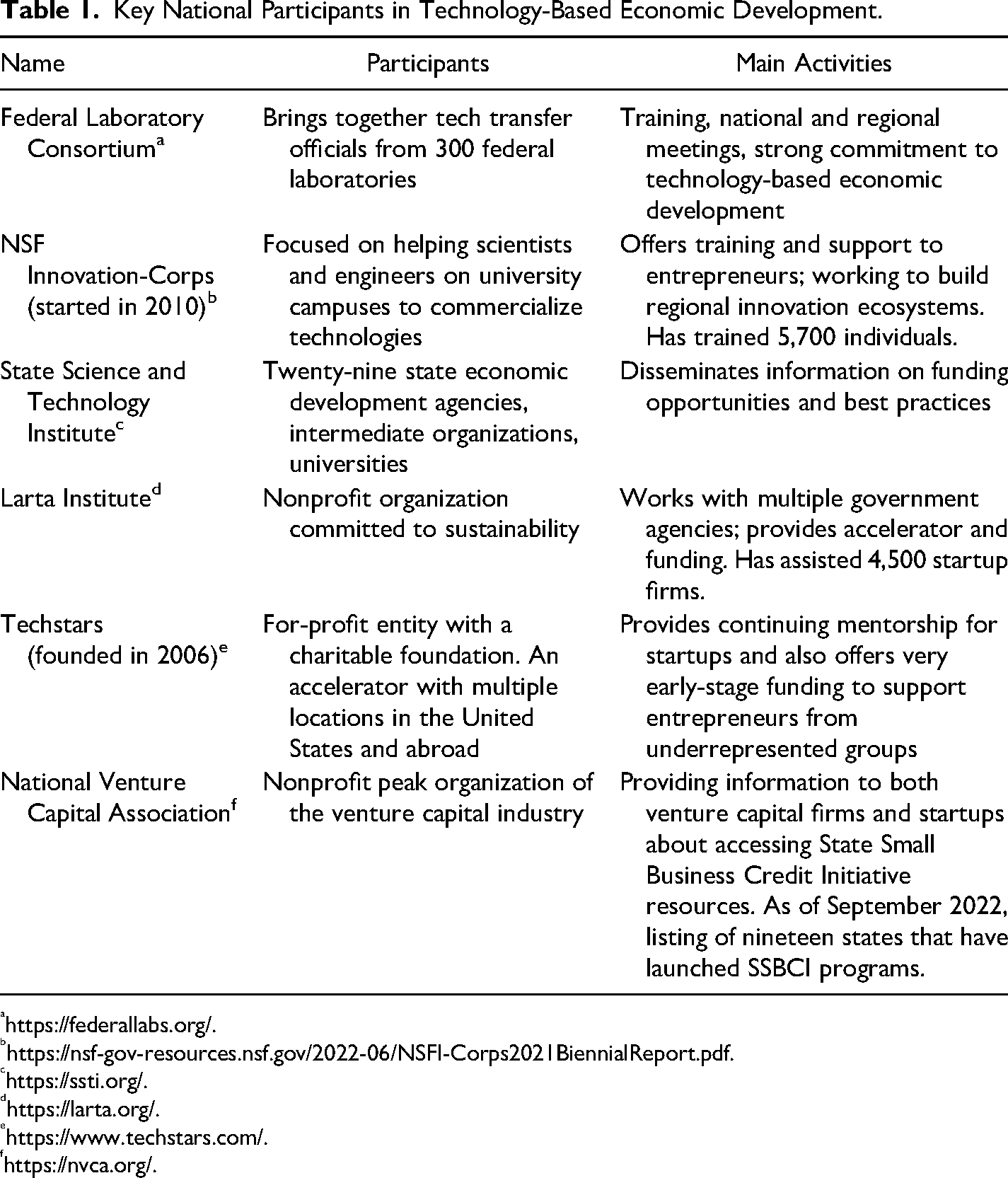
These state organizations such as Invest Nebraska are also closely networked with venture capitalists and angel investors. Moreover, some of these state programs allocate capital directly to private venture capital firms with a requirement that each dollar of public funds must be matched by three dollars of private funds. Finally, the thickening also involves a significant number of national organizations that provide services in many different states. To economize on space, some of the most important of these are described in Table 1. This is not intended as a complete list but as an indication of the variety of organizations active in this space.
Key National Participants in Technology-Based Economic Development.
https://nsf-gov-resources.nsf.gov/2022-06/NSFI-Corps2021BiennialReport.pdf.
Complicating the Story
While the changes to the developmental state over the past fifteen years have been substantial, the structure remains vulnerable to a frontal political attack by right-wing forces. Moreover, several key flaws in the system could increase the potency of such an attack. Several key reforms are urgently needed to ensure that the developmental state can be sustained even as it becomes more visible in political debates.
Despite the institutional thickening and the dramatically increased support at all levels of government for technology-based economic development, most of the public has very little understanding of how the innovation system works and how important it is in the overall economy. In this sense, the developmental state in the United States remains hidden. Most people, including scholars, seem to believe that most innovations originate in the laboratories of individual corporations. 62
How can something as significant and as diffuse as the DNS remain largely hidden? Part of the explanation is that decentralization contributes to invisibility. Japanese industrial policy, for example, was centered in one large government bureau, so that journalists and scholars could focus on what happened in that place. However, if a system has tentacles that reach into so many communities across the country, one might expect people to start tracing those tentacles back to their origin.
The explanation for why this has not happened is ideology. This is a story that goes back more than half a century. In the 1960s and 1970s, the United States experienced both powerful social movements and significant economic problems. Daniel Bell was not alone in arguing that these difficulties resulted from the transition from an industrial to a postindustrial society. 63 For Bell, it was clear that this transition required an expanded role for the federal government in managing and directing the economy. 64
This message was anathema to right-wing politicians and thinkers who were still campaigning to reverse the reforms of Franklin Roosevelt's New Deal. They advanced an alternative diagnosis that all of the problems of the society stemmed from the excessive growth of government and insufficient reliance on markets to allocate resources. This viewpoint won the political and ideological battle with the election of Ronald Reagan in 1980 that launched the forty-year reign of market fundamentalism or neoliberalism. During this reign, discussions of postindustrialism almost entirely disappeared from mainstream debates.
In fact, the idea of a developmental state is simply incompatible with market fundamentalism. In a widely read Bible of that movement, Milton and Rose Friedman urged that the National Science Foundation should be closed down since it was simply another arm of an intrusive regulatory state that was imperiling freedom. 65 Their underlying premise is that the private sector can be relied on to pursue scientific and technological advances in response to the signals of the market. 66 The point, however, is that these arguments are not just found in the pages of the Friedmans’ books. Right-wing billionaires and millionaires, led by Charles Koch and the late David Koch, have spent billions of dollars to push these ideas into the political arena through scholarship, think tanks, policy organizations, and political campaigns. 67
In a word, market fundamentalist ideology makes the developmental state invisible at several levels. Under its reign, it is simply taken for granted that the laboratories of corporations are the location of all important innovations and it is private investment that drives the economy. Second, journalists who are generally employed by profit-making enterprises have little incentive to write stories that undermine this prevailing narrative.
It is not surprising then that many people in the United States now embrace an attitude that has been labeled “everyday libertarianism.” 68 This is the belief that the income that an individual has earned belongs just to himself or herself and that claims on that income by others, including taxes, are largely illegitimate. Everyday libertarianism might have been an understandable view of the world in the United States in the nineteenth century when most workers were farmers, artisans, or small shopkeepers. However, it makes little sense in our technologically sophisticated and globalized economy where we are all incredibly dependent on others just to survive. This was made dramatically apparent when the COVID-driven shutdowns in 2020 revealed our dependence on frontline workers in hospitals, grocery stores, and delivery services.
Nevertheless, everyday libertarianism is appealing to many as a way to assert their personal sovereignty in a context where they do not, in fact, experience a high level of control over their circumstances. Furthermore, everyday libertarianism fits closely with other aspects of market fundamentalism including the belief that entrepreneurs are the source of innovation and that government involvement in the economy should be kept to an absolute minimum. 69
We have already seen how easily Donald Trump was able to mobilize a potent form of populism that fused together everyday libertarianism, market fundamentalism, resentment toward elites, anti-intellectualism, and fear of immigrants. While Trump's administration did not actually follow through on Steve Bannon's vision of destroying the administrative state, the danger is great that future demagogues might make a frontal assault on higher education, science and technology spending, and the entire developmental state. Two of the three weaknesses of the existing system could feed into the potency of such an assault.
The Continued Bias toward the Military
The US developmental state first emerged with the Pentagon's DARPA program. Since then, the technique for fostering innovation has been used to address a wide range of civilian needs. However, since half of the federal R&D spending is routed through the Defense Department and other national security agencies, a large share of these efforts focus on military needs. 70 The complexity is that the line between military and civilian needs is blurry. The US military, for example, has made large investments in renewable energy technologies since they learned in the Iraq War that large convoys required to bring petroleum to military bases were extremely vulnerable to enemy attack. 71 Similarly, while DARPA's investments in improved vaccine technologies proved valuable in fighting COVID, they were initiated to protect troops against use of biological weapons by an enemy.
Nevertheless, some national security spending on R&D has little or no possibility of ever improving the welfare of civilians. Moreover, potential military applications can bias the entire innovation process. For example, autonomous vehicles have been touted for their ability to reduce traffic congestion and facilitate transport through cities, but the Department of Defense has been eager to develop this technology since there would be a huge advantage in sending autonomous tanks into a battlefield. In fact, the substantial investments by corporations in this technology can be traced back to a prize competition organized by DARPA in 2004 that rewarded those whose vehicles could cover a large distance autonomously. 72 Since there are so many obvious problems with autonomous vehicles, a more civilian-focused innovation system would likely not have prioritized this very expensive and very challenging project.
In short, the developmental state has to be reformed to prioritize civilian needs and increase democratic input into the decisions about which technologies should be pursued. This is not easily done in a country with low levels of scientific literacy and where scientific findings on climate change and the COVID pandemic have been rejected by large segments of the population.
Nevertheless, without progress on this front, the danger is great that the entire developmental apparatus will be tarred as diabolical scientists building twenty-first-century versions of Dr. Frankenstein's monster.
The Absence of Gainsharing
The second critical flaw in the innovation system is the absence of gainsharing, so it has become a system where risks are socialized while rewards are privatized. The government takes on the risk by paying for much of the R&D through DARPA, SBIR, and other programs. However, the firms that use this support to become successful are able to reap all the profits that come from these public investments. So, for example, the algorithm that launched Google was developed as part of an NSF grant, but Google never had to pay anything back to the government beyond its tax bill. Moreover, the problem is intensified by the tax-avoiding strategies that have been particularly egregious among the firms that have been most heavily dependent on public investments. 73 This includes both many of the key tech firms and pharma firms that have systematically avoided taxes by shifting profits to low-tax environments overseas.
This dynamic makes it harder to sustain high levels of R&D and innovation spending at the federal level since there are so many other claims on limited government revenues. The obvious remedies are reforms in the tax system that eliminate the option for firms to shelter profits overseas and increased taxation on millionaires and billionaires. Another useful measure would be the introduction of a share levy for all newly incorporated businesses. A stake equal to 5 percent of all shares would be deposited with a National Innovation Fund. The fund would have to hold the shares for ten years, but it would then be free to sell shares in an orderly fashion with the proceeds used to strengthen the national innovation system. With this mechanism, the government would have had a 5 percent share of Google and Facebook that would generate billions of dollars to fund other innovations.
However, gainsharing also has other dimensions. Firms that benefit from government support also should be required to meet higher standards in their employment policies, their pricing policies, and their environmental policies. Since effective innovation is dependent on continuous learning, employees should not be treated as disposable assets. Instead, firms must provide decent compensation and benefits, construct viable career trajectories, increase the diversity of their employees, and allow those employees to organize in unions.
There has been some progress in this respect in some of the more recent government programs. The advanced manufacturing institutes have created training programs with local colleges and universities to provide a labor force with the appropriate skills. Many of these have placed emphasis on diversity, equity, and inclusion. The Economic Development Administration's Build Back Better Regional Challenge is explicit in emphasizing that proposals must include efforts to reach out to historically marginalized communities. Some of the applicants have included in their proposals funding to provide training opportunities for at-risk youth from low-income communities.
But the absence of more effective gainsharing makes it easier for those on the right to deride such efforts as corporate welfare that only benefits Silicon Valley billionaires. Demagogues could mobilize popular resentments against the combination of potentially dangerous new technologies and the enriching of those who are already very wealthy. The reality is that such resentment is justified. Elon Musk, for example, became the world's richest person through government support. He recruited engineers who had accumulated knowledge about electric vehicles from decades of government-sponsored research. Then he borrowed millions from the government to get Tesla's production started. Much of his net worth should have flowed back to the government.
Financing Small and Medium-Sized Enterprises
Technology startups continue to face an uphill struggle because they operate within a “winner-takes-all” financial and corporate system. The core problem is that the United States lacks an infrastructure of financial institutions that provide reliable and patient streams of nonpredatory lending to small and medium-sized businesses. The consequence is that such businesses either have to earn enough profits to be self-sustaining or they must turn to the stock market to raise capital. However, the stock market path is only an option for those firms with considerable profit potential, and it also usually involves significantly diluting the control of the firm by the founding entrepreneurs.
Since all of these paths are difficult, many promising startups end up being acquired by large corporations. Many of these larger firms have embraced the idea of “open innovation” in contrast to the traditional focus on the firm's own research laboratory. Open innovation often means scooping up startup firms with promising technologies. For firms with annual revenue of tens of billions of dollars, paying $20 million or even $100 million for a startup is not a significant expense. However, for the founding entrepreneurs of the startup, it is often enough to make them rich. It can also encourage them to believe that if they are able to create another startup, they might have the resources to maintain the firm's independence.
The problem for the innovation system, however, is that the acquiring firm often lacks the persistence and dedication to bring the technology to the market. In the most cynical cases, the goal of the acquisition is simply to eliminate a potential rival to a firm's already established product. 74 However, even when the acquiring firm is well-intentioned, it might not have the patience to overcome the barriers to commercialization. Moreover, bigger firms, as argued earlier, are usually limited in the number of new products that they can bring to the market in any given year. This can mean that the product of the acquired company becomes one of the innovations that is shelved in favor of more promising options.
In short, it is imperative for the long-term success of the innovation system that there be more opportunities for small and medium-sized enterprises to be financed without reliance on the existing stock market. This could be done with a developed infrastructure of financial institutions willing to provide such firms with patient capital. 75 This would probably also require some kind of government-financed loan guarantee program that reduced the risk for the financing institutions. When loans went into default because a startup failed, the financing firm might lose a portion of its investment, but other entities such as state governments, the federal government, and the federal reserve system might collectively compensate the remainder.
We have also suggested the idea of the federal government working in partnership with the private sector to create a new dedicated stock market for innovation-oriented startup firms. There would be a rigorous screening process, drawing on the model of the SBIR program, to make sure that listed firms had a legitimate and promising technology. There would also be limits on how much stock each firm could issue depending on how much sales revenue it was able to demonstrate. Then newly created mutual funds would take stakes in one hundred or one thousand of these firms and sell the funds to investors. Dividends and capital gains from those firms that proved profitable would then be redistributed to the investors. In the same way that venture capital firms make a profit when only one in twenty firms ultimately succeeds, this mechanism would provide investors with returns while also providing small and medium-sized enterprises with patient capital.
Conclusion
We have tried to show that over the past fifteen years, the role of the developmental state in shaping innovation and economic progress in the US economy has expanded dramatically. The number of substantial research institutes that have as their mission both to advance technologies and to contribute to regional economic development continues to expand, and governments at the state and local level have helped to create a complex web of coordinating organizations that help startup firms, train workers, and help technologists overcome network failures.
One way to see the impact of these efforts is in the growth of science and engineering occupations as a percentage of all employment. This includes employed people with bachelor's degrees, master's degrees, and PhDs in science and engineering, but it does not include technicians or medical personnel. Across the whole country, this rose from 3.89 percent in 2003 to 5.26 percent in 2020. Virtually all states participated in the increase, with the leading states being the District of Columbia with 11.25 percent, Washington at 8.87 percent, Maryland at 8.31 percent, and Virginia at 8.13 percent in 2020. 76 However, states such as Mississippi, Louisiana, and Nevada lag behind, with less than 3 percent of employment in these categories.
In short, Daniel Bell was correct; economic progress increasingly depends on advances in science and technology, and this has driven a very significant reorganization of the relationship between industry and government at the local, state, and federal levels. Unfortunately, this transformation has not been recognized by much of the academic community, by many opinion leaders, or by most of the public.
When transformations occur without the awareness and understanding of the citizenry, social divisions and conflict can be intensified. It does not seem a stretch to argue that the intense political polarization that US society has experienced over the past decade is directly related to the transformation described in this article. In fact, the divisions are most acute between inhabitants of the cities where much of the technology-based economic development has occurred and the rural areas that often lack access to such modern necessities as broadband and cell phone services.
The route out of this polarization requires several key steps. The developmental state must be dragged out of the shadows and made more visible. Its benefits in terms of employment opportunities must be broadened to include both rural and urban communities that have been left behind. The role of democratic input in shaping its priorities must be progressively expanded, and the wealth it creates must be more broadly shared rather than being monopolized by growing numbers of undeserving billionaires. To paraphrase Karl Polanyi, a postindustrial society can afford to be just and free. 77