







Abstract
Keywords
In the evolution of higher education systems from elite to mass and (in some countries) toward universal higher education, the range of study options available to prospective students has expanded (Guri-Rosenblit, Šebková, and Teichler 2007). Simultaneously, student populations have become increasingly diversified in terms of the pathways leading to higher education and sociodemographic characteristics, including age, gender, migration, and social background (Clancy and Goastellec 2007). Alongside the traditional students who enroll in higher education immediately after completing secondary schooling, reside on or near the university campus, and pursue full-time studies until degree completion, a growing number of students are distance-learning, part-time, or upwardly mobile with alternative access qualifications (Bowl and Bathmaker 2016; Schuetze and Slowey 2002).
Undoubtedly, this development has facilitated access and made higher education a viable choice for many who would otherwise have discarded it as an option. However, the expansion of higher education has not led to the abolishment of inequalities in tertiary education (Shavit, Arum, and Gamoran 2007). Indeed, accessing higher education does not equate to completing a higher education degree. Across Organization for Economic Co-operation and Development (OECD) countries, only 39 percent of full-time students complete their studies in the standard length of time. Adding three years to this standard duration, this figure rises to 67 percent (OECD 2019:208). This reveals two issues. First, every third person who enters higher education does not complete their studies even when allowed an ample time frame. Second, a substantial proportion of students graduate—on average, 28 percent—but (much) later than the standard study duration of their programs would indicate.
Extensive research has examined the circumstances and causes of higher education dropout, but a lack of attention has been given to higher education attainment as a long-term process. Given the diverse range of study options available, it is reasonable to assume the pathways followed after entering higher education vary significantly. Here, we refer to study trajectories, which encompass the diverse set of enrollment patterns experienced by students between first-time higher education enrollment and graduation (or terminal dropout). These trajectories include overall study duration, interruptions, switches of study programs, and the ultimate outcome of the higher education attainment process (graduation or noncompletion of a study program). Within this framework, we distinguish between linear and more complex trajectories. The former involves following a predefined standard pathway through higher education, completing studies without delays, interruptions, or switches of programs (e.g., obtaining a bachelor's degree after four years of consecutive full-time enrollment). Complex study trajectories deviate from these linear trajectories.
Students construct their study trajectories, for example, by deciding to switch majors or to take fewer courses. Linear or complex trajectories are also shaped by students’ social background and their parents’ provision of cultural and economic resources. The effect of social background on study trajectories may not be identical across countries and is likely moderated by the institutional contexts of different higher education systems—an issue that has not received appropriate research attention.
In many higher education systems, expansion goes hand-in-hand with stratification of higher education institutions and a diversification of study options. In light of the commodification and massification of higher education, the question of how higher education systems not only allow fair access but also maintain high-quality education and ensure all students receive the support needed to succeed is highly relevant. A diverse set of opportunities is certainly beneficial to nontraditional students, allowing them to design a flexible, tailored itinerary through higher education that makes it possible to study despite employment or care commitments, yet some developments may create new mechanisms of stratification. First, as widely acknowledged, there is social stratification in access to the most prestigious higher education institutions (Marginson 2016; Shavit et al. 2007). Second, a loosened and diverse study offering may place more responsibility on individual students because they must “build” their own trajectories toward degree completion. This could be a disadvantage for students with low socioeconomic status (SES), who may lack adequate resources to smoothly pass through higher education (Callender and Dougherty 2018).
This study aims to address the gaps in research regarding study trajectories by considering the mechanisms involved and the heterogeneity within and between higher education systems. Specifically, we retrace the study trajectories of bachelor-degree-seeking students and analyze social inequalities in the United States and Germany. In assessing the institutional structures of higher education as an intermediating factor linking social origin and study trajectories, we selected these two countries for comparison due to their similar degree structures, with a bachelor's being the first academic degree (Goerres, Siewert, and Wagemann 2019). Additionally, both countries exhibit high participation in higher education and strive to provide equal opportunities. Following a diverse case selection logic, they differ in key attributes, such as selection and access to higher education, the level of differentiation within the higher education landscape, and the extent of regulation (Seawright and Gerring 2008:300). Investigating the institutional structures in the German and U.S. cases provides valuable insights into how such differences moderate the stratification of study trajectories.
Several studies have examined study trajectories in the United States, and a few have looked at trajectories in Germany, but no comparative analysis has accounted for institutional structures when studying social inequalities and study trajectories. Previous findings on U.S. higher education suggest pronounced social stratification in study trajectories (Haas and Hadjar 2020). In an early study, Hearn (1992) found that disadvantaged students in the United States are more likely to engage in nontraditional enrollment patterns, such as part-time enrollment, delayed enrollment, and enrollment into nondegree programs. Downward mobility (reverse transfers) from a four-year to a two-year college is also more common among socioeconomically disadvantaged students, and horizontal or upward mobility (lateral transfers) from university to university is more common among socioeconomically advantaged students (Goldrick-Rab 2006; Goldrick-Rab and Pfeffer 2009). More complex study trajectories also decrease the likelihood of graduating in the United States—and this effect is more pronounced for students from disadvantaged backgrounds (Adelman 2006; Milesi 2010; Pfeffer and Goldrick-Rab 2011).
In contrast, study trajectory patterns seem less consequential in the German context, likely due to the fact that more flexible enrollment patterns, such as part-time enrollment, are not as common in Germany. Even so, a recent study found that low-SES students are more likely to drop out of German higher education, which may be partly explained by lower school and study performance and rational choice considerations (Müller and Klein 2023). Focusing on pre-higher education pathways and types of higher education institution, Müller and Schneider (2013) report that low-SES students and students with upwardly mobile educational paths are more likely to drop out from universities but not from universities of applied sciences in Germany. Completing an apprenticeship before higher education increases students’ dropout risk, whereas students who enroll in higher education following upper-secondary schooling—the “classic” pathway to higher education—are more likely to reenroll after dropping out of an initial study program (Müller and Schneider 2013; Tieben 2020).
To reconstruct bachelor-degree-seeking students’ study trajectories, we use two high-quality student panel studies—the U.S. Beginning Postsecondary Students (BPS) Longitudinal Study and the German National Educational Panel Study (NEPS). As a methodological contribution, we reconstruct trajectory patterns using sequence analysis, allowing for the simultaneous consideration of the study duration, the study outcome (completion vs. noncompletion), co-enrollment, study program switches, and study interruptions.
Conceptual Framework And Hypotheses: Linking Social Origin, The Institutional Context Of Higher Education, And Study Trajectories
Social Origin: The Effect of Individual Resources on Study Trajectories
Higher education attainment is a resource-intensive, long-term process. Compared to prior educational phases, it is less regulated and less structured, thus requiring more self-initiative, responsibility, and active personal assessment of choices and opportunities. Irrespective of cognitive ability, not all students are equally well prepared to master this process. Students who have more economic and cultural resources at their disposal—defined here as higher-education-specific knowledge—are better prepared for higher education (Bourdieu 1986; Hossler, Schmit, and Vesper 1999; Reisel 2013). Applying Boudon’s (1974) general educational inequalities framework to higher education, the two major mechanisms underlying inequalities in study trajectories relate to (1) resource-dependent differential achievement, with low-SES students more often being low-achieving students (primary effects), and (2) resource- and achievement-dependent educational decisions (Jackson 2013), for example, whether to postpone assignments, drop out, or change subjects. These decisions are often theorized as rational choices that are influenced by subtle class-specific mechanisms (Dumont, Klinge, and Maaz 2019). Other resource-focused concepts provide similar arguments. For example, the provision of economic and cultural resources facilitates certain options, and a lack of such resources constrains others (Bourdieu 1986; Bourdieu and Passeron 1979; Goldrick-Rab 2006).
Students are confronted with a range of costs, such as direct investments in higher education studies, including tuition fees, expenditures for technical equipment, and books, and expenses related to housing, relocation, and mobility. Prospective students may also anticipate a loss of income due to not being able to work or working less. They face the prospect of living on a tight budget for several years and the related insecurity and unpredictability. Thus, students’ social origin should not be narrowly equated to direct economic resources. It is also important to consider the relief function or safety net that allows students from advantaged backgrounds to study carefree. With regard to study trajectories, students who cannot rely on their parents’ economic support may have to work extensively or interrupt their studies to work full-time. Consequently, they may have to forgo extracurricular options, or they may not be as committed to their studies, which can have negative consequences on academic success and study duration (Roksa 2011; Triventi 2014; Zarifa et al. 2018).
In addition, high-SES parents are more likely to have the necessary navigational skills to arrange their children's study trajectories by providing information about reputable universities, different pathway options, fields of study, and graduate employment. In this vein, Hamilton, Roksa, and Nielsen (2018) refer to certain parents as “college concierges,” who ensure their offspring get access to the most promising universities and internships. Thus, we hypothesize that students with advantaged social origins are more likely to experience linear study trajectories—that is, remain enrolled in one study program without interruptions and graduate within the program's standard duration—because their parents’ economic, academic, and cultural resources help them avoid unforeseen detours or delays. In contrast, students from low-SES families, likely with fewer resources at their disposal, face a greater risk of experiencing unforeseen detours, making their study trajectories more complex. Consequently, low-SES students often make decisions based on a lack of resources, which, in turn, causes more complex study trajectories.
Linking Higher Education Context and Study Trajectories: Access to Higher Education and Differentiation
Since the European Bologna process in the 2000s, academic degree cycles in Germany and the United States have been formally similar (Powell, Bernhard, and Graf 2012). They also share features of modern mass higher education systems (i.e., expansion and widened access). Expansion started earlier in the United States and was notably stronger, reaching a point of universalism, but student numbers have risen tremendously during the past two decades in German higher education—likely as a process of catching up (Altbach, Reisberg, and de Wit 2017). Providing equal opportunities in higher education is an important issue in both countries, particularly in light of the rise of nontraditional students. Yet the German and U.S. systems differ markedly in terms of institutional logics that presumably shape students’ decision-making regarding their enrollment behavior and thus their study trajectories.
First, access to higher education is regulated very differently in the two systems. In the absence of formal stratification and ability tracking in secondary education, higher education access is more universal and inclusive in the United States; some parts of the U.S. higher education system are almost open access. Given that the labor market rewards generic rather than specific skills, higher education is the default postsecondary education option for U.S. students (Streeck 2011), and even low-achieving students are encouraged to enroll (Alexander, Bozick, and Entwisle 2008; Clark 1991; Kerckhoff, Haney, and Glennie 2001). However, as we describe in more detail, because the U.S. higher education system caters to students with very different needs and academic goals, higher education is also highly diversified, including an extensive postsecondary sector that provides shorter qualifications (e.g., certificates or associate degrees).
In contrast, the German education system is stratified, standardized, and not very permeable (Hadjar and Gross 2016; Jackson 2013; Kerckhoff 2001). Due to early tracking, less than half of all adolescents qualify for higher education through the classic route, via the
Key Indicators on Higher Education Attainment in Germany and the United States.
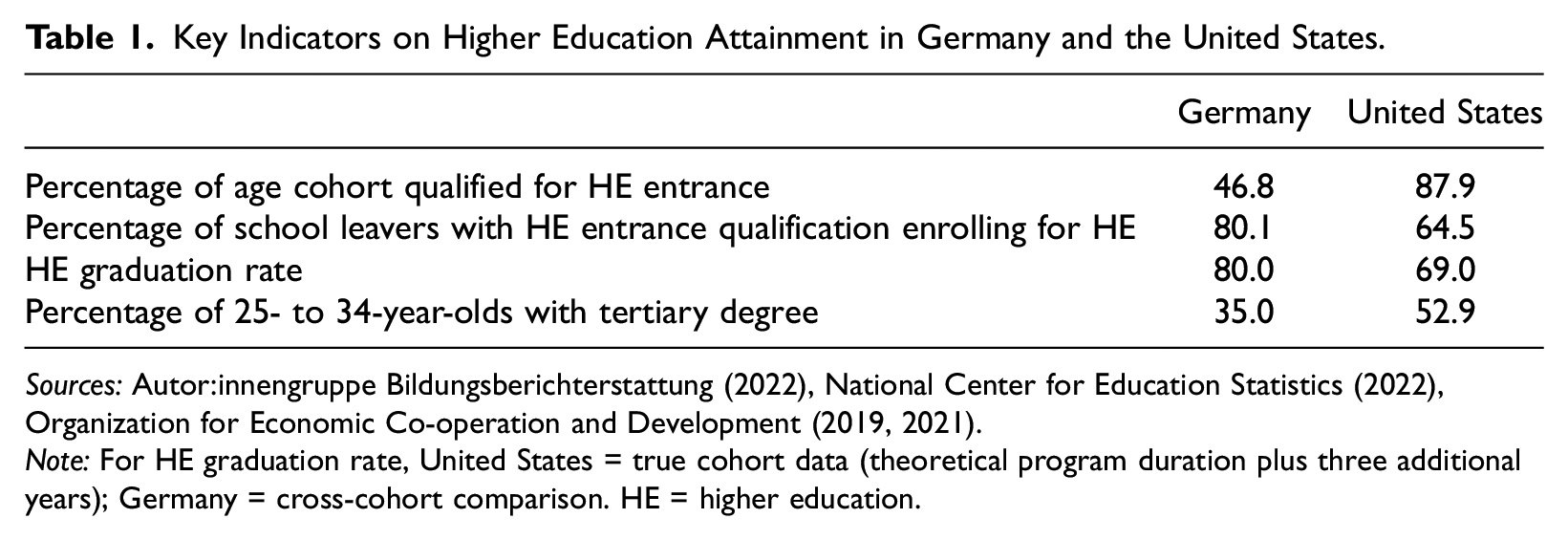
Second, closely related to the aspect of access is the degree of functional diversity and differentiation in the two higher education systems (Banscherus et al. 2015; Bastedo and Gumport 2003; Scott 2015). Given the “college for all” mentality, U.S. higher education remains the prime example of a highly diversified system, with seemingly endless study options intended to meet the needs of all students. Institutional differentiation in terms of orientation, prestige, funding mode, and selectivity is a major feature of U.S. higher education, ranging from the most reputable, world-class universities to more dubious private, for-profit colleges (Ayalon et al. 2008; Cohen and Kisker 2010). In between, comprehensive public universities and other four-year colleges offer full-time residential, remote, and part-time studies, and easily accessible community colleges cater to a wide range of learning, literacy, and training needs in addition to being a low-cost pathway to a four-year institution (Bess 1991). This diversity results from the manifold purposes of U.S. higher education.
In comparison, the German higher education landscape is less diversified. It is mostly public and more narrowly defined around the provision of initial academic education based on two main university types: universities and universities of applied sciences. Together, they enroll over 90 percent of all students. Apart from the degrees awarded in high-prestige fields, such as medicine and law (national state examination degrees) and doctoral education—all restricted to universities—they offer similar degrees. Historically, universities of applied sciences focus on teaching and applied research and have a more vocational orientation, whereas universities focus on basic research. Consequently, universities offer the full range of study subjects, whereas universities of applied sciences are often restricted to subjects with an applied orientation. Hierarchical or prestige differences between the universities are not pronounced, but they have recently been reinforced (Bloch and Mitterle 2017; Budd 2017). Currently, hybrid study–work programs and private higher education are on the rise, capitalizing on the inflexible public system, particularly in catering to the needs of nontraditional students (Graf 2016).
In summary, the institutional logic of the two higher education systems differs greatly with regard to (1) access to higher education (Germany: restricted and stratified; United States: almost universal) and (2) their degree of differentiation (Germany: low; United States: high). What implications does this have for study trajectories? Given that German higher education is more restricted and stratified, with fewer available paths, students entering German higher education are presumably well prepared in terms of academic aptitude and aspirations, and their trajectories should be more linear, with students likely to remain enrolled in the same study program until degree completion. In contrast, due to the more heterogeneous student body and a strongly diversified higher education landscape and study offerings, study trajectories in the United States will likely be more varied and complex.
State, Market, Student: Regulation and Marketization of Higher Education and Social Stratification in Study Trajectories
Another major difference pertains to the way governance and control of higher education indirectly shapes students’ behaviors. German higher education is mostly public, with a national needs-based financial aid system. German universities are financed primarily by the federal states but also by funding from the government. Except for a comparatively low administrative fee, public higher education is tuition free. A moderate—in comparative terms—study fee of € 500 per semester was introduced some years ago, but it was abolished gradually thereafter by all federal states following persistent student protests. 1 Responses to societal demands for lifelong learning or less conventional study settings have been slow. Although study offerings have diversified (Schröder 2015), study regulations are now more rigid compared to the pre-Bologna era.
The situation is quite different in the United States, which has less state involvement, a stronger market orientation, and more reliance on private engagement, accompanied by decentralization and deregulation (Buckner 2017). Public funding—70 percent of all students receive some type of public financial aid—is directly transferred to students (Bok 2015:93). Students may also benefit from a range of different types of fee waivers or grants provided by their universities. In such a market-based system, students’ demands loom large, propelling innovation and making higher education responsive to students’ needs. Students have greater autonomy, and they can “shop” for courses from an extensive and unregulated list of offerings; this is sometimes not in their best interests, and short-term profit-oriented organizations try to benefit as well. In the strongly diversified, marketplace-like U.S. higher education system, students are confronted with more choices.
More choice and individual responsibility are generally desirable, but such a setting may increase the effects of social origin on study trajectories: “[T]he greater a student's opportunity for choice, the more likely that the student's social background will structure his or her educational trajectories” (Pallas 2003:169). Being able to rely on parents’ experiences, networks, and advice could be a key factor in avoiding detours and facilitating linear study trajectories (Goldrick-Rab 2006). Moreover, given that the U.S. system is strongly based on private resources, higher education requires a greater financial commitment, particularly in light of anticipated future debt repayments. The inability to rely on parents’ financial support could thus be more influential in shaping students’ decisions in higher education, and thus study trajectories, in the United States compared to Germany. In fact, a lack of economic resources is a major reason for dropout in the United States but not in Germany (Bok 2015; Heublein 2014). Constructing and pursuing a linear study trajectory could also be more challenging for low-SES students in a more choice-intensive higher education context because these students are particularly vulnerable and dependent on formal guidance to help them navigate their studies and avoid detours.
Additionally, the highly stratified secondary education system in Germany, with several distinct school tracks and low permeability between tracks, leads to a selective group of students being eligible to transition to higher education (Hadjar and Gross 2016). Thus, higher education students in Germany are likely more homogeneous regarding SES compared to students in the United States. Accordingly, we hypothesize that the SES effect on study trajectories is more pronounced in higher education contexts that are more choice-intensive, place greater emphasis on individual responsibility, and are less structured. The direction of the social origin effect should be similar across the two countries (as stated in Hypothesis 1), but the magnitude of the effect may differ because the association between students’ social origin and their study trajectories is more pronounced in the United States compared to Germany.
Finally, a major mechanism underlying inequalities in study trajectories is the fact that students are systematically channeled into different parts of the higher education system. This may shape study trajectories because the degree of constraints and options to deviate from an ideal study pathway may vary by higher education institution. For example, various organizational dimensions influence dropout rates, including size, degree of selectivity, and amount spent on student services (spending on instruction and academic support has no significant effect; Chen 2012).
However, this effect depends on the degree of differentiation in the higher education landscape. In Germany, prospective students’ postsecondary pathways are predetermined based on their prior educational pathway and the type of higher education entrance qualification they obtained. Thus, students are already more or less “matched” to more vocational (the universities of applied sciences) or more academic (the universities) studies. In 2020, 91 percent of all university students obtained their access qualification through the classic upper-secondary schooling pathway, compared to 63 percent of all universities of applied sciences students (Autor:innengruppe Bildungsberichterstattung 2022). 2 In the United States, all high school graduates receive the same formal degree, but high school courses, extracurricular activities, and particularly standardized test scores enable students from advantaged backgrounds to access the more prestigious layers of the higher education system.
Both countries demonstrate a systematic channeling of students with advantaged backgrounds into the more selective, prestigious, and research-oriented strata of the higher education system (Davies and Guppy 1997; Marginson 2016; Mayer, Müller, and Pollak 2007; Winkler and Sackmann 2020). However, the degree of differentiation is much higher within the U.S. higher education system. This channeling of students from different social strata into different layers of the higher education system might be more consequential for study trajectories in the United States compared to Germany because students of high social origin are more likely to enter prestigious higher education institutions that provide their students more support, whereas students with the least family resources may end up at lower-tier schools that provide fewer institutional resources. Despite tracking, this might be less consequential in the more uniform German system, where institutional resources, and thus counseling and support infrastructure, might be distributed more equally across higher education institutions. We thus expect the type of higher education institution to be a relevant mediator of the social origin–study trajectory link in the United States but to a lesser extent in Germany.
Data And Methods
Data and Data Preparation
The analysis is based on two large-scale panel studies that surveyed students for the first time at the beginning of their studies and followed them throughout higher education. For the United States, we use the BPS Longitudinal Study, a large-scale panel study conducted by the National Center of Education Statistics at the U.S. Department of Education (Hill et al. 2016). It comprises first-time students in the 2011–12 academic year, surveyed at three time points (2012, 2014, and 2017), allowing for a reconstruction of study trajectories for a period of more than five years.
We reconstructed study trajectories in Germany using the NEPS (Blossfeld and Roßbach 2019), which followed students in public or state-approved universities and universities of applied sciences after enrollment in 2010–11. Students were surveyed about their study progress and other themes approximately twice a year, also allowing for a reconstruction of a period of more than five years.
To ensure equivalence across cases, we restrict this analysis to students studying toward a bachelor's degree. Thus, students in German higher education who initially enrolled in long degree programs (mostly
Description of the German and U.S. Samples.

Germany: exclusion of students in long programs, mostly state examinations degrees; United States: exclusion of mostly students in shorter programs (i.e., certificate programs or associate degree programs) and who do not intend to continue to bachelor studies. Students in private for-profit institutions were excluded. For details on the initial sample (U.S.), see Bryan, Cooney, and Elliot (2019:iii).
Reconstruction of Study Trajectories Using Sequence Analysis
We reconstruct study trajectories through bachelor's degree studies based on enrollment information from the month of first-time enrollment until the end of the observation period (approximately five and a half years) or after graduation from a bachelor's degree program. 3 As depicted in Table 3, the monthly study enrollment statuses differ slightly across the two cases. Specifically, because co-enrollment (i.e., concurrent enrollment) in more than one college is more common in U.S. higher education, we consider it for the U.S. case but not for the German one. In contrast, field of study changes are quite common in German higher education—students always enroll in one specific major at the beginning of their studies. Thus, we consider study program changes in the German case as sequential study phases. We consider study interruptions in both cases.
A Sequence Analysis of Study Trajectories.

We next conduct sequence analysis (optimal matching), that is, each trajectory is compared to an ideal-typical study trajectory (for the exact definition, see Table 3) by summing the number of transformations (substitutions or insertions/deletions) that would be needed to align each trajectory to the ideal-typical study trajectory (Cornwell 2015). Hence, we assign a value to each study trajectory signifying its similarity to the ideal-typical study trajectory and thus its linearity/complexity. To ease interpretation, we transform this dissimilarity index to a range of 0 to 100. The higher the value, the greater the deviation from a linear ideal-typical study trajectory is and thus the more complex the trajectory. A value of 0 or close to 0 signifies a linear ideal-typical study trajectory; a value of 100 indicates maximum deviation with certain interruptions or dropout events.
Figure 1 shows these study trajectories as sequence index plots, where each horizontal line represents an individual study trajectory, ordered by increasing complexity. Each panel from left to right depicts a quarter of the distance from the ideal-typical study trajectory scale. For example, for each country, the left-most panel illustrates trajectories with a deviation of 0 to below 25 from a linear ideal-typical trajectory, thus depicting mostly linear or almost linear trajectories. The right-most panel illustrates the most complex trajectories in each country, ranging from 75 to 100, showing that the most complex study trajectories are a heterogeneous set: They can be very long and incomplete (particularly in Germany) or may include a high number of changes and be very short and discontinuous (particularly in the United States).

Sequence index plots of study trajectories in Germany and the United States.
Operationalization of Covariates and Analytic Strategy
Table 4 provides an overview of all the other variables. Due to data limitations, social origin (SES) can only be operationalized along its main component, which is parents’ highest level of education, distinguished by three categories.
Variable Description.

Higher education institution refers to initial enrollment. For reasons of comparability, we consider only broad categories. The two categories in the German context are universities and universities of applied sciences. For the United States, we use three types of higher education institutions: broad-access institutions, including colleges focused on associate's degrees and four-year institutions that are minimally selective or that have open admission policies; moderately selective four-year institutions; and selective and very selective institutions, which include mostly research-intensive doctoral-granting institutions and liberal arts colleges.
Regarding students’ preparation for higher education, the German model includes the type of higher education access qualification (traditional [
In addition to the covariate distributions, Table 4 also displays the means of the dependent variable ‘distance from the ideal-typical study trajectory’ by SES and type of higher education institution. These bivariate descriptions reveal that the differences by SES and type of higher education institution are more pronounced and in the expected direction in the United States; the table yields no noteworthy differences according to SES in Germany.
In the following section, after providing a more detailed descriptive overview of study trajectories in the two countries, we estimate the study trajectories in a stepwise manner using linear regressions. The first model is a baseline model, including only SES. Subsequent models first add the control variables to reveal the direct effect of SES on study trajectories and, in another step, the higher education institution types. All displayed estimates and standard errors are based on Stata's
Results
Study Trajectories in Germany and the United States
Figure 1 displays the study trajectories as sequence index plots, where the stacked horizontal lines represent an individual study trajectory. As described earlier, four panels are shown for each country, each displaying a quarter of the distance from the ideal-typical study trajectory scale. Table 5 provides descriptive indicators of the distance from the ideal-typical study trajectory and some additional trajectory attributes.
Description of Study Trajectories in Germany and the United States.

In line with Hypothesis 2, Figure 1 and Table 5 show that study trajectories are more complex in the United States than in Germany, as evidenced by the higher mean value of the dependent variable of 38.0 compared to 31.8. Overall, fewer U.S. students graduated from a bachelor's program (66.0 percent in the United States compared to 76.6 percent in Germany). Dividing study trajectories into three broad categories (linear, complex, and dropout) yields a similar picture: More students in Germany followed a linear study trajectory (53.3 percent vs. 42.4 percent), and the share of students with a more complex study trajectory or who dropped out completely is higher in the United States (39.7 percent and 17.9 percent vs. 36.0 percent and 10.7 percent).
Results of the Linear Regression Models
Table 6 presents estimates of the linear regression models regarding the variables of interest (the results, including all covariates, are shown in Appendix Table B). The first model serves as a baseline model, including only SES; the second model adds more covariates (students’ prior educational pathways, preparation for higher education, prior academic achievement, initial major at first-time enrollment, and demographic variables). Regarding Hypothesis 1, which suggests a relationship between SES and study trajectories in both countries, the findings presented in Table 6 show a sizable and significant effect of SES on study trajectories in the United States (in Models 1 and 2, without and with control variables, respectively) but no effect on trajectories in Germany. Thus, Hypothesis 1 does not hold in general, but these findings are in line with Hypothesis 3, which predicts a more pronounced social origin effect on study trajectories in the United States. The
Regression Model Estimates.

Regarding Hypothesis 4, which posits that the type of higher education institution is a strong mediator of the SES effect in the United States but not in German higher education, Model 3 adds the type of higher education institution, revealing this has a strong effect on study trajectories in both cases. Although the SES effect in the U.S. models decreases, it remains large and significant, indicating that SES affects study trajectories beyond an indirect mechanism via the type of higher education institution attended. The coefficients are in the expected direction, quite pronounced, and significantly distant from the ideal-typical study trajectory in broad-access institutions and moderately selective four-year institutions compared to trajectories in more selective institutions. Although the possibility that higher education institutions mediate the SES effect in the German case can be ruled out, the effect is still noteworthy. In contrast to the U.S. findings, the study trajectories of students in universities of applied sciences are more linear overall compared to university students, and the social origin estimates remain stable. Consequently, Hypothesis 4 is rejected.
Conclusions
This article was motivated by the fact that social-origin-related disparities in access to higher education have been widely investigated, but little is known about the actual study trajectories in higher education in relation to social origin, particularly from a country-comparative perspective. Thus, this study focused on social origin differences in bachelor-degree-seeking students’ trajectories in two expanded higher education systems: Germany and the United States.
The sequence analysis provided a holistic picture of study trajectory patterns through higher education. According to arguments derived from Boudon (1974) and Bourdieu and Passeron (1979), low-SES students are disadvantaged with regard to educational processes due to a lack of economic and cultural resources. Our findings revealed that study trajectories are more complex in U.S. higher education compared to German higher education and are shaped by students’ social origin in the United States but not in Germany. Specifically, the study trajectories of low-SES students are less linear and more complex, irrespective of other individual-level characteristics, achievements, and preparation for higher education. In contrast, we did not find any significant association between social origin and study trajectories in the German higher education context. Thus, the first hypothesis suggesting that low social origin students have more complex trajectories irrespective of country contexts was rejected. Regarding the lack of effects of social origin in the German case, we note that other studies, differing somewhat in methodology, have identified social origin differences (Haas 2023b; Müller and Klein 2023). This suggests the conceptualization of study trajectories as deviation from an ideal-typical trajectory as a single indicator might fail to capture nuanced differences in students’ behavior based on social origin (e.g., regarding degree type or field of study changes). Hypotheses 2 and 3, predicting the diversified U.S. higher education system, its openness, and its private resource dependency will translate into more diverse, complex, and socially stratified study trajectories, were accepted (Bok 2015; Shavit et al. 2007).
Regarding intrasystem differentiation, the results show that study trajectories differ systematically according to the type of higher education institution in both countries. However, we had to reject Hypothesis 4 because it held only for the United States. There, inclusion of institution type reduced the SES effect, pointing to an indirect effect of SES-based sorting and selection into higher education institutions on study trajectories. More prestigious and selective higher education institutions facilitate more linear study trajectories compared to other types of higher education institutions. In the German case, we found that students at research-oriented universities are less likely to have linear study trajectories compared to students at more vocationally oriented universities of applied sciences. A major reason why the hypothesis did not hold in the German case may relate to the fact that structures and curricula in universities of applied sciences used to be less flexible than in (research) universities, particularly pre-Bologna. Furthermore, the higher social origin of university students may allow for more flexibility, that is, more opportunities to pursue life prospects that fit one's own interests. In contrast, students at universities of applied sciences, due to their comparatively lower SES backgrounds, may feel a stronger need to efficiently finish their studies and access the labor market. In line with this, a recent study found that differences in study trajectories by type of higher education institution do not result from systematic differences in student characteristics attending these institutions (Haas 2023a).
Our results make three key contributions to the existing literature. First, they expand the current research on nuanced social stratification mechanisms in higher education that work beyond access and completion. Importantly, the results also add a comparative perspective to the (thus far) single-case-study-oriented literature on students’ paths through higher education. By doing so, we reveal that different higher education institutions, perceived as being similar in international or comparative contexts (e.g., first- and second-tier institutions; Shavit et al. 2007), can differ in their meaning within their respective country contexts, as exemplified here by whether they facilitate or impede linear study trajectories. This study revealed that students at German universities of applied sciences (second-tier institutions) pursue more linear study trajectories compared to students at more research-oriented “first-tier” universities. In the U.S. higher education system, in contrast, students follow more linear study trajectories in the most selective universities. In large, less selective four-year institutions and especially in open-access institutions (second-tier), students’ trajectories are more complex. This emphasizes an underinvestigated issue, namely, that students’ experiences in higher education strongly and systematically vary between and within countries. These effects are not unequivocal across countries but are difficult to grasp in cross-comparative studies given the idiosyncrasy of different higher education systems.
Further research is needed on both the methodological and conceptual levels. Regarding the former, the current analysis controlled for a wide range of individual-level attributes. Nevertheless, selection and self-selection into higher education institutions based on unobserved characteristics cannot be ruled out and should be investigated further. Although this study was based on two high-quality, longitudinal data sources, ensuring a high degree of equivalence regarding the conceptualization and analytic sample design, some limitations should be noted. First, the reconstruction of study trajectories covers almost five and a half years. Most students were able to graduate within this period, but a nonnegligible share of students in both samples were still enrolled, so it was not possible to determine whether and when they would complete their studies. Second, the German results, which were entirely based on survey data, could be biased due to high panel attrition, likely resulting in underestimation of the complexity of study trajectories.
Another major challenge of this research relates to creating functional equivalence across higher education systems. Students in long degree programs in Germany—likely an advantaged SES group—were excluded due to their incompatibility in the context of the sequence analysis framework. In an attempt to construct meaningful comparable samples, we also excluded nondegree-granting, for-profit institutions and students in very short programs in the United States because such pathways are not widely regarded as academic education from a comparative perspective. To reduce complexity, we only controlled for fields of study but did not conduct a detailed, hypothesis-driven analysis regarding differences related to this aspect. In Germany, sorting students into fields of study (with differential risks for dropout) rather than university type may be a major driver of inequality. Analyzing different fields of study at different types of universities—here, the structures also differ between the United States and Germany—represents an important starting point for future research and may allow for a better comparison of university types and countries. We confirmed that institutional context (university types and the [higher] education system) matters, but future research should investigate these differences in more detail, especially with regard to what actually causes these observed differences in study trajectories. At the country level, this includes disentangling the extent to which prior selection into higher education in general—as well as sorting into specific university types and thus “matching” academic preparation and SES—matters. On the micro level, we might ask whether disparities result from individual information deficits, the ability to effectively navigate higher education, or differences in mentoring and guidance.
Overall, this study asked why study trajectories are more or less linear across social backgrounds, higher education systems, and university types. Our results suggest the institutional structures of higher education mirror the wider societal context, particularly with regard to how to achieve equality of opportunity (Mayer and Svallfors 2005; Pechar and Andres 2011; Pontusson 2005). In Germany, a socially stratified status quo is preserved through an “effective sorting machine” (Kerckhoff 2001:8), which restricts access to higher education to a fraction of each age cohort. All others are prevented from developing more ambitious aspirations at very early stages. Thus, the finding that study trajectories are less complex and not socially stratified in German higher education could be interpreted in light of an institutional logic of constraining individual choices and minimizing individual risks. In contrast, the U.S. system supports egalitarian values by avoiding formal segmentation and enabling broad access, based on the premise that dedication and individual motivation are sufficient to achieve success (Brint and Karabel 1989; Hossler et al. 1999). However, this exposes students to the risk of engaging in long and less stable study trajectories in a system with little regulation, concealed as individual responsibility in the event of failure (Callender and Dougherty 2018). Given the informal differentiation in secondary schooling and highly stratified higher education (Bastedo and Jaquette 2011; Davies and Zarifa 2012), socially stratified study trajectories could be perceived as a Matthew effect: Students with an advantaged social origin enter the most resource-rich and prestigious universities and thus are more likely to have linear higher education trajectories. In conclusion, the education systems of the United States and Germany both have deficits in terms of ensuring equality of opportunity, but the underlying mechanisms differ.
Footnotes
Research Ethics Statement
 ).
).ORCID iDs