







Abstract
Introduction
Although at the time of writing this article Africa is considered the least urbanised continent in the world, with an estimated 43% of its populace living in cities as of 2020, current urbanisation trajectories strongly indicate that this is likely to change in the coming decades (Cheeseman and de Gramont, 2017; Fox and Goodfellow, 2022; van Noorloos and Kloosterboer, 2018). At current urbanisation rates, for example, it is estimated that more than 2 billion more people will live in urban areas by 2050, with 90% of this increase expected to occur in Africa and Asia (Bassett et al., 2020). It took 150 years for Europe to shift from a 12% to 50% urban population, but current projections indicate that it will take Africa ‘only’ 90 years to experience the same shift (Fox and Goodfellow, 2022). Furthermore, recent modelling conducted by the United Nations projects that the three most populous cities in the world by 2100 will be Lagos (Nigeria), Kinshasa (the Democratic Republic of Congo) and Dar es Salam (Tanzania) respectively (Hoornweg and Pope, 2017). Rapid urbanisation and the emergence of mega-cities are thus an ongoing challenge for many governments and policymakers across Sub-Saharan Africa.
In other parts of the world – notably Europe, North America and parts of the Asia-Pacific – one response to the continual growth of megacities has been to look to a more intensive use of space through medium and high density development (cf. Admiraal and Cornaro, 2020; Reynolds, 2020). To make such intensive urban patterns work, long-term planning of underground infrastructures and volumetric spaces has been needed. As such, the underground has been widely recognised, and increasingly used, by urban planners and developers as an opportunity to move a variety of urban infrastructure underground to free up urban surface space, helping to create more liveable urban environments (Admiraal and Cornaro, 2020; Besner, 2016; Melo Zurita, 2020). Yet, so far, little attention has been paid to the urban underground in African cities.
In this paper, we have adopted a long-term perspective to understand the
Underground urbanism
While the development of urban undergrounds has a long history around the world (Diamond and Kassel, 2018), there has been a considerable acceleration of subterranean urban developments over the past couple of decades. A trend that is expected to continue (Admiraal and Cornaro, 2020; Reynolds, 2020). The use of urban underground development is widely considered by policy makers as an effective approach to help contemporary cities to achieve urban sustainability, resilience and liveability goals; as an opportunity to move a variety of urban infrastructure underground to free up urban surface space for amenity (Admiraal and Cornaro, 2020). Nevertheless, like all forms of ‘development’, utilising the underneath of cities can present a range of possibilities and challenges (Melo Zurita, 2020; von der Tann et al., 2021), and the configurations of underground urban development are shaped by political economies, geologies, legacies of human development and changing technologies (Garrett et al., 2020; von der Tann et al., 2016). The use of the urban underground can offer opportunities for a compact city and provide more efficient use of urban space; however underground urban infrastructure can often have a strong permanence, meaning that poorly implemented, or unplanned, uses of the underground can results in an inefficient or ineffective use of the space.
In considering the urban underground, the relationship between depth and infrastructure is pertinent. Recent scholarship distinguishes between the ‘shallow subsurface’ and the ‘deeper subsurface’ of urban space (Reynolds, 2020; von der Tann et al., 2020). The latter includes transportation infrastructure such as road tunnels and metro systems. While the shallow subsurface has among many things been a site for utility infrastructure (e.g. electricity, telecommunication, water and sewerage), and part of the broader ideal of the ‘network city’ in which every household is connected to relevant urban utilities: what has been described as the ‘modern infrastructural ideal’ (Graham and Marvin, 2001). The shallow subsurface across cities in Europe and North America underwent major changes during the first half of the 19th century as large-scale underground water and sanitation networks were developed (Gandy, 2004, 2006; Melo Zurita et al., 2018). This ‘modern infrastructure ideal’ approach to shallow subsurface development dominated urban governance and development in the post-World War II era, informing infrastructural projects around the world. The networked city, however, has in many ways collapsed due to governance reforms occurring since the 1980s that resulted in the creation of ‘secessionary networked spaces’ and the removal of infrastructure from the public sphere of democratic governance (Graham and Marvin, 2001; Hawken et al., 2021). This is what Graham and Marvin (2001) have described as ‘splintering urbanism’, whereby the networked city reaches only some urban residents. While splintering urbanism is a recognisable global trend, it has been most acute in Global South cities (Gandy, 2004). As Lawhon et al. (2018: 723) note, while the ‘modern infrastructure ideal’ was a widely accepted social and political goal to provide universal, uniform infrastructure in the Global South, ‘by the 1980s it was clear that budgets could no longer support this vision in part due to global economic trends and, more specifically, the forced adoption of structural adjustment programmes (i.e. loans provided by the International Monetary Fund and the World Bank to countries that experienced economic crises)’. The integrated city became an unfinished project (Graham and Marvin, 2001) that resulted in ‘a varied and differentiated infrastructural history in Global South cities that now house a mix of internationally financed urban megaprojects, centrally planned infrastructures and small-scale infrastructures initiated locally’ (Hawken et al., 2021: 2). Thus, a distinguishing feature of Global South urban centres is users engaging in a heterogeneous (informal and formal) infrastructure in addition to an ‘unfinished’ singular centralised network of infrastructure (Munro, 2020).
What this means in the context of African cities is that the use of the underground urban space is a patchwork of utility infrastructure (electricity wire, sewerage, water pipes, telecommunication cables) that, while being extended to reach more households, struggles to meet the needs of a rapidly growing urban populace. Furthermore, there is often a socio-economic geography to this partially networked city – stemming from the colonial era – whereby the wealthier households and neighbourhoods are connected to utility infrastructure, while the poorer population often relies more on ‘do-it-yourself’ urbanism, drawing on a range of heterogeneous infrastructures to realise their utility needs (Lawhon et al., 2018). This can include, as this Lagos case study will demonstrate, more informal engagements with the underground urban space, ranging from ‘legal’ activities such as drilling wells to source potable water, to activities considered in formalised planning as ‘illegal’, that include unauthorised water extraction (or even oil) from passing pipelines.
Examples of these informal urban underground interactions exist and are replicated all over the Global South. In this sense, the underground, is not only about the location of the infrastructure, but also about the underground practices to extend its reach and functionality to those parts of the city otherwise absent of it. Splintered is not only about the ‘fractioned’ or ‘fractured’ in this context, but when adding volume to the splintered there are social as well as geological dimensions for its fragmented – yet functional and essential – presence.
Volumetric Lagos
Lagos is a coastal city, located in part of the Dahomey Miogeosynclinal Basin of southwestern Nigeria. This sedimentary basin comprises a network of alternating sand and clay deposits with shale and limestone intercalations. Silt, peat and coal are also found at certain stratigraphic horizons (Davies, 2015). The city is in a region of coastal creeks and lagoons which is surrounded by the Lagos lagoon systems developed by barrier breaches associated with sand deposits. The surface geology is made up of the Benin Formation (Miocene to Recent) and recent littoral alluvial deposits, predominantly consisting of yellowish (ferruginous) and white sand bodies (Longe et al., 1987). In particular, the coast at Lagos is predominantly composed ‘of Quaternary deposits, which are the youngest sediments. Therefore, the coast of Lagos experiences high rates of subsidence, due to natural compaction and natural dewatering of the soil’ (Van Bentum, 2012: 14). The city of Lagos is sinking, the quotidian connection with underground is shaped by these movements and interactions with its hydrogeology. As discussed in the following sections, this subsistence creates various challenges with underground infrastructure, and in combination with urban development, can cause aquifer pollution, erosion and damage to pipelines and underground utility infrastructure (Ikuemonisan and Ozebo, 2020), certainly all of these challenges urban underground planning and development.
The Yoruba people settled in the region during the 14th century (Mann, 2010). Their initial settlement was on a sandy, swampy island at the entrance of a large lagoon on the coast. The island was about 5 km2 in size, and the initial settlers were predominantly migrant fishers. By the 1600s, the settlement had grown to become an important centre for local and regional trade (Mann, 2010). This region became embroiled in the Trans-Atlantic Slave trade during the 1770s, with Portuguese traders settling on the island, renaming it
During the period of British colonial rule, Lagos’ population grew, reaching a population of more than 650,000 people by the time of independence in the 1960s (Olukoju, 2003). As will be discussed below, it was during this colonial period that nascent utility infrastructures (waste-water, energy, telecommunications) began to be developed, often using the city’s shallow subsurface. The political economy of colonialism and imperialism shaped the expansion and destination of these networks, with development disproportionately focused on servicing European residential areas and the colonial administrative apparatus (Davies, 2018; Olukoju, 2003). Since Nigeria’s independence from British colonial rule in 1960, Lagos has grown rapidly. By 1980, the city’s population had reached 2.5 million residents, before growing to an estimated 7.5 million in 2000, and on to more than 14 million people in the 2010s (Adama, 2018). The urban extent of the city now covers an area of 1171 km2.
The urban development approach of Nigeria’s post-colonial government has gone through three distinctive phases. Initially, during the 1960s and 1970s, the governing urban philosophy in Lagos was imbued by African socialism (Akyeampong, 2018), where the state took a direct role in the planning and implementation of urban projects. This philosophy was abruptly and violently displaced in the 1980s by the ruling military government at the time, pressured by the IMF and World Bank to adopt neoliberal economic ‘reforms’, which reduced government spending on urban development projects, as well as international and national disinvestment in public infrastructure (Olajide and Lawanson, 2022). Thus, the period of Lagos’ most rapid growth (1970s to the 1990s) was characterised by public infrastructure investment neglect. Since 1999, when a democratic government returned to Nigeria, the state has arguably taken a more active role in Lagos’ urban development. However, as Olajide and Lawanson (2022: 1775) argue, the governance approach is still heavily neo-liberal with ‘decisions being made to position the city as an investment-friendly global city’, with infrastructural investment and development tending to focus on needs of wealthy companies and higher socio-economic demographics (Lawanson and Agunbiade, 2018; Olajide and Lawanson, 2022).
In the next section we review different urban underground uses and their historical development in Lagos, including utilities infrastructure (telecommunications, energy and water/sewerage), as well as the underground’s role in transport infrastructure. Our methodological approach, informing the analysis of across the rest of the paper was based on a systematic review of works relating to Lagos history and infrastructure development. Systematic reviews of academic databases (e.g. google scholar), newspapers and policy reports were conducted to source out information on utility infrastructure development in Lagos, and its relationship to the urban underground. We have spatially mapped some of this information – which is referred to in the following sections – onto the map in Figure 1.
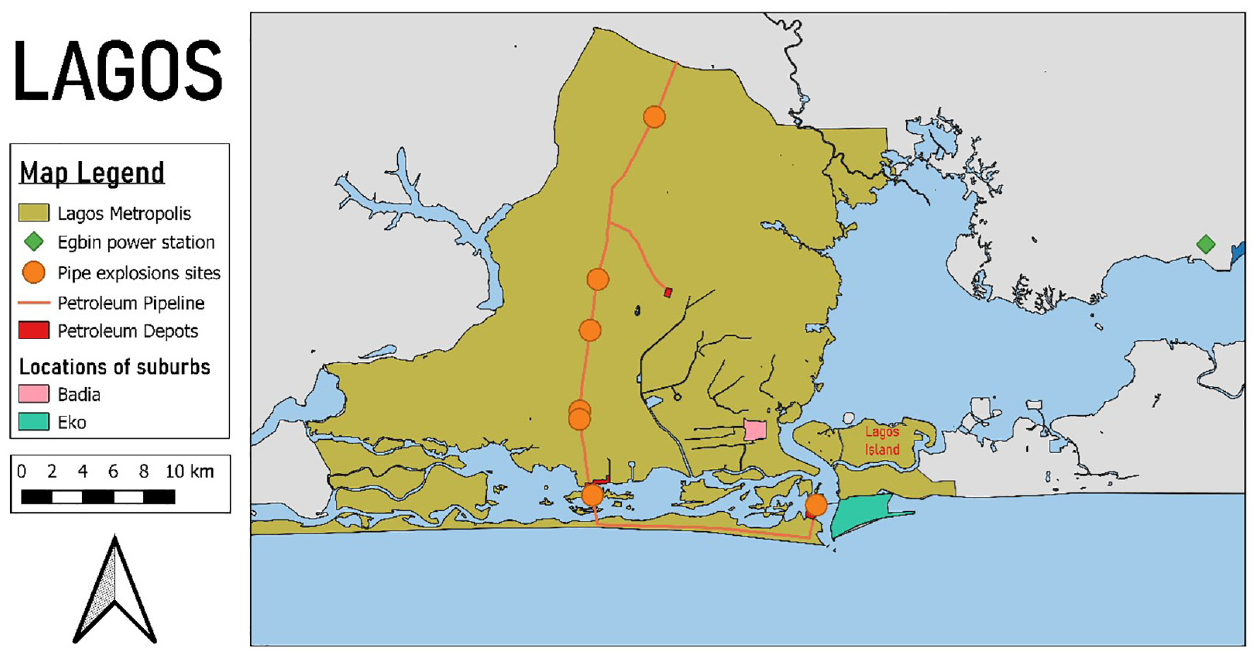
Map of Lagos with relevant sites and infrastructure mentioned in the paper.
Telecommunications infrastructure
The development of terrestrial and subterranean telecommunications infrastructure in Lagos has a long, slow and fragmented history – like many cities in the Global South. Initial development occurred in 1886 – when a cable connection was established between Lagos and London by the colonial administration – and within a decade all the colonial offices were fitted with a telephone service. Emblematic of splintered urbanism, however, is that the extension of this infrastructure to the broader Lagos (and Nigerian) public was extremely limited, and at independence in 1960 only 0.04% of Nigerian households were connected to the telephone network (Iwuagwu, 2014). Growth in telecommunication infrastructure in the post-colonial era was also initially slow, although services became increasingly commercialised. By 1999, only 0.4% of Nigerian households were connected to landline telephones. Connection costs were prohibitively high, while waiting times to be connected could run into years (Iwuagwu, 2014).
From 2000 onwards, Nigeria’s broader telecommunication industry, and subsequently infrastructure, experienced dramatic changes, driven by global changes in information communication technologies in the form of mobile phones and internet connections. Between 2001 and 2011, for example, Nigeria became the largest and fastest growing telecom market in Africa (Iwuagwu, 2014). There was a focus on ‘liberalising’ the country’s telecommunication markets, and in 2001 Digital Mobile Licences were auctioned to private sector companies (Sanda, 2018). The number of private sector companies grew rapidly during the first two decades of the 2000s. Given Lagos’ threadbare, and dated, existing telecommunication infrastructure, most of these companies (e.g. Communications Investments Limited, MTN Nigeria Limited and Econet Wireless Systems Limited) were subsequently required to bring their own infrastructure, with different companies trenching their own cables – in shallow subsurface. As part of this infrastructural development, these companies had to pay the Lagos State Infrastructure Maintenance and Regulatory Agency (LASIMRA) – the government agency responsible for regulating utility infrastructure within Lagos State – rights of way for any entrenched cables.
The establishment of these underground infrastructures would prove to be a haphazard process. In 2016, LASIMRA set up a utility network audit to map ‘the underground utilities network within the geographical boundaries of Lagos State (“affected persons”) and ensure that all utilities providers are in compliance with the statutory provisions in regard to all underground communication infrastructures’ (Adepetun, 2016: np) with the objective to build an overall database on underground facilities in Lagos. The audit revealed that several telecommunications service providers had installed cables in gutters and drains around Lagos in efforts to avoid payments for the right of way established by LASIMRA. The indiscriminate installation fibre optic cables had, unsurprisingly, led to flooding and compromised service quality (Akoni, 2013). In this context, these actions, driven by multinational telecommunications companies opted for not following guidelines and established process when it came to underground urban development, most likely as a cost-saving approach. In response to the report’s finding, the Lagos Government set up the Lagos State Unified Duct Infrastructure Project in 2020, which had the objective of deploying 6000 km of fibre optic cables across the state, with a target completion date of May 2022 (Adepetun, 2021). The purpose of the project is to develop ‘a singular [fibre optic] cable for all of the telecoms companies’, as part of the implementation of a ‘Dig Once’ policy in a bid to eliminate fragmentary and or constant digging of state roads (Sessou, 2020: np). Telecommunication companies, then, can lease the fibre cables from the government. Already the government has leased more than 2100 km of fibre optic to companies (Adepetun, 2021). Telecommunications is certainly an infrastructural sector that will require more of the shallow subsurface in future, the Dig Once policy is evidence of this.
Energy infrastructure
Urban energy infrastructure, similar to telecommunications, has its roots in the colonial state. Electric street lighting was first introduced to Lagos in 1898, with its distribution mainly limited to the European residential areas of the city (Edomah et al., 2016). Household electricity supply was developed during the early 1900s with the increased construction of power stations and the development of an electricity grid (Mabogunje, 1968). This included the 1901 installation of a 10,000-yard-long underground High Tension (HT) cable to connect the electricity grid across Lagos (Edomah et al., 2016). Demand for electricity, however, has always outstripped supply. Furthermore, the cost of connection and supply was beyond the reach of many Lagosians, with the network largely connected to wealthy households. Even greater struggles emerged during the post-colonial era due to Lagos’ population boom. For example, between 1970 and 1987, there was a 500% increase in residential consumers (Olukoju, 2003). From 2005 onwards, there has been an increase in the corporatisation and privatisation of this infrastructure and service provision (Olurode et al., 2018), with the objective to help ‘modernise to the sector’ and expand access. These desired outcomes, however, have not materialised and the electricity grid in Lagos is still limited and unreliable (Roy et al., 2020). Many households often need to find their own electricity, either accessing it indirectly (e.g. through friends), through independent electricity generation (e.g. diesel generators, solar photovoltaic), or through illegal connections to the grid (Ojedokun et al., 2021). While, for the most part, Lagos’ electrical grid has been terrestrial – strung across power poles around the city – as part of the Lagos State Unified Duct Infrastructure Project there is an increasing focus on placing electricity wires underground alongside telecommunication cables (Asu, 2021).
While the subterranean electricity network is relatively limited in Lagos, pipelines carrying hydrocarbon resources – linked to Nigeria’s oil industry – riddle the city. This includes the Escravos–Lagos Pipeline System, a natural gas pipeline built in 1989, which supplies gas from the Escravos region of the Niger Delta area to Egbin power station near Lagos (Biose, 2020), as well as pipelines carrying crude oil and gasoline to distribution depots and for export (see Figure 1). The development of this underground and terrestrial pipeline ‘network’ commenced in the late 1970s (Lawal, 1989), and today there are more than 5000 km of pipelines around the country (Omodanisi et al., 2015). The location of these pipelines tends to have a distinct socio-economic geography in Lagos as it crosses underneath and through economically marginalised suburbs. Across western Lagos there are various streets with the name Pipeline Road/Lane or NNPC Road, 1 which provide explicit hints on the subterranean infrastructure beneath. Thus, while these suburbs may lack access to utility infrastructures and the services they provide (i.e. water, telecommunications, electricity), their undergrounds are not absent from these. Furthermore, pipeline infrastructures, are not meant to service Lagosians, rather to supply a wider demand of these services.
It is therefore unsurprising that these hydrocarbon pipes beneath Lagos have been a source and object of urban conflict. The pipelines have been the target of theft, sabotage and vandalism. Oil bunkering – the act of drilling into the pipelines with the intent to steal for auto-consumption or to sell – is a common occurrence and costs the government billions of dollars per year (Olu-Adeyemi, 2020). Oil bunkering compromises the integrity of pipes, often resulting in pipeline explosion disasters causing mass casualties in the areas where the infrastructure is located. While these have been most prominent in the oil producing Niger Delta region, they have also occurred in Lagos, including explosions in 2000, 2006 and 2007 that resulted in many people being injured and a high number of casualties (Olu-Adeyemi, 2020; see Figure 1), as well as widespread environmental impacts (Omodanisi et al., 2015). Oil pipe vandalism is not the only cause of these events, in 2020 more than 20 people were killed in an explosion caused by an exposed oil pipe being hit by a heavy truck. The pipe had been exposed on the road’s surface due to erosion by Lagos’ intermittent floods and soil subsistence and erosion (Olawoyin, 2020). Given the pipeline infrastructure geographical distribution, Lagos pipeline explosions have tended to occur in areas largely populated by poorer socio-economic groups within the city or in peri-urban fringe communities. Poverty and vulnerability to pipeline explosions in Lagos are thus closely linked as the poorest live in the highest risk areas, where the pipelines traverse underground (Onuoha, 2009; see Figure 1).
Water infrastructure
Lagos residents during the urban settlement’s early years and up until the end of the 19th century were predominantly reliant on wells for their potable water supply (Olukoju, 2003). Due to the low and sandy character of the area, the water table under Lagos was high enough at the time for wells only 2–3 m deep to be sufficient for sourcing potable water. Most wells were dug holes in the ground, however, wealthier residents occasionally constructed bricked wells with filtration beds (with alternative layers of charcoal and iron at their base) and pumping systems (Brown, 1992). There was a limited shift away from private wells at the beginning of the 1900s, when the colonial government embarked on installing a piped potable water supply for the city.
The construction of a waterworks for the city was completed in 1910 and formally commissioned in 1915 (Mabogunje, 1968; Olukoju, 2007). Like early telecommunication infrastructure, as Olukoju (2003: 48) notes, ‘from the beginning, potable water from the waterworks was intended for the European Residential Area at Ikoyi [on Lagos Island]’, however, over time it was gradually extended to some of the other communities on Lagos Island. Given this splintered approach to piped water infrastructure, water wells remained (and still remain) a key source of water supply in Lagos. In 1921, for example, it was documented that there were 2679 wells within the Lagos metropolitan areas (Olukoju, 2003). While there was a gradual expansion of pipe-borne water supply during the colonial era, by the time of Nigerian independence large parts of the city were still not connected, particularly in areas of the mainland opposite Lagos Island. Some substantial expansions of the piped water network occurred from the late-1960s onwards, and by the late-1970s urban planners in Lagos anticipated that within 20 years the entire city would be connected to a modern water supply system (Gandy, 2004). This, however, did not eventuate, and by the beginning of the 2000s, less than 5% of households in the city had a direct water connection (Gandy, 2004). A fall from the estimated 10% of households that were connected in the 1960s (Gandy, 2006). Currently, less than 10% of Lagos households have direct access to piped potable water. This is despite the extensive effort by the Lagos state government in bridging this gap since the inauguration of the
Most Lagosians are therefore, reliant on groundwater wells for their potable water supply. Indeed, Nigeria has some of the highest percentage of urban households dependent on wells for potable water supply in Sub-Saharan Africa (Agwor, 2017). Water is sometimes accessed directly by households, through either private or public wells. However, most commonly, water is distributed by local organised and informal groups that extract the water from boreholes and sell it to households, often at exorbitant prices (Felbab-Brown, 2017). Some of these local groups even ‘go so far as to destroy public wells and pumps so that they can continue profiting financially and politically from their illegal water trade’ (Felbab-Brown, 2017: 33–34). Utility water pipes have also become a target for theft and vandalism, with the physical pipes being stolen and sold in the market (e.g. Ekamma, 2017; Nigerian Tribune, 2017). These convoluted circumstances have supported the high reliance on bore water, meaning that the water table beneath the city is gradually declining, thus requiring deeper wells for access (Shiru et al., 2020).
Additional impacts of the current underground water infrastructure arise from the limited sewerage and drainage infrastructure within Lagos. The development of waste and polluted water removal infrastructure was largely neglected during the colonial era, with limited drain development (Faleye, 2017) and the introduction of septic tanks for a select few in the 1930s (Seun, 2015). An estimated 1.85 billion cubic metres of wastewater is generated daily in Lagos, yet only 5% of the population is connected to the public sewerage system (Agwor, 2017). Thus, only a small minority of households have access to ‘improved sanitation services’. This means that much of the waste often finds its way to the surface of the city with rain flows and intermittent floods, flowing into groundwater systems and causing pollution (Shiru et al., 2020).
Transport infrastructure
Differing from water supply and electricity infrastructure, urban transport did not assume any great infrastructural investment in the city of Lagos during the 19th century, and it was only in the 20th century that mechanical (motor) transport was established as the dominant mode of urban transit. While the British government was developing an extensive metro in London during the early-20th century, similar transport investment was not realised in the empire’s colonies, and subsequent transport infrastructure development was geographically terrestrial, including roads, railways, trams (Olukoju, 2003), as well as ferries. Thus, the deeper material underground transformation of Lagos has, to date, largely been beyond the realm of infrastructure development.
There are, however, some indications that the underground of Lagos may be the site for urban development in the near future. For example, in 2016, the Nigeria Tunnelling Association (NTA) was established and subsequently adopted as a Member Nation of the International Tunnelling and Underground Space Association in 2017 (Lucas, 2017). The association has since been involved in hosting tunnelling and underground space focused conferences in the country, establishing links to the broader international tunnelling industry. Both the Ministries of Transportation and Housing and Urban Development have been heavily involved in some of these events and have expressed support for including tunnel engineering in the academic curriculum of the Nigerian Institute for Transport Technology, Zaria (Othiang, 2018). After a consultative session with the Nigerian Senate committee on Land Transport, tunnelling and underground space uses was integrated into the Transport bill, seeking ‘to adapt underground space technologies and tunnelling as alternative means of transportation for national development’, noting that the use of tunnelling ‘would ease the burden on road, rail transportation, especially in major cities of [Nigeria]’ (My Engineers, 2018: np). Nigeria is also in the process of constructing its first intra-city mass transit system, known as the Lagos Rail Mass Transit System, with the first two lines opened in December 2022. However, these initial lines are terrestrial or elevated, although there were discussions focused on how tunnelling and underground space could be integrated in the movement of people and goods across the city of Lagos (Agwor, 2017). Some key applications that are currently being looked at include the subterranean movement of cargo across Lagos and the transport of people from the domestic airport to the international airport.
Underground urbanism in Lagos city
Underground urban development in Lagos has occurred, so far, in the ‘shallow subsurface’ (von der Tann et al., 2020), with the trench of utilities infrastructure and other pipelines, as well as boring for water resources. In terms of ‘deeper’ underground development, such as construction of tunnelling infrastructure, as in many large cities in Africa (e.g. Dar Es Salam, Kinshasa), these remain largely aspirational. A recent market survey conducted by the International Tunnelling and Underground Space Association illustrates the striking difference between Asia and Africa, where Africa accounts for only 2% of the global tunnel investment market, while Asia accounts for around 70% (ITA-AITES, 2019).
The absence of deeper underground infrastructure is historical and systemic. Contrasting the underground developments occurring in some of the European capital cities – including the London Underground (1890) and Paris Métro (1900) – development projects in the colonies were focused to service locally residing Europeans and/or to transport goods for export. Certainly, such infrastructural developments had the goals of servicing the elite and moving goods out of the colonies. The splintered urban space that emerged (cf. Graham and Marvin, 2001) is a result of these historical processes. Accentuating this history, a major part of Lagos’ recent urban strategy has focused on megaprojects, which in effect secede from the existing city fabric. The Badian East Housing project in Lagos, for example, has been under development since 2013 and has involved the displacement of more than 3000 households of low-income communities in order to create a space that can be transformed into a ‘luxury residential enclaves for middle- and high-income earners’ (Olajide and Lawanson, 2022: 1769). The Eko Atlantic City project, which was also launched in 2013, is an ambitious urban development project involving the construction of a ‘new city’, drawing on private sector investment and development. Eko Atlantic City is being built on land reclaimed from the Atlantic Ocean, and includes the construction of the ‘Great Wall of Lagos’– an 8 km long wall meant to check shore-line erosion and flooding. The development will include ‘skyscrapers rising up to 35 floors, an eight lane 2-km boulevard, tree-lined streets and luxury apartments, roads, bridges and underground parking’. The overall cost of residences within Eko Atlantic City, however, like with the Badian East Housing project, means that ‘the promised luxurious urban lifestyle’ is only for a ‘relatively small minority of Lagosians’ (Adama, 2018: 271). As Mendelsohn (2018: 457) notes, these projects echo the ‘historical legacies of exclusionary planning’ in Lagos. Subterranean electricity grid, telecommunications and water infrastructure are developed as a part of the creation of these sites. The underground is also critical for the high-rise buildings in these developments. As McNeill (2022: 97) has noted, high rise buildings are ‘highly dependent on the colonization of underground space’ in terms of structural support for the physical builds, as well as providing services, such as underground parking. Through large-scale private sector funding, World Bank loans and some government funding, these projects are in effect creating a network city for a privileged few.
While large-scale (splintered) subterranean utility urban development – historically and contemporarily – has tended to be focused on wealthier socio-economic enclaves across Lagos, this does not mean that the underground is unused in poorer areas of the city – as we have outlined above. Haphazard subterranean infrastructure, whether in the form of hydrocarbon pipes or illegally laid telecommunication cables, are strewn across the city – with the former, in particular, transgressing poorer suburbs. Residents engage in forms of bricolage in relation to this underground, as they negotiate dynamic and heterogeneous infrastructure configurations. These engagements and infrastructural adaptation are a critical part of underground urban infrastructural geographies (Munro, 2020: 430), a form of volumetric do-it-yourself urbanism (Iveson, 2013). The urban underground is essential for households, whether through the digging of boreholes for water supply or ‘bunkering’ into pipes to extract hydrocarbon resources. In this sense, Lagos – and other cities in Africa – push us (urban academics and urban planning practitioners) to think about underground urbanism beyond the network city. The shallow urban underground is readily accessible to most households, and therefore is more amenable to a variety of interactions, some of them informal, by urban residents. As urban dwellers engage with ‘a diversity of the social and material configurations’ to realise their urban needs (Alba and Bruns, 2022: 146), including accessing the shallow underground for various livelihood and subsistence purposes.
Conclusion
Africa is rapidly urbanising, and many of the continent’s already large urban centres are on track to become the most populous cities in the world. Historical legacies of poorly developed and installed infrastructural projects stem from the colonial period – particularly in relation to utilities and transport infrastructure – and have resulted in a splintered urban divide. This legacy, combined with rapid urban growth and relatively limited (and often neo-liberally oriented) public funding has meant that addressing the critical challenges of urban sprawl means challenging the legacies of elite and preferential urban planning. In this paper, we have considered how a historical conceptualisation of the volumetric city – with particular attention paid to the urban underground – might help us to consider these urban challenges in a new light.
Two broad themes can be gleaned from the historical geography of Lagos’ subterranean development. First, the development of utility infrastructure has followed a distinct socio-economic geography: the laying of telecommunication wires, water pipe infrastructure and the electricity grid have tended to focus on providing ‘connections’ for wealthier households. This discriminatory infrastructure emerged during the colonial era, where infrastructural development focused on providing services for the European expatriate populous within the city. While there were aspirational masterplans in post-colonial governments (during the 1960s and 1970s) to transform Lagos into a ‘networked city’ that provided services for all, from the 1980s onwards more neoliberal forms of governance have resulted in urban developments that echo the city’s colonial past, with infrastructure development predominantly focused on the needs of wealthier residents. This can be most dramatically witnessed with the recent wealthy enclave developments. While this formal utility infrastructure development has had a limited geography, this has not meant that underground urban dynamics, practices and uses are absent in the poorer parts of Lagos. Indeed, many Lagosians look to the urban underground to extract resources for their subsistence and livelihoods, whether it is drilling boreholes to extract potable water or ‘bunkering’ into hydrocarbon pipelines to extract resource wealth. Complex political dynamics also mediate these relations, with local water mafia groups often engaging in practices to monopolise boreholes for water extraction and criminal syndicates coordinating hydrocarbon theft from pipelines.
Second, there is a geographical depth to the city’s urban underground. The ‘shallow subsurface’ (i.e. utilities) that has been the focus of development, while the ‘deeper subsurface’ has been arguably untouched by urban infrastructure. There is no underground metro system in Lagos, nor any underground road tunnels. Indeed, despite the rapid growing cities across Sub-Saharan Africa, there is only one (partially) underground metro system: the Gautrain in Gauteng, South Africa. Urban rail systems are under development in urban centres across Sub-Saharan Africa; however, all are either terrestrial or raised structures. The one exception, the Gautrain, stretches across South Africa’s neighbouring urban centres of Pretoria and Johannesburg, as well as linking to the OR Tambo International Airport. At the time of writing, it was the largest construction project in Sub-Saharan Africa and involved the construction of 80 km of rail, of which 15 km were underground (Boniface, 2008; du Plessis, 2010). Colonial governments ultimately did not make large-scale investment in urban transport infrastructures in their colonies. It is not, however, a case that deep excavation technology has not been in use in Sub-Saharan Africa, it has a long history in the mining sector (cf. Davenport, 2013; Raji and Abejide, 2014). Stemming from the colonial era, deep underground investment has favoured resource extraction (often for export profit) over the establishment of urban infrastructure. The absence of deeper urban underground projects has arguably continued in the post-colonial era, in particular in the last decade there has been a surge of investment in tunnelling infrastructure projects around the world, yet Sub-Saharan Africa has largely been excluded from this boom. Nevertheless, there are some nascent indications that there might be a turn to the deeper African urban underground in the future. First, the aforementioned Gautrain project (2006–2012) involved the construction of 15 km of tunnel and three underground metro stations under the city of Johannesburg. The project included the use of a tunnel boring machine (TBM) – named
Footnotes
Declaration of conflicting interests
Funding
ORCID iDs
