







Abstract
Introduction
Sharing is a fundamental human behavior and one that, according to urban economists, explains the existence of cities (Rosenthal and Strange, 2004). Classic works by anthropologists like Mauss (1925) and Sahlins (1972) argue that practices of sharing and exchange have great social, cultural, and economic importance. But sharing is not a uniform activity. Patterns differ according to the extent and nature of people’s social networks, the spatial contexts and cultures they inhabit, and their personalities. Further, the nature of sharing differs according to the relationship between the engaged parties. For example, sharing a meal with a family member arises from different motivations—and presents a different subjective experience—than sharing a public park with dozens of strangers.
Understanding sharing—and the factors that motivate and dissuade
Most scholarship on vehicle sharing emphasizes sharing between strangers, including services that fall into the “shared mobility” paradigm (Castellanos et al., 2022). A Google Scholar search for the term “carpool”—a type of sharing usually organized between co-workers or acquaintances—returns about 50,000 results. Yet searches for “Uber transportation” and “public transportation”—both cases of sharing with strangers—return 278,000 and 1.2 million results, respectively. This scholarly attention to public- and private-sector forms of vehicle sharing ignores the reality of shared travel in countries where the private automobile dominates. The USA is one such place. In 2022, 87% of trips took place in private automobiles (Federal Highway Administration, 2022). Meanwhile, fewer than 2% of trips took place via public transit (Federal Highway Administration, 2022). Commercial modes that foster vehicle sharing among strangers—such as taxis, ridehail, carshare, and car rental—collectively served less than 1% of all US trips in 2022 (Federal Highway Administration, 2022).
Additionally, researchers studying travel behavior, including sharing, emphasize the economic and time factors associated with mode choice, which Mokhtarian et al. (2015: 253) conceptualize as the “extrinsic” factors that motivate travel. Yet literature from the social sciences also suggests that sharing presents unique
As cities struggle to recover from the social and economic shocks of COVID-19, researchers have argued that socioemotional experiences and perceptions will increasingly influence decisions to share (Nuttah et al., 2023). This is relevant given shifting travel patterns in the post-pandemic era. At the height of the pandemic in Spring 2020, public health orders caused people to halt most travel. In the subsequent months and years,
In this debates paper, I explore shared transportation through the lens of the concepts of
An overview of sharing
Scholars—not to mention policymakers and businesspeople—have failed to produce a single definition of sharing. Most social scientists agree that sharing has occurred for millennia and has a unique social component (Benkler, 2004; Price, 1975). In terms of change over time, scholars like Agyeman and McLaren (2017) have argued that economic developments (including increased private ownership of goods) and social ones (such as increasing “competitive individualism”) have decreased the natural human tendency to share.
Yet, in contemporary society, people continue to regularly share food, housing, and information, among other goods (Kennedy, 2016). Digital platforms now help to facilitate the exchange of goods like spare rooms and clothing (Benkler, 2004; Finck and Ranchordás, 2016). Scholars from fields like management, business, environmental sciences, engineering, and hospitality studies have argued that these technologies can lead to more efficient use of goods, producing economic and environmental benefits (Dabić et al., 2024). But despite the increased attention to sharing linked to technological change, sharing encompasses actions that long predate the growth of digital platforms and that have great social meaning. Reviewing this provides insight into the factors that motivate and dissuade people from vehicle sharing. 3
What is sharing?
Definitions of sharing often vary by discipline, including those proffered by anthropologists (Widlok, 2013), geographers (Cockayne, 2016), and marketing scholars (Eckhardt and Bardhi, 2016). This partly reflects the fact that the term “sharing” has a positive connotation; attaching the label of sharing, then, reflects normative judgments and can help companies frame their businesses as good for society (Acquier et al., 2017; Finck and Ranchordás, 2016).
Sharing in versus sharing out
Cataloging the socioemotional aspects of sharing in transportation requires a distinction between sharing in and sharing out, terms used by scholars in cultural anthropology (Widlok, 2013), marketing (Belk, 2010), and media and communication (Kennedy, 2016). These types of sharing vary by the relationships between sharing parties. People share in with people they know, particularly family but also friends and acquaintances. They share out with strangers (Widlok, 2013). These categories of sharing can generate distinct social outcomes. According to marketing scholar Belk (2010), when sharing in, a person often deepens the relationship by drawing others into their intimate space. Sharing out, in contrast, explicitly crosses “boundaries separating self and other” (Belk, 2010: 725). Kennedy (2016: 462) notes that sharing in comprises “a cultural process of community inclusion,” while sharing out “creates no social ties.”
Characteristics of sharing in
Sharing in often occurs with family members. Addressing intra-family sharing, Price (1975) argues that it reflects early human tendencies toward a sexual division of labor in childrearing. Family sharing—either in money, goods, or time—usually flows from older to younger generations, mostly from parents to young children (Hofferth and Iceland, 1998). Sharing in can also occur outside of the household and nuclear family (a term referring to a household of two parents and their child(ren)). People with whom one might share in include extended family members, friends, coworkers, and neighbors (Belk, 2010).
Belk (2017) suggests that a person may integrate non-kin into their pseudo-family through the sharing-in process (e.g. among members of housing cooperatives (Ruiu, 2016)). Within the category of sharing in, empirical research has long indicated that outside of the market, US residents exchange resources via kin-based relationships more often than via relationships with friends or acquaintances (Ben-Porath, 1980; Cantor, 1979; Hofferth and Iceland, 1998).
Characteristics of sharing out
Sharing out, meanwhile, characterizes exchanges that happen with strangers. Sharing out can involve the use of public resources (such as parks and education; Belk, 2017; Buchanan, 1965). Sharing out can present practical challenges, especially in large communities. One issue is trust. When strangers share a common pool of resources, they cannot ensure that others will use these resources responsibly (Standing et al., 2019), an issue Hardin (1968) characterized as a “tragedy of the commons.” In the related problem of “free riders,” users may refuse to contribute toward shared resources (Buchanan, 1965). Another barrier is fear of the “leaky self,” or the discomfort that arises from a sense of contamination or impingement on privacy by strangers (Gregson and Crewe, 2003).
Third parties can mediate hindrances to sharing out. For example, governments facilitate sharing public spaces like basketball courts. Organizations may reduce risk by screening potential users (Horton and Zeckhauser, 2016). Price (1975) further notes that the information-processing limits of the human brain cap sharing, as people cannot personally know (nor evaluate) all potential sharing partners. Writing in the 1970s, he predicted that developing technologies could expand sharing opportunities (Price, 1975). Recent market developments bear out his prediction. Platform economy companies not only connect consumers but also allow them to evaluate and monitor the behavior of other users via online comments (Benkler, 2004); they thus overcome the limitations that Price (1975) identified.
Differences between sharing in and sharing out
While most research suggests that people share in resources more often than they share out resources (Laferrère and Wolff, 2006), these dynamics vary by the individual and the situation. Whether a person shares in or shares out depends on the individual
Another strand of the sharing literature comes from anthropologists, where scholars often analyze practices of food exchange. Belk (2010) reviews anthropological studies of food sharing among the Hadza (of Tanzania; Woodburn, 1998), the Inupiaq (of Alaska; Bodenhorn, 2005), and residents of Mangaldihi, India (Lamb, 2000). He notes that members of these cultures engage in widespread food sharing, favoring group notions of resource ownership over individual ones (Belk, 2010). Cultural contexts thus influence the types of sharing that occur, their prevalence, and their social meanings.
Motivations to share
Sharing to reduce costs
Sharing—particularly sharing access to a good—can lower user costs by enabling people to forego ownership (Acquier et al., 2017). When sharing access, a person pays for the temporary use of an item, attaining the optimum marginal benefit (Acquier et al., 2017). Owners can also benefit from sharing underused capacity (Finck and Ranchordás, 2016), for example by renting out a spare bedroom in their home (Horton and Zeckhauser, 2016).
Buchanan’s (1965) theory of “club goods” —a concept related to sharing access—also illustrates the value of sharing. Buchanan defines club goods as falling between purely private and public goods, involving a type of “cooperative membership” that extends “ownership-consumption rights over differing numbers of persons” (Buchanan, 1965: 1). He argues that when offering a club good, the coordinating party accounts for the fixed cost of the good, the nature of how one uses it (including its congestion limits), and the price people will pay (Buchanan, 1965). Club goods provide users with access to a larger array of services than would be available via individual ownership. Examples of club goods include gym memberships, internet services, and movie theaters.
Reciprocity—whether a person compensates another for sharing a good—influences whether sharing necessarily reduces user costs. When sharing is explicitly reciprocal, as for members of a food cooperative, a person reaps the financial benefits of pooling resources (Deller et al., 2009). Non-reciprocal sharing—for example, sharing food with a friend—may actually generate costs for the sharer. The ambiguity of the relationship between sharing and reciprocity thus influences whether (and to what degree) financial considerations motivate different forms of sharing.
Sharing for socioemotional benefits
In addition to its economic benefits, sharing can generate non-financial value. Sharing can contribute to what Becker (1974) calls one’s “social income,” a combination of a person’s monetary income and the value they assign to their social environment. As many anthropologists, social psychologists, and physicians have established, social interactions and ties have inherent value, including benefits for physical health (House et al., 1988; Van Lange and Columbus, 2021). Sharing in with family and close friends may be particularly meaningful or enjoyable (Basmajian, 2010; Mehu et al., 2007).
But even sharing out with strangers produces non-monetary benefits. The natural inclination to help strangers—also called “prosocial behavior” —may motivate some cases of sharing, such as allowing a stranger to use the telephone (Güroğlu et al., 2014). As to why people engage in prosocial behavior, generous or fair behavior may be important to a person’s identity and provide her with utility (Sobel, 2005). Similarly, Andreoni (1990) documented the “warm glow” associated with charitable giving. Community membership—for example, belonging to a food cooperative—may generate positive feelings, even if members do not interact (Benkler, 2004).
Cultural norms also influence the socioemotional value of sharing. For example, Second World War-era efforts to encourage carpooling in the USA appealed to patriotic sentiments to conserve resources such as gasoline and rubber (Ferguson, 1997). Recently, public outreach programs related to utilities and energy use have highlighted the positive environmental impacts of sharing (Gadenne et al., 2011). And while norms may influence the rates and types of helping that occur, prosocial behavior occurs in most cultures (House et al., 2013). Whether a result of socialization or a biological imperative, evidence from social psychology consistently suggests that people value helping others with no expectation of repayment (Knafo and Plomin, 2006). Both cultural conditioning and socialization appear to influence the propensity to share, and especially to share out.
Socioemotional deterrents to sharing
Despite its benefits, sharing has downsides that may deter users. Here, I detail three groups of factors that can deter sharing: (1) physical and social contamination, (2) fear of violence, and (3) uncertainty. While I emphasize socioemotional deterrents to sharing, some of them—for example, the specter of uncertainty—also have financial implications. Further, while most of these are relevant to sharing out, they also have implications for cases of sharing in.
Physical contamination
Concerns about physical contamination may arise in sharing. In public health studies, people regularly express fears of contracting an illness in shared spaces like public restrooms, which can discourage use (Hartigan et al., 2020). Researchers also find that people are less comfortable sharing objects with which their bodies have close contact (Hazée et al., 2019). Anxiety about health and the risk of contracting illness varies by person, based on individual psychological factors (Brand et al., 2013).
Yet levels of health anxiety also vary by non-individual factors. Unsurprisingly, researchers find that concerns about physical contamination in public spaces grew stronger globally during major public health crises. This occurred during the SARS virus in 2003 (Lau et al., 2003) and the H1N1 outbreak in 2009 (Tausczik et al., 2012). Health anxiety also grew during the COVID-19 pandemic in the early 2020s (Low and Smart, 2020) and may linger in the post-pandemic era (Kindred and Bates, 2023).
Social contamination
Related to the issue of physical contamination is social contamination. Social scientists have long examined the roles that social barriers play in structuring relationships between people. Weber (1922) and Goffman (1963), among others, argue that socially constructed categories—including class, race, and caste—help organize society and set rules for interactions. With limited information about strangers, negotiating roles and norms can be difficult (Goffman, 1971). People sharing the use of public space may thus take cues from one’s visual appearance about whether (and how) to properly engage with strangers (Goffman, 1971).
Interactions with co-workers or neighbors—cases of sharing in—can also impose socioemotional costs, requiring people to cross social lines that they prefer to keep separate (Goffman, 1959). Insofar as people maintain distinct identities in different contexts, when colleagues spend time outside of their normal environments (e.g. carpooling to work), this may require them to engage in what Goffman (1959: 208) calls “the art of impression management.” This means that they must work to maintain the previously negotiated roles for social interaction, which can shift based on different environments (Goffman, 1959). For example, a supervisor may struggle to retain an authoritative posture when encountering an employee in a casual situation (e.g. at a public pool).
Fear of violence
Fear of violence may also impose socioemotional costs on potential sharers. This is particularly true in cases of sharing out where people have limited information about other parties. As with health anxiety, fear of harm varies based on demographic characteristics and individual psychological ones (Jackson and Stafford, 2009). For example, on average, women (Pain, 2001) and older adults (Ceccato and Bamzar, 2016) express greater fears of experiencing violent crime compared to men and younger adults. Researchers have found that even when facing low levels of risk, some people withdraw from situations they deem dangerous (Hale, 1996).
Uncertainty
Sharing access can also cause uncertainty about access to a good. A person who owns a private ski chalet can schedule her vacation whenever she wants. Yet a person who takes part in cooperative ownership—for example, a vacation timeshare property—shares it with others, reducing flexibility in her use (Bradley and Sparks, 2012). Not only its availability but also the state or upkeep of a good fall beyond the complete control of each sharer. For example, people who live in a cooperative residential building share governance of it. This affects whether management of the building meets each member’s preferences (Low et al., 2012).
Users of platform economy services may encounter similar issues in the standardization of products and services. For example, Airbnb facilitates exchanges of temporary housing between owners and users (Forgacs and Dimanche, 2016). A consumer can feel reasonably sure that a hotel chain will offer certain amenities. Despite the reviews and photos available for Airbnb listings, however, shared accommodations in private homes may not offer the same consistency as hotel chains (Phua, 2019). These issues of uncertainty and inconsistency do not solely affect whether services and goods meet user preferences but can lead to psychological burdens for people anxious about their access to a good (Paul et al., 2023).
Sharing in transportation
The previous discussion has established that various factors influence how and why people share in and share out. Shifting to travel behavior, I now present a novel typology of shared transportation influenced by these findings. First, however, I synthesize some of the literature on “shared mobility” to establish its relationship to this typology. It is important to note, however, that some type of sharing occurs in virtually all transportation modes, including sharing public roads and sidewalks. However, most travel behavior researchers emphasize sharing
Additionally, as stated above, this article specifically investigates the socioemotional costs and benefits of sharing transportation. However, several review studies have addressed other aspects of shared transportation modes, comparing their sustainability impacts, financial costs, and frequency of use. For information on these other aspects of shared transport, I refer the reader to reviews by the National Academies of Sciences, Engineering, and Medicine (2016), Shaheen and Cohen (2019), and Chan and Shaheen (2012), among others.
Sharing versus shared mobility
In recent years, scholars and policymakers have used the term “shared mobility” to refer to shared transportation (Shaheen and Cohen, 2019). As with the term “sharing,” no single definition of shared mobility exists. Some scholars of shared mobility contend that it is a new phenomenon facilitated by digital technologies. Exemplifying this perspective, Castellanos et al. (2022) conducted a review of papers that feature definitions of shared mobility to create a taxonomy. In their definition, the authors include information and community technology (ICT)-enabled shared services, excluding car rentals, public transit, and traditional taxi services (Castellanos et al., 2022).
In contrast, other scholars of shared mobility and transportation include non-ICT-enabled services in their definitions. A report by the National Academies of Sciences, Engineering, and Medicine (2016) includes public transit and non-digital carpooling in the category of shared mobility. The US Department of Transportation (2023) also includes traditional public transportation and carpooling in its definition of shared mobility. The Shared-Use Mobility Center (2023), a public-interest organization, similarly incorporates public transit and traditional carpooling into its typology.
Varying definitions also reflect how sharing carries positive connotations (see above). Schor and Cansoy (2019) describe concerns among scholars and advocates that private companies have co-opted terms like “sharing” when selling goods and services. Definitions of shared mobility often incorporate whether the mode requires that travelers share space with others simultaneously (“parallel” sharing) versus whether they use vehicles at distinct points in time (“serial” sharing; Taylor and Garrett, 2019). Unlike Castellanos et al. (2022), Belk (2014: 11) thus labels Zipcar a form of “pseudo-sharing,” as it offers short-term rental access with no opportunity for collective ownership or simultaneous use.
Similarly, Currie (2018) objects to using “shared mobility” to refer to services that take a single passenger or party. In agreement with Currie, the Associated Press instructed members of the media to use the term “ridehail” (rather than “rideshare”) to refer to companies like Uber and Lyft (Warzel, 2015), arguing that “sharing” mischaracterizes the services that they offer. Yet some researchers—such as Gerte et al. (2018)—continue to refer to such services as “rideshare”; in a 2022 national study of travel behavior, the Federal Highway Administration used this term to refer to services like Uber and Lyft (Federal Highway Administration, 2022).
For the present typology, I take an expansive view of shared transportation. In addition to cases of parallel sharing, I include both ridehail and taxis, cases of serial sharing. 5 In contrast to Castellanos et al. (2022) and Mouratidis (2022), I also include non-digital services like public transit and casual carpooling in my typology. Finally, as the primary organizing principle, I distinguish between cases of sharing in and sharing out. The former includes travel with household members, a type of travel often excluded from studies of shared transportation and mobility (Delhomme and Gheorghiu, 2016; Neoh et al., 2017).
A typology of shared transportation
As various social scientists have argued (see above), the process of sharing varies based on the relationships between the parties (e.g. sharing in versus sharing out) and the types of activities it entails (e.g. serial versus parallel sharing). The same is true in transportation. Differences in relationships may cause not only different financial and time costs for travelers but also socioemotional ones. Creating a novel typology of shared transportation, then, enables urban scholars to systematically consider how these benefits might vary by the nature of vehicle sharing. Based on the trends I later present, the typology also suggests different approaches to encourage vehicle sharing. Figure 1 thus shows how the concepts of sharing in and out and parallel/serial sharing status inform this new typology.

A typology of shared transportation.
Per Figure 1, parallel forms of sharing in include high-occupancy vehicle (HOV) travel with household members (including family and roommates) and non-household members known to the person (e.g. co-workers, friends, and neighbors). Serial forms of sharing in include borrowing private vehicles from non-strangers. Sharing in for transportation may or may not involve financial reciprocity; while parents seldom charge their children for a ride to school, a person may request money for gasoline from a neighbor. Virtually all forms of sharing in for transportation are informal.
Sharing out for transportation encompasses a range of vehicle sharing. These include formal and regulated modes such as public transit, and informal cases such as hitchhiking. Serial sharing out includes taxi/ridehail, carshare/car rental, and micro-mobility services like scooter and bike sharing. Meanwhile, parallel sharing out includes public transit, public ridesharing services like Waze Carpool, and casual carpooling, in which both drivers and passengers queue up at predetermined locations along roads with HOV or high-occupancy toll (HOT) lanes (Zmud and Rojo, 2013).
It is important to appreciate just how pervasive forms of vehicle sharing in versus vehicle sharing out are in the USA, as well as changing trends. To this end, Figure 2 shows the modal distribution of trips taken by US residents from 2001 to 2022.
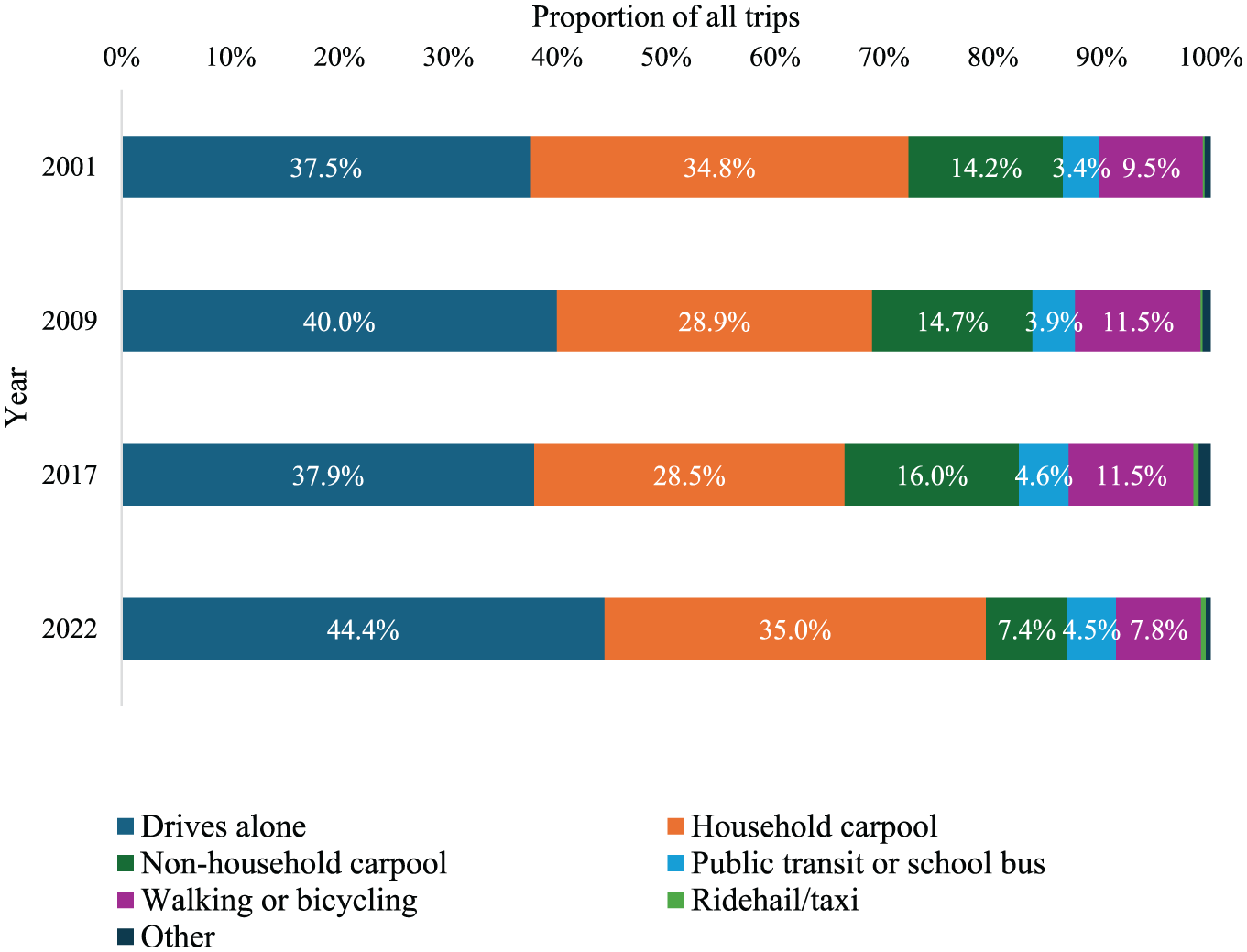
Mode used for all trips taken by US residents, 2001–2022.
While the data in Figure 2 do not perfectly map onto the categories in Figure 1, they do demonstrate the balance of the types of sharing in US travel. In the USA, sharing in dominates: traveling in private cars with other people—both household and non-household members—served over 42% of all trips in 2022. Sharing out—via school bus or public transit—served a paltry 4.5% of trips.
Figure 2 also shows changes over the last 20 years. While in 2022, sharing in still comprises the majority of sharing (e.g. not driving alone, walking, or bicycling), the balance has shifted from traveling with non-household members—including neighbors and coworkers—to only traveling with household members; sharing in with household members comprised 35% of all trips in 2022, up from 28.5% in 2017; sharing in with non-household members was 7.4% of all trips in 2022, down from 16.0% in 2017.
The socioemotional costs and benefits of shared transportation
The typology shown in Figure 1 invites questions about the distinct socioemotional costs and benefits that emerge in different types of vehicle sharing, including those unique to sharing in. These costs and benefits differ from the utilitarian aspects of shared transportation that accrue to the traveler, chiefly the trade-off between time and monetary costs. Mokhtarian et al. (2015) discuss this distinction at length. Relevant to the topic at hand, research suggests that non-monetary costs and benefits of sharing differ for sharing in versus sharing out for travel. It is critical to examine these socioemotional costs separately from other types of sharing (as in the ‘Socioemotional deterrents to sharing’ section above), given the unique nature of travel and thus vehicle sharing.
Further, this section provides an overview of how social factors may influence the subjective experience of sharing transportation. As described earlier, sociologists and anthropologists, among others, argue that cultural and social contexts greatly influence sharing practices. However, space precludes a thorough review of how spatial and cultural dynamics affect the social and emotional experience of vehicle sharing, given the remarkable diversity of transportation environments across the globe. The author encourages further work in this area.
Transportation sharing in
Below, I detail the socioemotional benefits of sharing in, its costs, and then explore the role of relationships (e.g. sharing with close family members versus acquaintances) in determining the balance of these costs and benefits.
Transportation sharing in: Socioemotional benefits
Sharing in for transportation can offer various socioemotional benefits for travelers. In parallel forms of sharing—for example, carpooling and giving/receiving rides—travelers can socialize and build relationships with family members, acquaintances, neighbors, and co-workers. Indeed, high rates of carpooling among US immigrants suggest that people disproportionately draw on social capital to first establish these informal networks for sharing (Blumenberg and Smart, 2014). Zhu and Fan (2018) find that people experience travel with household members as especially meaningful. Basmajian (2010) finds that mothers, in particular, value the time they spend driving their children to school as a time to connect and bond. The desire for social interaction may similarly motivate carpooling to work with co-workers (Li et al., 2007; Park et al., 2018). Lovejoy and Handy (2008) found that some ride seekers reported lending sympathetic ears to acquaintances who provided rides. In such cases, rather than exchanging money, passengers compensated drivers by providing emotional support (Lovejoy and Handy, 2008).
Transportation sharing in: Socioemotional costs
Sharing in for transportation can also impose significant socioemotional costs. In parallel sharing, which requires co-location with others, travelers must forego alone time (Jain and Lyons, 2008). Some people who drive alone to work report especially valuing the solo time it offers (Basmajian, 2010). Similarly, Kent (2014: 110) found that many drivers characterized commuting alone in an automobile as a “space to escape.” Li et al. (2007) also found that losing time alone dissuaded some people from carpooling to work. Further, people who receive rides from acquaintances worry about reciprocity, which may deter them from requesting assistance (Burkhardt, 1999). This is especially an issue for older adults who have ceased driving and thus cannot return the favor (Choi et al., 2019). Vulnerable groups may incur other socioemotional costs when sharing. For example, Lovejoy and Handy (2008) found that undocumented immigrants in the USA who sought rides worried that they put drivers at legal risk (Lovejoy and Handy, 2008).
Transportation sharing in: The role of relationships
Not all forms of sharing in—carpooling and ridesharing, for example—have the same socioemotional costs and benefits; costs and benefits can vary based on the strength of the relationship between sharing parties. Chaube et al. (2010) found that US university travelers with closer relationships reported greater comfort riding together. Their respondents expressed comfort riding with a friend and slightly less comfort carpooling with a friend of a friend (Chaube et al., 2010). Respondents also reported feeling more comfortable carpooling with a member from their extended social network than with a stranger (Chaube et al., 2010). In terms of parallel sharing in, interviewees have reported preferring to borrow the vehicle of a family member rather than a friend, perceiving these requests as less burdensome (Lovejoy and Handy, 2008). This agrees with findings on rates of kin-based versus non-kin-based resource exchange (see ‘Characteristics of sharing in’ section above).
Transportation sharing out: Socioemotional costs and benefits
Forms of sharing out for transportation, meanwhile, entail a variety of socioemotional costs and benefits. These especially differ based on parallel versus serial status. I thus first present the benefits of
Parallel transportation sharing out: Benefits
In parallel sharing out, strangers must co-occupy a vehicle. This offers similar potential for personal interactions present in forms of sharing in. For example, public transit riders may have pleasant (or unpleasant) interactions with strangers. Studies of public transit have identified how regular riders may develop relationships or a sense of community (Levin, 2016; Sheller, 2023). Even interactions with “familiar strangers” —who do not communicate verbally but only make visual contact—can benefit travelers emotionally (Zahnow et al., 2021).
Informal types of sharing out—like casual carpooling and hitchhiking—can offer similar benefits. In addition to the accessibility and cost benefits of casual carpooling, some travelers appreciate the opportunity to converse with other carpoolers (Burris and Winn, 2006; Zmud and Rojo, 2013). And hitchhiking offers a particularly intimate space for interactions with strangers. Schlebecker (1958: 327) argues that hitchhiking helped break down parochialism in the USA in the 20th century, as “Men do not mind exposing their innermost thoughts to strangers, because strangers seldom turn informer [… Thus] the continued appearance of hitchhikers reflected a general attachment to democracy.”
Parallel transportation sharing out: Costs
Colocation with strangers also raises the specter of danger. Some travelers report that fear of other people—both in a shared vehicle and while waiting at a stop or station—affects their use of public transit (Ingalls et al., 1994). As with findings on fear more generally (see ‘Fear of violence’ section above), these concerns especially influence the behavior of women (Klein, 2017) and older adults (Ralston and Patterson, 1983). In addition to public transit, researchers find that safety concerns and a global dislike of interacting with strangers dissuade some travelers from using shared ridehail services like UberPool and Lyft Line (Morris et al., 2019). As with patterns among public transit users, women raise such safety concerns more often than men (Morris et al., 2019). Indeed, some socioemotional costs appear to be unique to emerging mobility technologies with parallel sharing-out options like pooled ridehail, despite the fact that their digital platforms can mitigate safety concerns by verifying user identities. These costs include experiencing racial discrimination (Ge et al., 2020) and sexual harassment (Morris et al., 2019).
Low-tech options may also impose substantial socioemotional costs. Some US casual carpoolers have expressed concerns regarding physical safety and violence. However, in most casual carpooling situations, more than two parties travel in a private vehicle. This may reduce fear of violence from strangers; indeed, Houston women were more likely to participate in casual carpooling using HOV-3 rather than HOV-2 lanes (Zmud and Rojo, 2013). Hitchhiking, in particular, presents a problem, as passengers tend to ride alone with strangers (Paul, 2025). Indeed, scholars like Mahood (2016) have argued that concerns about danger and even murder helped hasten the decline of hitchhiking in the USA and Canada during the late 20th century.
Serial transportation sharing out: Socioemotional costs and benefits
For serial sharing out—including carsharing, taxis, non-pooled ridehail, and micro-mobility services—fewer socioemotional benefits
Some socioemotional costs in serial sharing out are possible, however, including anxiety about physical contamination. Hazée et al. (2019) found that when they highlighted the prospect of strangers using a carshare vehicle in close contact with their bodies, potential users expressed less interest in the service. Uncertainty in ridehail services—not only vehicle unavailability but also surge pricing—may cause anxiety for some users (Brown et al., 2022).
Challenges facing the future of shared transportation
In the last five years, vehicle sharing has declined rapidly in countries like the USA (see Figure 2). This includes declining rates of parallel sharing out (e.g. public transit)
Strategies to facilitate greater vehicle sharing will vary by location in the shared transportation typology. In terms of sharing out, researchers documented the role of socioemotional factors like health anxiety and fear in dissuading people from riding public transit during the COVID-19 pandemic in Japan (Parady et al., 2020), Israel (Kaplan et al., 2022), and Canada (Mashrur et al., 2023), among other places. Even after the pandemic, socioemotional factors continue to dampen transit use. Via surveys, Sarker et al. (2024) found that fear of antisocial behavior and crime has decreased transit ridership in Melbourne since the pandemic. Studying Montreal essential workers before and after the pandemic, Zarabi et al. (2025) found that groups who had switched from public transit to private car and back to transit reported lower enjoyment of their commutes, compared to those who took public transit over the entire period. They also established that former transit riders who switched permanently to cars reported increased stress levels (Zarabi et al., 2025). This suggests a role not only for time and money but also for subjective (and potentially emotional) factors that correlate with experiences of vehicle sharing. To address the socioemotional costs of sharing for transit riders, researchers have recommended that public transit agencies increase communication with riders about potential health or other risks (Bian et al., 2022) and take actions—for example, increasing security presence and lighting—to make people feel safer around strangers (Kapatsila and Grisé, 2025).
The encouragement of sharing in, including beyond the household, poses a more challenging prospect for agencies and cities. While public programs have generally sought financial or time-saving incentives—such as subsidized parking at workplaces or HOV lanes—policies to reduce the social costs of vehicle sharing are more difficult to imagine. Can local planning organizations promote norms that, for example, encourage coworkers to remain quiet on commutes together? How to increase the socioemotional benefits of sharing with non-household members is a puzzle, as well. Can non-profit organizations effectively communicate the potential satisfaction of providing a neighbor with a ride to the grocery store?
Ultimately, the relationships between shared transportation and time and monetary costs are critical to understanding cities, so studies frequently assess these factors. Yet sharing remains an essentially social experience, including in the context of transportation. Solving cities’ most pressing problems will require the facilitation of more vehicle sharing, and similarly, an understanding of the socioemotional factors that motivate doing so. The shared transportation typology presented here offers an organizing framework for scholars to assess and address its costs and benefits.
Footnotes
Acknowledgements
I thank Evelyn Blumenberg, Susan Handy, Michael Manville, Eric Morris, Brian Taylor, and three anonymous referees for providing helpful feedback on this paper.


Funding
The author received no financial support for the research, authorship, and/or publication of this article.
Declaration of conflicting interests
The author declared no potential conflicts of interest with respect to the research, authorship, and/or publication of this article.