







Abstract
Introduction
Lighter dark tourism attractions sit within the wide scope of dark tourism—travel to places of death and suffering (Ivanova & Light, 2018; D. Weaver et al., 2018). They are identified as being “light” in accordance with Stone’s (2006) Darkness Spectrum—a scale that measures an attraction’s level of darkness by its interpretation and operational characteristics, labeling attractions darker if commemorative and educational (e.g., Auschwitz-Birkenau Museum) or lighter if entertaining and commercial (e.g., London Dungeon). Specifically, lighter attractions are recognized as fun-centric experiences that use edutainment interpretation—the mixing of education with entertainment through interactive and innovative methods (Aksakal, 2015; Wright, 2021). Because of the growing demand for more interactive visitor experiences (Alabau-Montoya & Ruiz-Molina, 2020; Neuhofer & Buhalis, 2014), simulation technologies, co-creation, and re-enactment have become popular edutainment methods for creating impressions of the past that engage visitors more deeply in unique and memorable experiences (Åstrøm, 2020; Wyatt et al., 2021). Essential for these experiences are re-enactor tour guides (RTGs) who, as the hybrid of re-enactors and tour guides (uniformed and period-dressed), lead tours whilst personifying real people from the past, assuming their identity to make tour experiences more immersive (Turner & Peters, 2015). Although research of lighter dark tourism is mounting (Ivanova & Light, 2018; Light & Ivanova, 2022; Turner & Peters, 2015; Wright, 2021; Wyatt et al., 2021), few have explored guided tour experiences, particularly those led by RTGs. Thus, studies at darker attractions have become the predominant source for understanding tour-guided experiences within dark tourism (Carter et al., 2014; Potter, 2016; Walby & Piché, 2011; Wang et al., 2021). While these studies offer important insights of tour guides, it is unclear if their findings transfer to lighter attractions. Ivanova and Light (2018) suggest the limited attention given to lighter attractions is because some view them as less worthy of academic scrutiny due to their edutainment agenda. This is even more the case for lighter attractions that create
Because of the limited attention given to lighter attractions and also the general absence of RTGs in research, current understanding of the diversity of tour guides within the full scope of dark tourism remains incomplete. Thus, to address this gap, this study explores RTGs at lighter attractions; and since research of tour guides has relied largely on participant observation and tour content (Aloudat et al., 2020; Potter, 2016; Zhu & Xu, 2021), this study will directly engage with RTGs by exploring their perspectives of their role and their visitor experience. Framed by the subjects of lighter dark tourism, re-enactment interpretation, and tour guiding, the following research question guides this study:
This study offers several contributions. Theoretically, this study extends dark tourism research by introducing RTGs, thereby shedding light on the diversity of tour guided experiences within dark tourism. Specifically, it explores how RTGs differ from re-enactors and tour guides, how RTGs influence the visitor experience, and, since they personify real people from the past, how RTGs manage greater complexities (e.g., their own morals and values) of upholding the memory of those who once suffered, particularly if using humor or satire. Exploring RTGs at lighter attractions adds to the resolve of the dark-light research imbalance. Practically, this study helps visitor attraction management to understand better the perspectives of RTGs concerning their re-enactment of macabre histories for tourism purposes. This is important since RTGs, who, similar to tour guides, are charged with the responsibility of mediating the visitor experience (Bryon, 2012). This understanding can help to create stronger working relationships considering existing studies have noted work tensions caused by tour guides having little autonomy over their role (Bryon, 2012; Potter, 2016). Additionally, this study explores RTGs at lighter attractions that depict the harsh realities of 16th and 17th century life, specifically life with the plague—a topic that has been minimally explored in dark tourism research despite it being one of the most devastating experiences in human history when accounting for the societal upheavals, human suffering, and loss of life (Kelly, 2006). This extends the literature pertaining to lighter attractions, as well as how these attractions interpret and use plague history for visitor experiences, thereby prompting important questions for how these attractions will continue to capitalize on the plague in a post-COVID-19 world. Methodologically, this study contributes to research as it applies rich picture building—a visual data collecting method based on the notion “a picture is worth a thousand words” (Bell & Morse, 2013a). Very few tourism studies have used this method (Aldianto et al., 2020; Bunch, 2003; Wyborn & Cleland, 2010), and even fewer in dark tourism (Wyatt et al., 2021). While it is a popular method in education and management research for addressing complex social situations (Yeoman et al., 2016), this study’s use of rich picture building is a contribution to dark tourism research and is encouraged for future research that seeks to explore social-based issues.
Literature Review
Lighter dark Tourism Experiences
As purposefully designed visitor experiences that promote an edutaining interpretation of macabre themes, lighter dark tourism attractions are proliferating on a global scale, specifically in response to the increasing demand for affective, interactive, and unique experiences (Alabau-Montoya & Ruiz-Molina, 2020; Martini & Buda, 2020). Unlike darker attractions that, according to Stone’s (2006) Darkness Spectrum, generally promote commemorative interpretation to help visitors cope with and reflect on past tragedies, lighter attractions use edutainment interpretation to help visitors learn about macabre histories in a fun way (Dunkley, 2017; Ivanova & Light, 2018; Wyatt et al., 2021). Lighter attractions thus tend to use dynamic methods, including thematic staging, period-inspired props, immersive and sensory technologies, such as smell pods (i.e., canisters that emit manufactured smells to manipulate the environment), AR/VR technologies, amusement rides, co-creation, and re-enactment (Bowman & Pezzullo, 2009; Lacanienta et al., 2020; Wright, 2021). These juxtapose traditional interpretation methods at darker attractions (e.g., text panels, information boards, static exhibitions, self-guided and/or audio tours, reflection spaces) (Frew, 2017; Skipalis, 2012; Strange & Kempa, 2003).
Because lighter attractions generally represent events of more than 100 years past, whilst darker attractions generally depict more recent events, scholars have suggested the increasing temporal distance has created a social acceptance of lighter attractions being more light-hearted (Stone, 2006; Wright, 2018). However, this social acceptance has not reduced the criticisms of them being inauthentic, exploitative, and negatively impacting on public memory (Benzaquen-Gautier, 2020; E. H. Cohen, 2011; Hertzman et al., 2008; Mittermeier, 2016; Silverman, 2011; Virgili et al., 2018). It is perplexing however, that many darker attractions in recent years have adopted edutainment methods in response to the increasing demand for more engaging visitor experiences (Neuhofer & Buhalis, 2014) without acquiring the same criticisms directed at lighter attractions. For example, in the US, many Southern plantation homes use period-dressed tour guides (Potter, 2016), while the Conner Prairie living history museum offers a co-created re-enactment experience of the Underground Railroad (Magelssen, 2006). Even the darkest of places, such as the Dachau Concentration Camp Memorial and Museum, now uses AR/VR technologies to recreate its history in
In addition to the dark-light research imbalance, lighter attractions remain largely under-explored due to the attention of lighter dark tourism studies given predominantly to ghost tours (Garcia, 2012; Holloway, 2010), haunted spaces (Bristow, 2020; Heidelberg, 2015), and Merlin Entertainment’s Dungeon Experiences (Light & Ivanova, 2022; Powell & Iankova, 2016). Without a more holistic understanding of the range of lighter attractions, the unremitting criticisms of them remain largely unchallenged. This is problematic since lighter attractions can offer meaningful interpretations of the past (Light & Ivanova, 2022; Wyatt et al., 2021); and importantly, through re-enactments, they can relay stories of victims, marginalized groups, and every-day people who are often omitted from dominant narratives (Cook, 2004; de Groot, 2016; Tschida, 2022). In fact, studies have shown that lighter attractions, particularly those that use re-enactments, can be highly influential on visitor learning (Cook, 2004; de Groot, 2016; Tschida, 2022), helping them to contemplate their own mortality in a fun, but educational way (Ivanova & Light, 2018; Light & Ivanova, 2022). As such, there is an overt need for more research into the wider scope of lighter attractions and their contribution to dark tourism.
Re-enacting Dark Histories
As a growing trend at lighter attractions, and even more recently at darker attractions, re-enactments allow for affective and thought-provoking experiences that can engage visitors, nurture a greater sense of appreciation and learning, and potentially reconcile issues of stereotypes and public memory (de Groot, 2016; Jackson & Kidd, 2008; Tschida, 2022). Blending imaginative play with intellectual enrichment, re-enactments are costumed performances delivered with scripted monologs to create broader public interest in history and to help shape public memory (Agnew, 2004, 2020; Caronia, 2014; Quaranta, 2014). At lighter attractions, re-enactments may be staged performances of historical moments delivered by re-enactors as visitors spectate (Peirce & Putnam, 2014), for example, the
Despite the range of re-enactment experiences in dark tourism, much of our understanding of these experiences is set within studies of darker attractions, such as battlefield events (Daugbjerg, 2020; Swanson, 2019), US Southern plantations (Benjamin & Alderman, 2018; Potter, 2016), and Gulags (Barnes, 2020; Tiberghien & Lennon, 2020). Yet, within this scope few studies have explored RTG-led tours. Instead, focus is placed on experiences with re-enactors and/or tour guides (uniformed and period-dressed). Within lighter dark tourism studies, only a few have addressed re-enactments and/or RTG-led tours (Turner & Peters, 2015; Wyatt et al., 2021); however, these were not the main foci, but instead set within larger discussions of how edutainment visitor experiences are designed.
Re-enactors, Tour Guides, and RTGs
Because there is little research concerning RTGs, our understanding of them must draw on the literature of re-enactors and non-acting tour guides. Charged with the responsibility of mediating the visitor experience (Bryon, 2012), re-enactors and tour guides are important for bringing history to life (Modlin et al., 2011; Potter, 2016). Portraying characters from the past, re-enactors do not lead tours, but are instead often found in open air living history museums (e.g., Colonial Williamsburg, USA) or in staged events (e.g. Battle of Gettysburg reenactment, USA) (Agnew, 2004). Tour guides, on the other hand, do not portray anyone from the past, but instead deliver scripted narratives whilst dressed in a branded uniform or in period attire that supports the tour theme (Hwang & Lee, 2019; Potter, 2016). Both re-enactors and tour guides will often have a background in theater or history, which helps them to deliver convincing interpretations (Ferguson et al., 2016; Macdonald, 2006; Potter, 2016). However, despite the potential contributions of these backgrounds, they generally have limited autonomy over their roles and are often excluded from decisions about the experience (Bryon, 2012; Potter, 2016). Consequently, they often become creative storytellers, making judgments in real time, adapting their performance or narrative to align with their interests and/or in response to visitor reactions (Bowman, 1998; Brin & Noy, 2010; Modlin et al., 2011; Potter, 2016; Quinn & Ryan, 2016).
For tour guides in particular, they are also responsible for managing group dynamics, safeguarding the materiality of the place and delivering emergency response (Aloudat et al., 2020; Cheng et al., 2021; Macdonald, 2006; Modlin et al., 2011; Zhu & Xu, 2021). Being responsible for groups therefore requires training (Weiler & Ham, 2001), and a high level of emotional intelligence (Cheng et al., 2021) and professional competencies that help them to build a good rapport with visitors (Hwang & Lee, 2019). This is important for RTGs, because unlike tour guides, RTGs are not simply interpreting information. Rather, like re-enactors, RTGs embody those who once actually lived. Being able to perceive how visitors are responding to their portrayals is essential for not only ensuring a good experience, but for ensuring responsible representation (Brædder et al., 2017; Magelssen, 2006). Moreover, while Tu et al. (2020) suggests humor can be a powerful tool for helping visitors to cope with difficult and/or uncomfortable content, RTGs who use humor or satire must be able to make the necessary judgments of when to lessen their lightheartedness in response to visitor reactions. True, RTGs will influence the visitor experience, and like tour guides, may help them to cope with their emotions whilst learning about tragedy (Jordan & Prayag, 2022). However, what remains to be known is how RTGs manage their own feelings about portraying someone who once suffered for an enjoyable visitor experience, particularly when applying humor.
Designing Re-enactment Experiences
Re-enactments are often designed to place visitors in a simulated past for greater engagement, helping to stimulate deeper learning (Cook, 2004). The more realistic a re-enactment is, or rather, the more authentic it seems to visitors, the more effective it will be in engaging and immersing visitors in the experience (Gapps, 2010; Johnson, 2016). However, it is impossible to re-create history precisely (Cook, 2004; Johnson, 2016) because the body of re-enactors and RTGs, as well as the spaces in which re-enactments occur, will have changed over time and in consequence to the effects of modernity (Gapps, 2009; 2010). Therefore, re-enactments require several considerations to help create an impression of the past, starting with staging the physical environment (Åstrøm, 2020; Oren & Shani, 2012) with lighting and sensory technologies, such as smell pods and ambient sounds, and thematic sets that can act as markers of a time period, thereby helping to create an illusion that visitors have stepped back in time (Bowman, 1998; Bowman & Pezzullo, 2009; E. Cohen, 2007; Macdonald, 2007; Schwarz, 2009). Supporting this and referring to Hillestad’s (1980) Taxonomy of Appearance, Jablon-Roberts and Sanders (2019) posit a re-enactor’s costume and body are equal components that make up their appearance, and thus must resemble the respective time-period. In addition to their physical appearance, the re-enactor’s accent and vocabulary must reflect the time-period (Magelssen, 2006; Potter, 2016), which, as Ward and Wilkinson (2006) argue, can influence visitors’ comprehension and perceptions of the time-period.
Narratives are also key for bringing the past to life and engaging visitors. Although scripted, in first person, and written by the attraction management (Bright et al., 2018; Potter, 2016; Powers Conti, 2022), narratives are generally grounded in academic text (Garcia, 2012; Wyatt et al., 2021). Yet, management may soften or omit difficult truths to limit potential uncomfortableness (Bright et al., 2018; Silverman, 2011). Narratives may also be adapted by RTGs to emphasize their historical interests or to respond appropriately to visitor reactions (Bryon, 2012; Potter, 2016). Narratives may be further adapted through playful speculation when historical evidence is limited, which involves a creative approach that acknowledges the gaps in historical research to imagine plausible truths (Caronia, 2014; Chhabra, 2022; Verwort, 2014). Playful speculation is often used to imagine the realities of every-day people often omitted in historical writings and/or what life could have been like for people had tragedy not occurred (Powers Conti, 2022; Verwort, 2014). Although Saxton (2020) suggests playful speculation can complicate visitor learning and alter public memory, others (e.g., Apostolakis, 2003; D. B. Weaver, 2011) have argued visitors are capable of deciding what is historically accurate and/or authentic. As such, re-enactment experiences, even with playful speculation, can prompt visitors to think differently about the past and society’s relationship with it (de Groot, 2016); and by extension, help visitors to consider their own values, develop a sense of identity (Mittermeier, 2016), or establish emotional connections as they reflect on their own vulnerability and mortality (Chhabra, 2019).
Methodology
Introduction to the Study
This study, which focuses on the subjective perspectives of RTGs at lighter attractions, adopts a qualitative research design guided by interpretivism, allowing for the exploration of underlying contexts, reasons and meanings that may influence those perspectives (Matta, 2015; Ormston et al., 2014). Interpretative qualitative research has become widely accepted for dark tourism studies that seek to understand human behaviors and experiences (Podoshen et al., 2015; Stone & Sharpley, 2008), such as how RTGs perceive their role and visitor experience.
Data Collection
Because this study seeks to explore RTGs at lighter attractions that focus on plague history, a purposive sample of lighter attractions was conducted. The sampling criteria required the attractions to offer RTG-led tours, use the plague as a primary topic in the visitor experience, and use edutainment interpretation to ensure they would be considered as being “lighter” with respect to Stone’s (2006) Darkness Spectrum. Limitations of time and funding restricted the sample to locations in the UK and Ireland. Because much of dark tourism scholarship is dominated by single case study research (Light, 2017), three locations were chosen for this study (see Table 1), helping to demonstrate the variety of lighter attractions under-explored in dark tourism research.
Lighter dark tourism attractions included in the study.

The fieldwork (2017–2018) was conducted on-site at the three locations using focus groups, since this method is preferred for dark tourism studies dealing with social situations (Light, 2017). Access to the attractions and the RTGs was granted by their management who were approached via email about the study. Following a preliminary conversation with each manager, the authors’ confirmed their agreement to participate, arranged dates for data collection, and requested management circulate a participant information document among the RTGs to generate possible interest in preparation of arrival. Once on-site, RTGs were asked at random if they’d like to participate and were given further details of what participation would entail. Three RTGs agreed to participate at GGT, while two RTGs agreed to participate at S2D. Ten RTGs agreed to participate at RMKC, who were separated into two groups of five.
Management pre-arranged offices on-site for the focus groups at RMKC and S2D, which were closed from others for confidentiality. GGT’s RTGs requested to meet at a nearby café since they had no office spaces due to being a bus tour. All meetings were arranged around break times and/or before/after working hours to accommodate the RTGs’ shift-work. To comply with the authors’ University policies for ethical clearance, all participants were asked to confirm their agreement by signing a consent form that ensured their responses would be anonymized, but provided the opportunity to waive their anonymity if they wanted their name and/or job title to be included. All participants consented to their job titles being used. However, for simplification, “RTG” was used as a blanket pseudonym. The managers also signed a consent form, of which they all agreed to the use of their attraction’s name.
Focus Group Protocol
The focus groups were conducted using rich picture building—a data collecting method used in focus groups to encourage discussion and creative problem identification using pictorial representations in an effort to create a visual understanding of complex social issues (Bell et al., 2019). As a beneficial tool for evoking and recording insight into social situations, rich picture building is particularly useful for qualitative social studies, since humans are thought to communicate more easily through impressions and symbols than words (Bell & Morse, 2013a). The result of rich picture building is a rich picture, which are illustrations of detailed and/or simplistic pictorial representations of ideas or topics. The decision to use rich picture building in this study was based on Bell and Morse’s (2013a) argument that drawing thoughts and ideas about a given topic in pictorial form can benefit participants’ thinking process, helping them to express emotions and perceptions that might be too difficult to communicate orally or in writing. The goal of this method is not to create high art or to demonstrate one’s artistic abilities. Rather, it serves as a means to capture group thinking (Bell et al., 2019), and supports the group-think process in focus groups by encouraging participants to explore their conscious and potentially subconscious thoughts through visual expression (Bell & Morse, 2013b, p. 36). As a method that remains under-used in dark tourism research, the use of rich picture building in this study responds to the calls for alternative data collection methods (Dunkley, 2017; Light, 2017; Podoshen, 2013), thereby enhancing this study’s contributions.
For the rich picture building process, the RTGs were asked to consider the prompt:
The rich picture building sessions each started with 10 minutes of practice, where the RTGs individually sketched their responses to the prompt using pens and A4 paper, while the authors remained silent to prevent any influence. Next, each group was given 30 minutes to collectively draw their group response to the prompt using colored markers and poster paper (see Figures 1–4). During this time, an audio recorder captured the verbal discussions between the RTGs, while the authors took observational notes of visual clues and key topics discussed. Each group started with a discussion of what they drew in the practice session, which led to deeper conversations about what to include in their group picture. Each group had a “leader” who voluntarily started drawing the conversation or asked how they might draw what they were discussing. In each group, all participants engaged in the drawing. However, each group also had at least one participant who contributed more. While drawing, all RTGs communicated equally about what and how to draw the topics and issues discussed.

S2D rich picture.
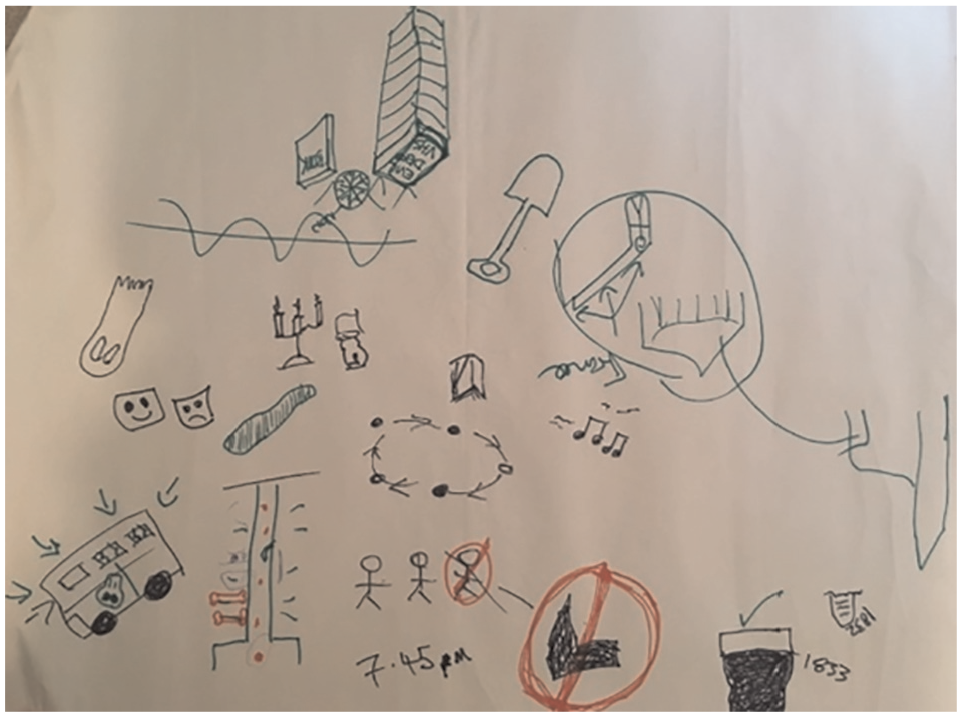
GGT rich picture.

RMKC 1 rich picture.

RMKC 2 rich picture.
Following the drawing sessions, a plenary allowed the groups to explain the meaning in each image of their pictures. This led to the RTGs adding new images of additional topics to the pictures, and being audio-recorded, the explanations also helped the authors to understand the meaning of each image.
Data Analysis
The rich pictures completed for this study were analyzed using Carney’s (1994) seven-step process for critiquing art, which Bell and Morse (2013b) suggest helps to merge formal analysis with interpretation by looking at the stylistic features to better understand the participants’ aims and goals and what they deem as important. Carney (1994) posited the process involves sequential steps, starting with identifying the context of the art through the characteristic features. From this, descriptive features and structures (e.g., colors, shapes, arrangements, textures) should be identified to support preliminary judgments about the artist (Carney, 1994). An assessment must also be made of the primary esthetic features (e.g., dominating representational or expressive images), as well as value features of the art’s form and content (e.g., grouped vs. isolated images) (Bell & Morse, 2013b). Carney (1994) suggests judgment then follows of the conditions of the value features, or rather if it is a “unified and harmonious design” (p. 20). With these assessments, low-level interpretations of the art are possible, which Bell and Morse (2013b) suggest establish the overall meaning and content of the picture. Finally, and for rich picture building, the low-level interpretations need to be compared to the participants’ explanations of their drawings, which will allow for high-level interpretations and a final critical judgment of the overall meaning and value of the picture (Bell & Morse, 2013b). For rich picture building, Carney’s (1994) steps for critiquing art is less about critiquing the artistic ability of the participants than it is about revealing the meaning and emotion within the pictures. In doing so, Carney’s (1994) process offers greater insights into the potentially unspoken perspectives of RTGs.
Following Bell and Morse’s (2013b) explanation for applying Carney’s (1994) process to rich pictures, the rich pictures created in this study were analyzed for their context and content to establish the low-level interpretations outlined in Table 2.
Rich Picture Analysis.

Following Bell and Morse’s (2013b) guidance to establish high-level interpretations and final critical judgments of the rich pictures, the groups’ explanations of their pictures were next reviewed and then compared to the low-level interpretations of the pictures. The explanations (audio recorded and transcribed) were analyzed through thematic analysis using manual coding and a line-by-line latent approach (see Table 3). This helped to identify the RTGs’ underlying feelings and perspectives within the semantic text (Braun & Clarke, 2006), thereby enhancing the meaning within the collected data (Clarke & Braun, 2017).
A Sample of the Verbal Data and Associated Codes.

When compared to the low-level interpretations of the rich pictures, the thematic analysis helped to establish high-level interpretations that allowed for final critical judgments of the RTGs’ perceptions of their role and their attractions’ visitor experience (see Table 4).
Rich Picture Analysis, Post-Plenary Review.

Trustworthiness of the data was achieved by following Lincoln and Guba’s (1985) recommendations to ensuring research quality. As such, credibility was achieved by the authors’ participation in each attraction’s visitor experience to see first-hand if the issues described in the rich pictures and post-drawing discussions were credible, of which many were indeed observed. Data validity was achieved through data triangulation of the rich pictures, recorded discussions during the rich picture drawing and the post-drawing explanations. Finally, the use of purposive sampling and the RTGs’ common experiences exposed by the rich pictures enhanced the transferability of the findings presented in the following.
Findings
The RTGs perceive their role as essential and their visitor experiences generally adequate. However, a number of issues appear to influence their perspectives, including issues of communication and inclusion, the management of historical accuracy, and the quality and effectiveness of design features. Commonalities across the rich pictures were identified and in the RTGs explanations of their drawings. As outlined in the following, these issues were in direct reference to how they perceived their role and the design of their visitor experience, specifically the use of edutainment interpretation and re-enactment.
RTGs Perspectives of Their Role
Discussing their role in running the S2D visitor experience, the images in Figure 5 denote the RTGs frustrations with communication issues. The rigid, hard lines depicting angry faces in Images B and C help to illustrate their frustrations, whilst the upward arms of the stick figures in image A reinforce their confusion illustrated by the numerous question marks. When compared to their verbal explanations, the images make clear the RTGs are unsure of their role and/or duties.

S2D—issues with communication: (A) staff do not know who to go to with their ideas or concerns; (B) there are no phones on-site to contact the Office Team (off-site) when needed; (C) staff must use email to contact Office Team, however, Wi-Fi does not always work; and (D) management sends maintenance to the site without informing staff in advance.
Similar findings were found of the RTGs at RMKC. Images A and B in Figure 6 reinforce the text statement in Image C about the lack of communication. As found with S2D, the images of unhappy faces depict the frustrations among the RTGs. Specifically, the wide eyes in Image A reflects surprise and/or confusion, whilst the use of red in Image B emphasizes the feeling of unhappiness. Interestingly, the text written in Image C makes clear the lack of communication. However, the splicing of terms suggests the RTGs lack the necessary support to understand their role and the visitor experience. Image C directly relates to images D and E, which, complimenting their verbal explanations, refer to the RTGs’ frustrations with the expectations placed on delivering 5-star tours within timing restrictions that prevents them from spending time answering visitor questions. Consequently, there is confusion and frustration with the purpose and objectives of their role and the visitor experience.

RMKC 1—issues with communication: (A) RTGs struggle with being able to answer all visitor questions within the strict tour times; (B) RTGs are generally unhappy with their role and the operations of visitor experience; (C) lacking communication creates issues for RTGs understanding their role and the visitor experience; (D) RTGs are under pressure to deliver 5-star tours, but are limited in how much time they can spend with visitors; and (E) RTGs want more time with visitors on their tour in order to deliver 5-star tours.
Communication issues induce the low RTG morale and feelings of not having a voice, particularly in reference to them offering ideas and observations of issues concerning the visitor experience (see Figure 7). Explaining Image A, one RTG stated broken props and technologies ruin the tour, which impacts staff morale: “See here is a wheel, and it’s broken. Then you have someone here saying ‘Just keep turning it, Jim’.

Common issues with the visitor experience: (A) RTGs are frustrated with the lack of change and reinvestment, resulting in the continued use of broken props; (B) tours are consistently booked to maximum capacity where no one can see or hear the RTGs properly; (C) random visitors are booked on tours with school groups to fill capacity, making it hard for RTGs to mediate; (D) owners/managers are never on-site to see the experience in action and where reinvestment is needed; and (E) reinvestment is needed, specifically into the actual site.
During their explanation and on the topic of speaking to management about their ideas, observations and/or frustrations, the RTGs at RMKC and S2D revealed feelings of being unsupported. Discussing their drawings, they commented “we don’t have a voice, I don’t think… we don’t get a say in any of it” and “I think that we should be able to just say,
The rich pictures also highlighted the RTGs’ other responsibilities, such as performing first aid and managing public safety. Figure 8, Image A refers to first aid as an issue since most of the RTGs are not first aid trained, and therefore cannot legally perform first aid when needed. The use of red for the question mark symbol in Image A denotes the importance in which the RTGs feel they should be first aid trained. This was explicit in their descriptions of experiences when visitors had fallen ill or collapsed on tour, resulting in them having to wait for help from the first aid trained management. Other RTGs commented on their responsibilities of managing public safety and needs. However, limiting operational issues, such as limited facilities (frustrated face in Image B) and staff shortages (red prohibition symbol over stick figure in Image C) complicates their role further as visitors will complain to them about operational issues, and yet they have no control or power to do anything about them.

Common issues with other duties: (A) RTGs are not full first aid trained, which is dangerous for unforeseen circumstances when leading tour groups; (B) visitors complain about the limited facilities on-site; staff must close the site to use nearby facilities; and (C) staff shortage limits tour experience and makes crowd management more challenging.
Despite the frustrations in the rich pictures, Figure 9 depicts the RTGs’ passion and love for the history and leading tours. They offer new ideas, such as extending the tour times as reflected in Image A and offering after-hour special events, such as stand-up comedian and film screenings as reflected in Image B, to generate more money for reinvestment, which would ensure 5-star visitor experiences. Additional comments support these images, such as “We are all very passionate about the site, but there is a lot of things that could be done that could make it a lot better for both the guests and staff.”

RTGs passion for the history and experience: (A) RTGs want more time to perform 5-star tour experiences; (B) RTGs have non-tour ideas that could generate more money to be reinvested into the tour; (C) RTGs think the tour idea is good, but the execution of it requires improvement; and (D) RTGs want to enhance to the tour with RTGs to better fulfill guest expectations.
In discussing the characters of the tours, and with specific reference to the plague, the RTGs were all very cognizant of the sensitivities that require consideration when dealing with a history of suffering and death. For this reason, the RTGs at GGT explained their main character is a nameless plague victim who is representative of all plague victims, thus removing any onus to the memory of anyone specific who suffered. This allows them to play with their vocal ability and physical movements to create a more engaging character, which the literature suggests is useful for enhancing the visitor experience (Magelssen, 2006; Ward & Wilkinson, 2006). Although the tour provides graphic details of how many suffered from the plague, the RTGs commented GGT is not like their
Sensitivity and a sense of gravity in personifying real people from the past was a key concern for the RTGs at RMKC. Because they depict real people from the past, Figure 10 depicts issues raised relating to their costumes and narrative, which affect the RTGs’ feelings of frustration and/or embarrassment, further influencing their negative perception of the tour’s historical integrity. Although period inspired, referring to Image B, the RTGs took issue with the costumes “cheap” appearance and poor maintenance. With comments such as, “We get people all the time saying the guides smelled quite bad on the tour. It is because the costumes are rancid,” it was clear the RTGs felt their costumes ought to be of better quality or at least better maintained in order to achieve the 5-star experience the attraction aimed to present. A few took issue with the fact they are to act and behave as though they are actually from the past. Referring to the unhappy looking Disney characters in Image B, one RTG stated the tour is not like Disneyland, as their visitors know they are not time-travelers visiting from the 17th century, and to suggest they do is patronizing.

RMKC—personifying real people: (A) The characters are too Disney and tarnish the historical integrity of the site; (B) the costumes are cheap and inauthentic; (C) the narrative is speculative; and (D) the history is airbrushed (softened) to make it more palatable for visitors.
In discussing their characters, the RTGs at S2D and GGT explained characters are assigned based on their performative abilities given most have a background in theater, while at RMKC they are based on their accents to help enhance the impression of having stepped into Edinburgh’s past. For example, those with Scottish accents re-enact Scottish characters, while most other accents re-enact Foul Clengers (i.e., plague cleaners). On this topic, one RTG appeared chuffed when explaining visitors “light up” when they hear their Scottish accent because “they think they’ve bagged themselves a little native.” While this could be seen as objectifying the locals (Potter, 2016), the RTG seemed unfazed by the issue.
In addition to acting as people from the past, Image C and D of Figure 10 represent the RTGs’ concerns of the speculative nature of the narrative, which makes their role more challenging. While some who had a theater background took issue with the writing of the script, others who have studied the history took issue with the content. Some argued parts of the narrative seemed airbrushed to lessen the grim nature of the history, which they depicted in Image D using wavy lines superseding the history, thus representing the speculation and/or softening that overshadows the actual history. They explained these issues made them feel pressured to bring the information (or misinformation) to life. Another commented the speculative nature of the script makes them feel bad for delivering what they perceive as lies. This led to discussions concerning the use of humor and appropriateness of jump scares, particularly in the plague room—an exhibition that depicts a family suffering from the plague, including a child having buboes lanced and a baby suffering in the arms of its mother. One RTG commented visitors often cry in this room because of the graphic details. There was a feeling of discontent on this issue, particularly concerning their personal morals and values in respecting the memory of those they portrayed. While some RTGs put more humor into their performance, others gauge how the visitors are reacting to the tour and content, and adapt their delivery to accommodate their reactions, such as being more sensitive in their storytelling.
RTGs Perspectives of the Design of Their Attraction’s Visitor Experience
As made clear in their perspectives of their role, the RTGs are all passionate about the history and their visitor experience. The findings reveal a balanced perspective of their visitor experiences with constructive criticisms and positive understandings reinforced with aspirational ideas.
The overall perspective among the RTGs is that their visitor experience is generally good. However, changes to accommodate a wider range of visitors would enhance the experience. At S2D, for example, the green check marks in Figure 11, Image A denotes the narrative is good. However, Image B signifies a need for more hands-on activities on the lower floor, particularly for children, since families with children do not spend as much time reading the text panels as older visitors (see Image C). Yet, they recognize their audience is not specifically children or families with children, and so balance is necessary. Image D and E were of particular importance, as they prompted discussions about marketing, which make the museum seem scary or like a Dungeon experience with lots of gore and character actors. While re-enactments occur, they are less regular due to the minimal space and staffing limitations, which is disappointing for both visitors and the RTGs, who like doing re-enactments (denoted in the happy faces of Figure 9, Image D). In fact, they stated once an RTG walked around the town dressed as the plague doctor and it not only raised awareness about the museum, but people became very engaged, coming to the museum deliberately to see the plague doctor.

S2D—reviewing the visitor experience: (A) the narrative is good; however there may be too much information on text panels; (B) the overall design is good, however there should be more hands-on exhibits downstairs; (C) families don’t spend as much time reading text panels as older visitors; and (D) marketing makes the museum seem more like a Dungeon experience.
Similarly, the RTGs at GGT also feel their visitor experience is good and accommodates a wide range of visitors through the strategically designed atmosphere. Figure 12 reveals design features, such as dramatic staging using bones to line seats and blackout curtains (Image A), lighting and music (Image B), were inspired by hammy horror movies of the 1980s, like

GGT—reviewing the visitor experience: (A) bus designed as a crypt with black-out curtains, the performance occurs on the top-deck; (B) film scores, such as
All of the attractions bring history to life through edutainment interpretation, specifically using sensory technologies, thematic staging, and re-enactments, which the RTGs agreed is generally popular among visitors, thereby reinforcing the Light and Ivanova’s (2021) findings. In fact, all RTGs commented on the need for more characters to enhance their visitor experiences. At RMKC for example, the RTGs argued more characters would help better simulate “real” accounts from the past, as opposed to using

RMKC—reviewing the visitor experience: (A) talking portraits ruin the historical integrity of the tour; (B) visitors can’t take their own photos, but the attraction can charge them for poor quality photos; (C) colored lights are blinding and ruin parts of the tour; and (D) too much time spent looking at a fake toilet instead of on Mary King’s Close.
Referring to Figure 13, Image B, they took issue with the fact that visitors are not allowed to take pictures with their own camera. One RTG explained this is because it would slow the tour down. However, they argued it is then frustrating because the business offers a poor-quality photo opportunity on Mary King’s Close that visitors must then pay for. They explained it is one of the ways that the business exploits the site. Other issues, such as the use of colored lights that distract from the tour experience (colored light projector shining at a stick figure with X’s in their eyes in Image C) and inauthentic props that distract from the physical site (replica 17th century toilet in Image D) were also a source for contention. The RTGs explained such tactics “compromise the historical integrity of the Close.” Instead, as reflected in Figure 14, they called for re-created streets that visitors could walk through to get a better sense of what life was really like on the Closes, and importantly, using strategic lighting to slowly reveal, for dramatic effect, Mary King’s Close, which is the tour focus, but currently receives the least tour time.

The RTGs’ tour idea.
Discussion
This study explored RTGs at lighter dark tourism attractions, focusing on their perspectives of their role and their visitor experience. From data collected in focus groups with rich picture building, the key findings revealed the RTGs perceive their role as being essential for their visitor experience; however, operational issues create challenges that affect them emotionally, which influences their tour delivery. The findings also revealed the RTGs held positive and negative perspectives of the visitor experience, which resulted in several ideas for how to enhance them. These findings not only extend the literature, but also contribute to practice with new insights for how RTGs are essential for enhancing visitor experiences given their direct observations, particularly when dealing with sensitive subjects, like the plague. Specifically, the findings revealed the RTGs constantly make judgments about their roles and their visitor experience, thus echoing Bryon (2012) and Potter (2016), and as a result, have formed new ideas for how to improve them with innovative ideas, such as hosting after-hours events and changing the design to be more simulative. These ideas offer practical contributions that demonstrate attraction management should create space for open conversations with RTGs about how visitors are reacting to the tour design in real-time and how the visitor experience could be further enhanced. Such efforts may help to lessen frustrations and thus tensions that appear to underlie RTG–management relationships, which, echoing Bryon (2012) and Potter (2016), are in consequence of RTGs’ limited autonomy to make changes and feelings of being ignored. Through open conversations, attraction management could better understand how and why RTGs make content and tour related judgments, which, as Quinn and Ryan (2016) also found, influences their decisions to make alterations in real-time. This is important for attraction management to understand because since these judgments are mostly in response to visitor reactions, the findings may offer management a greater understanding for what their visitors need or want from the experiences. True, some RTG judgments are due to their personal values and opinions concerning the narrative and interpretation design. However, given most of the RTGs have a background in theater or history, thus reinforcing Ferguson et al. (2016) and Macdonald’s (2006) claims, the findings demonstrate the RTGs’ capability of making sound decisions for enhancing the visitor experience. While the frustrations exposed raise questions as to why the RTGs do not find other work if they are so unhappy, the findings revealed their love for the history and tour guiding continue to motivate them. This echoes Bryon’s (2012) argument that it is often the passion for tour guiding and love and pride for the tour content that keeps guides motivated and enthusiastic about their role. For RTGs, this is even more the case because as they are not just guiding a tour. Rather, they are bringing to life those who once lived and suffered, which requires them to have an empathetic appreciation for enacting those people’s history (Christie & Mason, 2003; Potter, 2016) in order to appropriately respond and adjust their tour when visitors appear to find the content upsetting. Such considerations for how they personify real people who once suffered demonstrate their commitment to what Brædder et al. (2017) calls, responsible representation, and further evidences they understand the needed gravity and seriousness in their personifications, further extending the literature by demonstrating their emotional intelligence and ability to assess how content affects visitors (Brin & Noy, 2010; Cheng et al., 2021). This is of upmost importance considering they depict plague suffering in a post-COVID-19 world, which may now be more upsetting for visitors considering the similarities between the two pandemics in terms of human loss and suffering. It may be further difficult for visitors to accept a humorous depiction of the plague when physical similarities have been observed between the two pandemics, including the symptoms of fever and headache, the transmission capability via respiratory droplets (Gillespie, 2022), and their management via quarantine and personal protective attire (i.e., masks, gloves, outer clothing protection) (Shamekh et al., 2020). Still, the findings revealed the RTGs recognize visitor preferences for edutainment experiences (in a pre-COVID-19 world), including re-enactment, advanced technologies, and humor, thereby reinforcing the claims that humor and co-created experiences are beneficial for engaging visitors in learning about past tragedies (Light & Ivanova, 2022; Magelssen, 2006; Tu et al., 2020).
Conclusions
In review of the key findings, it is clear the role of RTGs is a significant one for visitor experiences. As reflected in Figure 15, they share functions and characteristics of re-enactors and tour guides (period-dressed and uniformed), thereby affirming the notion of hybridity (Turner & Peters, 2015). However, in being hybrid, as revealed in the findings, the RTGs also share the challenges and complexities of both re-enactors and tour guides, including responsible representation and delivering a quality performances, whilst leading tours and managing group dynamics and safety, and all while attempting to create impressions of the past by turning tragedy into an enjoyable visitor experience.

The scope of tour guiding in dark tourism.
Limitations and Recommendations for Future Research
As demonstrated previously, this study extends the literature and offers practical insights relating to RTGs at lighter attractions. However, several limitations help to promote suggestions for future research. First, this study brings RTGs to the forefront of dark tourism research, but it does not represent the full scope of RTGs also found at darker and/or gray attractions (i.e., those that share darker and lighter characteristics) (e.g., Cascades Female Factory Historic Site, Australia) who may face greater complexities in dealing with darker or more sensitive content. Second, although it introduces three unfamiliar lighter attractions to the range of locations found in the literature, this does not fully resolve the dark-light research imbalance that has left the wider scope of lighter attractions largely under-explored. Third, while the findings demonstrate RTGs are conscious about the seriousness of re-enacting human suffering and loss from the plague, the study was conducted prior to COVID-19. It is therefore unknown if RTGs feel it is still appropriate to re-enact scenes of the plague suffering since so many suffered from COVID-19, or what some are calling “the Black Death of the 21st century” (Shamekh et al., 2020). The limitations of this study thus promote suggestions for future research, specifically greater attention toward lighter attractions and the wider range of RTGs across the full dark tourism experience scape. This would enhance the transferability of these findings, whilst helping to resolve the dark-light research imbalance. Moreover, an exploration into how RTGs and visitors perceive humorous depictions of the plague in a post-COVID-19 world would clarify if there is still a social acceptance for lightheartedness in depicting pandemic-related tragedy. Finally, an examination of the role of RTGs from a management perspective could offer insights into how they perceive the inclusion of RTGs in tour management, how they can make the role more attractive for future RTGs, and what additional resources are needed to ensure RTGs are creating impressions of the past that engage visitors in unique and memorable experiences.
Footnotes
Declaration of Conflicting Interests
Funding
ORCID iD

Data Availability
.