







Abstract
Abduction or kidnapping—the unlawful seizure, transportation, and/or detention of a person against his or her will—is a crime that has been ignored by researchers in criminology and psychology, despite its serious nature as well as the various challenges it presents for law enforcement (Tillyer et al., 2015). For instance, DeLisi (2001) showed that individuals who commit kidnappings—just like those who commit rapes and murders—present more extensive violent arrest records compared with other habitual offenders. Similarly, people who commit kidnapping have been found to be 30 and 4 times more likely than males in the general population and individuals convicted of sexual crimes, respectively, to be later convicted of homicide, suggesting that kidnapping constitutes a risk for escalation in violence (Liu et al., 2008).
One of the reasons suggested to explain the paucity of academic attention has been the lack of data, especially in the United States where kidnappings are not included in the Federal Bureau of Investigation’s (FBI) Uniform Crime Report (UCR) or the National Crime Victimization Survey (NCVS). To fill this gap in the United States, the National Incidence Studies of Missing, Abducted, Runaway, and Thrown-away Children (NISMART) was established in 1988 (Finkelhor et al., 1990). However, several limitations have also been noted with this database, such as the inability to collect information about multiple crimes or co-occurring crimes (Tillyer et al., 2015). The most important of these limitations was that it included only cases involving children, suggesting that abductions were not a concern for adults. In fact, most of the existing literature on abductions concerned children (e.g., Baker et al., 2002; Collie & Shalev Greene, 2016; Park & Cho, 2019; Walsh et al., 2016; Warren et al., 2016). When adults—especially adult women—were victim of abduction, it was preceding another crime (e.g., rape, robbery). It has been suggested that the complexity associated with the combination of two distinct types of crime into a new one—such as sexual assault and homicide for sexual homicide, or in this case, abduction and sexual assault for sexually motivated abduction—could represent another reason as to why these “hybrid offenses” have been under-researched (Asdigian et al., 1995; see also Beauregard & Chopin, 2020). Another possible reason to explain this was related to the fact that research on abduction has mainly relied on what Walker (2014) has referred to as “celebrated cases”—that is, cases that make the headlines and capture the attention of the media but are considerably different from the overall general cases (see Mears, 2010). Finally, prior studies on abduction have focused only on certain aspects of this crime, neglecting to look at the entire criminal event.
In the current study, we argue that sexually motivated abductions are different from nonsexually motivated abductions—especially as to their target selection and criminal event characteristics—thereby showing that the motivation for a crime influences how it will be committed. Moreover, we propose that the act of abduction may reveal a specific crime-commission process different from sexual assaults committed without abductions. Identifying specific target selection and criminal event characteristics of sexually motivated abductions may help law enforcement agencies to better organize their response in such events as well as contribute to suspect prioritization (Rossmo, 2000; Shelton et al., 2016).
Analyzing Abduction: The Criminal Event Perspective
Criminological theories have often been criticized for neglecting the dynamic nature of the interpersonal interaction that occurs between an offender and a victim—that is, the event—focusing instead solely on the act (Kennedy & Forde, 1999). This failure led to the emergence of the criminal event perspective (CEP) (Miethe & Meier, 1994; Sacco & Kennedy, 2002a). According to Sacco and Kennedy (2002b), the behavior of any one participant (offender and victim) in the criminal event intersects with and influences the behavior of other participants, shaping the course of the event and determining the stages through which it progresses and the extent to which it will be judged a serious one. Applied to cases of abduction, CEP allows to better understand how the offender’s motivation may shape the targeting of his victim, his action during the crime, as well as how the victim is likely to react. The major advantage of CEP is that it conforms to the way the world works, that is, criminal events have a beginning and an end and occur over time in a sequential fashion (Sacco & Kennedy, 2002b). Certain routines of behavior serve as scripts for what is likely to occur in these types of situations (see Cornish, 1994). In criminology, each type of crime involves specific information processing that leads to a sequence of choices and actions (Cornish, 1994). Scripts inform us about the procedural aspects and requirements of crime-commission sequences, while identifying the decision processes and actions of offenders as well as the situational variables that play a role at each step of the specific crime committed. By focusing on events rather than acts, the CEP presents a framework for analyzing crime that is less dependent on single variable explanations, moving instead to a conceptual level that sees crime as a consequence of the choices people make in structured social contexts (Kennedy & Gibbs Van Brunschot, 2001).
Crime Behaviors and Characteristics of Abduction Cases
In their seminal study on cases of abductions in children and adolescents, Asdigian et al. (1995) showed that sexual assault abductions were more likely than nonsexual assault abductions to be committed by males, young adults, and lone perpetrators, on females and teenagers, with the use of physical violence, weapons, and ruse. One of their most significant findings, however, was that sexual assaults with abduction were clearly different from other sexual assaults, involving more acts of penetration by strangers. This finding led Asdigian et al. (1995) to suggest that the act of abduction was not random or negligible, but instead could facilitate the commission of a more serious crime.
Fitzgerald and People (2006) published a descriptive report of 238 cases of abductions that occurred between January and June 2004 under the jurisdiction of the New South Wales Police. Their investigation showed that while most of the victims were really abducted (57%), a large number of abductions were either unsuccessful (32%) or did not occur (e.g., victim provided a false statement, misunderstanding between the offender and victim; 11%). In actual cases of abduction, most victims were female aged of 24 years old. Interestingly, the abduction of children (less than 10 years old) was not a frequent occurrence (i.e., only 5%). As to the individuals committing these crimes, they were mostly strangers, followed by past or current intimate partners and friends or acquaintances. Victims were typically forced into the offender’s car or detained in a dwelling, and the event generally lasted a few hours (although some events lasted as long as 1 month). In most cases, no weapon was used. However, in cases where a weapon was used, it was mostly a knife, followed by guns and other objects (e.g., screwdriver). In terms of injuries, almost half did not experience any, whereas 16% and 6% were sexually or indecently assaulted, respectively. It is noteworthy that 31%, however, experienced a nonsexual physical assault during the event. Fitzgerald and People (2006) identified three main motivations for abduction, representing 88% of all cases: sexual desire (i.e., sexual or indecent assault on the victim or threatening comments of a sexual nature made to the victim; 35%), robbery (i.e., victim was robbed, an attempt was made or victim was threatened of being robbed; 29%), and retribution (i.e., acted out of rage with an intent to enact revenge against the victim; 24%). Interestingly, their findings also showed differences related to the motivation for the abduction (e.g., injuries, use of a weapon).
Using data from the National Incident Base Reporting System (NIBRS), Tillyer et al. (2015) tested whether the offender–victim relationship was associated with victim injury, sexual victimization, and correlates of arrest in kidnapping incidents. They found that kidnappings committed on family and acquaintance were more likely to result in victim injury compared with strangers. Similar to cases of sexual assaults, victims who knew their perpetrators were more likely to resist, leading these individuals to use instrumental violence to obtain compliance (Tillyer et al., 2015).
Furthermore, incidents committed against older victims, involving multiple offenders, male offenders, as well as male and female offenders were more likely to lead to victim injury. Similarly, those incidents that occurred at a private location, involving a weapon (i.e., knives or other weapons), and when the individual committing the kidnapping was under the influence of drugs and/or alcohol, were also more likely to lead to victim injury. On the other hand, incidents taking place during the day, at a semi-public location, involving younger male victims were less likely to result in victim injury.
Regarding sexual victimization during kidnapping incidents, results indicated that kidnapping incidents perpetrated by older, multiple, male, male, and female offenders, with the use of a knife, were more likely to include the sexual assault of the victims. However, kidnappings initiated during the day, involving older, multiple, male, male, and female victims were less likely to include a sexual assault. According to Tillyer et al. (2015), these findings could be related to the differences in criminal motivation by the offender–victim relationship.
Despite the fact that previous research has shown that abduction or kidnapping is related to more serious offenses and criminal careers, incidents not restricted to children have been largely ignored by criminological research. Partly based on the focus of previous studies on the abduction of children, target selection characteristics have been overlooked. Moreover, most published studies have examined abductions without considering the actual motivation for the act, neglecting to take into account the event characteristics. Therefore, the current study attempts to answer two different but related research questions: (a) Do sexually motivated abductions involve different target selection and criminal event characteristics from nonsexually motivated abductions? and (b) Do sexually motivated abductions involve different target selection and criminal event characteristics from nonabduction sexual assaults? The overarching goal of the study is to test whether the act of abduction perpetrated by a nonfamily member (i.e., acquaintance or stranger) may reveal a specific crime-commission process, as well as whether the act of abduction may be an indicator of a more serious crime. It is believed that such knowledge about the criminal event of abduction cases perpetrated by a nonfamily member could help law enforcement organize their response when they occur as well as prioritize certain suspects based on the target and event characteristics.
Method
Sample
The sample used in this study consists of 1,588 cases of abduction (1,288 sexually motivated and 270 nonsexually motivated) that occurred in France between 2000 and 2018. Since more than one definition of abduction exists in the literature, the current study defined cases of abduction by integrating various components from prior definitions. Thus, an abduction is the unlawful seizure, transportation, and/or detention of a person against his or her will. The current study included only those cases perpetrated by a nonfamily member (i.e., acquaintance or stranger). The study also included a group of nonabduction sexual assaults (
Procedure
All of these data were taken from a large national database including cases of extrafamilial (i.e., excluding violence occurring in a domestic context) violent and/or sexual assaults. This database includes information on offender, victim, and crime characteristics and data are derived from various sources of information. To avoid missing data, information is compiled by a team of crime analysts on violent crimes. Although it is still possible to have missing values as the information may not always be known, this was not the case with the variables examined in the current study. For each case, the information was taken from investigative reports, interview reports (i.e., with victims and offenders), medical/autopsy reports provided by pathologists, psychological reports provided by a team of forensic psychologists, and crime scene forensic reports. Instead of using only police reports or interviews with offenders, the current study used data compiled by the team of crime analysts responsible to code each violent crime recorded on the France territory. These crime analysts have been trained on how to code each variable of the database. Although no inter-reliability tests are possible (i.e., given this is a database used for operational purposes), the training of the crime analysts constitutes a safeguard for the quality of the information entered in the database (unlike using only police reports). Moreover, using all the available sources of information available for each criminal event (e.g., police report, victim statement, offender interview) allows the crime analysts to conduct triangulation of information, again adding to the quality of information used in the study. Ethics approval was obtained from the Institutional Review Board (IRB) of the first author’s institution to conduct the current study.
Measure
Two dependent variables were examined in the current study: (1) sexually motivated abduction (
Target Selection Characteristics
A total of 14 variables described target selection characteristics: (1) female, (2) single, (3) child, (4) lives alone, (5) disabled, (6) under the influence of alcohol prior to crime, (7) under the influence of drugs prior to crime, (8) involved in domestic activities when attacked, (9) sleeping when attacked, (10) in a parking lot when attacked, (11) commuting when attacked, (12) hitchhiking when attacked, (13) in a bar when attacked, and (14) involved in prostitution activities when attacked.
Event Characteristics
A total of 25 variables described the characteristics of the criminal event: (1) daytime attack, (2) weekend attack, (3) stranger attack (i.e., describes situations where offenders and victims were totally unknown to each other), (4) attacked at home, (5) victim targeted, (6) con approach (e.g., befriended the victim, posed as an authority figure, offered assistance), (7) surprise approach, (8) blitz approach, (9) resistance from victim, (10) negotiation with victim, (11) reassures victim, (12) use of restraints, (13) use of weapon (i.e., offender had a weapon during the crime but not necessarily used it), (14) victim beaten, (15) serious injuries inflicted, (16) victim killed, (17) victim kept in offender’s residence, (18) victim kept in offender’s car, (19) victim kept outdoors, (20) victim released intentionally, (21) vaginal penetration, (22) anal penetration, (23) fellatio, (24) masturbation, and (25) fondling.
Analytical Strategy
The analytical strategy used in the current study followed a multi-stage process. The first step consisted of identifying at the bivariate level (chi-square tests) the significant differences between sexually motivated abductions and nonsexually motivated abductions as to the target selection and the event characteristics. Then, the second step involved analyzing significant differences observed at the bivariate level in multivariate analyses. Sequential binomial regression analyses were used to both identify the specific characteristics associated with sexually motivated abductions and determine the weight of each block of variables (i.e., target selection and event characteristics). Model 1 included only the target selection characteristic, Model 2 included only the event characteristic variables, whereas Model 3 included both the target selection and event characteristic variables. The same process was repeated but this time looking at the differences between sexually motivated abductions and nonabduction sexual assaults. 2
Results
Table 1 presents the results of the descriptive and bivariate analyses (chi-square analyses) comparing sexually motivated and nonsexually motivated abductions with regard to the target selection characteristics. As can be seen, most of the abduction victims were female and more than half of them were also single. It is noteworthy that when looking at what the victims were doing during the victimization event, most of the victims were not engaging in what might be considered “high risk” behaviors. Only a minority of victims were engaged in, what we considered, high-risk behaviors of being under the influence of drugs or alcohol, hitchhiking, or involved in prostitution just prior to being abducted. Indeed, just prior to being abducted, most of the victims were engaged in behaviors that may be considered low risk.
Comparisons Between Sexually Motivated and Nonsexually Motivated Abductions on Target Selection Characteristics
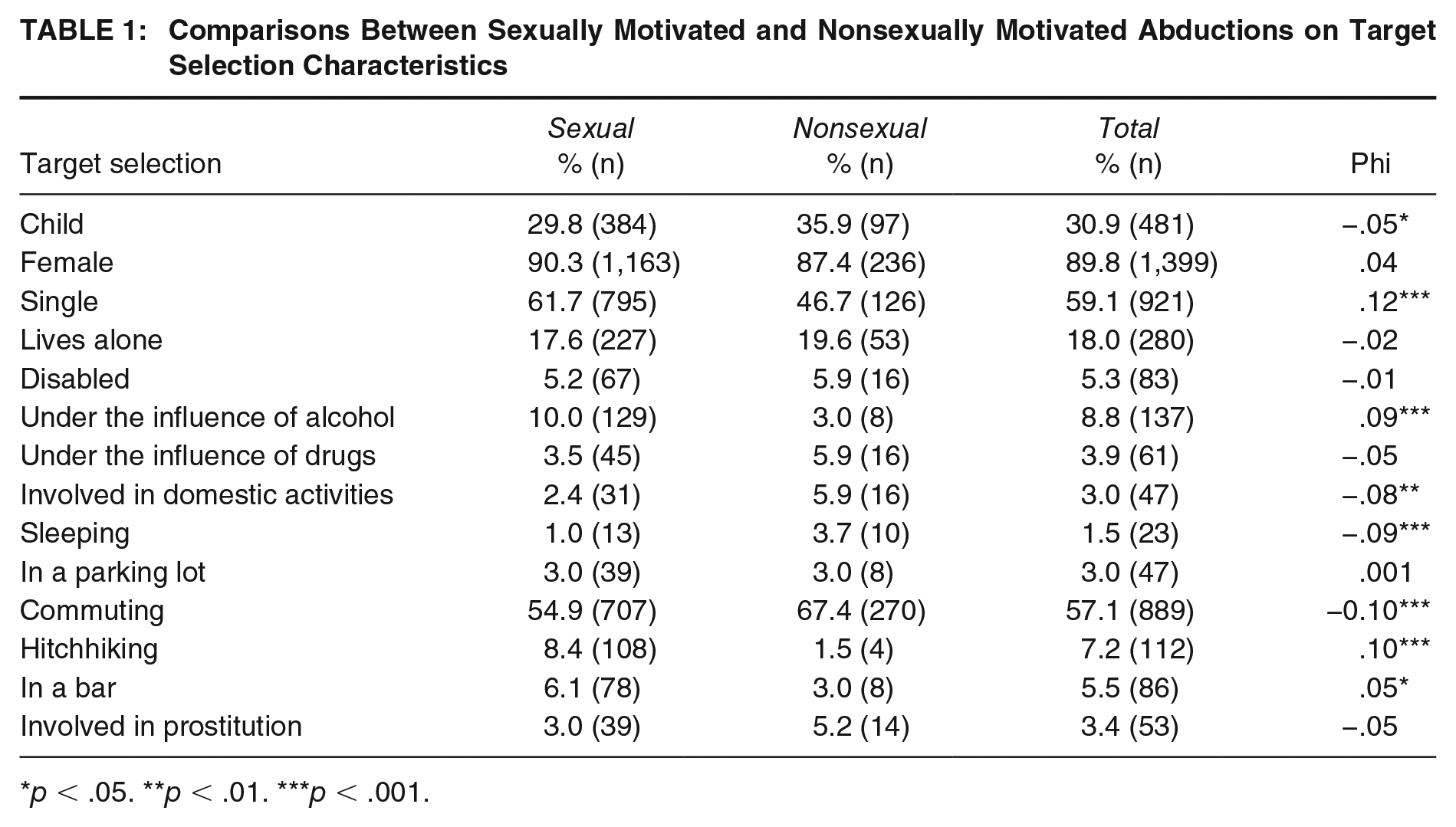
Despite this apparent low risk in abduction victims, there were significant differences between sexually motivated and nonsexually motivated cases. Abduction cases involving a single victim, under the influence of alcohol, hitchhiking or at a bar just prior of being abducted were more likely to be sexually motivated. However, cases where the victim was either involved in domestic activities, sleeping, or commuting prior to being abducted were more likely to be nonsexually motivated.
Table 2 presents results of the descriptive and bivariate analyses (chi-square analyses) comparing sexually motivated and nonsexually motivated abductions with regard to the event characteristics. A little over half of the abduction cases took place during daytime and about a third were perpetrated during the weekend. Interestingly, the majority of abduction cases were committed by strangers, with more than two thirds using a con approach. In only a third of the cases, a weapon was used, and a minority of victims were either beaten, seriously injured, or killed. Victims were typically kept in the offender’s car or outdoors, or in some cases, at the offender’s residence.
Comparisons Between Sexually Motivated and Nonsexually Motivated Abductions on Event Characteristics

Similar to the target selection characteristics, several event characteristics distinguished the sexually motivated and nonsexually motivated abduction cases. Abduction cases that took place during the weekend and for which the individual responsible for the crime used a con approach and where the victim resisted were more likely to be sexually motivated. Moreover, cases where the victim was kept in the offender’s car and were released intentionally were more likely to be sexually motivated. However, abduction cases that took place during daytime, at the victim’s home, involving a child, and using a surprise approach were more likely to be nonsexually motivated. Also, cases in which the individual committing the abduction reassured the victim, used restraints, beat the victim, and kept the victim outdoors were more likely to be nonsexually motivated.
Table 3 presents findings of the binomial sequential regression analyses examining the sexually motivated abductions. Model 1 included only the target selection characteristics and presented a Nagelkerke
Sequential Binomial Regression of Factors Predicting Sexually Motivated Abductions (

Model 2 included only the event characteristics and presented a Nagelkerke
Finally, Model 3 included both the target selection and event characteristics and presented a Nagelkerke
Table 4 presents results of the descriptive and bivariate analyses (chi-square analyses) comparing sexually motivated abductions and nonabduction sexual assaults with regard to the target selection characteristics. Results showed that sexually motivated abductions were more likely to involve a female, single, under the influence of alcohol and drugs, who was younger than victims involved in nonabduction sexual assaults. Hence, of the sexual assault victims, those who are unaccompanied young females under the influence of substances have a slightly higher risk of also being abducted. Moreover, victims of sexually motivated abductions were more likely to be attacked in a parking lot, while commuting, hitchhiking, in a bar, and while involved in prostitution activities. However, cases of nonabduction sexual assaults were more likely to involve victims who lived alone, as well as involved in domestic activities or sleeping when attacked.
Comparisons Between Sexually Motivated Abductions and Nonabduction Sexual Assaults on Target Selection Characteristics

Mean is reported with standard deviation between parentheses and Omega square for effect size.
Table 5 presents results of the descriptive and bivariate analyses (chi-square analyses) comparing sexually motivated abductions and nonabduction sexual assaults with regard to the event characteristics. Results showed that on one hand, sexually motivated abductions were more likely to be characterized by a stranger offender, who used a con or a surprise approach, on a resisting victim. Moreover, cases of sexually motivated abductions were more likely to involve the use of restraints, weapons, the beating of the victim, the infliction of serious injuries, and the killing of the victim. Sexually motivated abductions were also more likely to take place in the offender’s residence, his car, or outdoors, and to involve acts of vaginal penetration and fellatio. On the other hand, nonabduction sexual assaults were more likely to be committed during daytime, when the targeted victim was at home, using a blitz approach, with acts of fondling.
Comparisons Between Sexually motivated Abductions and Nonabduction Sexual Assaults on Event Characteristics

Table 6 presents findings of the binomial sequential regression analyses examining the sexually motivated abductions. Model 1 included only the target selection characteristics and presented a Nagelkerke
Sequential Binomial Regression of Factors Predicting the Abduction in Sexual Assaults (

Model 2 included only the event characteristics and presented a Nagelkerke
Finally, Model 3 included both the target selection and event characteristics and presented a Nagelkerke
Discussion
One specific type of abduction appears to be an integral part of sexual crimes. Thus, some individuals abduct victims—whether child or adult—for a sexual purpose, whereas others perpetrate the abduction for the purpose of robbery or retribution (Fitzgerald & People, 2006). The current study focuses on sexually motivated abduction and attempts to answer two different but related questions.
The first question examines whether sexually motivated abductions are different from nonsexually motivated abductions. Our findings show that when the abduction is sexually motivated, it presents several differences with other cases of abduction that are not sexually motivated. Our findings show that sexually motivated abductions are typically committed on victims who are single, while they are hitchhiking at night, and perpetrated in the offender’s car. Victims are likely to resist and to be released intentionally by the offender following the attack. Such findings are congruent with what has been suggested in previous research, meaning that abduction cases are heterogeneous, presenting different motivations such as retribution, robbery, or sexual desire (Fitzgerald & People, 2006). Moreover, these findings show the importance of disaggregating cases of abduction to fully understand the crime-commission process involved. Thus, it is possible that as shown by J. Kennedy and Whitehouse (1992), different types of abductions could also be related to various offender characteristics, an assertion that we hope to assess in future studies.
Instrumental Versus Expressive Violence
Although we did not expect to frame our findings based on dichotomous categories of violence, it seems that the instrumental/expressive concepts apply to cases of sexually motivated abductions. Originally suggested by Feshbach (1964), expressive violence is characterized by an aggressive response precipitated by anger-inducing conditions (e.g., insult, physical attack) with the explicit goal of making the victim suffer. As to instrumental aggression, the individual attempts to obtain a desired object (or status) regardless of the costs, and violence is used mostly if someone interferes with that goal (Salfati, 2000). What appears particularly important here is the absence of expressive violence in sexually motivated abductions compared with those that are nonsexually motivated. The main preoccupation for individuals who commit sexually motivated abductions seem to be the need for sexual gratification. Interestingly, these individuals are known to also present a low level of expressive aggression and the absence of anger related to the crime (e.g., Burgess et al., 2007; Knight & Prentky, 1990). The modus operandi adopted in sexually motivated abductions clearly show that these individuals make decisions in line with their main objective—obtaining sexual gratification—which are different from other types of abductions. Such decision-making during the criminal event shows that individuals committing sexually motivated abductions are not simply reacting to the environment, but that they operate using a general set of beliefs that suggests to them how behavior will be received by others, and how it will be influenced by the specific contexts in which they operate. In line with the CEP, these choices are made on the basis of past experience, future expectations, and assessment of current interaction (Kennedy & Gibbs Van Brunschot, 2001).
Sexually Motivated Abductions: A Specific Script of Sexual Offending?
Using the CEP allowed us to focus on the various behaviors taking place during abduction cases. While considering the criminal event of sexually motivated abductions, it appeared that this form of crime could in fact represents a specific crime script as in the work of Cornish (1994). This specific crime-commission process involved in sexually motivated abductions was also identified when compared with nonabduction sexual assaults, confirming our second research question. Thus, when considering simultaneously both target selection and event characteristics, our results show that individuals committing sexually motivated abductions are more likely to target victims who are single, under the influence of alcohol, with the victim either in a car, a parking lot, or commuting. Also, individuals committing sexually motivated abductions are more likely to use a con approach on a stranger victim, to use a weapon, restraints, inflict serious injuries, and penetrate vaginally the victim either in their residence or their car.
These stark differences between sexually motivated abductions and nonabduction sexual assaults seem to suggest that the act of abduction itself is indicative of a specific script involved in sexual assaults. In criminology, scripts refer to a knowledge structure, or schema, that “organizes our knowledge of people and events in ways which guide our understanding of other’s people behaviors” (Cornish, 1994, p. 32). Each type of crime involves specific information processing that leads to a sequence of choices and actions (Cornish, 1994). Scripts inform us about the procedural aspects and requirements of crime-commission sequences, while identifying the decision processes and actions of offenders as well as the situational variables that play a role at each step of the specific crime committed. They represent the complete sequence of instrumental decisions and actions prior to, during, and following the criminal act (Cornish & Clarke, 2002). Thus, some individuals motivated to commit a sexual assault may decide to kidnap their victim to complete their crime-commission process characterized by more violence. Hence, these perpetrators use a con or a ruse to approach the victim, enough so that they can kidnap her either from their own residence or in their car, which provide them with a safe location to vaginally penetrate her. As mentioned, these sexual assaults are also characterized by more violence, as indicated by the presence of restraints, weapons, and the serious injuries inflicted. This is congruent with the findings from Liu et al. (2008), who suggested that kidnapping constitutes a risk for escalation in violence as well as from Asdigian et al. (1995) who show that the act of abduction is not random or negligible, but instead may be adopted to facilitate the commission of a more serious crime.
The fact that abductions are more likely to involve strangers is not surprising and has been observed by Tillyer et al. (2015) who reminded us that from an opportunity perspective, kidnapping a victim who is readily accessible (e.g., a family member or an acquaintance) is not necessary to carry out a sexual assault. Maybe a little more surprising is the fact that contrary to Tillyer et al. (2015), our findings show that in cases involving abductions, stranger victims are more likely to sustain serious injuries. One hypothesis to explain our findings is that after the victim has been approached with a ruse, the following steps involve violence, for instance, to force the victim in the car, the use of a weapon—to either threat or inflict injuries. Therefore, the act of abduction is a decision part of the script that calls for other acts of violence during the crime-commission process, which is more likely to result in victims’ injuries. However, we cannot exclude that these conflicting results could be due to the nature of our data as well as the fact that the sample used by Tillyer et al. (2015) compared strangers with nonfamily acquaintances and did not compare with nonabduction sexual assaults.
Abduction as a Means to an End?
As mentioned in the introduction, most of the literature on abduction has focused on children. It is possible that, as suggested by Mears (2010), the focus on children was driven mainly by some of these “celebrated cases” (Walker, 2014). Our results show that the age of the victim (child versus adult) is far less relevant to understanding perpetrator or crime-commission characteristics in abduction cases than whether the act is sexually motivated or not.
However, our findings also show that when comparing cases of sexually motivated abductions with nonabduction sexual assaults, age makes a difference. Thus, individuals committing sexually motivated abductions tend to select younger victims, compared with those who commit nonabduction sexual assaults. In other words, younger victims are more likely to be abducted than older victims. Although this may appear as contradictory to our previous interpretation, we believe this is not the case. What these results are showing is that—as suggested by a CEP (Sacco & Kennedy, 1996)—the need to abduct a victim may be more related to the circumstances of the crime and the goal pursued by the offender than the actual age. Hence, individuals committing sexually motivated abductions may need to adapt their crime-commission process to the actual accessibility of the victim and the act of abduction may represent an effective strategy to procure a younger victim who is more accessible—compared with older victims—due to their lifestyle and routine activities (Beauregard & Chopin, 2021; Chopin & Beauregard, 2020a). Also, it is possible that when it comes to the choice of abducting or not, the decision is based on the circumstances and context of the criminal event and less on the victim itself (Horan & Beauregard, 2018). In other words, certain types of victims found themselves in certain situations given their lifestyle—which is largely influenced by their age—and these situations prompt the use of certain strategies (i.e., abduction) for individuals committing sexual assaults to get access to these victims and commit certain sexual acts.
Implications
One implication of the current study is related to the fact that abductions are less associated with a specific type of victim, but rather with specific situations. From a situational prevention perspective, this implies that it is possible to act on situational and/or environmental components to discourage potential perpetrators from acting. For instance, considering that many victims are abducted when involved in everyday activities during which they are particularly isolated and/or vulnerable (e.g., outside, close to the offender’s car), limiting crime opportunities could be achieved by acting directly on the location (e.g., increasing the number of CCTV cameras, promoting natural surveillance in underground parking garages). Also, the study distinguishes the specific factors that characterize different types of abductions. These specific characteristics of the crime-commission process could be used by investigators to better identify the motivation—sexual or not—of the abduction case they are facing. Such information would not only help refining their working hypotheses as well as guiding their investigation, but also could help narrowing down the number of suspects. As suggested by previous studies (e.g., J. Kennedy & Whitehouse, 1992), individuals committing sexually motivated abductions are more likely to present prior convictions for sexual crimes. Thus, using the sex offender registry in combination with where the victim was abducted could improve suspect prioritization (Rossmo, 2000; Shelton et al., 2016). Considering that time is crucial in cases of abduction (Park & Cho, 2019), being able to identify early whether it is sexually motivated could prove important in
Limitations and Future Directions
Despite the quality and details of the data used, our study suffers from some limitations. The study is based on police data, which depend largely on the crimes being reported and the information provided by the victims during the investigation. It is therefore possible that the current findings are not generalizable to all sexually motivated abductions and that some cases of abduction were never identified as such. Probably the most important limitation of this study is the lack of information about the individuals committing these crimes. As shown in the study by DeLisi (2001), having detailed information about the criminal career of these individuals could prove very useful in the understanding of abduction and how this particular offending behavior can be related to specific offender characteristics. In addition, it could have been important to have information about some of the socio-psychological issues that may act as catalyst in these sexually motivated abductions. For instance, information about the presence or not of psychopathy could provide better knowledge about the dynamic involved in these abductions. It is also necessary to note that some of the significant differences observed were low in magnitude—as well as some of the cells for the bivariate analyses—suggesting the need to replicate the current findings with a new sample. Finally, we are well-aware that our study tested an important number of independent variables, which could potentially lead to Type 1 error. Although this can be mitigated by the use of certain procedures (e.g., Bonferroni correction), we decided against it given the exploratory nature of our study. Despite its usefulness in certain conditions, procedures such as Bonferroni corrections, may also lead to Type II errors, which would have been more detrimental here given the goal of our study. However, this study included multivariate analyses following these multiple comparisons at the bivariate level, which reduced the impact of potential Type 1 errors.
Future studies will need to take into account various offender characteristics that could indicate which individuals are more likely to commit acts of abduction. Moreover, future studies will need to look at characteristics associated with sexually motivated abductions that may lead to the death of the victim. Considering that these cases are likely to attract a lot of attention from the police and the public in general, it would be important to identify these cases early to prevent a lethal outcome. The act of abduction does not appear random. It seems to be part of a specific crime-commission process, indicating a particular level of violence. The question remains, however, as whether such specific crime-commission process is limited to only certain types of offenders.
Conclusion
The overarching goal of our study was to test whether the act of abduction may reveal a specific crime-commission process, as well as whether the act of abduction may be an indicator of a more serious crime. Our findings suggest that it does. Not only have we found that the crime-commission process adopted by individuals committing sexually motivated abductions was different, but also that the act of abduction itself seems associated to a more dangerous and violent criminal event. Coupled with the finding from DeLisi (2001) showing that individuals committing kidnappings are at greater risk of subsequent serious offending, it is clear that this particular behavior must be taken seriously not only by law enforcement but also by the various actors involved in the criminal justice system (e.g., corrections, judges). Moreover, such attention to abduction should not be limited to child victims but also to adults.
Footnotes
Authors’ Note:
ORCID iD
