







Abstract
Since sweeping into presidential offices across Latin America in 2000s, the Pink Tide has sparked an intense scholarly debate (Webber and Carr, 2012; Latin American Perspectives, 2019; Ouviña and Thwaites Rey, 2019), as researchers have attempted to come to grips with the political economy of Pink Tide governments. In the field of international political economy (IPE), a strand of this debate dating back to the early days of the Pink Tide revolves around the term
Following the rise of right-leaning governments since the mid-2010, the different strands of the Pink Tide debate have offered possible explanations for the end of the leftward turn in the region (Sankey and Munck, 2016; Gaudichaud, Modonesi, and Webber, 2019; Ellner, 2019). One focus of this debate has been the link between economic downturn and the dwindling political support for Pink Tide governments. For example, scholars working with the concept of (neo-) extractivism have placed the end of the Pink Tide in the context of the end of the commodity boom in 2012, which left governments no longer able to finance various social spending policies (Antunes de Oliveira, 2019; Riggirozzi, 2020; Veltmeyer and Petras, 2020). The following article contributes to the discussion about this link by analyzing the issue of consumer goods imports for the case of Kirchnerism. It argues that in the case of Kirchnerism, imports of consumer goods are an important part of the explanation for the link between economic downturn and declining political support. However, while the issue of consumer goods imports is typically absent in the debate on Pink Tide governments, the extent to which they may have influenced the other case remains an avenue for further empirical investigation, beyond the scope of this article.
As with all Pink Tide governments, various attempts have been made to take stock of Kirchnerism, a term that refers to the three consecutive Argentinian government terms led by Néstor Kirchner (2003–2007) and Cristina Fernández de Kirchner (2007–2015) (Latin American Perspectives, 2015a; 2015b; Piva, 2015; Kulfas, 2016; Pucciarelli and Castellani, 2017). These attempts have yielded an extensive discussion of Argentina’s structural dependency on the export of primary goods. At the same time, however, analyses of the relationship between economic downturn and the fate of Pink Tide governments largely neglect the question of consumer goods imports, which represents another structural dependency hampering the Argentinian economy. Furthermore, the few studies that primarily focus on the question of consumption (Wortman, 2010; Del Cueto and Luzzi, 2016), seldomly relate it to a broader analysis of the economic strategy of Kirchnerism. Only recently has this started to change, as evidenced by terms such as the
As I do so, I argue that the implications of export and import dependency must be considered at the theoretical level, as they affect the peripheral state’s capacity for constructing hegemony. Focusing on the latter in the case of Kirchnerism, I analyze how imports, and especially imported consumer goods, contributed significantly to the economic problems Kirchnerism faced in its last years. I then link this analysis to the political conjuncture, demonstrating how these economic problems played an important role in the decline of political consent, particularly among the middle classes.
Section one introduces key theoretical concepts of the article and establishes a link between internationalized consumption patterns, external constraints, and hegemonic capacities. In section two, I present the data used in the article. Section three analyzes the external sector of the Argentinian economy, focusing on imports. Here I show that in addition to contributing to the energy deficit, imports of consumer goods have also contributed to the growing current account deficit. In section four, I describe the measures taken by the Argentinian government to address economic problems caused by external constraints during the last period of Kirchnerism. As I explain, these measures contributed to waning support, as they touched on highly symbolic aspects of everyday life, particularly among Argentina’s middle class. Section five concludes with some closing remarks.
Dependency and Hegemonic Capacities of the Peripheral State
During the Pink Tide, debates on state theory gained new traction. The question of
Gramsci himself develops his idea of hegemony out of his analysis of the capitalist state and its forms of domination. In his prison notebooks, Gramsci (1971: 244) writes: “[T]he State is the entire complex of practical and theoretical activities with which the ruling class not only justifies and maintains its dominance but manages to win the active consent of those over whom it rules.” The idea that the state must organize support through various means is encapsulated in Gramsci’s notion of hegemony. For him, “hegemony [. . .] is characterized by the combination of force and consent, which balance each other reciprocally, without force predominating excessively over consent” (1971: 80). For a state to forge consent, it must both make material concessions (most emblematically represented by the welfare state during Fordism) and promote cultural and ideological forms of integration (Gramsci, 1971: 161).
Various scholars have emphasized that the conditions to construct hegemony in Latin America are very different than in the capitalist centers (Aricó, 2005; Coutinho, 2013). Since the state is key to the construction of hegemony, the specificities of the peripheral state (Petras, 1982; Thwaites Rey, 2012) must be considered. With an eye towards Latin America in particular, proponents of dependency theory and (neo)structuralist thinkers have analyzed capitalist development on the periphery, highlighting Latin American states’ shared subordinated integration into the world market (for a good overview see Kay, 1989; Saad Filho, 2005). However, as Cardoso and Faletto (1979) argued, these states’ position of subordination is not to be understood in a deterministic manner as a factor that leads to an inevitable political outcome, but rather as mechanism that introduces external contradictions into their national contexts, bringing latent (yet ever present) contradictions within the capitalist mode of production to the fore. An almost paradigmatic example of this kind of mechanism, as we will see below, is the so-called
Dependency on the export of primary commodities is the classic example of Latin American countries’ subordinated integration into the global economy. Since the conjuncture of the Pink Tide, this dependency has been discussed under the term (neo)extractivism. However, less attention has been paid to how Latin American countries’ dependency on consumer goods imports also plays a role in their subordinated economic integration. This is surprising, as Latin America historically has had an “intense and persistent addiction to foreign consumption goods – European until World War I; mixed U.S. European since – of the affluent classes in Latin America” (Felix, 2015: 153).
Among the theory of dependency writers, or
International Consumer Imports and External Restrictions
Despite this long history, research on Latin American consumers remains scarce. In the Argentine case, existing studies on consumption mostly deal with the first period of Peronism from 1946–1955, when there was a massive expansion of domestic consumption due to the political and economic integration of the working masses— paralleling Fordism in Europe (Milanesio, 2013).
However, the roots of the country’s dependency on consumer goods imports lie primarily in the economic strategy of the following years and the “financial valuation model” that existed from 1976–2001 (Wainer and Schorr, 2014). In 1976, under the last military dictatorship in Argentina, Minister of Economy Martínez de Hoz opened the commodity and financial markets and kept the local currency overvalued (leading to the Argentinian term “plata dulce”, or “sweet money”). Subsequently in 1991, a similar system was established by President Carlos Menem under the auspices of the so-called convertibility plan. The ensuing consumption boom was financed by privatizations and foreign debt (Fair, 2013). This economic policy strategy meant that imports of consumer goods became cheap. In addition, under Menem, the sale of goods such as electronic household appliances was promoted by tax concessions to companies. As a consequence, neoliberalism in Argentina witnessed the proliferation of the “ciudadano consumidor” (citizen-consumer) (Svampa, 2010), a subjectivity strongly attached to a notion of social integration that depended on access to certain prestigious (international) products.
The importance of exports of natural resources and agribusiness products combined with the dependency on imports of consumer goods are historic continuities in the Argentinian economy (Capraro, 2007). These continuities imply certain structural constraints for development strategies. In Argentina, the resurgent debate about the so-called
Hegemonic Capacities
While external constraints are historic continuities of the Argentinian economy, its effects seem to be exacerbated in the present. As Wainer (2017) demonstrates, the recent period under Kirchnerism showed a dramatically increased elasticity of imports as income levels in Argentina today are three times higher than in the period between the late 1950s and early 1970s. The growing demand for imported products exerts “additional pressure on the trade balance” (Piva, 2019: 207, auth. transl.). Here, the political dimension of economic policies becomes apparent: “The internationalization of consumption patterns [. . .] grants a significant role to low exchange rate in the construction of consent within these sectors [middle classes]. Inversely, devaluations and commercial and exchange restrictions have a strong delegitimizing effect inasmuch they affect identity related forms of consumption” (Piva, 2019: 208).
This link between economic policies and political effects leads back to the question of hegemony in states at the periphery. In the case of Argentina, Oszlak (2014) has addressed the relationship between structural conditions and state capacities by using a neo-institutionalist approach. In contrast, an approach based in hegemony theory focuses not on the question of what capacities the state has to solve problems, but rather on how different class factions can universalize their interests and organize hegemony through the state via various (material) concessions or other measures. Elsewhere (Boos 2022), I argue that the room of maneuver of the peripheral state for constructing hegemony, i.e. its ability to grant (material) concessions of different classes and class fractions, is structurally constraint by its subordinated integration into the world market. Also, Grigera (2017) has shown that the redistributive capacities of these states are in fact highly dependent on the specific economic conjuncture. Therefore, I use the term hegemonic capacities to describe how structural characteristics of the Argentinian state alternately augment and restrict its ability to construct hegemony through the economic integration of different social classes.
As has been suggested in the debate on the economic reasons for the Pink Tide’s decline, from a Gramscian perspective, exports of primary commodity and the boom in commodity prices until 2011 provided Pink Tide governments political room for maneuver: these exports expanded Pink Tide governments’ hegemonic capacities by providing the material foundation for their redistribution policies. This link has been highlighted by the debate on (neo-)extractivism. However, previous work on external constraints of the Argentinian economy show that the question of imports must also to be considered. Connecting the historic and economic dimensions of consumption and imports with the question of hegemony, it becomes clear that governments will be obliged to take into account the demand for certain imported products if their goal is to integrate certain factions of the upper and middle class into their hegemonic project.
In this article, I analyze how imports affected the hegemonic capacities of the Argentinian state, especially during the last term of Kirchnerism. To be clear: undoubtedly, the problems of the Kirchner government can by no means be reduced to economic issues and certainly not to the external sector. I do not consider either to have inevitably determined Kirchnerism’s fate; rather, I view them as part of the explanation for the decline in political consent within Kirchnerism. Focusing on these issues, however, reveals key differences between the crisis of the Kirchner government in 2008 and the crisis from 2011 onward, as it shows how external constraint contributed to the reduction of hegemonic capacities.
Operationalisation and Data
To analyze the role of imports, and especially of imported consumer goods within the Kirchnerist economic strategy, I draw on various data for the years 2003–2015. First, I refer to data by the Argentinian National Institute of Statistics and Censuses (INDEC) for the external sector. Second, in order to analyze imports in detail, I turn towards the United Nations Commodity Trade Statistics Database (UN Comtrade). For this purpose, I combined Broad Economic Categories (BEC), which provides classifications by end-use (for details see United Nations 2018), with the detailed commodity classification within the 2002 Harmonized System (HS02). Third, for the analysis import regulations during the last term of Kirchnerism, I rely on trade policy data provided by the World Trade Organization (WTO).
In order to link this economic analysis to political developments, the article takes up insights from the young but continuously growing field of Everyday IPE (EIPE), which stresses the fundamental importance of the level of everyday life in the construction of hegemony. EIPE theorists place emphasis on everyday politics and forms of resistance. 1 My interest here, however, is more modest as I try to analyze how certain policies “manifest and are played out at the everyday level of ordinary people” (Hobson and Seabrooke, 2009: 296). To analyze how the effects of economic policies were perceived under Kirchnerism, I draw on the findings of electoral research and studies of social mobilizations during this period.
External Sector During Kirchnerism
Exports and International Prices
In its first years, Néstor Kirchner’s government succeeded in stabilizing the Argentinian economy and creating security for different classes and class factions. As others have correctly noted with their periodization of “post-convertibility”, parts of these macroeconomic policies were conceived before this first term of the Kirchner government (Grigera, 2013). An important example in this regard, as we will see in the next subsection, was the freezing of prices for public services, including energy prices (see also Boos, 2017). However, Kirchner successfully picked up the threads by pursuing a state-led development strategy (Bresser-Pereira; 2010, Féliz, 2012). Part of this neo-developmentalist agenda was to strengthen the domestic market by increasing consumption levels. Existing productive capacities were successfully reactivated. The government also renegotiated external debt (Cantamutto and Ozarow, 2016).
One important pillar at the beginning was the Kirchner government’s success in guaranteeing a stable and competitive real exchange rate and a low inflation rate (Frenkel and Rapetti, 2008; Damill and Frenkel, 2015). Through sterilization operations on the currency market, the government managed to keep inflation low and the Argentinian peso slightly undervalued. This exchange rate had positive effects on import substitution and boosted domestic consumption; exports were relatively cheap and competitive on the international market. Simultaneously, domestic production was protected by the higher cost of imports. In addition, the government pursued an expansionary monetary policy with low interest rates.
The neo-developmentalist strategy led to a swift recovery of the Argentinian economy. Especially the period from 2003–2007 saw strong growth in the country, with annual increases in GDP between 8 percent and 9 percent. After a dip caused by the Great Recession and internal economic turmoil in 2008 and 2009 (more detail below), the economy grew in 2010 and 2011 again. Yet as I will show, when growth slowed in the following years, the latent structural constraints of the Argentinian economy began to kick in.
In the early years, Kirchnerism benefited from exports, as rising international commodity prices from 2002 and 2003 onwards brought major profits for agricultural capital. As Wainer (2017: 95) shows, while exports gained importance for the Argentinian economy during the entire period of Kirchnerism, this was especially true during the first term of the Kirchner government. During this time, GDP growth was substantially driven by exports, particularly from the agricultural sector. Although not a new phenomenon, the export of soy and soy products took on a newfound importance, making it feasible for the government to make material concessions to nearly all social classes: social protection policies were advanced (Bertranou et al., 2015), and labor relations were partly re-institutionalized (Etchemendy and Collier, 2007). As a result, real wages increased, and the Argentinian middle class was able to recover their level of consumption from the years before the crisis (Wortman, 2010). Most fractions of the private sector also accepted the state’s regained importance, as revenues were high due to the international conjuncture. In summary: during the first term of Kirchnerism, the Argentinian state successfully used existing hegemonic capacities granted by favorable economic conditions to establish itself as a mediator between different class interests.
The crucial role of agrarian exports for the Kirchner governments explains why the agrarian sector became the scene of a key conflict during Kirchnerism. The agrarian conflict of 2008 was triggered by the government’s attempt to implement flexible export duties for agricultural products (Arceo, Basualdo and Arceo, 2009). With Resolution 125/2008, the government sought to increase the state’s share of the profits from the global resource boom. However, the major agricultural associations successfully resisted this attempt, rescinding the class compromise that had been forged since 2003 and openly questioning the state’s role as mediator in this compromise. They also succeeded in channeling preexisting discontent with the government within the urban middle class, which had already become evident in the election of the center-right businessman Mauricio Macri as mayor of Buenos Aires in mid-2007.
The 2008 crisis hinted at internal contradictions of the government’s economic strategy which would become even more apparent in the following years. Due to the Great Recession, 2009 saw exports decrease by about 20.5 percent compared to 2008. After a short recovery in 2010 and 2011, the end of the global resource boom struck the Argentinian economy and caused exports to fall again from 2012 onwards: for example, the price for soybeans fell by about 8.1 percent in 2013 compared to 2012, whereas the value of all exports fell by about 17 percent in 2015 compared to 2014. During the third and last term of Kirchnerism, exports dropped from 83.0 billion USD (2011) to 56.8 billion USD (2015).
In general, from 2011 onwards, the Argentinian economy stagnated or began to shrink. Private consumption declined, and high inflation rates led to further economic problems. From 2010 onwards, these changes were reflected in a current account deficit combined with an increasing depletion of foreign exchange reserves (see figure 1).
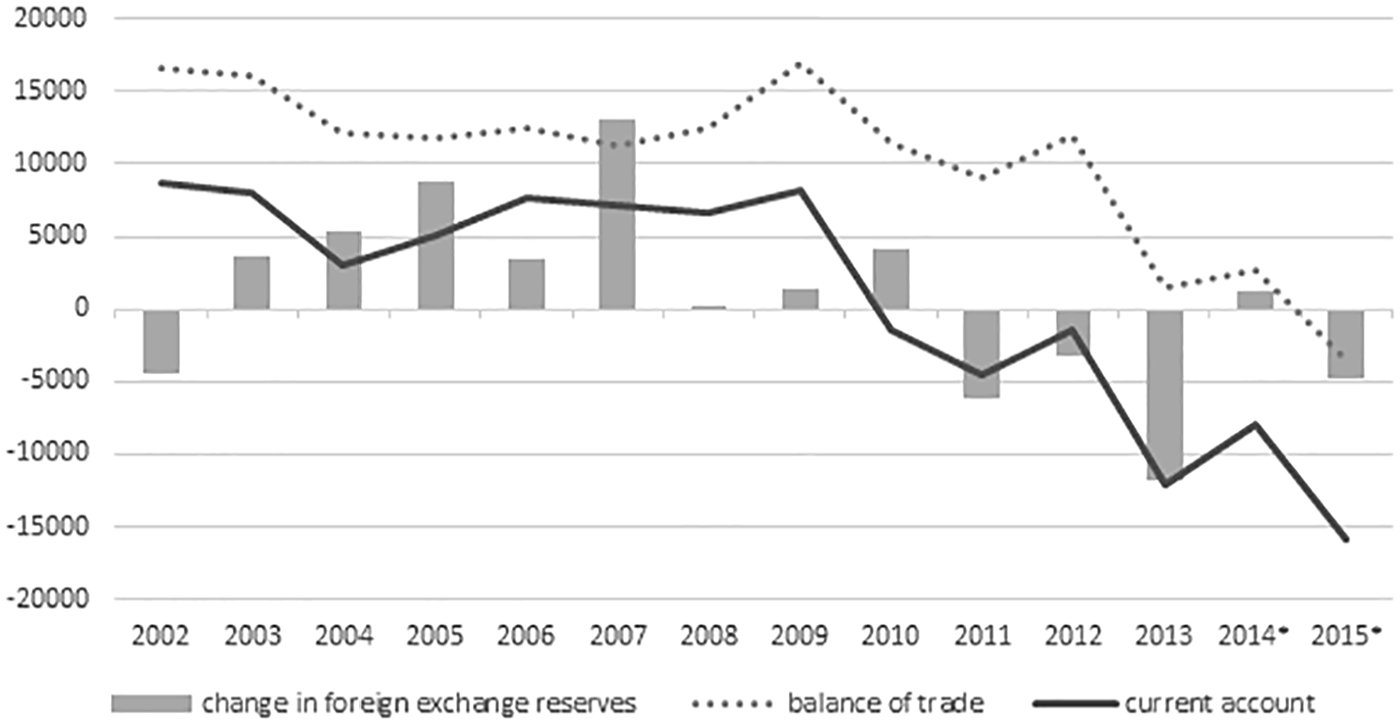
Argentinian balance of trade, current account and changes in foreign exchange reserves in million USD, 2002–2015.
Looking on the export side, one reason for the growing current account deficit was the collapse of global raw material prices from 2012 onward, which reduced the volume and value of exports compared to imports. However, during the last term of Kirchnerism, the composition of imports also changed decisively. The changes are analyzed in the following subsection.
External Constraints: Energy Deficit and Imported Consumer Goods
Imports increased significantly during the last term of Kirchnerism due to two crucial factors: First, the energy deficit, and second, the import of consumer goods. I will briefly describe the impact of the energy deficit, as it has been thoroughly studied by Argentinian economists and discussed within Argentinian media (Goldstein et al., 2016; Sabatella, 2018). The second decisive factor, the import of consumer goods, has not received the same attention from researchers and will thus be analyzed in more detail.
In 2011, the value of energy imports more than doubled compared to previous years, and Argentina became an energy-importing country. The deficit increased further in subsequent years (see figure 2). In response to this problem, the government partially renationalized the national natural gas and oil company

Argentinian energy balance (in million USD, left y-axis) public expenditure on energy and fuel supply (in % of GDP, right y-axis), 2003–2015.
Furthermore, energy and gas subsidies accounted for an increasingly large share of the public budget (see Figure 2). These subsidies had played a key role in maintaining support for the government; in 2002, before the first term of the Kirchner government, prices had been frozen. From then on, production capacity and prices for end consumers remained almost the same, while government subsidies made up the difference. The government found itself trapped in this policy (Bril-Mascarenhas and Post, 2015), as subsidies were an important pillar of Kirchnerism’s material concessions to the urban middle classes in Buenos Aires, who were the main beneficiaries (Goldstein et al., 2016).
The second factor that led to an overall increase in imports into Argentina was an increase in imported consumer goods. Table 1 shows the share that consumer goods made up of all imports. As it illustrates, from 2003–2015, consumer goods imports equaled fuels and lubricant imports (i.e., the much-discussed energy imports).
Argentinian Imports by Economic Use in Billion USD, 2003–2015

Among consumer goods imports, non-durable consumer goods accounted for the largest share (37.5 percent). They were followed by semi-durable (26.8 percent) and durable goods (14.9 percent). Food imports still accounted for 14.5 percent of all imports during the period under consideration. Figure 3 shows how import patterns evolved during the Kirchner administrations.

Imported consumer goods in Argentina, 2002–2015.
Analyzing semi-durable and durable goods further, the data show that electrical goods and machinery (29.8 percent) and textiles and footwear (23.7 percent) accounted for the lion’s share of imported consumer goods in this group (see table 2). Within the former category, televisions (15.1 percent), film and photo cameras (10.4 percent) and household appliances such as ovens and microwaves (9.8 percent) and refrigerators and freezers (9.9 percent) represent the largest product groups (an additional 13.2 percent are unspecified electrical appliances that do not fall into any of the other groups). The absence of computers and mobile phones in this list is due to the Comtrade codification system, which only partially classifies them as consumer goods.
Argentinian Imports of Durable and Semi-durable ConsumerGoods in million USD, 2003–2015

Figure 4 shows the change over time in imports of the top five products mentioned above, textiles and footwear, computers (and parts), and telephones and mobile phones (again, latter two are only partially imported as consumer goods). The sharp increase in mobile phones is clearly due to technological developments during this period. Nevertheless, imports increased in general until 2010 and 2011, but then declined again. With a volume of 44.4 billion USD, these four product groups alone constitute up to 6.9 percent of the total imports during the period 2003–2015. By comparison, the much-discussed energy imports, which posed major challenges to the Argentinian economy, accounted for 10.8 percent in the same period.

Most important items of imported durable and semi-durable consumer goods in Argentina from 2002–2015(in million USD).
As I will show in the next section, the regulatory policies implemented by Cristina Fernández de Kirchner during her last term (2011–2015) concerned these consumer goods in particular. Although these regulations reduced further import growth to some extent, they also brought out a deepening contradiction in the Kirchnerist construction of hegemony.
The Response of Kirchnerism
During the last of term of Fernández, a lackluster economy significantly reduced the hegemonic capacities of the Argentinian state. The fall in international commodity prices affected the export side of its strategy of hegemony construction, while energy and consumer goods affected the import side. The government was forced to address the issue of rising imports at the expense of political support.
As previously mentioned, the government reacted to the energy deficit by partially re-nationalizing YPF. However, production capacities were unable to meet demand in the short run (Kulfas, 2016: 200–210), and the effect of the energy deficit on the current account worsened over the next few years.
With regard to the import of consumer goods, the government focused on three key strategies: first, it tried boosting consumption of domestic products by creating a credit program to encourage private consumption of domestic consumer goods. The most emblematic of these programs was the
Second, the government tightened import regulations. Back in 2009, the government had already imposed further requirements for imports, raising the list of products which required special permits to be imported to 400 in order to protect domestic production. Following the addition of even more products to this list in 2011, a system overseen by the Ministry of Foreign Trade was introduced in 2012. Under this new system, the number of products subjected to an automated licensing procedure decreased, while the number of products requiring a non-automatic license rose to over 600 (in 2006 there were only 58) (World Trade Organization, 2013: 77). Consumer goods such as textiles, household appliances and electronics were particularly affected (see Table 3).
Commodity Groups Subject to Automatic and Non-automatic ImportLicences by Section of the HS07, Argentina

The government also took additional measures such as antidumping actions and restricting access to and issuing foreign exchange for imports. Most of these measures were introduced in late 2011 under the
Third, the government intervened against the draining of foreign exchange reserves and capital flight by limiting the acquisition of USD and credit card payments, even charging up to 30 percent for payments. In 2011, fears of a devaluation of the peso led to the first major capital flight, prompting the government to introduce the so-called
External Constratins and Everyday Life
The government’s response may have been rational from an economic perspective. However, as I will show in this section, the strong political reaction to these measures can partly be explained by the impact they had on the Argentinian middle class’ deeply rooted modes of living. As I have stated elsewhere, these measures touched on the “moral economy of the Argentinian middle class” (Boos, 2020), to borrow a term from E.P. Thompson. In what follows, I will first describe some of the measures’ effects on everyday life. I will then draw on evidence from electoral research and studies of social mobilizations to demonstrate the middle class’s shrinking support for and growing dissatisfaction with the government.
In 2008 and 2009, the Great Recession had an impact on GDP growth in Argentina. However, the country’s economic slump was mainly related to internal factors, as contradictions within the Kirchnerist model became visible at this point. From 2005 onwards, the government had decided to maintain the competitive exchange rate instead of prioritizing low inflation rates (Frenkel and Rapetti, 2007). However, the subsequent rapid rise in inflation (2008: 27.1 percent) brought back memories of the crisis years, and the general wage level stagnated for the first time since 2003 and even shrank in the private sector (Boos, 2017). Therefore, the middle class saw the agrarian conflict as an opportunity to punish the government for its inattentiveness to their demands (see Ozarow, 2019). Although not the focus of this article, the conflict also marked the origin of a growing rift between Kirchnerism and parts of the trade unions and other political allies (for a detailed periodization, see Boos, 2022). However, at this point, the international prices of raw materials continued to work in favor of the Kirchner government, which was able to regain the political initiative using its existing hegemonic capacities. After its defeat in the agrarian conflict, the government pushed ahead with some of its most emblematic policies in the following years, such as the
Yet shortly after this landslide victory, the government’s room for maneuver began to diminish. Contrary to the political crisis it faced in 2008 and 2009, new circumstantial factors such as the sharp decline of international raw material prices from 2013 onward worked against the Kirchner government by aggravating the structural constraints of the Argentinian economy. The government was forced to react and implemented the anti-crisis measures mentioned above. In its attempt to deal with the structural constrains of the development mode, i.e. with external constraints, it was confronted with the following dilemma: on the one hand, it had to stimulate private consumption as internal contradictions grew stronger and international crisis affected the Argentinian economy, while on the other, it had to counter the increasing current account deficit and shrinking international reserves fueled by rising imports.
As the crisis deepened, the Argentinian state’s hegemonic capacities continued to reduce while structural constraints had an impact on everyday life. Numerous power outages caused by the lack of energy supply infrastructure were the tangible expression of the rising energy deficit in everyday life. The outages peaked during the hot spell in the summer of 2013-2014, prompting the urban middle class to mobilize against the Kirchner government in the form of
Import restrictions and regulations on the acquisition of foreign currencies had a similar effect. The government’s import regulation affected sectors such as textiles, household appliances, and electronics. These products made up an important share of the imports of consumer goods, as shown in the previous section. However, because they are key goods within internationalized consumption pattern, the regulations applied to them were perceived in the public debate as an inadmissible intervention in the market and thus as an illegitimate restriction on consumer freedom.
The same applied to the restrictions on the purchase of foreign currencies. Rooted in previous devaluation experiences, the Argentinian middle and upper classes have historically tried to save in US dollars. Some sectors of the economy, such as the real estate sector, are also denominated in dollars. But in addition to its economic function, free access to the dollar is also a highly charged symbolic demand of the Argentinian middle class (on the Argentinian “culture of the dollar” see Luzzi and Wilkis, 2019). Hence, the foreign currency restriction led to an increasingly tense relationship between the government and the Argentinian middle class during Fernández’s second term. Their growing rejection of the government became visible in their electoral vote and in the streets.
Economic voting research has shown that poorer citizens tend to vote for Peronist candidates, while wealthier voters prefer anti-Peronist options. This pattern was also evident in the 2015 election, when socioeconomic status was strongly correlated with preference for Macri (Lupu, 2019). Interestingly, Kirchnerism had previously managed to partially challenge this tendency and gain some support among Argentina’s middle class: in the early years, Néstor Kirchner’s government gained the support of parts of the middle class based on the “pact of consumption” it forged with them. Although the government was punished in the 2009 midterm election for its actions in the agrarian conflict, this trend was reversed in the 2011 presidential election. As Calvo and Murillo (2012: 155) find: “The politically crucial middle class, once so critical of the administration’s performance, swung back toward favorability and pushed the president’s support up to 60 percent. The economy continued to do well throughout 2011, and the stage was set for Cristina Kirchner’s reelection.” Then in 2015, as electoral research shows, the economic downturn was a key factor in the waning support for Kirchnerism (Lupu, 2016; Murillo and Levitsky, 2019).
But the deepening division between the Argentinian government and middle class was not only expressed through electoral results. The latter’s discontent also materialized in a new cycle of mobilizations (Natalucci, 2019). Starting in 2012, this protest cycle was the first in which the Argentinian middle class had participated since the agrarian conflict in 2008. The most important mobilizations it involved— on September 13th, 2012, November 8th, 2012 and April 18th, 2013— were based on a very heterogeneous range of demands that nevertheless shared an individualistic framing. Additionally, the mobilizations themselves were mobilizations “from ‘negativity’” (Gold, 2015: 190 auth. transl.), i.e., they rejected certain policies or the government as a whole. Kirchnerism versus anti-Kirchnerism became the central political dividing line, with the former being perceived as increasingly authoritarian (Natalucci, 2018). For example, the regulation for acquiring foreign currencies became closely linked to the question of individual liberty.
Macri’s 2015 campaign promises to “depoliticize” the economy and bring back consumer freedoms perceived as individual rights resonated with the moral economy of the middle class. For example, his promise to “liberate” the foreign exchange market (a promise on which he later delivered) served the abstract ideal of individual freedom of choice. Furthermore, Macri’s assertion that structural problems of the Argentinian economy such as inflation would not be a problem if he became president, and that such problems were simply the result of the populist anomaly, was in a sense the promise of a “normal” economy.
Conclusion
In this article, I have analyzed the link between the structural constraints of the Argentinian economy and the construction of hegemony under Kirchnerism. I proposed the term hegemonic capacities to examine how these structural constraints played out in different periods. Departing from the external constraints of the Argentinian economy, I analyzed the external sector during Kirchnerism. Through this analysis, I showed that the government’s severe economic troubles from 2011 on were caused not only by the growing energy deficit, but also by imported consumer goods, which put additional pressure on a deteriorating current account and shrinking foreign exchange reserves. Therefore, the decline in hegemonic capacities was not solely attributable to the collapse of global commodity prices. Instead, confronted with a persistently declining current account, the government was compelled to address the problem of growing imports, despite the political costs associated with the implemented measures. Thus, the political costs were high because they touched on important symbolic areas of everyday life: the government’s measures were perceived as illegitimate state interference in individual (consumption) freedoms and personal liberty.
Piva (2019) argues that restriction on imports and devaluation can significantly affect the legitimacy of a government, as they encroach on consumer identities. The results provided in this article confirm this argument. Moreover, they raise further theoretical questions for hegemony theory about the interplay between imports of consumer goods and internationalized consumption. The importance of this issue and of the “moral economy of the middle class” (Boos, 2020) to hegemony theory seems to imply a significant constraint on economic policy measures available to governments which aim to gain or retain middle class support.