







Abstract
The discovery of the igneous-hosted Qingshen gas field in Songliao Basin, northern China suggests that igneous rocks may be an important target for future hydrocarbon exploration (Feng, 2006, 2008; Feng et al., 2011), as well as to the basic theory of hydrocarbon genesis (Liu et al., 2016). Recent exploration in the Tarim Bain, Western China and Bohai Bay Basin, Eastern China has identified more igneous-hosted oil and gas fields, highlighting the considerable hydrocarbon potential of these types of rock and the importance of investigating igneous rocks during exploration (Liu et al., 2010; Zhao et al., 2009; Zou et al., 2008). The formation of these igneous hydrocarbon reservoirs is thought to reflect the reservoir attributes of igneous rocks, meaning that to date exploration has focused on identifying high-quality igneous reservoirs.
Magmatism generally involves the transfer of deep-derived melts to upper crustal regions, with these melts transferring heat into sedimentary basins, which can promote hydrocarbon generation (Hu et al., 2004; Lee et al., 2017; Singh et al., 2016). These deeply derived melts also add solid catalysts into a basin (Jin, 1998) as well as volatiles that can facilitate hydrocarbon generation (Hu et al., 2005; Jin et al., 2002a, 2002b, 2004; Tao et al., 2017). Consequently, source rocks within sedimentary basins can be strongly affected by deeply derived melts. However, comparatively little research has been undertaken on the relationships between magmatism and hydrocarbon source rocks. Here, we investigate the influence of the relationship between magmatism and source rocks on hydrocarbon generation. New exploration strategies are proposed for magmatism-associated petroliferous basins.
Relationships between magmatism and hydrocarbon generation
Igneous rocks are present in many petroliferous basins, including the Songliao, Bohai Bay, and Subei basins of Eastern China, all of which are associated with deep-seated fractures and are located in rift zones. The Tarim and Sichuan basins of western China also contain significant volumes of igneous rocks and record multiple tectonic events. This means that igneous rocks can influence hydrocarbon generation in both young rift basins and in ancient and tectonically overprinted basins.
Previous research suggests that source rocks in petroliferous basins can undergo multiple hydrocarbon generation processes (Simoneit and Lonsdale, 1982), especially those in superimposed basins that record multiple tectonic events (Jin, 2005; Liu et al., 2017). Such tectonic events are commonly associated with magmatism that occurs either simultaneously with or later than the initial hydrocarbon generation from source rocks in the basin (Figure 1).

Geological model of the relationship between magmatism and source rocks. (a) The plane view of the relationship between igneous activity and the rock they affected. ‘A’ represents source rocks distal from igneous rocks that are not affected by igneous activity, whereas ‘B’ represents source rocks that are influenced by igneous-derived volatiles and ‘C’ represents source rocks that are affected by both volatiles and heat derived from magma. (b) The cross-section of S–S′ in (a). Red circles indicate hydrocarbon gas that is related to magmatism, with the red area indicating the location of deeply derived magmas that formed the igneous rocks in this area. The area of vertical lines indicates source rocks that have been affected by both heat and igneous gases, and the area of diagonal lines indicates the base of the sedimentary sequence and horizontal lines represent sedimentary rocks that are unaffected by the magmatism. These models are schematic.
Tarim Basin
The Tarim Basin records magmatism that has impacted the source rocks in the basin. Here, we examine the influence of igneous rocks on the generation of hydrocarbons from source rocks in the north Tarim Basin.
Previous research identified two sets of source rocks in the Tarim Basin, namely Cambrian–Lower Ordovician and Middle–Upper Ordovician source rocks (Liang et al., 2000; Yu and Fan, 2008; Zhang et al., 2000; Zhao, 2001). However, recent oil drilling, fieldwork, and other research suggests that lower Palaeozoic black to dark grey lime stones do not represent hydrocarbon source rocks, meaning that only the organic-rich mudstones in the basin were effective source rocks (Cai and Wang, 2010; Qiu et al., 2012). Consequently, the source rocks within the north Tarim Basin are black Lower Cambrian and Upper Ordovician mudstones within the southeastern, southern, and southwestern parts of this region.
Lower Cambrian source rocks initially produced hydrocarbons between the Silurian and the Middle–Late Devonian, with this Caledonian-orogeny-related maturation ending as a result of Hercynian tectonic uplift. Early Permian magmatism (Cheng et al., 2015) facilitated the generation of hydrocarbons within the Lower Cambrian and especially the Upper Ordovician source rocks in this region (Qiu et al., 2012). Consequently, the effects of magmatism in the Tarim Basin on source rocks can be divided into: (1) magmatism that was contemporaneous with the hydrocarbon generation peak within the source rocks (i.e. Middle–Upper Ordovician source rocks), and (2) magmatism that followed hydrocarbon generation (i.e. Lower–Middle Cambrian source rocks; Figure 2).

Timing of formation of the main source rocks, and magmatic and hydrocarbon generation events in the Tarim Basin and the Jiyang Depression of the Bohai Bay Basin.
Jiyang Depression
The Jiyang Depression is located in the southern Bohai Bay Basin and is one of several oil-rich regions in Eastern China. The source rocks in the Depression are dominated by lacustrine sediments, with oil and gas production in this region generally being derived from source rocks within the lacustrine Kongdian, Shahejie, and Dongying formations. These source rocks generated hydrocarbons during the Eocene (Hu et al., 2005). In addition, coal-bearing sediments are present within the Carboniferous Benxi and Shanxi formations, and the Permian Taiyuan Formation, indicating that these units are also promising source rocks within the Jiyang Depression (Cui et al., 2007; Table 1).
Geochemistry of lower Palaeozoic marine units within the Jiyang Depression.

TOC: total organic carbon.
aVitrinite reflectance.
The upper Palaeozoic coal-bearing formations within the Jiyang Depression were buried to a depth of ∼2500 m by the end of the Triassic, yielding a Ro value of 1.8% (Liu, 1998), just within the hydrocarbon generation window. This initial hydrocarbon generation ceased as a result of tectonic uplift.
Although the timing of magmatism in the Jiyang Depression remains controversial, it is generally accepted that the majority of magmatism in this area occurred during two events in the Mesozoic and Cenozoic. The Mesozoic magmatism occurred in the Middle Jurassic and Early Cretaceous, whereas the Cenozoic magmatism occurred during the Palaeogene and Neogene (Li et al., 2015). Consequently, the magmatism has influenced the source rocks in the Jiyang Depression by (1) occurring at the same time as initial hydrocarbon generation (i.e. the Palaeogene lacustrine source rocks) and (2) occurring later than this initial stage of magmatism (i.e. the Palaeozoic marine source rocks in this region; Figure 2).
Simulation experiments
Magmatism within petroliferous basins promotes the maturation of organic matter as a result of the heating of sedimentary source rocks (Guo, 2001; Hu et al., 2004). In addition, igneous rocks are generally enriched in Fe, Mn, Zn, Cu, and other metals, all of which lower the activation energy required to convert organic matter into hydrocarbons (Jin et al., 2007), again enhancing hydrocarbon generation. Magmas can also transport large amounts of volatiles (e.g. CO2 and H2) into petroliferous basins (Jin et al., 2002a; Kelemen and Hirth, 2012). Recent research has revealed that both Precambrian cratonic rocks (Brazelton et al., 2012; Kelemen and Hirth, 2012; Mayhew et al., 2013; Scambelluri et al., 2014; Sherwood et al., 2014) and deeply derived magmatic fluids (Meng et al., 2015) can provide hydrogen gas to sedimentary basins. Given that the H–H bond energy in H2 (436 kJ/mol) is lower than the H–OH bond energy (497 kJ/mol; Luo, 2004), H2 is expected to promote the hydrogenation of organic matter more effectively than H2O. It is difficult for solid igneous rocks to fully interact with source rocks as a result of a lack of direct contact; consequently, the thermal influence of these rocks is relatively limited (Hu et al., 2004; ‘C’ area in Figure 1(a)). In contrast, the small molecular size and the highly penetrative and easily diffused nature of H2 means that these molecules can migrate long distances, meaning that magma-derived H2 can affect a larger volume of source rocks than the thermal effects of these rocks (‘B’ in Figure 1(a) and area indicated by red circles in Figure 1(b)).
Experimental simulation of simultaneous hydrocarbon generation and magmatism
Tertiary igneous rocks and contemporaneous source rocks are present in the Jiyang Depression of the Bohai Bay Basin, East China. Jin et al. (2002a, 2002b) examined the effects of igneous rocks on hydrocarbon accumulation using a pyrolysis simulation experiment where H2 was added to organic matter. They reported that H2 significantly improved the generation of hydrocarbons from organic matter (Figure 3). The addition of H2 to type II2 source rocks from well Fan #15 results in the generation of voluminous liquid hydrocarbon after peak hydrocarbon production, yielding a 147% increase in the rate of liquid hydrocarbon generation. The productivity of liquid hydrocarbon of type III source rocks in well He #4 also increased substantially from the baseline values. This means that the addition of H2 can enhance the post-peak hydrocarbon generation capacity, especially for source rocks that are deficient in hydrogen.

Schematic diagram showing the experimental apparatus used during this study.
Experimental simulation of the influence of magmatism after initial hydrocarbon generation
This scenario involves older source rocks that have undergone hydrocarbon generation as a result of tectonism but then undergo a second hydrocarbon generation event as a result of the thermal effect of later magmatism. However, the characteristics of this second generation event remain unclear.
Design of simulation experiment
The experiments designed to investigate the nature of the magmatism-related second hydrocarbon generation event were undertaken at the Wuxi Institute of Petroleum Geology, Petroleum Exploration and Production Research Institute, Sinopec. These experiments used a patented apparatus that is shown schematically in Figure 3. This apparatus has a normal pyrolysis simulation apparatus (part A in Figure 3) with the addition of an empty cylinder (106 in part B) and a piston (105 in part B). The movement of the piston is controlled by 104 in part B, a valve (107) is present between the cylinder and part A, and part B is connected to part A by screw 108. Hydrogen gas was injected into cylinder 106 and pushed into part A by the movement of piston 105 and the opening of valve 107.
Both hydrogen gas and water were used in this experimental system. Comparisons with the results of previous research (Jin et al., 2002a, 2002b) were enabled by using similar volumes of hydrogen gas and water (100 ml of hydrogen gas and 10 ml of water for each 1 g of organic carbon in each individual experiment).
The processes of hydrocarbon generation were simulated by using immature marine source rocks from the Luquan Basin, South China, as reactants, with the kerogen geochemical characteristics of these rocks given in Table 2.
Comparison of the geochemical characteristics of the kerogens used in this study with kerogens from the Tarim Basin and the Jiyang Depression.

TOC: total organic carbon.
Table 2 indicates that the type II1 kerogens within the marine source rocks of the Tarim Basin and the Jiyang Depression have similar maturity, showing that the kerogens used during the simulation experiments had to be heated before the addition of H2 to simulate the effects of magmatism after the initial stages of hydrocarbon generation. In detail, H2 was added to the reactor at a temperature of 300°C to simulate the arrival of magmatic fluids after the initial hydrocarbon generation event. Reaction temperatures were varied from 350 to 600°C at intervals of 50°C, with H2 added without interrupting the experiment and reactions continuing for 48 h after the addition of H2.
The simulation experiments generated gaseous and liquid hydrocarbons, the former consisting of CH4, C2H6, C3H8,
Productivities of experiments designed to simulate magmatism after initial hydrocarbon generation.
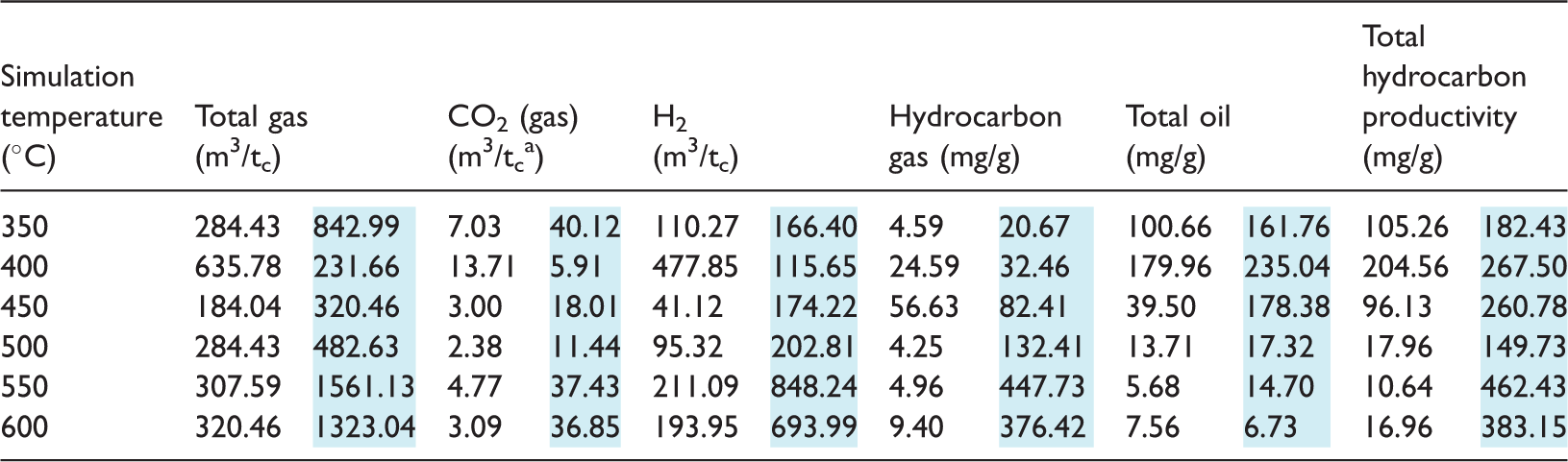
am3/tc units were used for gas productivity values and represent the total gas production in cubic meters per ton of original organic matter. The coloured columns on the right of each category reflect the results obtained with the addition of hydrogen gas during reactions at the same temperature.
Results and discussion
Hydrocarbon productivity
The results of experiments considering only the heat from magmatism yielded a peak total hydrocarbon productivity of 204.56 mg/g at 400°C (Table 3). These heat-only experiments yielded hydrocarbon generation patterns that are similar to those generated by traditional source rock pyrolysis where the peak of hydrocarbon generation is coincident with the stages of maturation of organic matter before decreasingly consistently with increasing temperature (Figure 4).

Patterns of hydrocarbon generation during simulation experiments with and without the addition of hydrogen. (a) Fan #15: Type II1 kerogen shows an increase in hydrocarbon productivity after the initial hydrocarbon generation peak, meaning that the addition of external hydrogen gas acts to supplement hydrocarbon generation after the hydrogen within the kerogen was exhausted. (b) He #4: Type III kerogen shows an increase in hydrocarbon productivity, indicating that the addition of external hydrogen gas can provide hydrogen for hydrocarbon generation after the exhaustion of the hydrogen that was originally present within the kerogen. Data are from Jin et al. (2002b).
The volatiles carried by magmas emplaced after the initial generation of hydrocarbons, including hydrogen gas, can supplement the hydrogen that was originally present within the kerogen and is partly or entirely used during the initial generation of hydrocarbons (Tissot and Welte, 1989), thereby contributing to hydrocarbon generation. However, in the present experiments the H2 derived from magmatic fluids had little or no effect on the generation of hydrocarbons from organic matter when extra H2 was added at temperatures that reflect the initial stage of hydrocarbon generation (250–300°C in Figure 4(a)). Increasing temperatures cause hydrocarbon productivity to reach a first peak at 400°C, at which point the addition of hydrogen to that already present within kerogen enables an increase in the formation of hydrocarbons (300–400°C in Figure 4(a)), yielding an increase in the liquid hydrocarbon productivity curve that reaches a peak at 147% for a temperature of 350°C and for type II kerogen (Figure 4(a)). This clearly shows that the addition of magmatic hydrogen gas can significantly increase liquid hydrocarbon productivity from type II kerogen, especially when the hydrogen within the kerogen in the source rocks has been exhausted. In addition, the type III kerogen liquid hydrocarbon productivity increases from the start of the experiments as a result of the addition of hydrogen (Figure 4(b)). This is similar to the type II kerogens in that the greatest hydrocarbon productivity increase occurs when the hydrogen within the kerogen has been consumed.
Differences between the two hydrocarbon generation models
The differences in the way that the timing of hydrogen availability affects hydrocarbon generation associated with the two relationships between magmatism and hydrocarbon source rocks are summarised in Figures 4 and 5.
The kerogens used in the simulations shown in Figures 4(a) and 5 are all type II kerogens, although the former illustrates hydrocarbon generation from lacustrine kerogens whereas the latter shows hydrocarbon generation from marine kerogens. These figures indicate that both types of kerogen have similar liquid hydrocarbon productivity trends for cases without the addition of hydrogen gas, yielding a hydrocarbon generation peak that is coincident with the mature stage of source rock maturation (350–400°C), followed by a decline in hydrocarbon productivity. The difference between lacustrine and marine organic matter reflects differences in the hydrocarbon generation models for these different kerogens (Petersen et al., 2011). However, the addition of hydrogen gas at different times yielded different relationships for the two types of kerogen considered here. The addition of hydrogen from the start of the experiment, which reflects contemporaneous magmatism and initial hydrocarbon generation (i.e. the younger source rocks shown in Figure 1), caused an increase in hydrocarbon generation after the peak in liquid hydrocarbon generation. In the post-hydrocarbon scenarios, where hydrogen gas was added after the initial stage of hydrocarbon generation (i.e. the older source rocks shown in Figure 1), the hydrogen gas causes an increase within the liquid hydrocarbon generation peak itself (Figures 4(a) and 5). This addition of hydrogen gas in this post-hydrocarbon scenarios had a longer lasting effect that spanned the mature to overmature stages of maturation (350–550°C) and yielded larger increases in liquid hydrocarbon productivity that are as high as 451.59% at 450°C and 258.80% at 550°C in the case that hydrogen gas was not actively added (Table 3; Figure 5). In comparison, the contemporaneous scenario yielded additional hydrogen-related liquid productivity increases of 247.13% relative to the case of no additional hydrogen at 400°C, and 110% at 450°C (Figure 4(a)).

Modelled liquid hydrocarbon generation for a scenario where magmatism occurred after initial hydrocarbon generation.
The addition of hydrogen only appears to have an obvious effect during the mature stages of maturation (300–400°C) in the contemporaneous scenario outlined above, whereas the addition of hydrogen in the post-hydrocarbon scenario affects hydrocarbon generation between the mature and overmature stages of source rock maturation (350–450°C).
Influence of hydrogen gas on the type of hydrocarbon generated in post-hydrocarbon scenarios
The total hydrocarbon generation (Figure 6) and gaseous hydrocarbon generation (Figure 7) trends indicate that the addition of hydrocarbons causes a significant increase in gaseous hydrocarbons rather than the genesis of oil. Total hydrocarbon productivity values during experiments focused on the post-hydrocarbon relationship indicate that the mature stage of maturation (350–400°C) is associated with a minor contribution of gaseous hydrocarbon productivity to the total hydrocarbon productivity value, whereas the overmature stage of maturation (temperatures >450°C) yields total hydrocarbon productivity values that are dominated by gaseous hydrocarbon productivity. Gaseous hydrocarbon generation also sharply increases at temperatures of >500°C as a result of the cracking of liquid hydrocarbons generated during the mature stage as well as by the cracking of kerogens (Liu, 2015; Liu et al., 2014, 2012b, 2005). The addition of hydrogen gas leads to liquid hydrocarbon cracking and produces more methane (Jin et al., 2007). The geochemistry of the gas associated with this process is the focus of a separate study by the present authors.

Patterns of the generation of total hydrocarbon for the second relationship experiments.

Gaseous hydrocarbon generation ratios for the second relationship experiments.
The addition of hydrocarbon gas during the overmature stage can increase liquid hydrocarbon productivity by as much as 451.59% (Figure 5), although the overall absolute production values remain quite low. The fact that gaseous hydrocarbon volumes increase up to temperatures of 550°C means that these gases were generated by the cracking of oil and kerogen, mainly by the cracking of oil during the overmature stage. This means that igneous activity can generate enough thermal energy to crack oil in the areas surrounding igneous rocks (i.e. area C in Figure 1(a)).
Implications for exploration in igneous petroliferous basins
The data presented in this study indicate that the addition of energy and hydrogen by magmatism can significantly promote the generation of hydrocarbons from sedimentary source rocks. The differences between the timing of igneous activity and the initial stages of hydrocarbon generation need to be identified to inform exploration strategies within igneous basins.
The exploration for hydrocarbons in igneous petroliferous basins has previously focused on the reservoir attributes of igneous rocks and the improvement of these attributes as a result of the influence of magmatism on clastic reservoirs (Zhao et al., 2009; Zou et al., 2008). Although the hydrogenation effect of igneous rocks on hydrocarbon source rocks has been discussed previously (Hu et al., 2004; Jin, 1998; Jin et al., 2002a, 2002b, 2004), the relationship between the timing of magmatism and hydrocarbon generation has not been systematically investigated. As such, the results of our study can inform future hydrocarbon exploration in igneous petroliferous basins.
Contemporaneous magmatism and hydrocarbon generation can yield significant increases in liquid hydrocarbon productivity, meaning that areas that show this relationship should be considered prospective for oil (Figure 4(a)). In comparison, igneous activity that post-dates initial hydrocarbon generation is indicative of an area that is prospective for both oil and gas. This is exemplified by the Tarim Basin, where increasing numbers of natural gas pools have been identified (He et al., 2015; Liu et al., 2012a; Wu et al., 2014a, 2014b); consequently, this basin has been a focus of natural gas exploration. However, exploration also needs to consider areas where older source rock formation and magmatism occurred at different times, as the heat and hydrogen provided by the latter can cause both kerogen and liquid hydrocarbons in the former to crack, generating increased amounts of natural gas.
2.
Previous exploration strategies considered that igneous rocks were not prospective for hydrocarbons (Feng et al., 2011; Liu et al., 2010). However, these rocks are now considered prospective for oil and gas exploration after several breakthroughs in our understanding of petroliferous basins (Feng et al., 2011). Previous exploration focused on identifying high-quality igneous rock reservoirs (Feng, 2008; Feng et al., 2011). The results of the present study suggest that magmatism can promote hydrocarbon generation within source rocks and that the different temporal relationships between magmatism and hydrocarbon generation will yield different patterns of hydrocarbon generation. As such, exploration should focus on identifying high-quality igneous reservoirs and consider the relationship between the timing of igneous activity and initial hydrocarbon generation, with the resulting information used to focus exploration on specific targets and stratigraphic units.
Conclusions
Two types of relationship exist between igneous activity and the initial generation of hydrocarbons within petroliferous basins, namely a simultaneous relationship or one where igneous activity post-dates hydrocarbon generation. These relationships have different influences on hydrocarbon generation. Contemporaneous igneous activity and initial hydrocarbon generation promotes the formation of liquid hydrocarbons. In comparison, magmatism that post-dates the initial stage of hydrocarbon generation also promotes liquid hydrocarbon generation, but more gaseous hydrocarbon, resulted in yielding total hydrocarbon productivities that can be 451.59% higher than normal hydrocarbon productivity even in the overmature stage of maturation. The majority of the increase in total hydrocarbon productivity from the mature stages onwards is the result of the generation of gaseous hydrocarbons by the cracking of liquid hydrocarbon, caused by the addition of magmatism-related hydrogen gas. The different timing relationships between igneous activity and the initial generation of hydrocarbon provide new exploration strategies for petroliferous basins containing igneous rock. Specifically, exploration should focus on oil in basins with contemporaneous magmatism and initial hydrocarbon generation, whereas both oil and gas should be targeted in basins with igneous activity that post-dates initial hydrocarbon generation. Exploration should focus on both identifying high-quality igneous rock reservoirs and the timing relationships between igneous activity and initial hydrocarbon generation.