







Abstract
Introduction
Coal resources are significantly more abundant than oil and gas, and can meet world energy requirements for hundreds of years, especially for China. Coal contains valuable metal elements which can be used as promising source of critical elements (Arbuzov and Mashen’kin, 2007; Seredin et al., 2013; Singh et al., 2016a; Sun et al., 2010, 2012a, 2012b; Yudovich and Ketris, 2006), coal utilization has had impact on the environment due to coal mining and coal combustion (Lamia and Mouhamed, 2017; Ozkaymak et al., 2017; Pian et al., 2016; Wang et al., 2014), coal will remain the dominant source of energy for many countries which have limited oil and gas resources, e.g. China, India, Poland and Turkey. Coal combustion may produce huge waste, enriched in metal elements which can qualify as a ore deposit (Sun, 2015). Therefore, these valuable metal elements in coal ash can be used as byproduct.
Concentrations of some metal elements in coal from the Ordos Basin have been reported (Sun et al., 2013, 2016; Zhao et al., 2014). Shi (2014) and Sun (2016) studied the concentration of aluminum (Al) in the coal from the Jungar Coalfield. Dai et al. (2006) and Qin et al. (2015a) studied the Ga enrichment. Sun et al. (2012b) and Qin et al. (2015b) studied Li concentration mechanism in coal from the Guanbanwusu coal mine. Zhao et al. (2014) studied Ba accumulation in the coal from the Huanglong Coalfield, southern region of Ordos Basin. Zhao et al. (2012) investigated REE accumulation mechanism in Huanglong Coalfield. Sun and Liu (2009) studied uranium (U) accumulation in coal measure.
The purpose of this study is to find the relationship of these elements in concentration processes and the geological controls, and finally, put forward an accumulation model for valuable elements in the Ordos Basin.
Geological setting
The geological history of Ordos Basin has been studied by many geologists (Liu et al., 1991, 2009; Sun and Liu, 2009; Shen, 2009; Duan et al., 2011). Here, only those aspects dealing with the coal geology were summarized and discussed.
Ordos Basin belongs to the North China Basin, and located at the western part of the Sino-Korean Craton (Figure 1). Its basement rock includes Archean rocks with Proterozoic sedimentary cover (Wan and Zeng, 2002). The basement rocks belong to the Cambrian. The Early to Middle Ordovician rocks consist of epicontinental carbonate sediments. After the Middle Ordovician period, the Sino-Korean Craton was uplifted and subjected to substantial erosion (Figure 2). Sediments of the Silurian, Devonian and part of the Early Carboniferous age are absent in the North China Basin because of the uplift of the North China Craton during the late Early Paleozoic (Li et al., 2010). This uplift was followed by a period of subsidence that resulted in a major transgression event from the northeast during the Middle Carboniferous period when the craton once again was covered by an epicontinental sea. In the Late Carboniferous period, North China Bain, including Ordos Basin, was uplifted slowly and the marine-terrigenous facies were formed. The sandstone, siltstone, carbonaceous shale and bauxite were deposited. In the Permian, Ordos Basin was uplifted continuously, and sandstone, siltstone, oil shale, clay and coal-forming plants were deposited in delta, river and lagoon environments. The coal-bearing Taiyuan Formation (crossing Upper Pennsylvanian and Lower Permian) and the Shanxi Formation (Middle Permian) subsequently formed in this area (Han and Yang, 1980). The sediments from the Permian Shanxi Formation were deposited in a fluvial-dominated deltaic depositional environment (Han and Yang, 1980). In the Mesozoic, sandstone, siltstone, clay, coal-forming plants were deposited in river and lake environments in Ordos Basin. Many energy mineral deposits were formed in the sediments (Duan et al., 2011). Huanglong Jurassic coalfield was formed in this time. The coal bearing formation consists of terrestrial clastic rocks and belongs to the Yan’an Formation of the Jurassic.

Paleogeographic map of the study area in the Middle Permian period (Modified from Sun et al. (2017)).

Geological map of the Ordos Basin.
Accumulation of selected elements
Aluminum
In Chinese coals, a unique type of coal with high-aluminium content occurs in the North China Basin. The Al2O3 content of the coal ash is higher than 45%, and even exceeds 60% in some coal mines (Table 1). This type of coal was named as ‘high-aluminium coal’ (Qi et al., 2006). ‘High-aluminium coal’ occurs in the Later Carboniferous and Permian (Sun, 2016).
Concentration of selected elements in coal of the Ordos Basin.
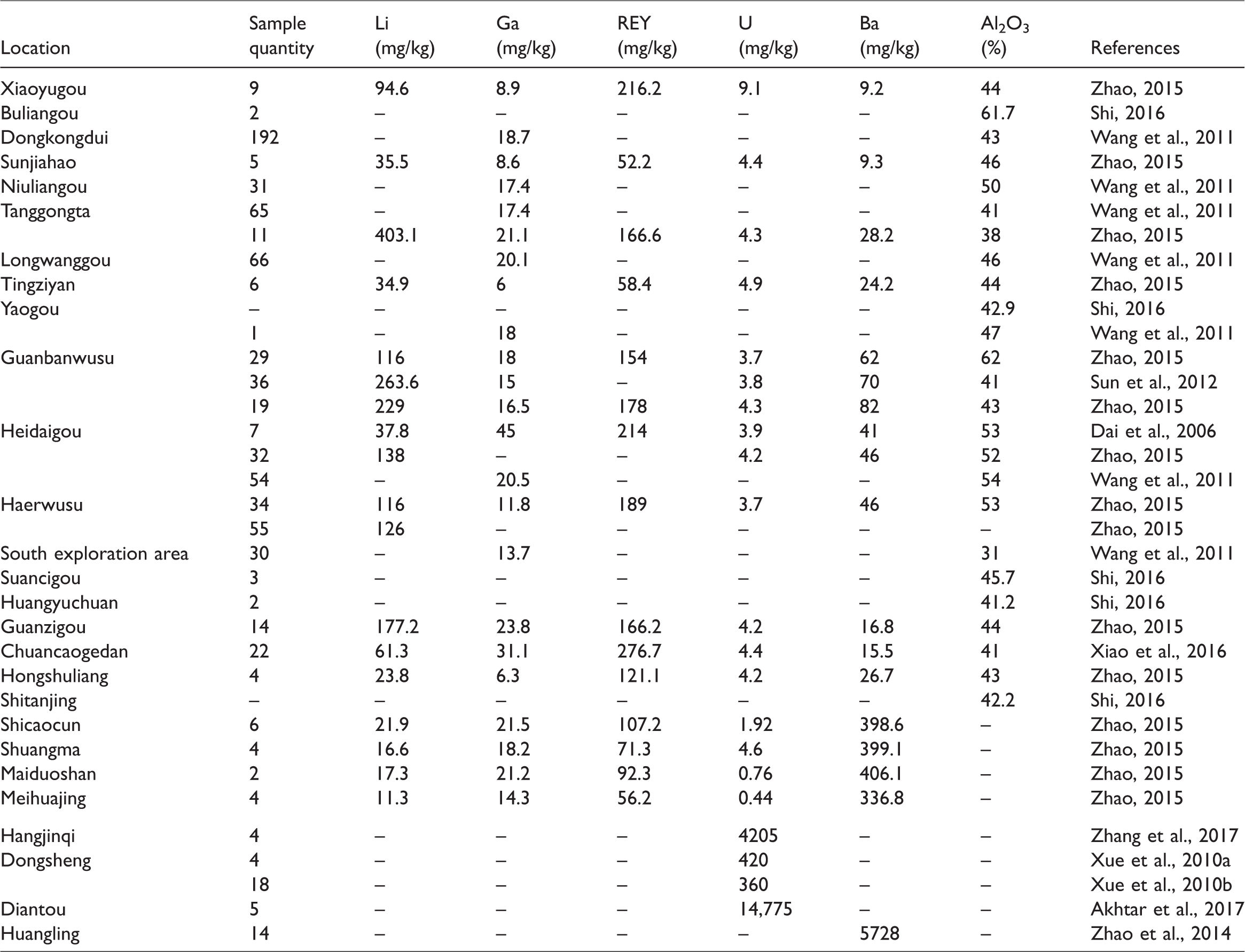
Al can be leached as byproduct from the ‘high-aluminium coal’ fly ash (Sun, 2016), and the residue can be used as construction material (Sun et al., 2012a). The coal reserves in Jungar Coalfield of Ordos Basin are approximately 36.7 Gt (Sun et al., 2013). Out of this, about 25% is ashes and thus, Al2O3 content is around 3.7 Gt (approximately 2 Gt Al, only in one coalfield). Because high concentration and potential economic significance of aluminium in ‘high-aluminium coal’ fly ash, Datang International Renewable Resources Development Co. Ltd has built a factory in 2013 to leach Al from coal fly ash (Sun, 2014). The pilot plants to produce Al2O3 from fly ash were also built by Shenhua Group Zhungeer Energy Corporation Limited (SGZECL) in 2011 (Seredin et al., 2013) and by China Coal Pingshuo Group Co. Ltd (Sun, 2016). Many scientists have studied the ‘high-aluminium coal’ because it can be used as Al resource (Jiang et al., 2015; Qi et al., 2006; Shi, 2014; Sun, 2014; Sun et al., 2016).
The ‘high-aluminium coal’ exists in the north of the Ordos Basin (Sun, 2016). The main minerals in the ‘high-aluminium coal’ are kaolinite, boehmite, pyrite, quartz and calcite (Sun et al., 2012b). The clay minerals, in general, occur as disseminated fine particles, lens-shaped, thin-layered and massive forms in collodetrinite or as cell-fillings in fusinite of syngenetic origin (Naik et al., 2016; Prachiti et al., 2011; Singh et al., 2016b, 2015a, 2015b; 2012; Singh and Singh, 1995). Boehmite is recorded in all the studied mines and is the second most dominant mineral. (Sun et al., 2012b). Pyrite is observed in all mines but in smaller concentration. The calcite contents are very low and mainly occur as fracture- or cleat-fillings, indicating that they are of epigenetic origin. Quartz is very rare and occurs as very fine particles of <10 μm. Most are observed as round edges, suggesting a terrigenous detrital origin (Sun, 2016).
The aluminium in the ‘high-aluminium coals’ mainly occur in clay minerals that originated from a sediment-source region, the Yinshan Oldland and Lüliang Peninsula, located in the northern and northeastern Ordos Basin (Sun et al., 2010, 2012b, 2013; Shi, 2014). Therefore, the Yinshan Oldland and Lüliang Peninsula could be one source of Al. According to Shen (2009), the base of Ordos Basin is undulating (Figure 3). The rising of the entire basin could have exposed the layer of greyish bauxite to the surface, which could have served as another source of Al (Sun et al., 2016).

Palaeogeomorphic map of the Ordos Basin before the sedimentary period of early Permian (Modified from Shen (2009)).
Lithium
The lithium (Li) enrichment in coals has been investigated by host of authors(Ketris and Yudovich, 2009; Lewińska-Preis et al., 2009; Qin et al., 2015a, 2015b; Sun et al., 2010; Zhao et al., 2002). Except for China, the average Li contents in coals are lower than 20 mg/kg in all other countries (Dale and Lavrencic, 1993; Franceschelli et al., 1998; Kara-Gulbay and Korkmaz, 2009; Zivotic et al., 2008).
The Li contents were measured in the samples from the northern area of Ordos Basin. The average Li content is 229 mg/kg in the coal samples and 654 mg/kg in the parting samples of the Guanbanwusu Mine (Table 1). The average Li content is 143 mg/kg in the coal samples of the Heidaigou Surface Mine. The average Li content is 119 mg/kg in the coal samples of the Haerwusu Surface Mine (Sun et al., 2016).
Yudovich and Ketris (2006) suggested 100 mg/kg as the economic grade of Li. Sun et al., (2012a, 2014) have studied the Li concentrations in Chinese coals and suggested that it was reasonable to take 120 mg/kg as mining grade (economic grade or industrial grade) for Chinese coals. According to their assessment, the coals from Ordos Basin qualify as a deposit. The total Li reserves have reached 2,406,600 tons, that is, 5,157,000 ton Li2O in the Jungar Coalfield, Ordos Basin (Sun et al., 2013).
According to Sun (2016), the Li concentration is mainly related to inorganic matter (silicate). The chief minerals in coals consist of kaolinite, boehmite, chlorite–group mineral, pyrite, quartz, calcite, gypsum, siderite, illite and amorphous clay material. The chlorite phase could be the most possible host for part of Li. The Yinshan Oldland and Lüliang Peninsula should be most possible source of Li of the ‘high-aluminium coal’ coal. The bauxite of the Benxi formation in the NE Jungar Coalfield (Lüliang Peninsula) could be another source of Li in the coal. However, the bauxite of the Benxi Formation was originally derived from the Yinshan Oldland and Lüliang Peninsula. Therefore, the final source of Li should be the Yanshan Oldland and Lüliang Peninsula.
Gallium
In recent years, the concentration of gallium (Ga) has been reported from several Chinese Permo-Carboniferous coalfields (Dai et al., 2006; Shi, 2014; Sun, 2015; Zhuang et al., 1998). In some of these coalfields, Ga is distributed widely enough to reach the ore-forming scale and have commercial value. The Ga contents exceed 30 mg/kg in the Heidaigou, northern area of Ordos Basin (Dai et al., 2006). The minimum mining grade for a Ga deposit in coals is 30 mg/kg according to the Geology and Ore Deposit Standard Specifications for Rare Metal Mineral Exploration of the People’s Republic of China (DZ/T 0203-2002, 2003). Referring to this standard, the Ga content has been highly enriched so as to be designated as Ga deposits in the Heidaigou. According to Dai et al. (2006), a super-large Ga deposit in the Ordos Basin has been formed. They reported that the ensured and prospected reserves of Ga in No.6 Coal are up to 6.3 ×10⁴ t and 8.57 × 10⁵ t in the Jungar Coalfield, Ordos Basin.
The Ga in coals occurs mainly in boehmite and organic matter, but boehmite is the main carrier of Ga (Dai et al., 2006). The boehmite in the Jungar Coalfield is cryptocrystalline, occurring mainly as lumps in collodetrinite and as cell-fillings in fusinite. Sometimes, it occurs as finely disseminated particles in collodetrinite.
As mentioned above (Dai et al., 2006; Shi, 2014), Al and rare metal concentrations in the ‘high-aluminium coals’ were controlled by regional geology. At first, the Inner Mongolia orogenic belt and the Late Paleozoic coal-bearing basins developed in the same structural framework. Yang et al. (2008) reported that not only the Yinshan Oldland existed in the north of Ordos Basin but the Lüiang Peninsula also rose as a paleo-highland in the eastern area of the Jungar Basin in the Carboniferous and Permian. The Lüliang Peninsula could have also influenced the sedimentation of the surrounding areas (Figure 3).
Rare earth elements and yttrium
The average rare earth elements and yttrium (REY) contents, based on the average individual element contents, are 68.5 mg/kg for world coals and 404 mg/kg for world coal ash (Ketris and Yudovich, 2009). REY recovery as a byproduct from coal deposits may be considered as a promising way to obtain these critical metals to meet the expected global demand (Seredin et al., 2013). Sun et al. (2014) and Ketris and Yudovich (2009) suggested that REY contents of 300 mg/kg in the coal could be used as the minimum mining grade.
The REY contents are higher than 100 mg/kg in the coal samples of the Permian coal from Ordos Basin (Sun, 2016). In several coal mines, their contents are even higher than 200 mg/kg (Sun et al., 2016). The highest content of REY occurs in the northern area of Ordos Basin (Sun, 2016).
REY have positive but low correlation coefficients with ash yields and SiO2 and it indicates that the REY have a mixed (organic and inorganic) affinity (Xu et al., 2011). Seredin et al., (2013) found out that the origin of high-REY accumulation was mainly terrigenous in the most part of Jungar coalfield.
All these elements (i.e. Al, Li, Ga, REY) with high concentrations in this type of coal are very valuable source to various industries and therefor make perfect economic sense and add extra benefits into coal mines if they can be recovered by beneficiation processes.
Uranium
Although U concentrations don’t occur directly in coal seams in the Ordos Basin, it occurs in the coal measure and closely related with coal seams (Sun and Liu, 2009). U has been found in seven formations of the entire basin (Chen, 2002; Di, 2002). The lowest U-bearing formation is the Sun-Jia-Gou group of the Upper Permian. The U-bearing rock is found in sandstones with thickness of 0.4 m in the southern basin. U content reaches 0.041%. There are three U-bearing formations in the Triassic. The U-bearing rocks are sandstones. There are two U-bearing formations in the Yan-an group of the Jurassic in the north basin and Zhiluo group in the internal basin, where sandstones act as the host rock. The U-bearing rocks are also sandstones. U-bearing formations occurred in the Cretaceous in the west basin. U-bearing strata belong to the Zhi-Dan series of the Middle Cretaceous. Seven formations show followed features:
All host rocks are sandstones and close coal seams; Most of them occurred in the edge of the basin or close faults; Insoluble organic matter in the host rocks is not rich.
U has presence in the entire basin. Dongsheng mine is only running district, and it is also the largest U deposit in the north part of the basin so far. According to Di (2002) and Chen (2002), U was enriched due to different mechanisms in the Ordos Basin. However, all U deposits occur along the margin of Ordos Basin (Figure 4). U accumulation may be related to faults and fluids. In the U-rich section of the Dongsheng mine, host rock is grey sandstone. Underlying strata is coal seam and clay. According to Sun and Liu (2009), the natural gas has migrated from Paleozoic strata may form a redox boundary. The 4UO22+ ions may react with CH4 and form 4UO2:


Concentration map of valuable elements in the Ordos Basin.
Barium
The average content of barium (Ba) in Chinese and world coal is 159 and 150 μg/g, respectively (Zhao et al., 2014). The average content of Ba in the coal of the Huanglong Coalfield located in the southern area of Ordos Basin is 5728 μg/g, with a maximum value of 26,423 μg/g (Zhao et al., 2014). The average Ba content in the coals present in Huanglong Coalfield is about 36 times higher than that of Chinese coal (159 μg/g). The average ash yield of the No.2 coal is 13.74%, and the Ba content enriches about 4.2%. Ba being an environmentally sensitive element (Finkelman, 1995), the significantly enriched Ba is potential hazard to human health and environment. However, the highest Ba content in coal ash of the Huanglong coal reaches 36.3%, which may be used as byproduct. Ba can be potentially used in the industry.
Accoring to Zhao et al. (2014), witherite is the Ba-host mineral in the Huanglong coal. A witherite deposit located in the Qinling Mountains is the largest Ba mineralization zone in China, and is also ranked one of the world’s largest witherite deposits. The ore bodies are hosted in the black shales of Lujiaping Formation of Lower Cambrian, which are sediment-sources for the Yan’an Formation during Jurassic. These Ba ores are the sources for the high Ba in the Huanglong Coal.
Ba is one of the potentially toxic elements to humans and environment. Although Ba is not included as a potentially hazardous trace element (PHTE) by the United States Environmental Protection Agency, it has been listed as a regulated constituent under Subtitle D of RCRA as solid wastes and an environmentally sensitive trace element of coal.
Occurrence modes of selected elements
The aluminium, Li, Ga and REY in the ‘high-aluminium coals’ mainly occur in minerals such as clay minerals, boehmite and chlorite that originated from a sediment-source region (Dai et al., 2006; Sun et al., 2010a, 2012b). The Yinshan Oldland, located in the northern and northeastern Ordos Basin, was one of the sediment regions during the Late Carboniferous and Middle Permian (Dai et al., 2006; Sun et al., 2013). The eastern uplift areas of the Ordos Basin were denudated from the Late Ordovician to Early Carboniferous, but the uplift subsided since Middle Carboniferous (Benxi Formation) (Yang et al., 2008). The rising of the Lüliang Peninsula could have exposed the layer of greyish bauxite to the surface (Figure 4), which could have served as a source of Al and rare metals for the peat moor of the coal seams (Sun et al., 2016). Ba accumulation occurred in the Mesozoic during uplift of the Qinling Mountains (Zhao et al., 2014). U accumulation may be related to faults and fluids in the Mesozoic and Cenozoic (Sun and Liu, 2009).
Concentrations of the elements were controlled by geological evolution and can be divided into three stages: First stage, the Yinshan Oldland and Lüliang Peninsula uplifted in the Permian, Al, Ga, Li and REY were moved into peat moors as forms of solid materials or complex; Second stage, the Qinling Mountains uplifted in the Mesozoic and Ba was moved into Huanglong Coalfield; Third stage, Ordos Basin uplifted and faults were formed around basin margin, and fluids carried U into redox boundary closed the coal seams after the Mesozoic. Finally, U was deposited because variation of chemical conditions. According to the concentration regularity of the elements, we may conclude that Al, Ga, Li and REY may enrich in the northern and northeastern areas of Ordos Basin; Ba may enrich in the southern area of Ordos Basin and U may enrich along the fault belts around Ordos Basin.
Conclusions
High concentrations of Al, Li, Ga, REY, U and Ba in the Ordos Basin were controlled by regional tectonics and paleogeography (Figure 4). Al, Li, Ga and REY were from the Yinshan Oldland and Lüliang Peninsula. Ba was from the Qinling Mountains. U was formed by fluids flow. A three-stage mode of occurrence for metal element enrichment and concentration model is identified.