







Abstract
Introduction
In 1760s, the industrial revolution began in Europe. Fossil fuel has become the main source of energy for human beings. As human consumption of fossil fuels increases year by year, environmental problems and global warming are getting worse. With the development of energy, clean energy is gradually replacing fossil energy. In the past three energy revolutions, there is a regularity: the content of carbon is reduced and the content of hydrogen is increased, the number ratio of atoms of carbon to hydrogen is becoming smaller from coal (1:1) to oil (1:2) and natural gas (1:4), decarburization is accelerating and hydrogen content is getting larger. It has become a natural law and the trend of energy development and utilization. As a new energy of zero carbon, hydrogen energy has the characteristics of environmental safety, high energy density, high conversion efficiency, abundant reserves, and wide application. The hydrogen is zero discharge and zero pollution, and it is the most promising alternative energy source. Hydrogen energy era is an era when hydrogen was the main energy source, and it is an ideal energy time. Natural gas is used as a transitional energy in the era of hydrogen energy, and hydrogen will become the main and absolute clean energy in the future of human society.
All countries in the world regard the development of hydrogen energy as a national strategy. They make plans, depict road maps, and explore the way of industrialization. Wind power is developing rapidly as clean energy, but a large number of wind curtailment (Duan, 2015; Huang, 2016; Zhang et al., 2012b) caused the waste of wind energy. It is still a topic for scholars all over the world to study. In recent years, although the issue of wind curtailment has been greatly eased (Díaz-González et al., 2012; Song et al., 2009; Zhang et al., 2012b), the healthy and sustainable development of renewable energy has not yet fully realized.
How to solve the problem of wind curtailment has become hot spots for researchers. It is also one of the bottlenecks that restrict the sound development of the wind power industry. The technology of hydrogen production by wind power provides a new idea to solve the problem of the wind curtailment (Liu et al., 2014; Qolipour et al., 2017; Shi et al., 2015; Zeng et al., 2012; Zhou et al., 2017), and it is important to solve the problem of wind power consumption on the spot. It is also propitious to the development of decentralized wind power generation technology and the efficient utilization of renewable energy (Rahmouni et al., 2016). Hydrogen is made by electrolysis of water and stored in hydrogen storage device (Ali et al., 2017; Fujii et al., 2015; Wang, 2016). On the one hand, hydrogen can be injected into the existing gas supply network as a clean and high-energy fuel to achieve complementary conversion of electricity to gas. On the other hand, it can be used directly and efficiently in high efficiency cleaning technology such as fuel cells. Hydrogen can be transformed to electric energy by fuel cell, and the electricity is transported to the power grid to improve the power quality. At the same time, hydrogen can be used as an energy carrier into the industrial and commercial fields by vehicle or pipeline, such as metallurgy, chemical industry, and other industries (Yuan et al., 2016). And the hydrogen production system by wind power will also greatly promote the rapid development of the vehicle by hydrogen fuel cell (Cao and Zhang, 2017).
Basic principle and technical characteristics of hydrogen production by wind power
The hydrogen production technology by wind power is a new environmental protection technology, which is directly applied to electrolysis water to produce hydrogen by generating electricity through wind turbines.
The basic principle of hydrogen production technology by wind power
The hydrogen production technology by wind power is considered as a “clean and efficient mode of energy use.” This mode is used to generate hydrogen by electrolysis which cannot be absorbed by the power grid or to generate hydrogen directly by using the electricity generated by non-grid-connected wind power. Hydrogen is stored and transported after pressurization and is applied to hydrogen fuel cell vehicles, and so on. Hydrogen production technology by wind power system is mainly composed of wind turbine, water electrolysis device, hydrogen storage device, fuel cell, power grid, and so on (Valverdeisorna et al., 2016). The ratio of wind power into power grid and hydrogen production is adjusted by the control system, and the wind curtailment power can be absorbed maximally, the wind power integration problem is relieved. The excess electric power of wind power generation is used to electrolyze water for hydrogen production. The storage density of hydrogen is increased by pressure hydrogen storage technology, solid-state hydrogen storage technology, and so on. The basic structure of the hydrogen production system is shown in Figure 1.

Basic structure of the wind power hydrogen production system.
Main technical characteristics of hydrogen production by wind power
1. High adaptability of wind turbines 2. High efficiency, high adaptability, environmental protection, and safety of electrolytic cell
Wind turbines not only send electrical energy by a converter device to the power grid, but also provide power for the hydrogen electrolytic cell (Takahashi et al., 2008). Therefore, the high adaptability of the wind turbine is required. That is, the wind turbine must have resistance to wind energy fluctuation.
The electrolytic cell of hydrogen production provides high purity hydrogen by the electrolysis of water, and the process needs to ensure the efficiency of energy conversion. And the fluctuation of power will have great influence on the life and hydrogen purity of electrolyzer. Therefore, the demand of the electrolyzer is higher. By optimizing the electrode, catalyst, and other materials, the electrolysis cost and hydrogen production efficiency can be reduced. The performance can be improved by optimizing the isolation membrane, and the power fluctuation of the electrolyzer can be improved by adjusting the process parameters, so as to ensure the safe operation of the system (Chang et al., 2016; Nishimura et al., 2017).
3. The flexibility, efficiency, and safety of the wind power hydrogen production control system
Integrated control system of hydrogen production technology by wind power includes the control system of hydrogen production, hydrogen storage, and fuel cell. The main technical characteristics include the flexible distribution of the ratio of hydrogen production power and safe operation of hydrogen production, hydrogen storage, and hydrogen system by control system.
Research status of hydrogen production technology by wind power
Traditional hydrogen production by electrolysis in the generation of electricity will make a lot of pollutant emissions. However, the hydrogen production technology by wind power is the use of “green” power and it is a clean technology. In recent years, many scholars have analyzed and verified the economy and feasibility of hydrogen production from wind power. Dutton et al. (2000) predicted the practical problems of the hydrogen production system by wind power and the possible problems of the development of the hydrogen production by wind power by summarizing the EU-funded hydrogen production projects. The influence of wind power fluctuation on the operation of electrolyzer was pointed out, and the method of improving the output power of the wind turbine is put forward. Kassem (2003) assessed the economics and feasibility of hydrogen production technology by wind power based on the intermittency of wind energy. Sherif et al. (2005) reviewed hydrogen production technology and pointed out that using wind energy to generate hydrogen can improve the competitiveness of wind power generation. Honnery and Moriarty (2009) of Monash University in Australia evaluated the technical potential of hydrogen production technology by wind power; it is estimated that the annual potential of hydrogen production technology by wind power is 116 EJ (1 EJ = 1018 J). Bartels et al. (2010) analyzed hydrogen production from an economic point of view and concluded that hydrogen production is feasible. Genç et al. (2012) reviewed the world’s research on the cost of hydrogen production from wind energy, and the economy of hydrogen production in Turkey was analyzed and the hydrogen production cost was calculated according to the cost of wind energy, and the annual yield of hydrogen energy in Pinarbasi, etc. was obtained. Bhandari et al. (2014) analyzed the hydrogen production technology by wind power from the perspective of life cycle assessment and concluded that hydrogen production from wind power is a well technology. Qolipour et al. (2017) evaluated the technicality and economy of hydrogen production technology by wind and solar power. The results show that it is feasible to make hydrogen from the wind power and it provides a new way to solve the problem of the wind curtailment.
In recent years, foreign scholars began to study the technology and theory of hydrogen production technology by wind power. Takahashi et al. (2008) proposed a coordinated control method for hydrogen production technology by wind power, the variable speed wind generator and hydrogen preparation device are installed together. The impact of wind energy fluctuation on power system and hydrogen generation plant was reduced by smooth power curve, and this system was introduced and simulated in detail in 2010, and its performance was evaluated. Hydrogen production control system assisted by power grid was proposed by Clúa et al. (2010) in the University of La Plata, a control strategy for regulating the current value of electrolyzer was also proposed, and the hydrogen production efficiency was optimized. Pino et al. (2011) analyzed the influence of the electrolyzer operating temperature on the hydrogen production system from the wind power generation. The production efficiency in actual operating temperature was compared with the efficiency in rated temperature. The conclusion showed that hydrogen production efficiency is overestimated at actual temperature. The wind power plant producing hydrogen by electrolysis was simulated by Valdés et al. (2013), and two methods for optimizing the power of hydrogen production by wind power were put forward and simulated. Belmokhtar et al. (2014) put forward a control strategy based on fuzzy logic for optimal management of hydrogen production technology by wind power. Sarrias-Mena et al. (2015) studied the coupling operation of the electrolyzer and the wind turbine for the hydrogen production, and the working characteristics of the four different electrolyzers were compared.
The hydrogen production project by wind power was first proposed by the United States, the project makes hydrogen by an array of generators connected to an electrolytic reactor. Europe is the leader in the field of storing energy by converting wind energy into hydrogen. The EU plans to achieve sustainable development without reliance on fossil fuels by the end of 2060, and the important part of achieving this goal is to store and apply renewable energy in the way of hydrogen. The EU has implemented a demonstration project on hydrogen production technology in Greece and Spain, and the project combined wind energy with hydrogen production technology. It involves hydrogen storage, fuel cells, and desalination technology, and it provides “green” hydrogen energy for energy storage, power supply, and supply of fresh water (He, 2015; Luo, 2017). In 2008, the Chinese Urban Planning and Design Institute proposed the construction pattern of the hydrogen production base of seawater desalination. North China Electric Power University, Shanghai University of Finance, and Economics and Beijing Green Source Technology Co., Ltd, and so on discussed the feasibility and economy of wind power generation hydrogen production, and the problems faced by hydrogen production by wind power. In 2011, the state of Brandenburg, Germany, built and operated the world’s first wind–hydrogen hybrid power station. In 2013, China National Electricity Co., Ltd proposed a new way of large-scale wind power storage–wind power hydrogen production and fuel cell power generation system, and pointed out that the effective storage of hydrogen and fuel cell technology are the key technical problems of the system. In 2014, Germany proposed the idea of using the hydrogen gas generated by wind power to inject gas net and set up demonstration plan. This is an important beginning of wind power production. The national renewable energy laboratory in U.S. and Xcel energy have launched a demonstration Wind2H2 project, the project uses wind power and photovoltaic to produce and store hydrogen, and it maximizes the use of renewable energy and optimizes energy transfer. Subsequently, Japan also proposed a series of plans and applications for the hydrogen production of wind power. In September 2016, the 70 MPa hydrogenation station (Tongji-Xinyuan hydrogenation station) in China was completed in Dalian, and the independent innovation of key equipment was realized in China. In 2017, the first hydrogen production industry application project in China: the hydrogen production station of Hebei Guyuan hydrogen production project was successfully started, it is the world’s largest hydrogen production project, and it provides experience and foundation for the realization of hydrogen production scale and industrialization of wind power. The hydrogen production technology by wind power has developed rapidly, but there is still a problem of low hydrogen production efficiency and high energy consumption for hydrogen production. However, the use of wind power to produce hydrogen is an effective way to promote the application of hydrogen energy (He, 2015; Li et al., 2008; Yin et al., 2016; Zhou, 2017a; Zhou, 2017b; Zhou and Wang, 2015).
Generally speaking, the hydrogen production technology by wind power is still at the stage of theoretical research. There are still a lot of problems to be solved, such as highly adaptable wind turbine, power control and adjustment method for wide power fluctuation, high power hydrogen production equipment suitable for wide power fluctuation, more efficient energy saving technology for hydrogen production, integrated control and safety of hydrogen production, and so on. More efficient and safe hydrogen storage technology and fuel cell also play a crucial role in the long-term development of hydrogen.
In general, Europe, represented by Germany, has developed relatively fast in hydrogen production, and there are demonstration projects in hydrogen production, hydrogen storage, and hydrogen use. At present, hydrogen is mainly used in hydrogen fuel generation and hydrogen fuel cell. The development of hydrogen cars in new energy vehicles is slow because of the need for huge infrastructure (such as hydrogen station, hydrogen transport network, etc.). Hydrogen energy is being paid more and more attention as a clean energy. It is an important strategic direction for the development of renewable energy.
The development prospect of hydrogen production technology
The development of hydrogen production will lead to the development of all walks of life, such as wind power equipment, hydrogen production, hydrogen storage, operation and hydrogen application, etc. First of all, in the process of generating electricity, a large number of wind turbines, gearboxes, blades, electric control systems, and infrastructure such as tower and bearing are used, and related machinery manufacturing and motor industry will develop rapidly. It will be helpful to the research of wind turbines and the upgrading of manufacturing industry. The technology of hydrogen production by electrolyzing water is reliable and efficient, and it has good application prospect. Hydrogen energy utilization mainly includes hydrogen production, safe and efficient storage, and scale application. It also contributes to our research on electrolysis and hydrogen storage technology, and it promotes the development of related equipment manufacturing industry. Hydrogen production technology will also play a significant role in the development of fuel cells. Fuel cells have high power generation efficiency and avoid serious environmental pollution. In recent years, fuel cell has achieved rapid development, the relevant technologies have been gradually mature, and different types of fuel cell buses and small cars have already conducted extensive demonstration operation.
Off-grid wind power generation technology
The off-grid electrolysis water system by wind power combines wind power directly with the new electrolytic water system. Wind power is not connected to the grid, which eliminates the impact of wind power on the grid, and achieves 100% efficiency and low-cost utilization of wind power. The process diagram of non-grid-connected hydrogen production is shown in Figure 2. Wind power generated by the wind turbine in the non-grid-connected wind power generation can be used by simple variation voltage and rectification. The voltage is adjusted from the transformer to the required voltage, and the alternating current is rectified to direct current. In the larger wind speed fluctuation, the electricity generated by the wind turbine can be used (Yan and Gu, 2010). The cost of the hydrogen production system is less than 30% or more than the cost of the grid-connected unit. The off-grid wind power generation technology is very efficient to solve the energy consumption problem, and the hydrogen produced is clean, renewable, and so on.

Process diagram of non-grid-connected wind power hydrogen production.
Hydrogen fuel cell motor vehicle
As one of the main uses of hydrogen energy, the hydrogen fuel cell vehicles have been developed rapidly in recent years. As early as in 1993, Canada Ballard developed the first zero-emission fuel cell bus with a top speed of 72 km/h, powered by proton exchange membrane. It triggered a global research and development of fuel cell vehicles. Many developed countries have invested a lot of manpower and financial resources to carry out research of electric vehicles powered by hydrogen fuel cell, and they have made great progress. Toyota launched the first hydrogen fuel cell car “Mirai” in 2015. Then, Hyundai also launched a fuel cell vehicle “Tusheng” (Fu, 2015; Zhang, 2017). In March 2017, Honda launched a hydrogen fuel cell vehicle (Clarity) in Japan. At the Frankfurt motor show, Mercedes unveiled the first mass-produced hydrogen fuel cell vehicle. China’s hydrogen fuel cell vehicles are in the commercial stage; Foshan (Yunfu) industrial transfer industrial park launched hydrogen fuel cell vehicle in 2017. The vehicle had entered the small-scale commercial promotion stage. The world’s first hydrogen fuel cell tramcar was carried out in Tangshan, Hebei, in 26 October 2017, the pollution free and zero discharge has been realized. The infrastructure for developing fuel cell vehicles is not yet complete, and the infrastructure development needs to be further strengthened. The driving mileage and life technology of the fuel cell are needed to be broken through. The development of the hydrogen production technology by wind power will greatly promote the development of fuel cell vehicles and improve the environment.
New type of hydrogen production equipment
The rapid development of the hydrogen production technology by wind power will lead to the further upgrading of the hydrogen production equipment by wind power. The high efficiency electrolytic hydrogen production system with wide power fluctuation will develop rapidly, such as electrolysis system based on alkaline electrolysis and electrolytic hydrogen production equipment based on proton exchange membrane technology, energy security, and so on. High efficiency and low-cost conversion are realized by the upgrading of its materials (Jin, 2017). The problem of low capacity of the electrolysis hydrogen production system also needs to be solved. The current scale of the wind power hydrogen production system is generally within a few megawatts, given that the large centralized wind power system has reached a few hundred megawatts or more; the deficiency of the capacity of the electrolysis hydrogen system will be a major obstacle to the practical application of the joint system and it is very important to study the more large-scale and higher capacity electrolysis hydrogen production system. At the same time, the technology of the hydrogen production by wind power will also drive the hydrogen fuel cell to develop at a higher power density, and it will drive the hydrogen storage equipment to complete the further upgrade. And the technology will make the hydrogen storage equipment have larger capacity and lower cost.
Future development trend
The 21st century is an era of efficient, clean, safe, and sustainable energy use. All countries in the world have taken the use of energy as the key in the field of scientific research. In recent years, wind energy plays a key role in the development of new energy. The production of hydrogen by the wind power not only provides a large amount of hydrogen energy, but also provides and produces a variety of products with direct economic benefits. It combines mature technologies such as power generation, electrolysis, and hydrogen energy applications. The continuous expansion of hydrogen production technology has gradually replaced conventional carbon energy, and the conversion efficiency can be further improved by large-scale application of hydrogen production technology by wind power. The hydrogen production technology by wind power is one of the ways of sustainable energy development in the future. Hydrogen production is of great significance to the development of future related industries, such as wind power industry, smart grid, fuel cell power generation system, new energy vehicles, and so on.
The development of hydrogen production by wind power will greatly enhance the production of hydrogen energy and realize the free use of hydrogen in various fields. The hydrogen energy industry, which is based on fuel cells, will develop greatly, such as hydrogen fuel cell car, distributed generation, emergency power supply, etc. The use of hydrogen fuel cells for distributed generation can meet the needs of different generation sizes and provide solutions for the power supply problems of industry, commerce, and housing. In the emergency power supply based on hydrogen fuel cell, it is applied directly to information technology department, bank, hospital, and other important enterprises and institutions. The development of hydrogen energy will lead to the clean utilization of fossil energy, which can realize the upgrading of oil quality and improve product quality for oil refining enterprises.
At present, the wind power hydrogen industry is developing toward the trend of intelligence and informationization, which will greatly promote the high quality development of wind power hydrogen industry. As a kind of clean energy, hydrogen can greatly promote the development of global environmental protection industry and alleviate the problem of global warming.
Key theory and technical problems for further study of hydrogen production by wind power
The difference between the hydrogen production technology by wind power and the traditional electrolysis hydrogen production is that the energy of the wind power is intermittent and fluctuant, and it presents a huge challenge to wind power and electrolytic hydrogen production. At present, the development of hydrogen production technology by wind power is not mature. There are still a lot of problems in many aspects of the hydrogen production technology, and the following is a list of some problems that needs to be solved in the development of hydrogen production technology.
Off-grid/grid-connected wind turbine technology
The wind power generator in off-grid/grid-connected hydrogen production not only supplies the power to the power grid, but also supplies power for the hydrogen production, and it is also necessary to adapt to the instability of the power grid. The electricity ratio of grid-connected and hydrogen production needs to be adjusted by control system. The innovation and development of high adaptability wind turbine is very important for the technology of hydrogen production (Jin, 2017; Valdés et al., 2013; Yoshida et al., 2015). At present, the most widely used wind turbines are double-fed wind turbine and permanent magnet direct drive wind turbine. At present, the structure, principle, working characteristics, and the adaptability for hydrogen production of the permanent magnet direct drive synchronous wind turbine and the double-fed induction wind turbine still need to be further studied. At the same time, the new switched reluctance generator and the generator of double salient pole structure for hydrogen production are also in the development and testing stage.
Double-fed asynchronous wind turbine and permanent magnet synchronous direct drive wind turbine
There are not many differences between the double-fed asynchronous wind turbine and permanent magnet synchronous direct drive wind turbine in the speed range and energy transfer. The reactive power regulation range of double-fed wind turbine is larger and the power quality is higher, but its control mode is more complex (Deng, 2014); the schematic diagram of double-fed generator is shown in Figure 3. The direct drive permanent magnet generator mainly reduces the rated speed of the motor by increasing the number of the magnetic pole, it reduces the speed increase gearbox components, and its performance and reliability are higher than double-fed wind turbine (Gao, 2017). Var compensator is not needed for permanent magnet direct drive synchronous wind generator. Although the utilization of wind energy is relatively high, the cost is high and the loss is large. The schematic diagram of direct drive permanent magnet wind turbine is shown in Figure 4. The above two kinds of generators are widely used in wind turbine, but there are still problems in the lack of adaptive capacity for hydrogen production system. Therefore, it is very urgent to design economic and adaptive wind turbines for the application of hydrogen production.

Schematic diagram of double-fed generator.

Schematic diagram of direct drive permanent magnet wind turbine.

Flow chart of electrolytic water hydrogen production equipment.
Switched reluctance generator
The application of switched reluctance generator in the wind power generation system was proposed after 1990s. The research of switched reluctance motor started late and it is currently in the stage of theoretical experiment. The high power supporting equipment is not complete and it is the current problem. The stator and rotor of switched reluctance generator are convex structures, and there is self-excitation function in switch reluctance motor; in the self-excited mode, the voltage can be automatically established with small DC excited power supply (Li, 2015), and direct current energy can be used directly. If it forms a complementary system with hydrogen production and fuel cell storage, it can reflect the advantages of time-sharing excitation and power generation. When the wind energy is enough, on the one hand, the switched reluctance generator can get excitation from the fuel pool, on the other hand, it will supply power for the load, and at the same time, it can supply electricity to the electrolytic cell, and transform the remaining electric energy into hydrogen energy to store up. When the wind is insufficient, the hydrogen energy stored will be released for use in the load. The generator has high efficiency, adaptability, and low cost, which is more suitable for the hydrogen production. For non-grid-connected hydrogen production, the wind generator will focus on the development direction of simple structure, easy maintenance, strong wind energy, high reliability, and low cost.
Doubly salient generator
The double salient DC generator is a dual salient structure, which is similar to the switched reluctance switch motor. The dual salient DC generator is simple in structure and low in cost. It is a motor suitable for the non-grid-connected wind power hydrogen production system. The operating principle and structure of a double salient pole generator are analyzed in detail by Qin (2006), and so on. In order to be widely used in direct drive power generation system, the theory and its operating mechanism of this kind of generator need to be studied more deeply. At present, the development of the generator is still in the stage of theoretical research and verification.
High efficiency electrolysis hydrogen production system with wide power fluctuation
The method of hydrogen production by electrolysis
The development of electrolysis hydrogen technology is quite mature. The key technology of the electrolysis water system is the electrolyzer. At present, according to the different electrolytes in the electrolyzer, it can be divided into three types: alkaline, proton exchange membrane, and solid oxide.
Alkaline electrolysis hydrogen production: it is one of the simplest and most mature hydrogen production methods. The flow chart of electrolytic water hydrogen production equipment is shown in Figure 5. The basic water electrolysis device is mostly bipolar pressure filter structure with high reliability and can run under normal temperature and atmospheric pressure. However, there are problems of environmental pollution caused by alkali infiltration and low efficiency of hydrogen production. The key technology of hydrogen production by alkaline electrolysis is to solve these two problems. Proton exchange electrolysis for hydrogen production: the PEM cell is mainly composed of two electrodes and polymer thin films. The proton exchange membrane is usually integrated with the electrode catalyst. The PEM electrolyzer needs no electrolyte, only pure water, which is safer and more reliable than alkaline electrolyzer. The efficiency of the hydrogen production method can reach more than 90% (Zhou, 2017), but it is difficult to use the precious metal platinum for its large-scale application, which is expensive. Solid oxide hydrogen production: solid oxide hydrogen can save 20–30%, and no precious metals are needed as electrodes, which greatly reduces the cost of hydrogen production.
The key technology of hydrogen production method is to develop the material to improve the hydrogen production efficiency. The improvement of safety in hydrogen production is still the key technology for the development of this technology (Long, 2016; Luo, 2017; Ning, 2017; Wei, 2016; Yuan et al., 2016; Zhang et al., 2016). The flow chart of hydrogen production is shown in Figure 6.
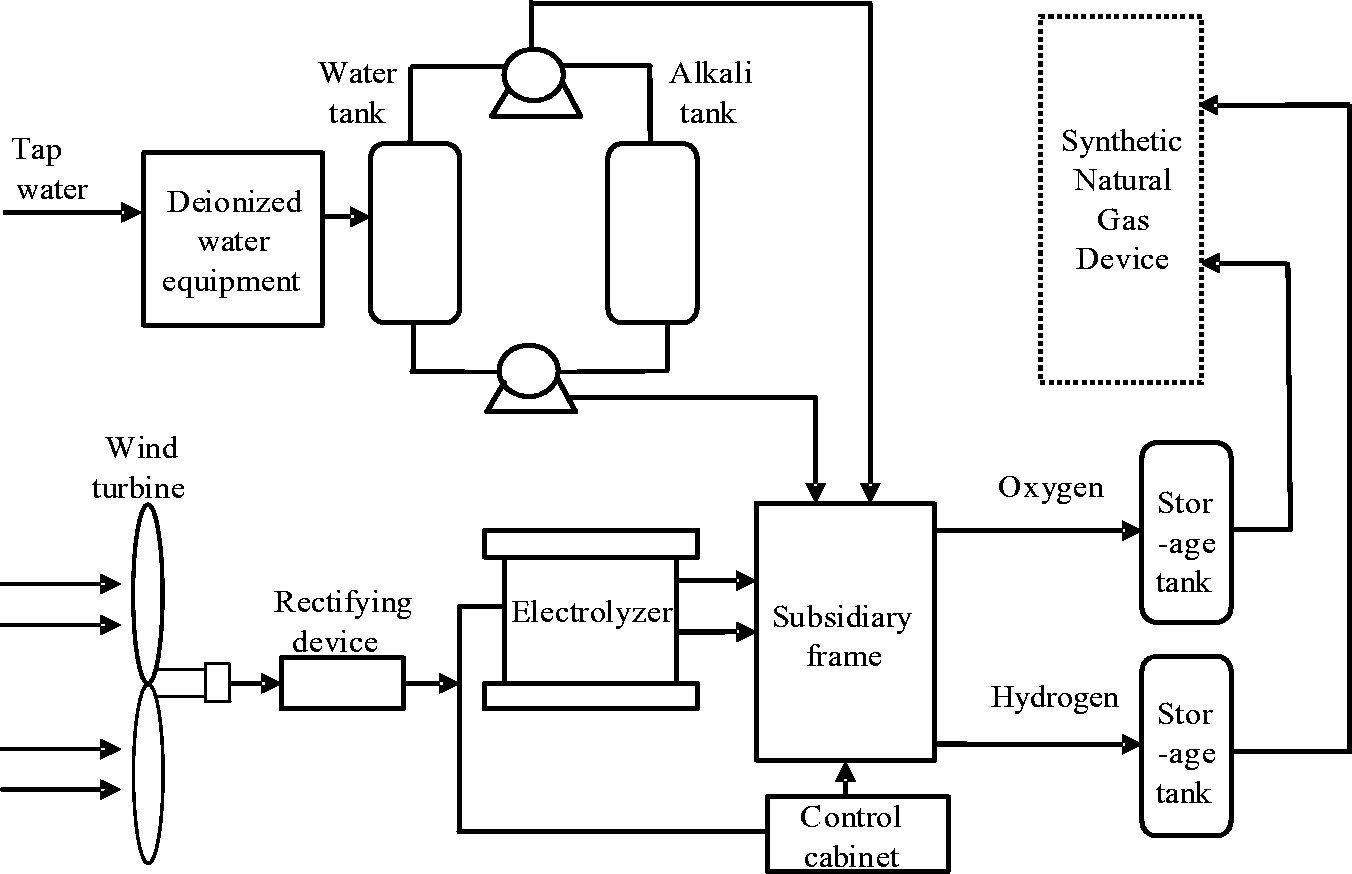
Flow chart of hydrogen production.
Adaptability of hydrogen production unit under the condition of wide power fluctuation of wind power
The power output fluctuation range of the wind power hydrogen production system has a certain influence on the hydrogen production device (Dobó and Palotás, 2016). There are two main aspects: the effect of large fluctuation on the life of equipment; the effect on the purity of the product gas. In order to prevent the mixture of hydrogen and oxygen in the hydrogen production system, the film cloth with the function of permeable gas isolation is placed between the cathode and the anode. But there is still a small amount of hydrogen and oxygen permeating the diaphragm. In order to prevent the explosion in the electrolysis device, the hydrogen oxygen concentration analyzer is installed. At the same time, in the experimental study, in the wide power fluctuation, the low power of hydrogen production will lead to the production of impure gas. Therefore, it is necessary to adjust the other process parameters to ensure the safe operation of hydrogen production under low power and to adjust the electrolyte circulation and power of the system on the same period. This method can greatly improve the purity of the gas. So for the hydrogen plant adaptability problem in condition of wind power fluctuation, by adjusting the process parameters to improve the purity of hydrogen is a key technology to ensure system safety operation, such as the use of methods and an electrolyte circulation system power regulation of hydrogen production system safe operation.
Hydroelectric hydrogen production technology of inorganic ion membrane
In the water electrolysis hydrogen production equipment of inorganic ion membrane, a series of problems caused by the use of the raw asbestos diaphragm have been fundamentally solved. It has the following advantages: the first is the advanced inorganic basic ionic membrane. The film thickness is only 0.2 mm, and it has strong ionic permeability, high hydrogen and oxygen gas separation, and the resistance value of cathode and anode two electrodes is small. The film voltage is very low and the electrode spacing is almost zero, so the cell voltage is not increased when the electrolysis current density is increased. Therefore, the heat of hair is small, the efficiency of electrolysis is high, and the energy consumption is greatly reduced. The second is that the inorganic basic ionic membrane is not easy to break up and is not soluble in the alkaline solution, and its operation safety is higher than that of the traditional electrolyzer. The third is the design of the electrolyte natural circulation, no longer using the circulating pump, which not only saves the energy consumption of the pump, but also eliminates a lot of troublesome maintenance and maintenance work.
Energy saving technology of water electrolysis system
The key of hydrogen production by water electrolysis is to reduce energy consumption in the process of electrolysis and improve the efficiency of energy conversion. The water electrolysis system consists of two systems, for hydrogen production by electrolyzer and hydrogen purification (Li and Zhou, 2010). In the process of water electrolysis, hydrogen consumption is reduced by adding additives in the electrolyte or using a low current density operation. The power consumption is reduced and hydrogen production efficiency is improved by improving the electrolyte materials and improving the control technology of the hydrogen purification system (Sakurai et al., 2015). At present, the energy consumption level is about 4.5–5.5 kWh/m3 H2 (standard), and the energy efficiency is from 72 to 82%.
At present, the key technologies of the wide power fluctuation and high efficiency electrolytic hydrogen production system are as follows: (1) the optimization of the cell structure, (2) the influence of the power input power fluctuation on the performance of the electrolyzer, and (3) the optimization of the control system. At present, the research on the adaptability of the wide power fluctuation of the water electrolysis plant is carried out. The adaptability experiment of the wide power fluctuation of the water electrolysis plant was completed by Ning Nan in 718 Research Institute of China Shipbuilding Heavy Industry Group, which changed the working temperature and the electrolyte circulation.The experimental data showed that the water electrolysis system is operated under the condition of wide power fluctuation under the load of 20–100%. The hydrogen content in oxygen is stable between 1.04 and 1.10%, which can meet the safe operation of the water electrolysis system (Ning, 2017). The wide power electrolyzer not only improves the efficiency of the wind power generation system, but also helps the safe operation of the electrolysis hydrogen system. Therefore, it is very important for the development of high efficiency and high efficiency electrolysis hydrogen production equipment.
Technology of fuel cell power generation
Fuel cell is an efficient and environment-friendly energy conversion device, which is a promising power source (Liu et al., 2006; Zhang et al., 2012a). Hydrogen fuel cell technology is a new power supply technology. In this technology, pure hydrogen is used as fuel and air as an oxidant. A proton exchange membrane fuel cell is used to generate electricity. It has the characteristics of simple structure, reliable, good adaptability, and quick start speed. The fuel cell power system is an independent power generation system, which ensures uninterrupted power supply. The power system of fuel cell is not only an independent power supply, but also as a standby power supply. And it can be used as a vehicle power system to replace the traditional engine, to provide power for the electric vehicle. At present, through the independent research and development of research institutions and enterprises, the technological breakthrough of the membrane electrode and metal plate of the core components of the hydrogen fuel cell has been realized and the production of hydrogen fuel cells has gradually matured (Nie et al., 2015). The uniformity of platinum catalyst coating was greatly improved, the use of platinum catalyst was greatly reduced, and carbon nanotube technology was used in the preparation of membrane electrode. Through this technology, the cost of the battery is reduced and the life of the fuel cell is improved. Through this technology, the power density of the membrane electrode is 2 W/cm2, the service life is 15,000 h, and the cost of the membrane electrode is reduced to the original 1/4.
In order to supply the hydrogen energy to the load or grid power, the quality of the energy released from the hydrogen fuel cell must reach the standard (Wei, 2016). Hydrogen fuel cell has poor output curve volt–ampere characteristics, low stability, and high power fluctuation, so the voltage is transferred by DC–DC transformation to power supply. Therefore, it is of great significance to study the efficient and stable transformation system for the utilization of hydrogen energy. At present, the bidirectional DC–DC converter is the main power conversion device. It is an important research direction to optimize the DC–DC conversion topology of hydrogen fuel cell, improve the fuel cell output characteristic, and realize stable pressure and boost pressure.
Integrated control and safety of electric hydrogen production
As a new industry, wind power hydrogen production has not formed a fixed form because of its own development and characteristics of production. Its operation and management includes the work of safe service in the process of hydrogen preparation, transmission, and application. It is very important to ensure the quality standard of hydrogen, reduce all kinds of loss, improve economic efficiency, and ensure the safety of economic operation and the safety of personnel. The wind power generation hydrogen fuel cell system consists of wind power generation system, electrolytic hydrogen production system, compression hydrogen storage system, fuel cell system, and other related coordination control (Belmokhtar et al., 2014). In the wind power generation system and the electrolysis hydrogen system, it is determined whether the hydrogen can be prepared by judging the size of the discarded air volume. The process cooperation between fuel cell system and other systems is guaranteed, which is coordinated control according to the capacity and quality of wind power integration, the actual demand of local load and the operation of hydrogen storage system. In the industrial chain of wind power hydrogen production, hydrogen preparation, hydrogen energy transmission and application, all links of hydrogenation stations have been put forward very high requirements in terms of fire control, safety, and management. In the distillation, storage, and injection technology of hydrogen and its system, it is necessary to meet the pressure characteristics and accurate requirements for flow and flow information. It also needs to meet the requirements of the metering and charging.
Control of electrolysis hydrogen system
The control system of electrolytic hydrogen production includes output voltage control, pressure control, liquid level control, temperature control of electrolyzer, circulation control of electrolyzer, purity control of hydrogen, purity control of oxygen, and so on. The input through the transformer and the rectifying cabinet set the DC power for the power supply grooves. The output voltage of the rectifier cabinet is required to control the output voltage, which ensures that the operating power of the hydrogen production system can be adjusted from 0 to 100%. The pressure can be adjusted within the range of the rated working pressure of the 50–100% after the operating pressure is set in the electrolytic hydrogen production equipment. Hydrogen and oxygen can be isolated through the liquid level control of the electrolyte to avoid the danger of explosion. The key to ensure that the diaphragm is not damaged is the temperature control of the electrolyzer. The drying process of the electrolyzer can be avoided through the continuous circulation of the electrolyte through the system to bring out the gas and heat produced by the equipment. The analysis and testing system of hydrogen and oxygen concentration is added to the electrolytic hydrogen production equipment to realize the monitoring and control of the purity of hydrogen. If the purity of hydrogen is not required to control the operation of the electrolysis system, this can prevent the explosion and ensure the safety of hydrogen production.
Control strategy of hydrogen storage system
At present, the main forms of hydrogen storage and transportation are metal hydride, high pressure gas, and low temperature liquid. The study of hydrogen mass transport pipeline is still in progress (Colón et al., 2016; Thornton et al., 2017). The control strategy of the compressed hydrogen storage system is mainly composed of the control strategy of the hydrogen charging process and the control strategy of the hydrogen supply process. The compression hydrogen storage system is composed of pressure sensor of buffer bottle, high pressure sensor of high pressure storage bottle, temperature sensor, and hydrogen leak sensor for storage system. The control of hydrogen supply process is mainly by sending signals to the high pressure hydrogen storage device to complete the gas supply. The high pressure hydrogen storage device releases hydrogen through the decompressor. Low pressure sensor can monitor the failure of the pressure reducer. It is installed on the pressure reducer to ensure the safe operation of the hydrogen storage and gas supply system (Cai et al., 2017).
Control strategy of fuel cell and micro DC-grid system
The fuel cell power generation system is composed of auxiliary system, heat dissipation system, host system, and so on (Zhang et al., 2017a). When the fuel cell receives the switch command of the system, the auxiliary system is started and self-checked. The maximum output capacity and maximum loading capacity of the fuel cell system are fed back to the successful self-inspection. The control system controls the power of the target of the converter to control the output power of the fuel cell system (Jayasankar and Vinatha, 2016). The basic control framework for the hydrogen production and micro DC-grid parts of the wind power is shown in Figure 7.

Control frame diagram of hydrogen production generation.
In view of the characteristics of the main application of DC in hydrogen production by wind power, it is one of the most important research points to carry out the corresponding micro DC-grid. The micro DC-grid structure is shown in Figure 8.

Micro DC-grid structure.
Micro DC-grid is a network consisting of distributed generation unit, energy storage device, and load according to a certain topology (Zhang et al., 2017b). The electric energy of the wind power can be incorporated into the micro DC-grid by the way of hydrogen production after a simple variable flow technique. The storage conversion of the electric energy is accomplished by the hydrogen storage system and the fuel cell. A power source that is boosted by a variable voltage flow, providing power to a user’s load or grid when the user or grid needs it. The micro grid is flexible in control and high energy utilization rate. It is suitable for the flexible adjustment and combination of wind power in wind power hydrogen production. It has great advantages in solving the wind power fluctuation in wide power range, high adaptive energy conversion, off/grid switching, and load power supply reliability (Haghi et al., 2017). The introduction of micro DC-grid in the technology of wind power hydrogen production provides a new direction for the development of distributed energy and the application and research of multienergy coupling storage system. This technology not only meets local users’ requirements for power quality and safety, but also greatly reduces the impact of wind power fluctuations on power systems or distributed energy sources (Yan and Kong, 2015). The synergistic operation of wind power grid and off network can not only improve the utilization of wind energy, but also reduce the impact on the power grid. It can also be flexible, reliable, and environmentally friendly.
Conclusion
In this paper, the development of hydrogen production technology by wind power is deeply analyzed and summarized. On the one hand, the hydrogen production technology can alleviate the “wind curtailment” problem of wind power generation. On the other hand, hydrogen energy, as a clean and efficient energy, has a great potential for application at present. Hydrogen is an important industrial gas and special gas, and it is widely used in many industries. In the era of green development, hydrogen energy, as a kind of clean energy, is expected to be greatly developed. The development of hydrogen production is still facing many key problems, such as mature wind turbine structure, optimization of electrolyzer for wind power fluctuation, high life fuel cell, and large capacity hydrogen storage equipment.