







Abstract
Introduction
The net oil imports of China increased by 10.1% to a record high of 29.4 × 10⁸ bbl in 2017, accounting for 68.4% of the total petroleum consumption (Wang et al., 2018). The excessive dependence on petroleum imports also inspired studies and explorations on domestic petroleum resources in China. Dongpu Depression in the Bohai Bay Basin is an essential petroleum production base for the Zhongyuan Oilfield, SINOPEC. The industrial oil flow in the Dongpu Depression was discovered in the Well PC1 in 1975, followed by development and construction in 1979. By 2015, Dongpu Depression have found more than 3.96 × 10¹¹ m3 gas reserves and 33.86 × 10⁸ bbl oil reserves (Tan et al., 2017). This obviously became a promising area for petroleum exploration. However, recent petroleum productions in the Dongpu Depression have been decreasing gradually in shallow strata less than 3500 m burial depth. To solve the problem of the rapid decline in petroleum production, it is of great significance to explore petroleum in deep strata such as the Shahejie 3 Formation that has a burial depth of more than 3500 m (Liu et al., 2017). Recent evaluations of petroleum resources in the Dongpu Depression based on two-dimensional basin simulation in 2003 did not help much on petroleum explorations of deep strata, because the thermal history in the Dongpu Depression has not been comprehensively studied before 2016 (Jiang et al., 2015, 2009; Li et al., 2016; Zuo et al., 2017b, 2017c), which led to inaccurate evaluations of petroleum resources. Therefore, further studies are needed to evaluate the petroleum resource potential, especially the resource distributions in deep strata such as the Shahejie 3 Formation, in the Dongpu Depression.
Source rock evaluation is defined as assessing the hydrocarbon-generating potential of sediments by its kerogen type, organic matter abundance, and thermal maturity. However, samples are usually insufficient in central areas of hydrocarbon generation and depressions which are not conventional targets for petroleum exploration, thus, conventional experimental test methods such as geochemical experiments are not viable to comprehensively study the Dongpu Depression.
In addition, observations can only be obtained on the source rock maturity at the present day, other than the source rock thermal maturity history and the associated hydrocarbon generation and expulsion, migration, and accumulation histories that help understand the entire process from petroleum generation to accumulation. With the development of modeling technology, the source rock thermal maturity history and time and space distribution in sedimentary basins can be quantitatively determined by basin simulation, and the basin simulation method is used in the study of source rock thermal maturity history in many basins (Belaid et al., 2010; Berthonneau et al., 2016; El-Shahat et al., 2009; González et al., 2013; Hakimi and Ahmed, 2016; Hu et al., 2001; Hudson and Hanson, 2010; Qiu et al., 2012, 2010; Zeinalzadeh et al., 2015; Zhu et al., 2016; Zuo et al., 2011, 2014, 2015b, 2015a, 2017a, 2016a, 2016b).
Based on the evaluation of the Shahejie 3 Formation source rocks and previous studies on the thermal history (Zuo et al., 2017c), this study modeled the source rock thermal maturity history of the Shahejie 3 Formation at four wells and source rock stratum of the Dongpu Depression using the BasinMod software, and favorable areas for petroleum exploration were also identified.
Geological settings
Dongpu Depression, the western part of the Linqing subbasin, locates in southern Bohai Bay Basin, North China with an area of 5300 km2 (Figure 1(a)). It is surrounded by eastern depression of Linqing subbasin to the north, Luxi uplift to the east, Lankao uplift to the south, and Neihuang uplift to the west (Figure 1(b)).

(a) Structural unit division of the Bohai Bay Basin and (b) structural unit division of the Dongpu Depression. BH: Bohai Bay; EL: Erlian; HL: Hailaer; HN: Hainan; Jun: Junggar; QD: Qaidam; SC: Sichuan; SL: Songliao; SNC: Southern part of North China; TW: Taiwan; YE: Yingen-Ejinaqi.
Bohai Bay Basin, 20 × 104 km2, is the central part of North China Craton. It experienced two strong rift movements during the Jurassic and from the Cretaceous to the Cenozoic and formed a large Mesozoic and Cenozoic rift basin. There develops the Cenozoic strata and remnants of the thinner Mesozoic strata (Li, 2007). Since the Cenozoic, the basin sedimentary center has gradually moved from the Jizhong, Linqing, and Liaohe subbasins at the edge of the basin to the Bozhong subbasin.
Dongpu Depression is one of the important petroleum units. It is a Cenozoic rift basin developed on the basement of the Paleozoic and Mesozoic, including the rift stage in the Paleogene and thermal subsidence stage from the Neogene to the Quaternary (Hou et al., 2001; Su et al., 2006). The rift stage includes three substages: (1) the initial rifting substage during the Shahejie 4 Formation depositional period (Es4) (50.5–45 Ma), the general shape of the depression forming, depositing red sandstone and gray mudstone in the lower part of the formation, and gray mudstone, interbedded gray, gray white mudstone and sandstone in the shallow, semideep lacustrine environments in the upper part of the formation; (2) the intense rifting substage during the Shahejie 3 Formation depositional period (Es3) (45–38 Ma), central uplift belt forming, depositing gray siltstone and mudstone in the deep and semideep lacustrine environments in this formation; (3) the later rifting substage from the Shahejie 2 Formation depositional period (Es2) to the Dongying Formation depositional period (Ed) (38–17 Ma), depositing purple red mudstone and oil-bearing sandstone in the river and delta environments in the Shahejie 2 Formation (Es2), light gray sandstone and mudstone in the fluvial and delta environments in the Shahejie 1 Formation (Es1) and interbedded purple red, gray green mudstone and purple red, gray green, gray white siltstone, fine sandstone and gravel sandstone in the fluvial and delta environments in the Dongying Formation (Ed). The thermal subsidence stage from the Guantao Formation depositional period (Ng) to present (17–0 Ma), depositing gray white, variegation mudstone, siltstone, sandstone, and conglomerate in the fluvial environments (Figure 2).

Stratigraphic column map of the Dongpu Depression (Zuo et al., 2017c).
Dongpu Depression includes the western gentle slope belt; western subdepression; central uplift belt; eastern subdepression; and Lanliao fault zone under control of the Changyuan, Huanghe, and Lanliao basement faults (Figure 1(b), Table 1). The Shahejie 3 Formation is an important source rock in the Dongpu Depression (Jiang et al., 2015), and it mainly developed in the Haitongji-Liutun area of the western subdepression, and Qianliyuan and Gegangji areas of the eastern subdepression (Liu et al., 2017).
Source rock developing areas of the Dongpu Depression.

Since the Cenozoic, Dongpu Depression has experienced two peaks of geothermal gradient during the Shahejie 3 Formation depositional period, 45–48°C/km, and the middle and late of the Dongying Formation depositional period, 40–43°C/km (Zuo et al., 2017c). The geothermal gradient has gradually decreased since the Neogene, and only 31–34°C/km at the present day (Zuo et al., 2017c) (Figure 3).
Methods
Source rock evaluation used the following geochemical experiment methods, Rock-Eval Pyrolysis, Elemental Analysis, Vitrinite Reflectance Analysis, and Chloroform Extraction. These geochemical data were collected in the Geological Laboratory of the Zhongyuan Oilfield, SINOPEC.
Based on the thermal history and present geothermal fields (Zuo et al., 2017c), source rock thermal maturity evolution is modeled by BasinMod software (2014 version). During modeling, the input parameters such as lithological data, each stratum thickness, erosion amount for key geological periods, rock thermophysical and geochemical data are first combined to establish a three-dimensional geological model, and then source rock thermal maturity evolution is modeled by basin simulation software. The modeled results can be determined if the modeled present maturity is consistent with measured vitrinite reflectance data. The thermal maturity evolution of the Shahejie 3 Formation in the Dongpu Depression was modeled using the Easy%Ro model of Ro (Sweeney and Burnham, 1990) with the BasinMod software.
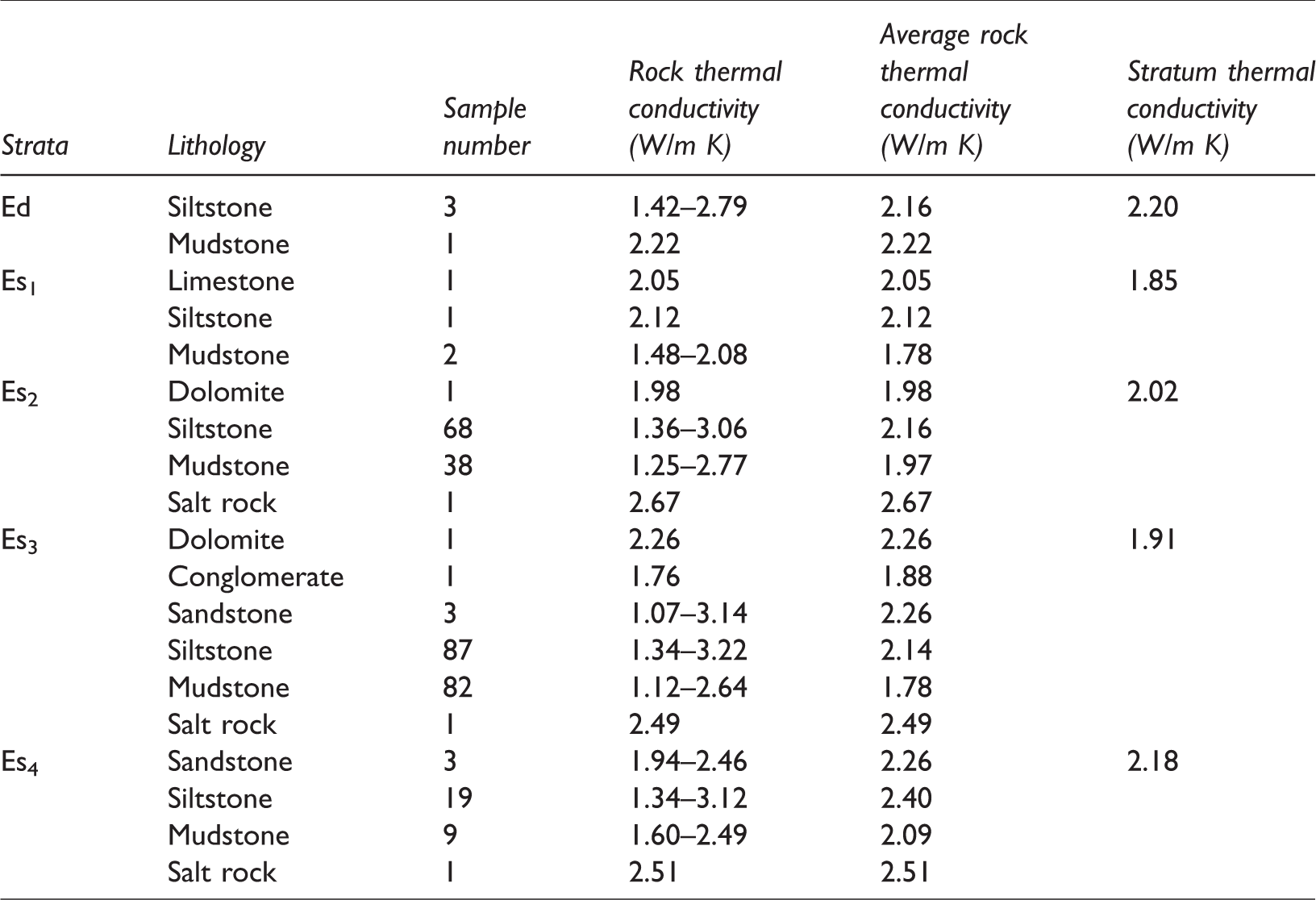
The thermophysical properties include rock thermal conductivity and heat production rate (Table 2) (Zuo et al., 2014), and the stratigraphic ages are shown in Figure 2. For the source rock thermal maturity evolution stages are as follows: immature (Ro < 0.5%), early mature (0.5% ≤Ro < 0.7%), mid-mature (0.7% ≤Ro < 1.0%), high mature (1.0% ≤Ro < 1.3%), wet-gas stage (1.3% ≤ Ro < 2.0%), and dry-gas stage (Ro ≥ 2.0%).
Rock thermal conductivity for strata in the Dongpu Depression (Zuo et al., 2014).
Results
Source rock evaluation
The Shahejie 3 Formation source rocks in the Dongpu Depression were evaluated based on the organic matter type, organic matter abundance, maturity, chloroform bitumen “A,” and dark mudstone distribution.
Organic matter abundance
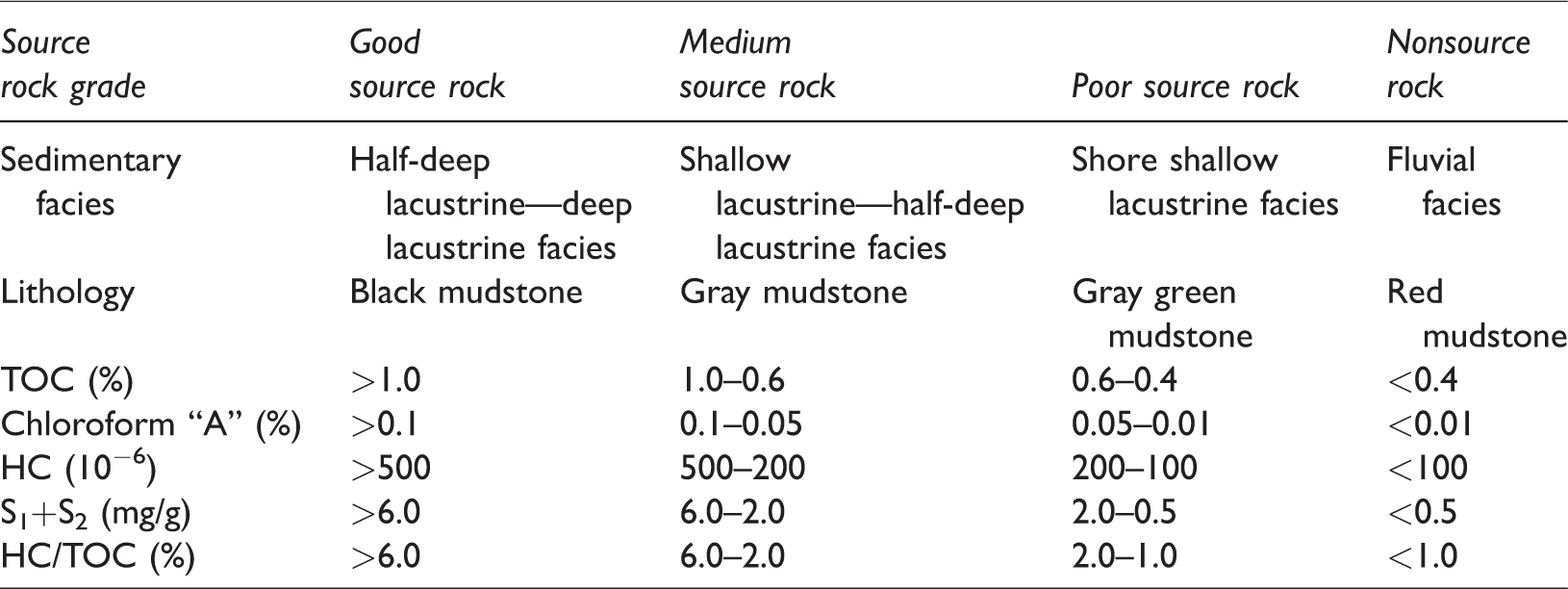
The continental source rock standard (Table 3) was used to assess the organic matter abundance. The results show the Shahejie 3 Formation in the Qianliyuan and Haitongji-Liutun areas of the Dongpu Depression are medium-good source rocks (Table 4). For instance, for the Shahejie 3 Formation source rocks in the Haitongji-Liutun area, TOC ranges from 0.04 to 8.51%, with an average of 0.80%; chloroform bitumen “A” ranges from 0.0004 to 1.9308%, with an average of 0.1776%; total hydrocarbon content (HC) ranges from 1.08 to 56135.00 ppm, with an average of 2272.82 ppm; and potential hydrocarbon generation amount (S1+S2) ranges from 0.001 to 68.450 mg/g, with an average of 2.738 mg/g (Table 4).
Evaluation criteria of terrestrial source rocks (Huang et al., 1984).
Organic matter abundance of the Shahejie 3 Formation source rocks in the Dongpu Depression.

The source rocks in the Gegangji and Menggangji areas are nonpoor source rocks (Table 4). For instance, for the Shahejie 3 Formation source rocks in the Gegangji area, TOC ranges from 0.04 to 3.85%, with an average of 0.40%; chloroform bitumen “A” ranges from 0.0013 to 0.7160%, with an average of 0.0409%; HC ranges from 0.75 to 1364.52 ppm, with an average of 56.72 ppm; and S1+S2 ranges from 0.001 to 16.440 mg/g, with an average of 0.683 mg/g (Table 4).
Organic matter type
The organic matter type for source rocks in the Dongpu Depression has been evaluated primarily based on pyrolysis experiment parameters. The source rocks mainly include type III kerogen in the Gegangji and Menggangji areas, but are dominated by types II and III kerogen with a small amount of type I kerogen in the Qianliyuan and Haitongji-Liutun areas (Figure 4). In summary, the organic matter types of the Shahejie 3 Formation source rocks are mainly types II and III kerogen with a small amount of type I kerogen in the Dongpu Depression.
Organic matter maturity
Based on the analysis of 409 samples of the vitrinite reflectance (Ro) data, the Shahejie 3 Formation source rocks in the Dongpu Depression have reached mature stage (Table 5, Figure 5). The maximum vitrinite reflectance are distributed in the Qianliyuan and Haitongji-Liutun areas, which are 2.83 and 2.25%, respectively, and the source rocks in these areas reached the dry-gas stage. The maximum vitrinite reflectance in the Gegangji and Menggangji areas are 1.67 and 1.43%, respectively (Table 5).
Vitrinite reflectance of the Shahejie 3 Formation source rocks in the Dongpu Depression.

Dark mudstone distribution
Based on logging, geochemical and seismic data, the dark mudstone distribution of the Shahejie 3 Formation source rocks in the Dongpu Depression was studied. The dark mudstone is mainly distributed in the Haitongji-Liutun, Gegangji, and Qianliyuan areas. The maximum thickness of dark mudstone is over 2400 m in the Haitongji-Liutun area, 2200 m in the Gegangji area, and 2000 m in the Qianliyuan area. The dark mudstone in the Menggangji area is generally undeveloped, with the maximum thickness only about 800 m (Figure 6).
In summary, the Shahejie 3 Formation source rocks of the Dongpu Depression are generally mature, with main contents of types II and III kerogen with a small amount of type I kerogen. In the Haitongji-Liutun and Qianliyuan area, organic matter abundance are evaluated as medium to good, and the dark mudstones are thick, with a thickness of 2400 and 2000 m, respectively.
Thermal maturity evolution of source rocks
Based on the thermal history and present geothermal field (Figure 3) of the Dongpu Depression (Zuo et al., 2017c), the thermal maturity evolution of the Shahejie 3 Formation in the typical wells, as well as its top and bottom strata, is modeled using BasinMod 1D and Basin View software, respectively.

Thermal history in the Dongpu Depression (updated based on Zuo et al., 2017b).

Organic matter types for source rocks in the Dongpu Depression. D: degradation rate; HI: hydrogen index; n: number of samples; Tmax: peak temperature of pyrolysis.

Vitrinite reflectance (Ro) data versus depth in the Dongpu Depression.

Mudstone thickness map of the Shahejie 3 Formation in the Dongpu Depression.
Thermal maturity evolution of source rocks in the typical wells
The modeled results of the four typical wells from the four areas are fit well for the measured Ro data (Figure 7). The simulation indicates that the Shahejie 3 Formation in the Well PS4 experienced the highest paleo-geotemperature during the Dongying Formation depositional period (Figure 7(a)). Thus, the Well PS4 only experienced one stage of hydrocarbon generation during the Dongying Formation depositional period (Figure 8(a)). The present temperature of the Shahejie 3 Formation sources rock in the Well PS14 is slightly higher than paleo-geotemperature during the Dongying Formation depositional period (Figure 7(b)), suggesting the Well PS14 experienced weak regenerated hydrocarbon from the Minghuazhen Formation depositional period to present (Figure 8(b)). For the Well T8, the present temperature at the bottom of the Shahejie 3 Formation source rocks is slightly lower than the paleo-temperature during the Dongying Formation depositional period, while the present temperature at the top of the Shahejie 3 Formation source rocks is slightly higher than the paleo-temperature during the Dongying Formation depositional period (Figure 7(c)). Thus, the bottom of the Shahejie 3 Formation source rocks in the Well T8 only experienced one stage of hydrocarbon generation, while the top of the Shahejie 3 Formation in the Well T8 experienced two stages of hydrocarbon generation which were during the Dongying Formation depositional period and from the Minghuazhen Formation depositional period to present, respectively (Figure 8(c)). The present temperature of the Shahejie 3 Formation in the Well PS6 is higher than the paleo-geotemperature during the Dongying Formation depositional period (Figure 7(d)), indicating the Well PS6 had regenerated hydrocarbon from the Minghuazhen Formation depositional period to present (Figure 8(d)).

The burial and thermal histories of the typical wells. “+” means measured vitrinite reflectance (Ro) datum, and the solid line means modeled result in the right chart.

Maturation history of the typical wells in the Dongpu Depression. Dashed line indicates no drilling through bottom.
The thermal maturity evolution of the Shahejie 3 Formation in four wells (Figures 7 and 8) reveals that all the source rocks reached mature stage: the top of the source rocks in the Wells PS4 and PS6 reached mid-mature stage, while the top of source rocks in the Wells PS14 and T8 only reached early mature stage, and the bottom of the source rocks in four wells all reached overmature stage.
Thermal maturity evolution of the Shahejie 3 Formation source rocks
At the end of the Shahejie 1 Formation depositional period, only the top of the Shahejie 3 Formation in the Qianliyuan area, north-central of the Menggangji area and south of the Haitongji-Liutun area reached the hydrocarbon generation threshold (Figure 9(a)). During the Dongying Formation depositional period, the source rocks were in mid-mature stage on average and reached high mature stage in the Qianliyuan area, north-central of the Menggangji area, and south of the Haitongji-Liutun area (Figure 9(b)). From the end of the Dongying Formation depositional period to the Guantao Formation depositional period, hydrocarbon generation paused in the Dongpu Depression with little change in the maturity of source rocks (Figure 9(c)). From the beginning of the Minghuazhen Formation depositional period to present, the source rock maturity substantially increased and generally reached high mature stage and even dry-gas stage in the Menggangji area and south of the Haitongji-Liutun area, but only slightly increased in the Qianliyuan area (Figure 9(d)).

Maturation level for the top of the Shahejie 3 Formation. The contour interval is 0.1%
At the end of the Shahejie 1 Formation depositional period, source rocks at the bottom of the Shahejie 3 Formation were generally in high mature stage in the eastern subdepression and western subdepression of the Dongpu Depression, and reached wet or dry-gas stage at the center of the Haitongji-Liutun, Qianliyuan, and Gegangji areas (Figure 10(a)). During the Dongying Formation, source rocks generally reached wet or dry-gas stage, with the maturity of 3.4% at the center of the Haitongji-Liutun, Qianliyuan, and Gegangji areas, 2.0 and 2.4% in the center and north of the Menggangji area, respectively (Figure 10(b)). From the end of the Dongying Formation depositional period to the Guantao Formation depositional period, hydrocarbon generation paused in the Dongpu Depression with little change in the maturity of source rocks (Figure 10(c)). From the beginning of the Minghuazhen Formation depositional period to present, the source rock maturity substantially increased in the Menggangji area and reached 2.4 and 2.8% in the central and north-central area, respectively, while changes of source rock maturity are minimal in other areas (Figure 10(d)).

Maturation level for the bottom of the Shahejie 3 Formation. The contour interval is 0.2%.
Discussion
The mature hydrocarbon generation history of source rocks is one of the important factors in the study of petroleum reservoir dynamics, and it determines the key period of oil and gas filling and oil and gas enrichment area. Therefore, it is of great significance to understand the hydrocarbon generation history in the Dongpu Depression for the petroleum reservoir dynamics and oil and gas enrichment area.
Two hydrocarbon generation stages?
Dongpu Depression was uplifted by the Dongying Movement and experienced increasing erosion during the middle and late of the Dongying Formation depositional period when hydrocarbon generation paused. The thickness of the sedimentary layers remained small during the Guantao Formation depositional period. Until in the Minghuazhen Formation depositional period, the sediment thickness rapidly increased and balanced out the reduction of stratum thickness resulted from the uplift and erosion during the middle and late of the Dongying Formation depositional period. The burial history shows that the burial depth of the present strata is larger than that during the Dongying Formation depositional period, which raised the question: is there a secondary hydrocarbon generation stage?
The two secondary hydrocarbon generation stages are mainly distinguished by temperature. Hydrocarbon can be regenerated when the temperature of the late-stage source rock exceeds the temperature of the earlier period with a certain magnitude. The maturity evolution of the Well PS6 in the Menggangji area indicates two hydrocarbon generation stages for the Shahejie 3 Formation: the first hydrocarbon generation was during the Dongying Formation depositional period, and the second was from the Minghuazhen Formation depositional period to present. However, the source rocks in the Menggangji area were evaluated as nonpoor source rocks with dark mudstone relatively undeveloped, implying low potential of hydrocarbon generation in this area, and this is consistent with the result of previous studies (Jiang et al., 2015, 2009).
The two hydrocarbon generation stages are not obvious in the other areas. The middle and lower parts of the Shahejie 3 Formation experienced a peak of hydrocarbon generation during the Dongying Formation depositional period when the bottom of the source rocks reached overmature stage. Therefore, it can be inferred that the Dongying Formation depositional period was the main period for petroleum generation which was controlled by the paleo-geothermal field in the Dongpu Depression. These are not consistent with the results of previous studies (Jiang et al., 2015,2009). They thought the two secondary hydrocarbon generations were obvious in the Qianliyuan and Haitongji-Liutun areas on basis of the later thickness compensation only during the Minghuazhen Formation to present and lack of thermal history study, and the result was wrong because the two secondary hydrocarbon generations are mainly determined by temperature.
Therefore, the study indicates that the most important oil and gas generation period in the Dongpu Depression during the depositional period of the Dongying Formation, and oil and gas during this period should be explored.
Favorable area for exploration
The petroleum discovered in this depression was mainly distributed in the northwest slope of the Qianliyuan area, the Pucheng uplift and the Wenliu uplift between the Qianliyuan area and Haitongji-Liutun area, the west Huzhuangji slope and the northwest slope of Haitongji-Liutun area, and the Shahejie 3 Formation source rocks also mainly developed in the Qianliyuan and Haitongji-Liutun areas. The middle and lower parts of the Shahejie 3 Formation source rocks all experienced peaks of hydrocarbon generation, and the bottom of source rocks generally reached the stage of dry-gas, implying a great potential to generate a large amount of petroleum. Therefore, the exploration for petroleum should be performed at the Shahejie 3 Formation source rocks in the Qianliyuan and Haitongji-Liutun areas to study the lithology and discover complex petroleum reservoirs.
Conclusions
(1) The Shahejie 3 Formation source rocks mainly developed in the Qianliyuan and Haitongji-Liutun areas of the Dongying Depression and are dominated by medium to high maturity source rocks that primarily include types II and III kerogen with a small amount of type I kerogen.
(2) There have been two hydrocarbon generation stages in the Menggangji area of the Dongpu Depression: one was during the Dongying Formation depositional period, and the other was from the Minghuazhen Formation depositional period to present. Whereas the source rocks in the Menggangji area are evaluated as nonpoor source rocks with dark mudstone relatively undeveloped, suggesting low potential for hydrocarbon generation. The two hydrocarbon generation stages are not obvious for other areas. The middle and lower parts of the Shahejie 3 Formation source rocks experienced a peak of hydrocarbon generation during the Dongying Formation depositional period when the bottom of the source rock reached overmature stage. The source rocks of the Dongpu Depression mainly developed in the Haitongji-Liutun and Qianliyuan areas, indicating high potential for hydrocarbon generation in these areas. Source rocks in the Gegangji area are evaluated as nonpoor source rocks, implying low potential hydrocarbon generation in this area.
(3) The thermal evolution of source rocks revealed that the main hydrocarbon generation period of the Shahejie 3 Formation was during the Dongying Formation depositional period, and the exploration for petroleum should be performed at the Shahejie 3 Formation source rocks in the Qianliyuan and Haitongji-Liutun areas to study the lithology and discover complex petroleum reservoirs. This study provides new insight for understanding the oil and gas exploration potential of the Dongpu Depression.