







Abstract
Keywords
Introduction
Shale gas is a type of unconventional natural gas resource which has become a research hotspot due to its abundant resources and wide distribution. In particular, the success of shale gas exploration in the United States has sparked a global boom in shale gas exploration. The shale gas in North America is mainly composed of high-quality marine siliceous rich shale with high content levels of organic matter and is in mature or overmature stages. The shale is buried at shallow to medium depths and has been found to have relatively rich gas adsorption characteristics. The brittle mineral content levels in the shale reservoirs are high, and the content levels of clay minerals are known to be low. Therefore, very developed cracks are evident, which is beneficial to the development of shale gas. In biogenic gas basins, cracks linked the atmosphere, fresh water, and shale during the early stages, which resulted in the generation of biogas. The cracks not only serve as gas storage, but also as good transportation systems for gas exploration (Curtis, 2002; Jarvie et al., 2007; Kinley et al., 2009; Kuuskraa, 2007; Loucks et al., 2009; Martineau, 2007; Pollastro et al., 2007).
China’s marine shale gas resources are mainly distributed in southern China, and in the northern China platform and Tarim platform regions. The marine fine-grained rocks are generally characterized by the large thicknesses of single layers, high abundance of organic matter, high silica content, low clay mineral content, and well-developed fractures. These characteristics are known to be favorable for shale gas accumulation and development. However, due to the older ages of the formations, the thermal evolution degree of some of the fine-grained rock is higher and beyond the peak of gas generation. Meanwhile, some of the shale is deeply buried with high structural complexity, which is known to be unfavorable for shale gas accumulation and development (Cheng et al., 2009; Li et al., 2009; Wang et al., 2017; Yang et al., 2013; Zhang et al., 2008a, 2008b; Zou et al., 2010).
China’s sea and land transitional facies are widely distributed in northern and southern China, as well as in the Tarim Basin (Li et al., 2009, 2017; Wang et al., 2017; Zhang et al., 2009; Zou et al., 2010). However, the rich organic matter of the marine and terrestrial shale of the Upper Palaeozoic Period are not considered to be suitable for independent exploration and exploitation of shale gas due to the small single layer thicknesses. Therefore, in the areas of the Yangtze, Yunnan, Guizhou, and Guangxi Provinces of China it has been found that the single shale layers are not thick enough for independent exploitations of shale gas deposits.
The Paleozoic Period in China was characterized by the sedimentation of the epicontinental sea, with such features as vast spreading actions, shallow water levels, and periodic transgression and regression actions. Widely distributed coal seams, carbonate, fine-grained sedimentary rocks, and so on had subsequently developed. However, the layer thicknesses were not large (Li et al., 2017).
Marine–continental transitional facies shale is mainly the rich organic shale which was formed through the formation of coal-bearing clastic rock masses during the Carboniferous–Permian period. The organic matter contained in the marine–continental transitional facies shale is given priority, along with terrigenous higher plants, shale and coal-seams symbiosis, and often sandstone interbedding. The longitudinal and transverse lithologic changed frequently, with the longitudinal continuous thicknesses remaining small, and the total thickness remaining large. The transverse thicknesses were unstable or quickly changed phases, with superimposed widespread distributions. The marine–continental transitional facies shale mainly compose the Benxi Formation, Taiyuan Formation, and Shanxi Formation of the Carboniferous–Permian system in Northern China (including the Ordos Basin and Bohai Bay Basin), and the Longtan Formation of the Permian in southern China (Bao et al., 2016; Dong et al., 2016; Shao et al., 2016).
The marine–continental transitional facies shale gases have five characteristics: (1) Deep marsh reed facies may be a favorable zone for controlling the development and distribution of high-quality shale in marine–continental transitional facies. Marine–continental transitional facies shale is widely distributed in the form of vertical and horizontal laminations. (2) Potassium and silty shale are favorable lithologic facies and can have the characteristics of high brittleness. (3) The matrix pores (intercrystalline, intergranular, and dissolution pores of clay minerals, and so on) are the main storage spaces. The organic matter pores are limited, and the micro-cracks are locally developed. (4) The thermal evolution is in the peak phase of life. (5) The transactions feature stable constructions, moderate burial depths, and good preservation conditions (Dong et al., 2016).
The main types of kerogen in China’s marine–continental transitional facies shale are types II and III, and the maturity of organic matter is generally high. The shale stratigraphic facies change quickly, with thin single layer thicknesses which are often interbedded with coal, dense sandstone, and even limestone. The mineral composition is characterized by rich clay shale. The total porosity was found to be low with some samples displaying developed micro-fractures. The pore types mainly include parallel plate-like narrow slit pores, and the organic pores make important contributions to the total pore structure of the rock. There have been major differences observed between the gas content levels measured in the shale and the gas adsorption capacities (Guo et al., 2015; Tang et al., 2016). The marine–continental transitional shale apertures are much less than 1 µm, and the organic matter content levels of the holes are low. Also, clay mineral intergranular pores, intergranular pores, pyrite mineral matrix pore development, and intergranular holes have been found to be rare (Li et al., 2015). The content of organic carbon and the maturity of the organic matter and immaculate layers in the marine–continental transitional shale have promoted the development of organic nano-scale pores. Meanwhile, the calcite content levels are known to have inhibited their development. The quartz and illite content levels promoted the micron pore development of the shale, while the carbonate content and buried depths inhibited their development. The quartz content, maturity of the organic matter, and total organic carbon (TOC) content levels promoted the development of the micro-fractures, while the carbonate content levels inhibited their development (Zhao and Guo, 2015). The main controlling factors of the gas content of the marine–continental transitional shale were determined to be the organic matter abundance, pyrite content, permeability, compensation density, and photoelectric absorption cross section index (Li et al., 2016). The content of TOC was found to be an important factor for the control of the gas content and gas-bearing capacity of the marine–continental transitional shale. Furthermore, the adsorption of rich clay minerals was observed to significantly increase the samples’ gas-bearing capacities (Tang et al., 2016).
Generally speaking, the present studies of marine and continental shale gas have become increasingly thorough. Meanwhile, the studies regarding sea-land interaction shale gas remain relatively weak and continue to lag behind other types of shale gas exploration and exploitation.
The area north of the Yellow River (Huanghebei Area) in Shandong Province was selected as the study area. In order to increase the available information, this study analyzed in depth the hydrocarbon potential, reservoir properties, and preservation conditions of the coal measures in the fine-grained rock masses of the Huanghebei Area.
Geological background
Tectonic characteristics
The Huanghebei Area is located in the northern section of the uplift of western Shandong. The western region of the area is bounded by the Yang’gu-Chiping Coalfield, and the northern section is bounded by the Qiguang Fault. The Woniushan Fault is on the eastern boundary side of the study area, and the uplift area of Taishan Mountain is located on the southern boundary (Figure 1).

Location and geological structure map of research area.
Main formation of the fine-grained rock masses
The shale gas source rock formations were mainly a set of dark fine-grained rock masses formed during the Carboniferous and Permian Periods, and contained from bottom to top, the Benxi Formation, Taiyuan Formation, Shanxi Formation, and Shihezi Group (Sun et al., 2002, 2016, 2017).
In the Benxi Formation, the lithology was purple and red iron mudstone and gray oolitic bauxite. The thicknesses were approximately 6 m in the west and 8 m in the east. Also, bottom conglomerate locally existed in the study area.
The Taiyuan Formation was characterized by thicknesses of between 150 and 175 m, and the main lithology was gray and black siltstone, mudstone, fine gray sandstone, and dark gray siltstone. Generally speaking, the average thickness was approximately 160 m, including seven limestone layers and the No. 14 coal seam (Yang et al., 2017).
In the Shanxi Formation, the thicknesses ranged from 100 to 150 m, and the lithology mainly consisted of gray-black fine sandstone and siltstone. Also, No. 3 to No. 5 coal seams were contained in this formation. The bottom of the formation was made up of medium-fine grained feldspar quartz sandstone with average thicknesses ranging between 3 and 5 m (Guo et al., 2016).
The Shihezi Group of the Permian Period was divided into the Heishan, Wanshan, Kuishan, and Xiaofuhe Formations. Due to the denudation in the area, only the Heishan and Wanshan Formations remained the study area. In the Heishan Formation, the main lithology was gray-white and grayish green siltstone, gray mudstone, and fine sandstone with thicknesses ranging from 53 to 97 m. In the Wanshan Formation, the main lithology was gray and gray-green siltstone and clay rock, with thicknesses of 125–160 m. The bottom of the formation was gray alumina clay mudstone (bauxite layer B). The upper section of the formation contained grayish white sandstone (Sun, 2016).
Development and distribution of the fine-grained rock in the Late Paleozoic strata
Formation environment of the fine-grained rock of the Late Paleozoic strata
In the western Shandong region, the Permo-Carboniferous is mainly a series of deep-gray black mudstone and fine-grained rock, which are both known to be important hydrocarbon source rock masses and reservoirs for shale gas.
The sedimentary environment had undergone the following processes: from shallow sea facies >marine–continental transitional facies > continental facies > formation of coal measures characterized by sandstone interbedded with mudstone. In terms of the coal seam roofs and floors, and the rock between the coal seams, it was observed that a set of high-quality reservoirs for shale gas had been formed. The Upper Paleozoic had undergone an entire process including the formation, development, peaking, atrophy, and transformation of the epicontinental sea basin. Accordingly, the lithofacies paleogeography had also experienced changes. The evolution sequence of the sedimentary system was as follows: tidal flat system > barrier lagoon system > delta system > river system (Li et al., 2018).
As a result, the entire set of factors, including the large thicknesses and rich organic fine-grained sedimentary series (primarily the fine-grained sedimentary rock of the Shanxi and Taiyuan Formations), provided good geological conditions for shale gas generation and development.
Characteristics and distribution of the fine-grained rock in the coal measures
Thin layers of fine-grained rock, sandstone and limestone, as well as coal seams, were continuously deposited in the Shanxi and Taiyuan Formations, forming a set of continuous deposition of shale gas reservoirs. The rich organic fine-grained rock and carbonaceous mudstone provided both source rock for shale gas and reservoir areas.
In the southwestern section of the study area, a coalbed methane parameter well which had been constructed in the Zhaoguan Mine revealed that gas overflow conditions existed in the individual thick mudstone and parts of the limestone. These findings indicated that the coal measures in the study area may contain shale gas or other unconventional gas resource potential.
It was revealed during the drilling of well JIGU-1 that the upper section of dark mudstone was mainly composed of dark-gray mudstone. Meanwhile, thin coal seams were occasionally discovered with single layer thicknesses of between 1 and 5.5 m (average of between 2 and 3 m). The rocks of the lower section of the Permian were dominated by gray and black carbonaceous shale containing a black coal seam with a single layer thickness of 1–9 m (average of between 2 and 5 m). The total thickness of the mudstone was determined to be 95.5 m, which accounted for 33.5% of the total thickness of the strata.
The Carboniferous strata are mainly composed of dark-gray and gray mudstone. A gray-brown and black carbonaceous shale and coal seam was concentrated in the upper section, with a single thickness of between 1 and 15.5 m, and an average thickness of 2–7 m. The total thickness of mudstone was 129.0 m, which accounted for 58.6% of the total thickness of the strata.
In this study, by analyzing the geological conditions of the fine-grained rock in the study area and the drilling results, it was determined that the fine-grained rock between the No. 5 and No. 10 coal seams within the Taiyuan and Shanxi Formations of the Carboniferous and Permian Periods in the study area displayed good geological conditions for shale gas development.
Then, based on the drilling data, the statistical data of the thicknesses of fine-grained rock masses in between the No. 5 and No. 10 coal seams in the study area showed that the total thicknesses were generally between 52.83 and 97.1 m, with an average thickness of 84.8 m. The thicknesses were found to be slightly larger in the western blocks of the study area where the average thickness was found to be greater than 90 m (Figure 2).
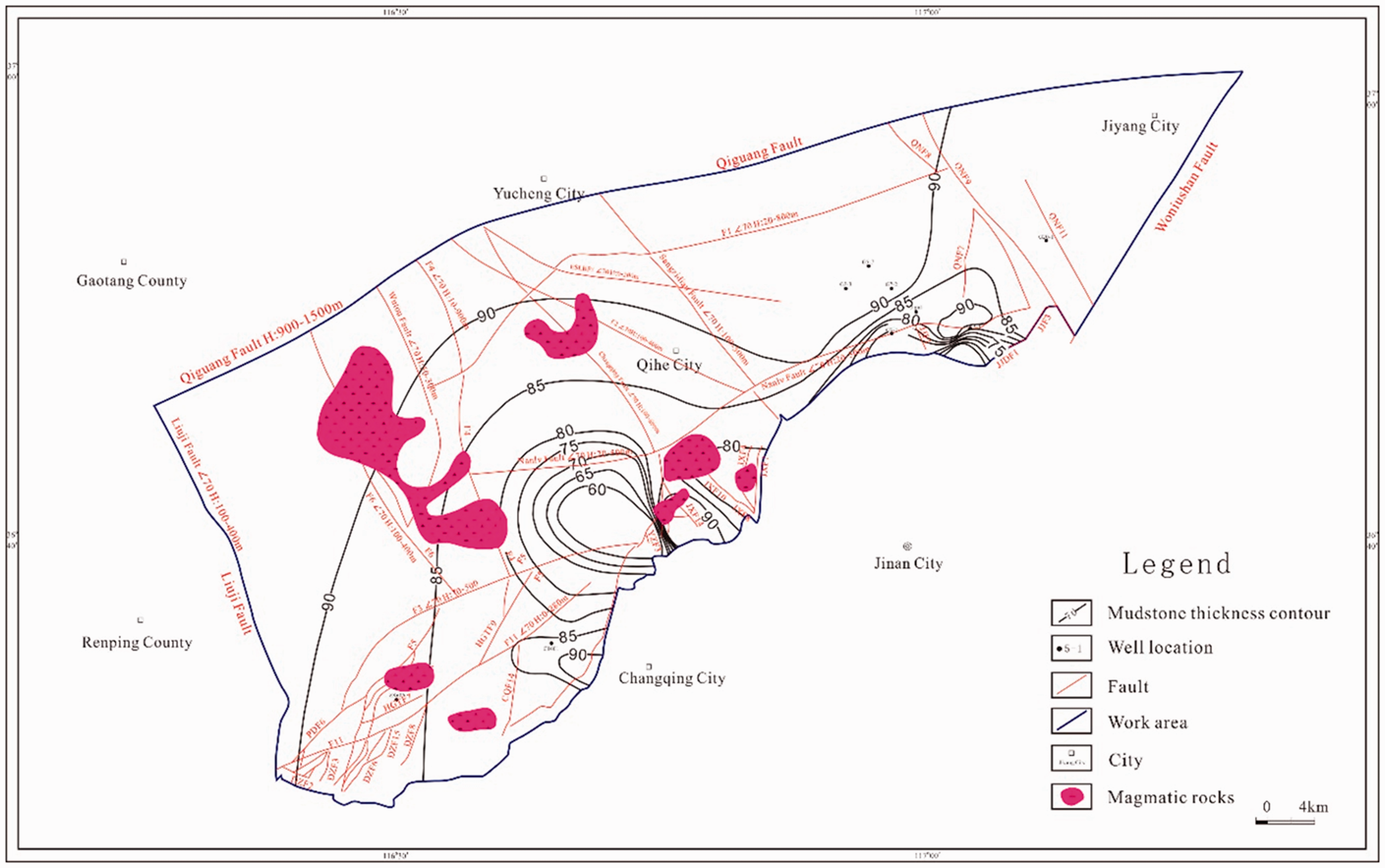
Thickness contour map of fine-grained rocks in Taiyuan Formation and Shanxi Formation of Huanghebei Coalfield.
Samples and experimental process
The fine-grained rock samples were mainly obtained from the four wells which were C1601, LU-1, YU-1, and LIAO-1 in the study area,and the sampling horizon was the Taiyuan and Shanxi Formations.
There were many types of experimental tests conducted in this study. The various testing equipment and analysis standards were as follows:
This study’s kerogen microscopy tests of the fine-grained rock samples were conducted using Zeiss A1 microscopic detection instrument equipment. The procedure for the kerogen microscopy test was based on the following:
The TOC content of fine-grained rock samples was tested using a CS-200 carbon sulfur analyzer (YQ4-04-06), and the test procedure was based on
The mineralogy of the fine-grained rock samples was determined using quantitative X-ray diffraction (XRD) analysis. The mineral composition was measured by a Rigaku D/Max-RB diffractometer. A scan rate of 4° (2θ)/min was used in the range 5°∼45° for the purpose of recording the XRD traces. The two processes utilized the same instrument and measurement conditions. The testing procedure was based on the
The morphology and pore types of the fine-grained rock samples were observed using scanning electron microscopy (SEM), and the scanning electron microscope model was QUANTA200.
The rock pyrolysis analysis equipment for the fine-grained rock samples included pyrolysis instrument (Rock-Eval 6). The test procedure was based on
The vitrinite reflectance (Ro) test equipment of the organic matter in the fine-grained rock samples included a microphotometer (UMSP-50) produced by Zeiss Co. The test procedure was based on the
The testing equipment which was used to determine the porosity and permeability of the fine-grained rock sample included a combined measurement instrument of porosity and permeability (U-MPP-1). The test procedure was based on a
Organic geochemical characteristics and mineral composition of the fine-grained rock masses of the Late Paleozoic coal measures
(1) Organic matter abundance in the fine-grained rock
The experimental data of the drilling cores in the Taiyuan and Shanxi Formations (C1601well), located in the southwestern section of the study area, showed that the TOC content of the dark fine-grained rock was between 0.43 and 17.65%, with an average of 2.66%. It was also found that the TOC content levels of the fine-grained rock were high, which indicated that the dark fine-grained rock masses were potential gas generation areas in this region (Figure 3). In the adjacent areas, the TOC content levels of the shale in the Taiyuan and Shanxi Formation (LIAO-1 well) ranged between 0.35 and 18.25%, with an average of 2.05%. The TOC content of the LU-1 well was between 0.21 and 5.35%, with an average of 2.12%.

The vertical variation of TOC content of the Carboniferous and Permian rocks form the Drilling C1601.
Overall, the TOC content levels of the dark fine-grained rock masses in the Taiyuan and Shanxi Formations were considered to be medium in the study area, with a minimum value of 0.43%; maximum value of 17.65%; and average value of 2.09%. It was found that the closer to the coal seam was, the higher the TOC content would, and there was a negative correlation observed between the TOC content in the fine-grained rock and the distance from the coal seam.
It was observed that in the plane distribution, the TOC content levels of fine-grained rock in the southern section of the study area were the highest and then had gradually decreased in all directions (Figure 4).

The TOC contour map of gas shale in the Huanghebei Coalfield.
(2) Types of organic material in the fine-grained rock masses
It was found that in the organic microscopic components of the fine-grained rock masses, the vitrinite group was rich, with content levels ranging between 30 and 80%. It was observed that the majority were distributed between 50 and 70% in Carboniferous and Permian strata of the study area. The content levels of inertial group were between 10 and 40% (generally less than 30%) and characterized by diffuse distributions. Therefore, the source rock types were determined to primarily be kerogen II, which accounted for more than 50% of the total number of samples, and the second most abundant were kerogen III.
(3) Thermal evolution degree of the organic matter of the fine-grained rock
At the present time, it is generally believed that the reflectance (Ro) of vitrinite groups are the most favorable for shale gas generation at 1.0–3.3% (Bai et al., 2011; Zhao et al., 2014). Therefore, the research objective intervals in fine-grained rock vitrinite reflectance (Ro) are between 0.72 and 1.25%, which is considered to be a good range for gas generation in dark fine-grained rock masses. In the study area, the maturity of the organic matter was found to be lower in the southern area (between 0.7 and 0.9%), and higher in the northern area (between 1.0 and 1.2%), with a local area observed to be above 1.2% (Figure 5).

The Ro contour map of fine-grained rock segments in the study area.
(4) Hydrocarbon potential of the fine-grained rock
The results of this study’s pyrolysis test of the fine-grained rock in the research objective interval showed that the hydrocarbon potentials at various depths (S1+S2) were very different. For example, 33 samples were between 0.09 and 17.45 mg/g, with an average of 1.99 mg/g, which was considered to be a medium hydrocarbon source rock. The maximum S1+S2 value reached 17 mg/g, which was considered to be a high-quality hydrocarbon source rock. These differences indicated that some of the layers in the Carboniferous and Permian strata of the study area could potentially serve as good source rock.
(5) Mineral composition of the fine-grained rock
In this research study, based on data obtained from the XRD analysis and the electronic microscope observations of the fine-grained rock of the Taiyuan and Shanxi Formation coal measures, the mineral composition was determined to mainly include quartz, plagioclase, siderite, dolomite, clay, and pyrite (Ji et al., 2012).
It was also observed that the main type of clay mineral in the fine-grained rock was kaolinite, and the content levels were generally more than 60%, with a maximum content level reaching as high 90%. The second most common was illite, with content levels generally between 20 and 30%, and a maximum value of 50%. The content levels of montmorillonite, chlorite, and halloysite were observed to be generally low, but the content of montmorillonite was extremely high in certain individual levels which were composed almost entirely of montmorillonite and illite/montmorillonite mixed layers (Meng, 2015) (Figure 6).

The composition of rocks in the Upper Paleozoic in the study area and adjacent areas.
(6) Brittle mineral components and content levels in the fine-grained rock
The content levels of brittle minerals were found to be directly related to the difficulties in reforming and fracturing the shale gas reservoirs. Therefore, the content levels of the brittle minerals were confirmed to be one of the important parameters in the evaluations of the storage conditions.
In accordance with LU-1 and YU-1, which were the two parameter wells used in this study for the brittle mineral analysis of the fine-grained rock of the Taiyuan and Shanxi Formations, the brittle minerals were mainly quartz and feldspar, with trace amounts of calcite, dolomite, ankerite, siderite, pyrite, and so on (Figure 7).

The percentage of mineral content in the coal region of southwest Shandong province.
The total content of brittle minerals ranged between 15.77 and 91.39%, and generally fell between 30 and 60%, with an average of 55.70%, which was considered to be a high brittle mineral content level. The content levels of quartz ranged from 3.48 to 74.12%, with an average level of 38.57%. Therefore, from the analysis results of the brittle mineral content, it was considered that the majority of the layers in the Carboniferous and Permian coal measures of the study area were suitable for fracturing and reconstruction processes (Curtis, 2002; Zou et al., 2010).
(7) Clay mineral components and content levels in the fine-grained rock
The content levels of clay minerals are very important to the evaluations of the fracturing performances of fine-grained rock. In addition, clay minerals are also another important carrier of methane adsorption.
In this research study, the acquired data from the shale gas parameter wells YU-1 and LU-1 in southwest Shandong Province showed that the clay minerals in the fine-grained rock of the Taiyuan and Shanxi Formations mainly included kaolinite, illite, illite/montmorillonite mixed layers, and so on. Among these, the kaolinite accounted for 5–68%, with an average of 30.77%; the illite/montmorillonite mixed layers accounted for 0–81%, with an average of 30.25%; the illite accounted for 0–94%, with an average of 24.82%; and the chlorite accounted for 0–37%, with an average of 12.77% (Figure 8).

The percentage content of clay mineral content in the coal region of southwest Shandong province.
Types of pores in the fine-grained rock masses of the Late Paleozoic coal measures
During this study’s experimental process, the obtained samples from the outcrops and drilling cores were analyzed using argon ion polishing and SEM. It was found that inorganic micro-holes and well-developed micro-cracks existed in the fine-grained rock masses of the Late Paleozoic coal measures in the Huanghebei Area, which suggested a good gas storage capacity (Jiao et al., 2014; Yu, 2013).
(1) Inorganic micro-holes
The inorganic pores of the target layer in the study area mainly included intragranular pores, intergranular pores, and dissolution pores in the fine-grained rock of the Late Paleozoic coal measures.
The intragranular pores had usually developed in contact with the mineral particles and appeared to be polygonal and elongated. The majority were primary pores which were distributed in the matrix and were generally observed to be irregular. Then, the polygonal holes had formed the remaining pore spaces of the soft and hard particles, which were found to be the most widely distributed among the rock masses in the study area (Figure 9(a)).

Pore characteristics of fine-grained rocks in the Upper Paleozoic in coal fields in Huangbei, Shandong province. (a) Strawberry-shaped pyrite intergranular pore, intercrystalline pores, dissolution holes (Huanghebei C1601, Taiyuan Formation 760 m, black mudstone); (b) to (d) pyrite microsphere-granular pores, dissolution pores (Huanghebei C1601, Taiyuan Formation 760 m, black mudstone).
It has been found that intergranular pores are very common in the clay minerals, especially in the illite/montmorillonite mixed layers. There was a certain connectiveness among the pores which provided diversions with the micro migration channels and also enhanced the capacity of the gas permeability (Figure 9(a) to (d)).
The dissolution pores refer to the dissolution of some unstable minerals, such as quartz, carbonate, feldspar, mica, and clay minerals. During the process of kerogen pyrolysis, the decarbonates form various corrosive derivatives, which results in the chemical dissolution of some chemically soluble mineral particles and the formations of dissolution holes (Figure 9(a) to (d)).
(2) Micro-cracks
The micro-cracks mainly included the stress cracks and interlayer cracks in the fine-grained rock masses of the Late Paleozoic coal measures, as detailed in Figure 10(a) to (d).

Micro-cracks in the Upper Paleozoic mud shale in the Upper Paleozoic of Huangbei Coalfields, Shandong province. (a) Huanghebei C1601, Taiyuan Formation 796 m, black mudstone (single polarization 10 × 5); (b) tension crack (Huanghebei C1601, Taiyuan Formation 796 m, black mudstone); (c) tension crack (Huanghebei C1601, Taiyuan Formation 833 m, black mudstone); (d) interlaminar fracture (Huanghebei C1601, Shanxi Formation 559 m, carbonaceous mudstone).
The aforementioned cracks were obviously serrated and curved, and had some extensibility. The formations of the macro-cracks were found to be mainly related to the following: brittleness, hydrocarbon generation of the organic matter, pore pressure of the strata, differential horizontal pressure, fractures and folds, and so on. The open micro-cracks potentially provided not only spaces for shale gas reservation, but also effective micro-channels for shale gas migration. In other words, where the micro-fractures were more developed, the shale gas production was often higher.
Gas content levels in the fine-grained rock and gas preservation conditions in the Late Paleozoic coal measures
Characteristics of the porosity and permeability
The porosity and permeability are the important parameters which are used to determine whether or not shale gas reservoirs have economic value. The basic porosity and permeability of fine-grained rock masses are generally very low. However, these can be greatly improved with the development of fractures (Li et al., 2009).
The porosity and permeability of the Late Paleozoic coal measures rich organic fine-grained rock in western Shandong were determined to be low. In the Huanghebei Area, the porosity of the Late Paleozoic coal measures fine-grained rock masses ranged between 3.8 and 3.9%, and the permeability ranged between 0.21 and 0.29 mD. In the Luxinan Area, which was located south of the study area, the porosity of the fine-grained rock masses of the Shanxi and Taiyuan Formations was found to range between 3.8 and 4.4%, and the permeability ranged between 0.35 and 0.51 mD. In the Yang’gu-Chiping Area, which was located west of the study area, the porosity of the fine-grained rock masses of the Shanxi and Taiyuan Formations ranged between 0.57 and 7.95% (with an average of 2.56%) and the permeability ranged between 0.01 and 0.43 mD.
In the longitudinal direction, the average porosity of the fine-grained rock of the Shanxi Formation was determined to be higher than that of the Taiyuan Formation, according to the sample analysis in the study area and the adjacent region. Also, the permeability of the fine-grained rock was observed to be higher in the Taiyuan Formation when compared to that of the Shanxi Formation.
Due to the fact that the shale gas was mainly adsorbed and dissociated on the organic surfaces and in the micro-pores, the micro-pores and micro-cracks of the fine-grained rock masses were determined to still belong to the effective storage spaces. These parameters were determined to be roughly equivalent to the porosity and permeability of the major shale gas production basins of the United States. Therefore, they were considered to display good reservoir conditions and could potentially provide spaces for shale gas storage.
Gas content levels of the fine-grained rock
Some scholars determined that the TOC content levels in fine-grained rock masses were the key factors affecting the adsorption capacities of shale gas (Jarvie et al., 2007; Ni, 2010; Tang et al., 2016; Zhang et al., 2009).
The parsing gas data which had been gathered from boreholes in the study area (Table 1) indicated that the study area’s objective interval contained certain amounts of parsing gas, which was found to range between 0.986 and 4.328 m3/t, with an average of 2.66 m3/t. As the results of previous studies have shown, the fine-grained rock masses in the study area contained high gas content, and the TOC content levels were generally positively correlated.
Gas content in fine-grained rock in Huanghebei Coalfield.

Burial depths and shale gas preservation abilities of the fine-grained rock
Pang and Zhou (1995) determined that the residual oil per m3 of shale is 1–3 kg, and residual gas is 1–3 m3. With the increasing of the buried depths, the residual amounts of oil and gas in shale gradually increase until reaching a maximum at the buried depth of 2000 m. Then, after the maximum is reached, the amounts tend to gradually decline.
The burial depths of the fine-grained rock in the Late Paleozoic coal measures were between 414.05 and 1290.55 m and displayed gradual increases from the southwest to the northwest with a major change range observed (Figure 11).

The buried depth contour of the fine-grained strata in Huanghebei Coalfield.
Structural development and shale gas preservation
Due to the particularity of their occurrence mode, shale gas reservoirs are controlled by faults. However, the influences of the faults can be neglected to some extent. Fault developments containing free gas from nearby clay shale gas channels may be the result of gas reservoir damages. However, the faults containing adsorbed gas may become effective gas capping layers.
The overall appearance of the Huanghebei Area is a gentle single oblique structure, which is controlled by four groups of high-angle normal faults. The faults which have developed in the eastern region are different from those in the western region. In the western region, the faults have not been very developed, with a group of faults striking in a northeastern direction. These are considered to be simple structures and have little impact on shale gas occurrence. However, in the eastern region of the study area, the faults are more developed and multiple faults coexist. This structural complexity is considered to be unfavorable for the storage of shale gas.
Awareness and discussion
In the Late Paleozoic coal measures, the Huanghebei Area of western Shandong has mainly developed a tidal flat-barrier lagoon depositional system and a large delta depositional system. The sedimentary thicknesses of the fine-grained rock in the area are large, with an average of 84.8 m. The TOC content levels of the fine-grained rock average 2.09%. The main organic matter type of the fine-grained rock is kerogen II, followed by kerogen III. The reflectivity of the vitrinite group (Ro) is between 0.72 and 1.25% and considered to be at a medium maturity stage. The hydrocarbon potential (S1+S2) of the fine-grained rock ranges between 0.09 and 17.45 mg/g, with an average of 1.99 mg/g, which reflects a medium hydrocarbon source rock. All of the above reflect the potential shale gas resources in the study area. In regard to the composition of the fine-grained rock, the average content of brittle minerals in the study area was 55.7%, which was considered to be a high brittle mineral content. The clay minerals mainly included kaolinite, illite, illite/montmorillonite mixed layers, and so on. In the micropore structures of fine-grained rock, dissolution pores and micro-cracks were found to be the dominated pores, followed by intragranular and intergranular pores. It was determined in this study that key parameters, such as gas generation and gas production, of the fine-grained rock in the study area were favorable for the formation of gas reservoirs. The desorption gas content was considerable at between 0.986 and 4.328 m3/t, with an average of 2.66 m3/t. The buried depths of fine-grained rock in the study area ranged between 414.05 and 1290.55 m, and the depths were found to be smaller in the southwest and gradually increased toward the north. The geological structures of the eastern region of the study area were observed to be more complex, which was considered to be unfavorable for shale gas accumulation. Therefore, attention should be paid during the evaluations of potential shale gas accumulation, particularly in the exploration and development planning of the research area.