







Abstract
Keywords
Introduction
Coal is still the basic source of energy for ensuring energy supply in China. In 2020, China's raw coal output was 3.9 billion tons, an increase of 1.4% over last year, and the coal consumption accounts for 56.8% of the total energy consumption Xinhua News Agency (2016). China's coal mining is gradually extending to the deep coal bed, which is characterized by “three high, two strong and one low” (high stress, high ground temperature, high gas, strong plasticity, strong timeliness and low permeability). As a result, gas dynamic disasters in coal mines are triggered more easily with higher intensity, making it more difficult to prevent and control gas disasters (Wang et al., 2019). Some anhydrous measures are used to increase the permeability of the coal body and improve the coal seam's drainage method (Qin et al., 2021, 2022). Borehole gas extraction is one of the most important measures to prevent and control mine gas disasters and accidents. The stability and service life of boreholes used for gas extraction are the premise to ensure efficient and continuous gas extraction in coal seam (Li et al., 2020), and the hole sealing quality of boreholes directly determines the gas extraction effect. Some scholars have carried out research on the mechanism of borehole air leakage and hole sealing technology. Zhou et al. (2016) established the mathematical models of air leakage in holes and fractures outside holes, and verified them through field measurement. Zhang et al. (2021) developed an improved sealing technology, which can fully seal the various fractures around the borehole for improving gas extraction. Liu et al. (2020) propose a new sealing method that integrates cement grouting and gel injection. Hu and Liu (2016) pointed out that: under the action of negative extraction pressure, the outside air entered the hole through the broken-rock circles of roadways and boreholes, and showed different characteristics of air leakage in different stages of extraction. Qiao and Cheng (2019) established an air leakage channel model for bedding boreholes, and concluded that the superposition and holing in the pressure relief zones of boreholes and roadways formed the main roadway of borehole air leakage. Wang et al. (2016a, 2016b) believed that the dynamic transfer of coal stress caused the hole sealing section of cement paste to be destroyed, thus forming an air leakage roadway between cement and coal wall. Wang et al. (2019) measured the gas concentration at different positions in the borehole, and obtained the gas flow characteristics and air leakage locations in the borehole. Wang et al. (2016a, 2016b) obtained the characteristics of the borehole leakage circle at different time and under different pressure as well as the dynamic change characteristics of the air leakage circle in the process of extraction through the dynamic air leakage model. Wang et al. (2020) combined bag-type segmented grouting technique, which is to inject different sealing materials into different regions divided by the stress, is proposed to block the air leakage channel. Guo (2020) systematically summarized six physical models of air leakage in underground gas extraction boreholes according to the factors affecting the extraction effect. Zhou et al. (2019) classified the borehole leakage points into three categories, that is, the gap between the sealing material and the extraction pipe, the gap between the sealing material and the borehole wall, and the composite fractures existing in the coal body around boreholes. Zhang et al. (2013) proposed a pouch-type hole sealing device characterized by two plugs and one grouting and the hole sealing method. Field tests showed that the new hole sealing device is simple and fast to operate, the operation time of single-hole hole sealing is less than 25 min, and the extraction concentration is 3 times that of ordinary polyurethane hole sealing concentration. Qi et al. (2018) designed a hole sealing device of “two plugging, one grouting and one dumping” in order to improve the extraction concentration of gas extraction boreholes. The field industrial tests showed that the grouting section of the new technique (“two plugging, one grouting and one dumping”) was compact, and the average gas volume fraction was still as high as 75% after 90 days of extraction. Wang et al. (2015) designed a new type of grouting sealing device. In the initial stage of hole sealing, composite pouches and grouting pressure were used to exert a supporting force of about 1 MPa on the borehole wall, and the cement grout could fully fill in the fractures around the borehole and effectively prevent air leakage from the fractures. In the later stage, the solidification and expansion of the grouting material supported the borehole wall again and effectively prevented the shrinkage and deformation of the sealing section from forming new air leakage roadways, playing a role in reducing the air leakage in the borehole. The engineering practice showed that the new grouting sealing method increased the gas volume fraction of boreholes by 162.2%, and the net amount of gas extraction in boreholes rose by 33.83%. Cheng et al. (2020) proposed grouting a non-solidified semi-fluid sealing material into the confined space formed by the expanded plugging material in the second section to seal the coal and rock fractures, and developed a non-solidified constant pressure system for cement paste sealing which can intelligently control the gas extraction boreholes. It realized the automatic monitoring and grouting of borehole sealing conditions. The field application showed that: with the technology, the gas extraction concentration could increase by 62% compared with the original one that used cement-based material for sealing, and the extraction time also doubled.
To sum up, many scholars have developed a lot of sealing materials and technologies to solve the failure of gas extraction which is caused by air leakage of sealing material itself, but they ignore the influence of air leakage in the fractured area of the surrounding rocks in roadways. Therefore, the author systematically studied the air leakage mode of boreholes, using numerical simulation method to simulate the physical phenomenon of gas leakage in gas drainage boreholes, and numerically analyzed the influence of air leakage on gas extraction under different influencing factors. The research results can provide theoretical basis for solving the problem of air leakage in boreholes in engineering practice.
Study on air leakage mode of extraction boreholes
Because of the fractures around the boreholes and the poor quality of the sealing hole, the air outside the borehole entered the borehole under the action of pressure gradient, leading to the decrease in the concentration of the extracted gas. The mode of air leakage can be mainly divided into two kinds: air leakage inside the borehole and air leakage outside the borehole.
Analysis of air leakage outside boreholes
The excavation of the roadway causes the redistribution of the surrounding rock stress. As shown in Figure 1, the fracture zone, plastic zone, elastic zone and primary rock stress zone are formed near the surrounding rock of the roadway. After the borehole is formed, the stress balance is broken again, and the stress around the borehole is redistributed again. According to the mechanical state of the coal body, the surrounding rock can be divided along the axis into pressure relief zone, pre-peak stress concentration zone, post-peak stress concentration zone and original rock stress zone.

Elastic plastic zone and stress distribution of surrounding rock of roadway.
After the coal body in the pressure relief zone experienced the limit stress, it caused the plastic deformation, the surrounding rock fractures, fracture development and the failure of carrying capacity. Therefore, the pressure relief zone is classified as the broken zone (Figure 2). After the maximum stress transfer, the coal mass in the post-peak stress concentration zone broke and formed macro cracks. Although the coal mass in the pre-peak stress concentration area did not experience the limit stress, the bearing pressure on the coal mass gradually increased, but did not reach the strength to break the coal mass. The mechanical state of coal mass and the gas occurrence in the primary rock stress zone didn't change. In the pressure relief zone and the post-peak stress concentration zone, the fracture development provided a roadway for the air leakage in the borehole. Under the action of the negative pressure gradient, the air outside the borehole entered the borehole through this roadway and mixed with the extracted gas in the extraction pipeline, resulting in a significant decrease in the gas extraction concentration. The air leakage passages of the coal wall in roadways can be divided into two types: the air leakage in the fractured zone of the roadway (in the axial direction of the borehole) and the air leakage in the fractured zone around the borehole (in the radial direction of the borehole). The fractured zone of the roadway and the air leakage circle of the borehole form the borehole air leakage passage. The field measurement in reference (Ma et al., 2020) showed that the fracture development zone of the mining roadway is 10∼15 m away from the coal wall.

Distribution of axial stress and air leakage in borehole.
After the borehole was formed, the cracks around the borehole developed and broke. If the hole sealing material could not effectively seal the cracks in the broken zone, the outside air would enter the borehole through the cracks under the impact of the negative pressure of extraction. In addition, if the hole sealing length of the borehole is not enough, the fractures in the pressure relief zone and stress concentration area cannot be effectively filled and sealed. Under the action of negative extraction pressure, air will also enter the borehole from the coal body cracks, resulting in the poor extraction effect.
The radial fracture area of the borehole is the area of the air leakage circle in the borehole. The coal mass around the borehole is assumed to be an ideal elastoplastic softening model, and the radius of the borehole pressure relief zone can be calculated by the following formula (Yuan and Chen, 1986).
Analysis of air leakage inside boreholes
In addition to the air leakage from the fractures around the borehole, another way of air leakage is that the air enters the extraction pipe through the gap in the sealing material under the action of the negative extraction pressure, and it is called the air leakage inside the hole. The quality of sealing material is an important factor affecting the quality of sealing hole. Therefore, improving the sealing material's airtight property can further improve the extraction effect.
One of the reasons for air leakage is that the sealing material is not in close contact with the borehole wall. As the borehole wall will get slightly deformed under the influence of stress, the sealing material and the borehole wall will be not as airtight as before, which makes air leakage possible and causes air leakage in the process of extraction. However, because the borehole is horizontal and has a relative dip angle during sealing, it is impossible for sealing materials to complete the sealing between the hole wall and the extraction pipe under the impact of its own gravity. Another reason is that the gaps are big and connected with each other in the pore sealing material, forming the air leakage passage. Therefore, in order to improve the sealing quality, the sealing material with low permeability and high compactness should be used to seal the hole.
Study on the influence mechanism of air leakage on gas extraction in extraction boreholes
Solid-gas (gas and air) coupling modeling of borehole air leakage
In actual production, the gas extraction through boreholes is influenced by complex factors. In order to facilitate the study, the following basic assumptions are made: (1) Coal is an elastic double-porosity medium, and coal deformation conforms to the hypothesis of small deformations; (2) The gas in the coal seam is the ideal saturated gas without considering temperature changes; (3) The gas and air transport in the coal seam is not interacting without considering the adsorption of coal to air.
According to the law of conservation of mass, the theory of coal deformation, the principle of Terzaghi effective stress and the Kozany-Carman equation, a solid-gas coupling mathematical model related to the air leakage in boreholes can be deduced:
Physical modeling and simulation parameter selection
As shown in Figure 3 below, the borehole gas extraction model is simplified into a two-dimensional physical model, and the coal mass is divided into two zones. In the figure, the left side of the model is the pressure relief zone formed by the roadway excavation, and the right side of the model is the undisturbed area of the coal seam. The parameters are set according to the actual situation of a certain mine. The borehole radius is 0.047 m, the crustal stress is 8.5 MPa, the supporting force of the hole sealing material is 0.2 MPa, the cohesion force of the coal mass is 100 MPa, the internal friction angle is 300, the roadway radius is 2.5 m, and the compressive strength of the coal mass is 7.3 MPa, Poisson's ratio of the coal-rock mass is 0.339, and the residual gas intensity is 1.75 MPa. According to the empirical formula (Yuan and Chen, 1986) for the fractured area of the roadway, the distance of the fractured area affected by the roadway excavation is 9.25 m, and it was 10 m in this model. The range of the borehole leak circle is 0.169 m through the calculation of the formula. 1 and the relative fracture range of the roadway can be ignored.

Model diagram of borehole gas extraction and grid division.
The initial conditions and boundary conditions for the air leakage model of the borehole in the gas extraction are set as follows: the upper end of the model is no displacement constraint, the boundary load is 8.5 MPa, and other boundaries are normal boundary displacement constraint. In the undisturbed zone as shown in Figure 1, the initial gas pressure is 1.57 MPa, the atmospheric pressure is 0.1 MPa in the boundary of the fractured zone, the initial permeability in the fractured zone is set as 3 orders of magnitude higher than the permeability of the primary rock (Yuan and Chen, 1986), the negative pressure of the borehole is 15 kPa, and the remaining boundaries are all non-flow boundaries. The main parameters are shown in Table 1.
List of physical parameters.

Numerical simulation result analysis
Analysis on the influence of extraction time on borehole leakage
The hole sealing depth is set as 4 m, the permeability in the fractured zone of the roadway is 2.8 × 10⁻¹⁵ md, the initial permeability of the undisturbed zone is 2.8 × 10⁻¹⁷ md, and the negative pressure of extraction is 15 KPa. The variation of the borehole air leakage range on the 10th day, 30th day and 60th day of extraction, and the rules about the borehole air leakage that changes with the extraction time are shown in Figure 4.

The range and quantity of air leakage vary with the extraction time.
As can be seen from Figure 4, the air content in the coal seam was low in the initial stage of extraction, and the amount of air entering the borehole was approximated to 0. As the extraction time increased, the air in the roadway kept entering the coal seam, and the air leakage area was mainly concentrated in the fractured zone of the roadway, while the air around the borehole entered the borehole under the negative pressure of the extraction. With the extension of the extraction time, the air leakage area of the borehole gradually expanded, and the influence range of the air leakage around the borehole also gradually increased. As a result, a lot of air entered the fracture zone of the roadway, but only part of the air around the borehole actually entered the borehole.
In previous studies, it was considered that: the borehole air leakage was caused by factors including deformation, hole collapse, etc. as the borehole extraction time increased. However, the research results show that even if there is no deformation, or hole collapse in the borehole, the borehole air leakage phenomenon still exists because of the fractures around the borehole and the effect of negative extraction pressure.
Influence of borehole air leakage on gas extraction at different hole sealing depths
The hole sealing depth is one of the key parameters to ensure the quality of gas extraction. In order to study the influence of the borehole air leakage on gas extraction at different hole sealing depths, the change rules of borehole air leakage range, air leakage amount and gas extraction amount were numerically simulated when the hole sealing depths were 4 m, 6 m, 8 m and 10 m respectively, as shown in Figures 5–7.

Borehole leakage field at different hole sealing depth.

Change rules of borehole air leakage at different hole sealing depths.

Change rules about the net amount and concentration of borehole gas extraction.
As can be seen from Figures 5–7, with the increase of the borehole sealing depth, the borehole air leakage amount gradually decreased (When the sealing depth is 4 m, the air leakage is about 3 times that at 10 m). In addition, both the effective extraction length of the borehole and the net amount of the gas extraction gradually decreased too. However, the gas extraction concentration gradually increased. The gas extraction concentration at the sealing depth of 8 m increased by about 10%∼20% compared with that at 4 m, while the gas extraction concentration at the sealing depth of 10 m and 8 m didn't increase significantly. In the calculation of the model, the fracture zone of the surrounding rock in the roadway is 9.28 m in range. Combined with the change rules of gas extraction concentration, economic cost and extraction effects, the reasonable sealing depth of the coal seam is 9 m∼10 m, that is, it exceeds the range of the surrounding-rock fracture zone of the roadway.
Influence of borehole air leakage on gas extraction at different extraction pressure
In order to investigate the change rules of borehole air leakage at different negative pressure of extraction, the changes in the borehole air leakage as well as the net amount and concentration of the gas extraction were numerically analyzed when the sealing depth was 4 m, and the negative extraction pressure was 15 KPa, 25 KPa and 30 KPa, respectively, as shown in Figures 8 and 9.

Borehole leakage field and leakage volume at different extraction pressure.

Changes of gas extraction net amount and concentration at different extraction pressures.
As can be seen from Figures 8 and 9: As the negative extraction pressure increased, the borehole air leakage also increased (the negative pressure rose by 10 KPa, and the leakage amount increased by about 0.5 L/min). In addition, the net amount of the gas extraction also increased, but its concentration dropped instead. This suggested that: when the negative extraction pressure increased, the borehole air leakage rose more than the added value in the gas extraction. The reasons are analyzed as follows: (1) On the one hand, with the increase of the extraction time, the gas content of the coal seam and the gas pressure gradient of the fracture provided by the negative pressure kept decreasing. In addition, the difference value between the power and matrix of the free gas in the fracture flowing into the borehole and the gas pressure of the fracture kept decreasing, so did the power of the matrix gas diffusion and the gas flow that was provided by the negative extraction pressure. On the other hand, with the increase of the extraction time, the proportion of the gas diffused from the matrix in the extracted gas was bigger and bigger, which suggested that the extracted gas per unit mass required overcoming more and more resistance. Due to the decrease of the extraction power and the increase of the resistance, the actual increment of the extracted gas was lower than that in the initial stage of extraction even if the negative pressure was increased in the later stage of gas extraction, namely, the effect of the negative extraction pressure reduced. (2) In the process of gas extraction, the negative pressure of gas extraction not only affects the gas flow in the coal seam, but also affects the air leakage and airflow in the fracture around the borehole. With the increase of extraction time, on the one hand, the effect of negative pressure gradually weakened, and the larger negative pressure made a smaller contribution to the gas extraction. The larger negative pressure is mainly used to extract the air flowing into the borehole from the surrounding fracture, so the air leakage volume gradually increased. On the other hand, as it was disturbed by the dynamic pressure of the extraction borehole and influenced by the shrinkage of the coal matrix, the fractures around the borehole gradually developed, and the air leakage resistance continuously decreased, Therefore, the air leakage volume gradually increased, and the gas extraction concentration continuously decreased.
Therefore, it is not an effective method to improve the gas extraction effect through increasing the negative extraction pressure, and the negative pressure cannot be blindly increased, especially in the later stage of the gas extraction. This is because the increase in the air leakage caused the extraction concentration to drop further when the negative extraction pressure is increased. In the later stage of the gas extraction, the negative pressure can be properly reduced to improve the gas extraction effect.
Influence of borehole air leakage on gas extraction at different degrees of fracture development
The higher the fracture development degree of the coal mass is, the better permeability it will achieve. To facilitate the research, the degree of fracture development around the borehole is represented by permeability. The permeability of the fracture zone and the sealing section in the roadway were set as follows: 2.8 × 10⁻¹⁵ md, 1.4 × 10⁻¹⁵ md, and 0.7 × 10⁻¹⁵ md, respectively. The remaining zones were set as the original coal seam permeability. The negative extraction pressure was 15 kPa, and the sealing depth was 4 m. Simulation results were shown in Figures 10 and 11.

Borehole leakage field and leakage volume at different permeability.

Changes of gas extraction net amount and concentration at different degree of fracture development.
It can be seen from Figures 10 and 11 that: (1) The higher the development degree of the fractured area in the roadway is, the higher the permeability will be. Consequently, the air leakage increases obviously. The permeability increased by 3 times, and the air leakage increased by about 6 times of the original, indicating that the development degree of the fracture in the roadway and the quality of the sealing hole has a significant impact on the air leakage in the borehole. (2) The development degree of the fractured zone in the roadway does not significantly influence the net amount of gas extraction mainly because the fracture area has a good permeability and gas transports more towards the roadway. Therefore, the anti-reflection measures to improve the gas extraction amount can only be effective when they are applied inside the coal seam. (3) The development degree of roadway fissure has a great influence on the gas extraction effect: namely, the permeability decreased by 3 times, and the gas extraction concentration decreased by about 30%. Therefore, attention should be paid to improving the hole sealing quality in the actual production, the fracture of the coal-rock seam around the borehole should be sealed to reduce the permeability of the fracture zone in the roadway.
Influence of borehole air leakage on gas extraction at different hole sealing quality
In order to study the influence of the hole sealing quality on borehole leakage and weaken the influence of fractures around the borehole, the hole sealing depth is set as 4 m, the negative extraction pressure is 15 KPa, and the hole sealing section and the gap of the hole wall are regarded as the air leakage zone (0.01 m). The permeability is used to represent the quality of the hole sealing quality. The permeability is 2.8 × 10⁻¹⁵ md in the hole sealing section and the fractured zone of the roadway, and the permeability of the undisturbed zone is 2.8 × 10⁻¹⁷ md. Figure 12 shows how the borehole air leakage changes with the extraction time when the influence of the hole sealing quality is considered or not considered.
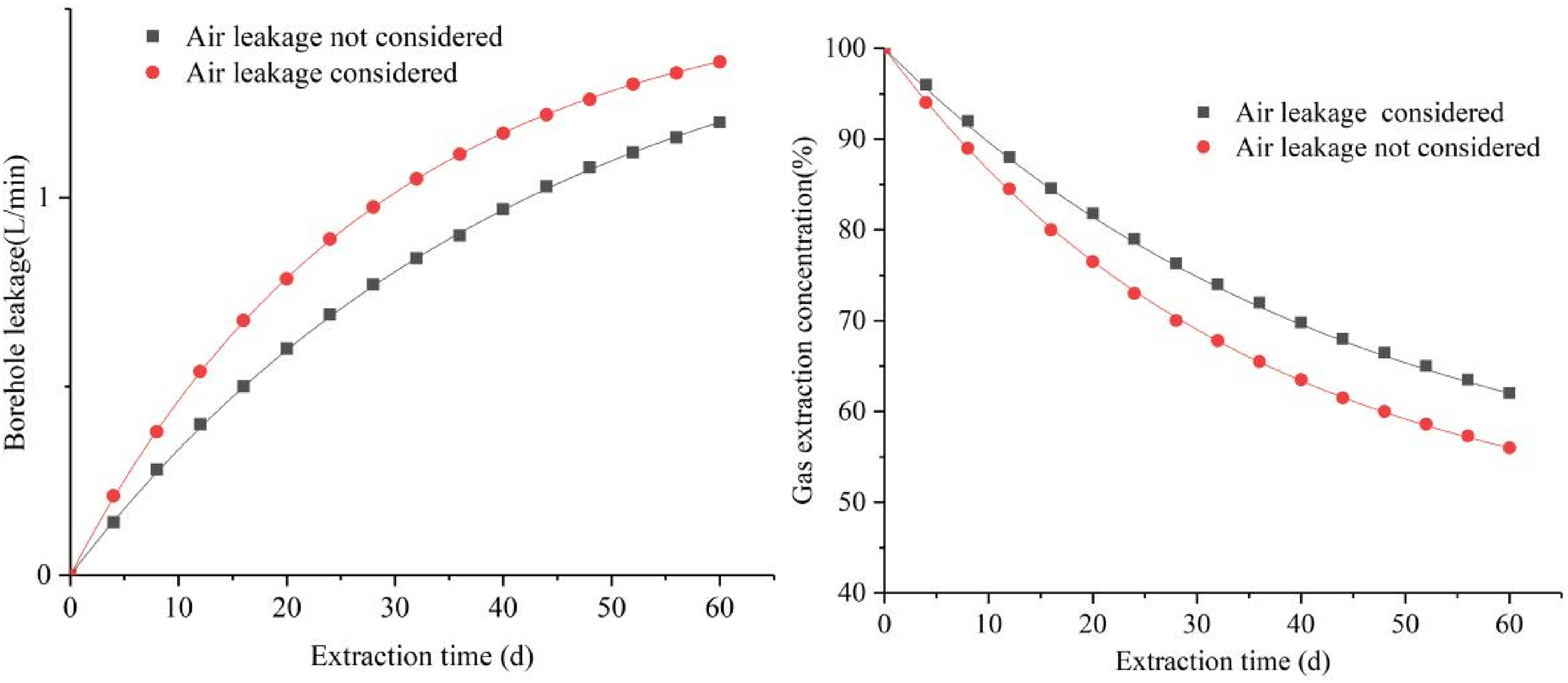
Comparative analysis on the influence of the hole sealing quality on borehole air leakage and gas extraction concentration.
As can be seen from Figure 12, given that the borehole air leakage in the sealing section (air leakage inside the hole) is more than that in the fractured zone around the borehole, the gas extraction concentration decreases. The sealing quality directly affects the borehole air leakage and the gas extraction effect, so attention should be paid to the selection and improvement of sealing material and sealing technique so that the airtightness and sealing quality of the sealing section can be improved.
Conclusions
In this paper, the borehole air leakage mode was studied, and a mathematical model was established to describe the borehole air leakage of the gas extraction. In addition, this paper also analyzed the change rules of borehole air leakage and gas extraction effect at different hole sealing depth, negative extraction pressure, degree of fracture development and hole sealing quality.
The hole sealing depth has a certain influence on the borehole air leakage and the gas extraction effect. As the hole sealing depth increased, the borehole air leakage gradually decreased (the air leakage at the hole sealing depth of 10 m is about three times lower than that at the hole sealing depth of 4 m). Moreover, both the effective extraction section of the borehole and the net amount of gas extraction gradually decreased, but the gas extraction concentration increased to some extent. The gas extraction concentration at 8 m increased by about 10%∼20% compared with that at 4 m. However, the gas extraction concentration didn't increase significantly at the sealing depth of 10 m and 8 m. Therefore, the reasonable sealing depth of this coal seam is 9–10 m. In engineering applications, the best sealing depth should be determined in consideration of economic costs and actual effects.
The negative pressure of borehole extraction has little influence on borehole air leakage and gas extraction. With the increase of the negative extraction pressure, the gas extraction net amount and borehole air leakage both increased, but the gas extraction concentration decreased. Therefore, it is not an effective method to improve the gas extraction effect through increasing the negative extraction pressure, and the negative pressure cannot be blindly increased, especially in the later stage of the gas extraction. This is because the increase in the air leakage caused the extraction concentration to drop further when the negative extraction pressure is increased. In engineering applications, the negative pressure of drainage can be appropriately reduced to increase the concentration of gas drainage, and appropriate sealing techniques can be used to reduce the permeability of the cracked area of the roadway, thereby improving the effect of gas drainage.
The borehole sealing quality has a great influence on the borehole air leakage and gas extraction effect. With the improvement of the sealing quality, the coal-rock fractures around the borehole were effectively sealed, and their permeability gradually decreased. Moreover, the borehole air leakage significantly reduced, and the gas extraction concentration increased significantly. Therefore, attention should be paid to the selection and improvement of sealing materials and sealing techniques in the actual production so that the airtightness and sealing quality of the hole sealing section can be improved.
Footnotes
Data availability
Declaration of conflicting interests
Funding
ORCID iDs
