







Abstract
Keywords
Introduction
Sinonasal inverted papillomas (SIP), characterized by endophytic growth patterns on histologic examination, are benign neoplasms that arise from the Schneiderian epithelium of the nasal cavity and paranasal sinuses. They comprise up to 4% of all primary nasal neoplasms. 1 Sinonasal inverted papilloma is mostly seen in the fifth and sixth decades, and the dominance of men is 3:1. 1
Sinonasal inverted papilloma has 3 main characteristic features: locally aggressive, high risk of recurrence, and possible malignant transformation. The recurrence rate for inverted papilloma has been reported as up to 50% in the literature. 2 Recurrence of the disease is mainly due to incomplete removal of the tumor at the resection site, but several risk factors associated with recurrences such as tumor location and osseous invasion, stage, growth pattern, and histopathologic features of the tumor and chosen surgical technique for initial operation have also been reported in several studies.1-4 Besides the high risk of local recurrence, SIP can transform into malignant conditions such as invasive squamous cell carcinoma. The malignancy may be synchronous or metachronous, and the overall malignancy rate varies between 7% and 11%. 1
The etiology and pathogenesis of SIP are still unknown. Although there are theories suggesting that the human papilloma virus (HPV) infection may be an etiologic cause, no exact conclusions have been reached. 2 Histologic examinations of SIP specimens revealed a high proliferation of the epithelial cells and downregulated apoptosis inhibition. As a result of these findings, SIP is thought to occur through a neoplastic process. 5
As a result of many studies conducted in recent years, it has been demonstrated that the inflammatory response has significant importance in the occurrence and prognosis of many benign/malignant tumors and different types of diseases. For the investigation of the inflammatory response, several hematologic parameters are easy to obtain and have a high rate of accuracy such as neutrophil-to-lymphocyte ratio (NLR), platelet-to-lymphocyte ratio (PLR), mean platelet volume (MPV), red cell distribution width (RDW), and platelet distribution width (PDW). Neutrophil-to-lymphocyte ratio has been suggested to be associated with various inflammatory conditions, such as diabetes mellitus (DM), cancer, inflammatory bowel disease, liver steatosis, and ulcerative colitis.6-10 Similarly, the relation between MPV and inflammatory conditions has been established in DM, nasal polyposis, functional bowel diseases, rheumatoid arthritis, cardiac conditions, and thyroid malignancy.11-16 Red cell distribution width is also increased in inflammatory processes including thyroid nodules, vertebral disc pathologies, and autoimmune diseases.17-19 Similarly, PDW has been reported to be increased in DM, hepatosteatosis, and coronary artery disease.9,20,21
The main objective of this study was to compare inflammatory hematologic markers in patients with SIP and age–sex- matched healthy controls.
Materials and Methods
The retrospective data of the patients who were diagnosed histologically as having SIP between 2010 and 2020 in a tertiary referral center were collected. The study was approved by the institutional review board (reference number and date: 53694 - 13/04/2020) and conducted in accordance with the principles of the Declaration of Helsinki.
Patients who had recurrent SIP, acute inflammation or infection, pneumonia, liver or kidney failure, thyroid disease, chronic obstructive pulmonary disease, myocardial infarction history, and systemic inflammatory disease were excluded from the study. After exclusion, a total of 65 patients with primary SIP and 65 healthy volunteers with no comorbidities were enrolled in the study. The age, sex, and complete blood count parameters obtained one week before the patients underwent surgical treatment were recorded.
Statistical Analysis
Statistical analysis was performed using the SPSS version 15.0 software (SPSS Inc). Parametric tests were used for data with normal distribution, and nonparametric tests were used for data with non-normal distribution. Continuous data are stated as mean ± standard deviation (SD), minimum–maximum values, and categorical data as number (n), percentage (%). The Mann-Whitney
Results
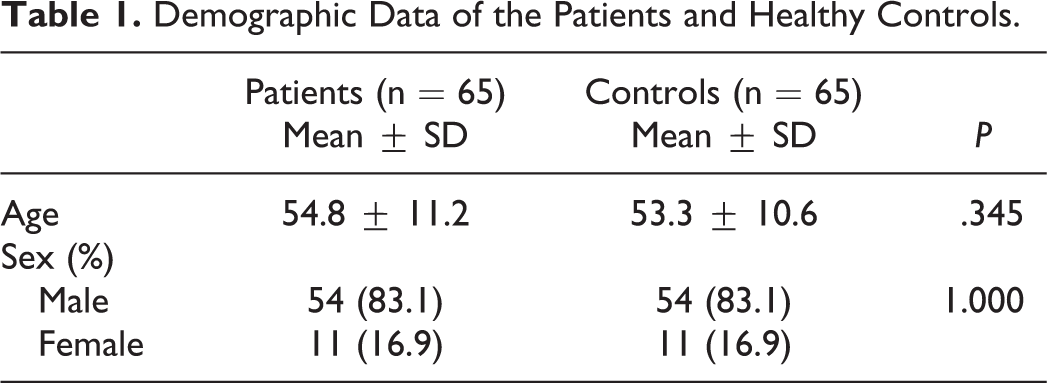
Sixty-five individuals (male: 54 [83.1%] and female: 11 [16.9%]) in the SIP patient group and 65 (male: 54 [83.1%] and female: 11 [16.9%]) individuals in the control group were reviewed. The mean ages for the patient and control groups were 54.8 ± 11.2 (range, 21-71) and 53.3 ± 10.6 (range, 21-71) years, respectively (Table 1). No statistically significant difference was found for the age and sex distribution between the 2 groups (
Demographic Data of the Patients and Healthy Controls.
No statistically significant difference was found in terms of hemoglobin, white blood cell, platelet, neutrophil, and lymphocyte counts between the patients and controls (
Comparison of Laboratory Parameter of Both Groups.

Abbreviations: MPV, mean platelet volume; NLR, neutrophil–lymphocyte ratio; PDW, platelet distribution width; PLR, platelet–lymphocyte ratio; RDW, red cell distribution width.
Logistic Regression Analysis.

Abbreviations: NLR, neutrophil–lymphocyte ratio; PLR, platelet–lymphocyte ratio.
Discussion
The relationship between inflammation and the carcinogenesis process has been well established since it was first mentioned by Virchow in 1863.
22
Multiple examples directly demonstrate this relationship between chronic infection and tumor development such as hepatitis virus infection in hepatoma,
Sinonasal papillomas are benign tumors of the paranasal sinuses and nasal cavity and they were categorized into 3 different subtypes based on histologic examination: exophytic papilloma (squamous or everted papilloma), oncocytic papilloma, and inverted papilloma. 24 According to this categorization, the most common subtype is inverted papilloma, which accounts for more than 50% of sinonasal papilloma cases. 25 The main characteristic histologic finding of SIP is endophytic growth of the thickened squamous neoplastic epithelium with an intact basement membrane into the underlying connective tissue. 24
The etiopathogenesis of the SIP is not yet fully understood but there are some theories associated with the disease. In recent years, many studies have been conducted to clarify the relationship between HPV infection and SIP. It has been reported that HPV infection might be one of the etiologic factors causing inverted papilloma based on the detection of HPV DNA in pathology specimens.2,5 In 2014, Govindaraj and Wang 24 reported that HPV might be an etiologic factor in the pathogenesis of SIP and its progression to dysplasia and malignancy. Histopathologic examination of SIP specimens showed the infiltration of stroma with numerous inflammatory cells. These included lymphocytes, polymorphonuclear leukocytes (PMNL), plasma cells, and eosinophils. The migration of PMNLs from stroma to the epithelium suggests that the inflammatory process may have an active role in the etiopathogenesis. 5 As far as we know, this is the first study to investigate pretreatment inflammatory blood markers in patients with SIP.
Neutrophilia may occur in various malignancies because of the production of myeloid growth factors by oncogenic cells and the coexistence of infection or cancer-related inflammation. However, lymphocytes have a crucial role against the tumorigenic process but lymphopenia can be seen in malignancy because of cancer-related immunosuppression. 26 Therefore, a high NLR may occur due to systemic inflammatory response caused by a malignant situation or a direct effect of oncogenic infectious agents. Accordingly, in recent years, the importance of NLR in numerous cancers including head and neck malignancies has been investigating widely. Liao et al 27 reported that a high NLR was associated with poor prognosis for nasopharyngeal cancers. Turri-Zanoni et al 28 investigated the prognostic significance of the pretreatment NLR and PLR in paranasal sinus cancer and demonstrated that high pretreatment NLR was a poor prognostic factor in advanced-stage sinonasal cancers. It has been reported that elevated NLR values in patients with thyroid nodules could be a useful marker for distinguishing malignant nodules from benign nodules. 7 In the current study, the increase in the pretreatment NLR levels of patients with inverted papilloma compared with the control group was not significant but logistic regression analysis showed that increase in the NLR could be used to distinguish patients with inverted papilloma from controls.
Platelets have crucial importance for the formation of homeostasis. After tissue damage, they interact with endothelial cells and trigger coagulation by aggregation. In addition to this function, they modulate the immune response by interacting with immune cells. The main cytokines such as TGF-β or VEGF, which have crucial importance for the promotion of the tumorigenesis process and the induction of metastasis, are secreted by platelets. 29 As a result of these functions, PLR and platelet count were used to determine the prognosis of the many types of malignancies. Kara et al 30 demonstrated that high pretreatment PLR in laryngeal cancer was a poor prognostic factor. A recent study that was conducted to determine the prognostic significance of the PLR in head and neck squamous cell carcinoma demonstrated that elevated PLR might be used as a marker for poor prognosis in head and neck cancers. 29 According to our results, no statistically significant difference was found both for platelet count and PLR between the patient and control groups. However, logistic regression analysis showed that the decrease in the PLR could be used to determine patients with inverted papilloma.
Red cell distribution width is used clinically in the differential diagnosis of anemias. However, in recent years, it is has been demonstrated that RDW may have crucial importance in several disorders including coronary heart disease, different types of cancer, venous thromboembolism, DM, and pneumonia. 31 Bozkurt et al 32 reported that pretreatment RDW was a poor prognostic factor in early-stage laryngeal cancers. A study investigating the relationship between RDW and thyroid nodules has shown that detection of elevated RDW preoperatively can be a cost-effective method for distinguishing malignant nodules from benign nodules. 17 According to our results, no statistically significant difference was found between the patient and the control groups in terms of RDW values.
Mean platelet volume and PDW, used to predict the functional changes and activation of platelets, are cost-effective and routinely available tests. Several pieces of evidence support the hypothesis that platelet activation during cancer promotes disease. However, the mechanism that causes this remains unclear. In a recent investigation, a relationship between MPV/PDW and thyroid cancer was shown; patients with thyroid cancer had decreased MPV and increased PDW compared with controls. 33 According to a study investigating PDW and MPV levels in laryngeal carcinoma, elevated PDW and decreased MPV levels were detected in patients with laryngeal carcinoma compared with patients with benign laryngeal diseases and healthy controls. 34 Another study reported that MPV levels of the nasal polyposis patients were significantly lower than the controls. 12 According to the results obtained in our study, no statistically significant difference was found between the MPV and PDW values of the patient and control groups.
We investigated the relationship between patients with SIP and a control group, but as is known, SIP could progress to dysplasia and malignancy and it has higher recurrence rates after the initial surgery. Further investigations for determining the effect of these hematologic parameters on prognosis are still required.
Conclusion
Sinonasal inverted papillomas are benign tumors that arise in the nasal cavity, whose etiology and pathogenesis are not fully elucidated, and have a high risk of recurrence and possible malignant transformation. Our results demonstrated that NLR and PLR could be used to determine patients with SIP.
Footnotes
Authors’ Note
Declaration of Conflicting Interests
Funding
ORCID iD
