







Abstract
Workplace harassment (also known as workplace bullying) refers to negative behavior an employee confronts from other employees (Saunders et al., 2007). In this paper, we focus on non-sexual workplace harassment—a common occurrence in organizations. Estimates of the yearly prevalence of non-sexual workplace harassment range between 8% and 16%, with a higher prevalence among women (Hango & Moyser, 2018; Nielsen et al., 2009). This implies that hundreds of millions of workers in the world are subject to workplace harassment every year. Being the target of workplace harassment has numerous negative consequences (for a systematic review and meta-analysis, see Boudrias et al., 2021; Nielsen & Einarsen, 2012). These include psychological effects (worsened mental health, increased rates of depression and anxiety), organizational effects (reduced job satisfaction, increased intent to leave, turnover, reduced job performance, and increased absenteeism), physical effects (increased health issues, including musculoskeletal disorders and back and neck pain), and social effects (increased conflicts at home).
Do people have a specific mental image of a workplace harassment victim? Research has uncovered a variety of social prototypes: the “overweight and jolly” type (Levine & Schweitzer, 2015), the “grouchy single” type (Greitemeyer, 2008), the “smart though cold doctor” type (Goranson et al., 2020), and the “crazy creative” type (Mueller et al., 2011). More than just judgments about people, these prototypes have consequences. People believe that veterans are more hands-on and less emotionally competent than non-veterans; subsequently, recruiters recommend them less for human-centered jobs (Shepherd et al., 2019). Non-profit organizations’ employees are considered to be more moral than for-profit organizations’ employees; therefore, they are judged more harshly when they commit a moral violation (Stiegert et al., 2021).
In this paper, we investigate the prototypical victim of workplace harassment. The present research contributes to the literature on social prototypes in organizations (Goh et al., 2021; Rosette et al., 2008; Stiegert et al., 2021) by investigating in lay-persons’ terms who best fits the prototype of someone who has been harassed at work. In doing so, the present research also contributes to the wide area of research on workplace harassment (Ehrenreich, 1999; Khubchandani & Price, 2015; Rospenda et al., 2008). We find that the extent that a victim conforms to the prototype affects how much a transgression is classified as workplace harassment, and the consequent punishment people want to mete to harassers.
Prototypes of Workplace Harassment Victims
Most of the research conducted on social prototypes has investigated social categories involving race and gender. For example, judgments of racial prejudice are influenced by prototypes: The same action is more likely to be classified as prejudiced when the perpetrator is white (Inman & Baron, 1996). Men are often stereotyped as offenders and women as victims, and perpetrators receive harsher punishments when they harm a woman versus a man (Reynolds et al., 2020). Judgments of sexist prejudice are also influenced by prototypes: The same behavior is more likely to be categorized as sexist when the perpetrator is a man (Baron et al., 1991). Likewise, people appraise an ambiguous behavior as more violent when the perpetrator is Black (Duncan, 1976). Prototypes of leaders have also been investigated, showing both gender-based (Nye & Forsyth, 1991) and race-based prototypes (Petsko & Rosette, 2022), such that maleness and whiteness are more likely to be associated with leadership. Despite the number of prototypes examined in the existing literature, prior research has generally focused on prototypes of specific social groups based on people’s demographics (e.g., gender and ethnicity) or occupational roles (e.g., leadership). In contrast, there has been little research attention on prototypes based on specific work
The present research explores who and what individuals imagine when they think of a victim of workplace harassment. In addition, our studies investigate if people’s prototypes affect the classification of behavior as workplace harassment, as well as the judgments rendered upon perpetrators such as how much they are punished. Our research extends scholarship in two ways. First, most past work on social prototypes has examined people’s judgments of behavior (e.g., seeking help) from someone who is more or less prototypical (e.g., a male vs. female leader; Rosette et al., 2015). In contrast, we examine behavior that is directed toward someone (harassment) and test how the behavior is perceived according to the recipients’ prototypicality. In this vein, it is not the judgments of a
Prototypes are thought to emerge from frequency (Rosch et al., 1976). Thus, we might expect the prototypical victim of workplace harassment to resemble actual victims. Several studies have found that compared with non-victims, victims of workplace harassment are shorter (Samsudin et al., 2018), more overweight (Khubchandani & Price, 2015), less attractive (Scott & Judge, 2013), more introverted (Glasø et al., 2007), and lower income (Braithwaite et al., 2008; Tsuno et al., 2015). Moreover, studies have suggested that social exclusion is a form of workplace bullying (O’Reilly et al., 2015). Among people who are more socially excluded are the less attractive (Zadro et al., 2006), more overweight (Levine & Schweitzer, 2015), more introverted (Hitlan et al., 2006), and lower income (Stewart et al., 2009). We further posit that political orientation could be a prototype-defining factor for victims of workplace harassment. Politically, conservatives are often perceived as agentic and reactive (Graham et al., 2012), and victims tend to be viewed as vulnerable or subordinate (Hershcovis & Barling, 2010). Put together, it is possible that people imagine victims of workplace harassment as shorter, more overweight, less attractive, more introverted, lower-paid, and more liberal than non-victims.
Consequences of Prototypes of Workplace Harassment Victims
In what follows, we make a series of predictions about the effects of the victim prototype on the classification of a behavior as workplace harassment, perceptions of victims’ psychological pain, blame attributed to the harasser, and punishment. Our work proposes an important driver of punishment in cases of workplace harassment and indicates that prototypicality should be taken into account when judging cases of workplace harassment—lest people make biased judgments.
Classifications of Workplace Harassment
We predict that workplace harassment will be classified as such when a victim is perceived to conform to the workplace harassment victim prototype. When harassment is ambiguous, we suggest it will appear less ambiguous (more classifiably as harassment) when the victim is shorter, more overweight, less attractive, etc. Research has found that when a person’s behavior (e.g., creativity) is less aligned with a perceived social prototype (e.g., a quirky creative person), people perceive the behavior as “less than” (Katz et al., 2022). Thus, on the flip side, a behavior may be perceived as “more than” when the behavior and prototype align. Specifically, we predict that people will classify an ambiguous harassment behavior as workplace harassment when the person subject to the harassment is a prototypical victim (e.g., short and unattractive) rather than non-prototypical (e.g., tall and attractive).
Perceptions of Psychological Pain
Being a victim of workplace harassment is a psychologically painful experience, both in the moment (Nielsen & Einarsen, 2012; Nielsen et al., 2009) and long term (Boudrias et al., 2021). If observers do not believe that a behavior is an instantiation of workplace harassment—because the victim is not prototypical—then they may likewise minimize the psychological consequences of the behavior. Specifically, people may perceive that victims experience more pain the more they resemble the prototype, implying that when victims are relatively non-prototypical, their pain is perceived to be smaller.
Blame and Punishment
Blame is an important moral concept involved in culpability and responsibility judgments in psychology (Malle et al., 2014). If a workplace behavior is perceived as greater in harassment and more painful, it is plausible that people (third parties) will likewise attribute more blame (i.e., personal responsibility of something wrong) to those who perpetrated it—and wish to punish them more in kind. We suggest that people will blame and punish perpetrators more when they have harassed a prototypical victim compared with a non-prototypical victim.
Attempting to Reduce the Effect of Prototypes
Is there a way to reduce the propensity to associate workplace harassment with individuals who fit the prototype compared with those who do not? Prior research has shown that potential biases in judgment and decision-making could be at least partially corrected when participants are instructed to deliberately disregard various cues or information that lead to biases (Dietvorst & Simonsohn, 2018; Ziano & Wang, 2021). In this context, it is possible that by explicitly asking people to ignore the personal features of the victim and focus on the behavior instead, the effect of prototypicality would diminish.
Studies Overview
We tested if people possess a prototype for a victim of workplace harassment, and the consequences that it could have for judgments and decisions that involve behavior appraisal, blame, and punishment in 13 pre-registered studies containing French, British, and U.S. American participants (for a summary of studies and sensitivity power analyses, see Table 1). All study data, analyses, and materials are available at: https://osf.io/7d8tc/. Analyses were performed with jamovi (The jamovi Project, 2019) and figures were built with the R package ggplot2 (Wickham et al., 2011). We determined our sample sizes so that our studies had enough power to detect at least
Summary of Studies and Sensitivity Power Analyses.

This study was conducted within subjects. SES = socio-economic status.
Study 1a
Before testing our predictions on how people might imagine victims of workplace harassment, we conducted an open-ended study that investigated what or who people picture when they are asked to think of a victim of workplace harassment. In general, when establishing the contours of the perceived features of a social group, it is good practice to ask, broadly speaking, what people imagine (Nicolas et al., 2022; Niemann et al., 1994). Thus, the objective of this pre-registered study (https://aspredicted.org/u8zv8.pdf) is to test what people imagine when they think of victims of workplace harassment in an open-ended format—to list what they think of.
Method
We recruited 190 U.S. American participants from Prolific. Two participants failed the attention check, which resulted in 188 participants (92 males, 91 females, 4 non-binary, and 1 preferred not to disclose; Workplace harassment occurs when an employee or group of employees feels threatened or is belittled by their colleagues. The sole purpose of a workplace harasser is to make their victims feel unsafe and uncomfortable. Workplace harassment goes by various names like “workplace bullying,” “mobbing,” “workplace aggression,” etc. In this survey, we want you to list what comes to mind when imagining victims of workplace harassment. We want you to list what comes to mind when you imagine the physical, social, and psychological characteristics of a victim of workplace harassment. There are no right or wrong answers, we are just interested in your opinion.
Then, we asked participants to write down two physical, two social, and two psychological features of victims of workplace harassment (six total features): “Which [
Results
The data resulted in 1,128 entries (six entries per participant). The output was first read in-depth by one of the authors, with the intent of identifying the major emerging themes and building a codebook. This reading resulted in several categories, which were given to two coders with a brief definition of each category. The coders, after a training session from one of the authors, assigned each entry to one of the categories. After discussion among the coders and the authors and several rounds of feedback, the analyses resulted in high agreement across the two coders (85%; Cohen’s κ = 0.81,
Results of Coding (Study 1a).


Word cloud of responses (Study 1a).
The plurality of responses (30%) focused on a victim’s negative feelings such as “anxious,” “depressed,” “scared,” and “stressed.” The next most frequent category of responses focused on a specific social judgment, a victim’s introversion: 25% of responses contained judgments such as “isolated,” “introvert,” and “quiet.” Participants also made physical judgments about a victim’s looks (7.3%; e.g., “unattractive”), height (6%; e.g., “short”), and body weight (4%; e.g., “overweight”), and they made socio-economic judgments (1.3%; “poor” or “uneducated”). In addition, participants speculated on a victim’s surface-level demographics such as their gender (7.2%), race (3.3%), and age (2.4%).
Discussion
This study shows that when people were asked to imagine a victim of workplace harassment, several themes emerged. First, victims were assumed to feel bad. This is expected as workplace harassment is unpleasant and aversive. Second, victims appeared to be imagined, somewhat, as: (a) behaving a certain way (introverted), (b) looking a certain way (unattractive, short, overweight), and (c) possessing a certain socio-economic status (poor, uneducated). Third, a victim’s demographics were also assumed insofar as people thought of gender, race, and age when imagining a victim of workplace harassment.
Although Study 1a tested the prototype effect in an open-ended manner which provided evidence of the effect in a setting that is free from activation effects that close-ended questions might have on participants’ responses, we acknowledge that the frequency of some themes was sometimes small. In part, this is because the lion’s share of responses fell into the “negative feelings” category which is perhaps self-evident because victims will undoubtedly feel bad. While “feeing bad” is probably what comes to mind first, we conducted Study 1b to assess what else comes to mind and compared how much a victim differs from a non-victim.
Study 1b
In this study, we sought to extend our investigation to quantitative measures of the prototype and compare them with different control conditions. We focused on the psychographic, physical, and socio-economic aspects because other research has focused on the effects of race and gender on workplace harassment (Kunz et al., 2023), including the imagined role that gender plays in assigning victimhood and deservingness (Reynolds et al., 2020). By contrast, the psychographic, physical, and socio-economic aspects have not been researched with the same depth. At the same time, while not the most frequently mentioned category, the success and the wealth of the victim might be important when people judge cases of workplace harassment, which is why we also focused on the socio-economic aspects of the victim in the studies that follow. Finally, given the centrality of political leanings in contemporary society, we also believed it was important to investigate the imagined political leanings of the victim of workplace harassment.
Study 1a provided hints that some categories could be at the forefront of participants’ attention when imagining a victim of workplace harassment. However, it is not clear from Study 1a the extent to which, for example, participants consider victims to be short or tall. Rather, Study 1a suggests that people mention height, as though it is potentially an important category, but to what degree (and what kind, short or tall) we cannot say. Thus, we conducted Study 1b (pre-registered, https://aspredicted.org/yg29b.pdf) to further test the prototype for a victim of workplace harassment by quantifying it—by comparing the extent that people rate victims and non-victims. When people imagine someone who has been harassed at work, do they imagine a similar “type” of person? This study finds out.
Method
We recruited 99 students from a business school in France who participated for course credit. One participant was excluded from the analyses for failing an attention check. This left 98 participants (38 males, 60 females, and 1 other,
We asked all participants to read two scenarios, one about Person A and another about Person B: Person A is a victim of workplace harassment, meaning that person A’s colleagues and supervisor often demean this person, insult this person, and exclude this person from meetings and other work-related communication. Person B is not a victim of workplace harassment, meaning that person A’s colleagues and supervisor do not demean this person, do not insult this person, and include this person in meetings and other work-related communication.
We asked participants six questions each about Person A and B, presented in random order: “Do you think person
Results and Discussion
We found participants perceived Person A as more of a victim of workplace harassment (

Features of prototypical victim of workplace harassment (Study 1b).
Features of Prototypical Victims of Workplace Harassment (Study 1b).

Studies 2a to f
Study 1b provided evidence of the prototype in a within-subjects design. Although this type of design has benefits (e.g., statistical power), it is sensitive to demand effects (Rosenthal & Rubin, 1978). Possibly, the manipulation was obvious to the study participants. Considering participants had little information about Person A and B, they may have inferred that Person A—the victim of workplace harassment—was hypothesized to be less attractive, and so on compared with Person B. After all, by asking participants to rate both Persons A and B, participants may have intuited that there should be a difference. That said, if the effect emerges in a between-subjects design, then we can be more certain that the effect observed in Study 1b is independent of demand effects.
Thus, Studies 2a to f employed between-subjects tests to further assess whether participants imagine a victim of workplace harassment as less attractive (Study 2a; pre-registered, https://aspredicted.org/9v628.pdf), shorter (Study 2b; pre-registered, https://aspredicted.org/3hg3f.pdf), less extroverted (Study 2c; pre-registered, https://aspredicted.org/z9kr8.pdf), paid less (Study 2d; pre-registered,https://aspredicted.org/x4eu6.pdf), more overweight (Study 2e; pre-registered, https://aspredicted.org/5sc9u.pdf), and more liberal (Study 2f; pre-registered, https://aspredicted.org/sz34c.pdf).
Study 2a Method
We recruited 299 U.S. American participants from Amazon Mechanical Turk (MTurk). Four participants failed the attention check, leaving 295 participants (157 males, 137 females, and 1 other,
We randomly assigned participants to one of two between-subjects conditions (control and harassment). We asked participants to judge someone’s attractiveness. In the control condition, we told participants, “If you imagine a white male insurance employee in their late 30s who has a normal relationship with his supervisor and coworker, who do you imagine?” By contrast, in the harassment condition, we told participants, If you imagine a white male insurance employee in their late 30s who is a victim of workplace harassment by his supervisor and coworkers (e.g., is frequently demeaned and insulted, is given menial tasks, is excluded from social and work activities) who do you imagine?
In both conditions, participants responded by choosing between “someone who is physically attractive” or “someone who is physically unattractive.”
Study 2a Results
By a considerable degree, participants were more likely to imagine an unattractive person in the harassment condition (122/141; 87%) compared with the control condition (43/154; 28%),

Features of prototypical victim of workplace harassment (Studies 2a-f).
Study 2b Method
We recruited 224 U.S. participants from MTurk. Five participants failed the attention check, leaving 219 participants (113 males, 104 females, and 2 other,
We randomly assigned participants to one of two between-subjects conditions (control and harassment). All participants read about Charles (“Charles Jefferson is a bank clerk at Whaegon, a bank in Dallas, Texas. He is originally from Amarillo, Texas. Charles is 37, has a Bachelor’s Degree in Economics, and is Caucasian. He makes $47,000 a year”).
Then, participants in the control condition read, “Charles is normally integrated at work—the other workers and his direct supervisor regularly include him in meetings about his duties.” By contrast, participants in the harassment condition read, “Charles is being isolated at work—the other workers and his direct supervisor regularly exclude him in meetings about his duties. Further, his boss is often demeaning to him, calling him names and making him do menial tasks.”
Next, we asked participants in both conditions to rate how tall they imagined Charles on a 22-point scale (each point representing an increment of 1 inch, or 2.5 cm), from 5 ft 0 inch (150 cm) to 6 ft 9 inch (206 cm). For each scale point, centimeter equivalences were provided. As a manipulation check, after the imagined height measure, we asked participants, “Is Charles Jefferson a victim of workplace harassment?”—participants responded from 1 (
Study 2b Results
Participants in the harassment condition perceived Charles as more of a victim of workplace harassment (
Study 2c Method
We recruited 196 U.S. American participants from MTurk. Five participants failed the attention check, leaving 191 participants (105 males, 86 females,
We randomly assigned participants to one of two between-subjects conditions (control and harassment). All participants read about Dahlia (“Dahlia McFarland is a nurse at LNS, a hospital in Houston, Texas. She is originally from Galveston, Texas. Dahlia is 37, has an Associate Degree in Nursing, and is Caucasian. She makes about $62,000 a year”).
Then, participants in the control condition read, “Dahlia is normally integrated at work—the other workers and her direct supervisor—also a woman—regularly include her in meetings about her duties and she has a normal rapport with her direct supervisor.” By contrast, participants in the harassment condition read, Dahlia is being isolated at work—the other workers and her direct supervisor regularly exclude her in meetings about her duties. Further, her supervisor—also a woman—is often demeaning to her, calling her names and making her do menial tasks.
Next, we asked participants in both conditions to assess Dahlia’s personality by rating her on four items: extroverted, enthusiastic, reserved (reversed-coded), and quiet (reversed-coded), each anchored from 1 (
Study 2c Results
Participants in the harassment condition perceived Dahlia as more of a victim of workplace harassment (
Study 2d Method
We recruited 202 U.S. American participants from MTurk. Nine participants failed the attention check, leaving 193 participants (110 males, 82 females, 1 preferred not to disclose,
We randomly assigned participants to one of two between-subjects conditions (control and harassment). All participants read about Jack (“Jack Voorhes is a bricklayer at GAF Construction, a construction company in New Orleans, Louisiana. He is originally from Baton Rouge, Louisiana. Jack is 33, has a GED, and is Caucasian”).
Then, participants in the control condition read, “Jack is normally integrated at work—the other workers and his direct supervisor regularly include him in meetings about his duties and he has a normal rapport with his direct supervisor.” By contrast, participants in the harassment condition read, “Jack is being isolated at work—the other workers and his direct supervisor regularly exclude him in meetings about his duties. Further, his boss is often demeaning to him, calling him names and making him do menial tasks.”
Next, we asked participants in both conditions to estimate Jack’s salary. We told participants that bricklayers at GAF are paid an hourly salary between $17.50 and $26.20. Participants indicated their estimate for Jack’s salary on a slider from $17.50 to $26.20 per hour, with 10-cent increments. As a manipulation check, we asked participants, “Do you think Jack is a victim of workplace harassment?”—participants responded from 1 (
Study 2d Results
Participants in the harassment condition perceived Jack as more of a victim of workplace harassment (
Study 2e Method
We recruited 327 U.S. American participants from MTurk. Fifteen failed the attention check, leaving 308 participants (171 males, 135 females, 1 other, and 1 preferred not to disclose,
We randomly assigned participants to one of two between-subjects conditions (control and harassment). We asked participants to judge someone’s weight. In the control condition, we told participants, “If you imagine a white male insurance employee in their late 30s who has a normal relationship with his supervisor and coworker, who do you imagine?” By contrast, in the harassment condition, we told participants, If you imagine a white male insurance employee in their late 30s who is a victim of workplace harassment by his supervisor and coworkers (e.g., is frequently demeaned and insulted, is given menial tasks, is excluded from social and work activities) who do you imagine?
All participants indicated their judgment by choosing between “someone who is in good physical shape” or “someone who is overweight.”
Study 2e Results
By a factor of over 3, participants were more likely to imagine an overweight person in the harassment condition (143/162; 88%) compared with the control condition (39/146; 27%),
Study 2f Method
We recruited 369 U.S. American participants from Prolific (115 males, 250 females, and 4 other;
We randomly assigned participants to one of two between-subjects conditions (control and harassment). In both of the control and harassment conditions, we told participants about K.F. (“K.F. is an administration worker at GAF Construction, a construction company in New Orleans, Louisiana. K.F. is originally from Baton Rouge, Louisiana. K.F. is 33, has an Associate’s Degree in Accounting, and is Caucasian”). In the harassment condition, we added that “K.F. is the victim of workplace harassment.” We asked participants in both conditions to guess K.F.’s political orientation from 1 (
Study 2f Results
We found that participants in the harassment condition imagined K.F. as less conservative (
Studies 2a to f Discussion
In sum, Studies 1a and b and 2a to f lay out the social prototype for victims of workplace harassment. It is notable that the effect sizes in Studies 1b and 2a to e were large—in some cases exceeding
Study 3
Studies 1a and b and 2a to f demonstrate that a victim of workplace harassment appears to conform to a prototype: People generally imagined a victim of workplace harassment as possessing a unique set of personal features. Considering this, would people treat victims and perpetrators differently according to whether a victim “fits” the prototype? It is this question that we investigated in Study 3 (pre-registered, https://aspredicted.org/23fs9.pdf) by testing the aftermath of a transgression between a harasser and a prototypical (vs. non-prototypical) victim. Specifically, we tested whether: (a) behavior is judged more classifiably as harassment when directed toward a prototypical (vs. non-prototypical) victim; (b) psychological pain is thought to be higher for a prototypical (vs. non-prototypical) victim; and (c) blame and desired punishment are higher for people who harass a prototypical (vs. non-prototypical) victim.
Method
We recruited 419 U.S. American and British participants from Prolific (105 males, 314 females;
We manipulated prototypicality by adding, “J.V. has a low salary, is overweight, introverted, shorter than average, and not very attractive. Politically, J.V. is a liberal” (prototypical condition); alternatively, “J.V. has a high salary, is in shape, extroverted, taller than average, and very attractive. Politically, J.V. is a conservative” (counterprototypical condition). In the control condition, we made no additions. In all conditions, we also added, “J.V.’s boss recently hid J.V.’s stapler.” A pre-test (
Next, we asked participants six questions, presented in random order: How they classified the behavior (“Workplace harassment is ‘the belittling or threatening behavior directed at an individual worker or a group of workers.’ Do you think the above behavior is workplace harassment?”), how they judged J.V.’s psychological pain (“How much pain do you think J.V. felt because of this behavior?”), how much they blamed J.V.’s boss (“How much blame do you think J.V.’s boss deserves?”), and how much J.V.’s boss should be punished (“Do you think J.V.’s boss should be punished for this behavior?”). Participants answered these questions from 1 (
Results
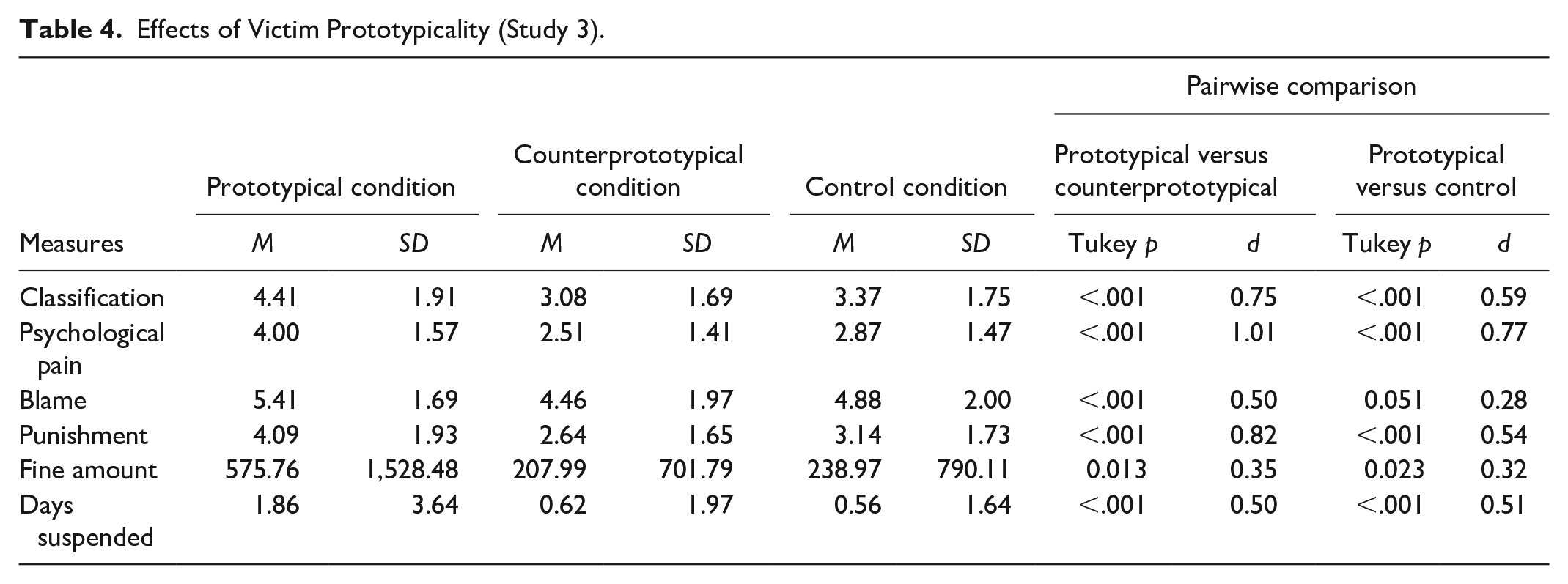
We conducted a one-way analysis of variance (ANOVA) on each dependent measure, separately comparing the mean levels in the prototypical condition with the mean levels in the counterprototypical and control conditions. For each of the six dependent measures, we found significant differences between the prototypical condition and the counterprototypical and control conditions. Moreover, we did not find significant differences between any of the dependent measures in the counterprototypical and control conditions. See Table 4 and Figure 4 for descriptive statistics and results of each test.
Effects of Victim Prototypicality (Study 3).
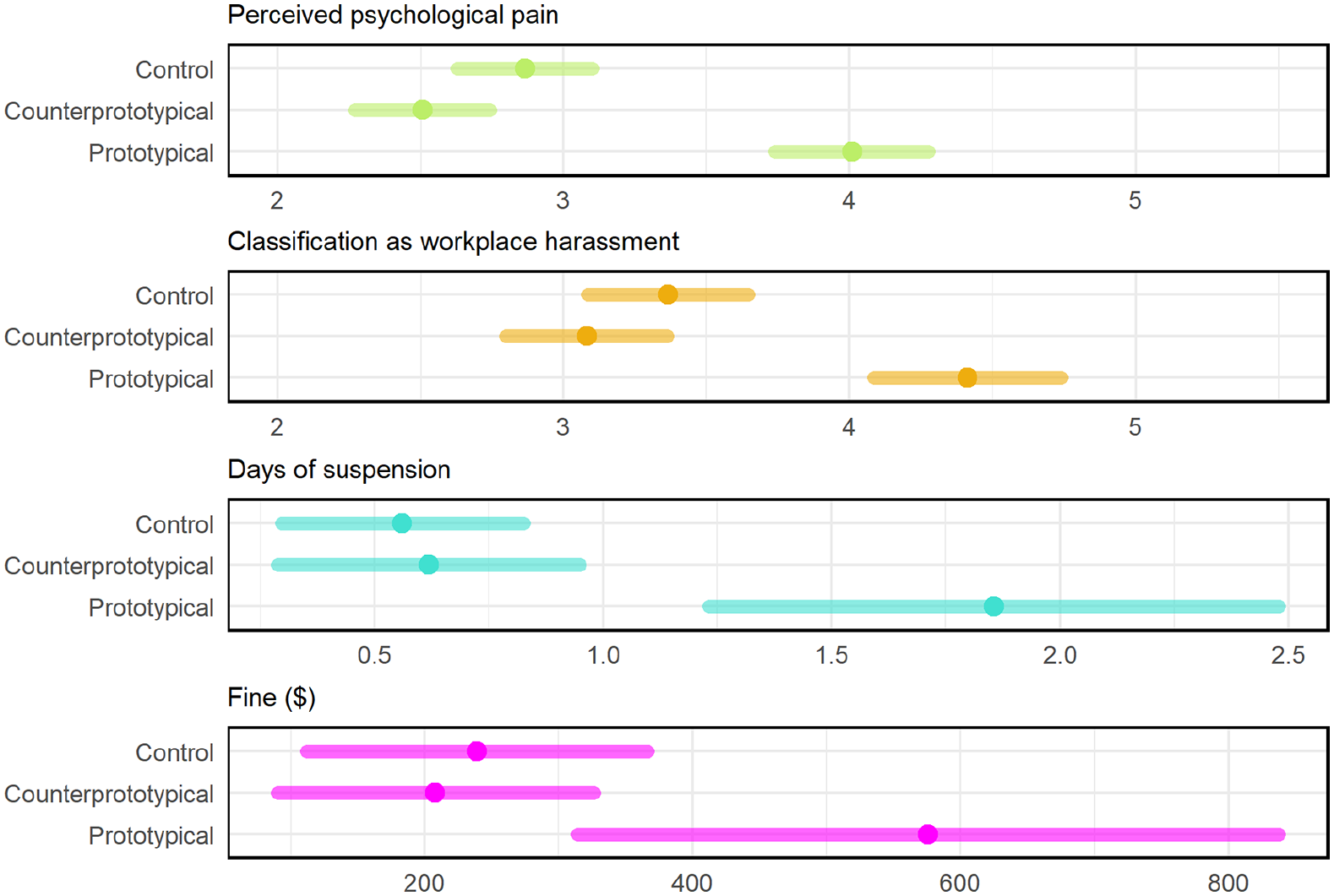
Effects of victim prototypicality (Study 3).
Discussion
This study shows the effects of harassing a prototypical victim of workplace harassment on downstream judgments, such as how much pain people imagine victims experience, how much blame they attribute to the perpetrator, and importantly, how much they think it is appropriate to punish the perpetrators. Perpetrators were considered more blameworthy when harassing a prototypical victim—and people favored that they be punished significantly more in kind. Of importance, we tested non-prototypical victims in two ways: in a baseline condition and in a counterprototypical condition. We found that compared with both conditions, participants’ judgments in the prototype condition were consistently and significantly different, demonstrating that compared with a baseline (the control condition), punishment increased when a prototypical victim was harassed at work rather than decreased when a counterprototypical victim was harassed. In more support, we found these effects replicated among HR professionals (see Study S1 in the Supplementary Material file).
Study 4
In Study 4 (pre-registered, https://aspredicted.org/n88ri.pdf), we studied a potential solution to the prototype effect. In cases of debiasing, research has found that shifting attention away from a person’s superficial features and toward more relevant criteria (e.g., their qualifications) reduces bias (Soll et al., 2015). We tested if this method will work in reducing the prototype effect.
Method
We recruited 456 U.S. participants from Prolific. Two participants failed the attention check, leaving 454 participants (157 males, 287 females, 7 non-binary people, 1 other, and 2 preferred not to disclose;
We randomly assigned participants to one of four conditions in a 2 (victim prototypicality: prototypical vs. counterprototypical) × 2 (instructions: present vs. absent) fully between-subjects design. We manipulated the victim-prototypicality factor by using the same materials from Study 3 in which participants read about J.V. who conformed to either a prototypical or counterprototypical victim of workplace harassment. Before participants answered the same questions from Study 3, we manipulated the instructions factor by adding to participants’ scenario in the present-instructions condition, “Important: While responding to the following questions, please ignore J.V.’s features and focus only on J.V.’s boss’s behavior” (we bolded and capitalized the instructions). In the absent-instructions condition, we did not add these instructions. After answering the six questions that assessed the behavior’s classification as workplace harassment, victim’s pain, perpetrator’s blame, and perpetrator’s punishment, we asked participants to answer two manipulation checks for the instructions factor (“How much did you focus on J.V.’s boss’s behavior when responding to the previous questions?” and “How much did you focus on J.V.’s features when responding to the previous questions?); participants responded to both checks from 1 (
Results
We found participants in the present-instructions condition reported that when they made their judgments, they focused more on the behavior (
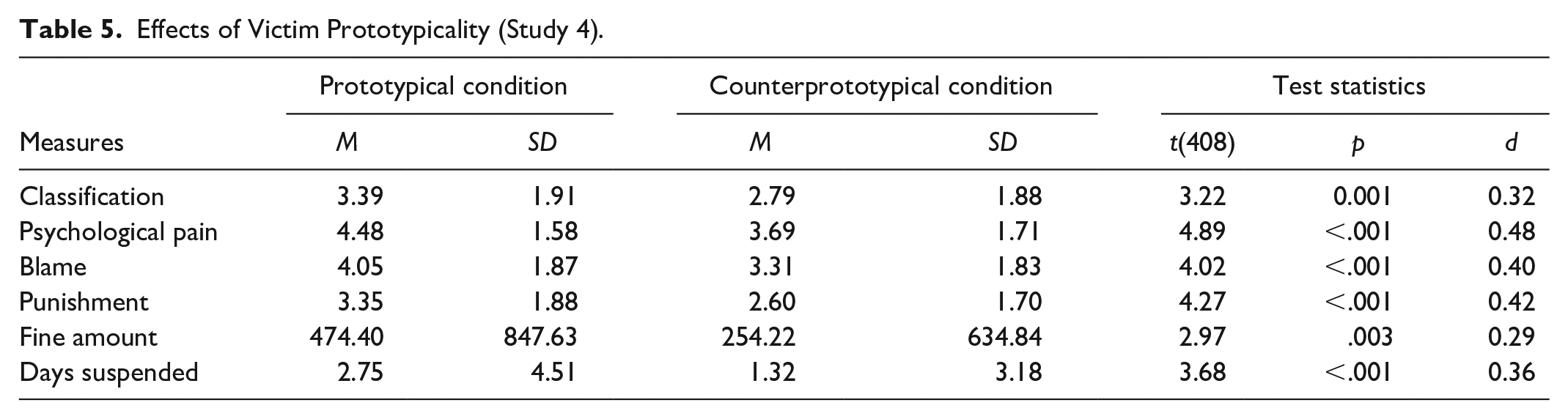
Would, however, participants’ judgments coincide with their alleged focus? That is, would the instructions to ignore J.V.’s features attenuate the prototype effect? We found they did not. We conducted a 2 (victim prototypicality: prototypical vs. counterprototypical) × 2 (instructions: present vs. absent) on each dependent measure. The main effect of victim was significant in each case (see Table 5 for descriptive statistics and results of each test), whereas the main effect of instructions (
Effects of Victim Prototypicality (Study 4).
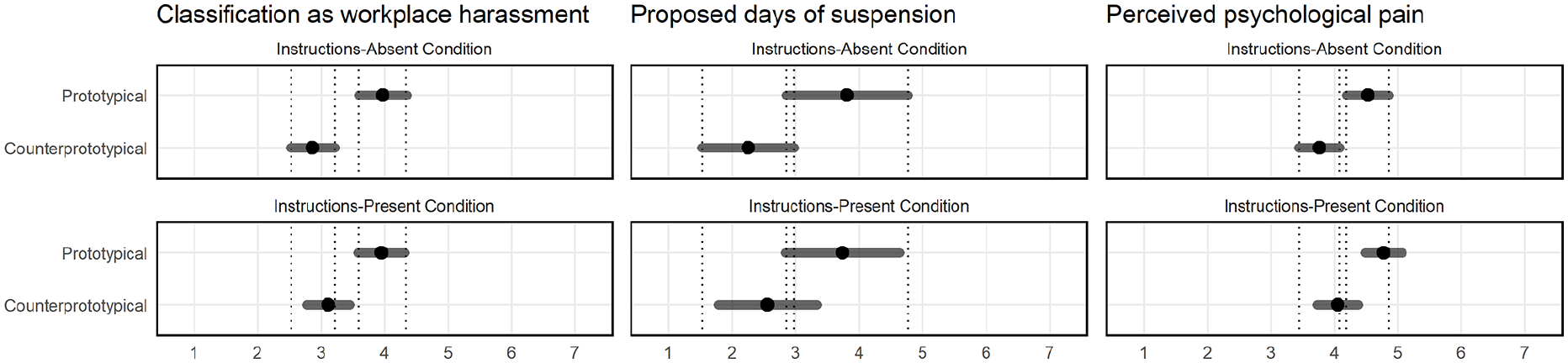
Effects of victim prototypicality (Study 4).
In an exploratory analysis, we tested whether participants’ focus on the victim’s personal features, and separately, on the behavior would moderate the results. As noted, participants self-reported that they focused considerably more on the behavior and little on the personal features. Yet, their judgments suggested otherwise. Possibly, among participants who report they focus more on behavior the effect is smaller, but, considering we found that participants’ self-reported responses were in conflict with their judgments, this is probably not the case. Indeed, when we conducted regressions on each dependent measure with the following predictor variables: participants’ condition, focus on behavior (and separately, focus on personal features), and the interaction between condition and focus, we did not find a significant interaction for any of the dependent measures (see Supplementary Material file for analyses and results). This shows that the level to which participants followed the instructions did not change how much participants were biased by the prototype effect.
Discussion
This study replicates our previous findings. Importantly, instructions that might debias the participants did not appear to help. Even though participants indicated they made their judgments based on their perceptions of the harassment behavior rather than on the victim’s description, they were still, ostensibly, influenced by the victim’s description. In fact, regardless of how much participants indicated they followed the instructions, the effect emerged. All things equal, if participants had successfully ignored the victim’s description, they would have rendered roughly equal punishments between conditions. Yet, we did not find this to be the case.
Study 5
In our studies so far, it is possible that we cannot disentangle the perceived traits of a victim of workplace harassment and the after-effects of workplace harassment. For instance, while someone introverted could be targeted by workplace harassment, they could also become more introverted after they experience workplace harassment. The objective of Study 5 (pre-registered, https://aspredicted.org/h9ge3.pdf) is to test whether being the target of workplace harassment in the future versus having already experienced harassment alters the judgments that people have of them.
Method
We recruited 300 U.S. American participants from Prolific. Two participants failed the attention check, leaving 298 participants (121 males, 170 females, 6 non-binary/third gender, and 1 preferred not to disclose; J.V. is an administration worker at BDP Accounting, an accounting company in Santa Fe, New Mexico with about $3 million in annual revenue and 50 employees. J.V. is originally from Albuquerque, New Mexico. J.V. is 33, has an Associated Degree in Accounting, and is Caucasian.
Then, participants in the control condition continued to the measures. Participants in the future condition read the following text before responding to the measures: J.V. is most likely going to be the target of workplace harassment, meaning that J.V.’s colleagues and supervisor will often demean this person, insult this person, and exclude this person from meetings and other work-related communication. To this point, J.V. has never been the target of workplace harassment.
By contrast, participants in the past condition read the following text before responding to the measures: J.V. has been the target of workplace harassment meaning that J.V.’s colleagues and supervisor often demean this person, insult this person, and exclude this person from meetings and other work-related communication.
We asked participants six questions that assess how they imagine J.V.: “How tall do you imagine J.V.?” from 1 (
Results and Discussion
The results show that compared with a control condition, the victims in the future and past conditions were imagined as less successful, less attractive, shorter, and less extroverted (see Table 6). We did not find differences in judgments of weight or political ideology. Of importance, participants’ judgments of the victim in the future and past conditions were very small (between
Features of Past and Future Prototypical Victims of Workplace Harassment (Study 5).

General Discussion
In our multi-method research, we tested “who” people imagine when they think of a victim of workplace harassment, and the effects this can have when a victim fits their perception. In 13 pre-registered studies, we found that people appeared to form a somewhat consistent prototype across different samples and evaluation modes. First, using an open-ended survey that measured which traits people think of when they imagine a victim of workplace harassment, we found that they made assumptions about a victim’s personality; they also remarked on a victim’s looks, height, weight, and their socio-economic status (Study 1a). Then in Studies 1b to 2f, we examined these traits in an experimental, quantitative fashion. We found that compared with a non-victim, people imagined a victim of workplace harassment as shorter, more overweight, more introverted, less attractive, and less successful. Notably, we found these effects when we indicated the victim was either white or Black (see Study S2 in the Supplemental Material file), suggesting the effects may evidence irrespective of victims’ race.
In our subsequent studies, we examined what effects these perceptions would have on the aftermath of workplace harassment (Studies 3-4 and S1). When victims fit the prototype, people’s judgments of the harassment changed in ways that benefited the victim or harmed the perpetrator. The harassment behavior was more firmly classified as harassment when the victim was prototypical; moreover, people perceived the victim to be more hurt by the harassment. Accordingly, people blamed the perpetrators and punished them more. In line with the robustness of the prototype (its relatively strong effects), the downstream effects were evidenced among both online panelists (Studies 3 and 4) and professionals who have experience dealing with workplace harassment (Study S1). Among these employees, we found a consistent pattern: Perpetrators were blamed and punished more when they harassed a prototypical victim versus non-prototypical victim—an effect that was unchanged according to how much experience employees have in dealing with managing harassment cases at work (Study S1).
In Study 4, we tried to correct people’s judgments by instructing them to ignore the victim’s personal features and focus instead on the behavior. This study rendered two conclusions: (a) the intervention failed; people “sided” more with a prototypical victim, suggesting it may be difficult to mitigate the prototype effect, and (b) people appeared to think they made decisions fairly, even when they did not. In Study 5, we contrasted the prototype that people have for a past victim versus a future victim of workplace harassment, finding little differences. This study showed that people’s prototypes are not based on (only) how victims may change or feel after harassment, but how they look or behave beforehand.
Theoretical Contributions
The present research makes theoretical contributions to the separate literature on social prototypes and workplace harassment. Prior research on prototypes has tended to study one feature at a time (e.g., a behavior is perceived to be more racist if directed toward a
In general, the present studies connect research on two important strains of scholarship—the research on prototypes in cognitive and social psychology (Goh et al., 2021; Niedenthal et al., 1985; Wages et al., 2022; Ziano & Koc, 2023) and the research on workplace harassment in legal psychology (Boudrias et al., 2021; Nielsen & Einarsen, 2012)—which until this point have proceeded in parallel. In our studies, participants appear to support prototypical victims by recommending harsher punishment to the perpetrators, yet they imagine prototypical victims in undesirable terms: for example, as less attractive and less successful. This might reflect a version of just-world thinking (Furnham, 1993), whereby people may contend that unfortunate people are collateral targets of harassment. Similarly, it might reflect a willingness to redress injustice, by favoring harsher punishments to harassers of prototypical (i.e., relatively disadvantaged) victims. In addition, people could be employing a sympathy halo: When they feel sympathy toward a person (e.g., a victim), they imagine other factors to be consistent with their victimhood (thus maintaining their disadvantaged station).
Practical Implications
The present research carries practical implications for how organizations and the legal system might deal with the effects of prototypes of victims of workplace harassment. Organizations should be mindful of the prototypes of workplace harassment victims, and acknowledge that easy fixes are not enough to fight them. Even people with experience dealing with workplace harassment were influenced by prototypes when judging cases of workplace harassment, suggesting that experience is not a factor that protects against the power of prototypes.
Sometimes workplace harassment cases cannot be decided within an organization and instead make their way through the legal system, ending up before an arbitrator, a judge, or a jury. Legal institutions could be alerted to the prototypes people possess and the consequences thereof. Currently, jurors in the United States are sometimes provided instruction on implicit biases. To our knowledge, these instructions contain mostly education on racial biases. Possibly, training could include “prototype instruction” in which jurors and other relevant parties learn about social prototypes. To be sure, people are aware of stereotyping. We suspect they are less aware of prototyping, and perhaps increasing awareness to people’s prototypes and how they make decisions that “fit” will mitigate some of the bias. Relatedly, anonymizing details about the victim could help as well; however, research has found that even when people make “blind” judgments, they are still subject to other biases (Tsay, 2013).
Our participants were from France, the United Kingdom, and the United States. We therefore encourage research about the same phenomenon conducted with non-Western participants. Furthermore, we conducted only scenario-based experiments that were light on detail. Actual harassment cases are more complicated than the scenarios we tested. This does raise a question of whether our results, in particular the results rendered from the failed intervention, will emerge in real-life cases of workplace harassment. A test of our propositions with secondary data in real organizations could assuage this limitation. We suspect the effects will be smaller in real-life cases, but this is hardly encouraging because the effects that we observed in our studies are quite high (sometimes
We tested a heavy-handed method to reduce the effect of prototypes (i.e., instructing participants to ignore the features of the victim and focus on the behavior at hand). To our surprise, the intervention was unsuccessful—though perhaps it could still work in real-life cases of harassment. It will be fruitful if future research can identify an effective method for reducing the effects of prototypes that are even more heavy-handed—at least more effective. Possibly, there is not one, and instead of searching for easy methods, organizations should rely more on upstream decisions, such as hiring more diverse employees which could diminish the prototype effect vis-à-vis diverse interactions people have at work.
Supplemental Material
sj-docx-1-psp-10.1177_01461672241235388 – Supplemental material for Prototypes of Victims of Workplace Harassment
Supplemental material, sj-docx-1-psp-10.1177_01461672241235388 for Prototypes of Victims of Workplace Harassment by Ignazio Ziano and Evan Polman in Personality and Social Psychology Bulletin
Footnotes
 .
.Authors’ Contributions
Declaration of Conflicting Interests
Funding
ORCID iDs
Supplemental Material
References
Supplementary Material
Please find the following supplemental material available below.
For Open Access articles published under a Creative Commons License, all supplemental material carries the same license as the article it is associated with.
For non-Open Access articles published, all supplemental material carries a non-exclusive license, and permission requests for re-use of supplemental material or any part of supplemental material shall be sent directly to the copyright owner as specified in the copyright notice associated with the article.
