







Abstract
Keywords
Introduction
With the advent of Web 2.0 and its affordances, the contemporary youth from the global South has moved beyond the role of mere consumers of global cultural flows to that of content creators with global aspirations (Bhatia, 2024; Bhatia and Pathak-Shelat, 2023). However, despite the promises of democratization through new media technologies, the online public sphere is still not a level playing field. Countries of the global North still dictate the norms and practices of online participation, and the affordance of global visibility and publicity promised by social media are not always easily materialized in the lives of the influencers from the global South. This paper is situated at the intersection of the promise of global visibility and engagement through social media and the material realities engendered by the geo-political position of the youth from the global South vis-a-vis social media platforms. Based on our examination of content created by the seven influencers who are based in India and position themselves as global influencers and their engagement with their local and global followers, we propose two themes: The first theme, which we call templatization, addresses how influencers are communicating global issues and social media platform affordance usage (standardized formats) to local audiences. The second theme of culture brokerage explores how they communicate local realities to global audiences. Templatization is the process where influencers develop affordance literacy and harness the potential of a platform’s technological possibilities and uses. Culture brokering is a negotiation strategy that serves as a bridge between the templatized experience of content creation/network building and influencers’ aspirations to nurture a unique global identity for self, carve novel spaces for collaboration and communication about their quotidian-lived experiences and realities, and foreground their local cultures in an increasingly globalized digital environment. Our paper contributes to the much-needed bottom-up empirical insights on influencer culture that foregrounds the ontologies and practices of the global South.
Review of literature
Global influencers on social media
The proliferation of social media platforms in the early 2000s is characterized by the emergence of user-generated content (Boyd and Ellison, 2007). While early studies explored how social media users were actively and simultaneously producing and consuming content, that is, prosumer cultures (Bruns, 2009; Jenkins, 2006) or produsage (Bruns, 2008), research in the 2010s emphasized how content creation on social media could be monetized (Bishop, 2021; Cunningham and Craig, 2019; Duffy, 2017). Today, a robust body of literature explores productive interlinkages between social media influencers, digital labor, and consumerism (Bauman, 2007; Hund and McGuigan, 2019; Shaw, 2017).
Some scholars (Duffy et al., 2021; Glatt, 2022) have also suggested the workings of the platforms as a macro institution of power that primarily regulates the influencers’ online interactions and content creation practices and experiences. They also challenge the unnuanced assumptions that individualization of content creation on social media is a means of self-expression and democratization of communication. Social media’s affordances sustain a particular form of platform ecosystem and compel influencers and other creative laborers to abide by the platform’s dominant logic of individualization and metricization, including constant changes in their algorithmic systems (Christin and Lu, 2023; Terranova, 2022).
We draw theoretical force from this body of literature and argue that influencers deploy the technological affordances of social media platforms to produce content, generate a following, and create their online brands. In doing this, they constantly push against the technical constraints imposed by social media platforms and develop evolving digital vocabulary/practices to enable their subjectivity and culturally unique expressions of their everyday lives. We make a case that social media influencers from the global South act like cultural brokers – between their local/national cultural realities and those of their global followers, between their subjectivity and the technical rigidity of the social media platforms, and between their aspirations and the limitations of the digital platforms they inhabit. Our goal is to examine if and how social media platforms enable new modes of production and global cultural expression, how global influencers negotiate with these affordances, and the dominant logic of participation on social media to produce globally relevant content, transcultural communities, and diverse experiences that foreground their aspirations, creative motivations, and values.
Our paper departs from the available literature exploring the interlinkages between creative labor, platform affordances, and influencers in three significant ways. First, most studies adopt a critical approach to examine the platformization of cultural production. The main argument in these studies is that platformization is influenced by macro (markets, governance, and infrastructures) and micro (quotidian online practices and realities) forces of power. Though our paper appreciates the macro-micro connections, we center individual negotiations manifesting as digital vernacularity, that is, how influencers negotiate the authority of platform affordances in creating content representative of their cultural realities and personal aspirations. Second, the available literature does not adopt a bottom-up approach of examining the content created by social media influencers to trace the unique combination of styles, grammar, and logic that they use to create content and a virtual community of followers. Foregrounding the influencer’s strategic choices as reflected in the content they create and the participation they enact online helps us identify the organically evolving online communicative habits that the influencers adopt and modify to align with the functionality and possibilities afforded by the platforms.
Third, scholars such as Gillespie (2010), Montfort and Bogost (2009), Bruns and Burgess (2011), and others contend that though platform affordances (de)limit particular forms of expressions and participation, ongoing interactions and creativity of users give rise to shared grammars of communication that push the boundaries of and even compel adaptations of standard forms of articulation on social media platforms. Few studies have offered empirical findings to support these theoretical implications (Gibbs et al., 2015; Keller, 2019; Lee, 2023). Our analysis looks at the online content created by seven global influencers based in the global South and attends to ways in which they mobilize social media affordances to articulate self, negotiate the boundaries between public culture and subjective identities and interactions, and create transnational communities through virtual networks.
These platforms use standard and universal procedures to measure social media influencers’ impact, success, credibility, and popularity. Even as influencers in the global South contexts templatize their content and online participation to align with the affordance-based requirements of the platform, they actively center local and culturally unique experiences through their social media profiles and engagement. Also, literature on social media influencers alludes to global North realities as individual-driven and aspirational or as the primary site for analysis for initiating trends and practices in the realm of creative labor. On the other hand, the parallel in the global South is either underexplored or captured by marketing studies literature on the advertising potential of the influencer economy. So, there is a gap in addressing the everyday negotiation strategies of social media influencers in the global South as they navigate platform affordances and content/engagement templates to carve a niche space for self-expression as global content creators who are relevant across cultural and national boundaries (Bhatia and Pathak-Shelat, 2023).
The primary premise of our paper is that social media influencers, especially in the global South, act as cultural brokers. They negotiate with standardized creative practices imposed by the features of social media platforms designed primarily by and for people in the global North. We intend to acknowledge the agency of social media influencers as they navigate the dominant logic of individualization and metricization of social media platforms primarily designed for users in the global North. They also ideate ways to prioritize their local cultural and personal experiences as they try to make their content (displayed in templatized formats) relevant and exciting for transnational audiences. To demonstrate how these negotiations take place between standard – personal, templatized – cultural, and technical – unique, we will trace the evolution of the concept of affordances in the following section.
Platform affordances
Scholars in the field of human-computer interaction ideated the concept of affordance to flesh out “the complex relationship between technology’s material and social factors” (Duffy et al., 2017). Technologies have inbuilt or embedded functionality, that is, their technical properties. However, when people interact with these technologies, they can confer new uses. A nuanced and active relationship exists between a technology’s technical capabilities and a social actor’s use of these technical features (Evans et al., 2017).
According to Faraj and Azad (2012: 254), an affordance is a multifaceted relational structure, not just a single attribute or property, or functionality of the technology artifact or the actor. That is, affordance is often realized via the enactment of several mutuality relations between the technology, the artifact, and the actor.
An affordance-based approach to technology centers on two main arguments. First, technology and its inbuilt features have the ability to limit, guide, determine, allow, or constrain certain user behaviors, actions, and experiences. Second, users can ascribe unique meanings and functions to technologies – functions that were not preestablished as a possibility due to the envisioned scope of the affordances. Though this conceptualization identifies social actors, especially users, as critical stakeholders, it does not elaborate on the role of user agency (Rodríguez-Hidalgo, 2020). We use the concept of agency as a theoretical framework to examine social media affordances from the perspective of influencers who devise negotiation strategies to deploy social media functionality to initiate a series of social actions. When social media influencers weave their novel forms of “cultural participation and self-expression” (Burgess, 2007) to align with and even modify the conventions, formats, and styles established and validated by social media affordances, users’ agency comes into play. We combine the affordance-based approach and a deep engagement with users’ agency to reveal how social media influencers negotiate with Instagram’s affordances to create content, experiences, and networks representing their local and cultural realities – the ordinary everydayness (Burgess, 2007: 13). Documenting their negotiation strategies is instrumental in appreciating the ways in which the influencers juxtapose and accommodate what is central to their personal contexts/local experiences with institutionalized environments stabilized through social media affordances. We call social media influencers cultural brokers for three reasons: 1. They bridge the gap between their personal aspirations/subjective experiences and the scope and possibilities afforded by social media; 2. They use social media to mediate between their cultures/identities and people from across national and cultural borders, and 3. They use social media to create and sustain a network/community of followers from different cultures who might have shared interest/s. As cultural brokers, social media influencers enact creativity not only through their content or self-expression but also through their strategic choice to foster social connections and virtual communities for experiencing belongingness. In doing this, they are actively circumventing, or at least stretching, the limits imposed by Instagram’s affordances.
Vernacular creativity and social media platforms
Burgess (2007) introduced the concept of vernacular creativity to describe a phenomenon where content producers center their lived realities – local cultures and everyday experiences, in the content they create using the affordances of social media platforms. According to Burgess, when people produce content on global social media platforms, they retain their “ordinary everydayness” –their quotidian practices, aspirations, experiences, and motivations, instead of strictly complying with the expectations, forms, and habits standardized by the high culture or institutionalized/technologized environments of productions. Vernacular creativity is often used as a heuristic device to understand creative practices on new media that emerge in non-elite, non-standardized, and niche communication contexts. Drawing theoretical force from the approach of Negus and Pickering (2004), Burgess argues that vernacular creativity is based on recombining the available material resources in novel ways. Such a process of recombination has two unique implications. One, the recombined cultural resources embed familiar elements and create a recognizable experience for the consumers of the materials.
Second, the process of innovative recombination gives rise to a novel experience, thus piquing the interest and attention of the receivers. In articulating vernacular creativity expressed through digital platforms, content creators and influencers make sense of a platform’s technological possibilities and limitations through constant use and interaction with its interface (McVeigh-Schultz and Baym, 2015). Also, influencers interact with virtual communities and networks of content creators who devise new and novel functions extending the established technological possibilities of social media platforms. The process of constant and active engagement with functions and technological functions standardized as norms by the platforms and the new ways the boundaries of technological possibilities are disrupted or challenged generates languages, grammar, logic, and conventions that are both generic or standardized and personalized or niche. Social media influencers from the global South interact with the technological affordances of global digital platforms that consider users in the global North to be the standard consumers of digital platforms and products. These aspiring influencers develop technical capabilities and platform awareness to navigate the algorithmic logic and media processes foreign to their cultural, political, and quotidian realities. Simultaneously, they create ruptures around the dominant rationality of content creation on social media through customized negotiation strategies to retain the centrality of their local realities and cultures within a globalized digital environment.
Digital platforms determine rules for what kind of content and behaviors are amplified and which interactions are discouraged. They also tend to change the rules through technical and policy measures, which does not always seem fair to the creator communities (Gillespie, 2018; Suzor, 2019). Platform affordances, as articulated by social media companies and the explicitly standardized functions of the interface features, are limiting and modeled after consumers in the global North (Bhatia, 2023). As a result, content creators and influencers deliberately test the boundaries of these platform rules and the various mechanisms standardized to publish their content. Consequently, a content creator’s success and reachability are directly related to specific metrics of visibility, including, but not limited to, likes, comments, and shares. Influencers in the global South must negotiate with these limitations – the informational architecture and affordances of social media that are inherently trained to favor practices, identities, and cultures in the global North (Bishop, 2019; Bucher, 2012). Content creators in the global South navigate the established grammar, conventions, and experiences and create space for their personal, highly customized, and local lives to interact with each other and the foreign influencers in a global digital platform without being trivialized as an anomaly. The influencers use a process we define as “templatization” – they embrace the technological possibilities of social media while actively pushing against the functional, interpretive, communicative, and networking possibilities afforded by digital platforms. A user’s capacity to maneuver through technology – its materiality and the cultural context under which the technology is used are interconnected and cannot be studied in isolation (Evans et al., 2017). Though the functions, features, and other interface elements of digital platforms inform the scope of the technological affordances, scholars (Arriagada and Siles, 2023; Bishop, 2021; Costa, 2018) also argue that the (re)use of social media platforms cannot be determined a priori. When influencers create and circulate content on social media platforms, they do not use social media affordances as innate functions that define the limits of technological, cultural, interpersonal, and community interactions online. Instead, they perceive social media affordances as “ongoing enactments by specific users that vary across space and time” (Costa, 2018). Influencers from the global South and with a significant global audience deliberately abide by the normalized format and language of content standardized by corporations, states, and majority users. Within those standardized formats, they create nuances to communicate the interlinkages between their lived local realities and global aspirations and norms. Influencers act as cultural brokers and customize their content at the intersection of global and local. Templatization is the process of identifying and executing a standard format aligned with the established and top-down conventions/languages of social media engagement while maintaining autonomy, subjectivity, and local nuances in the content and networks the influencers create.
Our article addresses two overarching questions: 1. How do influencers prioritize individualization and localization of media products while aligning their online practices with standardized logic, language, and formats of the social media platforms? 2. How do influencers create subjective and personalized online engagement possibilities while attracting and retaining audiences from foreign cultures and countries?
Methodology
To approach our research questions, we use the critical technocultural discourse analysis (CTDA) framework (Brock, 2018) to understand how global influencers from the Global South negotiate with the standardized informational architecture of social media platforms to situate and communicate their unique subjectivities and cultural realities.
In the article, CTDA offers a framework to look at the discursive practices of influencers from the global South, who act as cultural brokers while utilizing the affordances of the platform to re-orient their practices as well as integrate the material and symbolic aspects of the platform to templatize their content to cater to the global audience. We shortlisted Masoom Minawala, Brinda Sharma, Rohan Chakravarty, Trinetra, Sushant Divgikar, Sharanya Iyer, and Larissa D’Sa in our sample. 1 We shortlisted these seven influencers based on the engagement and comments received by global audiences on their respective platforms and their engagement with international brands and collaborations that could help them attain global audiences. We looked at the cultural brokering strategies of these influencers from the global South to understand how they produce globally relevant content that complements the hashtags, audio choices, etc. and allows for greater visibility while also tying up their local realities to the affordances of the platforms. Within the CTDA framework, we use thematic analysis (Braun and Clarke, 2012) to code the discursive strategies deployed by the content creators by utilizing specific affordances. We have divided our analysis into two primary themes: 1. Templatization is the process where influencers develop affordance literacy and harness the potential of Instagram’s technological possibilities and uses. 2. Culture brokering is a negotiation strategy that serves as a bridge between the templatized experience of content creation/network building and influencers’ aspirations to nurture a unique identity for self, carve novel spaces for collaboration and communication about their quotidian-lived experiences and realities, and foreground their local cultures in an increasingly globalized digital environment
Analysis
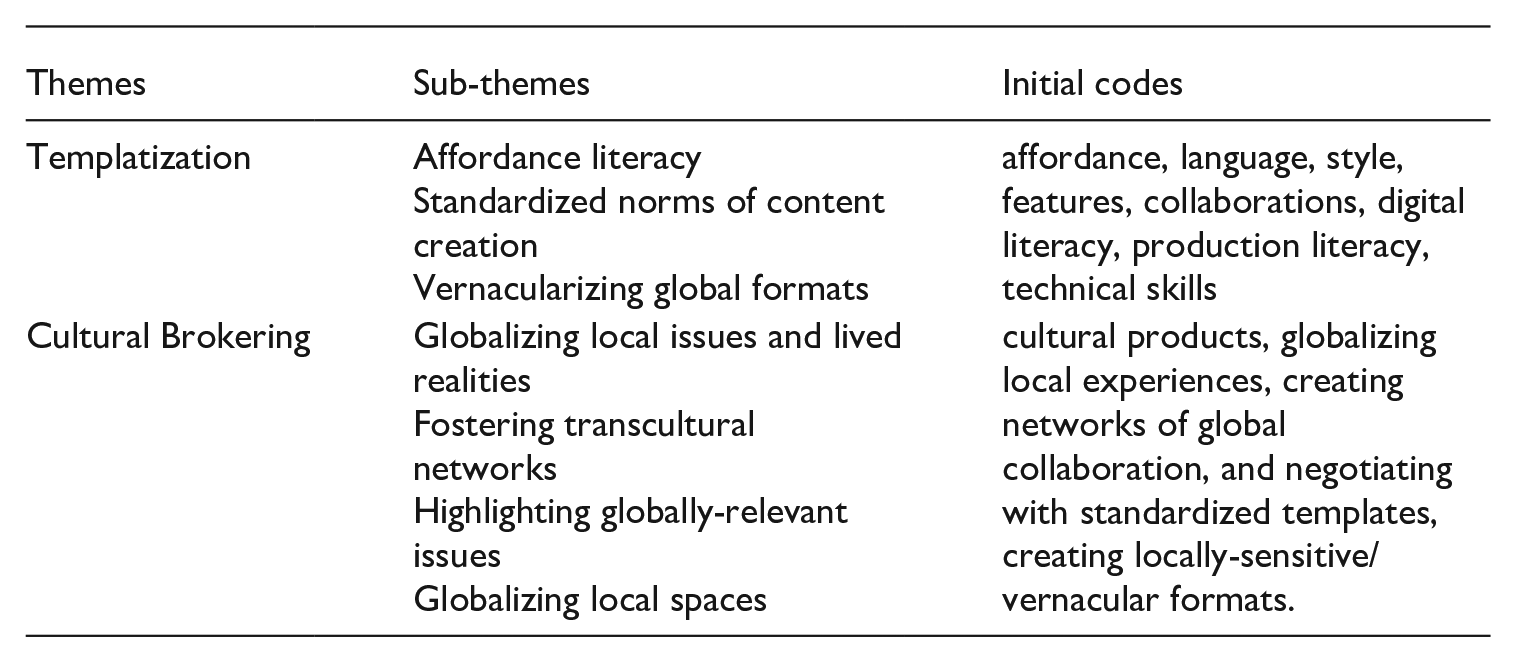
Thematic Table: Templatization and cultural brokering
Templatization
Influencers in countries of the global South use social media platforms primarily designed for consumers in the global North (Bhatia and Pathak-Shelat, 2023). The design, interfaces, and informational architectures of global social media platforms inherently embed the aspirations, realities, and practices of global North users. We extend the theoretical arguments offered by scholars such as Bhatia (2023), Pathak-Shelat and DeShano (2014), and others to propose that most social media platforms formalize specific languages, formats, and dialogues through platform policies and explicitly comprehensible practices. Social media platforms, therefore, design interfaces and develop functionalities that mould and inform conversations, engagement, and experiences of users online. These platforms select people in the global North as the standard and universal customers/producers of social media and structure platform mechanisms around this assumption (Bhatia, 2023). Contrarily, people’s use of technologies unfolds in unpredictable ways because users with distinct cultures, histories, values, aspirations, and realities confer social value on technologies through careful “configuration, mediation, and active interpretation” (Pinch and Bijker, 1984). Our findings suggest that influencers from the global South appreciate the delicacy between compliance with the dominant rationality of social media platforms and the desire for unique, culturally distinct/rich, and personable content and networks on global social media platforms. Their online content, engagements, and networks reflect how these global South influencers navigate the technological affordances of digital platforms and their aspirations to preserve and share their lived experiences through their digital labor. A glance at the content created by the influencers in this research may indicate that the influencers deliberately filter out local cultural elements and particularities to cater to a global audience that might not have the cultural literacy to appreciate their local realities. Their content reveals a generic format: global topics and narratives, unified and generic (sometimes even stereotypical) representations of their local cultures, and the use of globally famous hashtags to promote their content. Also, producing content using globally relevant narratives may lead to the presentation of a sanitized version of the situation in their local contexts. For example, Masoom Minawala produces content on global topics and discussions such as the struggles of a working mother, the spirit of professionalism, and finding a balance between domestic and professional commitments, among others. She does not engage with the struggles of a working mother in the Indian context, which includes a subsection of working mothers with ordinary jobs who do not have the glamorous lifestyle of high-profile celebrity mothers (Image 1).
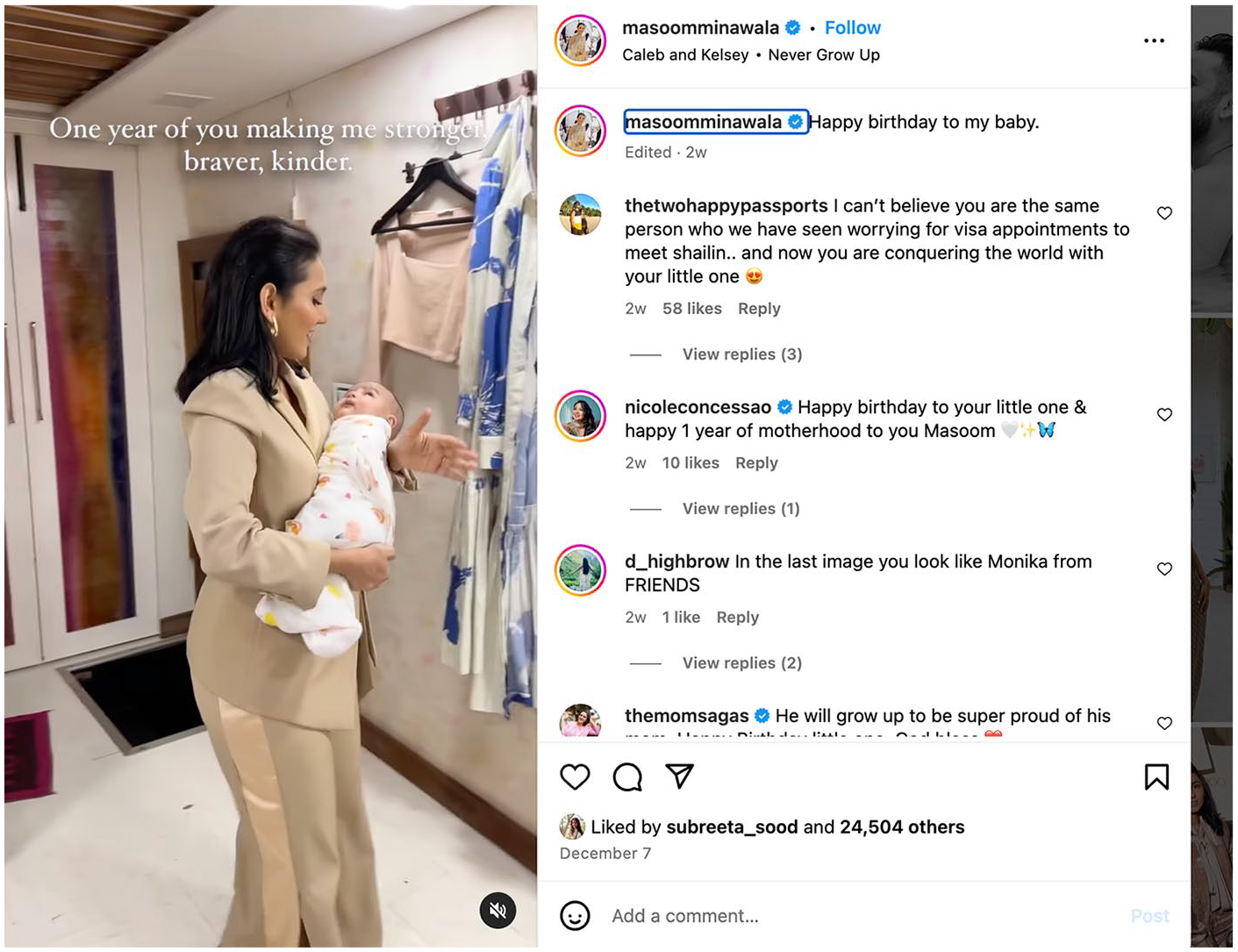
Screenshot of a reel depicting Massom celebrating her child’s first birthday and how motherhood has transformed her life.
Even when Masoom sympathizes with mothers in general, she does not highlight the class differences that enable empowered mothers to afford help in raising their children. She consistently leaves out a segment of working mothers going through parenting challenges without support in predominantly patriarchal cultures in the country. Her content pushes the perspective of a career-oriented mother from a high-class background who hustles and juggles the demands of motherhood and entrepreneurship. She continuously puts forth the notion of pushing one’s limits over resting, thus reinforcing the neo-liberal and patriarchal narrative of meritoriousness. She presents an optimistic view of her challenges; the narrative may begin with her vulnerabilities, but the endings are similar – overcoming hardships and striving against all odds (Image 2).
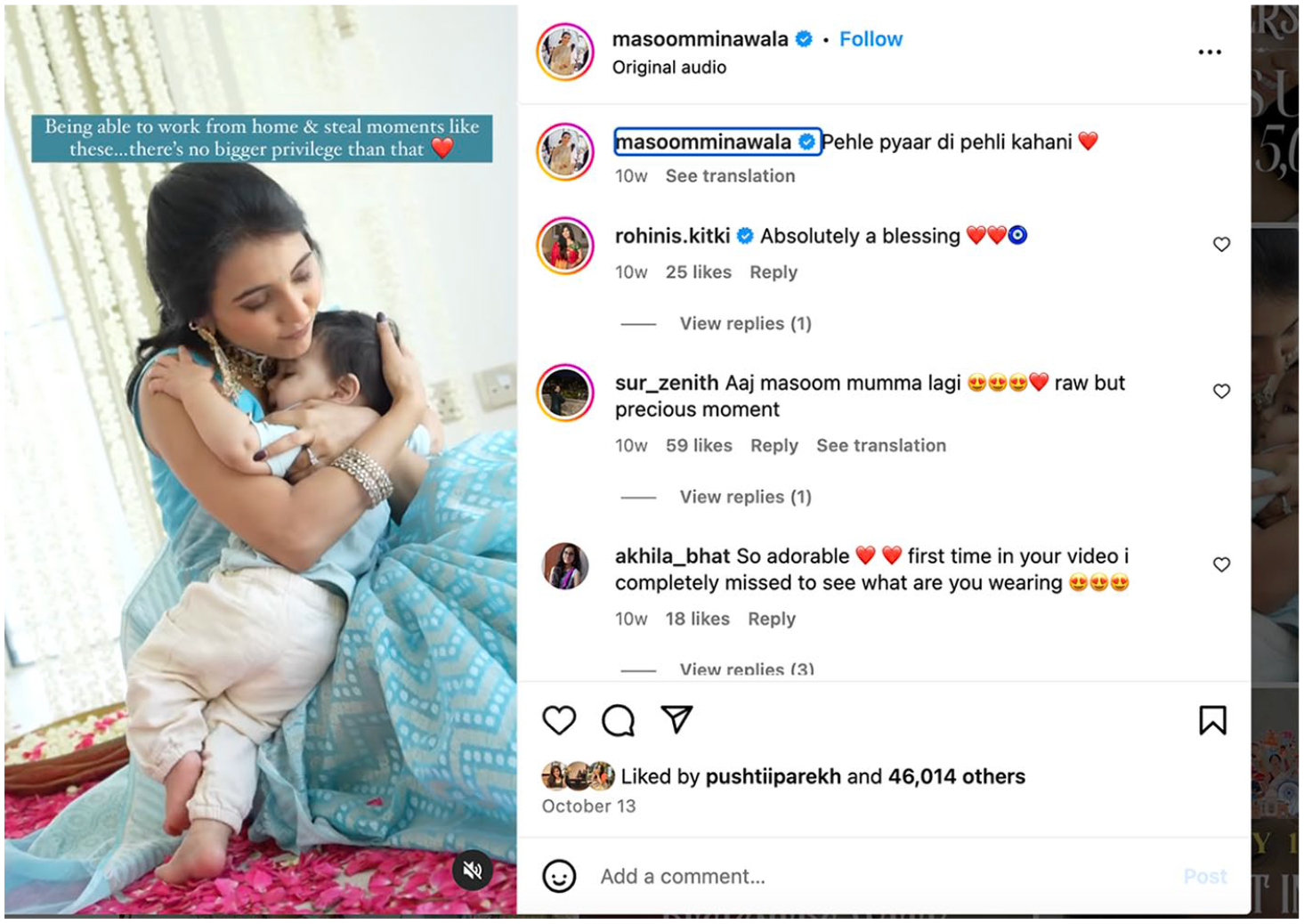
Screenshot of a reel depicting Masoom playing with her child. The text on the reel says, “Being able to work from home and steal moments like these . . . there’s no bigger privilege than that.” The reel reinforces the idea of Masoom cherishing motherhood while also being a working mother and having a work-life balance.
The influencer does not leave room for contextual blockages that may arise because of local cultural specificities, such as the unrecognized and invisible domestic labor compelled onto women in many Indian households. Our analysis indicates that she centers her personal experiences as a working mother when creating content on globally relevant, non-subjective, and generalized topics such as women empowerment, breaking the glass ceiling, and feminism. Using her personal experiences as an interpretive frame to lend authenticity to her content is a strategy to preserve the local while engaging with global audiences. She, however, maintains the interlinkages of her personal-local struggles with the dominant discourse of being a global public figure. Her Instagram bio mentions she is a “Generation Equality Aly” at @unwomenindia (Image 3). 2

Screenshot of Masoom’s bio on Instagram.
She promotes Indian designers and fashion while highlighting her collaborations with international fashion houses and product companies. We coded the esthetics of her Instagram profile as Indo-Global – representing the reality of her Indian heritage and local fashion and the popularity and desirability of global luxury brands. The esthetics of her photos and videos align with the universality of globally connected spaces of experience – soft lights, full-makeup look, high-end and designer products, and luxurious backgrounds. Even when she is situated in India, her content is illustrative of the process of flattening categories in a globalized world order. She uses the logic of informational architecture supported by Instagram: a collage of videos with voice-over (in English) and subtitles in English and Hindi. The reels are short, visually vibrant, and use over-produced and photoshopped images/videos of cities, self, and experiences. She understands the potential of hashtags on Instagram – the possibility of creating a global collective viewing experience and community. Even when she does not use hashtags to promote herself, she deploys hashtags to promote her social media campaigns. She extensively used #SupportIndianDesigners to emphasize her rootedness in and commitment to local cultures and contexts.
Sushant Divgikr’s Instagram profile reveals similar strategies for content production and identity articulation. Both influencers keep local elements in their content intact while communicating with a global audience. For instance, their wardrobe esthetics are quintessentially Indian – lehengas, sarees, and traditional jewellery. Sushant often displays their singing skills by mixing Bollywood songs with international music. Sushant creates content to position themselves as a drag queen and calls themselves the Indian Drag Royalty in the profile bio. They repeatedly produce reels that showcase their artistic streak through vocal ranges, modeling, dancing, and acting skills. They use a hashtag pool for all their content. The hashtags range from generic and global labels such as #trans, #transisbeautiful, #lgbt, and #grwm, to locally contextualized labels such as #namaslay (namaste + slay), #india, #indian, names of different Indian festivals (#navratri, #dushera, #diwali). Sushant deploys the potentialities afforded by social media to foster local and global audiences. They also collaborate with international celebrities such as Lily Singh and Sasha Colby. Collaboration is an affordance that allows influencers to tap into each other’s networks of followers. Influencers in India collaborate with international celebrities and content creators to expand their networks and connect with people from different countries and cultures. We also observed that influencers collaborate in two ways: 1. They use the collaborate function on Instagram and create shared posts with their international partners. 2. Influencers tag international content creators/celebrities/organizations. When the influencers use the collaboration function on Instagram, their shared content is directly visible on the feeds of both partners. As a result, their content is directly accessed by domestic and international networks of followers (Images 4–6).
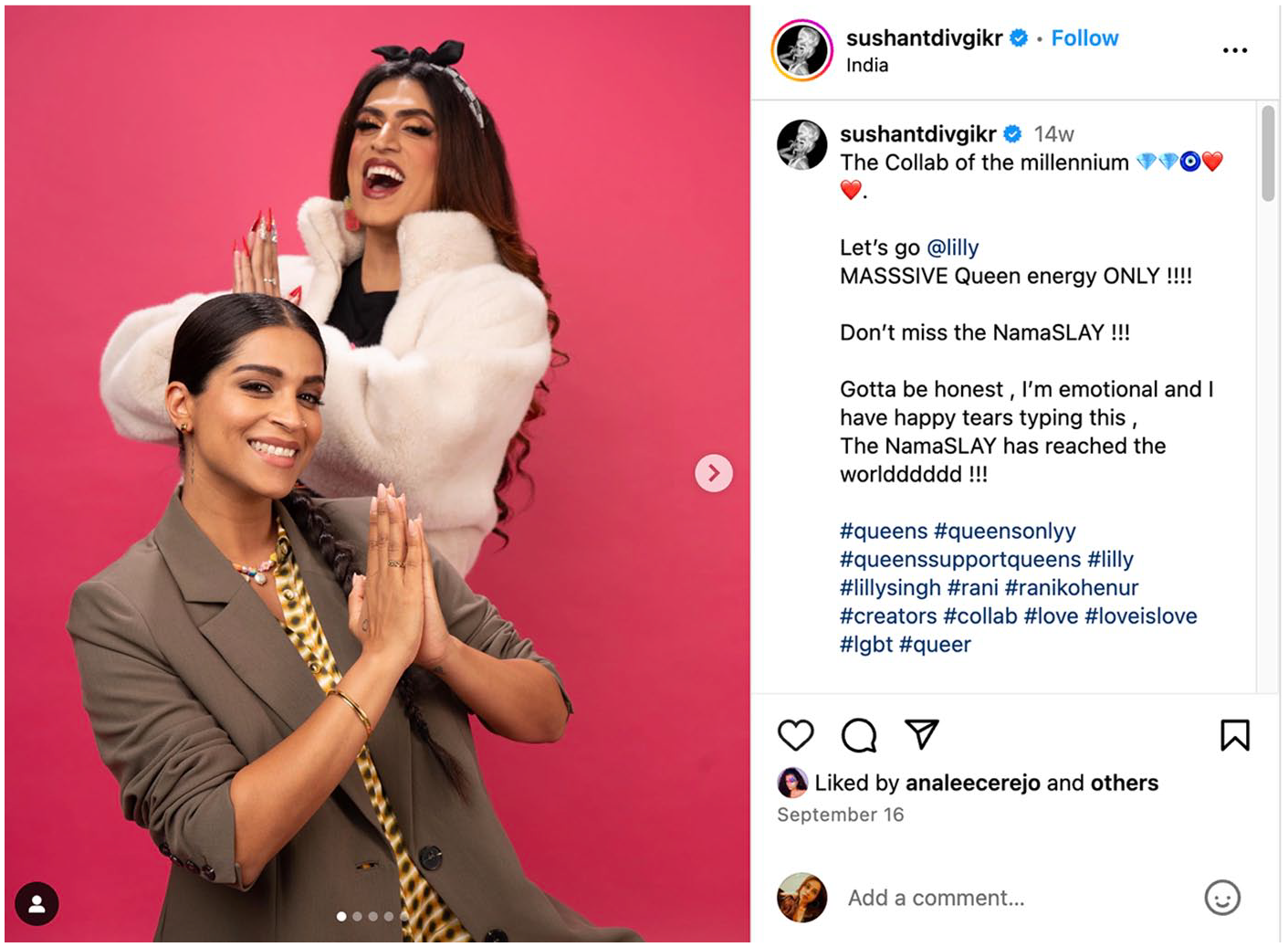
Screenshot of a picture of Sushant Divgikr striking a “namastey” pose with Indo-Canadian content creator, Lily Singh. The image depicts Sushant collaborating with Lily Singh in an effort to have a global name and followership.
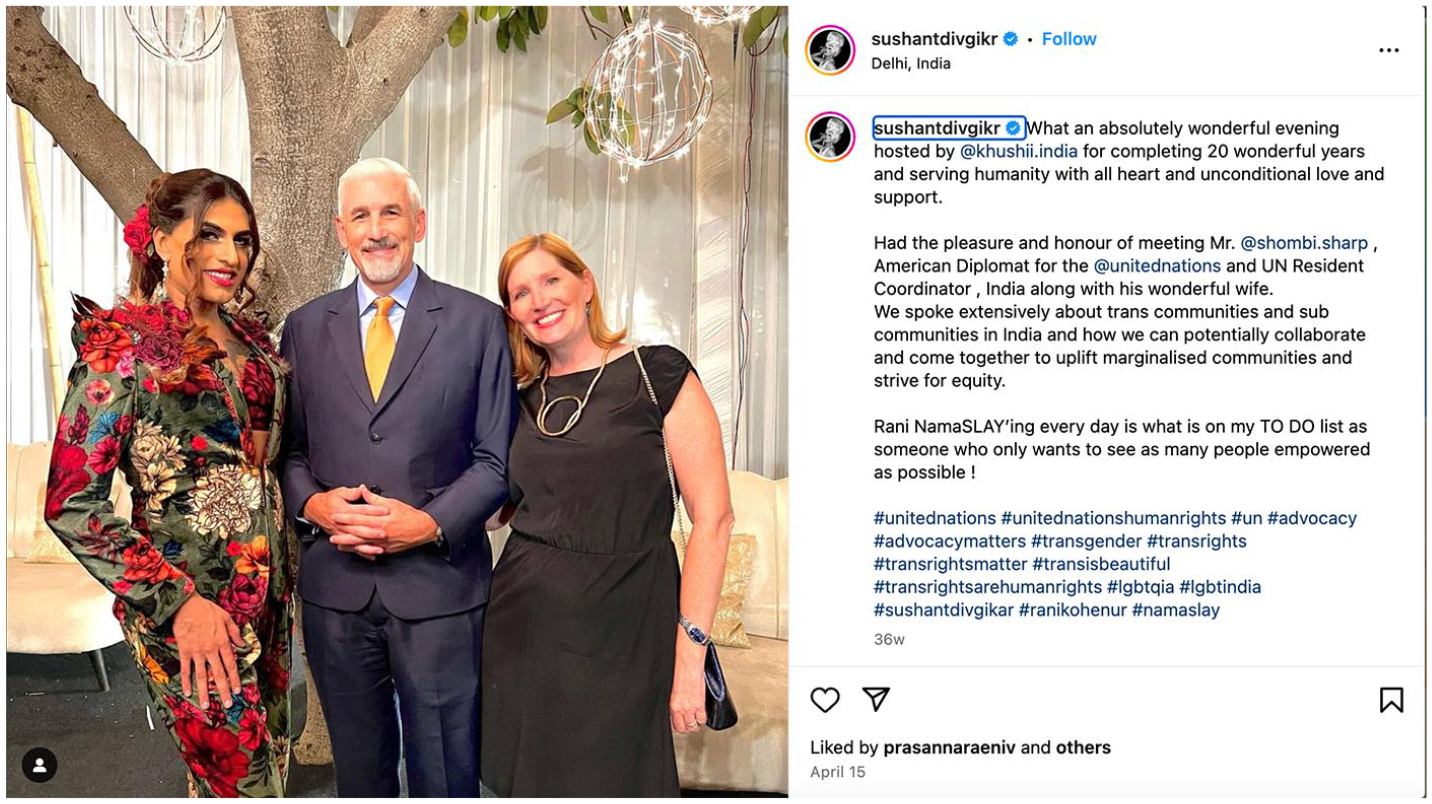
Screenshot of a picture of Sushant Divgikr with American Diplomat Shombi Sharp and his wife. The post’s caption depicts Sushant talking about the empowerment of the trans communities through such global endeavors.
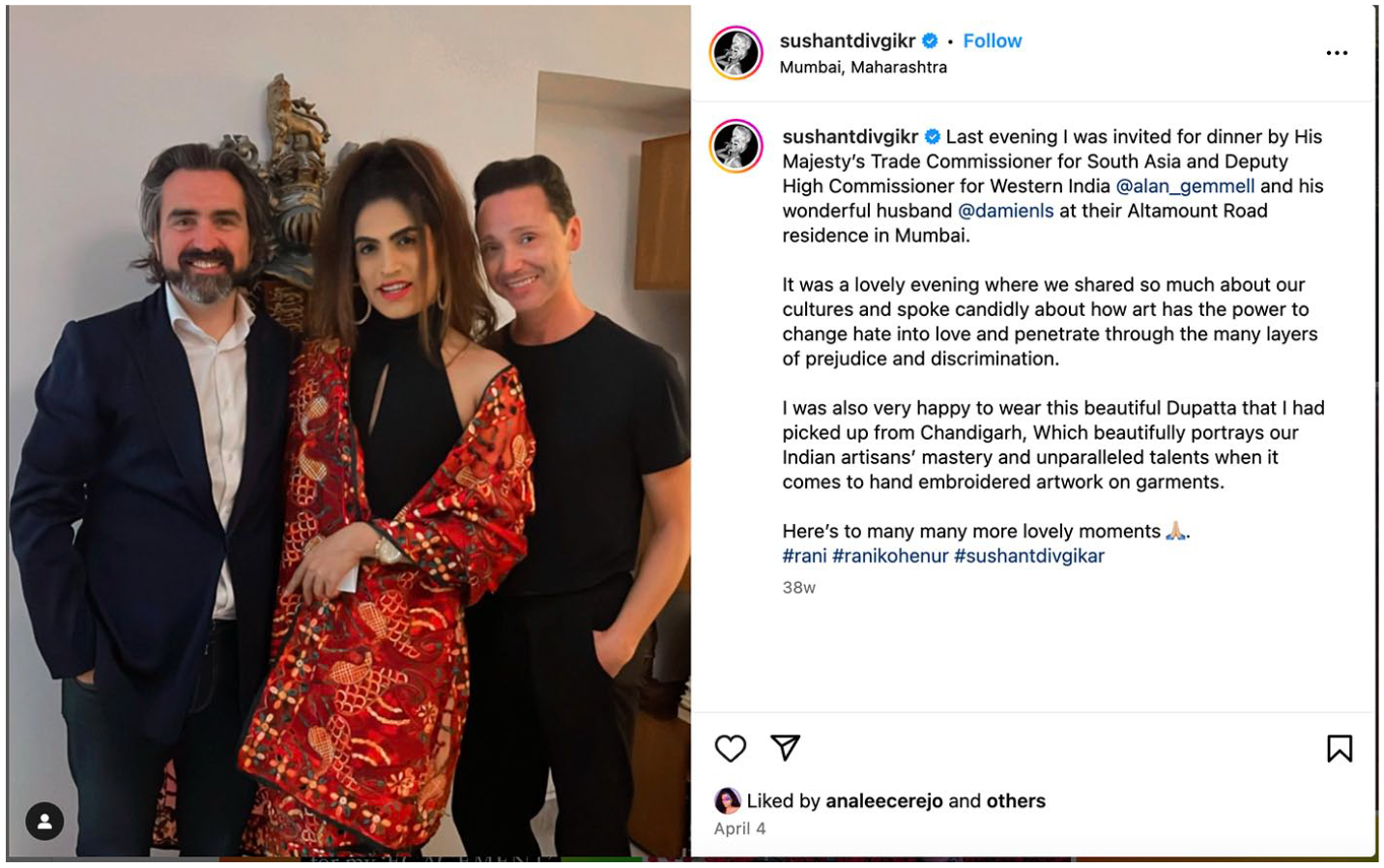
Screenshot of a picture of Sushant Divgikr with His Majesty’s Trade Commissioner for South Asia and the British Deputy High Commissioner for Western India, Alan Gemmell, and his husband. The caption of the post depicts Sushant talking about art and culture transforming humanity globally.
On the other hand, when influencers use tags (@xyz) to collaborate with international content creators, they often have indirect access to the follower networks. In other words, when they use tagging as an affordance to establish collaboration, they are not visible in the primary feed of their international partner. They are visible in the secondary feed, constituting posts where others have tagged the international partner. We define this as an indirect access of international networks of followers through collaboration. The content of these global South influencers reveals a desire to replicate the international and platform-normalized standards of representation and content creation on social media platforms. The engagement with these posts is mainly domestic, highlighting the primacy of local networks, offline realities, and cultural similarities in harnessing followership on social media. Domestic engagement, however, is critical because this gives the influencers a high follower count, which is crucial for staying ahead in the competition and getting noticed. Domestic engagement is the stepping stone for widening the reach to global audiences. Even when the influencer intends to performa global identity and invite international participation, their online experiences often foreground their local identities and realities.
The dominant logic of Instagram encourages collaboration among influencers and between influencers and audiences/followers. Let us look at the latter case. Influencers encourage their followers to use their content to build more content. For example, influencers will choreograph hook steps or create content, especially photos and reels, that the followers can reuse to produce more fan content. For example, the tagged sections on Sushant and Trinetra’s Instagram profiles include fan art and thank-you letters. Many followers have reused their photos and videos to create fan art/dedicated content or popularize issues that the influencers support – queerness, the LGBTQ community, and non-heteronormative gender identities – issues that are also globally relevant. The influencers also acknowledge the role of content created by their followers and how such engagement activities enhance their following and broaden their networks. Some influencers reshare the follower-created content or engage with it through their official handle to build momentum and sustain the popularity of their online profiles.
Templatization is also visible in their efforts to understand and acknowledge the significance of their local networks in building their image as conscious-minded celebrities online. The influencers mimic the visual esthetics enabled by the affordances of Instagram – fast-paced videos, quick cuts or transitions, and a sense of continuous movement. These videos/reels also use frequent slow-motion effects to establish the influencer’s awe. While these technical and editorial elements are similar across reels created by influencers, local artifacts rooted in local contexts and regional networks lend a distinct vibe and meaning that resonates with the consumption desires and aspirations of their local followers. For instance, in a short reel, Larissa D’Sa explores the Great Chamber in Kanab, Utah. It is a one-shot video captured by a trained/professional videographer. The reel is well-edited and well-timed, with a Bollywood soundtrack (local for most of her followers) in the background. The video opens with a close-up shot of Larissa walking up a slope and pans to an aerial view of the vast foreign landscape (presumably captured by a drone). The production style is format-driven; some of her reels include a countdown or a list format, prompting the followers to guess the destination, rate their favorite ones, select locations for their bucket list, offer recommendations, and participate in giveaway competitions (Images 7 and 8).

Screenshot of part 1 of the reel posted by Larissa D’Sa with a shot panning her visit to a chamber in Utah.

Screenshot of part 2 of the reel by Larissa, where the location zooms out and gives a full view of the chamber in Utah.
These standard formats are commonly observed across reels created by influencers from different cultural and national contexts. They are standard in that they are designed to harness the potential of social media affordances such as easy circulation, editability, collaboration, scalability, and replicability (Boyd, 2010; Treem and Leonardi, 2013). Even so, the visual and textual cues found the influencers’ association with their local followers. For example, in Larissa’s reels, even when the location or paid partnership is with foreign organizations and locations, she uses Bollywood songs as the background score for her content. She also localizes her content using regionally relevant hashtags such as #YedaYeditravels, #christmas, #indiatravelgram, and #indiantravelblogger. Another strategy that travel influencers use to localize their content is to continue creating content through collaboration with Indian branches of international companies (GoPro, Samsung) even when they are in foreign locations. Though they aspire to engage with foreign audiences and foster global image and connections, their local-national-regional networks and popularity enable them to monetize their content creation practices and creative labor on social media. As a result, they use templatization as a process to maintain the productive interconnections between local and global.
Cultural brokering
While templatization addresses how influencers communicate global issues through social media affordance usage to local audiences, the theme of cultural brokering explores how they communicate local realities to global audiences while retaining the interest and relevance of their content. According to Bhatia and Pathak-Shelat (2023), social media platforms initiate rapid cultural exchange without extensive or physical relocation or movement. Influencers and content creators deploy the social media affordance of networking and association to foster intermittent and incomplete contact between different cultures, nations, and lifestyles. This incomplete contact between their followers can spur the familiarization of their local networks to remote, foreign, or global cultures. Our findings suggest that influencers in the global South proactively position themselves and their social media engagement practices and content to broker 3 a space for the co-existence of different cultural values, lifestyles, and identities. Let us examine how Rohan Chakravarty (@green_humor), an environment-focused cartoonist with 151,000 followers on Instagram, creates online identity and content to broker connections between local realities and global issues. Rohan’s cartoons cover a wide range of global and local environmental issues – from discussions on restoring the population of local geckos in Union Island in the Caribbean, politics of discrimination and violence against environment activists in Columbia, to celebrating international days dedicated to rare animals such as Okapi from Central Africa and Kakapo in New Zealand (Images 9 and 10).
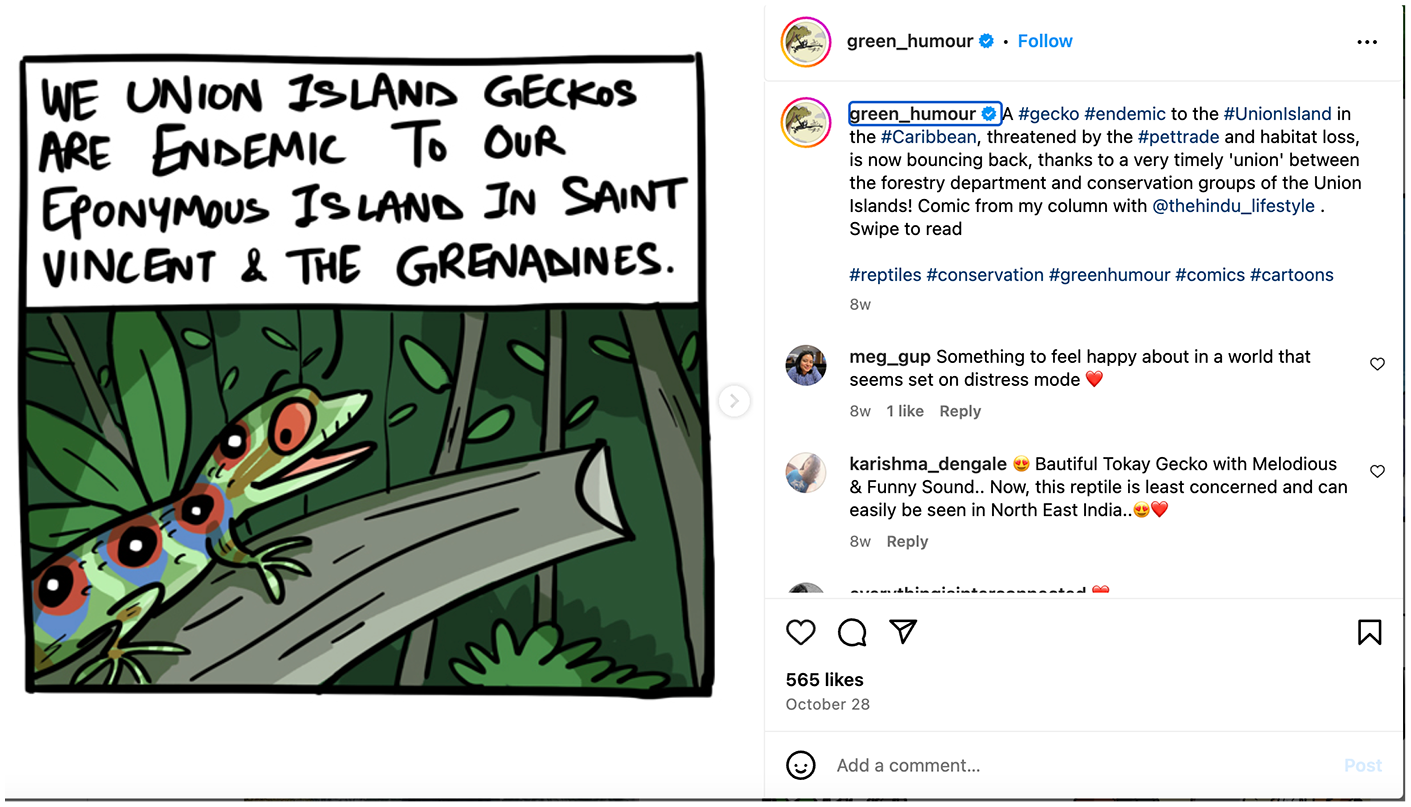
Screenshot of a comic by Rohan Chakravorty depicting the endemic species of Gecko.

Screenshot of a comic by Rohan Chakravorty depicting Okapi and Kakapo.
As a cultural broker, Rohan prints cartoons and comics of different and/or endangered species from different regions worldwide. He mainly sells merchandise with these prints to people in his local contexts and networks. He also publishes the content of his offline and global engagement about climate issues at international conferences. He uses a hashtag pool that establishes overlaps between the local climate issues in India and the impact of climate change in countries across the globe. Most of his hashtags for such globally relevant content include #climategrief, #ecoanxiety, #climateresilience, and #climate justice. These generic hashtags may enable Rohan to insert his content within a more extensive and international pool of discourses on climate and justice. However, these hashtags also reflect that Rohan prioritizes educating people in India about climate-related issues over establishing international networks.
Even then, his content and approach to representing climate issues on social media share similarities with the content and online engagement of other influencers, even from a different field. We argue that such similarities between content created by influencers across genres, modes, language, esthetics, and affect reflect the consistency of basic affordances that embedded creative labor on social media platforms. Another case in point is Larissa’s Instagram content and engagement practices. As a travel blogger, Larissa creates a lot of travel content on Instagram to introduce and educate her followers about cultural practices in different countries. From creating content about Fulehung – a cultural local event in Switzerland, celebrating the Onam festival in a Kasavu saree to exploring regional cuisines and restaurants in Vietnam, her Instagram profile is a site for cultural brokerage. Analyzing how she posts content reveals that she alternates creating posts covering her travel to foreign locations and her trips within India. She explicitly maintains a modern Indian persona – posting content demonstrating her Indianness and rootedness in local cultures and cities while indicating that she is in tune with global trends. Like Larissa, all the influencers explicitly identify as Indian on Independence and Republic Day. They wear tricolored clothes, use Bollywood songs on patriotism as background score, and produce a romanticized vision of living in India. Even as they negotiate the cultural differences in ways to create a synergy between local and global realities, they often present a sanitized or at least unidimensional understanding of the coexistence of cultures. Their content seldom engages with the politics of co-existence, such as implicit biases, discursive and corporeal violence, racism, and other discriminatory practices against the marginal/minority culture. For example, Larissa promotes herself as a “badass biker” – an empowered woman who rides a motorbike and is an avid traveler. She never discusses her positionality as a highclass and privileged woman who might not experience the same level of violence and safety issues as a middle-and-lower income woman traveler would. Also, when traveling in different countries, her content and online engagement practices do not hold space for such nuanced discussions on understanding the politics of different cultures, especially for women’s safety.
Similarly, Brinda is a travel influencer and discusses the benefits of traveling from the perspective of a high-class and privileged Indian woman. Her Instagram content does not consider the environmental cost of traveling and tourism, while she consistently promotes the significance of nature and our environment. We argue that social media influencers are predisposed to create content that is viral without being controversial. They do not want to create a niche network of followers or a particularly narrow interest-based community. Social media affordances use specific metrics of visibility, encouraging content creators and influencers to prioritize the logic of big numbers to capitalize on their online creative labor. When influencers deploy the logic of numbers, they focus on creating content that is easy to follow, share, and relate to by a wide range of viewers from both their local and global contexts. Engaging with nuances instead of enabling flat categories to flourish through their online content and engagement is counterintuitive to using social media to gain popularity, followers, and capital. Social media influencers in this study include cultural artifacts – signs and symbols, to represent their local cultural backgrounds and realities. Almost all influencers, for example, use the English script to communicate in Hindi with their followers. Using Hinglish (Hindi + English) is a communication strategy to ground their global experiences in their local identities. This communication strategy is used in different formats: writing the entire post and engaging with the audience in Hinglish, adding a sentence or two in a post drafted in English, and editing audios for reels with voiceovers in English. For example, Trinetra’s Instagram bio reads: “actor, doctor, trans, aurat (woman), vagairah (etc) (Images 11).”
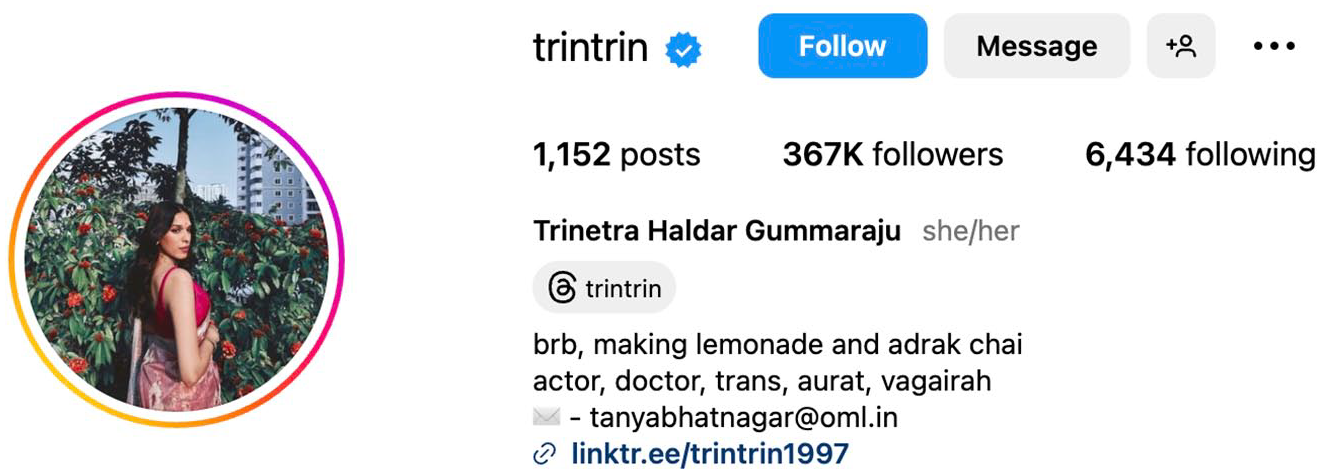
Screenshot of Trinetra’s bio on Instagram.
Similarly, while they used English/Hinglish for content related to local and global realities, they also curated audio segments for their reels representing the specific locations/cultures they visited or discussed. For example, when travel influencers visited a foreign country and created a series of reels and posts about the location, they often used songs and audio segments native to the culture they were discussing/representing in their content.
Finally, many influencers used overt signs and symbols to represent their local-regional and national identities. A critical observation across the social media profiles of Larissa, Sushant, Masoom, Trinetra, and Brinda is that all refer to their Indian identity in their content very often. Many include shots and photos of the Indian national flag, performing religious rituals during Indian festivals, and representing the local streets, towns, and cities in India through photoshopped photos and highly edited videos and reels. On the contrary, Rohan is a social media influencer and cartoonist, creating content that rejects flat categories and acknowledges nuances in discussions of local and global issues. Though his Instagram profile reflects that his content and engagement style are aligned with the dominant logic and use of social media affordances, he creates content that is primarily satirical, nuanced, and complicated enough to deny any binary categorization. He has curated his Instagram profile to engage with users with similar ideological values. Though he encourages diversity with regard to the cultural representation of climate justice debates across regional/local and foreign contexts, his epistemological orientation is fixed and invites participation from members who are driven by the same interests and values. Unlike other influencers who reinforce the affordance of circulation and create viral content, Rohan’s content encourages greater participation from a small community of like-minded and morally driven individuals. In other words, Instagram’s dominant logic of individualization does not always occupy the same space as an influencer’s desire to gather a large follower network. Sometimes, influencers tend to garner more attention from a globally dispersed small community if their content is issue-focused and niche (Images 1–14).

Screenshot of a comic by Rohan Chakravorty depicting the detrimental effects of GDP growth on the environment.
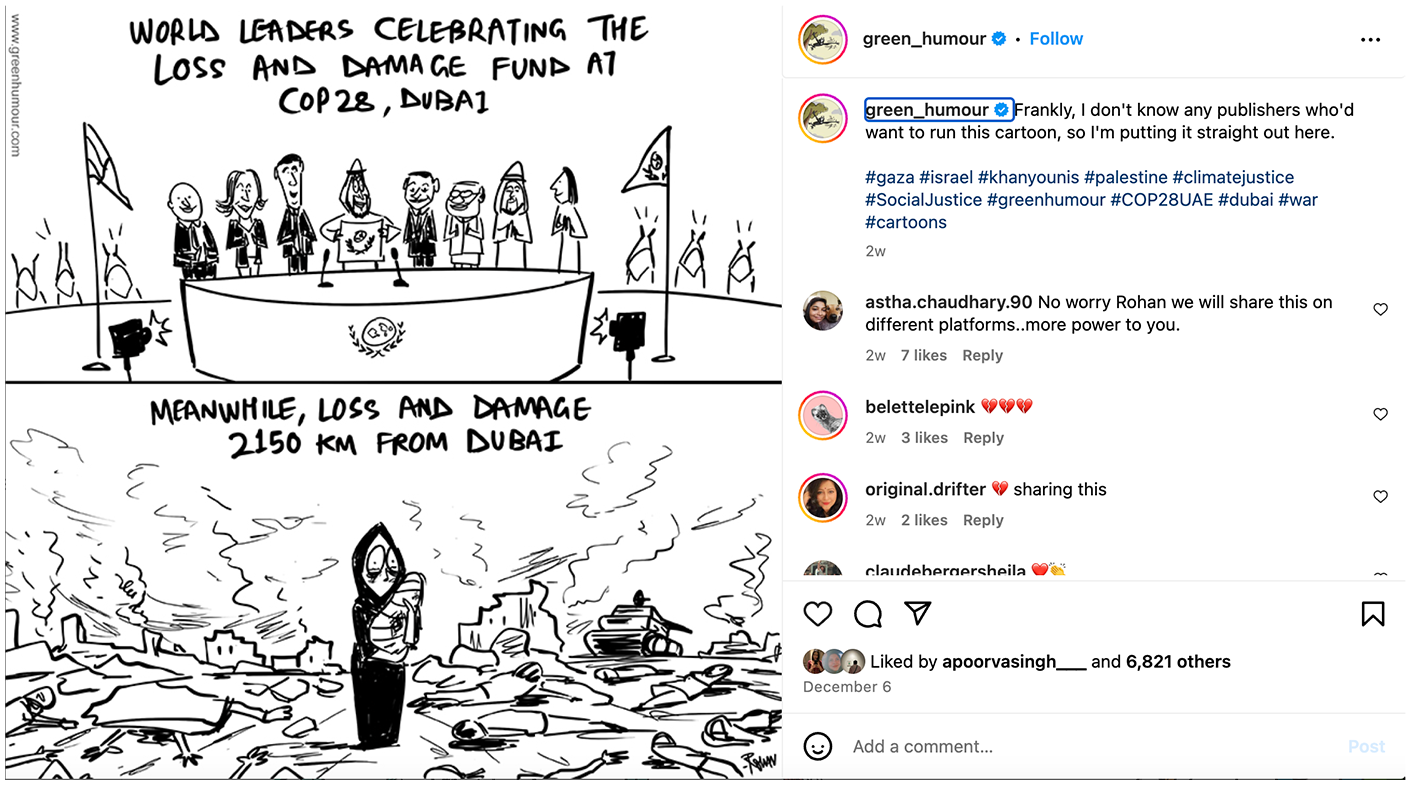
Screenshot of a comic by Rohan Chakravorty critiquing the complacency of global initiatives like COP28 by world leaders against the backdrop of the Israel-Palestine conflict.

Screenshot of a comic by Rohan Chakravorty drawing stark parallels between climate change and colonialism against the backdrop of the Native Hawaiian struggle for sovereignty from the US occupation.
To summarize how influencers create transcultural networks through social media affordances, it is essential to identify their content creation practices and online engagement activities. We observed that the influencers in this study used three core strategies (content +engagement) to nurture transcultural networks. First, they foreground their local identities – religious, cultural, and regional, while engaging with global cultural flows and users from across the world. Second, influencers create content representing how global cultural practices and aspirations materialize in their local contexts. Third, influencers communicate and articulate their local realities and identities globally even when they follow templates (formats, techniques, and processes) standardized due to Instagram’s affordances.
Conclusion
We studied social media content created by seven India-based influencers who position themselves as global influencers. We also examined samples of engagement by their domestic and global audiences with the content they post. Our article addresses two overarching questions: 1. How do influencers prioritize individualization and localization of media products while aligning their online practices with standardized logic, language, and formats of the social media platforms? 2. How do influencers create subjective and personalized online engagement possibilities while attracting and retaining audiences from foreign cultures and countries?
Our textual analysis prompted us to advance two dominant themes. The first is Templatization: Influencers and other creative laborers are compelled to abide by the norms and practices sustained by the platform ecosystem through specific affordances. These norms and practices are designed per the esthetics and cultural sensibilities of users from the global North and involve individualization, metricization, and constant algorithmic changes. The second theme is that of culture brokerage. We argue that influencers from the global South negotiate around the limits posed by the technical affordances and norms of social media to express digital vernacularity. In the process, they act like cultural brokers – between their cultural realities and those of their followers, between their subjectivity and the technical rigidity of the social media platforms, and between their global aspirations and the limitations of the digital platforms they inhabit. We observe that influencers who position themselves as global influencers make strategic choices to translate globally relevant issues to suit their domestic audiences. Domestic followers fulfil the demands of metricization by providing the strength of numbers, one of the crucial measures for influencer visibility. They again make different strategic choices for expressing their aspirations and local cultural realities while carving a niche as globally relevant influencers. We combine the affordance-based approach and a deep engagement with users’ agency to reveal these two sets of strategic negotiations.
Our research cautions against an over-celebratory perspective of the changed dynamics of the global cultural flows. While the influencers from the global South that we studied have found some success in reaching global audiences, they have to constantly negotiate with global North-centric design, norms, and practices. They are compelled to package their persona and content in forms that are unique and interesting enough to catch and sustain the attention of global audiences and, at the same time, templatized enough to remain palatable to them.
Footnotes
Funding
ORCID iD
