







Abstract
Keywords
Introduction
In the last decades diversity management has become a burgeoning field of research in management and organization studies (Bendl, Bleijenbergh, Henttonen, & Mills, 2015; Zanoni, Janssens, Benschop, & Nkomo, 2010). Diversity management refers to the specific programmes, policies and practices that organizations have developed and implemented to manage a diverse workforce effectively and to promote organizational equality (Nkomo & Hoobler, 2014; Prasad & Mills, 1997). Despite the popularity of diversity management, the effects of these practices are understudied, except for the numerical representation of marginalized groups in management ranks (Kalev, Dobbin, & Kelly, 2006; Nkomo & Hoobler, 2014). Organizations tend to implement similar practices such as mentoring programmes, diversity training and networks without much situational specificity. This suggests that there is little variation in diversity management practices as if ‘one size fits all’ (Benschop, Holgersson, Van den Brink, & Wahl, 2015; Foldy, 2002; Janssens & Zanoni, 2014). Additionally, most diversity management practices focus on single identity categories (i.e. women, ethnic minorities, LGBTs) without questioning the heterogeneity within these categories (Tatli & Özbilgin, 2012).
Critical diversity studies have called attention to the theoretical concept of intersectionality to consider multiple intersecting identities and to study them as complex and mutually reinforcing or contradicting processes (Acker, 2006; Holvino, 2010; Rodriguez, Holvino, Fletcher, & Nkomo, 2016; Zanoni et al., 2010). Yet, few of these insights have found their way into the research on diversity management practices in organizations. Most studies consider diversity categories as stand-alone phenomena, overlooking the role of intersectionality (Holvino, 2010; Tatli & Özbilgin, 2012). Hitherto, the theoretical implications of intersectionality for the practices of diversity management in organizations remain an uncharted terrain. This means that we lack knowledge on how the complexity of different identity categories, inequalities and their intersections impact diversity management practices.
To address this gap, our study focuses on diversity networks as exemplars of present-day single category diversity management. Diversity networks are in-company networks intending to inform and support employees with similar social identities (Foldy, 2002) and a widely popular practice in organizations (Benschop et al., 2015; Kaplan, Sabin, & Smaller-Swift, 2009). We will focus on answering the research question:
Our paper is based on a multiple case study in two Dutch organizations, a financial service organization and a governmental service organization. These organizations accommodate different diversity networks, i.e. women’s networks, ethnic minority networks, LGBT networks, disability networks and young employee networks. We use the concept of structural intersectionality to analyse how network members negotiate their multiple identities vis-a-vis their membership of diversity networks. The concept of political intersectionality enables us to explore the political strategies of diversity networks to build coalitions across identity categories.
With our intersectional analysis of diversity networks, we contribute to the literature on diversity management practices by highlighting how dynamic processes of privilege and disadvantage play a role in the preservation of single identity categories. Organizational inequalities cannot be dismantled separately because they entail multiple intersecting identities that mutually reinforce each other. We argue that the notion of structural intersectionality challenges inequalities in single category diversity networks by revealing subordination as well as hitherto silenced privileges. By introducing political intersectionality, we reveal a politics of preserving privilege in diversity networks that obscures the intersection of different forms of inequality.
Theoretical Background
Diversity management practices: one size fits all?
Despite the proliferation of diversity management, we still know little about which diversity management practices are most effective, and moreover in which organizational settings and contexts (Bendl et al., 2015; Janssens & Zanoni, 2014; Zanoni et al., 2010). Scholars have highlighted that many organizations retain their diversity management practices from the previous century without much reflection on how little progress has been made (Nkomo & Hoobler, 2014). One possible explanation for the limited progress might be that diversity management practices remain firmly entrenched in identity-based initiatives aimed at increasing the number of historically marginalized social groups in organizations (Kalev et al., 2006; Nkomo & Hoobler, 2014). Consequently, the majority of the research on diversity management practices typically concentrates on the effectiveness in terms of numerical outcomes of these identity-based practices such as diversity training, mentoring programmes and networks. This predominant focus on single identity categories (i.e. gender, race, ethnicity) as stand-alone phenomena (Tatli & Özbilgin, 2012) is underpinned by an inaccurate assumption of a certain similarity of various categories of difference (Zanoni et al., 2010). For example, in research addressing gender inequality and the advancement of women, women are often considered as a single, homogeneous group. As such, current studies on diversity management practices fail to theorize the heterogeneity within identity categories. Single identity approaches ignore the complex reality of multiple differences and inequalities (Nkomo & Hoobler, 2014; Tatli & Özbilgin, 2012). For example, Kalev et al. (2006) showed that diversity management practices work out differently for various groups of employees in US organizations: while white women significantly benefitted from networking programmes, black women do not, and black men are even disadvantaged by these programmes.
Since the mid-1990s, studies with a more critical perspective on organizational diversity management have emerged (Nkomo & Hoobler, 2014; Prasad & Mills, 1997; Zanoni et al., 2010). Critical diversity scholars took issue with the fixed, predefined, essentialist notions of identity categories and developed an understanding of diversity and identities as ‘socially (re)produced in on-going, context-specific processes’ (Zanoni et al., 2010, p. 10). Individuals always have multiple identities that intersect in various ways through time and space. Yet, thus far, intersectionality has not been studied in relation to diversity management practices in organizations. Apart from critical diversity studies, the diversity management literature has been ‘almost deaf’ to the realities of multiple identities and their intersections (Nkomo & Hoobler, 2014, p. 255). In this paper, we will take into account multiple identity categories by applying an intersectionality lens to study single category diversity networks.
Intersectionality in organizations
Intersectionality can be defined as the interaction between multiple categories of difference (Davis, 2008; Holvino, 2010). Kimberlé Crenshaw (1989) first coined the term ‘intersectionality’ in her law study on discrimination against black women. According to Crenshaw (1989), these women were not discriminated against because they were women, nor were they discriminated against because they were black, they were discriminated against because they were black women. Crenshaw (1989) used the concept of intersectionality to help scholars think about different identities and how these identities possibly collide in ways that are not understood by focusing on single identity categories. Within black feminist scholarship, intersectionality was used to critique feminist research for a lack of consciousness of the experiences of women of color, who unlike white women are neither white nor economically privileged (Crenshaw, 1991; Holvino, 2010). Feminists of color criticized the essentialism inherent in the dominant liberal white feminist paradigm that defined women as a homogeneous group (Holvino, 2010; McCall, 2005). Counterbalancing this paradigm, the introduction of intersectionality made way for the recognition of differences among women and, moreover, for a more comprehensive understanding of the effects of other identity categories on women’s identities, experiences and struggles (Holvino, 2010).
Since Crenshaw (1989) introduced the term, intersectionality has become a thriving concept (see, inter alia, Collins & Bilge, 2016; Cho, Crenshaw, & McCall, 2013; Davis, 2008; Hancock, 2007; Holvino, 2010; McCall, 2005; Nash, 2008; Rodriguez et al., 2016; Yuval-Davis, 2006; Zanoni & Janssens, 2015). While it was first used to pinpoint and explore the intersections between gender, race and related processes of disadvantage, intersectionality today is used in a broader sense considering the intersections between various other categories, i.e. class, religion, age, sexual orientation, disability and occupational status (e.g. Atewologun & Sealy, 2014; Boogaard & Roggeband, 2010; Bowleg, 2008; Essers & Benschop, 2007; Kelan, 2014; Mik-Meyer, 2015).
Although the importance of intersectionality is widely recognized, intersectionality remains at the margins in management and organization studies and does not live up to its full potential to explore structures of inequality in organizations (Rodriguez et al., 2016). The majority of organizational scholarship adopts a structural intersectionality perspective and focuses on the individual experiences of people with multiple (mostly disadvantaged) intersecting identities (e.g. Adib & Guerrier, 2003; Essers & Benschop, 2007). A political intersectionality perspective on the other hand is less prevalent. Responding to the call by Rodriguez et al. (2016) for more systemic analyses of intersectionality in management and organization studies, our study draws on both structural intersectionality and political intersectionality to gain insight into how diversity networks and their members deal with multiple intersecting identities.
Structural intersectionality
Structural intersectionality refers to how the experiences of people within a particular identity category are qualitatively different from each other depending on their other intersecting identities (Cole, 2008; Crenshaw, 1991). Structural intersectionality thus focuses on the
In this study, we use the concept of structural intersectionality to analyse how diversity network members negotiate their multiple identities vis-a-vis their membership of diversity networks.
Political intersectionality
Crenshaw (1991) introduced the concept of political intersectionality to indicate how inequalities and their intersections are relevant to policies and political strategies of groups of people who occupy multiple subordinate identities. As strategies on one axis of inequality are almost never neutral towards other axes, political differences are most relevant (Verloo, 2006). Political intersectionality allows us to move away from the individual level of analysis and to theorize about identity categories as ‘axes of multiple inequalities’ (Cole, 2008, p. 450) that mutually define, shape, and reinforce one another. For example, using political intersectionality, Crenshaw (1991) shows the political struggles of women of color whose concerns were neither addressed by feminist movements nor by antiracist movements. Crenshaw (1991) argues that ‘the failure of feminism to interrogate race … will often replicate and reinforce the subordination of people of color, and the failure of antiracism to interrogate patriarchy means that antiracism will frequently reproduce the subordination of women’ (p. 1252).
Especially in the field of management and organization studies, there is a lack of theoretical consideration of political intersectionality (see Verloo, 2009). Intersectionality scholars such as Carastathis (2013), Cole (2008) and Verloo (2006) have demonstrated the potential of this dimension of intersectionality. Political intersectionality allows us to take into account how intersectionality is important for organizational policies and how social identity groups organize themselves between two or more political agendas or movements. According to Crenshaw (1995), ‘any attempt to mobilize identity is a negotiation, a discussion among those in identity groups to put forth an agenda that fully recognizes the various political interests, conflicting though they may be, that exist within identity categories’ (p. 12). She proposes to reconceptualize social identity groups as ‘potential coalitions waiting to be formed’ (p. 1299). This requires an emphasis on common experiences and political strategies, highlighting the possibilities of working together across multiple categories of difference (Carastathis, 2013; Cole, 2008). Cole (2008) uses political intersectionality to illustrate how different social identity groups succeed in building successful coalitions based on their shared marginalized positions. An example of such a coalition is the organization of the 2004 March for Women’s Lives in the United States. The initial idea of the march was to demonstrate in favor of (predominantly white) women’s rights to abortion. Eventually, the focus of the march was broadened beyond abortion rights, including the reproductive concerns of women of color as well (Cole, 2008).
Thus, the concept of political intersectionality offers a unique opportunity to study diversity networks as ‘potential coalitions waiting to be formed’. We conceptualize diversity networks as possible coalitions and we analyse the political strategies of diversity networks to build coalitions for equality across single identity categories.
Methodology
Research design
Studying intersectionality empirically is challenging. A proper intersectional methodology should be able to take into account ‘the methodological murkiness’ (Nash, 2008, p. 5) and ‘the complexity that arises when the subject of analysis expands to include multiple … categories of analysis’ (McCall, 2005, p. 1772). McCall (2005) addresses these methodological challenges by introducing three approaches to study intersectionality. First, the anticategorical approach that completely rejects the use of categories. Second, the intracategorical approach that focuses on one single identity category and analytically unravels the influences of other categories. And third, the intercategorical approach that focuses on the relationships between multiple categories (Kelan, 2014; McCall, 2005).
Previous studies of structural intersectionality predominantly take an intracategorical approach. Most studies use narratives and interviews to explore the lived experiences of individuals at the intersection of multiple identities (e.g. Adib & Guerrier, 2003; Essers & Benschop, 2007). Empirical studies on political intersectionality are few and rely mainly on historical case studies and documents (e.g. Carastathis, 2013; Cole, 2008; Verloo, 2006). As political intersectionality focuses on the dynamics of both difference and sameness, it allows analysing
In this study, we rely on a qualitative methodology to thoroughly investigate structural and political intersectionality. We conducted a multiple-case study with different diversity networks as our cases (see below). A case study facilitates the analysis of complex and little understood phenomena (Eisenhardt & Graebner, 2007; Yin, 2009) and is well suited to examine the ‘how’ and ‘why’ of intersectional dynamics in real-life organizational contexts. Compared to a single-case study, a multiple-case study yields a broader and more comprehensive exploration (Eisenhardt & Graebner, 2007) of intersectionality in diversity networks.
Cases and data collection
We collected our empirical material in ten diversity networks in two Dutch organizations, a financial service organization and a governmental service organization. We selected these organizations because they are well known for their diversity management, and because they accommodate various diversity networks. We briefly introduce the two organizations and the ten networks studied.
The first organization is a financial service organization (Finance), situated throughout the Netherlands. Finance has six different diversity networks: a network for women in senior management positions (‘Women at the top’), a network for women in middle management positions (‘Ladies with ambition’), an ethnic minority network, an LGBT network, a disability network and a young employee network (age 18–35). The networks are organized nationally, are officially recognized by the organization and receive financial support. The second organization is a large governmental service organization (Govt). The diversity networks of Govt are organized on a national level as well as on local levels. In this study, we focus on four diversity networks that are organized nationally: a women’s network, an LGBT network, a disability network and a network for ‘young’ employees (all ages; employees can join if they support the ideas of this network).
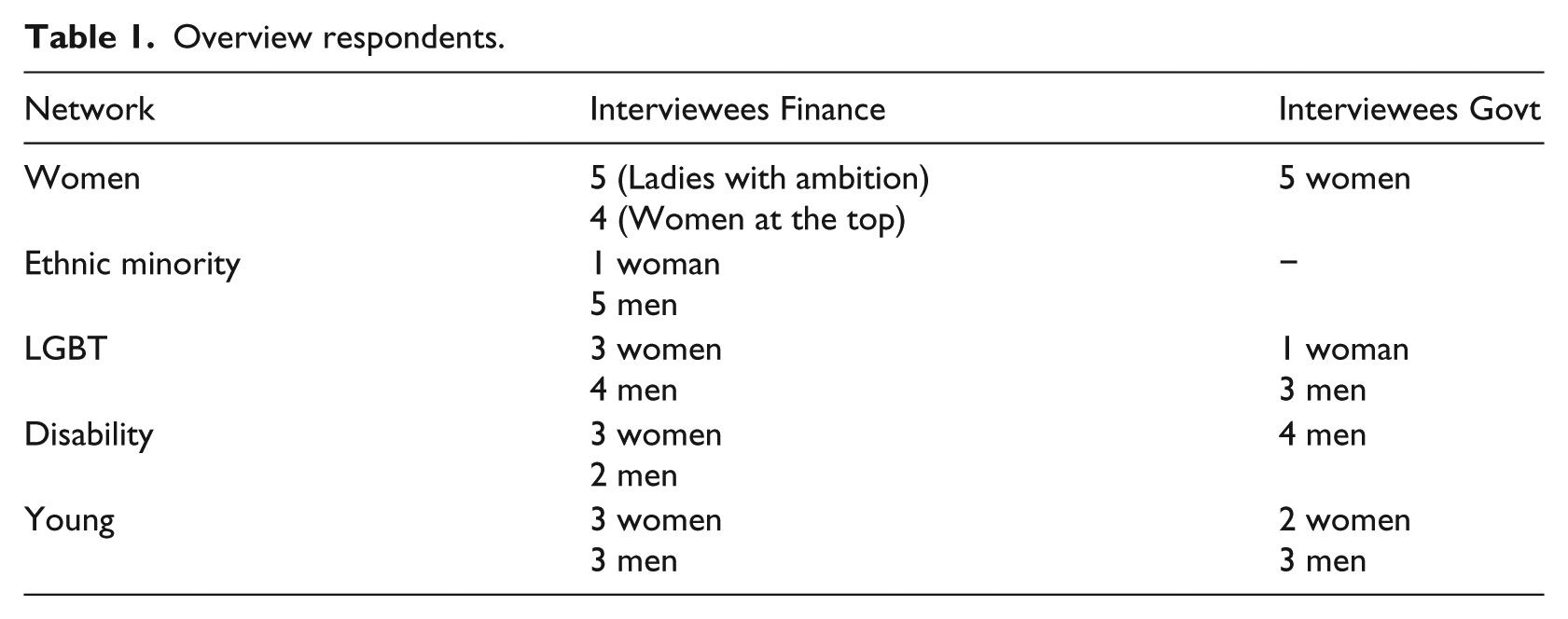
The first author conducted 51 in-depth semi-structured interviews with active network members, 33 interviews in Finance and 18 in Govt (see Table 1). Interview questions dealt with topics such as the network’s history, goals and activities, members’ motivations to join a particular diversity network, whether and why they joined multiple networks, and if and how their networks collaborated with other networks. The interviews were conducted in Dutch, lasted between 45 minutes and two hours, were tape-recorded and transcribed verbatim. As well as interviews, the first author observed 46 network meetings that presented a total of 145 hours of observation. These observations yielded additional insight into the negotiations and coalition building between diversity networks. Examples of network meetings are: board meetings where network leaders discuss their course of action, ‘cross-network’ meetings between multiple networks, and collaborative network events. Last, we analysed documents such as annual plans and meeting minutes which contained information about the collaboration between different networks and the network’s perspective on multiple identities (or the lack thereof).
Overview respondents.
Data analysis
Our data analysis relies on an abductive approach, going back and forth between theory and empirical material (Van Maanen, Sørensen, & Mitchell, 2007). Our focal data consisted of the interview material, as interviewees are able to thoroughly reflect on their identities, their network membership and the interaction between networks. Observation notes and documents not only allowed for triangulation, but also complemented the interviews to build a more accurate account of political intersectionality. By attending network meetings, we were able to observe how members talked about coalition building and collaborating with other networks, and how their collaboration worked out in actual events. The documents provided information about whether networks plan to work together and whether members discuss collaboration and coalition building during meetings that were not attended by the first author.
We started our data analysis by reading through all our empirical material. We identified the fragments that made some reference to multiple identity categories. In doing so, the data were reduced to those fragments that involved multiple identities in networks. This selection resulted in the material that is central to this paper. We noted how little awareness there is with regard to multiple identities in networks. Only a minority of fragments referred to the intersections of multiple identity categories explicitly.
Next, we made a distinction between fragments that related to structural intersectionality and fragments that related to political intersectionality. The following analytical questions guided our analysis:
(1) With regard to structural intersectionality: where do individual network members talk about their multiple identities; how do they talk about their multiple identities in relation to diversity network membership; and
(2) With regard to political intersectionality: where do diversity networks collaborate or talk about collaborating; what does this collaboration entail; what hampers collaboration?
This helped to identify patterns in identity negotiations related to membership of multiple networks (structural intersectionality) and in collaboration and coalition building between different diversity networks (political intersectionality).
The patterns related to structural intersectionality involved three different strategies regarding how individual network members dealt with the single category structure: complying with the single category structure, problematizing the single category structure as an individual problem, and challenging the single category structure. By categorizing these strategies, we noted how the single category structure of diversity networks was linked to processes of privilege and disadvantage. We therefore turned to the literature on privilege and derived the analytical concept of intersectional marginalization; i.e. the marginalization of people with multiple subordinate identities relative to those with a single subordinate identity (Crenshaw, 1989). By looking at the role of privilege and intersectional marginalization in diversity networks, we noted a pattern of systematic exclusion of members with multiple disadvantaged identities and analysed this as the dynamics of structural intersectionality in diversity networks.
Analysing the patterns related to political intersectionality, we noted how interviewees mentioned that collaboration between diversity networks was desirable, yet actual collaboration did not occur or remained limited. Our observation material and documents allowed us to connect what was said in the interviews to what actually happened during network events and meetings. We observed that also during events multiple identity categories and their intersections were not addressed. When collaboration did occur, this was limited to categories that are similar, such as a collaborative event organized by two women’s networks. Even during meetings between different diversity networks, the focus was largely on sharing information rather than actual collaboration and coalition building. This realization led us to delve deeper into why collaboration remained limited. Our attention was drawn again to the single category structure and the processes of privilege and disadvantage. To understand these dynamics, we returned to the literature on privilege and political intersectionality. Going back and forth between the theory and the data, we identified a business case rationale for diversity networks and a politics of identity. To understand this business case, we invoked the concept of the ‘Oppression Olympics’; i.e. a competition between disadvantaged groups to prove themselves as the most oppressed (Hancock, 2007). Our analysis of political intersectionality revealed a reversed ‘Oppression Olympics’, where diversity networks tend to emphasize their added value to the organization, ignoring disadvantage and oppression.
In our findings section, we present a selection of instances of structural and political intersectionality. These instances were not chosen because of their statistical representativeness, but rather ‘in light of their evocative content, their ability to highlight the complexity and richness of experience’ (Poggio, 2006, p. 230). To secure anonymity, pseudonyms are used for respondents. Table 2 provides additional data.
Additional data and supporting quotes.

Reflection
As qualitative researchers, we are aware that the presence of the first author, who is a white, heterosexual, able-bodied woman, may have influenced the data obtained through both the observations and the interviews. For example, as observer, the first author would blend in during an event of the women’s network or the young employee network. Also, during interviews with LGBT network members, the sexual orientation of the interviewer became salient when interviewees reflected on their lived experiences in a heteronormative society. As our interpretations of the empirical material are influenced by our own intersectional identities, extensive discussions among the authors helped to nuance certain interpretations and made us aware of processes of privilege and disadvantage.
Findings
In this section, we explore various ways in which structural and political intersectionality shed light on the complex reality of multiple identity categories in relation to diversity networks. We analyse how network members talk about their multiple identities, collaborating with other diversity networks and the tensions that arise when doing so.
Structural intersectionality: identity negotiations of individual network members
Identity negotiations take shape in the decision to join one or multiple diversity networks. Although all our respondents are potential members of multiple networks, only a minority actually joins multiple networks. To elaborate on structural intersectionality, we have selected three interview fragments that represent three different strategies of how individual network members negotiate their multiple intersecting identities in relation to diversity networks.
Complying with the single category structure
We introduce our first fragment from Sonya. She is an ethnic minority woman and a member of both the ethnic minority network and the women’s network ‘Ladies with ambition’ in Finance: The [ethnic minority network] is very much to empower and to connect and uh, well network uh, to create a network and coming together and talking about it and just … That is important too, you know … a safe haven, because there is diversity, but that you belong somewhere … Because then you have the support of like-minded [people], it is about that. That you feel part of a larger whole and feeling supported by that. That you do not feel like a Don Quixote, fighting against the evil outside world, no, there are others that also feel the same as you do and so maybe have the same struggles as you have. … I get a lot of support from that … [The women’s network] is more concrete. So a women’s network, we have a more concrete goal. That is just more women at the top. So it looks the same: more culturally diverse colleagues at the top, but it is not one-on-one translatable, because cultural diverse does still have to win a whole terrain of uh, support. Uh, in acceptance.
Sonya is one of the few respondents who joined multiple networks and she explicitly distinguishes between the importance of membership of the ethnic minority network on the one hand, and the importance of membership of the women’s network on the other hand. According to Sonya, next to developing a network and making social connections, membership of the ethnic minority network is especially important for the support of ‘like-minded’ people, a safe space (‘haven’) that gives people a sense of belongingness. Sonya says that she received much support by sharing her struggles, that she compares to the struggles of ‘Don Quixote against the evil outside world’. Membership of the women’s network, on the other hand, is important for career purposes: getting more women in higher organizational positions. Although Sonya acknowledges that the same holds true for ethnic minority employees in higher organizational positions, she states that it is not the same issue.
As an ethnic minority woman, Sonya negotiates her multiple identities by joining two different networks, but without mentioning possible intersectional dynamics between them. She talks of ‘struggles’ but refers to the struggles of ethnic minority employees as a category, without mentioning the struggles of ethnic minority women specifically. For women issues one joins the women’s network, and for ethnic minority aspects one joins the ethnic minority network. As such, Sonya goes along with the categorization created by diversity networks and complies with the single category structure.
Problematizing the single category structure as individual issue
Our second fragment is from Alice. Alice is also a member of multiple networks: the disability network and the LGBT network in Finance.
I have to say that at a certain moment … that I thought I go to the [disability network], … and we indeed have a gay network … that I thought at a certain moment, do I have to choose now in which group I fall? … Let’s say that I enter the Moroccan network, and I enter with my wheelchair, I am the exception there again. And if I enter the gay group with my wheelchair, then I have the same. And that is quite difficult sometimes, because I think … you go in because you are gay, but in the meantime, I am also that disabled that enters there. And well … you cannot prevent it, but you do have the feeling a little bit that you have to choose.
In contrast to Sonya, Alice problematizes the network’s structure and displays a personal discomfort with regard to the focus on single categories. Reflecting on which network to join, Alice feels that she has to choose between diversity networks. Alice’s account illustrates that the single category networks leave little room for the intersection of multiple subordinate identities. As diversity networks revolve around one subordinate identity category, other identity categories and their intersections are overlooked. For instance, the central category within the LGBT network is LGBT, and the subordinate position of LGBT employees is their key focus. LGBT employees are regarded as a homogeneous category and possible differences within this particular category are neglected. Due to the network’s focus on one single identity, Alice feels the odd one out and an exception by being ‘the disabled’ in the LGBT network, or ‘the lesbian’ in the disability network.
Alice’s quote exemplifies that the single category structure has implications particularly for network members with multiple subordinate identities, such as for example disabled lesbian women. This resonates with what Crenshaw (1989) has termed ‘intersectional marginalization’, i.e. the marginalization of multiple subordinate identities. Network members with multiple subordinate identities are marginalized relative to members with a single subordinate identity and, as a result, possible tensions arise. Instead of questioning the single category structure of diversity networks, Alice takes the structure for granted and makes her discomfort a personal issue rather than a network issue.
Challenging the single category structure
Our third fragment is from Selma, a member of both the women’s network ‘Ladies with ambition’ and the ethnic minority network in Finance. Whereas Alice’s strategy is to take up the experienced tension with the single category structure as a personal issue, Selma questions the network itself. Instead of internalizing the problem, Selma challenges the single category structure of the women’s network: I have a bicultural background myself too, so I think that is very important as well … I once started with the [ethnic minority] network … and I noticed that when I moved to gender, that my purpose was also … not only to support women and to help them in their ambition, but also cultural, with a cultural background. … And I think I fulfil a double role. If you have a women’s network, an event, then you have more biculturals as well. So how can you have both, let’s say striking down two flies with one swing.
Selma calls attention to the intersection of gender and ethnicity within the women’s network. Instead of joining multiple networks and complying with the single category structure, she points at how ethnicity is relevant for members of the women’s network. As we have seen with Alice, focusing on one single identity category, networks overlook the differences within that particular category. Within the women’s network the main focus is on the category ‘gender’: We have very consciously, have said there is still so much to do about only the piece of gender, let’s focus on that. … We [women] still have to go a long way. … People coming from foreign countries, with foreign backgrounds, since they have, do have other problems. (Ruth, women’s network, Finance)
Ruth is an ethnic majority woman and a member of the women’s network ‘Ladies with ambition’. This quote from Ruth illustrates that the women’s network is focusing on gender issues only. Referring to ethnic minorities as ‘people’, Ruth ignores ethnic minority women within the women’s network. As such, Ruth’s account reflects underlying notions of white privilege, centralizing ethnic majority women in the women’s network. A significant aspect of privilege is that it is unmarked; privilege is so universally normalized that it literally goes without saying for those who are privileged (Ferber, 2012; McIntosh, 2012). The power of whiteness is so embedded in organizations (Puwar, 2004), that consequently, white privilege is difficult to name and denaturalize (Liu & Baker, 2016). Because of her privileged ethnic majority identity, Ruth is not able to see beyond the single category of ‘women’. In contrast, Selma, with multiple subordinate identities, is able to vocalize the need for an intersectional perspective within the women’s network. Instead of taking the single category structure for granted, Selma challenges the women’s network to pay attention to multiple intersecting identities (ethnic minority women).
Our analyses of structural intersectionality have provided insight into the strategies of individual network members to negotiate multiple intersecting identities in relation to their membership of diversity networks. Whereas Sonya seemingly complies with the single category structure of diversity networks, Alice and Selma problematize the network’s focus on single identity categories. While Alice feels her distress is an individual struggle, Selma makes her intersectional identity struggle a political endeavour and challenges the structure of the network to take multiple intersecting identities into account. Our analyses showed how these identity negotiations are intertwined with positions of privilege and disadvantage. Within diversity networks, privileged categories such as maleness, whiteness, heterosexuality, able-bodiedness are silenced and assumed as the self-evident norm. Thus, by ignoring intragroup differences, the single category structure of diversity networks reinforces privilege. Network members with single subordinated identities and intersecting privileged identities are normalized, whereas members with multiple subordinate identities are intersectionally marginalized.
Political intersectionality: coalition building between diversity networks
Using the concept of political intersectionality, we shed light on how diversity networks attempt to build coalitions between multiple identity categories. Our analysis shows, however, that coalition building is challenging and actual collaboration between diversity networks remains limited in both organizations. Despite the low level of actual collaboration, networks articulate a strong rhetoric of wanting to work together: collaboration between different diversity networks is desirable and something to strive for. Our data suggest that the networks’ rhetoric of ‘we should collaborate’ is predominantly motivated by instrumental objectives.
[The LGBT network] has been active much longer, they are pretty well organized nationally, so they have a subsidiary too, so annually they can organize [events]. I did some networking with them, … you have to be clever like that. Look, they do have some money. (Fran, women’s network and LGBT network, Govt) So you have different [disability networks] … who are all individually kicking towards the organization. That is not really organized, coordinated. Sometimes you have the same interests. Of course, sometimes you do not. It would be nice actually if you could let those [disability networks] exist, all with their own issues, because all have their own problems, but with for example a meeting with all chairs, so there is a representative nationally for the HR side and management. Because … management will go crazy if we all going to do that individually. (John, disability network, Govt)
The accounts of Fran and John illustrate that collaborations between diversity networks are important in gaining resources. Fran realizes that her own women’s network and the LGBT network maintain different positions. She thinks strategically about the collaboration with other networks and taking advantage of their financial resources. Additionally, according to John, building coalitions is valuable in order to have a better chance of receiving organizational support: allegedly, a coalition of different disability networks would have a stronger claim on getting the desired attention from the management.
Next to instrumental objectives, diversity networks also refer to possible coalitions that are valuable for mutual learning experiences.
I think that we as networks within [Finance] should gang together much more. In the sense of, you can learn so much from each other. There have been so many battles. That for example the women, the gays and the disabled have had as well. (Mo, ethnic minority network and young employee network, Finance)
According to Mo, different diversity networks within Finance should collaborate more. He sees the potential for possible coalitions and considers these coalitions to be valuable for mutual learning experiences, particularly with regard to inequality. He compares the ‘battles’ of the ethnic minority employees to the battles of the women, the LGBTs and the disabled, who are all disadvantaged groups.
We observe that diversity networks draw on the rhetoric of collaboration, yet, actual collaboration remains limited. Our observation material shows that in the very few cases that collaboration does occur, it concerns similar networks, like a joint event organized by two women’s networks, or recurrent meetings between various disability networks. We observe that the level of ambition is low and coalitions largely revolve around instrumental issues. When diversity networks attempt to collaborate across multiple identity categories, or focus on more fundamental issues such as organizational inequalities, coalition building turns out to be challenging and complex.
Reversed Oppression Olympics
Our analysis of structural intersectionality revealed processes of privilege. Privileged categories are taken for granted and considered as the self-evident norm, while members with multiple subordinate identities are marginalized. Our analysis of political intersectionality shows that these processes of privilege also impact the coalition building between diversity networks.
In my opinion, from the organizational [perspective], the [young employee network] is the most important: the future of the [organization]. The other networks are there, but less important. (Michelle, women’s network and LGBT network, Finance)
According to Michelle, the young employee network is considered as the most important network within Finance. Young employees are constructed as talented employees that make a valuable contribution to the organization (see Dennissen, Benschop, & Van den Brink, 2018). The prominent status of the young employee network points at a certain hierarchy or ‘pecking order’ (see Tatli & Özbilgin, 2012). The first place in this implicit pecking order is assigned to the young employee network, which provides them with a privileged position. Both in Finance and in Govt, they appear the preferred coalition partner for other diversity networks. However, the young employee networks are hesitant to build coalitions with diversity networks that represent more disadvantaged groups.
In general, networks were [like], we are disadvantaged and we want … we want to put ourselves more onto the map. … They [other networks] wanted something from the [organization], while we were like we want to contribute to the [organization]. And that is the big difference between [the young employee network] and other networks. Except that … I think the [LGBT network] also really contribute. … Imagine you [have an LGBT-related issue] … Then you really have a contribution, added value to the [organization] and I think that is important within a network. You should not only disadv-, or not only saying that … hold out your hand [for money], [because] ‘we [disadvantaged networks] want to do something nice with our club because we are already disadvantaged’. (Tim, young employee network, Govt) [There] were multiple moments when those other clubs with us, uh … wanted to sit together and then make some sort of statement together. We never felt really … [their] approach was more about complaining and we did not want that. We saw ourselves more as a change club, that was doing positive, creative things. (Hannah, young employee network, Govt)
The accounts of Tim and Hannah illustrate that the young employee network is not very willing to collaborate with other diversity networks that represent ‘disadvantaged’ groups. According to Tim and Hannah, the goals of the young employee network and the goals of the ‘other’ diversity networks differ. They state that the young employee network wants to make a positive contribution to the organization. With the exception of the LGBT network, the ‘other’ diversity networks are seen as complaining and trying to gain something (e.g. financial resources, facilities) from the organization. By doing so, Tim and Hannah construct a dichotomy between diversity networks that are adding value to the organization versus diversity networks that are disadvantage-centred. Only diversity networks that are making a contribution to the organization are considered valuable and worthwhile, a line of reasoning well known as the business case (Zanoni et al., 2010). Previous intersectionality research highlighted a competition between disadvantaged groups to prove themselves as the most oppressed. Hancock (2007) has termed this competition the ‘Oppression Olympics’. However, we observe that diversity networks tone down oppression in order to be considered as a valuable coalition partner to the organization as if they are partaking in a reversed ‘Oppression Olympics’.
We are not a crybaby-club, so it should not be about, ‘jeez what are we piteous and you have to help us’, no: we are a club that says, well, we can mean something to the organization. (John, disability network, Govt) I want to initiate a [network] based on strength, a network-club, a knowledge-club, rather than ‘we have a few pathetic boys that sit in the corner and we need to get them out of there’. (Peter, LGBT network, Finance)
These quotes illustrate the networks’ emphasis on strength, knowledge and their positive contribution to the organization, rather than on pity and disadvantage. Diversity networks that are critical towards the organization, that want to make a statement or ask for facilities, are considered as complaining and whining. In the reversed Oppression Olympics, diversity networks emphasize their added value to the organization and tend to deflect attention to any kind of oppression. As such, organizational critique with regard to the inequalities that disadvantaged groups have to deal with, is constructed as a complaint and downplayed. By means of the reversed Oppression Olympics of diversity networks, organizational inequalities, disadvantage and privilege are silenced.
Identity politics
Besides the revelation of a reversed Oppression Olympics, our analysis of political intersectionality has also drawn attention to the impact of identity politics. ‘Identity politics’ refers to the articulation of political beliefs in the name of a particular social group, claiming a certain political stance (Bickford, 1997). Being organized around a single social identity, diversity networks exercise identity politics in organizations. We illustrate the impact of these identity politics by presenting our analysis of an attempt towards collaboration and coalition building between the LGBT network and the ethnic minority network in Finance.
A possible topic could be homosexuality and being an [ethnic minority], that is of course a sensitive topic, especially in the Muslim world. Uh, for example, how do Muslims [within the organization] deal with uh, if they see people that are openly gay or … that sort of things. How do you, or if you are gay yourself and you are Muslim, what kind of problems are there? Do they not dare to, uh … come out of the closet? Because, what if a family member would find out, that sort of thing. Maybe we could have made a theme about that. But that has not happened thus far. (Evan, LGBT network, Finance)
Evan addresses the disadvantaged positions of both ethnic minorities and LGBTs and makes the connection across diversity networks by mentioning possible interests they would have in common. Although Evan attempts to find a common ground among members of the LGBT network and the ethnic minority network, tensions arise when a potential collaboration between the LGBT network and the ethnic minority network is getting more explicit: With the [ethnic minority network] we looked into a joint theme for organizing an [ethnic minority]-LGBT event. The [ethnic minority network] was not that enthusiastic about choosing a gay theme specifically for the whole event. It could be more general and meant to network, like drinks. For them, networking is their main goal, not questioning themes. Next year we as [network] board want to sit around the table with the [ethnic minority network] to see how we can organize a joint event. Even if it would be drinks, it enhances the acceptance of LGBTs among members of the [ethnic minority network] in a way that is without obligations, without dedicating a theme with a keynote speaker to it. (Annual plan, LGBT network, Finance) If you look at the gaybian and [ethnic minority] network, then actually that is an interesting combination, because in certain cultures it is even harder to be open about your sexual orientation, so we have been brainstorming about that; what could you do with that? But I am afraid that if we organize a joint event that it will especially involve the gaybian members and a large part of our members to a lesser extent. So that is a bit difficult. (Joe, ethnic minority network, Finance)
Although the LGBT network would like to address the struggles of ethnic minority LGBT employees, the ethnic minority network is portrayed as less enthusiastic. Joe’s excerpt shows that a coalition between the ethnic minority network and the LGBT network is seen as relevant and interesting. According to Joe, there are similar issues that members of both networks struggle with, especially members with intersecting ethnic minority-LGBT identities. Nevertheless, Joe also displays his doubts about a joint event that would only cater for the ethnic minority-LGBT members, and not for the ‘majority’ of non-LGBT members of the ethnic minority network. Hence, a broader, less controversial theme, just drinks or networking are suggested as alternatives for a joint event.
By narrowing down the relevance of an LGBT-related theme to only those members with LGBT-ethnic identities, homosexuality is reduced to an issue of a small minority of network members rather than a matter of the organization at large. Instead of challenging organizational heteronormativity – i.e. the portrayed norm of heterosexuality within organizations and society (Wildman & Davis, 1994) – the ethnic minority network enacts heterosexual privilege by choosing to remain silent about LGBT issues. Interestingly, they are silent about whiteness as well. An LGBT-related theme is the only theme that emerges when discussing a possible collaboration between the LGBT network and the ethnic minority network. Whiteness, either in relation to the LGBT network or to the organization, is not addressed. This reflects an identity politics that is preserving the privileged identities, in this case, the ethnic majority in the LGBT network and the heterosexual majority in the ethnic minority network. It is the privileged majority of the network who sets the agenda according to their interests. This does not include interrogating processes of privilege, heteronormativity and whiteness in the organization.
Our analysis of political intersectionality highlighted how diversity networks deal with the complex reality of multiple identities and their intersections. In theory, all diversity networks agree that ‘they should collaborate’. However, in practice, actual collaboration and coalition building is shown to be difficult and challenging. We showed how a politics of privilege, i.e. a reversed Oppression Olympics and identity politics, creates tensions between diversity networks that hamper collaboration and coalition building. Moreover, due to these politics of privilege, diversity networks fail to address the dynamics of multiple inequalities in organizations.
Discussion
The aim of this paper has been to further our knowledge on diversity management practices by applying an intersectionality lens to single category diversity networks. Thus far, the theoretical implications of intersectionality for organizations’ diversity management practices remained an uncharted terrain. Current studies on diversity management practices fail to theorize the heterogeneity within identity categories. Analysing diversity networks as exemplars of current single category diversity management practices through an intersectionality lens, we developed a better understanding of how single category diversity networks sustain intersectional inequalities in organizations. This allowed us to contribute to the theory on diversity management practices in two ways. First, we identified the dynamics of structural intersectionality in diversity networks, theorizing how these single category networks are inextricably linked with processes of privilege and disadvantage. Second, by introducing the notion of political intersectionality, we gained a better understanding of how diversity networks are hindered by a politics of preserving privilege rather than interrogating it. We conclude our paper with the implications for diversity management practices in organizations.
Dynamics of structural intersectionality in diversity networks
Our first contribution pertains to the identification of the dynamics of structural intersectionality in single category diversity networks. We have shown three possible strategies regarding how individual network members dealt with the single category structure of diversity networks. These strategies illustrate how single identity categories are taken for granted and almost hegemonically accepted. It becomes difficult to question the single category structure, and the vast majority of network members goes along with the categorical organization of diversity networks. Even though some members display their concern with how diversity networks are organized, this is constructed as an individual issue rather than a structural problem. Very few network members try to make room for their multiple identities within diversity networks and actually challenge the single category structure. When single category networks go as unchallenged as they do, multiple intersecting identities remain obscured. This is a dynamic that normalizes the idea of separate identity categories and facilitates the continuous avoidance of the complexity of intersectionality in diversity networks.
With the dynamics of structural intersectionality, we show how single category diversity networks are inextricably linked with processes of privilege and disadvantage. Hitherto, the single category structure of diversity networks has informed research that only examines the impact on disadvantaged identity groups. The predominant focus on disadvantage and oppression leaves the role of privilege underexposed and unmarked (Tatli & Özbilgin, 2012; Verloo, 2009). In line with privilege studies (see Ferber, 2012; McIntosh, 2012), our study shows that network members with multiple subordinate identities vocalize the need for intersectional perspectives, whereas network members with single subordinate identities tend to remain unaware of the privileges that go with their other identities. Network members with single subordinate identities eschew issues relating to other identity categories because they believe that these issues fall within the scope of other networks. Ethnic majority women of the women’s network, for example, suggested that issues relating to ethnicity ‘belong’ with the ethnic minority network, further reducing their responsibility and involvement in this issue.
Theorizing the simultaneous processes of privilege and disadvantage in diversity networks helps us to explain the ambiguous results from previous studies. The single category structure of diversity networks obscures the role of unmarked categories of privilege and reinforces the exclusionary effects of intersectional marginalization: the marginalization of people with multiple subordinate identities relative to those with single subordinate identities (Crenshaw, 1989). This sustains the taken-for-grantedness of privileged categories as well as the fixed and essentialist notions of disadvantaged categories (Pratto & Stewart, 2012; Tatli & Özbilgin, 2012). As Grillo (1995) pointed out: ‘in every set of [identity] categories there is not only subordination, but also its counterpart, privilege’ (p. 18). Our contribution to these insights is that the notion of structural intersectionality can challenge inequalities in single category diversity management practices by revealing subordination as well as hitherto silenced privileges.
Political intersectionality: revealing the politics of preserving privilege
Concerning our second contribution about the introduction of political intersectionality in diversity networks, we show how diversity networks are hindered by a politics of preserving privilege rather than interrogating it. The intersectionality literature has used the notion of political intersectionality to examine the policies and political strategies of disadvantaged groups and social movements (Carastathis, 2013; Crenshaw, 1991; Verloo, 2006), but the theoretical elaboration in diversity management practices lags behind. It may seem that diversity networks are potential allies in combatting inequalities in organizations, yet their collaboration has been seriously understudied, with the exception of Scully (2009) and Colgan (2016) who highlight a few examples of networks working together. The concept of political intersectionality allows us to highlight the rhetoric of beneficial collaboration and shows how actual collaboration between diversity networks is fraught with problems.
We argue that the single category design of networks hinders collaboration to address diversity and inequality in organizations. Our study has provided the first theoretical insights into how diversity networks take part in a
Theorizing political intersectionality in the study of diversity networks helps us to further unpack the identity politics of diversity networks and to understand how their political standpoints and actions promote their network’s interests. We highlight how networks’ identity politics shape which inequalities are and are not addressed within the networks. Collaboration between networks would entail prioritizing interests of a minority of the network members at the alleged expense of majority members. An example was the failed collaboration between the ethnic minority and the LGBT networks, because of the perceived limited appeal of an event to the non-LGBT ethnic minority members. This corroborates Crenshaw’s point that ‘identity politics tend to give privilege to the narratives of those in dominant categories … and the ways those narratives construct [the] primary agendas about what first to deal with’ (Crenshaw, 1995, p. 5). Various scholars have criticized identity politics for its adverse effects in fostering exclusion (Bendl, Fleischmann, & Walenta, 2008; Verloo, 2006; Yuval-Davis, 2006) and we also observe this in diversity networks. The politics of preserving privilege in diversity networks obscures the intersection of different forms of inequality and leaves the inequalities along other axes of difference intact. We contribute to the literature on diversity management practices by highlighting how business politics and identity politics play a role in the preservation of single category structures. Organizational inequalities cannot be dismantled separately because they entail multiple intersecting identities that mutually reinforce each other. This means that, as long as diversity networks remain single-category focused, they cannot incorporate structural and political intersectionality and do not work successfully to change the status quo in organizations.
Implications for future research and diversity management practices
In this study, we have shown how the focus of diversity management practices on disadvantage and single categories has failed to capture the role of privilege in maintaining and (re)producing the status quo. The implications of structural and political intersectionality require new ways of studying and practising diversity management. Diversity is not a single category issue and diversity is not only about disadvantage. Both scholars and practitioners have overlooked the political dimension of diversity management in organizations. Due to the focus on the business case, disadvantage and inequality have become the elephant in the room in many organizations. Our analysis of single category diversity networks may serve as a starting point to challenge how diversity management is organized and to address the role of hitherto silenced privileges. Here, we offer some final reflections for future research and practice.
In the light of the political nature of diversity management, it is essential that practitioners gain an understanding of organizational processes of power and privilege. Addressing diversity as a business case might legitimize organizational diversity management but obscures the social justice side of diversity and in the long run systemic inequalities persist. To (re)design diversity management practices that can take into account intersectionality and multiple inequalities, a close collaboration between scholars and practitioners is needed. This collaboration helps to develop diversity management practices that go beyond the business case (Tomlinson & Schwabenland, 2010) and to better assess how diversity management practices impact processes of power and privilege that sustain and (re)produce inequalities. As Verloo (2006) notes, practices on one axis of inequality are almost never neutral to other axes. A close examination and awareness of the simultaneous processes of disadvantage and privilege would enable diversity researchers and practitioners to explicitly address and interrogate them.
Furthermore, our findings suggest that it is also important to involve privileged members of historically marginalized groups in diversity management practices. Although addressing privilege will not be an easy task, starting these conversations is indispensable to advance awareness of intersectionality, intersectional marginalization and the implications for equality and social justice (Atewologun & Sealy, 2014). Drawing on Scully, Rothenberg, Beaton and Tang (2017), the concept of ‘privilege work’ might be helpful. Privilege work entails an ongoing reflection on one’s privileged status as well as the relationship to the underprivileged (Scully et al., 2017). Such reflections may raise the awareness of privilege, the acceptance of being privileged, and, moreover, the process of owning up to privilege (Scully et al., 2017). For example, engaging in privilege work, ethnic minority networks and LGBT networks might be able to organize a collaborative event that addresses both white and heterosexual privilege in the organization. A refocus on privilege may not only reduce the tendency to assign diversity management practices to historically marginalized groups, but also challenge the heterogeneity within these groups.
Last, the politics of privilege might also reflect wider socio-political structures. Social norms of the privileged have become generalized normative expectations for marginalized groups (McIntosh, 2012), not only in organizations, but also in society at large. As Rodriguez et al. (2016) noted, ‘intersectional analyses should not be confined to organizational practices … but also identify transnational practices and processes that construct and reconstruct marginalization and privilege in other societal spaces’ (p. 211). As this study has been conducted in the Dutch context, a comparative study on intersectionality in relation to diversity networks in different national contexts would provide a more comprehensive understanding of the importance of the wider socio-political structures within those contexts.
Putting intersectionality into practice will be a ‘long-term thorny endeavor’ (Benschop et al., 2015, p. 569; Rodriguez et al., 2016). Our study on structural and political intersectionality in single category diversity networks suggest that the complexity of multiple identity categories, inequalities and their intersections requires ongoing reflection processes. Especially our introduction of political intersectionality is promising in this respect, as it addresses how inequalities and their intersections are relevant to organizational policies. Rethinking diversity management to build on reflective and critical perspectives with attention to structural and political intersectionality will open up possibilities towards more effective diversity management practices that foster organizational equality.