







Abstract
Keywords
Since shopping malls originated in the Western economies that have different socio-economic contexts, mall developers in the developing Asian markets should have endeavoured to understand the concept of a mall and related shopping behaviour before institutionalizing it in the local markets. This needed compatible modifications in the format, structure, and mall-mix (Singh & Bose, 2008). However, modifications did not happen in case of shopping malls in India. During the early 2000s, the market witnessed emergence and growth of large integrated retail format (Singh & Prashar, 2014). With practically no malls until 1997, a sudden surge in supply of mall space continued unabated until the global recession of 2008–2009. Multiple malls were planned in a single catchment area in many Indian metropolitan cities, leading to clustering of malls in a locality. Most of these malls were identical as they replicated the Western malls and ended up being clones in terms of location, layout, and tenant-mix (Singh & Prashar, 2014). The Indian developers only added lavish exteriors. All this led to encroachment on each other’s catchment area and target shoppers, resulting in an unviable business (Prashar et al., 2015).
The Indian economy was integrating with the global order. Witnessing swift and fundamental changes in the cultural milieu, Indian shoppers were evolving and shaping expectations by blending global standards with local needs. It was soon realized that most of the malls were not delivering what was specifically expected (Tsai, 2010). The majority of the mall developers did not even know ‘what the Indian shoppers need?’ (Singh & Sahay, 2012).
This study aims to decipher the expectations of Indian mall shoppers besides identifying the variables that predict the mall selection behaviour, as manifested through loyalty. It is assumed that if developers know the expectations of mall shoppers, they shall plan and/or modify their service-mix judiciously. The shoppers, in turn, are likely to reward customer-centric malls by preferring them to other malls by repeated visits.
Existing studies related to mall selection have used framework such as stimulus–organism–response (SOR) or structural equation modeling (SEM) as a technique (Runyan, Kim, & Baker, 2012; Shim & Eastlick, 1998; Wakefield & Baker, 1998). However, these studies are prominently restricted to the identification of cause–effect relationship between select antecedent variables and shoppers’ mall selection behaviour. The predictability of preference among shoppers for a particular mall has not been investigated. To address this gap, the following research objectives were identified: (a) predicting loyalty for a particular mall using artificial neural network (ANN) technique; and (b) analysing the relative significance of various determining variables that influence mall selection behaviour of shoppers.
REVIEW OF LITERATURE
Organizations’ marketing processes and actions revolve around the concept of customer loyalty. This includes loyalty towards the firm, brand, service, dealer, and store (Dick & Basu, 1994). Existing literature on loyalty pivots around understanding it through behavioural as well as attitudinal measures (Kahn, Kalwani, & Morrison, 1986; Massey, Montgomery, & Morrison, 1970). Few studies have examined customer loyalty in premise of shopping malls (Majumdar, 2005). As per studies such as LeHew and Fairhurst (2000), Lowry (1997), and Stoltman et al. (1991), shopping in a mall is a relative choice phenomenon. In their study, Dick and Basu (1994) have recognized shopping experience as an important determinant of mall loyalty. Expecting to generate more footfalls and shoppers’ traffic, mall managers endeavour to provide an enhanced shopping experience by creating suitable mall ambience, varied mix of stores, attractive sales promotions, and relative economic gains.
Extensive literature review on shopping experience reveals a vast gamut of antecedent factors that influence shoppers’ preferences for a specific mall. Pioneering the study on examining the correlation between patronage towards a mall and mall characteristics such as size and distance, Huff and Rust (1984) provided a formula for forecasting mall patronage based on the cost (accessibility) versus utility (size). It was observed that the size of a mall is an important variable that influences shoppers’ mall selection behaviour. Craig, Ghosh and McLafferty (1984) emphasized the importance of the location of the store studies such as Baker and Haytko (2000) and Reimers and Clulow (2009) examined and elaborated the importance of the distance of shopping mall from home.
Babin, Darden and Griffin (1994) posited that shoppers derive value, only when they perceive ‘being provided with complete shopping experience’ and not just ‘selling them goods and services’. Hence, it becomes pertinent for mall managers to create a total shopping experience for visitors. This holistic shopping experience comprises of all defining factors that determine shoppers’ choice of a specific mall (Kerin, Jain, & Howard, 1992). Upon experiencing this value, shoppers’ likelihood of store patronage increases. Furthering this, Csaba and Askergaard (1999) highlighted the significance of adaptation of shopping experiences. Applying the concept of entertainment in malls, Kim, Jikeyong and Minsung (2005) noted that by using it as a differentiating strategy, mall managers aim at increasing footfall share. Accordingly, since there exists association between elements of entertainment and shoppers’ behaviour, managers must identify the attributes and characteristics of malls that make shopping enjoyable and entertaining for consumers.
Expanding the concept of convenience, researchers have also taken other dimensions into consideration: availability of benches in malls (Venkateswarulu & Uniyal, 2007), ease of locating shops (Wakefield & Baker, 1998; Ward, John, & Mary, 1992), utilities such as water and restrooms (Oppewal & Timmermans, 1999), and number of lifts available for vertical circulation (Singh & Prashar, 2014). In an Indian setting, Venkateswarulu and Uniyal (2007) established the significance of parking space available at a mall. Similarly, availability of open space and wide corridors has also been found to be critical in mall selection (Ward et al., 1992). Srivastava and Kaul (2014) noted a positive influence of convenience and social interaction on both customer experience as well as customer satisfaction.
A vast literature on shopping experience in malls revolves around retail store elements referred to as atmospheric factors. These include store display, lighting, music, aroma, temperature, and other ambient factors. Many studies have observed a correlation between these retailer-controlled factors and shoppers’ buying behaviour. Donovan and Rossiter (1982) noted that while store selection is influenced largely by cognitive factors, emotional response is induced by in-store environment that determines the extent to which shoppers might spend beyond their planned list. Wakefield and Baker (1998) noted a positive relationship between malls’ attributes such as music, lighting, temperature, design, architecture, stores, restrooms and entertainment, and shoppers’ predisposition towards a mall. Mattila and Wirtz (2001) also confirmed the effect of individual atmospheric variables such as in-store aroma and music on shoppers’ behaviour and patronage intentions. With 38 variables related to mall characteristics, Kim et al. (2005) developed a framework to illustrate the relationship between antecedent factors and shoppers’ selection of mall. In all, these variables can be grouped into nine categories: layout of stores and facilities within a mall; design and architecture of mall, façade, and other physical elements of a mall; extra facilities such as medical care, restrooms, etc.; shoppers’ mood enhancing cues such as lighting, aroma, etc.; courtesy and friendliness of mall employees; options for exit (getting out of mall); exhibition and display of products, new arrivals, and offers; music and restaurant options; and facilities for vertical and horizontal movement within the mall. A combination of these influences the shoppers’ overall experience in a mall.
Recently, Zhang et al. (2011) observed that shoppers’ perceptions about the products’ value are moulded by the mall atmospherics, which has an influence on their emotional responses and behaviour. Many studies have used specific variables constituting mall ambience, which have been identified as significant influencers of shoppers’ mall loyalty and patronage behaviour. These include: temperature (Wakefield & Baker, 1998), cleanliness (Oppewal & Timmermans, 1999), pleasant odour (Kim et al., 2005; Lunardo, 2012), lighting (Hui & Bateson, 1991; Spangenberg, Grohmann, & Sprott, 1996), and background music (Prashar, Parsad, & Vijay, 2015a; Ward et al., 1992). Babin, Hardesty and Suter (2003) observed the impact of various colour and light combinations on shoppers’ reactions and their perception towards patronizing the mall. Similarly, Broekemier, Marquardt and Gentry (2008) noted that happy (or sad) music influences consumers’ purpose directly while shopping.
Factors adding to malls’ marketing focus have also been extensively studied. Ward et al. (1992) considered store interior design as an important determinant and studied its influence on shoppers’ feelings and their intentions to revisit. This was further substantiated by studies such as Oppewal and Timmermans (1999) and Wakefield and Baker (1998). Singh and Prashar (2014) identified attractive appearance of a mall (façade) to be a significant variable in influencing shoppers’ perception towards mall. In their study on new malls in the UK, Kirkup and Rafiq (1994) concluded that development of strong, unique, and reliable tenant-mix is vital for the success of a shopping centre.
Studies such as Frasquet, Gil and Molla (2001) and Warnaby and Yip (2005) have observed that shoppers tend to get attracted by special events and promotional schemes organized by a mall. Mall managers must differentiate between promotions that drive sales versus promotions that drive visits and show possible combinations that would be effective in generating optimum customer behaviour (Parsons, 2003).
Safety and security inside a mall also is a significant theme impacting shopping behaviour (Wakefield & Baker, 1998). While studying perceived value of shopping malls, Frasquet et al. (2001) included personal security as an important variable. Overstreet and Clodfelter (1995) noted that customers put greatest value on mall activities that address their safety outside the shopping centre. This might include posting of security personnel and surveillance cameras outside the venue. Jackson, Stoel and Brantley (2011) also noted ‘safety of a mall’ to be an important attribute towards selection of the mall. In a study conducted among Indian mall shoppers, Singh and Prashar (2014) posited that commitment and preparedness of a mall management in handling acts of terrorism, strength of related infrastructural facilities in the malls, etc., are significant inputs for shoppers in deciding for a mall. Availability of fire extinguishers and emergency escape provisions are other important variables influencing Indian shoppers’ patronage behaviour (Singh & Prashar, 2014; Venkateswarulu & Uniyal, 2007).
There exist numerous studies pertaining to management issues of organized retail stores and shopping malls. However, these studies are limited to developed economies such as the US, the UK, and Europe, where the phenomenon of a mall has matured. There are very few studies that have explored developing markets like India. Undertaking research in the Indian context, Kuruvilla and Ganguli (2008) have noted that managing factors such as good infrastructure, customer tastes, tenant-mix, leasing practices, and rental rates can improve relationship between mall developers and retail shop owners. Tripathi and Siddiqui (2008) examined the correlation between service environment and mall shoppers’ re-patronage intention using analytical hierarchy process. Accordingly, a mall’s servicescape constitutes of elements such as the interior of a mall, social dimensions, internal displays, and exterior facility.
Swaminathan and Vani (2008) examined shoppers’ perception and attitude towards shopping malls and highlighted 15 variables that had an influence on shoppers’ attitude. Venkateswarulu and Uniyal (2007) identified a set of variables that describes consumers’ intent to patronage a shopping mall. Chattopadhyaya and Sengupta (2006) posited that shopping malls with clear and distinct positioning had higher customer patronage.
It is evident from the extensive literature review that the studies have focused on identifying the causal relationship between the variables and mall selection. However, none of the studies have attempted to predict shoppers’ mall selection behaviour and determine the relative significance of these antecedent factors. It is important here to differentiate the two terms: causation and prediction. Shmueli (2010, p. 291) defined causality as ‘the application of statistical models to data for testing causal hypotheses about theoretical constructs’. And predictive modelling has been defined as ‘the process of applying a statistical model or data-mining algorithm to data for the purpose of predicting new or future observations’. Based on these distinctions, it can be clearly seen that causation (explanatory modelling) deals with testing for causality by forming various hypothesis about the relationship between the variables. On the other hand, prediction does not deal with hypothesis formulation and identification of associated relationship. It aims to observe the data and predict the future outcomes based on the data (Shmueli, 2010). All the earlier studies in the field have identified the causal relationship and none of them have attempted to predict shoppers’ mall selection behaviour. This was the motivation for the authors to undertake this study.
The researchers explore the predictability of selection of a mall using a non-linear compensatory technique on select antecedent factors and identifying the relative significance of these variables. We propose that the model developed using neural network technique would be a valuable tool for mall developers in predicting shoppers’ mall selection behaviour.
Select Variables Used for the Study

PREDICTIVE MODELLING: ARTIFICIAL NEURAL NETWORK TECHNIQUE
Predictive models define rules for forecasting the values of one or more elements in a data set (outputs), using the values of other elements in the data set (inputs). Developed over the years, these modelling methods use procedures that have been established by various methodological researches in the areas of statistics, pattern recognition, and machine learning. To analyse mall shoppers’ data, we have used ANN technique in the present research. This technique was developed as generalized outcomes of mathematical models of human cognition through biological neurons. It is considered as an information processing system that has certain performance characteristics in common with human neural biology. This technique uses a number of simple processors linked together to ‘learn’ the relationships between sets of variables (dependent and independent). According to Zhang, Patuwo and Hu (1998), ANN technique constantly adjusts the values of the interconnections between its neural units.
Studies That Have Used ANN Technique

NEURAL NETWORK MODEL
Neural networks comprise three different layers: input, hidden, and output (refer Figure 1 and Appendix B). Predictor (input) variables are represented by I (I

RESEARCH METHODOLOGY AND DATA COLLECTION
Using cross-sectional research design, this multi-stage, multi-method study has been conducted in Mumbai, a financial capital and one of the largest metropolitan cities of India. With 21 million residents, the city’s per capita income is ₹167,000 (US$2,530), which is nearly double the national average.
The study commenced with detailed exploration of available literature on shoppers’ behaviour with respect to mall selection. A list with 22 antecedent variables (refer Table 1) influencing shoppers’ decision in selecting malls was prepared. A panel comprising six members (three experts each from academia and industry) was entrusted with the task of examining the importance and impact of these factors on shoppers’ decision in selecting a particular mall. Upon the approval of the panel, all the 22 variables were translated into statements. Each statement measured the level of agreement about the relevance of a variable in influencing shoppers’ mall selection decision. To record the responses, a 5-point Likert’s scale was used, where ‘1’ and ‘5’ represented the least and the highest agreement with the statement, respectively. The structured questionnaire ended with the statement ‘I prefer to visit a specific mall’. This statement was to measure the willingness of respondents to visit a specific mall. The responses to this dichotomous statement, ‘Yes’ or ‘No’, formed the dependent variable for the research. The respondents were also requested to share information regarding demographic variables.
Cronbach’s Alpha Values for Factors

RESULTS AND ANALYSIS
Sensitivity Analysis
Output of Sensitivity Analysis (Parameter Estimates)

As can be seen from the table, the maximum and minimum absolute sensitivity values are 1.807 and 0.002, respectively. Since all of the variables had nonzero value in all the eight layers, there is no requirement to eliminate any variables from the network model (Chiang et al., 2006).
Classification Matrix
Neural Network Classification Matrix

Calculated Indicators for Holdout Set

From the testing sample, we note that the model correctly classified 69 cases of the total 71 loyal shoppers (TP). Also, of 46 non-loyal shoppers, 42 have been classified correctly (TN). Cumulatively, the model correctly predicted nearly 95 per cent of the test cases. Only 5 per cent elements were incorrectly projected (refer Table 5). With very high accuracy of prediction, this model may be considered very pertinent in capturing the data. Table 6 reflects other prominent indices for test set.
Accuracy of the predictions made from the model reflects the model’s quality. It reflects how often the model is correct. With the very high accuracy, the model correctly predicts 94.87 per cent of mall visitors as either mall loyal shoppers or non-loyal shoppers. Nearly 95 predictions made out of 100 are correct. The other indicator, precision reflects the percentage of predicted positive cases that are correct. The precision value for this model is 94.52 per cent, indicating it to be highly precise. Thus, when the neural model predicts shoppers to be loyal, 9 out of 10 times, it turns out to be correct. Recall (sensitivity) signifies model’s capability to correctly identify mall loyal shoppers or real positive cases that have been correctly predicted positive. With its high value of 97.18 per cent, the present model has a very good ability for identifying mall loyal shoppers.
Specificity, on the other hand, represents the situation in which a case turns out to be a non-loyal mall shopper and the model had correctly predicted it. It reflects the proportion of non-loyal shoppers that have been truly predicted (true negative) out of the total non-loyal shoppers (true negative + false positive). This measures the goodness of a model at avoiding false alarms. Our neural network model had the specificity value of 91.30 per cent, implying that the model is able to identify non-loyal shoppers with 91.3 per cent correctness.
To further check accuracy of the model, F1 score is used. F1 is calculated as the harmonic mean of precision and sensitivity (weighted average of the precision and recall). The best and worst F1 scores are 1 and 0, respectively. The F1 score from the model is 09,583, which is very close to 1, indicating its goodness in terms of predictive accuracy.
Thus, all the six indices suggest that the predictive model developed using neural network technique is a good model.
Receiver Operating Characteristic Curve
In order to explicate the performance of the predictive model developed using neural network technique, a graphical plot called Receiver Operating Characteristic curve (or ROC curve) is drawn. This pictorial representation of a true positive rate (sensitivity) on y-axis and false positive rate (1–specificity) on x-axis for all possible decision cut-off points facilitates in selecting an optimal model and discards suboptimal ones. According to Zweig and Campbell (1993), accuracy of a testing set is high when ROC curve touches the upper left corner. The dependent variable in this study has only two categories: mall loyal and non-loyal. Figure 2 portrays curves for these two categories.

Green line represents non-loyal customer/rare visitor of a shopping mall; blue line represents loyal customer/high frequency visitor of a shopping mall.
Since the ROC curves in Figure 2 are closer to the upper left corner, the model may be considered as a highly suitable predictive method.
Area under the Curve

Relative Significance of Select Variables

Importance and Significance of Select Variables
The significance of independent variable reflects the extent to which the network model’s predicted value will change as the value of the independent variable is changed. Table 8 reflects relative importance of the 22 listed variables that stir shoppers in favour of a specific mall. We observe that the two most significant variables among these are commitment of a mall in handling acts of terrorism and ease of locating utilities such as water and restrooms. All the variables have been classified under five factors: ambience, physical infrastructure, marketing focus, convenience to shoppers, and safety and security (Singh & Prashar, 2014).
Relative Significance of Five Factors

The factor-wise significance shows that shoppers consider convenience to be the most important factor. This observation is in conformity with the past studies, which indicate that traffic congestion does influence selection of shopping location in metropolitan cities (Ramesh, Prasad, & Goyal, 2011). This also suggests that shoppers often find huge shopping malls and unmanageable crowd to be a big deterrent. Emergence of online shopping, for a wide range of products and services, is an indication of this dominant need for convenience. This is followed by safety and security. With unprecedented acts of terrorism in public place around the world, this finding is in conformity with the global trend. The Indian shoppers share a global sense of consciousness and apprehension for the acts of terrorism, resulting in a higher significance assigned to this factor. One might be tempted to conclude that these two factors taken together, account for nearly two-thirds significance assigned to all the factors. It may be wrongly inferred that mall shoppers in metropolitan cities like Mumbai are driven primarily by utilitarian motives. Results may be explained by arguing that due to prolonged and intense exposure, the concept of shopping mall has lost its novelty value in these cities, and shoppers are now more objective and impartial in their decision-making. The argument, however, falls flat on its face, when variable-wise scores are examined in terms of magnitude. It is noted that out of 22 variables, the highest significance (24.7%) is assigned to a single factor commitment of a mall in handling acts of terrorism. This score is much higher than scores of 2.7, 1.0, and 1.1 assigned to other variables under the factor ‘safety & security’. In the absence of variable on terrorism, the factor (safety & security) shall stand a poor 5th among the five factors.
The three remaining factors: ambience, physical infrastructure, and marketing focus represent the hedonic aspects of shopping. Though they are ranked 3rd, 4th, and 5th, respectively, the mathematical value of significance assigned to them is almost the same. It could mean that hedonic factors also drive mall shoppers of big cities like Mumbai. These three factors are also important decision areas for mall management. Where the first two factors, safety and security; and convenience, are differentiating factors, the remaining three, ambience; physical infrastructure; and marketing focus, are hygiene factors for mall management.
Select Variables with High Significance
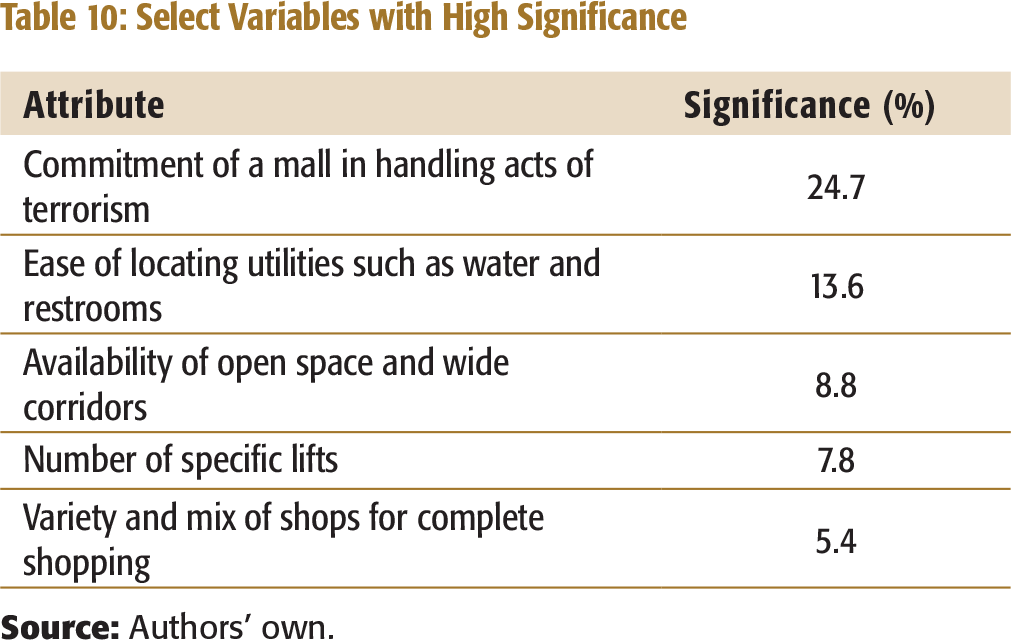
A closer look at the variable-wise scores indicate that examining these results further at the level of individual attributes, one observes that overall importance of attributes ranges between 24.7 per cent (commitment of a mall in handling acts of terrorism) to 1 per cent (strength of railings and other infrastructural facilities). Interestingly, both the attributes converge into a single factor named ‘safety and security’. It means that shoppers are indeed concerned about safety and security inside the malls, but all the sources of threat/danger are not equally critical. Hence, mall management must understand the relevant apprehensions and act accordingly to encourage shoppers to visit malls. Since managing a single aspect like ‘handling acts of terror’ shall take care of one-fourth of total impact on loyalty, it is pertinent for mall developers to provide requisite measures against acts of terrorism.
With respect to convenience, the major contribution (13.6% out of 33.3%) comes from ease in locating utilities. The mall management must place utilities at accessible locations and use signage(s) to convey the location to improve the convenience of shoppers. While looking at the physical infrastructure factor, we see that the availability of open space and wide corridors contribute the most. By ensuring an adequate open space and wide alleys in and around the shopping mall, developers can significantly improve the shoppers’ perceptions about the quality of physical infrastructure. A look at the top five variable scores reflects that mall selection in Mumbai is driven primarily by utilitarian aspects. It is noteworthy that loyalty of mall shoppers can be significantly enhanced, if mall managers create provisions for utilities, open spaces, and lifts besides taking care of safety needed against acts of terrorist violence. Varied tenant-mix in shopping malls shall always add value for the shoppers. Developing policy framework using these five strategic variables will help mall managers in meeting more than 60 per cent expectations of shoppers.
DISCUSSION AND CONCLUSION
Though the theme of this research article has been partially explored in the past, this study, for the first time, uses a non-compensatory technique to examine and predict the mall selection behaviour. While doing so, it extracts the relative significance of individual factors influencing mall selection decision. This aspect was missing in leading researches on this theme. Another distinction of this study is its scope for practical application. This study facilitates better managerial decision-making by exploring the relative significance of factors influencing a mall selection decision.
Besides high initial investment, shopping malls have a high operating cost to keep the infrastructure and facilities in good shape. Over time, the operating cost (maintenance cost) increases steadily because physical infrastructure and facilities deteriorate exponentially with time. The manpower costs also rise. However, revenues generated by mall may not increase commensurately. In most cases, it follows an opposite trend owing to increased competition from new malls and setting in of customer boredom. Allocation of financial resources, thus, becomes a key area. Mall managers have a wide range of decisions to make, but all of them do not influence shoppers equally. Results of this study provide mall managers with an in-depth understanding of antecedent factors and their relative significance. It helps in identifying the most critical aspects of shopping and allocating resources to these on preferential basis. Thus, the results of this study have resource optimization implications as well.
Vide this research, the neural network technique has been used for the first time to forecast loyalty of the mall shoppers. With more than 94 per cent accuracy in predicting mall loyal shoppers, the binary classifier model, so developed, has significantly good predictive power. The result has been statistically supported by ROC curve. This is in confirmation with an earlier study of Kumar, Rao and Soni (1995), according to which neural network has a better prediction rate. Reflecting the remarkable growth in the mall sector in India, this article contributes to the retail literature in varied ways. The model provides a powerful forecasting instrument for mall managers in recognizing mall loyal shoppers. The sensitivity analysis indicates that all the input variables that have been used as independent variables are statically suitable for prediction. Though, their relative contribution varies. With this accurate forecasting model, mall managers can manage resources efficiently, plan promotion activity, and even aptly negotiate with the tenants. For the mall managers, whose main concern is to increase footfall and decrease unnecessary costs on relevant variables influencing shoppers, forecasting the size of mall loyal shoppers market is very critical.
Findings of the article also generate vital insights on consumer behaviour in context of shopping malls in India. It was often debated whether Indian loyal shoppers look for hedonic or utilitarian benefits during their visit to a shopping mall. Since shopping malls are relatively new to the Indian markets, shoppers are expected to show initial euphoria due to the novelty value of the entity. In contrast with the traditional retail stores, shopping malls offer superior aesthetics, ambience, and marketing orientation. Presented as the key differentiators for shopping malls, these aspects should emerge as the dominant attributes when shoppers are contacted. Results of this study, however, give radically different results.
This study establishes that Indian mall shoppers predominantly look for convenience, which alone garnered one-third of the total influence among the significant factors. Thus, the significance of convenience is 66 per cent more than what is expected in a scenario, when all the five determinants contribute equally. This strongly indicates that Indian mall shoppers are more utilitarian than hedonic. In a way, this study facilitates better managerial decision-making by exploring the relative significance of factors that influence mall selection decision.
Results of this study, however, should be examined in its proper context. The respondents’ sample came from an Indian metropolitan city of Mumbai. Since shopping malls first made their entry in the cities only, shoppers living here have a higher level of familiarity with malls. This may have led to dilution of hedonic focus or ‘wearing off’ of novelty value. It means that upcoming shopping malls in India should not overinvest in making these malls look beautiful. Aesthetics and ambience seems to be a ‘hygiene’ factor in metropolitan cities. Here, special emphasis should be made on making these places convenient. In light of malls becoming crowded during peak hours and festive seasons, resources should be deployed preferentially to improve convenience. For this, mall managers need not confine to the list of attributes listed in this research, but visualize all possible ways in which shopping can be made more convenient.
Though there have been no terrorist attacks in Indian shopping malls, shoppers living in metropolitan cities, being more educated; aware; and globally connected, are aware of such acts of terror in other countries. Consequently, security also appears as a dominant concern. Present and upcoming shopping malls should ensure state-of-the-art security arrangements and make these obvious to the shoppers.
Like other developing economies, India is also witnessing fast transition from mom-and-pop shops to large shopping malls. Hence, it is pertinent for marketing researcher to decipher the shopping culture and analyse its impact on shopping behaviour. The limitations of this article shall provide the future direction for research. The present study has used convenience sampling, which is vulnerable to selection bias and influences beyond the control of researchers, and hence future studies should incorporate random sampling techniques. Being limited to Indian market, generality of the conclusions is difficult. For future studies, it would be worth to test the forecasting ability of neural network model, using cross-country comparison. Also, longitudinal analysis on the topic shall provide better insights by incorporating dynamic behaviour of shoppers. Results of this study provide a generalized framework for mall selection by shoppers in a big Indian city like Mumbai. However, one must be careful before generalizing its results to other big Indian cities and smaller towns in India. It is because local aspects may moderate the dynamics. Also, it is important to realize that mall shoppers in smaller cities, whether in India or abroad, may not assign similar weightage to the factors. Extending results of this study to smaller towns may bring in differing variables with varied significance. Shoppers in smaller towns might not experience the superior shopping experience. However, this hypothesis needs to be tested before stating it conclusively. An alternate hypothesis may be: there is no difference in expectation of shoppers of a small town and a metropolitan city. In this case, results of the study would be extended as such to a smaller town.
APPENDIX A: DEMOGRAPHIC PROFILE OF THE RESPONDENTS

NEURAL NETWORK MODEL
