







Abstract
Keywords
Introduction
Ghosting, defined as the sudden and unexplained ending of a relationship by ignoring another person’s attempts to communicate, has become an increasingly common phenomenon in modern interpersonal relationships (Kay & Courtice, 2022). This trend is primarily driven by the transformative influence of social technologies, which have redefined how individuals initiate, maintain, and terminate connections (Leckfor et al., 2023). While ghosting is often associated with romantic relationships, it also occurs in friendships, family interactions, and even professional settings (Kay & Courtice, 2022; Wu & Bamishigbin, 2023). Regardless of context, ghostees—those on the receiving end of ghosting—report significant emotional distress, including heightened pain, uncertainty, depression, and even an increased risk of non-suicidal self-injury (Ding et al., 2024; Leckfor et al., 2023; Timmermans et al., 2021). Ghosters, on the other hand, are not immune to adverse psychological outcomes, often experiencing guilt and regret following their actions (Freedman et al., 2024; Yap et al., 2021).
Among young adults, ghosting is particularly prevalent. Research on individuals aged 18–35 found that 65% had ghosted a romantic partner or interest, while 72% had been ghosted (Koessler et al., 2019b). Although ghosting has been heavily studied in romantic contexts, it is equally prevalent in non-romantic relationships, particularly friendships. For example, Powell et al. (2021) found that 45% of participants reported being ghosted by friends, and Pancani et al. (2021) revealed that nearly half (46%) of participants recalled being ghosted in a friendship rather than a romantic relationship. These findings challenge the assumption that ghosting is primarily a romantic phenomenon and underscore the importance of examining ghosting across multiple relational contexts.
Despite its prevalence, ghosting remains understudied, particularly in close relationships—interpersonal connections characterized by emotional intimacy, trust, and meaningful interactions. Close relationships, whether romantic or platonic, require ongoing effort to maintain and are especially vulnerable to the emotional disruption caused by ghosting (Oswald, 2017; Perlman, 2017). Existing research has predominantly focused on the consequences of ghosting for ghostees or the motivations of ghosters (e.g., Ding et al., 2024; Freedman et al., 2019; Manning et al., 2019; Wu & Bamishigbin, 2023), with most studies conducted in Western contexts (e.g., Biolcati et al., 2021; Koessler et al., 2019a; LeFebvre et al., 2019; Timmermans et al., 2021). In contrast, limited attention has been given to how individuals perceive ghosting behavior and those who engage in it, particularly across different genders, relational contexts, prior ghosting experiences, and within non-Western or collectivist cultures, where relational norms may vary significantly.
Gender norms, relationship contexts, and ghosting perceptions
Research on the relationship between gender and engagement in ghosting has produced mixed findings. While Biolcati et al. (2021) reported that women are more likely to engage in ghosting in romantic relationships, Navarro et al. (2021) found no significant gender differences in ghosting behavior. These inconsistencies suggest that although gender may not directly predict ghosting behavior, factors such as relationship context, gender norms, and social expectations could significantly influence how ghosting behavior and ghosters are perceived.
Previous research indicates that men are more likely to adopt emotionally detached, inhibitory, and restrictive communication styles, while women tend to favor nurturing, constructive approaches that emphasize emotional resolution and relational harmony (e.g., Felmlee et al., 2012; Hall, 2011; Havlicek, 2018; Ivy & Buckland, 2004). These contrasting communication styles may affect how ghosting is evaluated. For example, men might perceive ghosting as a more acceptable and likable strategy, as it aligns with societal norms that emphasize emotional independence. In contrast, women may view ghosting as inconsistent with their preferred relational approach, which prioritizes accountability and emotional care.
Gender norms may also influence how individuals perceive male versus female ghosters. Women who engage in ghosting may be seen as acting against societal expectations of emotional responsibility, while men’s ghosting behavior may align more naturally with traditional gender roles. However, cross-sex dynamics can introduce additional layers of complexity (Felmlee et al., 2012; Havlicek, 2018). For instance, women’s safety concerns in cross-sex relationships might make them more inclined to view female ghosters and their behavior as justified or contextually understandable (Freedman et al., 2022).
Despite these insights, it remains unclear how gender dynamics shape perceptions of ghosting behaviors in close cross-sex relationships or whether men and women evaluate ghosters of their own gender differently across various relational contexts. These nuances highlight the complex interplay between gender norms, relational context, and the gender of the ghoster, suggesting that these factors likely interact in multifaceted ways to influence evaluations of ghosting behavior and the individuals who engage in it.
The role of past experiences with ghosting
Social Cognitive Theory (Bandura, 1977, 1986) offers a valuable framework for understanding attitudes toward ghosting. It highlights the influence of past experiences on shaping behaviors and perceptions. According to this theory, individuals’ previous encounters with specific behaviors can significantly impact their future actions and attitudes in similar contexts. Supporting this perspective, Navarro et al. (2021) found that individuals who had been ghosted were more likely to ghost others, suggesting a cyclical pattern of behavior. Additionally, Bandura’s theory of moral disengagement (1999; 2002) explains how individuals who have previously ghosted others may rationalize their actions, reframing ghosting as a morally acceptable behavior by interpreting it as a necessary step for self-protection or emotional well-being. As a result, these individuals may perceive ghosting as more acceptable and less morally problematic.
Conversely, individuals who have been ghosted may develop heightened emotional sensitivity, potentially leading them to view both ghosting behavior and ghosters more negatively. However, it remains unclear whether the emotional distress associated with being ghosted, such as emotional pain, anger, uncertainty, depression, and even an increased risk of non-suicidal self-injury (Ding et al., 2024; Leckfor et al., 2023; Pancani et al., 2021; Timmermans et al., 2021), translates into stable attitudinal shifts toward ghosting.
Gaps in the existing literature
Although prior research has offered valuable insights into the attitudes toward ghosting, several limitations persist. For example, Yap et al. (2021) found that ghosting a friend is perceived as more socially acceptable than ghosting a romantic partner. However, their qualitative approach limits the generalizability of these findings. Similarly, LeFebvre et al. (2019) revealed that ghosting is more acceptable in short-term or less meaningful romantic relationships. However, whether this perception holds in long-term, emotionally significant relationships remains unclear. Context-specific studies, such as Timmermans et al.’s (2021) investigation of ghosting among Dutch mobile daters, may not fully capture perceptions in broader relational contexts. Additionally, previous research has relied heavily on participants’ personal experiences, introducing potential biases. In some studies, overly romantic-focused descriptions of ghosting (e.g., Koessler et al., 2019, 2019b; LeFebvre et al., 2019) further obscure our understanding of how perceptions differ across relationship types.
Another important limitation of existing ghosting research is its heavy reliance on samples from WEIRD (Western, Educated, Industrialized, Rich, and Democratic) societies. Most studies have been conducted in countries such as the United States, the Netherlands, Belgium, and Italy (e.g., Biolcati et al., 2021; Koessler et al., 2019a; LeFebvre et al., 2019; Timmermans et al., 2021), where values emphasizing individual autonomy and gender equality are more culturally entrenched. Conversely, Türkiye represents a more collectivist, patriarchal, and religious context, where interpersonal responsibility, modesty, and gendered norms in cross-sex relationships are more deeply emphasized (e.g., Akdoğan & Çimşir, 2022; Arat, 2010; Özdemir Sarıgil, 2022).
These cultural dynamics likely influence both communication styles and perceptions of relationship termination. In collectivist societies, indirect communication is often preferred to avoid confrontation and preserve social harmony (Merkin, 2018; Tanova & Nadiri, 2010), which may render ghosting more understandable as a face-saving strategy. At the same time, patriarchal and religious norms that emphasize loyalty, modesty, and moral accountability may intensify negative perceptions of ghosting, framing it as a violation of relational and ethical expectations. Additionally, the social sensitivity surrounding cross-sex friendships and non-marital relationships in conservative cultures may lead individuals to view ghosting in such relationships even more critically. Gendered expectations may further contribute to asymmetrical judgments, with female ghosters being evaluated more harshly for transgressing modesty and relational commitment norms.
Despite these culturally significant dynamics, little is known about how ghosting is perceived in non-WEIRD contexts such as Türkiye. Although interest in ghosting research is growing within Türkiye, empirical studies remain limited. For instance, Atalar et al. (2025) recently adapted the Ghosting Questionnaire (Jahrami et al., 2023) into Turkish, while Duman and Nazari (2024) explored the associations between love bombing, self-efficacy in romantic relationships, and ghosting among young Turkish adults, finding a moderate positive correlation between love bombing and ghosting. However, no study has systematically examined how gender, relational context, and prior experiences influence perceptions of ghosting within Türkiye. Addressing this gap, the present study investigates ghosting perceptions within a Turkish cultural framework, which is likely to yield patterns of perception distinct from those observed in WEIRD societies.
Current study
Building on these identified gaps, the present study examines how participant gender, ghoster gender, relational context (romantic vs. friendship), and prior ghosting experiences influence perceptions of ghosting and ghosters in Türkiye, a non-WEIRD, traditionally conservative, and collectivist context where emotional responsibility, modesty, and cross-sex relational expectations may significantly impact evaluations. A vignette-based experimental design was employed, featuring standardized scenarios that varied by ghoster gender and relationship type. This approach allowed for controlled comparisons across conditions while minimizing the biases often introduced by retrospective self-report. The study aims to enhance understanding of the demographic, contextual, and experiential factors that shape ghosting evaluations while expanding insight into how modern relational behaviors are perceived across cultural contexts.
Building on prior evidence that ghosting is predominantly perceived as a socially inappropriate behavior in close relationships (e.g., Navarro et al., 2021; Pancani et al., 2021), we proposed the following hypotheses regarding the role of relational context:
Drawing on gender stereotypes that associate men with emotional detachment and agency and women with relational care and accountability (e.g., Felmlee et al., 2012; Hall, 2011; Ivy & Buckland, 2004), we hypothesized that perceptions of ghosting behavior and ghosters would differ based on the gender of the ghoster:
Extending gendered emotional norms to participants’ perceptions, we hypothesized that male participants, socialized to value emotional independence, would view ghosting more favorably than female participants, who are typically socialized to prioritize emotional care and relational accountability. Additionally, we expected participant gender to interact with ghoster gender, such that individuals would perceive ghosters more favorably when the ghoster was of the same gender, reflecting in-group favoritism and aligning with mechanisms of moral disengagement (Bandura, 1999, 2002).
The following hypotheses (H4–H7) were exploratory and informed by potential rationalization mechanisms (e.g., cognitive dissonance, moral disengagement) as well as cyclical patterns observed in prior research on ghosting behavior (e.g., LeFebvre, 2017; Navarro et al., 2021). These hypotheses involved binary, self-reported variables, such as prior experience ghosting others and prior experience being ghosted:
Method
Design
The study employed a 2 × 2 × 2 between-subjects crossed factorial design to examine perceptions of ghosting. Participants were presented with one of four researcher-created vignettes, each depicting a scenario in which either Ahmet (male) or Merve (female) suddenly disappeared, set within the context of either a cross-sex friendship or a heterosexual romantic relationship. This design systematically manipulated two independent variables—the gender of the ghoster (
The random assignment of participants to one of the four scenarios ensured that each level of one independent variable was paired with every level of the others. The between-subjects structure ensured that each participant was exposed to only one scenario, representing a specific relationship context and gender of the ghost. Participants then evaluated two dependent variables: the “appropriateness” of the ghosting behavior and the “likability” of the person exhibiting this behavior. This factorial design allowed for an examination of the main and interaction effects of the gender of the ghoster, participant gender, and relational context on participants’ perceptions, offering a robust methodological foundation for understanding the dynamics of ghosting.
Participants and procedure
An a priori power analysis was conducted using G*Power 3.1 to determine the required sample size for the present study (Faul et al., 2009), which employed a 2 × 2 × 2 between-subjects factorial design. Using the MANOVA: Special Effects and Interactions option with a medium effect size (f2 (V) = 0.25), an alpha level of .05, and desired power levels of .80 and .95, the required total sample sizes to detect an interaction effect were calculated as 32 and 46 participants, respectively. However, acknowledging that small to medium effect sizes are more common in psychological research and that MANOVA requires robust sample sizes to guard against assumption violations, we followed Cutillo’s (2019) recommendation that 15–20 participants per cell are typically needed for reliable multivariate analysis. With eight cells in our design, this corresponds to a recommended total sample size of 120–160 participants. As a result, our sample appears to have sufficient statistical power to detect both main and interaction effects.
The participant recruitment and composition details are as follows: The study included 224 participants (112 women, 112 men;
Upon obtaining approval from the university review board, the first author collected the data from volunteer students during the spring semester of the 2023-2024 academic year as part of her dissertation while completing her master’s degree at a public university in Türkiye. In addition to evaluating the “appropriateness” of the ghosting behavior and the “likability” of the individual engaging in it, participants also answered various demographic questions, such as their age, sex and field of study. The average time spent completing the survey was 5–10 minutes; no financial or other incentives were provided to participants.
Measures
The data for the study were collected through four short scenarios (vignettes) created by the researcher, items created to assess the appropriateness of the ghosting behavior, items designed to evaluate the likability of the ghoster, and a demographic information form. Participant sex was assessed using a binary item: What is your sex? (Male, Female). In line with common practice in psychological research on gender roles and perceptions (e.g., Felmlee et al., 2012), we refer to this variable as “gender” throughout the manuscript to reflect its conceptual alignment with normative gender expectations and social role theory (Eagly et al., 2000).
Vignettes
Vignettes, defined as carefully crafted hypothetical descriptions of a person, object, or situation (Atzmüller & Steiner, 2010), are widely used in social sciences to explore phenomena shaped by social desirability, moral values, and gender-based responses (e.g., Butterworth et al., 2019). Each vignette (see Appendix) featured the same characters (Ahmet and Merve) but varied in two key aspects: the gender of the individual who ghosts (either Ahmet or Merve) and the relationship context (friendship vs. romantic relationship). In the romantic relationship scenarios, the story portrayed Merve and Ahmet as “a couple studying at universities in different cities who frequently talk on the phone throughout the day.” In contrast, the friendship scenarios depicted Merve and Ahmet as “close friends studying at universities in different cities who frequently talk on the phone throughout the day.”
Perceptions of behavioral appropriateness and the likability of the ghoster
The items used to measure the two dependent variables, perceived appropriateness of the behavior and likability of the ghoster, were developed for this study and conceptually adapted from previous work examining reactions to interpersonal transgressions and social judgments (e.g., Butterworth et al., 2019; Nixon & Guajardo, 2023). After reading the vignette, participants rated the ghoster and their behavior on a 7-point Likert scale ranging from 1 (Strongly Disagree) to 7 (Strongly Agree).
Perceived appropriateness
Participants assessed behavioral appropriateness using six items, including: “I might behave similarly to [Ahmet/Merve] in such a situation,” “[Ahmet/Merve] probably has a reasonable justification for behaving this way,” “[Ahmet’s/Merve’s] behavior is one of the appropriate ways to end a relationship,” “I think [Ahmet’s/Merve’s] behavior is an acceptable type of behavior,” and two reverse-coded items (e.g., “I do not find such behaviors appropriate”). An exploratory factor analysis (EFA) revealed that one item (e.g., “[Ahmet/Merve] has suffered…”) had low communality and a factor loading below .30, and was subsequently removed.
A confirmatory factor analysis (CFA) using maximum likelihood estimation confirmed the unidimensional structure of the remaining five items: χ2 (5) = 4.83,
Ghoster likability
Likability of the ghoster was assessed using four items, such as: “I would like to be friends with someone like [Ahmet/Merve],” “I feel as though I would get along well with [Ahmet/Merve],” “[Ahmet/Merve] seems like the kind of person who gets along well with others,” and “[Ahmet/Merve] is probably a likable person.” An EFA supported the construct validity of the scale. A CFA with maximum likelihood estimation was conducted to test the hypothesized unidimensional structure, with one correlated residual specified between the first and second items based on theoretical similarity and modification indices. The model demonstrated excellent fit: χ2 (1) = 0.134,
Analytic strategy and assumption testing
The data were analyzed using SPSS 24. To address the first three hypotheses, which aimed to determine the effects of (1) the gender of the ghoster, (2) the gender of the participant, and (3) the type of ghosting on two dependent variables—(1) perceptions of the appropriateness of the behavior and (2) perceptions of the likability of the ghoster—a 2 × 2 × 2 MANOVA was conducted. To address the fourth and fifth hypotheses, which explored the effects of previously engaging in ghosting behavior and previously being ghosted on the two dependent variables,
Before conducting the MANOVA, the assumptions of multivariate normality, homogeneity of variances, and equality of covariance matrices were assessed. A Pearson correlation analysis revealed that the dependent variables (perceived appropriateness and likability) were moderately correlated (r = .54), which is within the acceptable range of .10–.80 (Field, 2009), indicating no multicollinearity. The Shapiro-Wilk test indicated that the assumption of univariate normality was violated (
No multivariate outliers were detected, as all Mahalanobis distance values fell below the critical chi-square threshold of 13.82 for 2 degrees of freedom (Tabachnick & Fidell, 2007). Levene’s Test suggested that the assumption of homogeneity of variances was met for perceived appropriateness (
Given the robustness of MANOVA to minor violations, particularly when group sizes are equal or nearly equal, Pillai’s Trace was used to interpret multivariate effects, as it is more robust to assumption violations than Wilks’ Lambda. Thus, the MANOVA results were considered valid and interpretable under the assumptions.
For main effects and interactions based on a priori hypotheses, results were evaluated using the conventional significance threshold of α = .05. However, for the seven post hoc comparisons conducted to explore significant interactions, a Bonferroni correction was applied to control the family-wise Type I error rate, resulting in an adjusted significance level of α = .007 (i.e., 0.05/7). Only post hoc results meeting this corrected threshold were interpreted as statistically significant.
Results
Descriptive statistics
Correlation analyses revealed a moderate relationship (r = 0.54) between the two dependent variables: perceptions of behavioral appropriateness and likability of the ghoster. Additionally, previous engagement in ghosting was moderately correlated with finding the behavior appropriate (r = 0.48) and finding the ghoster likable (r = 0.34). In contrast, no significant correlation was found between previous experiences of being ghosted and the dependent variables. However, there was a moderate correlation (r = 0.29) between having been ghosted and having engaged in ghosting behavior.
Descriptive statistics for perceived appropriateness and likability by participant gender, ghoster gender, relationship context, and ghosting experiences.

Results related to hypotheses
A 2 × 2 × 2 MANOVA revealed significant multivariate effects of ghosting context (friendship vs. romantic relationship;
The effect of ghosting context (Romantic relationships vs. friendships) on perceptions of behavioral appropriateness and the likability of the ghoster
The results indicate that the context of ghosting behavior ( Perceived Likability of the Ghoster across Participant Gender and Relationship Context. 
In contrast, in friendship contexts, perceptions of likability did not significantly differ between male (
The effect of the ghoster’s gender on perceptions of behavioral appropriateness and the likability of the ghoster
The results indicate that the gender of the ghoster did not have a significant main effect on the dependent variables. However, there was a significant interaction between ghoster gender and participant gender on perceptions of appropriateness (
The effect of participant Gender on Perceptions of Behavioral Appropriateness and the likability of the ghoster
Participant gender had no significant main effect on perceptions of the appropriateness of the behavior. However, it had a significant main effect on perceptions of the likability of the ghoster, (
As shown in Figure 2, which displays perceived appropriateness of ghosting by participant and ghoster gender, when the ghoster was male, male participants ( Perceived Appropriateness of Ghosting by Participant and Ghoster Gender. 
Similar patterns were observed for perceptions of likability, as shown in Figure 3, which displays perceived likability of the ghoster across participants and ghoster gender. When the ghoster was male, male participants ( Perceived Likability of the Ghoster by Participant and Ghoster Gender. 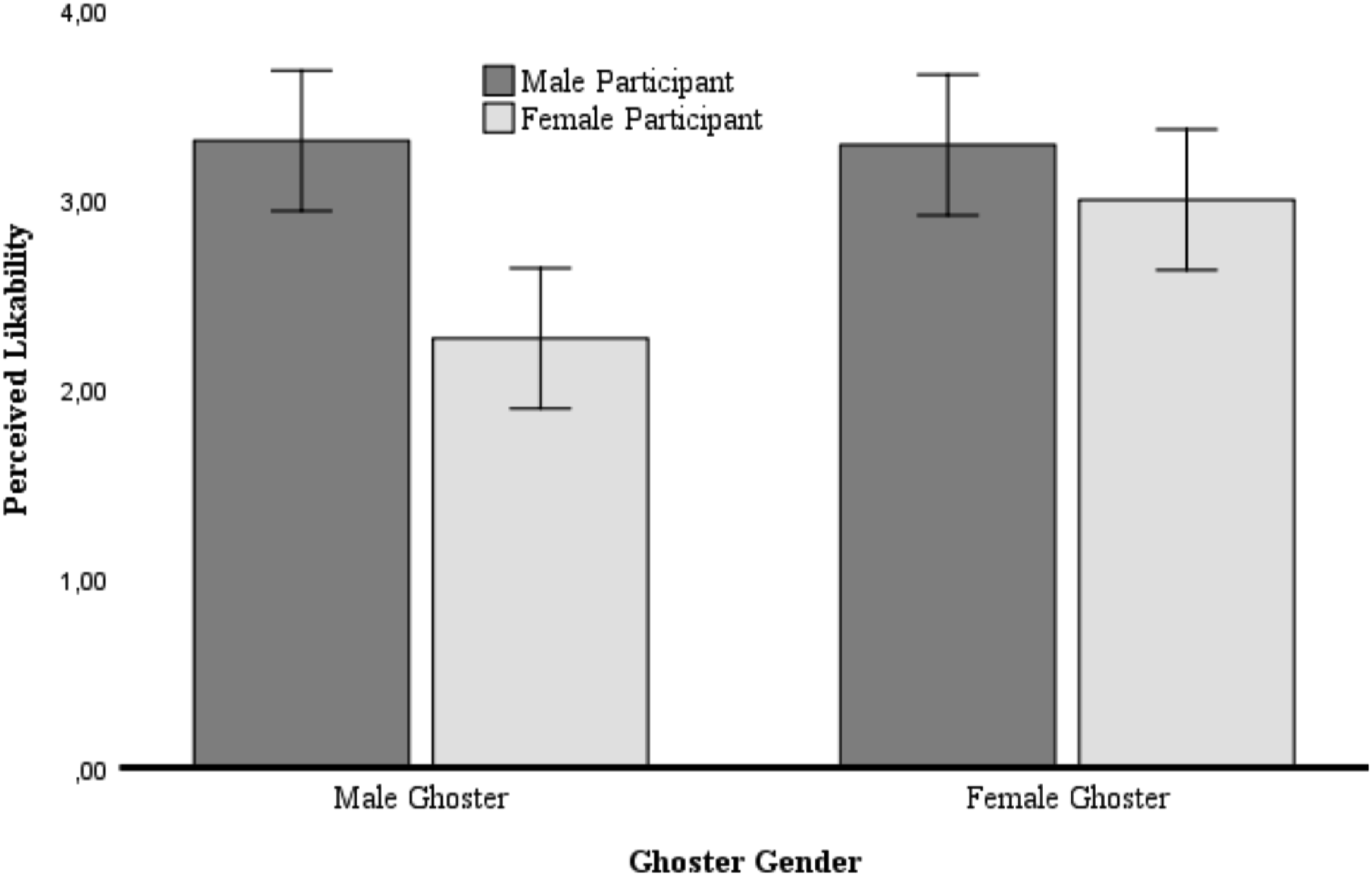
The effect of previous engagement in ghosting behavior on perceptions of behavioral appropriateness and the likability of the ghoster
The effect of previous experience of being ghosted on perceptions of behavioral appropriateness and the likability of the ghoster
The
Relationship between previous experience of being ghosted and engaging in ghosting behavior
A Chi-Square test was conducted to determine whether there was a significant relationship between the categorical variables of previous experience of being ghosted (
Relationships Between Previous Experience of Being Ghosted and engaging in ghosting behavior and gender
A slightly higher percentage of men reported having ghosted others (yes: 35%) and being ghosted themselves (yes: 72%) compared to women (yes: 32% for ghosting; yes: 66% for being ghosted). Chi-square tests were conducted to determine whether these gender-based differences in binary outcomes (yes/no) were statistically significant. The results indicated that gender was not significantly associated with either engagement in ghosting behavior (
Discussion
The current study examined how relational context (romantic vs. friendship) and gender (of both the participant and the ghoster) influence perceptions of ghosting behavior and ghoster likability in close cross-sex relationships. The findings reveal complex interaction effects among these variables, expanding on prior research while addressing notable gaps in the literature. We also explored whether previous ghosting experiences, assessed as binary indicators of engagement in or exposure to ghosting, shaped evaluations and showed patterns of reciprocity or gender association.
Relational context
Our findings support our null hypothesis regarding relational context, indicating that ghosting was perceived as equally inappropriate across both romantic and friendship contexts (H1a). This result contrasts with Yap et al. (2021), who found that ghosting a friend is considered more socially acceptable than ghosting a romantic partner. However, it aligns with most research suggesting that ghosting is generally viewed as inappropriate (e.g., Freedman et al., 2024; Navarro et al., 2021; Pancani et al., 2021), regardless of relational context.
It is important to note that Biolcati et al. (2021) proposed that ghosting might be more acceptable in new or casual romantic relationships. In contrast, our study’s vignettes depicted established relationships, where mutual trust and emotional investment are typically higher. This suggests that ghosting is perceived as equally inappropriate when relational closeness exists, whether in romantic or platonic relationships. This shared perception likely stems from foundational similarities between these relationship types, including mutual trust, attachment needs, and the expectation of closure when a relationship ends (e.g., Oswald, 2017; Perlman, 2017).
Perceptions of likability, however, diverged from our second null hypothesis regarding relational context (H1b). Ghosters in romantic scenarios were rated as more likable than those in friendship scenarios. However, this finding should be interpreted in light of the moderating role of participant gender, which also contradicts our null hypothesis that no interaction would emerge between relationship context and participant gender or ghoster gender in shaping perceptions of either appropriateness or likability (H1c). Specifically, the results showed that male participants rated ghosters as more likable in romantic scenarios compared to friendship scenarios, whereas female participants displayed no significant differences across relational contexts. This finding suggests that likability and perceived appropriateness are distinct yet related constructs in evaluations of ghosting. While men did not view ghosting in romantic contexts as more appropriate, they still found ghosters in such scenarios to be more likable. This distinction implies that men might separate their moral evaluation of the act (appropriateness) from their social evaluation of the individual (likability). Romantic ghosting could be interpreted by men as a more emotionally relatable or understandable behavior, even if it is not viewed as socially acceptable.
In contrast, women’s consistent ratings of likability and appropriateness across relational contexts suggest that relational context plays a less central role in their evaluations. This finding aligns with existing gender norms, which propose that women often prioritize relational accountability, emotional care, and consistency in their expectations across different types of relationships (e.g., Felmlee et al., 2012; Hall, 2011; Havlicek, 2018; Ivy & Buckland, 2004).
Ghoster gender and participant gender
Contrary to our hypotheses predicting higher ratings of appropriateness and likability for male ghosters, ghoster gender did not significantly influence perceptions of either behavioral appropriateness (H2a) or ghoster likability (H2b). Similarly, contrary to our hypothesis (H3a), male participants did not rate ghosting behavior as more appropriate than female participants. However, as expected (H3c), both male and female participants rated ghosting as more appropriate when it was committed by someone of their own gender, highlighting a clear in-group bias in evaluations. This pattern suggests that individuals may unconsciously apply more lenient standards when evaluating members of their own gender group, especially in emotionally close cross-sex relationships.
This in-group bias aligns with Navarro et al.’s (2021) suggestion that gendered patterns of moral disengagement may become more pronounced in certain relational contexts (e.g., casual vs. serious relationships) or under situational pressures. Moral disengagement (Bandura, 1999, 2002) refers to the cognitive mechanisms by which individuals rationalize or excuse transgressions, especially those committed by in-group members, through strategies such as minimizing harm or attributing blame to external circumstances. The finding that participants rated ghosting as more appropriate when enacted by someone of their own gender may reflect selective moral leniency facilitated by such mechanisms.
Men’s higher acceptance of male ghosters may also reflect gendered emotional norms, whereby men are socialized to value emotional independence and detachment, traits that can make ghosting appear more socially acceptable among male actors (Felmlee et al., 2012; Hall, 2011; Havlicek, 2018; Ivy & Buckland, 2004). In contrast, women are typically socialized to prioritize emotional accountability and relational care, making their higher acceptance of female ghosters appear inconsistent with normative gender expectations. Beyond gendered patterns of moral disengagement, the cross-sex nature of the scenarios may also help explain this inconsistency. Women may perceive ghosting in cross-sex relationships as more acceptable due to safety concerns, leading to greater understanding when female ghosters engage in emotionally driven or contextually justified behaviors (Freedman et al., 2022). These findings suggest that participants’ evaluations are shaped by an interplay of gendered expectations and situational dynamics, resulting in differing standards of appropriateness depending on the gender of the ghoster.
In terms of likability, we found that male participants rated ghosters as more likable than female participants, consistent with our hypothesis H3b. However, contrary to hypothesis H3d, which predicted that individuals would perceive ghosters of their own gender as more likable, only female participants showed this pattern, rating female ghosters as more likable than male ghosters. In contrast, male participants rated ghosters of both genders similarly. This suggests that male participants may have relied on broader contextual or relational cues when evaluating likability, whereas female participants may have held male ghosters to stricter relational standards, perceiving their actions as violations of emotional accountability. Thus, women may evaluate ghosters through a lens shaped by gendered relational norms, whereas men may apply more lenient or situationally flexible judgments.
The role of previous experiences with ghosting in perceptions
Consistent with our fourth hypothesis (H4), participants who had previously engaged in ghosting rated the behavior as significantly more appropriate and the ghoster as significantly more likable than those who had not ghosted others. This finding aligns with Navarro et al. (2021), who proposed that individuals may rationalize their prior behaviors to reduce cognitive dissonance. According to Social Cognitive Theory (Bandura, 1977, 1986), past behavior plays a key role in shaping future attitudes, especially in similar contexts. From the perspective of moral disengagement (Bandura, 1999, 2002), individuals who have ghosted others may selectively adjust their moral evaluations, reframing ghosting as less harmful or more justifiable to protect their self-image. These self-protective mechanisms reduce feelings of guilt and help preserve moral identity, thereby making ghosting seem more acceptable and less ethically problematic. Taken together, our findings suggest that prior engagement in ghosting may promote both rationalization and moral disengagement, reinforcing a cycle in which the behavior becomes easier to justify and more likely to recur (Di Santo et al., 2022; Navarro et al., 2021).
Contrary to our fifth hypothesis (H5), no significant differences were observed between participants who had been ghosted and those who had not regarding their perceptions of behavioral appropriateness and ghoster likability. This finding is surprising, given previous research suggesting that ghostees often experience significant emotional harm, including heightened pain, anger, uncertainty, depression, and even increased risk of non-suicidal self-injury (Ding et al., 2024; Leckfor et al., 2023; Pancani et al., 2021; Timmermans et al., 2021). These emotional consequences might lead one to expect that ghostees’ ratings of behavioral appropriateness and ghoster likability would be negatively affected by their experiences.
Several factors may help explain the lack of significant effects. First, the emotional distress associated with being ghosted may not directly translate into evaluative judgments of the behavior or the perpetrator. Ghostees may cognitively separate their emotional reactions from their assessments of social norms. Second, individual differences such as self-esteem and attachment style might moderate these effects (Di Santo et al., 2022; Langlais et al., 2024; Powell et al., 2021). Individuals with higher self-esteem or secure attachment may be better equipped to rationalize and minimize the impact of the ghosting experience on their evaluations.
Third, the increasing normalization of ghosting in modern dating culture may attenuate negative judgments. As ghosting becomes more widespread and socially accepted (Kay & Courtice, 2022; Koessler et al., 2019b), individuals may be less likely to view it as a serious transgression. Fourth, mechanisms such as cognitive dissonance reduction may come into play: to resolve the psychological discomfort arising from conflicting beliefs about self-worth and the experience of being ghosted, ghostees may downplay the inappropriateness of the behavior or rationalize the ghoster’s actions (Festinger, 1962; McGrath, 2017; Navarro et al., 2021).
Additionally, variations in the severity of the ghosting experience (e.g., casual vs. intense relationship) and the time that has passed since the event may influence perceptions. Participants who experienced less severe ghosting or who had sufficient time to emotionally recover might not harbor strong negative evaluations. Because the present study did not assess the intensity or recency of ghosting experiences, these factors may have obscured potential effects. Future research should explore these possibilities by investigating how the normalization of ghosting, cognitive coping mechanisms, timing since the event, and severity of the ghosting experience interact with individual differences to shape evaluations of ghosting behavior.
Relationships between previous experience of being ghosted, engaging in ghosting behavior, and gender
Supporting our sixth hypothesis (H6), our results revealed a significant relationship between previous experiences of being ghosted and engaging in ghosting behavior. This finding aligns with prior research suggesting that individuals who have been ghosted are more likely to ghost others (Di Santo et al., 2022; Navarro et al., 2021). According to Social Cognitive Theory (Bandura, 1986, 1999), prior experiences shape attitudes and behaviors in similar future situations, suggesting that ghosting may be internalized as a learned relational strategy. Individuals who have experienced ghosting may come to view it as an acceptable or expected behavior, thereby perpetuating a cyclical pattern of ghosting in interpersonal relationships.
Consistent with our seventh hypothesis (H7), participant gender was not significantly associated with previous experiences of being ghosted or engaging in ghosting behavior. Although Biolcati et al. (2021) reported that women are more likely to engage in ghosting in cyber dating contexts, Navarro et al. (2021) found no significant gender differences in ghosting behavior. Our findings align with Navarro et al. (2021), suggesting that ghosting is not inherently gendered. Instead, ghosting behavior might be shaped by situational factors, personal coping mechanisms, and unconscious beliefs about the nature and functioning of romantic relationships (e.g., Freedman et al., 2019; Powell et al., 2021). Furthermore, socio-cognitive and relational factors, such as moral disengagement and withdrawal-oriented conflict resolution styles, may play a key role in driving ghosting behavior (Biolcati et al., 2021; LeFebvre, 2017; Navarro et al., 2021).
These findings have important implications for real-world relational dynamics. The fact that ghosting is broadly perceived as inappropriate across both friendships and romantic relationships, particularly in established cross-sex relationships, underscores the value of direct communication when ending or distancing such relationships. Individuals may reduce relational harm by providing brief but honest closure rather than abruptly cutting off contact. Additionally, the observed in-group biases suggest that people may unconsciously judge relational behaviors more leniently when enacted by those similar to themselves; increasing awareness of this bias may foster more equitable and empathetic relationship evaluations. These insights could inform psychoeducational programs and relationship counseling, helping individuals recognize and address avoidance-based conflict resolution tendencies. Finally, understanding how past ghosting experiences shape future attitudes and behaviors may support the development of therapeutic interventions to promote healthier communication patterns and emotional accountability in friendships and romantic partnerships.
Limitations and future research directions
While the current study offers valuable insights into how relational context, gender, and past experiences influence perceptions of ghosting behavior and ghoster likability, several limitations warrant consideration. First, although the sample size (
Third, several demographic variables—including race/ethnicity, sexual orientation, disability status, and socioeconomic indicators such as income or class background—were not assessed. Although participants reported their sex, age, and field of study, the absence of these additional dimensions limits the sample’s representativeness and hinders intersectional analyses. Future research should incorporate these variables to enhance demographic transparency and ensure inclusivity in participant representation.
Fourth, the study employed hypothetical vignettes to examine ghosting perceptions. While effective for controlled comparisons and reducing social desirability bias (Atzmüller & Steiner, 2010), vignettes may not fully capture the emotional intensity or situational complexity of real-life experiences. Mixed-method approaches, such as in-depth interviews or observational studies, could provide richer insights.
Moreover, the sample’s cultural and demographic characteristics may limit the generalizability of the findings. Specifically, the study was conducted in Türkiye, a context shaped by collectivist values, patriarchal norms, and religious traditions that influence relational expectations and communication styles (Akdoğan & Çimşir, 2022; Arat, 2010; Özdemir Sarıgil, 2022). While this provides a valuable non-WEIRD perspective, these cultural factors may also shape how ghosting is viewed. In addition, the relatively young age of participants (
Lastly, our vignettes focused exclusively on close cross-sex relationships and examined only two relational contexts (romantic vs. platonic) without specifying relationship duration or reasons for ghosting. Yet factors such as relationship length, perceived closeness, and motivations for ghosting are likely to shape evaluations of both the behavior and the ghoster significantly. Future studies could broaden ghosting scenarios by comparing short-term versus long-term relationships or distinguishing between conflict-driven and avoidance-driven ghosting. Exploring these nuances would provide a more comprehensive understanding of how various relational and situational contexts influence perceptions of ghosting.
Conclusion
This study provides insights into how relational context, gender, and prior experiences influence perceptions of ghosting behavior and the likability of ghosters in cross-sex relationships. While ghosting is generally perceived as inappropriate in both romantic and friendship contexts, evaluations of ghosters vary by participant gender and its interaction with both relational context and ghoster gender, reflecting gendered social norms and moral frameworks. Moreover, individuals who have engaged in ghosting tend to view both the behavior and the ghoster more favorably, whereas those who have been ghosted do not, highlighting psychological mechanisms such as self-justification, moral disengagement, and social learning.
The results can be interpreted to suggest that in Türkiye’s collectivist, patriarchal, and religious context (Akdoğan & Çimşir, 2022; Arat, 2010; Özdemir Sarıgil, 2022), even cross-sex friendships may be perceived as romantic, leading to heightened expectations for emotional accountability and greater perceived inappropriateness of ghosting. By situating ghosting within this sociocultural framework, the study expands the limited body of research in Türkiye and contributes a cross-cultural perspective on a phenomenon largely explored in Western contexts.
Footnotes
Author contributions
Declaration of conflicting interests
Funding
Ethical approval
ORCID iD

Data Availability Statement
Use of generative artificial intelligence tools
Open research statement
.