







Abstract
Keywords
Introduction
Understanding what drives family firm performance has been explored at length. Businesses, including family firms, benefit from entrepreneurial strategies in terms of profitability, growth, innovation and international performance (Arzubiaga et al., 2018; Calabrò et al., 2021; Wales, 2016). Entrepreneurial orientation (EO) refers to ‘entrepreneurial strategy-making processes that key decision makers use to enact their firm’s organisational purpose, sustain its vision, and create competitive advantage(s)’ (Rauch et al., 2009: 763), and generally relates to innovativeness, proactivity and risk-taking (Miller, 1983). Consequently, a firm’s competitiveness and hence, sustainable performance, depends on its capability to establish an entrepreneurial orientation and reap its benefits. ‘This need is even greater in family firms with a vision to succeed across generations’ (Cruz and Nordqvist, 2012: 33).
Despite this common agreement, research in the realm of family firms has generated contradictory debates about whether family firms are contexts conducive towards entrepreneurial strategizing (Casillas et al., 2011; Gimenez-Fernandez et al., 2021; Hernández-Linares and López-Fernández, 2018). On the one hand, conservatism, paternalism and nepotism are characteristics considered to be preventative of entrepreneurial behaviour in family firms. On the other hand, a family’s emotional attachment to the business and the desire to secure the business for future generations and protect the family’s reputation are listed as drivers of entrepreneurship in family firms. Thus, there is little agreement regarding how EO can be effectively transformed into family firm performance (Arzubiaga et al., 2018; Bauweraerts et al., 2021; Calabrò et al., 2021). Family firm-specific cultural and organisational influences on EO are often explained via stewardship theory (Howorth et al., 2010; Howorth and Robinson, 2020). True stewardship is entrepreneurial in nature and emphasises protecting and nurturing family firm wealth in its entirety, benefiting both the family and its business (Howorth and Robinson, 2020); this has been termed
With strategy implementation in family firms, appropriate leadership behaviour, that is, the process of influencing ‘a group of individuals to achieve a common goal’ (Northouse, 2015: 6), is a core component of effective stewardship (Pearson and Marler, 2010). While strategic postures provide direction, an effective implementation of strategy requires suitable leadership behaviour (Engelen et al., 2015). In entrepreneurially oriented family firms, we argue that entrepreneurial leadership is a necessary and effective stewardship practice (Howorth and Robinson, 2020; Miller et al., 2013). Entrepreneurial leadership builds on stewardship principles such as establishing an open, autonomous, trusting, supportive and nurturing environment; it also complies with the family’s and business’ entrepreneurial goals (Discua Cruz et al., 2013; Fries et al., 2021; Renko et al., 2015). Research on the effectiveness of EO, and its implementation mechanisms, needs to acknowledge context as the proposition that EO is a universal blessing has been deemed ‘overly simplistic’ (Wiklund and Shepherd, 2005: 76). Accordingly, we take account of environmental dynamism when testing the effectiveness of stewardship practices related to entrepreneurial leadership in family firms. The high rate of change in terms of customer and competitor behaviour associated with dynamic environments (Khandwalla, 1977) makes dynamism a conducive context for entrepreneurially oriented family firms. The proactive, risk-taking and innovative nature of entrepreneurially oriented family firms leads to better anticipation of, and adjustment to, environmental change (Casillas et al., 2011; Yu et al., 2019). Based on a sample of 162 family SMEs from Western Austria, we contribute to the family business and entrepreneurship literature by testing effective orchestrations of entrepreneurial activities in family SMEs (Bauweraerts et al., 2021; Casillas et al., 2011; Kallmuenzer et al., 2018). We contribute to this debate by focussing on actual stewardship practices in the form of entrepreneurial leadership. Existing research has largely relied on proxies of stewardship behaviour such as the family membership of executives or family involvement to explain the effectiveness of family firm EO (Bauweraerts et al., 2021; Casillas et al., 2010). The use of proxies, however, neglects the fact that family membership or involvement does not necessarily equate with actual stewardship behaviour protecting and nurturing family firm wealth (Howorth and Robinson, 2020; Zahra et al., 2008). Consequently, we extend the research on entrepreneurial stewardship in family firms which focuses on explaining collective entrepreneurial dynamics in family teams and business portfolios (Discua Cruz et al., 2013) by introducing a leadership perspective to the debate. We test how and when stewardship practices related to entrepreneurial leadership facilitate the transformation of entrepreneurial strategies into family firm performance. As such, we enhance understanding of leadership in family firms in general, and entrepreneurial leadership specifically (Fries et al., 2021; Kansikas et al., 2012; Leitch and Volery, 2017; Renko et al., 2012). Leadership research in family firms is scarce; it largely focuses on issues such as the family membership of leaders (Bauweraerts et al., 2021) or generational issues (Mussolino and Calabrò, 2014); it rarely explores EO context (Hernández-Linares and López-Fernández, 2018).
Further, research on the boundary conditions of the EO-performance relationship in family firms is unlikely to adopt true configurational perspectives simultaneously considering the interplay of multiple contingency factors. Prior research has focused either on individual external contingency factors such as environmental dynamism (Yu et al., 2019), or on individual family business-internal contingency factors such as family-related goals (Kallmuenzer et al., 2018). Existing configurational studies have investigated interactions between EO and family business-internal characteristics such as firm size, participative decision-making and generational involvement and stages (Bauweraerts et al., 2021; Chirico et al., 2011). Configurational research investigating family business-internal and environmental contingencies of EO and consequently, strategic fit in family firms, has been limited to individual EO dimensions (Yu et al., 2019). By considering the interactions between EO, entrepreneurial leadership and environmental dynamism, we close this gap In doing so, we increase our understanding of strategic fit in family firms by establishing the role of stewardship practices for achieving strategic fit. We also respond to the calls to shed light on how EO is effectively transformed into family firm performance (Wales et al., 2021), while also covering multilevel variables when investigating family firm performance (McKenny et al., 2013).
Theoretical Background and Hypotheses Development
A Stewardship Perspective of Entrepreneurial Practices in Family Firms
EO describes an organisational posture of how decision-making practices determine firm responses towards new technologies and reactions to new product–market opportunities involving risks. We consider a family SME to be entrepreneurially oriented when it simultaneously displays high levels of innovativeness, risk-taking and proactivity (Covin and Slevin, 1989; Miller, 1983; Wales et al., 2019). This perspective contrasts with the multidimensional conceptualisation of EO (Lumpkin and Dess, 1996), which argues that EO is a phenomenon with roots in the domains of innovation, proactivity, risk-taking, autonomy and competitive aggressiveness. Not all of these dimensions have to be simultaneously present at the same level but may instead complement each other. While the unidimensional conceptualisation ‘specifies what EO looks like’, the multidimensional conceptualisation ‘specifies where to look for EO’ (Covin and Wales, 2012: 681). Consequentially, the unidimensional conceptualisation suits our research goal better as we are interested in how family SMEs can reap the benefits of EO in its entirety.
EO is shaped through cultural influences on national or societal, regional, industry and firm levels (Gupta and Levenburg, 2010; Howorth et al., 2010; Wales et al., 2019). These cultural dimensions shape firm values, attitudes and behaviours as they form and transform EO (Howorth et al., 2010; Lee et al., 2019). This is also applicable to family firms that over generations can become embedded in certain cultural settings (Howorth et al., 2010). One theoretical lens frequently applied to explain entrepreneurship in family firms is stewardship theory (Bauweraerts et al., 2021; Howorth and Robinson, 2020). This theory provides insights into situations where managers are not driven by individual goals but act in the best interests of the firm because their motives are aligned with its well-being (Davis et al., 1997). Stewardship theory provides a contrasting perspective to agency theory that theorises about self-serving managers and associated governance costs. Stewardship theory is a relevant theoretical perspective for family firms given the common conjunction of ownership and management in family SMEs (Chrisman et al., 2012; Howorth et al., 2010).
Stewardship governance is associated with facilitating and empowering management and leadership practices promoting a deep identification with the business (Davis et al., 1997). Stewardship cultures are based on trust, less formalisation and more flexibility. The facilitating and empowering nature of stewardship practices yield a greater identification with the family and its business, increasing employee commitment and motivation to contribute to family firm wealth while diminishing self-serving actions. Here, family business members act as stewards. In the best interest of the firm, stewards not only follow the family business’ strategic goals but also seek to expand the firm’s assets instead of merely protecting them. Howorth and Robinson (2020: 70) conclude that ‘a stewardship perspective that is true to these roots would be entrepreneurial, and family members who wish to expand the wealth, assets, and opportunities of the family would be active entrepreneurially’. Studying family entrepreneurial teams and their business portfolios, Discua Cruz et al. (2013) coin the term
EO and entrepreneurial leadership are two distinct phenomena (Dess et al., 2003); the latter increases the potential of the former. While EO describes a firmwide posture capturing organisational decision-making practices that determine responses to opportunities, possibly involving risks (Lumpkin and Dess, 1996), entrepreneurial leadership refers to individual managerial behaviours ‘influencing and directing the performance of group members towards the achievement of organisational goals that involve recognizing and exploiting entrepreneurial opportunities’ (Renko et al., 2015: p. 55). Building on stewardship principles (Fries et al., 2021), entrepreneurial leadership levers off social exchanges (Dess et al., 2003); this is not necessarily the case with EO as top management decision-making can take place separately from other organisational ranks. Leadership in entrepreneurially oriented family firms is not necessarily based on entrepreneurial values (Casillas et al., 2011; Chirico and Nordqvist, 2010; Renko et al., 2015). For instance, it could strictly implement what has been planned and ordered by top management. Entrepreneurial leadership is a crucial stewardship means for triggering entrepreneurial behaviour amongst members of the firm and meeting the goals of an entrepreneurially oriented family firm while fostering performance. This is key because family goals, including non-financial ones, are best achieved by increasing firm prosperity (Bauweraerts et al., 2021).
Previous research investigating stewardship behaviour in family firms suggests that they develop effective stewardship practices such as entrepreneurial leadership to a varying degree (Miller et al., 2013). This is emphasised by two contradictory lines of argumentation that describe family firms as entrepreneurial or non-entrepreneurial, depending on their family-specific cultures and goals (Casillas et al., 2011). One explanation being that family firms face the possibility of trade-offs between paternalism and entrepreneurship leading to inertia as decisions are taken with a family focus directed towards preserving traditions (Chirico and Nordqvist, 2010). Koiranen (2003) demonstrates that paternalism and entrepreneurship in family firms are related through emotions. Renko et al. (2012: 177) argue that ‘the prevalence of paternalistic leadership practices in family business may be closely related to the strong emotional connections prevalent in such firms and the need to behave entrepreneurially’. However, family firms that face inertia due to trade-offs between paternalism and entrepreneurship lack a true and effective stewardship culture and display poor stewardship practices (Eddleston et al., 2011; Zahra et al., 2008). Instead of empowering their employees, they overwhelm them with care suppressing any proactive and innovative contribution to the firm’s wealth (Koiranen, 2003), preventing them from becoming family firm stewards (Zahra et al., 2008). Family firms in this instance fail to implement a culture of entrepreneurial stewardship where identifying entrepreneurial opportunities to increase the family’s assets is a collective effort (Discua Cruz et al., 2013). Such cultural trade-offs often cause disharmony between strategy and the organisation.
We argue that for family firms to be able to effectively turn their EO into performance, they need to develop stewardship practices related to entrepreneurial leadership. However, the effectiveness of strategies (Lumpkin and Dess, 2001) and stewardship cultures (Chirico and Baù, 2014) upon firm prosperity are contingent on the environmental context. All firms need to achieve strategic fit between strategy, the organisation and the environment (Carmeli et al., 2010; Lindow et al., 2010). The following sections develop hypotheses discussing how configurations of stewardship practices related to entrepreneurial leadership and environmental dynamism influence the EO-performance link in family firms.
Configurations of EO, Entrepreneurial Leadership and Environmental Dynamism and Their Influence on Performance
Entrepreneurial Leadership and EO in Family Firms
Stewardship theory postulates that the ‘identification with and achievement of the organisation’s strategic mission can lead to intrinsic satisfaction and provide a significant source of personal utility for stewards’ (Zahra et al., 2008: 1037). In family firms, EO is strengthened through stewardship cultures. This is especially the case when there are strong bonds between the family and the firm and there is strong interaction between family members and the firm (Eddleston et al., 2011). Appropriate leadership behaviour based on stewardship principles is a key component of such stewardship cultures (Eddleston, 2008; Pearson and Marler, 2010). Entrepreneurial leadership incorporates strong stewardship principles, seeking to turn firm members into entrepreneurial agents; this is particularly important in the case of entrepreneurial family firms. Entrepreneurial leaders challenge a firm’s dominant logic as well as their subordinates (Ireland et al., 2003), encouraging followers to set entrepreneurial goals (Gupta et al., 2004; Ireland et al., 2003), which in turn creates strategic fit with the family firm’s strategic posture.
Entrepreneurial leaders ‘emphasize building commitment through active, creative, and discovery-driven engagement with the opportunities presented by the environment’ (Gupta et al., 2004: 255). Here, entrepreneurial leaders trigger business opportunity recognition and exploitation among their followers (Gupta et al., 2004). While ‘opportunity recognition is about perception, exploitation is about action, and the goals set by entrepreneurial leaders involve both’ (Renko et al., 2015: 57). Entrepreneurial leadership fosters the development of growth-related (substantive) and opportunity spotting, and change-related (dynamic) organisational capabilities (Koryak et al., 2015). Thus, entrepreneurial leadership protects (i.e. change capabilities) and nurtures (i.e. growth capabilities) firm wealth, which is the foundation of good stewardship in family firms (Howorth and Robinson, 2020). Entrepreneurial leaders themselves identify innovation opportunities, emphasise the benefits to the entire firm and secure resources for exploiting opportunities (Ireland et al., 2003). Consequently, they act as role models and can be described as true stewards, acting entrepreneurially and sacrificing their own interests for the wealth of the family firm and its employees (Fries et al., 2021; Howorth and Robinson, 2020).
Entrepreneurial leadership builds on transformational leadership principles such as articulating a vivid and motivating vision, the intellectual stimulation of followers or inspirational motivation (Fries et al., 2021; Renko et al., 2015). Transformational leadership principles are a core foundation of a family firm’s stewardship orientation (Eddleston, 2008) as such leadership behaviour triggers stronger emotional connection and psychological ownership among employees, turning them into family firm stewards (Fries et al., 2021). The capacity of entrepreneurial leaders to articulate a compelling entrepreneurial vision creating a common understanding within the family business is a particularly important stewardship practice as it replaces paternalistic behaviour (Fries et al., 2021). Another stewardship component of entrepreneurial leadership is its foundation in participative leadership that strengthens intrinsic motivations to engage in innovation and develop an entrepreneurial mindset (Fries et al., 2021). Entrepreneurial leadership rests upon social exchange (Dess et al., 2003), identified as one of the core stewardship-based leadership behaviours for implementing a stewardship culture (Pearson and Marler, 2010). Furthermore, entrepreneurial leadership intersects with creativity-supportive leadership as this is an important aspect of innovation and opportunity seeking (Renko et al., 2015), enabling followers to become active entrepreneurial stewards nurturing the family business. In sum, the attributes of entrepreneurial leadership strengthen follower identification, involvement and intrinsic motivation and consciousness, driving them to act as stewards in charge of innovation and future success (Fries et al., 2021; Zahra et al., 2008).
Based on stewardship theory, we expect entrepreneurial leadership to be an effective practice for creating an entrepreneurial stewardship culture, turning family firm members into intrinsically driven stewards seeking to achieve the firm’s entrepreneurial goals. As entrepreneurial leadership strengthens the capacity among all those in the firm to challenge current situations, take risks and be creative, it prevents family firms from falling into the ‘paternalism trap’ that triggers inertia instead of entrepreneurship (Chirico and Nordqvist, 2010). Entrepreneurial leadership will therefore, enable family firms to balance ‘care taking’ and ‘care-giving’ attitudes, meaning that employees not only have the freedom to express ideas, but are also empowered to follow them (Koiranen, 2003). Empirical evidence supports our reasoning. For instance, it has been shown that managerial individual innovation behaviour can be transformed more easily into firm-level exploration in family-owned firms (Strobl et al., 2020b). Research has also demonstrated that entrepreneurial leadership correlates with EO (Renko et al., 2015), triggering exploration and exploitation innovation outcomes in organisations, with a special emphasis on the former (Strobl et al., 2020a). Based on this reasoning, we propose the following hypothesis:
The relationship between EO and family firm financial performance is stronger when stewardship practices related to entrepreneurial leadership are high.
Environmental Dynamism and EO in Family Firms
Environmental dynamism describes contexts characterised by high rates of change and uncertainty (Miller and Friesen, 1983). Customer expectations, production and service trends vary constantly and competitor actions are typically unpredictable. Despite posing survival challenges (Bettis and Hitt, 1995), the dynamic nature of these environments generates business opportunities. Here, strategies focussing on innovation are beneficial because they provide external strategic fit (Miller, 1983; Miller and Friesen, 1983). Not responding appropriately to environmental changes generates a misalignment between strategy and environment and has been shown to be a major driver of organisational failure (Miles and Snow, 1994). In dynamic environments, firms must respond quickly and proactively: ‘a strong proactive tendency gives a firm the ability to anticipate change or needs in the marketplace and be among the first to act on them’ (Lumpkin and Dess, 2001: 445). The uncertainty associated with environmental dynamism diminishes managerial capabilities to predict future outcomes and address the impacts of unexpected events (Khandwalla, 1977). Consequently, dynamic environments also require risk-taking: in dynamic environments, ‘performance should be highest for those firms that have an orientation for pursuing new opportunities because they have a good fit between their strategic orientation and the environment’ (Wiklund and Shepherd, 2005). EO is exactly this kind of strategic posture (Covin and Slevin, 1991). This is also the case for family firms (Casillas et al., 2011) as they display greater EO under conditions of environmental dynamism (Cruz and Nordqvist, 2012), seeking external strategic fit. Thus, as dynamism in the environment establishes an external strategic fit with an entrepreneurial posture, we expect that family firms displaying a high EO will perform better in these environmental contexts. Therefore, we posit:
The relationship between EO and family firm financial performance is stronger when environmental dynamism is high.
Configuring Entrepreneurial Leadership, Environmental Dynamism and EO in Family Firms
There is evidence that an external strategic fit with dynamic environments requires capabilities related to adaptation and change (Beer et al., 2005). In family firms, stewardship behaviour, such as entrepreneurial leadership, helps to leverage external strategic fit between firm strategy and the environment. In family firms with a stewardship orientation, ‘the family and employees interact to create a setting where ideas about how to monitor and respond to changes in the environment can flourish’ (Zahra et al., 2008: 1049). Consequently, a stewardship orientation establishes the necessary strategic flexibility (Zahra et al., 2008) which is necessary to cope with uncertain environmental conditions (Shimizu and Hitt, 2004). Thus, there will be a reinforcing effect between stewardship practices related to entrepreneurial leadership and environmental dynamisms in entrepreneurially oriented family firms. A stewardship orientation is based on practices including nurturing trust, participation, identification and ownership among family firm members, which helps to introduce rapid change and initiatives to react to changing environmental circumstances (Zahra et al., 2008). Along with its transformational and participative components, entrepreneurial leadership also involves these stewardship practices (Fries et al., 2021) as it focuses on creating an open environment, empowering organisational members from all ranks to engage in opportunity recognition (Ireland et al., 2003; Renko et al., 2015; Zahra et al., 2008).
Stewardship practices related to entrepreneurial leadership strengthen the trust, commitment and intrinsic motivation of all family firm members to contribute to family firm goals. These practices, furthermore, minimise resistance to change, fostering information and knowledge exchange and collaboration and can even increase explorative employee behaviour, yielding possible solutions for coping with environmental change (Eddleston et al., 2011; Zahra et al., 2008). Stewardship practices related to entrepreneurial leadership as a result strengthen the growth- and change-related dynamic capabilities of family firms (Fries et al., 2021; Howorth et al., 2010; Koryak et al., 2015) crucial for prevailing in dynamic environments. Stewardship practices related to entrepreneurial leadership increase the strategic flexibility of family firms in two ways: They increase the capacity to create viable solutions to external change and also, the capacity to implement organisational change.
Based on these arguments, we expect the outcomes of EO in family firms to depend on how well the firm’s strategy aligns with environmental conditions (external strategic fit), as well as capabilities to leverage potential benefits from this alignment through suitable leadership based on entrepreneurial stewardship principles. Consequently, when pursuing entrepreneurial strategies related to risk-taking, innovation and proactiveness, family firms will perform best when environmental conditions are dynamic and stewardship practices related to entrepreneurial leadership are highly developed. While environmental dynamism will provide an abundance of opportunities for exploitation (Chirico and Baù, 2014; Miller, 1983), entrepreneurial leadership prevents family firms from paternalism-induced inertia (Chirico and Nordqvist, 2010) by turning family and non-family employees into entrepreneurial stewards seeking to grow the family’s assets (Discua Cruz et al., 2013; Eddleston et al., 2011; Fries et al., 2021; Zahra et al., 2008). Therefore, we propose:
The EO–financial performance relationship depends on configurations of environmental dynamism and stewardship practices related to entrepreneurial leadership. We propose that environmental dynamism and stewardship practices related to entrepreneurial leadership have a reinforcing effect on the EO–financial performance relationship in family firms.
Method
Sample and Procedure
We selected a sample of family SMEs from three Western Austrian provinces (Vorarlberg, Tyrol and Salzburg) to investigate the proposed hypotheses. The relationships of interest are likely to be more pronounced in an SME context where ownership and management are usually aligned within the owner family, and where family values and behaviour have a key role (Chrisman et al., 2012; Howorth et al., 2010; Kotlar and De Massis, 2013). Western Austria is characterised by a strong SME and family business culture. The region provided a suitable context for this investigation because it is relatively homogeneous in terms of its institutional and legal setting, economic activity, population, income and infrastructure. This also minimised the probability of contextual biases in our results, as a family firm’s ‘environmental context (that is, cultural, demographic, economic, educational, legal and social) can shape family firm formation, diversity and development’ (Howorth et al., 2010: 440). In general, 99.7% of all businesses in Austria are SMEs, which contribute 61.8% to its total added value (European Commission, 2019). These, mostly micro businesses (<10 employees), employ about 68.3% (approximately 1.9 million people) of the Austrian workforce (European Commission, 2019). 19.8% of the businesses employing 20.8 of the Austrian SME workforce are located in Western Austria (WKO, 2018a). An estimated 90% of all firms in Austria are family firms (Haushofer, 2013; WKO, 2018b). Even after excluding the number of solo self-employed entrepreneurs, 54% of all businesses in Austria are family firms (Haushofer, 2013). The percentage of family businesses among Austrian SMEs decreases with business size: while 88% of micro businesses (<10 employees) and 78% of small businesses (10–49 employees) are family firms, only 63% of medium-sized businesses (50–249 employees) are family firms (Haushofer, 2013). These businesses are largely active in the wholesale and retail, tourism, construction, handicraft and manufacturing industries (Haushofer, 2013; WKO, 2018b).
In Austria, data on family firm SMEs is not systematically captured in official databases. Moreover, the databases that are available do not provide insights into leadership or strategy-related variables such as entrepreneurial leadership and EO. Hence, a survey was chosen to collect the data with the questionnaire addressed to family firm managers in leading positions, such as owners and CEOs. These key informants are deemed to be the most knowledgeable when it comes to reporting on issues such as EO (Cruz and Nordqvist, 2012; Engelen et al., 2015). In cooperation with the Austrian Chamber of Commerce, which provided a random sample of potential family businesses that agreed to be contacted, a sampling frame was created. Overall, 1056 family firms in Western Austria were identified. These were contacted with an email link to an online questionnaire in June 2014. To ensure that only top managers answered the survey, respondents had to report their position in the firm (96% of respondents were managers with ownership stakes or CEOs, while 4% held other top managerial positions in their respective firms). Two email reminders were sent out four and eight weeks later, and one phone call was made after 12 weeks to complete the data collection in September 2014.
Sample characteristics.

* Multiple answers possible (
Measurement
Existing scales were adapted to the study context to ensure the validity and reliability of the measurement of the variables of interest. The original scales were developed in English; a translation-back translation procedure by two university academics was undertaken to guarantee the validity and reliability of the German survey. A pre-test among six academics and two family business executives was also conducted, yielding minor adjustments regarding the survey’s wording and structure.
As outlined above, we followed the unidimensional conceptualisation of EO (Covin and Slevin, 1989; Miller, 1983; Wales et al., 2019), with EO conceptualised as ‘the intersection of, or shared variance among, these dimensions. In the absence of covariation among innovativeness, risk taking, and proactiveness the presence of an EO […] should not be claimed’ (Covin and Wales, 2012: 680). The scale by Covin and Slevin (1989) was adapted. The scale measures the dimensions of risk-taking (sample item: ‘In general, the top managers of my firm have a strong proclivity for low-risk projects (with normal and certain rates of return)’ vs. ‘… for high-risk projects (with chances of very high returns)’), proactivity (sample item: ‘In general, the top managers of my firm have a strong tendency to “follow the leader” in introducing new products or ideas’ vs. ‘… to be ahead of other competitors in introducing novel ideas or products’) and innovativeness (sample item: ‘Changes in product or service lines have been mostly of a minor nature’ vs. ‘… have usually been quite dramatic’) with three items each on a seven-point semantic differential.
Entrepreneurial leadership was assessed with eight items adapted from Renko et al. (2015). In line with similar survey research investigating SME leadership (Engelen et al., 2015), key informants were asked to evaluate leadership behaviour by agreeing or disagreeing with the eight items (sample item: ‘As a manager I am able to push my followers to challenge the current ways we do business’) along a seven-point scale. Although there is evidence that managers inflate their own ratings (Podsakoff and Organ, 1986), and subordinates deliver more accurate assessments of leadership behaviour, we opted for the self-rating approach. First, top managers are the more appropriate choice for measuring the other variables of interest in this study. Second, research also shows that self-reporting measures can generally capture leadership behaviour (Fleenor et al., 2010), especially when it is not about measuring the exact level of behaviour but detecting a certain pattern within it (Kim and Yukl, 1995). In this study, we sought to investigate whether respondents displayed a certain pattern of entrepreneurial leadership behaviour. Further, we expected potential biases stemming from inflated self-perceptions to be normally distributed.
Environmental dynamism was adapted from Jansen et al. (2006). This scale contains five items (sample item: ‘In our market, the volumes of products and services to be delivered change fast and often’). The respondents rated their level of agreement based on a seven-point scale. As financial performance data on all the firms in our sample was not publicly available, we relied on subjective performance evaluations; there is evidence that this does not bias results (Rauch et al., 2009). Following Lumpkin and Dess (2001), we measured financial performance by asking respondents to rate returns on sales, gross profit and net profit over a period of 3 years in comparison to their competitors on a seven-point scale (from 1 = low performer, to 7 = high performer).
Because contextual factors from multiple levels might affect family firm performance (McKenny et al., 2013), we also included several control variables on the organisational, family and environmental levels. On the organisational level, we controlled for potential firm size effects in terms of number of employees (Strobl et al., 2020b). Further, following Zahra et al. (2008), we controlled for firm age in terms of the number of years since the firm was founded. Evidence indicates the importance of family firm diversity (Howorth et al., 2010); so, we also included controls on the family level. Family business research highlights potential generational influences in family firms (Cruz and Nordqvist, 2012), which is why a dummy variable was included controlling for whether the founder generation was in charge of the business. Following Zahra et al. (2008), we controlled for the overall number of family members working in the business, as well as for the number of non-family members actively involved in management (Arzubiaga et al., 2018). Based on previous research investigating family firm performance (Casillas and Moreno, 2010; Kallmuenzer et al., 2018), we controlled for family influence (item: ‘In my family business, family members exert control over the firm’s strategic decisions’) using a seven-point scale (from 1 = strongly disagree, to 7 = strongly agree). This item was adapted from Berrone et al. (2012). We also controlled for potential influences from family membership of the CEO (Arzubiaga et al., 2018). In terms of the environmental level, we included industry dummies to control for industry-specific performance effects (Kallmuenzer et al., 2018).
Results
Bias Testing
Survey research entails the possibility of facing potential biases such as common method bias (Podsakoff et al., 2003). To avoid this, we guaranteed anonymity and confidentiality to the survey respondents (Podsakoff et al., 2012). Furthermore, as described before, measures were adapted from existing research and pre-tested. Finally, the main variables of interest were measured with multi-item measures (Harrison et al., 1996). Besides these a priori measures, we also investigated the data for common method bias.
First, we validated our dependent variable with archival performance data. For a subsample of 32 firms, we were able to access basic balance sheets and calculate return on assets (ROA). Our survey took place halfway through the year 2014, so we gathered data for the period 2011 to 2014 to match our self-report measure covering performance in comparison to competitors over a 3-year period. We calculated averages for the periods 2011 to 2013 (ROA2011 to 2013), 2012 to 2014 (ROA2012 to 2014) and 2011 to 2014 (ROA2011 to 2014). We found highly significant correlations of 0.46*** for ROA2011 to 2013 (
Measurement Model
A CFA was performed in AMOS 26.0.0 to investigate the measurement model. To achieve acceptable model fit, one item each of the EO dimensions of innovativeness and proactiveness, as well as entrepreneurial leadership had to be excluded. Furthermore, two items of environmental dynamism were deleted. As all measures were based on reflective measurement models, excluding these items should not pose any problems (Jarvis et al., 2003). In line with Miller’s (1983) original conceptualisation when using Covin and Slevin’s (1989) scale, we measured EO as a Type-I second-order construct (Covin and Wales, 2012). Thus, the reflective first-order constructs of innovativeness (AVE = 0.58; CR = 0.74), risk-taking (AVE = 0.66; CR = 0.85) and proactiveness (AVE = 0.59; CR = 0.74) were reflective dimensions of the second-order EO construct (AVE = 0.67; CR = 0.85). The confirmatory factor analysis provided empirical support for this view of the EO construct. Following Kreiser et al. (2002), a considerable degree of co-variance was given when the dimensions showed correlations of 0.5 or higher. The CFA revealed correlations of 0.69 between innovativeness and risk-taking, 0.73 between innovativeness and proactiveness and 0.49 between risk-taking and proactiveness. All other latent variables of our analysis were reflective first-order constructs.
Variable correlations, means and standard deviations.

Note: Square root of AVE in italics on the diagonal; significant at *
Hypothesis Testing
For hypotheses testing, we conducted a series of hierarchical ordinary least squares (OLS) regressions in SPSS 26.0.0. This approach is appropriate and effective for investigating multilevel influences on family firm performance (Chirico et al., 2011; Yu et al., 2019) when the independence of error terms assumption is plausible (McKenny et al., 2013). This was the case for this study, as it involved no nested data gathered from multiple sources. In addition, this analysis approach was chosen over a structural equation modelling (SEM) approach for several reasons (Byrne, 2013; Tinsley and Brown, 2000). First, we were interested in the configurations of independent variables which are tested using higher-order interaction terms. Interaction terms often cause problems in SEM, and most SEM software packages are not able to handle higher-order interactions. Second, this research focussed on predicting one dependent variable (i.e. financial performance), that is, we were not interested in researching a complex model structure. Third, the research was based on a comparably small sample size, which often causes problems when applying SEM.
Empirically, three-way interactions capture configurational perspectives (Wiklund and Shepherd, 2005). Because the analysis involved interaction terms, all predicting variables were standardised (Aiken and West, 1991). To understand the true relationships between independent variables, their interactions among each other and the dependent variables, and their main effects, two-way and three-way interaction terms must be considered together (Aguinis et al., 2016; Brambor et al., 2006). The significance of the term with the highest order determines the relationships between the variables constituting this term and the dependent variable (Dawson and Richter, 2006). Thus, the influences of EO, entrepreneurial leadership and environmental dynamism, as well as their two-way interactions depend on the significance of their three-way interaction.
Results ordinary least squares regression.

Note: Significant at
Figure 1 visualises how the combination of different levels (low/high = ± 1 standard deviation) of entrepreneurial leadership and environmental dynamism influence the EO–financial performance link in Austrian family SMEs. Figure 1 shows that the EO–financial performance link turned out to be positive when at least one of the contextual factors was present on a high level. In situations where entrepreneurial leadership and environmental dynamism were simultaneously present at low levels, Figure 1 indicates a negative relationship between EO and financial performance for Austrian family SMEs. Overall, situations where high EO was facilitated through high levels of entrepreneurial leadership and environmental dynamism led to the highest financial performance for the sampled businesses. The relationships between entrepreneurial orientation, entrepreneurial leadership, environmental dynamism and financial performance in family firms.
Results simple slope analysis.

Conditional effects analysis.

Note: Significant at

The marginal effect of entrepreneurial orientation on financial performance under varying levels of entrepreneurial leadership and environmental dynamism.
Figure 2 shows that the marginal effect of EO was negative under conditions of low entrepreneurial leadership and low environmental dynamism. With increasing environmental dynamism, this effect turned positive when environmental dynamism was present at medium levels. However, the 95% confidence interval showed that these effects were not significant. The relationship between EO and financial performance in Austrian family SMEs became positive and significant when entrepreneurial leadership shifted from low to medium, and environmental dynamism was high at the same time (β = 0.36**; T statistic = 2.24). The marginal effect remained positive when entrepreneurial leadership increased from medium to high. This effect became insignificant depending on the level of environmental dynamism. The effect turned insignificant for the first time when entrepreneurial leadership was medium and environmental dynamism went from medium to low (β = 0.09; T statistic = 0.62). The effect became significant again as entrepreneurial leadership went from medium to high. Interestingly, the marginal effect of EO became insignificant at the 5% level again when entrepreneurial leadership and environmental dynamism were high (β = 0.30*; T statistic = 1.66). Roughly, 52% of the observations fell into the significant regions of the three-way interactions.
We also investigated how the interaction between EO and entrepreneurial leadership develops under changing levels of environmental dynamism. Figure 3 illustrates these findings by presenting the marginal effects of the EO entrepreneurial leadership interaction, and the respective 95% confidence interval for observed values of environmental dynamism. The interaction term showed a strong positive and significant marginal effect on financial performance in Austrian family firms, which decreased with increasing levels of environmental dynamism (see Figure 3). The effect turned insignificant at medium to high levels of environmental dynamism. For the interaction between EO and entrepreneurial leadership, roughly 36% of the observations were significant. The marginal effect of the interaction between entrepreneurial orientation and entrepreneurial leadership on financial performance under varying levels of environmental dynamism.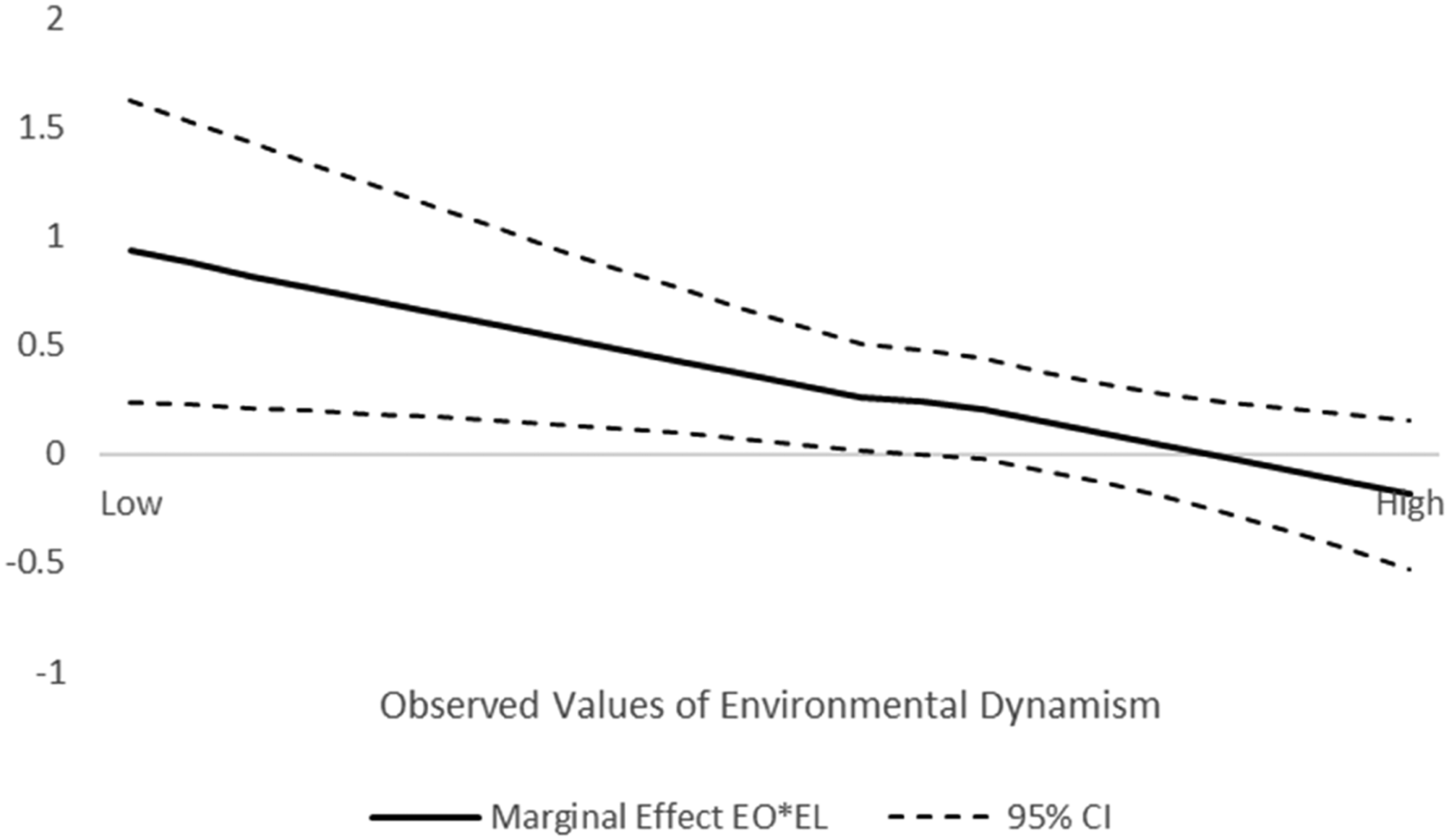
This analysis indicates two important issues. First, for a positive and significant link between EO and financial performance in Austrian family SMEs, entrepreneurial leadership needs to meet a certain threshold, which according to this study lies between low and medium levels of entrepreneurial leadership (see Figure 2). Reaping the benefits of entrepreneurial top-level decision-making requires a minimum level of entrepreneurial stewardship-oriented leadership behaviour in Austrian family firms. Second, how effective entrepreneurial leadership is in such firms depends on environmental dynamism. Environmental dynamism appears to be more beneficial at low and medium levels of entrepreneurial leadership (see Figure 3). We reason that environmental dynamism is a double-edged sword: while dynamic environments provide Austrian family SMEs with business opportunities, and consequently an external strategic fit with EO, at the same time they increase volatility and unpredictability. As can be seen under conditions of low and medium levels of entrepreneurial leadership, dynamic environments can compensate for shortcomings in entrepreneurial stewardship-related leadership behaviour by providing sufficient opportunities. However, when Austrian family firms display well-developed stewardship related to entrepreneurial leadership that strengthens opportunity recognition and exploitation, the negative effect associated with environmental dynamism becomes visible (see Figure 3). As a result, we find partial support for H1 and H3. While we find the EO–financial performance link in Austrian family firms to be dependent upon configurations of entrepreneurial leadership and environmental dynamism, we do not find a reinforcing effect. H2 is not supported.
Discussion
This article contributes to research demonstrating that the relationship between EO and performance is neither simple nor linear (Tang et al., 2008). We also find that Austrian family SMEs can only profit financially from EO when well-developed stewardship practices, related to entrepreneurial leadership, are in place or when environmental conditions provide an abundance of entrepreneurial opportunities. For family SMEs with an entrepreneurial stance, the highest performance is observed where there are configurations of high stewardship practices related to entrepreneurial leadership and high environmental dynamism. The poorest performance is observed among configurations of low stewardship practices related to entrepreneurial leadership and low environmental dynamism. So, in family SMEs, the non-linearities observed between EO and performance (Tang et al., 2008) might partly stem from specific configurations of internal stewardship-related elements and external environmental factors providing, or not providing, strategic fit with EO.
In line with stewardship theory (Howorth and Robinson, 2020), internal implementation mechanisms of strategy in terms of stewardship-related entrepreneurial leadership are crucial for family firms. We derive from this that entrepreneurial leadership is an effective stewardship practice that enables entrepreneurially oriented family SMEs to successfully develop an effective stewardship culture (Eddleston et al., 2011; Howorth and Robinson, 2020). They can overcome trade-offs between paternalism and entrepreneurship and related inertia (Chirico and Nordqvist, 2010). Entrepreneurial leadership builds upon stewardship principles such as employee empowerment and participation, trust and support, as well as visionary and intellectual stimulation (Fries et al., 2021; Zahra et al., 2008). Such leadership enables all members of family SMEs to recognise entrepreneurial opportunities and secure resources for their exploitation. Thus, entrepreneurial leadership turns family and non-family employees into stewards who intrinsically strive to reach the family firm’s entrepreneurial goals and create wealth for the family and the business. It also prevents family SMEs from falling into a ‘care taking’ mode (Koiranen, 2003) which grants little autonomy and freedom to employees to engage in opportunity recognition and exploitation and fails to develop the necessary level of sensitivity and attentiveness to available opportunities (Carmeli et al., 2010).
We have shown that family SMEs in Austria need to exert at least medium levels of stewardship-related entrepreneurial leadership to transform EO into financial performance. As such, we provide evidence that stewardship practices related to entrepreneurial leadership in the form of leading subordinates to challenging current situations, risk and creativity are a precondition for successful entrepreneurial endeavours by Austrian family SMEs. In situations when the entire family business is entrepreneurially alert due to their entrepreneurial stewardship orientation (Discua Cruz et al., 2013), entrepreneurial opportunities can even be detected in stable environments where such opportunities are rare.
Our research illustrates how this is the most conducive context for family SMEs to efficiently turn an entrepreneurial posture into performance. Stable environments can also provide external strategic fit with EO when family firms manage to overcome the potential disadvantages of their cultural peculiarities by adopting suitable strategy implementation mechanisms in the form of stewardship practices related to entrepreneurial leadership. This is an important contribution because although entrepreneurial leadership has been identified as a leadership style prevalent in family firms (Fries et al., 2021; Kansikas et al., 2012), performance implications and boundary conditions have not yet been investigated. Consequently, we show that in entrepreneurially oriented family SMEs, entrepreneurial stewardship practices are crucial for establishing strategic fitness (Beer et al., 2005). These findings extend the literature on entrepreneurial stewardship (Discua Cruz et al., 2013) which has focused on explaining collective entrepreneurial dynamics in family teams and their business portfolios. We add to this literature in two ways. First, by introducing a leadership perspective to entrepreneurial stewardship, we show that individual family assets are nurtured most effectively when stewardship behaviour focusses on expanding collective entrepreneurial dynamics beyond the family to include non-family members. Second, we extend this literature by showing how the implementation of strategic decision-making related to EO is dependent on entrepreneurial stewardship behaviour. In this respect, entrepreneurial leadership is not only an effective, but a necessary stewardship practice for overcoming the shortcomings of family firms in terms of introducing EO, such as risk aversion (Gómez-Mejía et al., 2007), temporal fluctuations of proactiveness (De Massis et al., 2014) or unfavourable attitudes towards innovation (Bergfeld and Weber, 2011).
Generally, the strength of the EO–financial performance link in family SMEs depends on configurations of internal and external factors, whereas extreme configurations (low–low vs high–high) undermine the EO–financial performance link. This finding indicates that environmental dynamism cannot be viewed solely as a blessing for small and medium-sized family firms, even when they have established an entrepreneurial stewardship culture conducive to EO. This finding is to some extent surprising, although not unprecedented in research on small businesses. Wiklund and Shepherd (2005) provide similar insights for small businesses in general, and based on a resource-based view, highlight that differentiation in terms of unique resource endowments might explain this finding. More specifically, they conclude that ‘EO can be used to overcome environmental and resource constraints’ (Wiklund and Shepherd, 2005: 85). Our study points towards a slightly different interpretation. For Austrian family SMEs, environmental dynamism appears to be a curse and a blessing at the same time. While it provides external strategic fit to EO, and facilitates reaping the financial benefits of EO, it does so only for family SMEs with low to medium stewardship practices related to entrepreneurial leadership. Consequentially, weakly developed stewardship cultures grant less autonomy and freedom to employees and non-leading family members to express and follow ideas and act as stewards. Here, the abundance of opportunities provided in dynamic environmental conditions makes up for a weak stewardship culture and leadership practices inconsistent with EO. However, as soon as family firms manage to align their business culture to EO and overcome cultural issues associated with the paternalism-entrepreneurship paradox (Chirico and Nordqvist, 2010), the downsides of dynamic environments become visible. Varying customer expectations, production and service trends, as well as unpredictable competitor actions diminish the managerial capabilities to predict the future outcomes and impacts of events (Khandwalla, 1977), and even pose survival challenges (Bettis and Hitt, 1995) even though stewardship practices related to entrepreneurial leadership increase the family firm’s strategic flexibility (Zahra et al., 2008).
The following managerial implications can be drawn based on this discussion. First, entrepreneurial family SMEs must strive for a true or entrepreneurial stewardship culture that stimulates entrepreneurship focussing on family firm prosperity. Promoting a trusting, open and cooperative environment, as well as strengthening psychological ownership and commitment, are important when doing this. Processes, communication and reward structures should stimulate entrepreneurial leadership among managers. Second, family firm leadership should actively engage in challenging well-worn paths, as our findings indicate that directing individuals on all organisational levels towards opportunity recognition and exploitation will pay off financially. Third, family SMEs should implement environmental scanning or monitoring systems to stimulate both an ongoing discussion of environmental changes and proactive action. Although environmental scanning is crucial, the information gathered then needs to be discussed in cross-organisational teams involving family and non-family employees to avoid misinterpretations while benefitting from the identification of entrepreneurial opportunities throughout the organisation. This holds true for small and medium-sized family firms where non-family member participation in strategic management processes is scarce, but provides valuable insight from outside of the family (Arzubiaga et al., 2018; Tabor et al., 2018). Thus, family firm managers should make use of strategic fitness processes that align the organisation to strategy and stimulate change-related strategizing and strategy implementation (Beer et al., 2005).
Our analysis is not without limitations but it does provide a solid foundation for future research initiatives. We applied a narrow definition of family firms, mainly capturing behaviour in the form of what has been described as ‘family entrepreneurial teams’ (Howorth and Robinson, 2020). The findings, therefore, might not be generalisable to situations with less active family involvement in management. Further, different types of family firms follow different strategies and goals (Westhead and Howorth, 2007). Testing the robustness of our findings using broader family business definitions and contrasting family firm types with each other might provide important insight into key boundary conditions. Our sample was limited to Western Austria, which is characterised by a specific institutional and cultural context that is driven by established family SMEs, particularly in the rural mountainous regions. There is evidence that institutional and cultural contexts might influence family firm behaviour and also form EO (Gupta and Levenburg, 2010; Howorth et al., 2010; Lee and Peterson, 2000; Wales et al., 2019). It would be especially interesting to investigate stewardship behaviour in emerging economies, as most research concentrates on developed economies in Western countries. Further, in emerging economies, environmental dynamics are characterised through greater economic, political and social instabilities, making strategizing even more difficult due to greater uncertainty (Hoskisson et al., 2000). Configurational research on family firms in emerging economies could account and compensate for this by, for example, investigating how dynamic political environments (e.g. rapidly and frequently changing rules and regulations) affect entrepreneurial practices. Summing up, while this study delivers valuable insights for family SMEs from developed institutional settings, especially from German-speaking Europe, future research should try to replicate and extend these findings within other cultures and regions (Yu et al., 2019).
Moreover, our study followed a survey design relying on single key informants. This procedure makes sense in terms of increasing sample size, efficiency and feasibility. Despite employing countermeasures to mitigate potential biases (Harrison et al., 1996; Podsakoff et al., 2012), they cannot be excluded entirely. Further, although the research design and approach to analysis ‘can be used effectively to test multilevel models’ (McKenny et al., 2013: 598), we acknowledge that the investigation of multilevel factors influencing family firm performance would benefit from more complex approaches to sampling and data collection (i.e. multiple respondents and data sources) as well as other multilevel analysis approaches (McKenny et al., 2013). Therefore, future studies should prove the robustness of the results by applying other methods and using different data.
Conclusion
This article investigates how effective true stewardship behaviour is entrepreneurial in nature (Howorth and Robinson, 2020; Miller et al., 2013). Focussing on the effectiveness of actual stewardship behaviour related to entrepreneurial leadership and its environmental boundary conditions, we extend existing research on the EO-performance link in family firms. Previous research has relied on proxies of stewardship behaviour such as the family membership of executives or family involvement (Bauweraerts et al., 2021; Casillas et al., 2010). While such factors might be indicative of family commitment, this is a necessary, albeit insufficient condition of entrepreneurial capabilities (Zahra et al., 2008). Committed family leaders, following actual stewardship practices, such as entrepreneurial leadership, create productive conditions within these circumstances. Consequently, by focussing on actual entrepreneurial stewardship practices (Discua Cruz et al., 2013), this research makes an important contribution through an explanation for contradictions revealed in the extant literature regarding whether or not family firms are entrepreneurial in nature (Casillas et al., 2011; Gimenez-Fernandez et al., 2021; Hernández-Linares and López-Fernández, 2018). Introducing a leadership perspective to the current debate, this research identifies how the existence of entrepreneurial stewardship practices embedding all (family and non-family) members of family SMEs into collective entrepreneurial dynamics addresses this question.
We also contribute to the research investigating environmental influences on family SMEs (Casillas et al., 2011; Chirico and Baù, 2014; Yu et al., 2019). Following a stewardship perspective (Davis et al., 1997), our results provide evidence that while entrepreneurial configurations indicating the strategic fitness in family SMEs (EO coupled with stewardship practices related to entrepreneurial leadership) provide mechanisms to cope with dynamism in the environment, they do not completely circumvent the disadvantages that accompany such dynamism. Overall, family SMEs still achieved the highest financial performance in situations where an EO was facilitated through stewardship practice related to entrepreneurial leadership and high environmental dynamism. However, the EO-performance link itself turned out to be weaker under such circumstances. Consequently, environmental dynamism is a double-edged sword, both facilitating and impeding the transformation of EO into family SME performance. While environmental dynamism provides entrepreneurial opportunities for family SMEs, it also involves survival challenges making predictions difficult (Bettis and Hitt, 1995; Khandwalla, 1977). These challenges become visible once family SMEs are perfectly aligned internally in terms of entrepreneurial stewardship-related leadership and strategic decision-making. This adds to existing research on EO and environmental dynamism in family firms (Casillas et al., 2010; Yu et al., 2019), as well as in general terms (Wiklund and Shepherd, 2005), by providing a more fine-grained understanding of how environmental dynamism influences entrepreneurial configurations in family SMEs.
Footnotes
Acknowledgements
Funding
ORCID iDs
