







Abstract
Introduction
West African countries are transforming rapidly into ‘biometric states’ by subscribing to European migration actors for the erection of virtual borders with biometric ID identifiers, surveillance technologies and central migrant databases. Biometric facilities and IT equipment such as the Migration Information and Data Analysis System (MIDAS) have been installed across a number of West African countries.
Europe’s tightening of West African border corridors evidence some ugly aspects of profuse policisation which seriously undermine both the European and West Africa’s security objectives. Currently, there is serious intensification of the security practices of the European Border and Coast Guard Agency, Frontex, in third countries (Donko et al., 2022; Léonard & Kaunert, 2020), including criminalisation of migrants and refugees (Bello, 2022; Fargues, 2020) and human rights abuses (Ligouri, 2021). Such incidents are reported in the Agadez region in Niger, and along the borders with Burkina Faso, Mali and Nigeria. Economic Community of West African States’ (ECOWAS) citizens are randomly harassed, arrested and stopped by Nigerien border security officials, working alongside Frontex border guards on the suspicion of irregular transition from Libya to Europe (Brachet, 2018). More compelling is the often overlooked migrants’ burgeoning mobility capital – the daily struggles, resilience and expanding migrant-smuggling complex (Iwuoha, 2020), through which they forge agentic mechanisms to negotiate and control their own mobilities, informally.
Academic literature on European externalisation policies and biometrics cooperation in Africa traverse binary themes of border securitisation and human rights (de)protection (Donko et al., 2022; Lavenex & Piper, 2022; Thevenin, 2021). While the EU’s collaborative interest prioritises migration management, return and reintegration contexts (Frowd, 2018; Galya & Volker, 2021), West African partners mainly show interest in the donor-funding and security aspects of intra-regional mobility (ECOWAS Strategic Plan 2011-2015, 2011, p. 13). Border externalisation, thus, asserts polemical and lopsided migration power relations between the West and the Global South (Acharya, 2016; FitzGerald, 2020; Iwuoha, 2019). The African Union views externalisation as a strategy for extending the control of African territorial space (Prentzas, 2021) with increasing politicisation of national and regional migration and biometric policies (Creta, 2021; Iwuoha & Mbaegbu, 2021). However, there is a paucity of data on the connection between EU externalisation practices, especially its ‘biometric bordering’ aspects, and the rippling effects on (im)mobilities in West African borderlands. This commentary precisely addresses this gap.
Focusing on the Niger’s experience, we spell out three important contributions. First, we explain how the new European biometric infrastructures are used to produce racialized and gendered subjects through consistent migrant identity de(re)construction. This subverts African states’ administrative, decisional, sovereign and territorial prerogatives. In doing so, we highlight the biometric complicity dimensions that implicate both the European and national government actors in criminalising vulnerable migrants and deepening inequalities on access to free movement in West Africa. Second, we conceive the concept of ‘biometrics power’ to demonstrate the specific modality of neoliberal forms of (biometric) power relations which perpetuate global inequalities in biometric identification and (im)mobility governance. Third, we show migrants’ agentic mechanisms, especially illustrating how moral mobility agents contest European biometric borders, via discoveries and implantation of parallel border routes.
We adopt qualitative research methods, using case study method and grounded theory. This helps us to understand the European biometric border intervention contexts, processes and outcomes in the case of Niger, learning from their cause and effect relationships. The use of grounded theory helps us to frame the concept of biometric power to explain why events happened the way they did. We are able to describe the specific modality of neoliberal forms of (biometric) power relations which perpetuate global inequalities in biometric identification and (im)mobility governance.
European Biometric ID System and West African Borders
The biometrics ID system has become the new frontier of EU migration control in West Africa. A number of European biometric ID technologies have been established across African borders for the purpose of migrant data collection, verification and storage in centralised databases. This enables European migration actors to seek to externally control migration in West Africa. One of these biometric technologies is the fingerprint data collection machine, MIDAS, which had been developed by the International Organization for Migration (IOM) and mounted at several border posts between Burkina Faso and Niger (Kantchari-Makalondi), Benin (Malanville), Nigeria (Dan Issa/Farou, Dan Barto, Sassoumbroune and three other borderlands) and Mali (Kundikaré) (Dauchy, 2023).
Importantly, the EU biometric program is boosting the expanding biometrics and digital identity market in Africa. The fast-rising biometrics market in Africa is estimated at €1.4 billion (Aït-Hatrit, 2020), growing at an annual rate of 21% above other world regions (Toesland, 2021). This is because almost half a billion people in Africa have no proof of identity (World Bank, 2021). For this reason, the World Bank rolled out the West Africa Unique Identification for Regional Integration and Inclusion (WURI) Program in 2018, at the cost of US$395.1 million. WURI participants include Côte d’Ivoire and Guinea (Phase I), and Togo, Benin, Burkina Faso and Niger (Phase II). These countries had been given directives to implement biometrics ID programs as a precondition for their citizens to gain access to basic services – health and pension, banking, social registries, and more importantly, cross-border mobility. The World Bank provided €4.4 million to ECOWAS, €1.8 million to Côte d’Ivoire, and €5.3 million to Djibouti for biometrics ID programs (World Bank, 2020).
The EU Emergency Trust Fund (EUTF) for Africa was the major source of funding for the expansion of the EU biometrics agenda on the African continent as a whole. The EUTF, conceived in November 2015 at the Valletta Summit, is pivotal for the exercise of effective control of developments across migration routes by key EU institutions. By 2018, the EUTF budget had climbed to €3.4 billion, while a further €5 to €9 billion had been proposed for 2021–2027 (Claes & Schmauder, 2020). In 2016, EUTF set up €500 million bilateral Migration Partnership Frameworks (MPF) in West Africa, involving Ethiopia, Nigeria, Niger, Mali and Senegal, as a direct response to the ‘migration (governance) crisis’ faced at the EU external zones.
European Union, Biometric Power and Territoriality
The EU plays a crucial role as a supranational policy entrepreneur by enabling normative construction of asylum and migration policy in third countries (Kaunert, 2009, 2010). EU cooperation on asylum matters has significantly increased the legal standards applicable to asylum-seekers and refugees. There is ongoing debate on the impact of EU ‘system of venues’ and/or ‘shopping for venue’ in asylum policy-making. Some scholars argue that the switch to an EU venue for asylum policy-making helps to promote a more liberal and less restrictive asylum policy-making (Kaunert & Léonard, 2012). This supports the claim that the EU asylum policy facilitates the strengthening and codification of several rights for asylum-seekers and refugees and not generally designed for their ‘securitisation’. What has therefore impacted significantly on the ability of asylum-seekers to gain access to asylum systems in the EU are the links constructed between asylum, irregular migration and terrorism in Europe in recent years (Léonard & Kaunert, 2019). Besides, the EU seeks to establish an integrated management system for external borders with a view to ensuring a high and uniform level of control of persons and surveillance at the external borders (Kaunert & Léonard, 2012).
In this context, European externalisation via biometrics can be better understood as part of a border infrastructural upgrade and spatial stretching (Amoore, 2006) on the African continent. Biometrics thus represents a specific modality of European border infrastructure control instrument, which is designed to streamline (im)mobilities. This system in turn goes on to reproduce, challenge and subvert the state border as process, institution and symbol. While enforcing ‘govern-mobility’, European biometrics not only control (im)mobilities but creates its own biometric citizenship (Amoore, 2013) and biometric nationality (Iwuoha and Martin, 2023), which do not necessarily overlap with state citizenship or nationality.
FitzGerald (2019) notes that direct state control over space and geographic borders is of declining significance and that states outsource or externalise their monopoly of migration control by way of extra-territorialisation. A duplication of borderland territorial control represents a process of hyper-territorialisation. Manipulation of territoriality is critical both for logic and practice, resulting in states sharing the legitimate means of coercion over (im)mobilities in such a way that questions or undermines Global south state sovereignty. Externalisation of migration control thus de-powers or denies the state its prescriptive monopoly over the legitimate means of movement (Torpey, 2018). Biometrics operates as a remote control (FitzGerald, 2019), articulating divergent forms of migratory enforcement at the edge of a state’s territory. van Munster and Sterkx (2006, p. 238) describe de-territorialisation as the increasing external control of state territorial borderlands despite the continuing geographical location and symbolic value of borders. De-territorialisation encourages acts of rebordering, involving an uptick in ‘boundary control and boundary congruence’ to the advantage of an externalising power (Popescu, 2012, p. 77).
This gives us a glimpse of how the intrusion of digital technologies into border management has significantly transformed nation-states, sovereignty, territory and borders as well as redefining their interactive effects. Particularly, the militarisation and biometricisation of borders has led to the re-articulation, stretching and expansion of state’s sovereignty (Jones et al., 2017; Jones & Johnson, 2016). In doing so, biometric technologies diminish state sovereignty and imperium, while creating territorially unbounded political authority (Longo, 2017). For example, biometric power – such as border-data sorting and storage – has been unilaterally exercised by European authorities to systematically control (im)mobilities, including the exclusion, oppression and criminalisation of unwanted migrants (Metcalfe & Dencik, 2019). With biometric incursion into bordering, state’s power over borders and borderland territories has been partially suspended or totally lost; superimposed and/or externalised. Amelung and Machado (2019, p. 392) use the term, bio-bordering to describe how the territorial foundations of national state autonomy are partially but purposefully suspended when establishing biometric data exchange. In essence, the European biometric bordering (combined with external-troops securitisation) has intensified and externalised spatial control of West African borderland territorial spaces. This foregrounds the creation of a biometric territorial space controlled by external powers. More importantly, this process reinforces the atomisation and minoritisation of national state’s migration-control power over the biometricised borderlands. This implies that West African countries that subscribe to this European biometrics border partly exchange their own sovereignty over the control of their borderland territorial spaces.
Criminalisation and Securitisation of (Im)mobilities
Clampdown on Migration Industry and Economic Depravity
Free mobilities underscore the prevailing mixed migratory shifts involving over 450 million West African residents. Only a few ECOWAS citizens hold a passport or travel document as this was never a precondition to transborder migration. Previously in Niger – a popular anchorage for mixed migration (labour, trade and services, agricultural, mining), – ECOWAS citizens who had no travel documents stayed safe or moved freely without them. Foreigners enjoyed unrestricted transborder movements, and their transporters faced no outright restrictions. At a point, a disturbing increase in migratory influx into Europe, through the Libyan borders, incensed Europeans who pressured Niger to crackdown on this through-migration. For example, in 2016, the IOM indicated that at least 333,891 individuals transited from northern Niger into Libya.
On 26 May 2015, the Nigerien government enacted Law 2015-36 which distinguished ‘legal’ and ‘illegal’ migration (République du Niger, 2015). The law, effective from 2016, had other repressive policy initiatives, inspired by the 2015 Valetta Summit. Niger’s migration policy, described by Nigeriens as the ‘diktat of Europe, to which the Nigerien authorities obeyed to hit the jackpot’ (Tubiana et al., 2018, p. 30) focuses on (1) repressive measures to toughen and deter migration; (2) facilitating development cooperation to create alternative livelihoods to the migration industry; and (3) achieving voluntary migrant return to West Africa through the IOM (Müller, 2018, p. 38).
The EU initially sent €140 million to the Nigerien government to control illegal migration, but Niger demanded €1 billion (Reuters. 2016). Niger received €230 million in 2018; and additional €600 million in 2020 from the EUTF (Claes & Schmauder, 2020).
Prior to the 2015 notorious anti-immigration law, migrants travelled freely and uninterruptedly across the borders in buses and trucks legally operated by private companies, such as Rimbo. So abruptly, the new law prohibited the transportation of migrants as ‘illegal trafficking of migrants’. From 2016 to 2018, Niger’s security officials made suspicious arrests of migrant facilitators, including 282 drivers, truck owners, ‘coaxers’ (intermediaries) and ‘ghetto’ owners sheltering migrants, and seized about 600 vehicles (Claes & Schmauder, 2020). In the first half of 2017, more than 10,000 foreigners were either harassed, detained at the borders or chased out from Niger. This forced down the number of foreigners transiting through Niger from 350 per day in 2016 to 60–120 a week in 2018 (Tubiana et al., 2018).
Before the 2015 law, the migration economy in northern Niger provided livelihoods to at least 100,000 people, but in 2017 the number had declined to 6565. Providing alternative income and livelihoods for disengaged borderbrokers could cost the EU an estimated €400 million. However, only 371 border brokers received small amounts, about €2300 ($2616) per person to start a new life; an additional €8 million were mapped out for the second phase that would accommodate up to 600 smugglers from March 2019 (Zandonini, 2019). Apart from the complaints of many neglected uncompensated smugglers, the €2300 dished out was peanuts compared to the amounts that each smuggler earned while in the jungle hustle. This generally caused great discontent among local beneficiaries from the migration economy. More importantly, on the one hand, the locals vehemently questioned the transparency in funds distribution by politicians; and on other hand, they fault the EU for over-focusing on the securitisation aspects while neglecting development-cooperation agreements.
Migrants Challenge Their Biometric Instrumentalisation and Securitisation
Old and New Irregular Migrant Routes Reported by Niger Authorities.
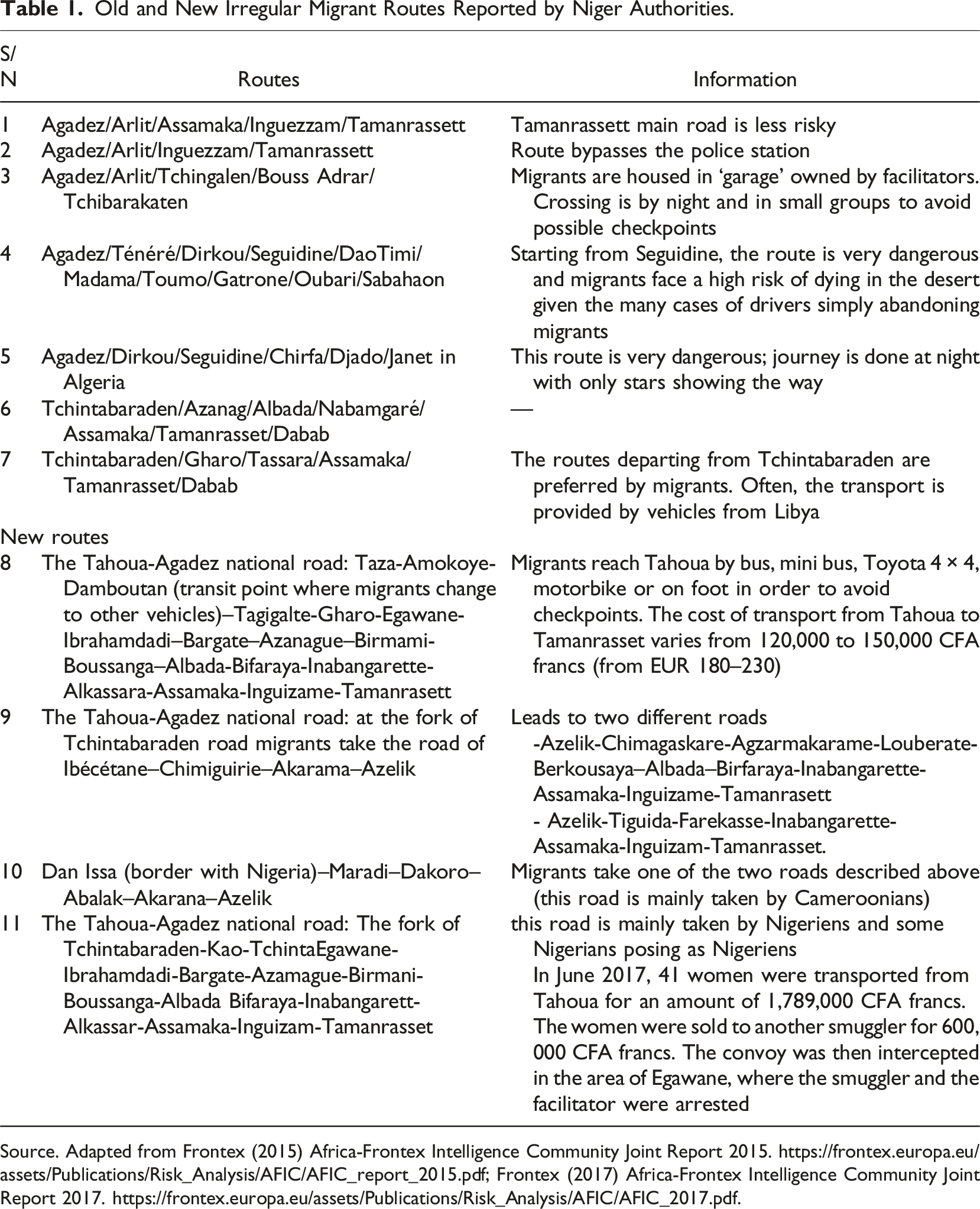
Source. Adapted from Frontex (2015) Africa-Frontex Intelligence Community Joint Report 2015. https://frontex.europa.eu/assets/Publications/Risk_Analysis/AFIC/AFIC_report_2015.pdf; Frontex (2017) Africa-Frontex Intelligence Community Joint Report 2017. https://frontex.europa.eu/assets/Publications/Risk_Analysis/AFIC/AFIC_2017.pdf.

Old and New Irregular Migrant Routes in Niger.
Nevertheless, agentic acts have increasingly become a very costly and life-threatening venture; the routes had been too dangerous and risky with only a few ‘professional’ drivers able to navigate through them (Tubiana et al., 2018). Smugglers now resort to midnight travel to facilitate ‘deborderisation’, as security officials rarely operate after midnight. Military patrols sometimes fire bullets at the truck’s tyres to stop, often faster, drivers – at times wounding migrants sitting at the back of the truck (Molenaar et al., 2017). In most cases, the drivers abandon their passengers once they have sighted either bandits or security operatives chasing them. Some of the migrants were abandoned in difficult terrains along the first stretch of the road to Puits Espoir (Hope’s Well), in the middle, or even as far as the Dirkou oasis, midway to Libya – a stretch of perilous road infested by chronic banditry. More than 1000 migrants were abandoned in 2017; while the number of deaths recorded in the desert along the Niger-Libyan route increased from 71 in 2015, 95 in 2016, to 427 in 2017. Migrant mortality, mainly resulting from dehydration, surged with at least 38 migrant deaths recorded every month, as against 11 deaths prior to the implementation of the new migration law; June became the worst of months with migrant deaths rising to 40, 55 and 130, in 2015, 2016 and 2017, respectively. Particularly in 2017, more than 70 migrant deaths were recorded in May, July and October (Anacko, 2017; IOM, 2017; Tubiana et al., 2018). As of June 2023, IOM has rescued more than 97,700 vulnerable migrants, of which 89% were men, 5% women and 6% children; and supported 640 victims of trafficking as well as 1550 unaccompanied migrant children. Also, IOM completed more than 151,750 medical consultations and referred over 4380 migrants to medical care (IOM, 2023). This shows the health impacts of the migratory risks to which the vulnerable migrants, including women and children, had been subjected. Migration fees have skyrocketed too. As against €120–€300 from Agadez to the Libyan border, migrants paid up to €400 or as high as XOF 300–600,000 (€450–900) in a denser truck that sardined 15–30 people. About €1400 is charged for small group trips (Müller, 2018). On one occasion, four arrested drivers paid XOF 1.5 million (€2300) each to security officials to escape (Tubiana et al., 2018).
Both migrants and smugglers had been very resistant and extremely determined to defend, perpetuate and control their own borderscapes in defiance of the EU’s rebordering measures. For example, Agadez Regional Council President Mohamed Anacko stated that ‘We’re trying to persuade the youth to respect the law but we lack arguments’ (Tubiana et al., 2018, p. 28). This has obviously shown the deficits of EU biometrics rebordering and securitisation in Niger. With declining moral authority and a compromised security sector, state authorities have turned back to smugglers; they recruited some smugglers to clamp down on their former colleagues (who are still in business), and to arrest, detain and expel migrants. Such ‘volunteers’ or ‘partners’ were rewarded handsomely from the EU funding. On the other hand, some of the Libyan Tubu militants, even though they were also smugglers and vehicle owners, mounted and signposted themselves as official border guards, and earned income by taxing both migrants and smugglers at installed checkpoints. These further polluted or repudiated the European biometrics rebordering and struggle to replicate ‘actual borders’ as against the many ‘arbitrary borders’ and checkpoints which have sprang up under their nose with little or no control.
A rapid process of migrant re-containerisation has also taken shape. Before the clamp down on ghettos and their operators including pick-up truck drivers in 2017, the Nigerien police recorded about 70 ‘ghettos’ in mudbrick compounds in the Agadez city alone which containerised migrants who spent weeks or months preparing for their onward trips. But subsequently, after going underground, it became impossible to count the number of resurrected and newly planted ghettos. Now, the ghettos are more invisible, discreet and mobile with the gates always shut, constantly changing locations, along Arlit, Dirkou, and Séguédine; and increasingly run by foreigners with formidable and elastic networks, including Senegalese, Cameroonians, Gambians, Nigerians and Guineans. These ghettos had been terribly overpopulated, having up to 200 people in one ghetto, and consequently, unsanitary, unhealthy and extremely risky, particularly without healthcare. Nevertheless, migrants accept these conditions in so far it guaranteed their unfettered northbound movements. They even pay higher smuggling fees which have quadrupled to the range of XOF 500,000 (Molenaar et al., 2017). This situation proves the extent to which migrants are determined to control their own migratory patterns and (im)mobilities despite the present challenges.
Conclusion
Ironically, the EU border biometricisation and securitisation unwittingly entrenched smugglers’ ‘deep placement’ and not ‘displacement’ in the borderland. The whole equation illustrates the migrant-borderbroker complex in which moral mobility agents challenge the European Union’s rebordering scheme. First, with the benefit of their ‘deep placement’ or ‘rootedness’ in borderlands, borderbrokers (‘smugglers’) help migrants to achieve and control their own mobility aspirations. Second, through the act of ‘debordering’, they re-enact free movement for migrants as enshrined in the 1979 ECOWAS framework. Third, while inventing new migratory routes they renegotiate borders by ‘decentering European external borders’; and by so doing, fourth, they demonstrate contested degrees of ownership or possession of borderlands as against state-centric/external border control. This is possible through increased non-state transnational sociospatial cooperation and networking (Olukayode, 2016). Simply put, the migrant-borderbroker complex bluntly asserts migratory emancipation and audacious control of ‘reclaimed’ borderscapes. This reinvents/reinforces a historical and traditional sense of free movement exercised prior to the enactment of the colonially determined borders.
The EU’s approach to expanding its border control is ineffective and unsustainable, marred as it also is by state corruption. Its efforts to invest in, and spur, programs for improved local economic and life opportunities to reduce the desire or felt need for migrants to decide to travel abroad were limited in scope and not effectively implemented by government. There continues to be a need for workable and inclusive policies to provide sustainable economic opportunities that may dissuade local people from seeking to travel by irregular means. The circumstances, stories, and any lessons drawn from them here, are not exclusive to Niger but should be seen as potentially applicable to some other African states, especially the transit states in regions where the EU has pursued the implementation of similar border securitisation.
Footnotes
Declaration of Conflicting Interests
The author(s) declared no potential conflicts of interest with respect to the research, authorship, and/or publication of this article.
Funding
The author(s) disclosed receipt of the following financial support for the research, authorship, and/or publication of this article: This project is funded by the British Academy with funding number: VF2/100815.
Ethical Statement

Data Availability Statement
Research data for this study is with the researchers and can be shared upon request.