







Abstract
The role of ‘urgency’ is inherently linked to International Relations (IR) as many of the main research topics such as humanitarian crisis, environmental degradation, nuclear proliferation and violent conflict are considered to be pressing issues which need to be addressed quickly in order to prevent disasters. The notion of ‘urgency’ has been studied in a number of different strands of IR literature including securitization theory and its constitution of ‘imminent’ threat (Jensen & Stepputat, 2013; Patomäki, 2014) or the literature on the role of time in IR (Hom, 2020; Hutchings, 2008; Jarvis, 2009; McIntosh, 2020; Solomon, 2014).
This research note wants to bring ‘urgency’ to the fields of insurgency and internal displacement and investigate if the construction of ‘urgency’ in media reporting on insurgency can be linked to an increase in internal displacement. While the straight forward explanation for internal displacement in situations of insurgency points to increased levels of violence, others have emphasised the role of geography; infrastructure, social networks and the media in such conflict (Adhikari, 2012, 2013; Braithwaite et al., 2020; Davenport et al., 2003; Lee, 2019; Lischer, 2007; Melander & Öberg, 2007; Schmeidl, 1997; Turkoglu & Chadefaux, 2019). This paper suggests that it is not only levels of media reporting which are important to understand internal displacement, but it is about
We want to tentatively investigate this connection in the form of a plausibility probe. As Eckstein (1975, p. 108) points out, ‘plausibility probes involve attempts to determine whether potential validity may reasonably be considered great enough to warrant the pains and costs of testing’ in more detail and with more resources. It is meant as a first step to see whether such a direction is potentially fruitful for further investigation. It is not a comprehensive study which tests the various hypothesis in the validity of their causal explanations.
Urgency is here understood as a feeling of pressure to act due to time considerations. It is a feeling of concern which calls for action and in which there is less time for critical refection on costs and benefits or push and pull factors. In order to grasp ‘urgency’ in media reporting the research note suggests a method of predicate analysis which is concerned with how something is presented to be by focusing on the nouns, verbs and adjectives which predicate the phenomenon into a particular kind of situation. By employing a variety of thesaurus and dictionary we deductively developed a set of ‘urgency’ words which was used as part of the search criteria in the analysis of media reporting on insurgency in Nigeria between 2011 and 2019. Our hypothesis was that the number of ‘urgency’ words will correlate with the level of internal displacement.
The main contributions of this short research note are that it picks up a method of predicate analysis, which has not received much attention in IR, and in a plausibility probe indicates that the predicative construction of (ins)urgency could be important to understand the connection between violent conflict and internal displacement. It thereby mainly wants to contribute to the literature on internal displacement during violent conflict by showing that the constitution of urgency in media discourse could be a contributing factor in the rise of internal displacement. At the same time, it wants to encourage others to rethink the merits of predicate analysis as a discourse analytical method which can serve as a bridge between post-positivist notions of discourse and positivist understandings of hypothesis testing.
In order to investigate this assumption, the research note will be structured as follows: section one will briefly elaborate on the conflict with Boko Haram in Nigeria and indicate some of the suggested direct and indirect linkages between insurgency and internal displacement. Section two turns to the role of the media in insurgency and internal displacement as well as the research on the constitution of urgency in crisis. Section three will elaborate on a method of predicate analysis and reflect on the data selection. Section four will investigate the media reporting by four major Nigerian news outlets (
Boko Haram, Conflict and Internal Displacement in Nigeria
Since the onset of the Boko Haram insurgency in 2009, more than two million individuals have been displaced in Nigeria’s north-eastern region (2022), with this migration being considered primarily driven by the group’s violence, expanding territorial influence, and the resultant instability (Campbell & Harwood, 2018). The conflict between Boko Haram and the Nigerian state involves complex ideological, socio-political, and military factors. At its core is the clash between Boko Haram’s extremist views and Nigeria’s secular government. The group’s origins lie in the ambition to create an Islamic state governed by strict Sharia law, challenging Nigeria’s secular constitution. Initially, Boko Haram’s founder, Mohammed Yusuf, framed the group’s opposition to Western-style education as a critique of the government’s failure to address poverty and corruption in the northern region (Onuoha, 2014). Consequently, the insurgency reflects not only a religious struggle but also a response to socio-economic grievances.
The internal displacement crisis in Nigeria is primarily concentrated in the northeastern states of Borno, Adamawa, and Yobe, where Boko Haram’s activities have been most intense. The insurgents’ targeted attacks on villages and towns, coupled with abductions and mass killings, have forced entire communities to abandon their homes and livelihoods (Okereke, 2017). According to the Internal Displacement Monitoring Centre (IDMC), Nigeria has 3.6 million internally displaced people as of 2023, placing it among the top nations with a sizable displaced population. In the following paragraphs we want to briefly review some of the literature and arguments on the causes of internal displacement in Nigeria by focusing on firstly direct violence by Boko Haram, secondly, the role of indirect violence of the conflict between Boko Haram and the Nigerian state and thirdly on failures of government.
Direct Violence by Boko Haram
Attacks by Boko Haram have taken many forms, including suicide bombings, pillages, and the destruction of entire towns and villages. Beginning in 2010, Boko Haram has been accountable for a number of well-known attacks, including the 2011 bombing of a United Nations post in Abuja that claimed the lives of at least 21 people and injured numerous others (Mukhtar et al., 2018). Another noteworthy instance is the 2013 terrorist attack on a Kano bus terminal that killed twenty people, and the 2011 Christmas Day bombing of a Madalla church that killed at least thirty-seven people (Eme et al., 2018). One of the most well-known attacks was the 2014 kidnapping of 276 schoolgirls from the town of Chibok, which sparked the #BringBackOurGirls movement (Kanu et al., 2019).
Literature that examines the linkage between internal displacement and insurgency by Boko Haram in Nigeria points to the direct effects of such violence by Boko Haram which forces people to leave the conflict zones in an attempt to escape the widespread chaos and fear that these attacks have caused in the impacted areas. Much of the literature argues that the majority of the time, residents have been forced to flee due to the terror that Boko Haram has caused. Villages and towns within the group’s operational area have been systematically destroyed, and those that remain have been forced to relocate. The insurgency’s violent tactics, including bombings, kidnappings, and village raids, have created an atmosphere of insecurity, compelling many residents of the affected regions, particularly in northeastern Nigeria, to flee their homes for safety (Omogunloye et al., 2023).
Indirect Violence of the Conflict
Others hold that internal displacement is due to the larger conflict between Boko Haram and the Nigerian state. The literature on the direct link between violence and internal displacement holds that the violent conflict between Boko Haram and the Nigerian state has significantly contributed to the rise in Internally Displaced Persons (IDPs) within and outside the country. So internal displacement is not only due to the violence committed by Boko Haram but also the result of the violent response of the Nigerian state. In an attempt to contain the group and restore peace to the affected areas, the Nigerian government has implemented several military tactics in response to the emergence of Boko Haram’s insurgency (Iwuoha, 2019). As some authors have pointed out, few, if any, of these counterterrorism measures have been able to lessen Boko Haram’s operational capabilities without also causing internal displacement, as fighting between the insurgents and counterinsurgency forces frequently results in innocent civilians becoming refugees within their own nation (Iwuoha, 2019).
Air strikes have been one of Nigeria’s primary counterterrorism measures. Air raids on Boko Haram-occupied areas and military campaigns in conjunction with regional forces supporting the Multinational Joint Task Force (MNJTF) were among the operations, which are primarily carried out with the aid of other countries like the United States and the United Kingdom, and which target Boko Haram enclaves (Iyekekpolo, 2016). However, there have been instances where these operations have resulted in disproportionate collateral damage, with airstrikes specifically targeting populated areas, levelling buildings, and forcing residents to relocate internally. As an example, in 2017, the Nigerian Air Force accidentally conducted an airstrike on a refugee camp in Rann, Borno State, Nigeria, killing over 100 individuals, including civilians and aid workers fleeing the terrorist organization Boko Haram (Omogunloye et al., 2023). This incident brought to light the perils of the government’s military-oriented approach, which, while necessary to defeat Boko Haram, resulted in the indiscriminate killing of innocent bystanders. Similarly, the Nigerian military’s ground operations, in coordination with foreign forces, have also resulted in the eviction of local inhabitants. According to Saka and Bojang (2022), for instance, joint operations in Borno State’s Baga and Dikwa have resulted in widespread displacement as locals are caught in the crossfire between Nigerian troops and Boko Haram terrorists.
Government Failure
A third strand of literature points to government failures as a means of explaining internal displacement. For example, Kamta et al. (2021) contend that displacement within the Lake Chad Basin arises from intersecting socio-political vulnerabilities – including poverty, unemployment, systemic inequality, and community marginalization – which collectively foster insecurity, conflict, and displacement, while simultaneously enabling the proliferation of armed groups like Boko Haram. Targba (2022) and Mukhtar et al. (2017) posit that the perceived inadequacy of Nigeria’s leadership in addressing fundamental national imperatives, including employment generation, equitable resource allocation, and infrastructural advancement, serves to exacerbate the prevailing insecurity within the country. This dynamic is said to be further exacerbated by the marginalization and displacement of communities, as these conditions heighten the likelihood of insurgent activities, with aggrieved individuals often resorting to joining or forming insurgent groups as a means of addressing grievances and securing vital resources (Letswa & Isyaku, 2018; Metelits, 2009). So internal displacement in Nigeria is predominantly considered a consequence of political instability, manifesting through phenomena such as coups, civil wars, and persecution wherein the collapse of state mechanisms to uphold order or protect citizens from widespread violence (Fisk, 2020; Simeon, 2024).
Internally Displaced Persons centres themselves can also contribute further to internal displacement as they are frequently overcrowded and devoid of sanitary facilities, food, medical supplies, and other necessities (Izuakor, 2022). In many cases, displaced individuals have fled to overcrowded and under-resourced IDP camps, where conditions are harsh, and access to basic services like healthcare, education, and clean water is limited. The inadequate living conditions in these camps have led to secondary displacement, where individuals leave the camps to seek better living standards elsewhere, thus perpetuating a cycle of internal migration and insecurity (Salleh et al., 2018).
Media, Insurgency, and Internal Displacement in Nigeria
While the research on the direct and indirect relationship between insurgency and internal displacement migrations is well-established (Adhikari, 2012, 2013; Davenport et al., 2003; Lischer, 2007; Melander & Öberg, 2007; Schmeidl, 1997; Turkoglu & Chadefaux, 2019), the role of media in insurgency and its relation to displacement is still somewhat understudied. The impact of media on insurgencies has become increasingly significant in contemporary conflicts, influencing public perception and shaping narratives (Auwal & Ersoy, 2024; Brittain-Hale, 2023; Manekin & Wood, 2020). Media serves not only as a tool for information but also as a catalyst for mobilization and strategy within insurgent movements. Platforms such as Twitter, Facebook, and Telegram enable insurgent groups to broadcast narratives, recruit followers, and coordinate activities while bypassing traditional media channels. This digital revolution has reshaped the nature of insurgency, upping the stakes in information warfare and use of strategic narratives; transforming recruitment strategies, operational tactics, and the overall fabric of insurgent movements worldwide (Betz, 2008; Romaniuk et al., 2024). The ubiquity of social networking services allow insurgents to rapidly disseminate information and mobilize support while evading traditional forms of surveillance and control. By leveraging the inherent anonymity and vast reach of social media, insurgents can operate with greater flexibility and resilience, making it challenging for authorities to effectively monitor and counter their activities (Schingh, 2024). In the same vein, the impact of traditional media on insurgencies has become increasingly significant in contemporary conflicts, influencing public perception and shaping narratives (Betz, 2008; Gilboa, 2009). Traditional media plays a crucial role in shaping societal dynamics, public perceptions and policy responses to insurgency by disseminating information, influencing beliefs, attitudes, and behaviours, and potentially mobilizing support or opposition (Forest, 2009).
The role of Nigerian traditional media in shaping public perception of insurgency has been significant (Hamid & Baba, 2014; Ngige et al., 2016; Yusuf et al., 2022). They have played a major role – both positive and negative – in shaping public perception and discourse framing around insurgency, particularly the Boko Haram crisis (Okey-Ogueji, 2016). Traditional media outlets, including newspapers, radio, and television, have the ability to influence public opinion through their coverage and framing of events (Payne, 2008). A discourse study of the application of linguistic tools in media reporting of conflict events examined how selected Nigerian newspaper headlines addressed the issue of insurgency (Ebebe et al., 2021). It found that traditional media often sensationalize insurgency news, which can heighten public fear and anxiety (
A comprehensive study highlighted the use of six distinct frames in broadcast media coverage of Boko Haram: fear frames, horror frames, war frames, peace frames, hope frames, and unity frames (Gever & Nwabuzor, 2018). Another study enumerated other frames in media reporting of Boko Haram activities,
A Method of Predicate Analysis
While discourse analysis in general has thrived in IR and we now encounter different discourse analytical methods such as critical discourse analysis, metaphor analysis or narrative analysis (Neumann, 2008; Hansen, 2013; Jackson, 2005; Spencer, 2010; 2016) when investigating most topics of international politics, predicate analysis is not very common. While predicate analysis was one of the very first suggestions by early discourse scholars in IR such as Doty (1993) and Milliken (1999), the idea has since not been developed further. One reason for this may be that it is concerned more with individual words and is closer to notions of content or framing analysis. The basic idea is that objects or events are given certain characteristics through attaching adjectives and adverbs to them (Åhäll & Borg, 2013). ‘Predication of a noun constructs the thing(s) named as a particular sort of thing, with particular features and capacities’ (Milliken, 1999, p. 232). We would add that the labelling of the noun as the use of other nouns in connection to the predicated object or event is also central for the idea of predicate analysis. In our analysis, both the verb ‘urgent’ or the noun ‘urgency’ seem important when considering the constitution of the event of insurgency.
We will employ a means of predicate analysis which rest on the deductive development of an urgency word cloud from the study of thesaurus and dictionary. By starting with the concept of ‘urgency’ we gathered synonyms and related concepts in the form of nouns, verbs and adjectives which could be used in the writing of text as a means of constructing urgency in media reporting. This deductive process was substituted with inductive gathering of new words where encountered in the empirical data. This process led to a list of 42 urgency words. 1
In order to relate the data in the empirical analysis with levels of insurgency and internal displacement in Nigeria we used two existing databases. For the levels of insurgency we used the START Global Terrorism Database (1970–2020) at the University of Maryland which covers attacks by Boko Haram between 2011 and 2019. 2 For the level of internal displacement in Nigeria we used the conflict and violence data for internal displacements from the Internal Displacement Monitoring Centre found under the country profile of Nigeria. 3 As data at the time of writing in both databases only overlapped between 2011 and 2019 we focused on this time period in the investigation of the media reporting on Boko Haram.
For the analysis, we decided to concentrate on four of the largest and most popular news outlets in Nigeria:
Due to the fact that we did not have access to the individual news articles via an archive and the websites of the news outlets did not allow for a detailed search, we decided to focus on the Twitter/X post of each news outlet which made reference to published articles. For the purposes of data collection, we deployed the Advanced Search Operator (ASO) functionality of the popular social networking service, Twitter now known as X, to extract a ‘backdraft’ of news reports posted on the platform in the form of ‘tweets’ by four leading Nigerian newspapers –
The advanced search functionality of Twitter/X proved invaluable for aggregating news reports that focused on the framing of urgency in media coverage of Boko Haram’s activities in northeastern Nigeria. This tool enables highly refined searches by utilizing various filters across multiple categories. 4 Initially, the search was structured by pairing specific urgency-related keywords such as ‘emergency’ or ‘pressure’ with ‘Boko Haram’, combined with the Twitter/X handles of six key newspapers to ensure precision – @mobilepunch, @saharareporters, @thisdaylive, and @premiumtimesng. Each occurrence of an urgency term within an article was assigned a code of 1 and counted incrementally. For further rigour, the ASO was also used to track every news article that mentioned ‘Boko Haram’ in the lead or headline from 2011 to 2019, allowing for an accurate count of the total number of reports during this period. The search filters were configured with specific date ranges to capture posts within a defined timeframe. This method ensured a comprehensive and targeted dataset that aligned with the research goals; and even more so the use of multiple filters maximized both the scope and precision of the results.
Creating (ins)urgency in Media Reporting on Boko Haram
From the existing research on insurgency and internal displacement and the role of the media one can extract at least three basic hypotheses in their causal relationship which we want to consider in the case of insurgency by Boko Haram in Nigeria. The first hypothesis would argue for a direct link between violence and migration and would simply hold that a rise in terrorism and fatalities leads to more internal displacement (H1). The second hypothesis would claim a more indirect link and hold that it is the level of media reporting on insurgency which creates a feeling of threat which then lead to more internal displacement (H2). This paper wants to refine this hypothesis a little further and investigate the plausibility of a third hypothesis which suggests that it is the number of urgency words in the media reporting which creates a feeling of urgency in the population and contributes to an increase of internal displacement (H3).
Rather than a full test of these hypotheses the following section should be read as a plausibility probe as especially as the media data used is not the ‘gold standard’ required for such a test. As will be elaborated below in more detail, we had to, due to a lack of access, rely on Twitter/X posts by the news outlets rather than the reports themselves. Furthermore, the data on insurgenct violence does not always make clear if an act of violence committed in Nigeria was due to Boko Haram. Despite these limitations we see merit in the idea of considering the relationship between the constitution of ‘urgency’ in media reporting and the levels of internal displacement which nevertheless needs further research in order to fully assess the nature of the relationship between predication and the physical movement of people. (Graph 1) Terrorism and internal displacement in Nigeria (2011–2019).
Considering the number of attacks as well as the level of fatalities in these attacks we see that internal displacement started to greatly increase from 2012 reaching its peak in 2014 with 975.000 internally displaced people due to violent conflict in Nigeria. Between 2012 and 2016 the numbers of internally displaced people correspond to the rise and fall in the level of terrorism and the level of resulting fatalities. In this period hypothesis 1 continues to seem plausible. This change between 2016 and 2017 when we see both a rise in terrorism (1023–1138) and the numbers of fatalities (695–860), but a continued decrease in the level of forced displacement (279.000 in 2017). Similarly, we see that a sharp increase of internal displacement in 2018 (541.000) is accompanied with a small increase in terrorism (1138–1157) and a decrease in fatalities (860–803). Both of which run counter to the expectations of hypothesis 1. (Graph 2) Number of news reports on Boko Haram (2011–2019).
With regard to the levels of news reporting on Boko Haram in general without any consideration to the construction of urgency, we see that the rise and fall of media reporting correlates with the rise and fall of forced displacement between 2012 and 2017, lending plausibility to hypothesis 2. This, however, changes with the increase of forced displacement between 2017 and 2018 (279.00–541.000) which is accompanied with a continued decrease of articles on Boko Haram to 1500 in 2018. (Graph 3) Number of urgency words in news reports on Boko Haram (2011–2019).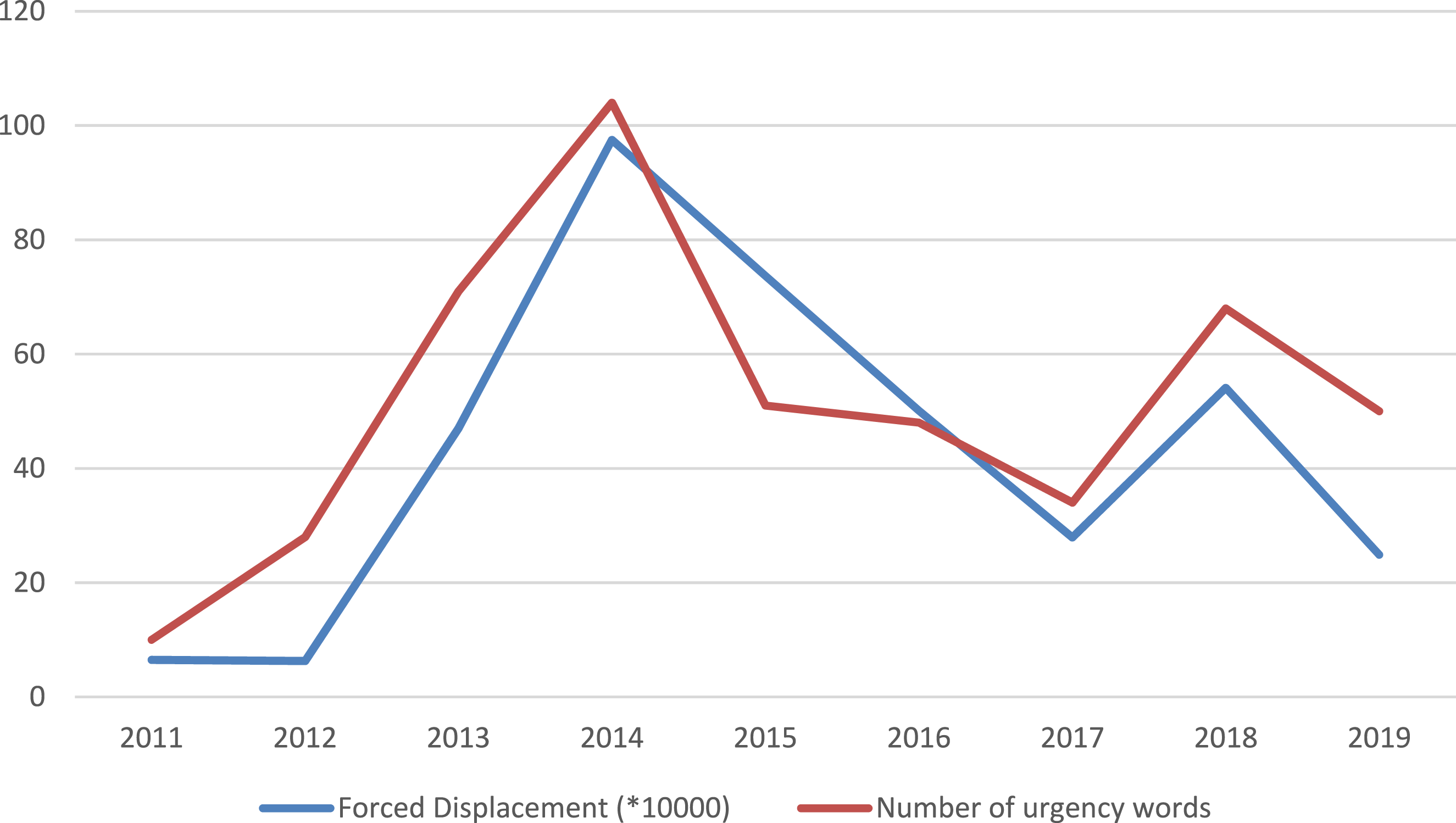
Examining the levels of urgency in the media reporting, that is, the number of urgency words found in the Tweets of the selected news outlets, we found that the trend of an increase or decrease of urgency word correlated with the trend in forced displacement in every year under investigation. This leads us to consider hypothesis 3 as plausible and in need of further investigation.
Conclusion: The Urgent Need for Research
The main contribution of this research note is, firstly, its elaboration of a method of predicate analysis which so far has not been fully articulated in IR. Secondly, it should be read as a plausibility probe of the connection between internal displacement, insurgency, and the constitution of ‘urgency’ in media discourse. While the relationship between insurgency and forced displacement seems straightforward and research has reflected on many of the direct and indirect causes of displacement in situations of violent conflict, the role of ‘urgency’ has been understudied. The note suggested that the constitution of urgency in media reporting is relevant for understanding internal displacement in situations of insurgency. By employing a method of predicate analysis of Twitter/X posts by Nigerian media outlets the note showed that the rise of internal displacement correlates with the level of urgency in media reporting on the conflict. While unable to show causation and prove a causal relationship between the two, the note nevertheless hopes to have emphasized the urgent need for more research on the issue. In particular, the insights from crisis communication seem central to a more detailed investigation on the linkage of ‘urgency’ and internal displacement in situations of insurgency.
Footnotes
Declaration of Conflicting Interests
The author(s) declared no potential conflicts of interest with respect to the research, authorship, and/or publication of this article.
Funding
The author(s) received no financial support for the research, authorship, and/or publication of this article.

Notes
Author Biographies