







Abstract
Keywords
Introduction
Colombia’s Adolescent Criminal Responsibility System (Sistema de Responsabilidad Penal para Adolescentes, SRPA) seeks to assess and address the mental health of young individuals undergoing resocialization. Evidence indicates a high prevalence of psychological and psychiatric disorders among adolescents and young adults within the juvenile justice system, which may contribute to persistent behavioral issues and recidivism (Abram et al., 2015; Kim et al., 2017). However, the relationship between mental health and recidivism is complex and primarily correlational (Schubert et al., 2011), highlighting the need to explore other psychological factors that may influence these processes, such as empathy and emotional self-efficacy.
Although the incarceration of young offenders is intended to promote rehabilitation and reduce recidivism, research has documented its adverse effects. In many cases, deprivation of liberty reinforces problematic behaviors, increases social isolation, and contributes to stigmatization (Cullen et al., 2011). Additionally, studies have shown that incarceration can exacerbate preexisting emotional issues and create difficulties in emotional regulation (Abram et al., 2015; Hatzenbuehler et al., 2015). These findings highlight the need to analyze variables such as empathy and emotional self-efficacy, which may play a crucial role in mitigating these negative effects and fostering more effective resocialization strategies.
Empathy, understood as a multidimensional psychological construct, plays a fundamental role in regulating social behavior. It consists of two main dimensions: cognitive empathy, which enables the understanding of others’ thoughts and emotions, and affective empathy, which involves experiencing an emotional response to others’ emotional states (Davis, 1996; Decety & Jackson, 2004). In the context of juvenile delinquency, deficits in empathy have been linked to higher levels of aggression and difficulties in emotional regulation, thereby increasing the risk of recidivism (Craig et al., 2025; van Langen et al., 2014).
Empathy Deficit as a Common Factor in Juvenile Delinquency
Numerous studies have identified a lack of empathy as a key trait in antisocial personality and criminal behavior. However, empirical research explicitly evaluating empathy in comparison to psychopathy measures remains limited (Bergstrøm et al., 2021). The relationship between empathy development and the reduction of aggression in juvenile offenders is still uncertain, particularly within the context of targeted interventions. While empathy domains show significant correlations with psychopathy factors, they do not statistically predict violence (Nigel et al., 2018). Additionally, evidence suggests that the accumulation of childhood traumatic experiences negatively affects empathy development, which can hinder emotional regulation and increase the likelihood of antisocial behaviors. These empathy deficits may contribute to difficulties in interpersonal relationships and a heightened risk of criminal recidivism among youth in conflict with the law (Narvey et al., 2021). However, the way empathy manifests in juvenile offenders varies depending on the type of offense and gender (Gómez Tabares & Durán Palacio, 2020; Jolliffe & Farrington, 2021; O’Neill, 2020; Pechorro et al., 2021; Tisak & Goldstein, 2023), suggesting that adverse experiences may modulate its impact on delinquent behavior.
The development of empathy is crucial for acquiring self-regulation skills, fostering healthy socioemotional growth, and adopting prosocial behaviors (Decety et al., 2016; Eisenberg et al., 2014; Spinrad et al., 2017). There is a strong correlation between cognitive empathy and Theory of Mind (ToM), which enables individuals to recognize and understand others’ beliefs, desires, and intentions (Milone et al., 2019). In this regard, some studies have found that sexual offenders exhibit lower levels of cognitive empathy compared to the general population.
However, a meta-analysis conducted by Morrow (2020) suggests that these individuals do not show significant differences in their levels of ToM or affective empathy. Furthermore, the relationship between empathy and aggression remains a subject of debate: while Vachon et al. (2014) identified a weak negative correlation between the two variables, Gómez-Leal et al. (2020) found a significant negative correlation between aggression and the cognitive dimension of empathy, which includes perspective-taking, cognitive reappraisal, and positive affect. Conversely, Green et al. (2018) observed that high levels of affective empathy are associated with an increased presence of depressive symptoms, whereas cognitive empathy appears to serve a protective role by reducing the likelihood of experiencing such symptoms.
The mediating role of empathy in the emotional and behavioral regulation of young offenders has been highlighted in various studies. For instance, Schoeps et al. (2020) found that both cognitive and affective empathy influence the manifestation of emotional and behavioral problems in youth, as well as the expression of prosocial behavior. In this context, young individuals who report higher levels of confidence, communication skills, and lower levels of peer alienation tend to develop stronger empathy, which translates into fewer symptoms of anxiety and depression, reduced maladaptive behaviors, and a greater inclination to help and care for their peers. In contrast, those who experience conflicts or interpersonal distancing are more likely to develop anxiety, sadness, aggression, and apathy—factors that, in turn, are linked to the emergence of behavioral problems.
Emotional Self-Efficacy and Juvenile Delinquency
Emotional self-efficacy, defined as the belief in one’s ability to regulate and manage emotions in challenging situations (Bandura, 2001), plays a crucial role in controlling aggression and fostering prosocial behaviors. Pung et al. (2015) and Megías et al. (2018) demonstrated that self-control is a significant predictor of peer aggression and delinquency. Young individuals with low self-control are more prone to physical aggression and tend to associate with delinquent peers. Moreover, the uninhibited expression of negative emotions can impair their ability to manage sadness, anxiety, and anger, thereby increasing the risk of problematic behaviors.
Research suggests that higher emotional self-efficacy is associated with fewer behavioral difficulties and increased prosocial behavior (Mesurado et al., 2018). Conversely, low levels of emotional self-efficacy and prosocial values have been linked to problematic behaviors such as delinquency, substance abuse, and risky sexual behaviors (Ludwig & Pittman, 1999). Additionally, young individuals with high emotional self-efficacy tend to develop more effective coping strategies, enabling them to better navigate adverse situations and reduce the risk of recidivism (Bandura, 2001; Patrick et al., 2018; Wentzel, 2014). This suggests that emotional self-efficacy is not only a protective factor against aggression but also a key mechanism for resilience and emotional well-being among youth in conflict with the law.
Empathy, Emotional Self-Efficacy, and Behavioral Issues in Juvenile Offenders
The role of empathy and emotional self-efficacy in regulating juvenile behavior has been extensively studied. Throughout this work, empathy—both cognitive and affective—has been highlighted as essential in moderating aggression and other emotional challenges. Likewise, emotional self-efficacy has been shown to function as a protective mechanism, helping young offenders manage their emotions more effectively and reduce the likelihood of reoffending.
However, significant research gaps remain. In particular, how to effectively foster perspective-taking and emotional self-efficacy in these individuals to translate these factors into positive behavioral changes is not yet fully understood. Furthermore, the relationship between empathy, emotional self-efficacy, and behavioral difficulties within the juvenile justice system remains underexplored. Identifying effective strategies to strengthen these aspects could be a key factor in improving interventions aimed at this population.
Current Study
An analysis of demographic trends in Colombia’s Adolescent Criminal Responsibility System (Sistema de Responsabilidad Penal para Adolescentes, SRPA) reveals that between 2006 and 2019, a total of 278,169 adolescents and young adults entered the system, 88% of whom were male (Observatorio del Bienestar de la Niñez, 2022). This gender distribution aligns with previous research showing that juvenile offenders aged 15 to 17 years exhibit higher levels of delinquent behavior compared to other age groups. Moreover, late adolescence has been identified as a critical period in the transition from antisocial behavior, underscoring the need for targeted interventions at this stage of development (Brame & Piquero, 2003; Sweeten et al., 2013).
Within this context, the present study aims to examine how empathy and emotional self-efficacy influence the behavioral strengths and difficulties of adolescents and young adults sanctioned by the SRPA with custodial measures. Specifically, it seeks to determine whether emotional self-efficacy moderates the relationship between empathy and disruptive behaviors, which could provide valuable insights for designing effective intervention programs in the juvenile justice system.
The study’s central hypothesis posits that behavioral problems, emotional symptoms, hyperactivity, peer-related difficulties, and prosocial behavior are influenced by the regulatory effect of emotional self-efficacy and empathy. Furthermore, it proposes that regulatory emotional self-efficacy functions as a mediating mechanism in the association between empathy and the emotional and behavioral strengths and difficulties of juvenile offenders.
By analyzing these factors, this study aims to identify effective strategies for enhancing emotional regulation and promoting prosocial adaptation in this vulnerable population. The findings are expected to contribute key elements to the design of interventions that mitigate emotional symptoms and behavioral issues, ultimately reducing the risk of recidivism and facilitating more effective reintegration processes.
Methods
Participants
The sample consisted of 220 young offenders with custodial sentences in two specialized care centers in Colombia, aged between 15 and 20 years (
Sociodemographic and Legal Characteristics of the Participants.

Instruments
Sociodemographic Questionnaire
A questionnaire of a specifically designed nature was utilized to ascertain information pertinent to the demographic characteristics of the participants, including age, gender, the type of criminal offense committed, socioeconomic stratum, familial structure, and socioeconomic condition.
Strengths and Difficulties Questionnaire (SDQ)
This questionnaire profiles the emotional and behavioral problems and symptoms of adolescents up to 17 years of age and over 18 years of age, as outlined by Goodman (1997). Each item is answered on a 3-point Likert scale (1 = not true, 3 = completely true). The questionnaire comprises 25 items, divided into five subscales: emotional symptoms (ω = .75), behavioral problems (ω = .76), hyperactivity symptoms (ω = .66), peer problems (ω = .65), and difficulties (ω = .77), as well as prosocial behavior (ω = .78) and strengths (ω = .78).
The psychometric properties of the Spanish version of the SDQ have been previously examined by Ortuño-Sierra et al. (2015). In a recent study, Ortuño-Sierra et al. (2022) confirmed the five-factor structure of the Spanish version of the questionnaire in populations of adolescents (≤17 years) and young adults (≥18 years), demonstrating optimal goodness-of-fit indicators and measurement invariance by age and gender. The internal consistency of the total difficulties score was ω = .74, with subscale values ranging from ω = .52 to .71. For this study, internal consistency for the total difficulties scale was ω = .77 and α = .70, with subscale values ranging from ω = .65 to .78.
Interpersonal Reactivity Index (IRI)
The instrument assesses both the cognitive and affective components of empathy (Davis, 1983). The instrument comprises 28 Likert-type self-report items, with five response options (ranging from 1 = does not describe me at all to 5 = describes me very well). Four distinct aspects of empathy are evaluated: perspective-taking, fantasy, empathic concern, and personal distress. Perspective-taking and fantasy represent the cognitive aspect of empathy, whereas empathic concern and personal distress constitute the affective aspect. The original version exhibited an internal consistency ranging from .68 to .79, with a test-retest reliability of .61 to .81 (Davis, 1983). The translated and adapted version to Spanish with adolescents confirmed the structure of the four factors previously identified (Mestre et al., 2004).
The study conducted by Arenas Estevez et al. (2021) validated the four-factor structure in a sample of university students and demonstrated that the proposed model is gender-invariant. The scale demonstrated satisfactory internal consistency (α) when applied to a Colombian juvenile offender population (total empathy (α = .73), perspective taking (α = .71), fantasy (α = .69), empathic concern (α = .82), and personal distress (α = .73); Gómez Tabares & Narváez Marín, 2019). For this study, the internal consistency for the total scale was ω = .85 and α = .84, while the subscales exhibited a range of ω values between .71 and .73.
Regulatory Emotional Self-Efficacy Scale (RESE)
The questionnaire employs a Likert-type scale with five response options, ranging from “1 = Incapable” to “5 = Totally Capable” (Caprara et al., 2008). It is designed to assess the degree of perceived self-efficacy regarding positive affect expression (POS) and negative affect management (NEG). The internal consistency of the POS scale was found to be ω = .90, while the NEG scale demonstrated an internal consistency of ω = .91. The Positive Emotional Self-Efficacy (POS) scale encompasses humor (ω = .86) and empathic self-efficacy (ω = .88), while the Negative Emotional Self-Efficacy (NEG) scale encompasses shame (ω = .86). The scale has been utilized with adolescent populations in Italy, the United States, Spain, and Bolivia, exhibiting reliability indices that range from .69 to .97 (Caprara et al., 2008). In Colombia, the scale has been employed in studies with adolescents with psychosocial vulnerability (Gómez Tabares & Narváez Marín, 2020) and adolescents disengaged from illegal armed groups (Gómez Tabares, 2019). The internal consistency indices with Cronbach’s alpha for the subscales ranged from .76 to .86. For this study, the internal consistency for the total scale was ω = .94 and α = .93, while the subscales exhibited a range of .86 to .91 (ω).
Data Collection Procedure
The instruments were administered by the researchers in the institutional setting in both cities of Colombia. The instruments were completed using pencils and paper in groups of 20 individuals, under the supervision of the psychologist or pedagogical specialist of the institution. The administration of the instruments lasted between 45 and 60 min per group, and data collection was completed over 3 months.
Ethical Aspects and Access to the Population
This study was conducted following the ethical principles of respect for autonomy, privacy, dignity, protection, and the pursuit of good and justice in human research. Furthermore, the stipulations outlined in Law 1090 of 2006 and Resolution 8430 of 1993 were met, specifically by the provisions of articles 25, 26, and 50, which pertain to the informed consent of the participants. To ensure the protection of participants and the institution, the research and its instruments were submitted to the Ethics Committee of the Universidad Católica Luis Amigó (Colombia) and the Instituto Colombiano de Bienestar Familiar (ICBF), both nationally and regionally from Medellín and Manizales.
Procedure for the Analysis of Information
The results of the measurement instrument were digitized and coded in an Excel data matrix. The data were analyzed using the statistical package SPSS v. 25 (IBM Corporation, 2017) and the open-source program Jamovi, version 2.4 (2023). SPSS was used to analyze the internal consistency of the instruments based on McDonald (1999) Omega and Cronbach’s alpha. McDonald (1999) Omega is an appropriate statistical tool for analyzing the internal consistency of multifactorial instruments, employing factor loadings in its calculations (Gerbing & Anderson, 1988; McDonald, 1999). Subsequently, Pearson’s
To evaluate the model fit, the Comparative Fit Index (CFI), Tucker-Lewis Index (TLI), Bentler-Bonett Non-normed Fit Index (NNFI), Relative Noncentrality Index (RNI), Bentler-Bonett Normed Fit Index (NFI), Bollen’s Relative Fit Index (RFI), and Bollen’s Incremental Fit Index (IFI) were employed. Values equal to or greater than 0.90 on these indicators indicate an optimal fit of the proposed model (Byrne, 2016). In addition, the Root Mean Square Error of Approximation (RMSEA) was evaluated. Values below 0.08 in RMSEA evidence a good model fit (Byrne, 2016). Together, these indicators provide a rigorous and detailed assessment of the model’s fit to the data.
Results
Correlation analyses were conducted to examine the relationship between the measures of strengths and difficulties, regulatory emotional self-efficacy, and empathy (see Table 2). The global difficulties dimension and behavioral problems exhibited a direct and significant correlation with the empathy dimensions of fantasy and personal distress. Additionally, the difficulties dimension demonstrated an inverse correlation with empathic self-efficacy. The results indicated that hyperactivity symptoms exhibited an inverse and significant correlation with regulatory emotional self-efficacy (total score), the use of humor, empathic self-efficacy, self-efficacy in managing negative affect, and self-efficacy for moral emotions (shame).
Correlations Between the Strengths and Difficulties Questionnaire (SDQ), Regulatory Emotional Self-Efficacy Variables, and Empathy Dimensions.

The correlation between internalizing emotional symptoms and total empathy, fantasy, empathic concern, and personal distress was direct and significant. In contrast, peer problems exhibited significant inverse correlations with regulatory emotional self-efficacy (total score), self-efficacy for expressing positive affect, humor, and empathic self-efficacy. Finally, the prosocial strengths dimension exhibited a direct and significant correlation with all variables of regulatory emotional self-efficacy and empathy.
A series of multiple linear regression analyses were conducted to determine the influence of self-efficacy for emotional regulation (RESE) and empathy (IRI) on strengths and difficulties (SDQ). The total difficulties score was found to be explained by 4% (
Hyperactivity symptoms (
Prosocial strengths were explained 19% (
Additional analyses were conducted to determine the specific effects of the dimensions of self-efficacy for emotional regulation and empathy on strengths and difficulties. The results of the analyses are presented in Table 3.
Effect of Regulatory Emotional Self-Efficacy (RESE) and Empathy (IRI) Variables on Strengths and Difficulties Questionnaire (SDQ).

The study found that self-efficacy in managing negative affect, perspective taking, and personal distress contributed significant effects, explaining 12% of the total difficulties score (
Furthermore, the study revealed that perspective taking, and personal distress had a significant effect on behavior problems, explaining 11% of the variance (
The results indicate that personal distress was the only factor that had a significant effect, explaining 13% of the emotional symptoms (
Additional analyses were conducted to identify patterns of association involving emotional self-efficacy as a mediator of empathy in predicting difficulties and strengths. Two structural equation models were proposed to determine the direct and indirect effects of empathy and emotional self-efficacy on difficulties (model 1) and strengths (model 2). The goodness-of-fit indicators for both models were satisfactory, as shown in Table 4.
Goodness-of-Fit Statistics of the Structural Equation Models.

The structural equation model of difficulties is depicted in Figure 1. Empathy was found to have a positive and significant effect on regulatory emotional self-efficacy (
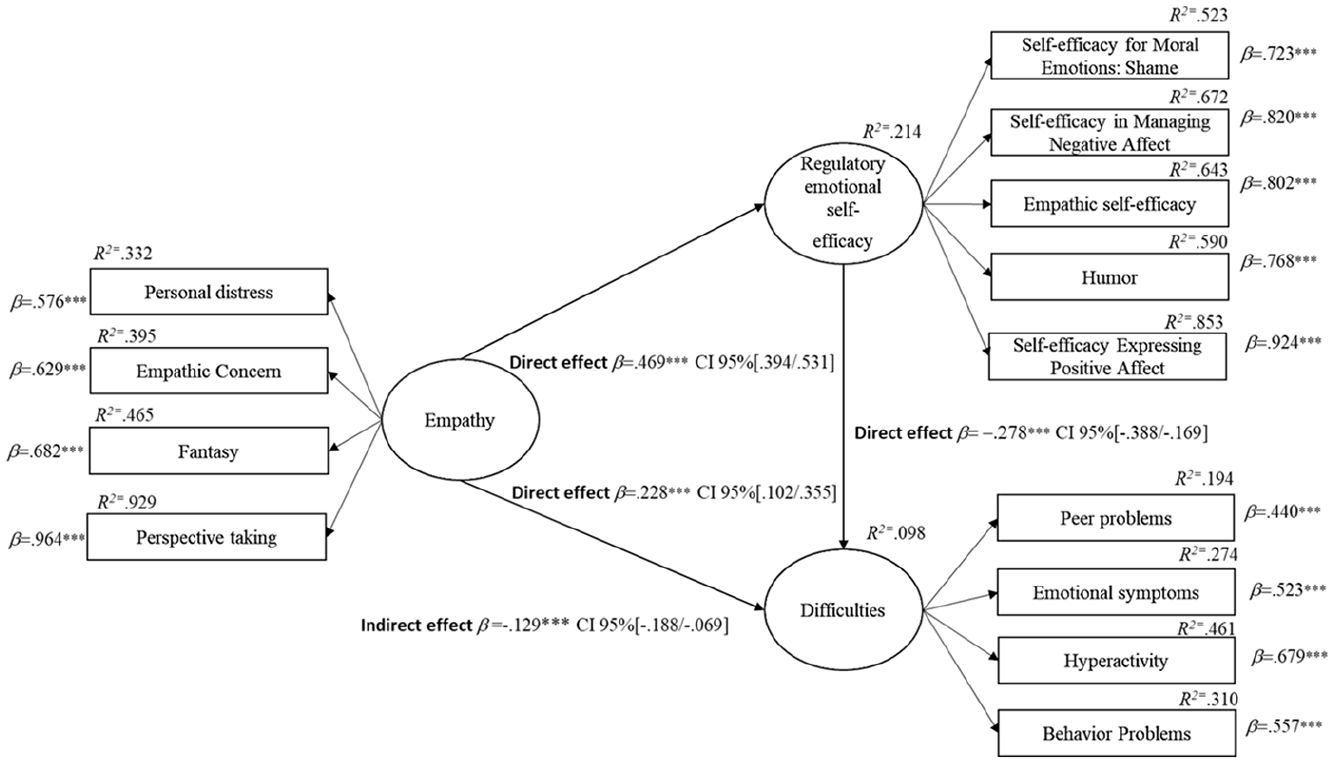
Structural equation modeling of the effect of empathy on difficulties and the mediating role of regulatory emotional self-efficacy.
Figure 2 shows the structural model of prosocial strengths, which is reflected in the items that define it. Empathy was found to have a positive and significant effect on regulatory emotional self-efficacy (
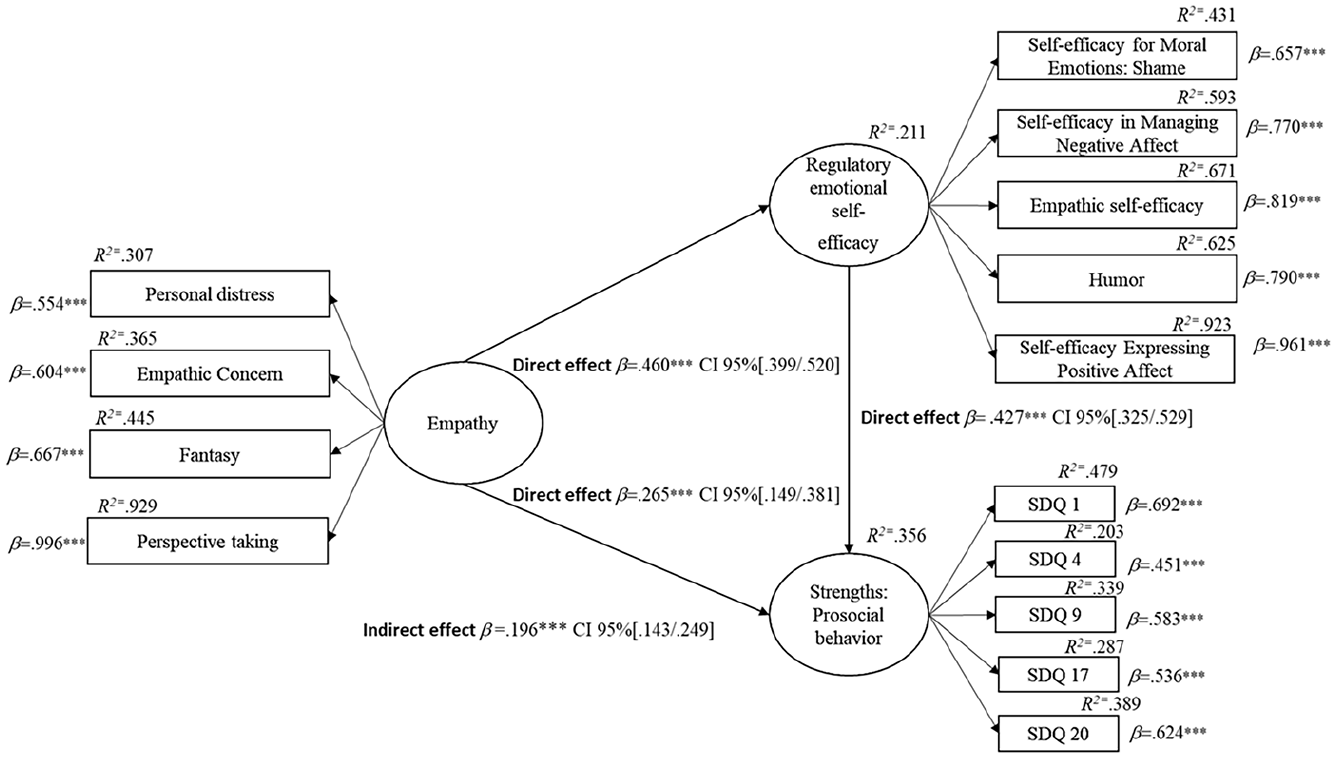
Structural equation modeling of the effect of empathy on prosocial strengths and the mediating role of emotional self-efficacy.
Empathy was found to account for 21% (
Discussion
The objective of this study was to analyze the effects of empathy and emotional self-efficacy on the behavioral strengths and difficulties of adolescents and young adults sanctioned by the Adolescent Criminal Responsibility System (Sistema de Responsabilidad Penal para Adolescentes, SRPA) and placed in specialized care centers.
The findings of this study confirm and expand upon previous research regarding the relationship between empathy, emotional self-efficacy, and behavioral strengths and difficulties in justice-involved youth. Specifically, correlation and regression analyses indicate that regulatory emotional self-efficacy has a protective effect against emotional and behavioral difficulties, while empathy exhibits a more complex relationship, depending on the specific dimension being evaluated.
Identifying emotional self-efficacy as a protective factor underscores the need to incorporate programs aimed at strengthening this skill within rehabilitation and reintegration strategies. Additionally, the complexity of the relationship between empathy and behavioral difficulties highlights the importance of addressing this variable in a nuanced manner, avoiding simplistic approaches that assume fostering empathy will always yield positive behavioral outcomes for young offenders.
One of the most significant findings of this study is the positive correlation between externalizing emotional symptoms and the fantasy and personal distress dimensions of empathy. Given the scarcity of prior research exploring this relationship in justice-involved youth, these results suggest that certain aspects of empathy may be associated with heightened emotional vulnerability and difficulties in affective regulation, rather than consistently serving as a protective factor (Decety & Jackson, 2004; van Langen et al., 2014). These findings align with previous studies indicating that personal distress and over-identification with others’ suffering can increase levels of anxiety, depression, and stress in vulnerable populations, which, in turn, may contribute to the emergence of externalizing behaviors (Mesurado et al., 2018). The evidence presented here suggests that rather than promoting empathy in a generalized manner, interventions should focus on teaching emotional regulation strategies to prevent maladaptive distress responses among delinquent youth.
The results also reveal that regulatory emotional self-efficacy has a significant inverse effect on hyperactivity symptoms and peer-related problems. This reinforces prior research indicating that high emotional self-efficacy enables adolescents to manage their emotions more effectively, reduce impulsivity, and enhance interpersonal skills (Bandura, 2001; Patrick et al., 2018; Wentzel, 2014). In line with these findings, the study’s hypothesis is partially confirmed, as emotional self-efficacy does moderate the relationship between empathy and behavioral difficulties; however, its impact appears to be more pronounced in reducing social interaction problems and improving emotional regulation.
From an intervention perspective, this finding suggests that rehabilitation programs for justice-involved youth should prioritize the development of emotional regulation skills as a key component. Furthermore, public policies incorporating initiatives to strengthen emotional self-efficacy could contribute to a significant reduction in recidivism rates and improve the social adaptation of these individuals.
Consistent with previous studies, this research found that both regulatory emotional self-efficacy and empathy account for a significant proportion of the variance in prosocial behavior. This aligns with existing literature suggesting that perspective-taking ability and self-efficacy in emotional regulation are key predictors of prosocial conduct (Eisenberg et al., 2014; Mesurado et al., 2018). However, structural equation models revealed that regulatory emotional self-efficacy plays a significant mediating role in the relationship between empathy and prosocial behavior, reinforcing the idea that empathy alone is insufficient to promote prosocial conduct unless accompanied by effective emotional regulation skills.
In terms of public policy, these findings suggest that prevention and rehabilitation programs should adopt a comprehensive approach that not only fosters empathy but also strengthens emotional self-efficacy. This entails designing strategies that not only teach young people to understand and resonate with others’ emotions but also equip them with the tools to manage their own emotional responses effectively, ultimately fostering healthier and less conflict-prone interactions.
Limitations and Future Research
Despite the contributions of this study, it is important to acknowledge certain limitations. First, the data were collected through self-report, which introduces the risk of bias in participants’ perceptions. Future studies should incorporate key informants, such as educators, pedagogues, or psychosocial teams, to compare self-reported data with third-party evaluations, thereby enhancing the validity of the results. Additionally, while validated measures of empathy and emotional self-efficacy were included, the specific context of juvenile justice may influence how participants report their emotional and prosocial skills. In this regard, employing mixed methodologies that combine quantitative and qualitative approaches would provide a deeper understanding of these psychological processes in youth in conflict with the law.
Another relevant aspect is that the statistical analyses did not consider the variability of criminal trajectories or the duration of individuals’ involvement in the juvenile justice system. This information is restricted and held under judicial custody in Specialized Attention Centers for juvenile offenders in Colombia, limiting access. However, examining these variables would offer a better understanding of the relationship between age, recidivism, and the evolution of criminal behavior. Furthermore, future research could explore how the life experiences of juvenile offenders affect their psychological functioning and likelihood of recidivism, which would contribute to the development of more personalized and effective interventions.
Finally, since this study employed a cross-sectional design, the conclusions were based on correlational associations between the variables analyzed. To establish causal relationships, it is recommended to implement longitudinal studies that track the evolution of empathy and emotional self-efficacy over time and assess their impact on behavioral and emotional regulation.
Conclusions
Overall, the findings underscore the importance of regulatory emotional self-efficacy as a key factor in reducing behavioral difficulties and fostering prosocial behavior among justice-involved youth. They also highlight that the effects of empathy vary depending on the specific dimension assessed, emphasizing the need to consider how these processes interact in vulnerable contexts. These results have significant implications for the design of intervention programs aimed at enhancing emotional regulation in youth with delinquent trajectories, with the goal of reducing recidivism risk and promoting social adaptation. Furthermore, they suggest that public policies should integrate strategies that not only foster empathy but also develop effective emotional regulation skills to maximize the positive impact of juvenile justice interventions.
Footnotes
Acknowledgements
The authors express their gratitude to the young people who participated in the research and extend special thanks to the Congregación de Religiosos Terciarios Capuchinos de Nuestra Señora de los Dolores, Provincia de San José. And to the Carlos Lleras Restrepo Specialized Juvenile Care Centers in Medellín and Ciudadela Los Zagales in Manizales, Colombia, for their invaluable cooperation and for enabling access to their facilities. The authors are indebted to the institutions for their support in administering the psychological instruments that were used for the data collection in this study. The Instituto Colombiano de Bienestar Familiar gives the legal permissions for the execution of this study with young people subjected to custodial measures in the custody of the Instituto Colombiano de Bienestar Familiar. The research was carried out within the framework of the project “
Data Availability
The availability of research data is contingent upon the decision and approval of the Instituto Colombiano de Bienestar Familiar (ICBF) and the Specialized Youth Care Centers, specifically Carlos Lleras Restrepo in Medellín and Ciudadela Los Zagales in Manizales, Colombia. The focus of this information pertains to minors in the custody of the Colombian state.
Declaration of Conflicting Interests
The author(s) declared no potential conflicts of interest with respect to the research, authorship, and/or publication of this article.
Funding
The author(s) disclosed receipt of the following financial support for the research, authorship, and/or publication of this article: The financial support for this study was provided by the Congregación de Religiosos Terciarios Capuchinos de Nuestra Señora de los Dolores, Provincia de San José, and by Universidad Católica Luis Amigó, Colombia.
Ethical Approval
The research that supports this article was approved by the Ethics Committee of the Universidad Católica Luis Amigó on September 12, 2021, after informed consent was obtained. This approval complies with Resolution 008430 of 1993, issued by the Ministerio de Salud of Colombia, which dictates scientific, technical, and administrative norms for health research in Title II, Articles 5, 6, and 11. The Ethics Committee of the Vice Rector Office for Research determined that the study represented minimal risk, since it did not intend to intervene or intentionally modify physiological, sociological, or psychological variables of the research subjects. At the end of 2021, we received consent, authorization, technical, and administrative endorsement from the Instituto Colombiano de Bienestar Familiar to conduct the study. Additionally, we obtained permission from two Specialized Care Centers for young people: Carlos Lleras Restrepo in Medellín and Ciudadela Los Zagales in Manizales, to provide all the logistical support required for the research.
Consent to Participate
The participants voluntarily consented to participate in the study after being informed of the objectives and purposes of the study. This consent was approved by the Ethics Committee of the Vice-Rectory of Research of the Universidad Católica Luis Amigó, Colombia.
Consent for Publication
The participants’ voluntary signature on the informed consent form constituted their authorization for the researchers and the Universidad Católica Luis Amigó to publish the results of the study. The Instituto Colombiano de Bienestar Familiar gave its authorization for the publication and dissemination of the manuscript.

