







Abstract
Introduction
In 2021, Google's Africa Investment Fund made one of its first ever investments in a Ugandan tech startup called “SafeBoda.” As the name suggests, SafeBoda aims to improve passenger safety for Uganda's
On-demand platforms like SafeBoda and Lori Systems rely on the ability to access and track services in real time, generally on mobile phones. While there is undeniably still a digital divide in Africa, access to mobile phones—including “smart” and “feature” phones that allow additional functionality—is growing quickly. It is estimated that by 2025 there will be more than 600 million unique mobile phone subscribers in sub-Saharan Africa (GSMA Intelligence, 2019). And, in contrast to the trajectory in the global North, mobile phones are already the primary way through which people access the Internet (GSMA, 2021).
This, coupled with supply-side investments in large-scale digital infrastructure, has spurred a boom in the platformization of work, economies, and services in many African cities—often along the lines imagined by smart city proponents. By platform we embrace a wide array of digitally enabled services that allow the exchange of services between more than one user (Srnicek, 2017). Of course, the rise of platformization and associated smart investments has not been uniformly distributed across Africa's diverse geographies. While some cities, like Asmara, have few users and extremely high latency in connectivity, cities such as Kigali and Nairobi have been dubbed “Silicon Savannahs”, foregrounded for their widespread Internet access, their adoption of smart city programs, their thriving entrepreneurial ecosystems, and their ability to attract venture capital—such as Google Africa's investment arm—for various types of platform experimentations. While the notion of Silicon Savannahs is commonly used by tech commentators, for example on Techcrunch or Wired, academic critics have also deployed it to highlight the contradictions and pitfalls of this investment rush directed to African digital infrastructure and startups (Graham & Mann, 2013; Rosenberg & Brent, 2020), which often produce or replicate colonial and neoliberal exploitation along tech capital's new frontiers.
This article focuses on a specific frontier of platformization: the enrollment of motorcycle taxis—and of the riders who operate them—into digital dashboards that coordinate last-mile logistics and commuting. In African cities, motorcycles have enabled the movement of goods and people for at least four decades. Small and agile, these vehicles provide a competitive advantage—navigating unpaved roads, consuming little fuel, and moving quickly through jammed traffic—in places where mobility infrastructure is highly splintered and fragmented. At first glance, the platformization of two-wheel logistics on the African continent seems to follow the well-known playbook of what technology critic Evgeny Morozov (2013) has called “techno-solutionism”: a Promethean faith in the capacity of digital technology to fix broken systems, whether they are democratic institutions or, as in this case, unwieldy mobility systems. However, this arguably techno-pessimistic reading of so-called “platform urbanism” (Barns, 2019) leaves us with a bleak outlook on the future of the African city as a site of accumulation and exploitation (Guma et al., 2023), and minimal space to read different patterns of how platforms evolve and fail, or even to imagine their generative reconfigurations, as Leszczynski (2020) suggests. Such frames of reference tell us very little about the urban economies transformed by the processes through which mobility systems become platformed.
To combat simplistic and derivative readings of African urban economies, we address platform urbanism in Africa—as it manifests in the digitization of motorcycle services—through a “southern urban perspective” (Bhan, 2019). Building on different geographies of knowledge (Roy, 2016), such a perspective contributes significantly to centering African experiences in urban theory and resisting attempts to position local experiences as case studies that confirm or disprove global concepts (Ndlovu-Gatsheni, 2015).
Within Southern scholarship, platform urban economies have been usefully theorized against labor, and financial and regulatory practices that are unique to the reality of Southern cities. This has broadened the rubric of platform urbanism, showing how, especially in mobility economies, the rise of platforms has been “characterized by a dialectic of proliferation, mutation, and consolidation” (Stehlin et al., 2020: 1251), while shoring up the contingent histories through which digital apps interface informal economies, various forms of political organization, and diverse speculations about African urban futures (e.g., Amorim & Moda, 2020; Arubayi, 2021; Doherty, 2022; Frey, 2020; Giddy, 2021; Pollio, 2021).
Following in the footsteps of these works, the primary case studies that anchor this article are two East African cities, Kigali (Rwanda) and Nairobi (Kenya), both of which have received global recognition for their commitments to foster “ICT-led development” (Heeks, 2017) and to become “startup cities” (McNeill, 2017, Sitas et al., 2022). Yet, how these recent histories play out in the emergence of platform economies has received little attention (with exceptions such as Iazzolino & Mann, 2021). Through the empirical foundation of these cases, we argue that the platformization of motorcycles in these cities (and arguably others) does not constitute merely a next or new frontier for techno-capital seeking new terrains for profit expansion. To substantiate this, we make two critical points.
First, we show that platform urbanism dovetails two decades of supply-side investments in connectivity infrastructure which have made possible the kind of almost ubiquitous urban access to digital services upon which platforms rely and are predicated. We chart how the creation of these urban ecosystems of platform mobilities have depended on developmental efforts carried out by the state—especially through national governments at the behest of international donors and lenders. This suggests that the platformization of informal mobility systems in urban Africa is as much a frontier of techno-capital as it is of the developmental state at different scales and in contingent ways.
Second and relatedly, we show that platform urbanism is not simply a case of global finance landing in Africa. As with financial practices more broadly, platform urbanism is characterized by a proliferation of experiments in which domestic and international capital coalesce. Moreover, platforms intersect in dynamic ways with informal economies and value chains that often have very tenuous links to high-risk capital investments.
Overall, a Southern urban perspective on contemporary “platform mobility” technologies, including that of the motorcycle, allows us to engage in a midrange theorization of contemporary dynamics in urban Africa, without dissolving the diversity of these processes into a totalizing account of the strides of platform capitalism on the continent.
Platform urbanism and the southerning of techno-frontierism
We frame our article against a set of conceptual debates within urban studies. We begin by looking at the key conversations related to platform urbanism in relation to the startup city. We follow this by homing in on critiques of “techno-frontiers”—where digital platforms are framed as a solution to complex issues and critiqued for their implicit and explicit drive for the exploitation of labor and urban precarity. As it is specifically the platformization of motorcycles that we are interested in this article, we then turn to a conversation about this vital economy, common in so many African cities. Finally, we turn our attention to the conceptual offering of Southern urbanism—the orientation and methodological toolkit it provides for understanding platform economies, particularly in the context of informal infrastructural systems and labor markets. These conceptual anchors ground this piece.
Platform urbanism and the startup city
While Information and Communications Technology (ICT) is sometimes neglected in the scholarship of urban services, research on telecommunication networks have animated the so-called “infrastructural turn” in urban studies since the early 2000s (Graham, 2000; Coutard & Rutherford, 2015). Recently, the notion of “platform urbanism” (Barns, 2020) has theorized the emergence of digital platforms that seek to innovate (and often monetize) existing urban economies, from the real estate sector (Fields, 2022) to hospitality (Celata et al., 2020; Cocola-Gant and Gago, 2021) and mobility (Stehlin et al., 2020).
Scholars of platform urbanism therefore acknowledge the increasing power that tech companies wield over city governance (see Ferreri and Sanyal, 2018; Hodson and McMeekin, 2021; McNeill, 2016; Saddowski, 2020). They also demonstrate how urban environments and city infrastructures are used as testbeds for platform business models (Barns, 2020; Mattern, 2016). In the context of urban Africa, a few contributions have specifically addressed how the flexible and often exploitative regimes of labor, encoded by urban platforms, interface existing economies, regulatory frameworks, and organizational practices (Anwar et al., 2022; Arubayi, 2021; Carmody & Fortuin, 2019; Pollio, 2019; Iazzolino, 2021).
A related concern speaks to the fact that the “urban state” (Cirolia, 2022) itself is involved in the making of platforms. The notion of “startup urbanism” (Rossi & Dibella, 2017) or the “startup city” (McNeill, 2017) capture precisely the ways in which cities across the globe have engineered their “innovation complex” (Zukin, 2021), an assemblage of institutions and infrastructures that nurture the germination of digital platforms. In urban Africa, characteristically, the making of these innovation ecosystems has also been couched in the developmental rationalities of the state (Guma & Monstadt, 2021; Pollio, 2020; Pollio & Cirolia, 2022). This of course aligns with the push by international lenders to use ICT to spur entrepreneurial forms of development (Heeks, 2017). Not unlike the “world class city” (McDonald, 2012) or the “creative city” (Nkula- Wenz, 2019; Sitas, 2020), the “smart city” (Watson, 2015) has been inscribed into both discourses and investment programs in African urban areas, shaping imaginaries and practices alike. From online tax payment systems to “intelligent meters,” smart city investments often aim to use digital platforms to optimize or improve service delivery in cities across the continent.
Techno-solutionism at the digital frontier
Despite incredible efforts on the part of states to provide urban services, African cities experience pervasive service delivery failures, leaving ample space for private sector players (both formal and informal) to intervene. In this nexus between development and enterprise, technological fixes (Guma et al. 2023) have been interpreted as new frontiers of profit, where informal African economies are captured by digital platforms and transformed into new sites of capital accumulation. Recently, for example, the rise of fintech platforms that subsume informal financial practices into data-driven dashboards has been critiqued by scholars concerned with the neocoloniality of the technology-finance nexus (Langley & Leyshon, 2022; see also Langley & Rodima-Taylor, 2022 for overview). Of course, there is a long tradition of analysis regarding techno-solutionism (Morozov, 2013) seeking to “capture” informality. This was the case, for example, of a valid (and now very long-standing) critique of Hernando De Soto-inspired techno-fixes in the context of informal settlements. Development economist De Soto advocated for the inclusion of informal housing into recognized systems of land ownership and administration, spurring a landslide of programs aimed at property titling through new technical means. Still, very recently, blockchain-based land registries are being experimented with across Africa.
The political economy critique of these experiments has thus stressed the ways in which bureaucratic and territorial technologies build new markets for the capitalist exploitation of informal practices and alternative systems of ownership and transaction. More broadly, most African states have approached informality with a combination of regulation, eradication, and incorporation. At the same time, Silicon Valley ideologies increasingly permeate both development discourse (Pollio, 2022) and the ways in which many African states have embraced technological entrepreneurship as a key vehicle of economic transformation (Friederici et al., 2020). Also evident is that global digital companies have tried to create technological solutions for markets that have thus far escaped the circuits of global capital in Africa—Uber being a case in point. The platformization of informal and other variously precarious economies, be it in the mobility sector or related to other kinds of gig work (Anwar & Graham, 2021), creates avenues to both capture premiums on transactions and tax informal sectors. Although the most visible platform urbanism actors are indeed global corporations such as Uber and Airbnb, which have been operating in African cities for almost a decade, platform business models exist across a variety of alternative urban economies (Lynch, 2020; Scholz, 2016; Stehlin et al., 2020) and are sometimes sold to, and adopted by, local governments to develop service and monitoring dashboards (Antenucci, 2019). In Africa, one of the informal sectors increasingly targeted by these platform innovations is that of motorcycle taxis, a notorious urban industry constantly on the cusp of regulatory battles, attempts at taxation, and fragmented incorporation into public transport services.
The role of motorcycle taxis in African urban mobility
In this article, we use the term motorcycle taxis to include the use of motorcycles to provide passenger services, last-mile logistics and deliveries, and courier services. Motorcycle taxis fall within the broader category of paratransit (which also includes
In fact, motorcycle taxi service operations are often framed as “filling the gaps” in existing infrastructure networks across African cities. Dilapidated public bus systems, sprawling urban settlements, and undermaintained road networks create the essential conditions for the agile, low-cost, and distributed mobility options that the motorcycle allows (Cervero & Golub, 2007; Goodfellow, 2015; Howe 2003). In addition to filling gaps in the material networks of the city, the sector generates a significant amount of employment, both directly and indirectly (Nyassogbo, 2011). It is for this reason that the sector is often tightly linked to local politics. For example, as Goodfellow (2015) explains, motorcycle taxi riders in Kampala represent a major political client group, undermining attempts at regulation. By contrast, in Kigali they play an important role in securitizing the city, which has complemented attempts to regulate the sector. Notably, in all of the literature, policy debates, and popular speech—“rider” refers to the person who operates the motorcycle, shuttling either commuters or goods.
The incremental migration of motorcycle taxi riders onto coordinated digital platforms is a relatively new phenomenon, accelerated by the COVID-19 pandemic. Therefore, existing research on the so-called “gig economy” in Africa has thus far focused mostly on drivers and cars (e.g., Carmody & Fortuin, 2019; Iazzolino, 2021; Odendaal, 2021; Pollio, 2019). There remains a lot to understand about how the management of “platform labor” (Van Doorn, 2017) transforms a sector where the majority of riders are already precarious and depend on inconsistent forms of work. Similarly, there is a lack of understanding of how public actors participate in the funding, design, and implementation of platform mobility apps that seek to tap into the paratransit industry.
In fact, it is undeniable that this important and powerful sector is being changed through the development of dedicated digital platforms. Motorcyclists are increasingly in high demand as residents opt to avoid traffic jams and receive meals, groceries, medicines, and parcels delivered straight to their homes. They have become a pre-eminent mode for providing door-to-door, on-demand, last-mile services. Despite this proliferation, however, little is known about what is happening on a city scale, as these platform ecosystems and their urban interfaces are constantly shifting and adapting.
Southern perspective on cities and (digital) infrastructure
In the past two decades, there has been a transformation in the role of African scholarship in urban theorization (see recent
Southern urban theory recognizes that theory is “placed,” in the sense that it comes from particular places, and from the things that scholars have seen and studied there (Bhan, 2019). Importantly, the purpose of thinking from place, and in particular from African cities, is not to reject all dominant and canonical theory (Ong, 2011; Parnell & Robinson, 2013). Nor is the intention to avoid generalization and fixate indefinitely on particularities. Instead,
We are, therefore, equally inspired by an ambivalent approach to technology—one which does not see a particular technological shift as deterministic or neutral, but rather as “suspended between different possibilities” and as a “scene of struggle” (Feenberg, 1991: 12; see also Furlong, 2011). We believe this aligns with Southern urbanisms’ refusal to impose normative logics developed elsewhere. Techno-ambivalence, we believe, provides an inherently Southern orientation. This way of seeing resists assumptions of technological change as necessarily sinister, manipulative or exploitative. While acknowledging that it often can be, it allows for a politics of possibility to emerge.
In fact, there is a practical angle to Southern urbanism and techno-ambivalence as it relates to the economies of service delivery and platforms. As Bhan (2019) suggests, failing to account for the specificity through which these existing infrastructural configurations come into being, in favor of what seems more theoretically desirable or neat, renders research powerless in any attempt to improve these systems. Context is thus vital. For scholars, this means that studies of platforms and their implication in one context might not translate well in others (e.g., looking at Airbnb in a European city will unlikely translate to the same findings in an African city, where land and housing markets are fundamentally different). We will return to these practical implications in the conclusion section of this article.
Methods and approach
As Southern scholars have shown us, strong case studies are crucial for understanding and explaining complex and intertwined urban phenomena, and are particularly essential for grappling with rapidly urbanizing African cities (Duminy et al., 2014, Robinson, 2022). Historically, the geopolitics of knowledge production have assumed the global South to be the place of empirics, and the global North the place of theory-making based on the empirical evidence gathered elsewhere (de Sousa Santos, 2014; Mkandawire, 1997; Mama, 2007). A Southerning of methods asserts the importance of theorizing in and from the global South. Therefore, placing theory through case studies, both methodologically and conceptually, is crucial. This allows for an emplaced and contextually responsive analysis of platformization as part of an array of technological, social, political, and spatial dynamics, ecosystems, and arrangements.
We specifically use African cities—and particularly Kigali and Nairobi—as sites for inductive theorization. In doing so, we do not seek to create entirely new theoretical propositions, but rather to consider how centering the experiences and empirics from these places challenges, extends, and supplements existing concepts and ideas.
Data collection
This article focuses on Kigali and Nairobi, situated in the regional and continental processes underway. These two cities were selected as they are both capital cities in East Africa where motorcycles are a key mode of urban mobility and where tech has been a central component of urban development discourse and planning (Friederici, 2018; Ndemo & Weiss, 2017). At the same time, from the perspective of the continent and its diversity, they have very different regulatory dynamics (on both national and local scales), presenting intersecting opportunities for diverse learning.
This article relies heavily on primary data and creative synthesis efforts. The primary research underpinning this article has two thrusts. The first is Africa-wide research on ICT transitions and investment. And the second is a multicity and multiyear study of Kigali and Nairobi (2020–2022). Notably, and despite efforts over the past decade to expand our knowledge of African cities, there remain huge gaps in existing data.
As a starting point, the authors compiled information on ICT investment in Africa at large, with a focus on the investment impact on cities. We mapped the core investment programs currently in operation on the continent, grouping them in various ways to see how different funders are engaging with the landscape. The study mapped the deep sea cables currently connecting Africa to the global Internet and identified how these cables intersected with terrestrial investments linking landing points with Kigali and we mapped the data centers and their locations in each city, as well as the development startup spaces and venture capital investments in platforms. To chart the governance arrangements to which platforms were subject, we reviewed ICT and transport policies both in Africa at large, and with a focus on Kigali and Nairobi.
The second thrust focuses on the two cities in detail, developing a bespoke dataset. The study included the documentation of motorcycle taxi platforms in both cities, narrowing down those that “went live” between 2010 and 2020. For each platform, we tabled its lifespan, its financing, its functions, its basic business model (e.g., B2B and B2C), and the role of fintech, especially payment systems (notably, this information had to be scavenged through a mix of methods, including downloading each platform, searching venture capital databases, etc.). This catalog was supplemented with richer case studies, two per city (Sitas et al., 2022). In terms of data collection, the researchers made use of digital archives, as much of the information on the platforms explored in this article is documented in databases that specialize in news about ICT, startups, venture capital, and accelerator programs. We also draw from the document databases of organizations like the AfDB, World Bank, and respective ministries. In order to understand how the various platforms worked, we downloaded the apps, placed orders, e-hailed and rode on taxis, and spoke to call center agents to ask questions about the functionality of the platforms.
Between 10 and 15 interviews were undertaken with stakeholders from the public and private sectors in each city. They included regulators, local government officials, tech companies and experts in the field and were identified in collaboration with local researchers to ensure the credibility of the research. Informal interviews were also undertaken with platform users to further understand how people interact with platforms on a daily basis. Users included both riders registered on the various platforms and those who use these services to commute or purchase goods.
Sense-making and story-writing
Southern urbanism scholarship has often started from multicase studies—sometimes arranged comparatively and sometimes held lightly side-by-side. This, too, was our starting point for data collection. We found, however, that descriptions of the cases alone did not help us to “see” the ways in which such insights could speak from place into wider theory. In order to make sense of the data and craft the findings into contingent stories on platform urbanism, we held a series of workshops with the research team, digitally and in person in Nairobi. In these workshops we focused on identifying the ways in which the cases interfaced with the themes of the study, namely informal economies and infrastructural development. Through the process of writing these interconnections (which included multiple rounds of refinement), we were able to identify the “storylines” through which the cases, presented in this article, come to animate Southern perspectives on platform urbanism. This process relied on iteratively tracing, unpacking, situating, and comparing.
Silicon stories: Placing platforms in African cities
To challenge and extend how we “see” platform urbanism in African cities, the following section unpacks two important and contingent processes that underpin the core of our arguments in this article. The first argument is that, in urban Africa, platform proliferation has crucially depended on developmental ICT investments. As such, the rise of urban platform ecosystems cannot be read in isolation from supranational and national development processes that support startup cities. We unpack this in the section below, which explores the underpinnings of platform proliferations. The second argument is that, as platforms emerge in Africa, they adapt, transform, and experiment in unique ways, mobilizing different rationalities and different combinations of global and local capital. As these platforms evolve, they do so in conversation with the real economies of the city—economies which differ from their Northern counterparts as regards dynamics and patterns. These stories challenge derivative readings of platforms in Africa. Overall, we show that African cities are not simply the next (or last) frontier of speculative platformization, but reflect contingent histories of state investment, dynamic circulation of capital, and diverse interfaces with existing urban economies.
Infrastructuring the Silicon Savannah: The underpinnings of platform proliferations
It is not possible to grasp the contemporary surge of platformed motorcycle taxis in Kigali and Nairobi without understanding the foundational investments—large-scale infrastructures—which have facilitated the possibility of digital services. This might be regarded as an obvious statement, given that access to connectivity infrastructure is always necessary for on-demand, data-enabled urban platforms (see Narayan, 2022). However, in the context of these two cities, which are often dubbed “Silicon Savannahs,” urban scholars have regurlarly ignored these infrastructural investments, focusing attention on the highly visible dimensions of platformed ecosystems—such as the marketing of startups or government-driven smart city policies. By turning attention to the often-invisible systems which underpin platform proliferation, we shed light on underexplored dimensions of smart city processes in Africa, exposing critical actors involved in infrastructure programs.
On a global scale, ICT investment increasingly forms part of the international development project, animated by discourses that frame ICT as essential, not only to economic growth in Africa, but also for just, sustainable, and inclusive social development; see, for example, Sustainable Development Goal (SDG) 9c (United Nations, 2016). In many African countries, ICT is indeed one of the few infrastructure sectors with consistent and substantial growth. For example, according to the World Bank (October 2019: para. 2), “Kenya has seen its Information and Communications Technology (ICT) sector grow an average of 10.8% annually since 2016.” While there is undoubtedly still a “digital divide,” investments in both hard systems and digital ecosystems have also been fundamental in expanding access to, and the quality of, digital services, particularly in Africa's urban areas. From accessing education to remitting monies, this connectivity has had a range of important impacts.
The backbone of this ICT investment is the hardwired broadband, including submarine and underground fiber optic cables which connect Africa to the global Internet (the most recent addition being Google's Equiano). Nairobi, for example, is connected by six sea cables that land in Mombasa. Also, part of this sectoral investment is the mobile broadband—the 3G, 4G, and 5G technologies providing wireless access to the Internet via mobile telephony networks and the data center-enabled Internet exchanges, cloud and colocation services which reduce latency and allow data to be hosted locally. These capital-intensive investments are complemented by initiatives that foster digital ecosystems more broadly, incentivizing the digitization of public services and nurturing startup enterprises across different fields, from financial inclusion to civic-tech (Friederici et al., 2020; Pollio & Cirolia, 2022).
While the impacts of these investments are not confined to cities, they often have urban bias: the submarine cables that are the foundation of Internet access touch the continent's shores near major urban centers (Starosielski, 2015). Additionally, data centers are predominantly located in cities, where they benefit from more reliable electricity. As one of the engineers in Cape Town's leading colocation center indicated “we are like landlords—our only job is to keep the servers cool and connected. And we spend a huge amount of money to ensure this.” Perhaps obviously, accelerator and incubation programs are often launched in the largest of Africa's cities, such as Cape Town and Nairobi, where there are considerable networking and lifestyle benefits (Friederici et al., 2020; Guma, 2021; Pollio & Cirolia, 2022).
Understanding this investment requires mapping not only of what is being developed, but also who is involved. While platforms—including the mobility apps we discuss in this article—are often presented as the domain of risk-hungry venture capitalists, the underlying hardware is delivered by a nexus of international consortia featuring global equipment manufacturers, investment funds, large software companies, private and parastatal telcos, and specialized middle-mile companies. Importantly, global flows into African ICT systems also take the form of bilateral and multilateral lending for ICT projects, dating back 20 years, much of which has required the liberalization of telecom sectors as a condition of financing agreements (Keck & Djiofack-Zebaze, 2006). These investments have provided the backbone which connects Africa to the global Internet and allows platforms, like those we explore in this article, to operate.
Global initiatives are supplemented by pan-African programs, driven by regional actors. The African Union's Agenda 2063, and the supporting Programme for Infrastructure Development in Africa (PIDA), for example, include key projects related to the development of a pan-African e-Network and improvements in cyber security. In 2021, PIDA had more than a hundred ICT projects across Africa. Alongside this, SMART Africa, an initiative aiming to drive pan-African ICT investment, chaired by Rwanda's president Kagame, was endorsed by all African heads of state in 2014 (alongside international organizations and multinational tech companies such as Google and Huawei). SMART Africa has multiple flagship projects, including the promotion of the digital economy in Kenya and smart cities in Rwanda. Notably, the regional interest in ICT is also not new. In 1996, United Nations Economic Commission for Africa (UNECA), headquartered in Addis Ababa, called for national information communication infrastructure plans (abbreviated as NICI plans), to be created across the continent (UNECA, 2001). This suggests that—for over 20 years—pan-African agencies have been instrumental in the ICT agenda.
Whether referring to older loan conditionalities, or to the SDGs and PIDA, the overarching consequence has been that African nation states have taken on these agendas and tailored, co-financed and implemented them at country scale. As such, most national governments have their own digital and ICT programs. A brief look at Rwanda, one of our cases, provides ample evidence of the ways in which nation states themselves are driving large-scale ICT programs and projects. Rwanda, despite being geographically constrained, has been a champion for Internet connectivity, branding itself under various “smart” and “tech” banners. This branding takes place locally—and can be seen on the signage across the city—as well as on international fora. Rwanda Vision 2020, which was conceived of in the early 2000s and revised in 2012, portrays ICT as a cross-cutting leitmotif for national development (Republic of Rwanda, 2012). To give effect to this vision, starting in the early 2000s, the country began to invest rapidly in their ICT infrastructure, adopting a series of rolling plans, outlined in Table 1 below.
Rwanda ICT strategic and action plans.
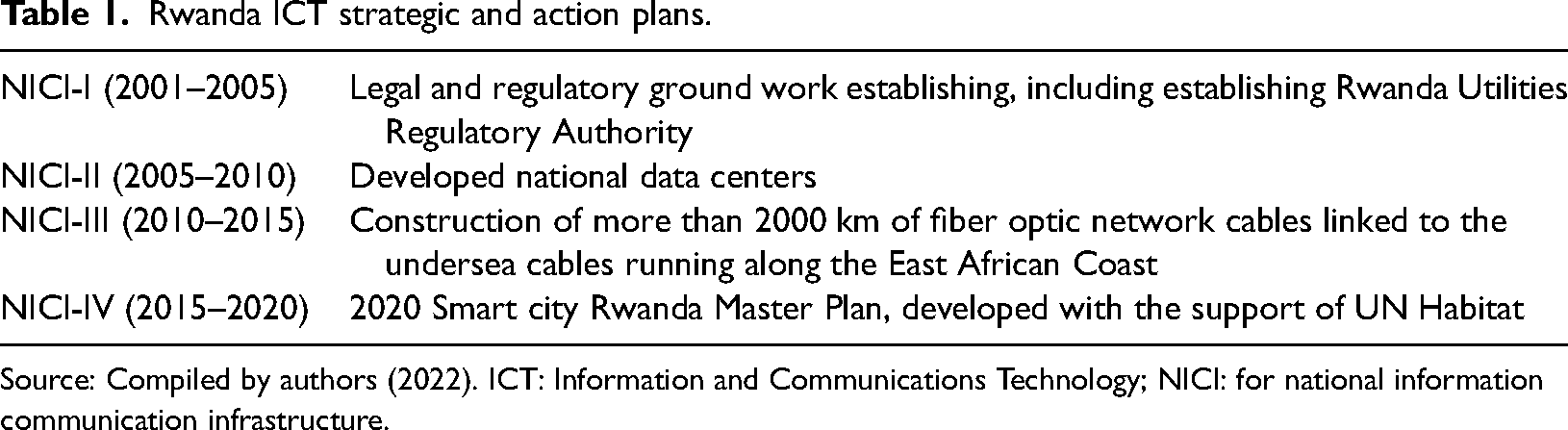
Source: Compiled by authors (2022). ICT: Information and Communications Technology; NICI: for national information communication infrastructure.
In Rwanda, as in other African countries, national utility companies and telecom companies (privatized to various extents) have been central to the implementation of these programs, showing an alliance between the developmental state and the private sector, supported by regional and global bodies and consortia. The Rwandan case also shows the increasing centrality of cities in ICT planning, with the latest NICI focused on urban programs in Kigali and other urban centers in the country. This plan shifted toward reality when, at the Transform Africa 2017 event in Kigali, Inmarsat, a leading global satellite organization, signed an MOU with the Rwanda National Government and the Smart City Alliance in a pledge to transform Kigali into a smart city. This was not just a discursive move. Inmarsat, in partnership with Actility, created a Low Power Wide Area Network (using the LoRaWAN protocol) covering the entire city. Without investment in this urban network, platformed services would be significantly more challenging, if possible at all.
Such investments have also been made in Nairobi, showcasing a similarly wide spectrum of actors between global companies and state authorities. For example, Google has launched its first product development center in Africa, in the city; Nairobi County's “Information Communication Technology & e-Government” has attempted to move various services online; and Kenya Power (the national energy utility) has coupled national electrification with the laying of a dark fiber network. This dark fiber network now extensively connects the country's major urban centers with each other and with the international Internet backbone in the whole of East Africa. Clients of this network in Nairobi are large telcos and smaller ISP startups which are now developing platform services in Nairobi's densely populated lower middle-class suburbs underserviced by other providers. As a Chinese tech entrepreneur leading one of these startups noted “we work both with the utility as well as local people who want to create businesses or build their skills.” These new companies not only deliver affordable uncapped Internet to low-income areas of Nairobi, but also create their own platform services, for local mobility, logistics, and beyond. All of these dovetailed a number of smart city plans and projects couched in Kenya's development agendas, the latest being
What do these variegated and multiscale examples do for our understanding of platform economies in urban Africa generally, and in the case study cities in particular? Most explicitly, they foreground the centrality of large technical systems and investments. Behind this is the important role that African states—supported by large-scale investments by multilateral and supranational investors—have played in the “making” of platform ecosystems and in the development of the infrastructural backbone to support access to connectivity, local data hosting capacity, and low latency. African states are largely involved in this invisible groundwork. Additionally, physical infrastructures, as the examples above show, have been complemented by specific initiatives aimed at supporting innovation cultures, whether through subsidizing startup incubation programs (as in the case of the National Data Centre in Konza, outside Nairobi), or more generally, by creating favorable conditions for digital companies to operate.
There are also some cases, albeit rare, where the state has been actively involved in the creation of specific service delivery platforms. In the context of motorcycle taxis, this is probably best illustrated in a very particular example from Kigali, where national authorities have been driving not only the underlying infrastructure (discussed above) but also the deployment of a specific platform: the Intelligent Connected Fare Meter (ICFM) system. ICFM is a government-sponsored digital tracking system that involves fitting motorcycles with GPS trackers to monitor and standardize e-hailing fares. First implemented (although largely unsuccessful) in 2018, the ICFM was the initial product of Yego Innovision, a subsidiary of the Singapore-based software company Kommlabs. The backend system allows Rwanda Utilities Regulatory Authority to monitor YegoMoto activities and to set trip fare modalities according to the regulations. Despite considerable resistance from riders (resulting in a stop–start approach to implementation), the Rwandan government has insisted on implementing the platform, and the smart meter has become ubiquitous in driving the platformization of motorcycles in the city.
In sum, the current rise of platformed motorcycle mobility services must be seen within the context of much longer-term (and at times less visible) investments that have been made, by public bodies, large private companies (such as tech or telecommunication companies), and multilaterals (such as the African Development Bank), in support of these ecosystems. For platform urban scholars—those concerned with Silicon Savannahs and other Southern geographies—it is vital to engage with the large technical systems that underpin platformization and understand the role which African states themselves have played in these processes.
Platforming paratransit: Diversification, imitation, circulation, and localization
Having accounted for the importance of large technical systems (and the developmental actors behind them) in platform urbanism, we now turn to how technology capital, both international and domestic, is shaping platform motorcycle innovations. In doing so, we showcase another Silicon Savannah story, this time from the vantage point of the booming platform experimentation that has been driven by the private sector over the past 4 years.
The government-sponsored ICFM in Kigali, introduced earlier, is, in fact, a rare example of a state-driven platformization of paratransit. Most mobility platforms are conceptualized, financed, and launched by the private sector—startups at various stages of development. The growth of this phenomenon in African cities, while beginning in earnest before COVID-19, expanded considerably during the pandemic, as regulations sought to limit human contact. This is particularly true for e-commerce, as the lower-middle, middle, and upper classes in the two cities moved to online shopping for products such as groceries, medicine, water, cooking fuel, and prepared foods. Notably, many of these commodities were already being moved and delivered by motorcycle taxis prior to the pandemic. This was a largely informal economy based on localized networks and personal connections. Firms commonly used riders to move goods. Households relied on the services of a personal rider, who would in turn delegate tasks to a personal network of other riders, both for commuting and deliveries. Digital apps have intervened in this economy by shifting the on-demand provision of these services onto an algorithmic platform. This scaled up the networks considerably.
Based on data collected in 2021, Tables 2 and 3 provide an overview of platforms that were active in Kigali and Nairobi at the time of this research. These only include those that have dedicated motorcycle taxis, with riders either integrated directly into the platform, or connected through the ordering process, usually via WhatsApp. Many more platforms do use motorcycle riders in less formalized ways. Since the time of data collection, this list has probably changed subsequently, as the ecosystem is constantly moving, new platforms being introduced, others dying, and some merging. Tables 2 and 3, however, offer a useful snapshot and illustration.
Platforms in Kigali as of May 2021.

Source: Authors (2022).
Platforms in Nairobi as of November 2021.
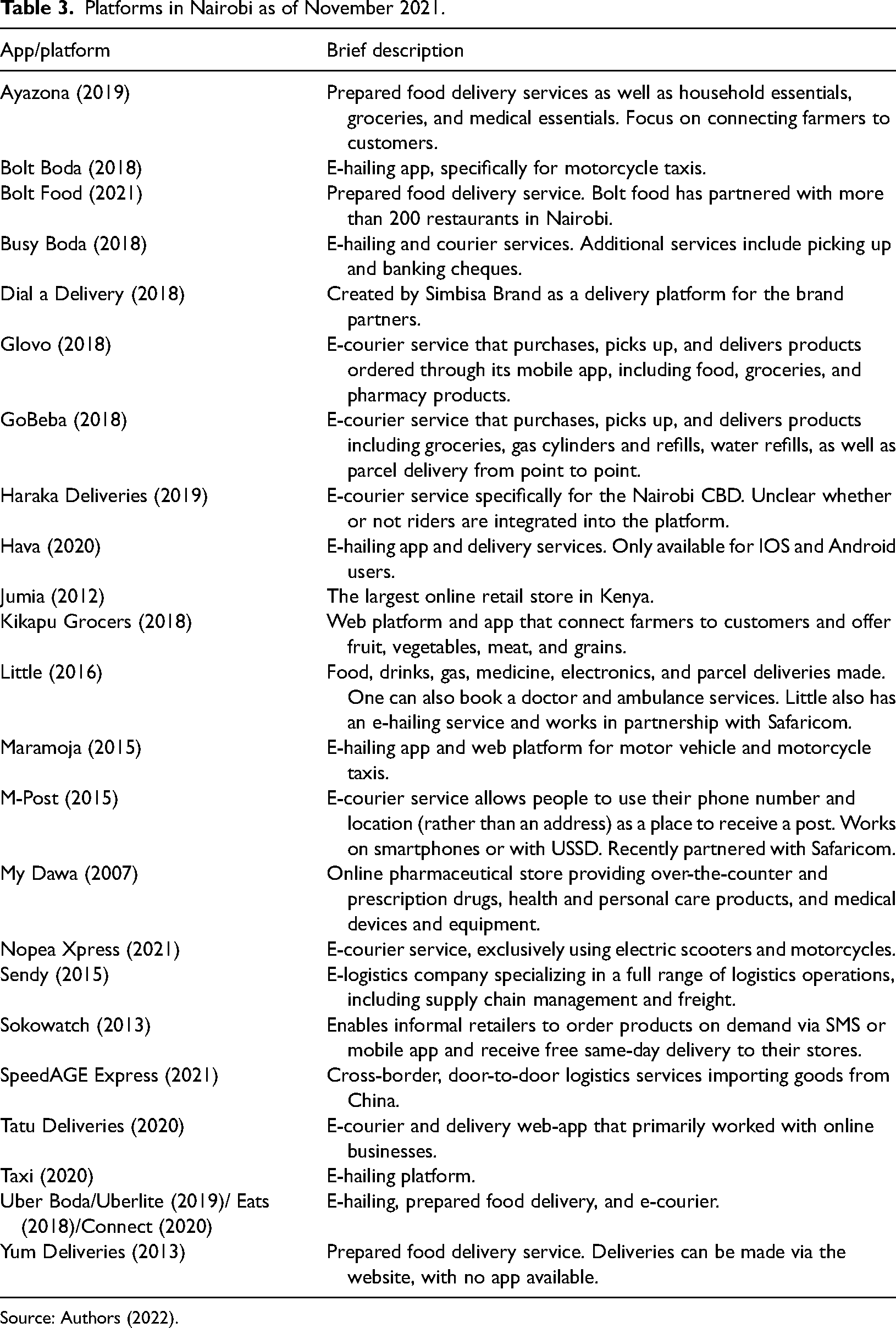
Source: Authors (2022).
From Tables 2 and 3, two trends are evident. First, there has been a rapid rise in platforms in the past 4 years. These not only map onto the COVID-19 pandemic, but also prefigured it. As several interviewees noted, many were thinking in this space before COVID—but it was the pandemic that helped them make the case to funders of the need and potential of platform services. Second, Tables 2 and 3 show incredible diversity of offering and specialization. Platforms specialize in the kind of service they offer, and, if they are in the delivery business, in the kind of commodities that they move. Platforms range from e-hailing, whereby users access on-demand pillion services for commuting, to deliveries, such as groceries and medicines. There are also platforms that have a multi-tiered offering; this is usually the case with larger players, such as Uber and Bolt. In this sense, there has not only been a rise in platforms, but also a diversification of their offerings.
Not uncommon for startups globally, each platform has a niche it aims to fill—a specialty offering of some sort. In Nairobi, where the startup space is crowded, this was particularly evident in our research. Busy Boda, for example, offers riders loans, insurance, and safety training, and a rider program was developed to support female entrepreneurs. Ayazona, through Ignite Labs, developed a complete week-long grocery and essentials kit, working with a budget of as low as KES1,000 (US$9) per household. My Dawa allows you not only to buy medicine, but also to speak to a doctor via the platform. Maramoja aims to address issues of safety by allowing users to see the social media accounts of riders before selecting them. A scattering of companies also make their mark (and mobilize “green” resources) by working in the e-mobility space, offering electric motorcycles, linked not only to digital platforms, but also to charging networks. This diversity not only reflects common trends within startup spaces to craft offerings that aim to address very specific economic and social issues, it also demonstrates how motorcycle taxis have become integrated into many aspects of urban operations, mobility, and everyday life.
Such a process of diversification is also a function of the unique urban contexts of cities like Nairobi and Kigali, where these dashboards not only specialize in optimizing informal riders’ networks, through data-driven monitoring, they also seek to improve the interface between motorcycle networks and other informal economies, offering services that range from customized quick-commerce from “wet markets” (e.g., GoBeba) to restocking for informal traders (e.g., Sokowatch). In other words, while these datafied systems may be read as a form of what Altenried (2019) has called “digital Taylorism,” they also reflect an attempt at transforming urban economies and labor practices that are already highly precarious and, sometimes, exploitative.
Another insight from the mapping of all motorcycle platforms across the two cities speaks to the intersections between global techno-capital and local innovation and adaptation. Our research suggests that local and global capital come together to experiment in these cities. For example, the Kenyan platform table includes global tech giants such as Uber (the United States), Glovo (Spanish/German), and Bolt (Estonia), all of which have had to adapt to the local context, the most obvious examples being through the inclusion of motorcycles, M-Pesa mobile money, and WhatsApp communications between riders and users and other components of local economies. Moreover, these giants were not at the forefront of these experiments, as many local platforms already existed in this space and still sit side-by-side with global platforms (Odendaal, 2023). At the same time, interviews with representatives of these companies indicate locally developed platforms transcend their origin stories, tapping into global venture capital, employing techy expatriates, and benefiting from various pan-African incubation programs.
Rwanda further nuances these insights on the local–global finance dichotomy. Motorcycle-based platforms in Kigali comprise primarily homegrown startups. However, what it means to be homegrown is contestable. For example, the e-commerce platform Vuba Vuba entered the market in the wake of Jumia's exit. Jumia is a pan-African e-commerce platform initiated in Lagos and funded primarily by German investors. The newly formed Vuba Vuba managing director had been the head of now defunct Jumia Foods Rwanda, and in setting up the new company, brought about 80% of Jumia's employees into the new platform. This suggests that, while the app itself was locally designed, and funded by local banks, it built itself on the legacy of Jumia. Another important example in the e-hailing space is YegoMoto, a moto-taxi platform that is part of Yego Innovision, a locally registered Rwandan business conceived for and tailored to the Rwandan market. In contrast to the homegrown narrative, the founders themselves are international entrepreneurs who got their business idea while attending the Transform Africa Summit that was held in Kigali in 2013, and the company has a subsidiary relationship with a Singaporean software development company. These examples challenge us to think about how ideas circulate—rather than trying to pinpoint markers of indigeneity. It further suggests (as Goodfellow (2020) has argued for the real estate sector in urban Africa), that domestic capital's interaction with local economies is vital for understanding urban development.
Regardless of where these platforms originate, localization, and specialization are necessary for survival in a crowded and young market. Platforms have to extend and develop new supply chains, for example, working with “wet markets” (sokos) or mini-marts (Sendy). According to our interviews, this localization can also be seen in the analog and algorithmic workarounds that are a central feature of the use of platforms, where a rider's knowledge of the city often trumps GPS routes, WhatsApp is preferable to using in-app messaging systems, and phone calls often more efficiently connect and coordinate between riders and users. These localized adaptations, while often happening outside the platforms themselves, are vital to their functioning as urban economies of mobility and last-mile logistics.
Beyond the content of Tables 2 and 3, interviews and case studies of particular platforms show us that African “startup cities” (Pollio & Cirolia, 2022), such as Kigali and Nairobi, are indeed melting pots and entanglements of local investors, global tech companies, diaspora returnees, pan-African entrepreneurs, and locally bootstrapped startups. The complexity of these assemblages shows that there is not a straight line from global investment to local implementation, but rather a more integrated, entangled, and iterative process of platforms customizing themselves to the local context.
Conclusion: Southerning platform urbanism and the limits of tech-frontierism
It is tempting to see the rise of platforms in the motorcycle space in urban Africa as a story about global tech-frontierism: venture capital seeking, speculating in, and even constructing new markets to exploit for revenue. The emergence of these platforms, particularly fintech platforms, has raised concerns about the exploitative nature of global techno-capital, with some critics arguing that platform economies in Africa grasp onto the racialized economic marginalization of its people (Langley & Leyshon, 2022). We do not reject this reading of platforms but have sought to weave additional storylines. In fact, a Southern orientation to our research reads these storylines as a means to disrupt canonical discourses, (re)
The call for an ambivalent reading of technological landings, launched from this Southern orientation, is not simply about showcasing complexity and speaking back to Northern theory-making. It is also about initiating new conversations on how emergent technological shifts can (and indeed should) be harnessed, reconfigured, and reworked toward more equitable and accessible urban futures. The platformization of motorcycles dexterously intersects with the urban economies of Kigali and Nairobi, creating algorithmic dynamics that are bound to change these cities in ways that will not necessarily follow the dynamics of platform urbanism that other scholars have observed in the global North, where informal economies are not as central and dominant in the everyday life of cities. Neither will the same kind of regulatory efforts brought about in other contexts necessarily work in urban Africa, if replicated and repurposed.
Our article therefore started by reflecting on the rise of large technical systems and the development project which has facilitated these capital-intensive investments. We suggested that platform economies are being developed on the back of a plethora of ICT infrastructure programs—from global connectivity to localized networks. It is infrequent that accounts of platformization recognize these vital investments and the central role of African states, development finance institutions and international consortia. Failing to recognize this runs the risk of overinflating the role of big tech, startups and venture capital in shaping platformization in African cities. And underestimating the possibility that, in the same way as African states tailored vast scale ICT systems to domestic developmental agendas, so too might they regulate and direct platform economies toward digital and urban futures which reflect more progressive possibilities, principles, or politics.
We then turned to the substance of the platformed motorcycle infrastructures. While acknowledging the precarity and exploitation brought about by global platforms in African cities, we suggest a more complex picture of platform circulation and adoption, particularly in their relation to global and local economies. While many of these platforms are indeed global variants of known companies (such as Uber or Jumia), and are therefore sustained by the circulation of transnational capital and by the availability of cheap and precarious labor, many other platforms are locally designed and developed, showcasing a range of different economic rationalities and attempts at addressing specific market gaps. Some of these experiments are even predicated on improving the working conditions of riders—promises that will need to be tested but should not be disregarded.
Ultimately, whether initiated locally or mobilized from global circuits, platforms land in place in complex ways, iterating and adapting to local contexts. More than imposing on the city a singular algorithmic logic, these platforms are forced to work with city systems, everyday practices, and contingent circumstances. We therefore echo and extend the work of Stehlin et al. (2020) and others in arguing that these complex stories should be researched and read alongside the better-established critiques emanating from concerns about the financialization, datafication, labor flexibilization, and neocolonization of African cities through platform technologies.
Footnotes
Acknowledgements
Declaration of conflicting interests
Funding
ORCID iD
