







Abstract
Introduction
To be successful, protest groups must back their demands with sufficient threats to sway political leaders. When civic groups seeking political change employ different forms of disruptive interference such as demonstrations and violent campaigns, the threats they pose are claimed to be enhanced when a bargainer can mobilize more resources (e.g. participants, money, facilities, violence), demonstrating its ability to attack a competing bargainer in case negotiations fail (Banks, 1990; Fearon, 1997; Schelling, 1960). Consistent with these insights from bargaining theory, much of the protest literature explicitly argues or implicitly depends on the assumption that protest groups mobilizing more resources have a higher ability to force political leaders to the bargaining table and are more likely to obtain concessions (Bell et al., 2014; DeNardo, 1985; Gamson, 1975; Lipsky, 1968; McCarthy and Zald, 1977; Schumaker, 1975). 1
Although the assumption concerning resources is widely accepted, it is contradicted by two sets of empirical phenomena. The first puzzle is why some large-scale protests fail to win political leaders’ concessions. Consider the cases of antinuclear protests in the 1970s. France and West Germany achieved higher levels of participant mobilization than other antinuclear movements in Europe and the US (Kitschelt, 1986: 71–72), 2 but made little impact on government policies. Their American counterparts, however, succeeded in forcing the abandonment of several nuclear power plants planned or under construction (Kitschelt, 1986: 71–72; Kolb, 2007), although protests in West Germany and France should have posed greater threats to the governments and therefore won government concessions if the conventional wisdom is true. Further, one group’s excessively large mobilization promotes counter-mobilization by another seeking to maintain the status quo (Tilly and Tarrow, 2015: 38), making bargaining with government less straightforward.
The second puzzle is why some protest groups reduce the amount of resources available for disruptive activity by investing in their organizational development. The antinuclear protesters in the US bargained with the government by spending some of their resources on building their organizational infrastructure rather than only on street demonstrations (Kitschelt, 1986: 68). For unstructured, grassroots protest groups to transform into structured organizations, they must invest in organizational infrastructure. For example, the US recycling movement hired paid professional staff and incorporated key activists during its loose process of structuring into a national recycling association in the 1960s, rather than using volunteers (Lounsbury, 2005: 77–83); successful antinuclear movements made efforts to win legal incorporation and transform from grassroots to regional or national groups founding umbrella and branch offices (Nelkin and Fallows, 1978); and lobbyists are obliged to register and pay the fee in most US states. However, simply hiring full-time staff and acquiring office facilities does not immediately inflict damage upon governments. From a resource-mobilization perspective contending that the more resources are mobilized for disruptive interference in what governments are responsible for, the more powerful a protest becomes, the allocation of resources to organizational development should not immediately improve a group’s ability to influence the policymaking process. Moreover, the formation of organized advocacy groups can be threatening to political leaders in future periods as it may facilitate coordination among protesters with stronger leadership. Such long-term effects are not necessarily promising, however, owing to a potential decrease in public support or issue salience compared with the effect of disruptive action that can punish political leaders. Notwithstanding, US antinuclear protests devoted considerable effort towards organizational development to great success. Moreover, civic advocacy groups investing in both protest activity and organizational development usually have a larger impact on the policymaking process than episodic protest groups with few organizational foundations.
Relatedly, it is also puzzling that despite several benefits of organizational development claimed thus far, not all protest groups mobilize resources for their organizational evolution. If organizational development benefits organized groups, every group should have invested in it. 3 Therefore, certain short-term incentives must cause civic advocacy groups to allocate resources to organizational infrastructure.
By formalizing a one-shot bargaining model of protests between a political leader and two sets of audiences to whom the political leader must appeal, I will clarify a mechanism by which those puzzling processes can go hand in hand and show that protest groups do have incentives to distribute some resources to building organizational infrastructure, even in a one-shot game. This article proves that excessively high investment of resources in protest activity perversely undermines a protest group’s ability to influence the government policymaking process because it facilitates a counter-protest that offsets the impact of the original protest. This result challenges the conventional wisdom that the greater the resources mobilized for protests the more successful the protests will be.
The findings demonstrate that protest groups can benefit from distributing resources between both protest activity and organizational development, although the more resources groups use for organizational infrastructure, the fewer costs they can then impose upon government today. Weakening a protest group’s capacity to sway the government in a credible, observable manner (i.e. organizing groups) makes a pivotal contribution to a competing protest group’s willingness to stage a counter-protest and thereby improve its odds of winning concessions. This finding explains why the US antinuclear protests in the 1970s led to substantial government concessions despite their relatively low level of resource mobilization for protest activity whereas those in West Germany did not. This result can also explain why radical civil resistance, such as terrorism, tends to backfire by hardening the population’s stance (Abrahms, 2013; Fortna, 2015; Gould and Klor, 2010). This article presents, to the best of my knowledge, the first attempt to theorize the significance of a strategy to reduce counter-protests.
This article speaks to the literature on civic advocacy groups. Although protest groups and interest groups attempt to influence policymaking processes in essentially the same way (Berry, 1999: 142), these groups have been examined separately: sociologists have predominantly examined protests (e.g. Gamson, 1975) and interest group politics have primarily been studied in economics (e.g. Grossman and Helpman, 1994; Tullock, 1980). With the premise that organized advocacy groups, including interest groups, and episodic protest groups are on a continuum representing the degree of organizational development and by endogenizing civic groups’ decision on their organizational forms, this article bridges several groups of literature that have often failed to talk to each other.
Literature
Protests are predominantly discussed in the collective-action framework (e.g. Gavious and Mizrahi, 1999; Karklins and Petersen, 1993). Although the resolution of coordination problems is essential for protests to emerge, the cases of unfruitful protests demonstrate that coordination does not always guarantee success. To better understand protest consequences, protests also need to be discussed in terms of threats. Protesters have opportunities to punish political leaders
Only a few studies formalize the bargaining aspect of protests (Lindvall, 2010; Scartascini and Tommasi, 2012). The inter-state bargaining literature, however, provides insights into the role of resource mobilization as threats (e.g. Fearon, 1997; Schelling, 1960; Slantchev, 2005) to suggest that protesters should impose a sufficient magnitude of threats towards government to make the government prefer the retraction of threats to their fulfillment. A number of studies on civil resistance depend on the assumption that the more resources a group mobilizes for protest activity, the greater the group’s threat becomes (Bell et al., 2014; Gamson, 1975; McCarthy and Zald, 1977; Schumaker, 1975; Tenorio, 2014). However, this conventional wisdom is now under increasing challenge.
First, the amount of resources mobilized for protest activity does not always positively correlate with protest outcomes. Empirical studies have yielded mixed (Colby, 1982; Giugni, 2004) and contradictory (Taft and Ross, 1969) results concerning the efficacy of a high level of mobilization. Cases question the applicability of a costly signalling framework to the context of protests. Some protests using significant resources failed to win political leaders’ concessions and often provoked counter-protests to offset the efforts of the initial protests. For example, rightist protests such as segregationist protests (Andrews, 2002) and antiabortion protests (Meyer and Staggenborg, 1996) often faced counter-protests, and antigovernment protests in countless countries such as Russia, the US and Thailand have also propelled rival movements. Meanwhile, a small number of protesters have made ‘a big splash’ such as those during the New York rent strikes (Nie and Verba, 1975: 24) and
Second, the literature on protests and on bargaining in general tends to overlook the possibility of counter-mobilization when analysing the interaction between protesters and government, relying on the assumption that political leaders have only one set of audiences to appeal to. This assumption may hold in the context of inter-state bargaining in which domestic audiences uniformly do not want their home leader to concede, 5 but not in the context of domestic bargaining in which public preferences about their leaders’ concessions are diverse. The effects of concessions are essentially twofold (Schelling, 1960: 34). Suppose that an incumbent leader modifies a given status-quo policy that she has implemented. Protesters dissatisfied with the policy may construe her concessions favourably, whereas people who prefer the previous policy may think that the leader has broken her prior commitment and may become suspicious of any new pretence at commitment. This situation indicates that, in domestic bargaining, larger mobilization in protest activity aimed at increasing the probability of executive concessions may incentivise counter-mobilization seeking to offset the impact of the initial mobilization. Although a few exceptions directly deal with counter-protests such as Meyer and Staggenborg (1996) and Zald and Useem (1987), they do not analyse how the emergence of counter-protests constrains political leaders’ decision-making. Little is known about such countervailing strategies that one group employs against another. 6
Furthermore, a theoretical shortcoming of protest literature has yet to be solved. Most literature on protest takes it for granted that protest groups have already formed, although a number of protests were staged without back-offices or clear leadership. In other words, people should have options regarding the formation of protest organizations, the extent to which they make their organizations institutionalized, and the amount of resources they will utilize for protest activities. One reason for the lack of perspective on endogenous institutionalization is in part attributed to the fragmentation of scholarship. Traditionally,
The second reason for this shortcoming is that the effect of resource mobilization for protests and organizations is not clearly discerned. Protest literature assumes that using resources benefits protest groups no matter the purpose. Yet protests and organizations are different in their observability and uncertainty. Protesting on the street is intended to be seen by the public and government to improve the policy influence and social presence whilst organizing civil groups is less visible, often behind the curtain. Furthermore, groups’ organizational development does not necessarily guarantee their future ability to threaten a government and to survive. 7 Given governments’ limited ability to address threats, ongoing threats should be immediate threats to government unlike potential threats in future periods. Without dissecting the effect of protest groups’ resource mobilization, we may miscalculate the effect of protests.
Thus, the literature on protest may not have overcome the selection bias inherited in the categorization of civic groups. Selection effects present an inferential problem because citizens should have incentives to form better organized groups such as lobbying groups if they provide better bargaining leverage. From a resource-mobilization perspective, then, no persuasive answer as to how civic groups rationally determine their organizational forms and what endogenous factors produce such different degrees of bargaining leverage between civic advocacy groups of different levels of organizational development has been found. If civic groups that devote resources to organizational development are more likely to succeed than those that do not, it would follow that those protest groups that the protest literature analyses fail to achieve their goals despite mobilizing all resources for protest activity. Placing episodic protest groups and organized civic groups on a continuum representing different degrees of organizational development, then, matters for more accurately assessing the effect of resource mobilization and more coherently understanding ordinary citizens’ political participation.
The model
The model highlights strategic interaction between a political leader and two sets of audiences, which is sketched in Figure 1. Two groups of citizens are potentially in conflict over a given status-quo policy
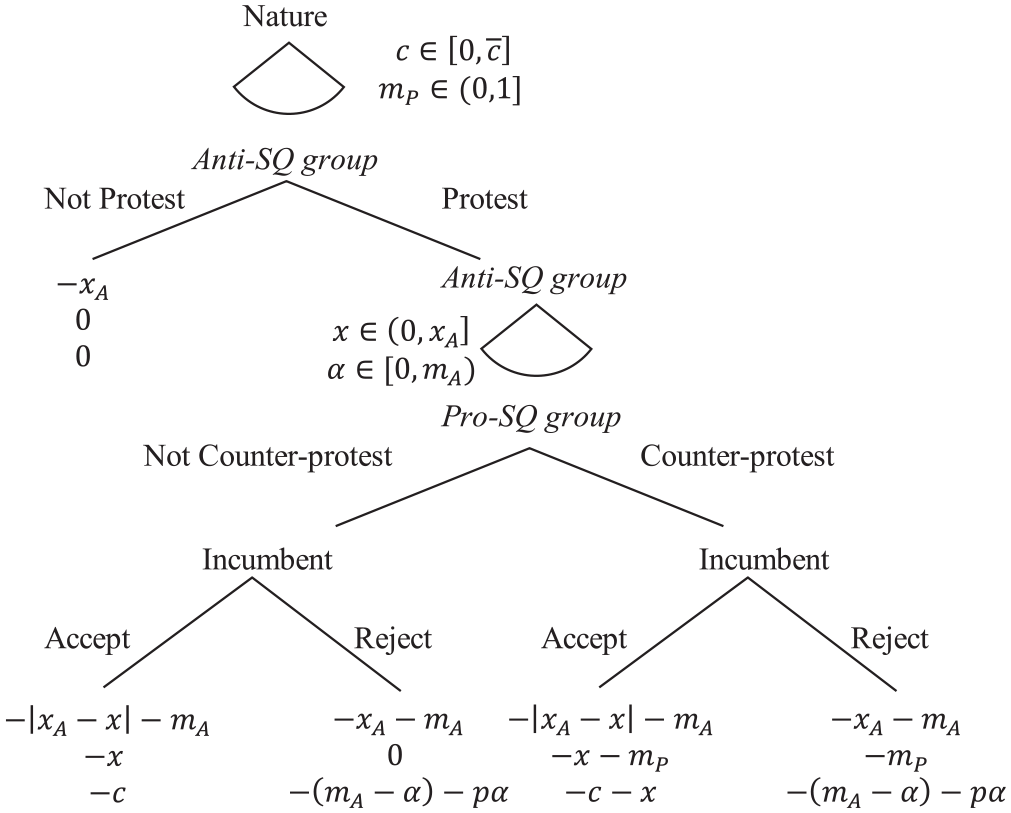
Sequence of play.
The game begins with Nature randomly selecting
Second,
When
Third,
The payoffs for both groups are determined by policy outcomes and costs of mobilization. Benefits from policy outcomes depend on the distance between the final policy outcome and the ideal point of each group. If the game ends in the status quo,
Since
Before turning to formal results, it is important to assess whether the model’s structure and assumptions are sufficiently reasonable. One of the key assumptions is that
The second assumption is that
The third assumption is that
It should be noted that collective action problems are not assumed to occur for either side in this game. A theoretical rationale for this is elite leadership theory (e.g. Calvert, 1992), in which members of each group are assumed to participate in protests if their leaders stand up. Furthermore, formal results of this model could capture elements of collective action problems in interpreting the results, despite not explicitly formalizing.
Finally,
Equilibrium
To gain a better understanding of how domestic audiences’ heterogeneous preferences affect equilibrium outcomes, I first solve the baseline model assuming that the audiences are monolithically against the SQ (i.e. no
Bargaining before an audience
The equilibrium in which every citizen prefers the executive concession is equivalent to a simple take-it-or-leave-it game between
Proposition 1
Suppose that
Proposition 1 provides simple comparative statics concerning the effect of resource mobilization. The minimal amount of resources

Equilibrium policy outcome in Proposition 1 if
Consider a hypothetical situation in which all the populace has an identical preference over a certain policy and no group opposes
Bargaining before two audiences: the escalation of conflict
I now solve the entire game introduced above, in which two protest groups with different political goals bargain with the political leader. In this subsection, I solve the baseline model assuming
Proposition 2
Suppose that no resources are spent on organizational infrastructure.

while she stages a protest if

proposing

When a potential opposition exists, the equilibrium behaviour of

(i)
Figure 3 shows that a nonmonotonic relationship between
Let me consider

Equilibrium strategies of
Proposition 3
Suppose
(i) is increasing in
(ii) is decreasing in
Proposition 3 shows comparative statics regarding the probability of a counter-protest. For larger
The effect of

moves to the left, and the minimum
Thus,
The initial stage of antinuclear protests in West Germany illustrates the equilibrium when the investment of full resources in protest activity fuels counter-protests and undermines the protest group’s odds of winning government concessions. The antinuclear movement in Germany began in the Wyhl area and fled to grassroots protest groups in many other cities (Rucht, 1990: 204). Many antinuclear movements in the early and mid-1970s employed conventional means of protests. For instance, in the Brokdorf and Grohnde areas, the antinuclear groups mobilized mass demonstrations and even militant cooperation, but they ended in direct and violent battles with police (Karapin, 2007: 115–121). Thus, the antinuclear protest groups gained a good deal of resources (high
Moreover, several other studies lend empirical support to the formal result that counter-protests impede political changes. Andrews’s (1997, 2001) quantitative studies on the Mississippi civil rights movement show that white resistance had a significant negative impact on political change. McCright and Dunlap (2000) examine conservative movements against global warning issues in the US and contend that they successfully halted the government endorsement for the Kyoto Protocol in 1997.
Nonetheless, these equilibrium results call into question the considerable impact that civic advocacy groups with large resource pools can exert on the policymaking process. How can resourceful protest groups overcome the problem that their protests may provoke counter-protests?
Organizational diversification: effective deterrence of counter-protests
Comparing the following equilibrium, in which
Proposition 4
Suppose that

for organizational infrastructure if

Proposition 5
Suppose
Proposition 4 demonstrate the players’ best responses when

Players’ best responses with sample parameters.
Consider why more resourceful

An illustration of
Yet another effect of
This result suggests that there is a tradeoff between
Proposition 6
The amount of
(i) increasing in
(ii) increasing in
(iii) decreasing in
Comparative statics in Proposition 6 reveal the tradeoff that
The formal results enable us to answer the second question: why does investing in organizational development have a positive effect on their bargaining leverage despite reducing the amount of resources available for protest activity? Proposition 2 demonstrates that making demands through protest activity without building an organizational foundation is not necessarily the best way to negotiate with
The organizational evolution of US antinuclear movements exemplifies how investment in organizational infrastructure contributes to the deterrence of counter-protests and the improvement of the organized protest group’s bargaining power. Antinuclear protests prior to 1974 were fragmented, and the groups often conducted sit-ins in specific nuclear facilities and voiced their concerns mainly by participating in public hearings (Nelkin and Fallows, 1978: 279). In the mid-1970s, they changed from grassroots civic groups to regional or national groups (Nelkin and Fallows, 1978: 280–281) and changed how they allocated resources. Instead of allocating resources to protest activity in their initial stage (
Discussion
Comparing the propositions so far offers new insights regarding the effects of resource mobilization. First, the amount of resources that protest groups possess is not the most important determinant of protest success. As Propositions 2 and 3 show, counter-protests can rarely be deterred when resourceful protest groups invest no resources in organizational infrastructure. What matters more is how protest groups allocate their resources between protest activity and organizational development. As Propositions 4 and 5 reveal, investment in organizational infrastructure helps protest groups deter potential counter-protests and increase the range of
Second, the allocation of resources towards organizational development signals that the protest group will not undertake too assertive tactics. In equilibrium,
Specifically, what makes the process of organizational development inherently special? How is investing in organizational development different from simply burning resources? First, the strategy of burning resources cannot apply to every type of resource. Destroying banknotes and facilities is possible but not destroying human resources. The option to consume resources for organizational capacity is thus plausible and consistent with norms. Second, simply burning resources would not have a lasting effect on protest groups’ ability to pose threats. As previously noted, organizing protest groups can benefit them on a long-term basis despite weakening their ability to threaten governments, and governments’ anxiety about protest groups’ future capability will improve their bargaining leverage today.
Third, and most importantly, consuming resources through organizational development communicates the reduction of resources to other actors in more credible and observable ways than other means. Democracies emphasize information disclosure and ensure formal procedures. Once a protest group has obtained corporate status, they must publicly disclose information about membership and organizational size and issue settlement reports. High observability backed by institutional setup enables protest groups to credibly show their commitment to the de-radicalization of their activity.
This implication provides a logical prediction that if the investment is made behind closed doors, it might not have such effects on potential opposition. Suppose that a protest group pays to make people stay home rather than joining counter-protests. It may reduce the number of potential protesters who will participate in counter-protests, but such a payment would not alleviate a competing group’s fear concerning the original protest group’s potential ability to force policy changes. The original protest group may not reveal that it has bought off potential protesters, and even if it does so, it would be difficult for a competing protest group to check all the individual payments made and accurately assess the remaining amount of resources the original protest group possesses. Another example is terrorist organizations. Lake (2002) and Abrahms (2008) indicate that terrorist groups often prioritize improving their organizational survival over accomplishing their political goals; however, the organizational development of terrorist groups is unlikely to operate in the same manner since it occurs stealthily. Thus, the formal findings dovetail with empirical observations that more organized protest groups tend to gain more bargaining leverage without resorting to radical means.17,18
Furthermore, the results above provide additional empirical implications. First, we cannot measure the strength of protest groups merely by observing the size of resources mobilized for protest activity or by observing the magnitude of policy changes demanded. As the bold line in Figures 3 and 5 shows, protest groups with relatively intermediate resource mobilization capacity successfully moderate a counter-protest and achieve their policy goals whereas those possessing high capacity cannot necessarily do so because of a high probability of fuelling counter-protests. Rather, the amount of resources spent on founding non-transitory protest groups would be a better proxy to infer protest groups’ potential policy influence.
Second, protest tactics that include direct costs on political leaders, such as demonstrations and violent campaigns, give protesters only limited policy influence. Instead, protest groups’ ability to influence policies can be enhanced by using resources in such a way that it does not directly attack political leaders. This implication comports with the empirical findings by scholars like those of Stephan and Chenoweth (2008), Franklin (2009) and Chenoweth and Stephan (2011), namely that non-violent resistance is more effective than violent resistance. The mechanism by which radical tactics tend to backfire by hardening the stance of the populace is also consistent with recent studies on terrorism that call into question the conventional wisdom that violence allows civil resistance to achieve its policy aims (Abrahms, 2006, 2013; Fortna, 2015; Gould and Klor, 2010).
Although I highlight the importance of resource allocation to organizational development, my results could potentially be due to other causal explanations, like principal–agent issues. Protest groups that pay less in organizational infrastructure may be more likely to suffer from supervision of their participants, which may lead to violent clashes and lower success rate. Admittedly, the strength of leadership is sometimes correlated with the levels of organizational development. However, several cases show otherwise. For example, the People’s Alliance for Democracy (PAD), an unorganized antigovernment protest group in Thailand, 19 started to protest peacefully in 2006, changing to more radical tactics in 2008 such as seizing an international airport and government buildings. After successfully overthrowing Prime Minister Thaksin, the PAD leaders had been training security guards who could serve as shock troops when they chose to take the offensive (Ockey, 2009: 322). Given that the number of PAD demonstrators had decreased dramatically in the two years (Ockey, 2009: 322–332), it should have been easier for its leaders to facilitate coordination among the members. This episode demonstrates that the leaders did consider using violence for their political goal, rather than proving that such radical means of protesting were attributed to the failure of the principal control. Hence, violent protests and the lower success rate of such protests cannot simply be attributed to principal–agent problems.
Despite not explicitly formalizing, this model could capture elements of collective action problems. The lower threshold of
Conclusions and extensions
This article suggests a framework to scrutinize the effects of resource mobilization on protest consequences. It does so by formalizing a bargaining game between a political leader and two competing protest groups and by endogenizing a protest group’s choice about its organizational form. The model proves that the greater mobilization of resources for protest activity does not consistently improve a protest group’s ability to achieve policy changes because it raises the probability of a counter-protest offsetting the impact of original protest. This result suggests that protest groups’ neglecting to consider the heterogenous preferences of domestic audiences can lead to inefficient mobilization of resources.
The model sheds light on the double-edged effects of investing resources in organizational infrastructure. On the one hand, investment in organizational infrastructure reduces the amount of resources available for pressuring activities and hence decreases protesters’ ability to carry costs on a political leader. On the other, investment in organizations decreases the probability of counter-protests by affecting a competing group’s expectation that the political leader is less likely to accept a policy change. By credibly showing that the amount of resources available for protest activity has been reduced, resourceful protest groups are more likely to translate much of their resource mobilization capacity into equivalent levels of threats towards the political leader. Thus, protest groups would face a tradeoff between the pursuit of ideal policies and smooth bargaining without rival groups’ intervention. If protest groups seek extensive policy changes, they need to mobilize a larger amount of their resources for protest activity to pose greater threats to political leaders, but it occasions rival groups’ interventions. Some protest groups might be better off by limiting the levels of protest activity and offering a compromise policy deal to government. A precise evaluation of the impact of organizing protest groups on political leaders’ decision-making would require further research, but differentiating the process from the product of organizational development conceptually and studying organizational evolution as commitment devices to choose de-radicalized dissent tactics could advance our understanding of the organizational diversification of civic advocacy groups.
Taken together, the findings challenge and are consistent with conventional wisdom: the more resources are mobilized, the more powerful the protest is. Better access to resources allows protest groups to afford to develop in an organizational sense and to commit to the de-radicalization of their activities, not because a larger resource pool allows protest groups to impose heavier costs on political leaders. Maintaining the central idea of resource mobilization theory, this article provides a new way of interpreting the formation of interest groups and bridges a gap between the literature on protest groups and on interest groups. While it is difficult to measure resources of organized groups and hence organizational development in any meaningful and comparable way (Berry, 1999: 147), future research should overcome this difficulty to pursue systematic, empirical evidence for the formal findings.
A way to produce more insightful models would be to highlight structural effects on the levels of transparency in the process of organizational development. I assume that the amount of resources paid for organizational infrastructure is known to every player, but communicating resource consumption in credible ways may not be easy for some types of groups or in some types of regimes. Incorporating characteristics of dissident groups and regimes might further clarify the complicated diversification of civic advocacy groups and the effects of political rules on the consequences of protests.
Supplemental Material
190506_online_appendix – Supplemental material for Protest, counter-protest and organizational diversification of protest groups
Supplemental material, 190506_online_appendix for Protest, counter-protest and organizational diversification of protest groups by Kana Inata in Conflict Management and Peace Science
Footnotes
Funding
ORCID iD

Supplemental material
References
Supplementary Material
Please find the following supplemental material available below.
For Open Access articles published under a Creative Commons License, all supplemental material carries the same license as the article it is associated with.
For non-Open Access articles published, all supplemental material carries a non-exclusive license, and permission requests for re-use of supplemental material or any part of supplemental material shall be sent directly to the copyright owner as specified in the copyright notice associated with the article.
