







Abstract
Introduction
New power-sharing and territorial self-governance (TSG) (i.e., federalization, devolution, and different forms of decentralization) arrangements are key elements of the toolbox international donors use to manage conflicts with an ethnic, linguistic, or religious component. 1 Conflict management aims to reduce the damage a conflict imposes on its parties, especially civilians, while the “prospects for conflict resolution seem far-off.” 2 Although the international management of many conflicts worldwide included the introduction of new TSG arrangements, the literature provides mixed accounts of the results of applying TSG solutions. While the cases of North Macedonia and Bosnia and Herzegovina are generally considered successful due to the lasting peace achieved, the experience of Nepal, parts of Indonesia, and Nigeria reveals conflicting developments under new power-sharing or TSG arrangements. As new power-sharing or TSG arrangements can fuel conflicts by empowering subnational actors, 3 donors are careful to “do no harm,” that is, not to undermine local conditions by means of external support. 4
Although there has been increasing research on the nexus between decentralization and conflict management recently, several research gaps remain and further conceptualization is required. The main challenge results from the lack of cross-fertilization between the literature on decentralization as a governance reform and decentralization as a tool for sharing power between different groups and managing conflicts. The interplay between these strands is needed to enable scholars and practitioners to improve their awareness of issues that clash with international donors’ optimistic expectations of decentralization. These issues include traditions of centralized government, institutional weaknesses at local level, or a hierarchic political culture. One major challenge—for both the practice and study of the application of TSG arrangements in conflict settings—relates to the external engagement of third states, that is, their support for secessionist movements and de facto states, or their participation in conflicts through proxies. This has only been covered tangentially by the literature on TSG solutions and conflict management and has tended to be addressed more thoroughly by research on patron–client relations. 5
Against this background, this article seeks to contribute to the emerging debate on the nexus between international donor support for decentralization (frequently related to TSG arrangements) and conflict management while exploring the conflict in eastern Ukraine prior to the Russian Federation’s full-scale invasion of Ukraine on 24 February 2022. 6 This requires innovatively linking several research strands, such as development aid, decentralization as a governance reform, and conflict management, with TSG. The case of Ukraine is highly relevant for exploring the decentralization–conflict management nexus in international donors’ activities, as, despite international efforts, the hybrid war in eastern Ukraine culminated in Russia’s full-scale invasion.
From an outside perspective, decentralization seems an appropriate solution to resolve and prevent the spread or intensification of simmering violent conflicts, such as the conflict in eastern Ukraine between 2015 and 2022. Nevertheless, although TSG solutions were fostered and also supported by international donors, the conflict was not resolved and conflict management efforts did not prevent its escalation to a major interstate war. However, Russia’s involvement in the conflict through its proxies since the conflict’s outbreak in 2014 weakened the decentralization–conflict management nexus in the Ukrainian case, despite the fact that decentralization was part of the political conditions for conflict resolution under the 2014 Minsk I and 2015 Minsk II agreements. 7 Both agreements envisaged the breakaway parts of the Donbas region being reintegrated into Ukraine subject to an array of security conditions (ceasefire, the withdrawal of weapons and illegal armed groups from the contested territories) and the Ukrainian government taking a series of political steps, such as constitutional reform, decentralization, and granting the reintegrated region broad political autonomy. 8
The Russian Federation’s involvement in the conflict as a conflict party and its attempts to deny this by stressing the role of the Donetsk and Luhansk People’s Republics (“DPR” and “LPR”) contributed to the stalemate in the implementation of the Minsk II agreement due to the creation of the “sequencing trap,” that is, disagreement over the sequencing of security and political steps under the Minsk II agreement and the conditions under which the Ukrainian side would be able to regain control over all parts of the border.
9
However, it also made decentralization a very sensitive topic for international donors to address within this conflict setting. The hybridity of Russia’s involvement in the conflict was,
The article is structured as follows: First, it introduces three strands of literature relating to (1) development aid research and donors’ motivation; (2) donor support for decentralization reform as part of the institution-building and governance agenda; and (3) the use of decentralization as a TSG solution in conflict-affected settings. The main part of this article will explore the decentralization–conflict management nexus in the engagement of international donors in Ukraine by analyzing documents pertaining to the portfolio of donors’ programs and projects in the domains of decentralization and conflict management during the period from 2014 until Russia’s full-scale invasion of Ukraine on 24 February 2022. The concluding part of the article will discuss the implications of the Ukrainian case for studies of TSG arrangements as a conflict management tool.
State of the Art and Gaps in the Research on Development Aid, International Support for Decentralization, and Conflict Management
Development cooperation can be seen as satisfying four criteria: (1) it pursues the aim of supporting national or international development priorities; (2) it is not driven by profit; (3) it adheres to a policy of “positive discrimination” in favor of developing countries, that is, by creating new opportunities for them; and (4) it seeks to advance the local ownership of the developing country in question. 11 We understand donor engagement as meeting these four constitutive criteria and also perceive both official development assistance (ODA) and non-ODA resources (e.g., stabilization funds, humanitarian assistance) as typical forms of support in the domains of conflict management. 12 That said, the long-term financial and technical support for the implementation of TSG arrangements as a development priority and the long-term priorities in the domains of health, education, and social policy are more likely to be exercised through ODA.
While development studies represent a dynamic knowledge field, they are marked by several inadequacies, especially regarding donor activities in the post-Soviet space, as studies of international development cooperation tend to focus on unveiling donor practices in specific contexts and the effects of their use. 13 Rather than referring to overarching concepts from political science or International Relations (IR), a large number of the studies on donor engagement focus on certain general principles of engagement (e.g., transparency, local ownership, or aid effectiveness). 14 A case in point is the UN 2015 Agenda 2030 for Sustainable Development, “a plan of action for people, planet and prosperity” that has served as a set of benchmarks against which donor engagement has been studied. 15 The focus on benchmarks and deliverables not only promotes researchers’ tendency to concentrate on specific practices and their effects rather than conceptual issues and their interplay with practices, but it also impacts the research investigating donors’ motivation and how donors implement their priorities and development aid portfolios. The prominence of exploring donor engagement through the lens of IR theories—that is, realism or liberal and neoliberal institutionalism 16 —does not sufficiently address the complex rationale behind donors’ strategic choices, portfolios, and trends. This complex set of motivations is composed of a combination of political, economic, and security issues, in addition to concerns pertaining to institutions and ideas. As our case study will show, the complex interplay of rationale and priorities is characteristic of international donor support in conflict-affected regions, including the implementation of TSG arrangements as a tool to manage conflicts.
Notably, the prevailing geographical focus of development cooperation studies has been Africa, Latin America, and the Caribbean, as well as Southeast Asia, while contributions exploring donor engagement in the post-Soviet space through the development studies lens have been limited. 17 The reasons for this are manifold.
The most evident of these reasons is related to the fact that international development cooperation did not target post-Soviet countries until later than the abovementioned regions. Furthermore, the scholarly focus has been placed on integration processes rather than on development cooperation. In addition, international actors’ involvement in the region’s conflict management has been explored primarily from a (geo)political perspective 18 and with respect to the European Union’s (EU) political relations with post-Soviet countries. 19 Hence, given international donors’ extensive support for reforms in the post-Soviet space, it would be highly relevant to supplement existing research with a development studies perspective. As demonstrated by Ala’ Alrababa’h et al. in their research on eastern Ukraine, the development studies lens is well suited to improving our understanding of donors’ engagement in the context of so-called “post-Soviet conflicts.” 20 Against this background, the prewar decentralization–conflict management nexus in Ukraine is of interest for development aid research as well as for the post-Soviet space, the strategies Russia employs to increase its influence, and the region’s conflict-affected territories.
Decentralization as a Tool for the Advancement of Governance and for Conflict Management
The literature on donor support for decentralization reforms in various areas of the world indicates two empirical categories. The first encompasses support for decentralization in the form of institutional reform and governance programs, not necessarily in conflict settings. 21 Such support measures usually aim at improving (fiscal) governance effectiveness; providing citizens with better access to administrative, education, and health care services; and advancing local democracy and political participation. 22 Under the second category, decentralization serves as a channel to implement new arrangements for power-sharing and TSG in the societies affected by conflicts with interethnic, linguistic, religious, or identity components. 23
Decentralization as a Tool to Advance Governance
Since the mid-1980s, decentralization has frequently been recommended to developing countries and continues to be supported to this day. 24 Donors’ rationale for supporting such decentralization has largely been explained by the lack of success of the centralized approach in development aid. From the donors’ perspective (as exemplified by the World Bank, for instance), centralized governments face two interrelated challenges: (1) their representatives are far removed from communities and lack knowledge regarding local preferences and priorities; and (2) the people living in these communities do not have a sense of ownership with respect to development projects and, therefore, make little effort to sustain them. 25 Decentralization is thus believed to create and satisfy the prerequisites for successfully achieving objectives through the increased participation of local stakeholders and their functional empowerment, creating opportunities for communities to acquire the resources necessary to finance projects that genuinely matter to them. 26
Although donor-supported decentralization reforms have been implemented in various developing countries worldwide—for example, in Peru in 1983–1986 or in Cambodia in 2005–2008—scholars point to the lack of a consistent definition of decentralization.
27
Due to the uniqueness of the decentralization agenda in each context, it should be referred to as an umbrella term for distinct concepts. From the political-economy viewpoint, four “ideal types” of decentralization can be distinguished.
28
(1)
Neither international donor agencies nor scholars have a comprehensive recipe for successful decentralization. The cross-regional comparisons between Latin America and Asia demonstrate both the contextual embeddedness of each specific reform and their strikingly different outcomes. 30 For instance, since the mid-2000s, decentralization reform has seemingly improved the performance of the sub-state government, while in Vietnam it had a positive effect on accountability, local democracy, and poverty reduction. 31 Donor-supported decentralization reforms in Brazil and Argentina, in contrast, were more problematic, resulting in the emergence of new inequalities, and both countries reverted to partial re-centralization. 32 There is also no consensus among scholars as to the relationship between different forms of decentralization and other crucial concepts, such as democratic governance or economic growth. 33
Further research strands look at the local preconditions that are conducive to externally supported decentralization. Even relatively old contributions offer useful multifactor frameworks. Rondinelli et al., for example, argued that viable decentralization reform requires an integrated political-economy framework, considering “the services to be decentralized, the characteristics of users, and financial and organizational alternatives.” 34 Moreover, Rondinelli et al., 35 as well as other authors, 36 emphasize the need to consider political and socioeconomic conditions. Strong political commitment and support, and sufficient administrative and technical capacity within the central government and subnational bodies (in devolved states) are regarded as essential political prerequisites for successful top-down decentralization. In contrast, typical obstacles to decentralization include opposition from elites, high-level political corruption, and state capture. In organizational terms, decentralization requires detailed laws and regulations that outline the allocation of funds and responsibilities between levels of government, subnational entities, and considerable human and financial resources, as well as the appropriate psychological and behavioral conditions, including an adequate level of trust between authorities at all levels. 37 A widespread concern relates to the emergence of overlapping areas of authority, which might be at risk of misuse in conflict settings. Finally, due to its cross-cutting nature, successful decentralization tends to be accompanied by reforms in other domains, such as public administration, governance, and anti-corruption, 38 which are essential for tackling specific risks of decentralization, including the weakening of a state’s capacity to redistribute wealth, ineffective local administration, or an increase in local and regional corruption. 39
Interestingly, neither Rondinelli et al. 40 nor a number of other authors seeking to identify the prerequisites for successful decentralization and/or related risks 41 refer to the presence or absence of a domestic or internationalized violent conflict in target countries. From a political theory perspective, decentralization requires the monopoly of the legitimate use of physical force within a given territory (as shown by Max Weber), which is not the case if a country faces a secessionist conflict. 42 The conflict factor is often not referred to in empirical contributions that highlight the donor-supported decentralization design in different countries and regions. 43 Does this mean that international donors mainly supported decentralization in countries where there was no such conflict? For many contexts (e.g., Peru in the mid-1980s or Cambodia since the early 2000s), the answer to this question is “yes.” In other cases (especially the meta-analyses of factors underlying the success or failure of decentralization), whether or not conflict is taken into account seems to be determined by the conceptual divide between two literature strands: the literature on decentralization as a governance reform and the literature on the use of decentralization as a TSG arrangement in the conflict management context. Hence, if implemented in conflict settings, the design of decentralization reforms should ideally be informed by both these strands of the literature, to which this article intends to contribute.
Decentralization as a Form of TSG Arrangement to Manage Intrastate Conflict
Another strand of literature that deals with decentralization but de facto exists in parallel to the literature on decentralization and governance reform is the literature on decentralization as a TSG arrangement to manage conflicts. TSG solutions, including decentralization, are primarily implemented to deal with ethnocultural conflicts whereby “increasingly assertive minority groups [demand] recognition, accommodation, autonomy and/or territorial independence.” 44 Moreover, several Western countries (France, Spain, Belgium, Canada) take measures to accommodate diversity and prevent secessionism or violent conflicts, as seen in the 2019–2020 Catalan protests, where constitutionally guaranteed autonomy did not serve as a panacea against secessionism. On the whole, there is a consensus among supranational and international organizations (EU, UN, OSCE [Organization for Security and Co-operation in Europe]) that different aspects of diversity (i.e., ethnic, cultural, linguistic, or religious) shall be protected rather than forcibly eliminated. 45 One notable exemption, however, is Kosovo, where the risk of genocide drove the international community to promote its independence. 46
Wolff distinguishes between four types of TSG arrangements that can serve as conflict management tools: (1)
As illustrated by the various cases worldwide where these arrangements are applied, minority–majority cleavages can be protracted but settled. 50 For instance, although Bosnia and Herzegovina is prone to governance challenges, such as corruption and state capture, the reorganization of the country into an asymmetric federation is seen in the literature as a viable framework for interethnic accommodation and conflict prevention. 51 There has been no violent conflict in or with respect to Gagauzia since it was established as an autonomous territorial unit within the Republic of Moldova in 1994. 52 The preservation of the territorial integrity of a multiethnic state in North Macedonia following the 2001 ethnic conflict is considered in the literature as a decentralization success story, whereby it helped the country address political, socioeconomic, and cultural inequalities, as well as pursue the objective of European integration. 53 Nevertheless, as demonstrated by the mixed results of decentralization in dealing with conflicts in the Indonesian provinces of Aceh (declared as a success) and Papua, the transfer of authority and funds to the local level does not guarantee a contribution to conflict management. 54
Although numerous empirical and meta-analytical studies praise the ability of decentralization to mitigate conflicts by enhancing local ownership, 55 it might in fact fuel rather than quell further conflicts, as it offers a considerable number of opportunities and resources for extremist regionalist parties and nationalist movements that artificially exacerbate tensions. 56 By empowering subnational stakeholders, decentralization may also weaken central government’s informal parallel governance structures, potentially posing new risks. 57 Nepal, where the very debate about new TSG arrangements (federalization) led to violent cleavages, 58 is a clear example of this. Federalism in Nigeria also failed to resolve ethnic conflicts and also conflicts over the use of resources. 59 Accordingly, scholars point to the importance of power-sharing mechanisms that ensure minorities are represented at the central level, as well as the interinstitutional division of power as preconditions for the successful use of TSG arrangements to manage conflicts. 60
To conclude, first, little cross-fertilization exists between the more general scholarship on donor-supported decentralization with the aim of improving governance and research relating to conflict management. Second, and what is more decisive, the research lacks accounts of situations where an entity claiming to be a conflict party is in fact a proxy, used by a third state, which, through its active involvement, influences the success of decentralization or rather allegedly increases the risks. 61 Overall, research into the challenges of hybrid conflicts and the use of intrastate entities as proxies in international conflicts or conflicts combining an intrastate and an international dimension remains marginal compared to the literature on TSG arrangements as a means of conflict management, despite the empirical evidence that has emerged over decades. Our study intends to address this gap by linking both strands and applying them to the case of Ukraine.
Support for Decentralization Reform in Ukraine and Its Link to Conflict Resolution (2014–February 2022)
Empirically, the decentralization–conflict management nexus in donors’ activities in Ukraine is centered on three key topics: (1) the underlying objectives of the reforms and their connection to the Minsk process; (2) the structure and scope of international donor engagement; and (3) links to conflict resolution. Our study focuses on the ten largest decentralization support programs in Ukraine, conducted by key bilateral donors (the EU and its Member States, the United States, Canada, and Switzerland) and multilateral organizations (the United Nations Development Programme [UNDP] and Council of Europe [CoE]) during the period from 2013 to 2021. The projects were selected based on two criteria: (1) size of funding (largest funds) and (2) primary focus on decentralization (not those with decentralization as one of several issues).
Background, Reform Objectives, and Connection to the Minsk Process
Reforms of local self-governance and the empowerment of local communities in Ukraine date back to the mid-1990s. Adopted in 1996, the Constitution of Ukraine provided for local self-government, understood as local residents’ “right to solve the issues of local significance independently in terms defined by the Constitution of Ukraine and Laws of Ukraine.” 62 The adoption of the Law of Ukraine “On Local Self-Government” in Ukraine and the ratification of the European Charter of Local Self-Government in 1997 provided an impetus for the creation of Ukraine’s local government system. 63 This legal framework also encompassed the Constitution of the Autonomous Republic of Crimea (1999a) and the legislation on the special status of Kyiv (1999b). 64 While the system of local self-government was formed in the early 2000s, Ukrainian political and scholarly debate during the period from 2000 to 2013 devoted little attention to this topic. 65
The decentralization reform, initiated by the 2014 government Concept of Local Self-Government and Territorial Organization of Power in Ukraine, was no more than a top-down endeavor. 66 Although the Concept was introduced in 1 April 2014, by which time the country had already seen the annexation of Crimea and the start of unrest in eastern Ukraine, it only refers to preexisting challenges of poor quality of and accessibility to public services, as evidenced in substandard conditions of heating, sewage, water supply, and housing and the incompatibility between local socioeconomic development policies and communities’ interests. The Concept also stressed the lack of direct democracy and excessive centralization of powers. To address this, the Concept suggested a two-stage decentralization reform with four key objectives: (1) ensuring quality and accessibility of public services; (2) achieving an optimal distribution of authority between the local self-government and local executive bodies; (3) defining a well-substantiated territorial foundation for the activities of local self-government and executive bodies; and (4) creating the necessary material, financial, and organizational conditions for the local self-government bodies to exercise their own delegated authorities. 67
Hence, the first stage of the reform (2014–2019) focused on enhancing territorial communities’ capacity to exercise their new responsibilities and marking out the boundaries for the authorities of local self-government and the central executive. 68 This resulted in 1,470 amalgamated communities in government-controlled territories (compared with the 11,250 before the reform), which received new areas of authority (e.g., in education, health, and social services) and new funds due to a new interbudgetary transfer system. 69 At the same time, funds were distributed through the State Development Fund. Nevertheless, the measures to contain the Covid-19 pandemic demonstrated the communities’ continued dependence on the center. While the second stage of the reform (2020–2021) has not yet been fully evaluated, the communities’ financial dependence and inadequate management are anticipated to persist. Further challenges and inequalities are expected to stem from the effects of the war, as some communities in the northern and southeastern parts of Ukraine have experienced severe destruction, occupation, and emigration.
Prior to the full-scale war, which de facto put an end to the Minsk peace process, the link with the conflict in eastern Ukraine and the implementation of the Minsk II agreement had been the most sensitive aspect of the decentralization reform. In particular, the political part of the Minsk II agreement foresaw the implementation of a constitutional reform, in addition to other new laws, in 2015, thereby allowing for decentralization and a special status for certain areas of the Donetsk and Luhansk regions. 70 Changes to the law have been implemented through the Law “On Special Order of Local Self-Government in Certain Areas of Donetsk and Luhansk Regions” (“Special Order Law”), which stipulated the introduction of the “special order of local self-government” or “special status” as conditional on the fulfillment of the Minsk II agreement’s security conditions. 71 This, however, was not implemented, as the Minsk agreement remained in stalemate until it ceased to exist due to the war in February 2022. 72
The situation with “constitutionalizing” decentralization has been different. The first attempt to submit the respective draft law to parliament was by the former President of Ukraine Petro Poroshenko in 2015. 73 Although this draft law did not elaborate on the status of the Donetsk and Luhansk regions and only made reference to the Special Order Law, it was rejected by the parliament due to fears of excessive rights being granted to these regions. 74 The second attempt to introduce decentralization-related changes into the Constitution of Ukraine came from the current President Volodymyr Zelenskyy in 2019. In contrast to the 2015 draft law, this newer legislation did not contain any reference to the status of the Donetsk and Luhansk regions. 75 Yet, following discussion with the expert community, the draft law was withdrawn for further discussion and amendments. This time, the law was withdrawn amid concerns about the formulation of the territorial communities’ rights and the status of prefects—recently introduced government posts responsible for state steering of the communities. 76 Following expert consultations in 2019–2021, new attempts at establishing legal decentralization are quite unlikely. 77
Although the Minsk II agreement viewed decentralization as a TSG arrangement aimed at resolving the conflict in eastern Ukraine, the decentralization reform–related discourses and laws have so far had little connection to conflict resolution. Due to the stalemate in the implementation of the Minsk II agreement, it was highly unlikely that such constitutional changes would be connected to the “special status” of the Donetsk and Luhansk regions. Furthermore, the 2015 and 2019 constitutional amendments related to decentralization have been strongly securitized due to fears that decentralization may eventually lead to the loss of the Donetsk and Luhansk regions. The contribution of decentralization reforms to conflict resolution, for example, by empowering regions and communities and making reintegration with Ukraine a more attractive option for the population of the uncontrolled territories, have therefore not been on the agenda.
Setting the Scene: Structure and Scope of International Donor Engagement with Respect to the Decentralization Reform
The early post-Euromaidan era has largely been marked by active donor coordination and their efforts to set reform priorities amid Ukraine’s fragility. 78 However, as Table 2 shows, decentralization has been one of the reforms with the most active donor engagement and the strongest donor coordination.
Early decentralization-related policy documents and programs (from the EU, the United States, Canada, and Switzerland) demonstrate the absence of an explicit link between decentralization and support for conflict resolution. In the discourse, decentralization was associated with “local empowerment” and “social cohesion” rather than being viewed as a TSG solution, as was seen when the first donors’ programs to support decentralization were launched in early 2014
Neither Minsk I nor Minsk II turned donors’ support for decentralization as a governance reform into the promotion of decentralization as a TSG solution, as indicated by the structure of the Donor Board on Decentralization in Ukraine (Donor Decentralization Board), its declared objectives, and its project scope (see Table 1). This board, launched in 2017, serves as a platform for coordination between the Ministry of Communities and Territories Development of Ukraine (“Minregion”), foreign diplomatic missions, and the relevant donor agencies. The board consists of a secretariat and six working groups, whose key areas of focus are presented in Table 2.
Ten Largest Decentralization Programs in Ukraine
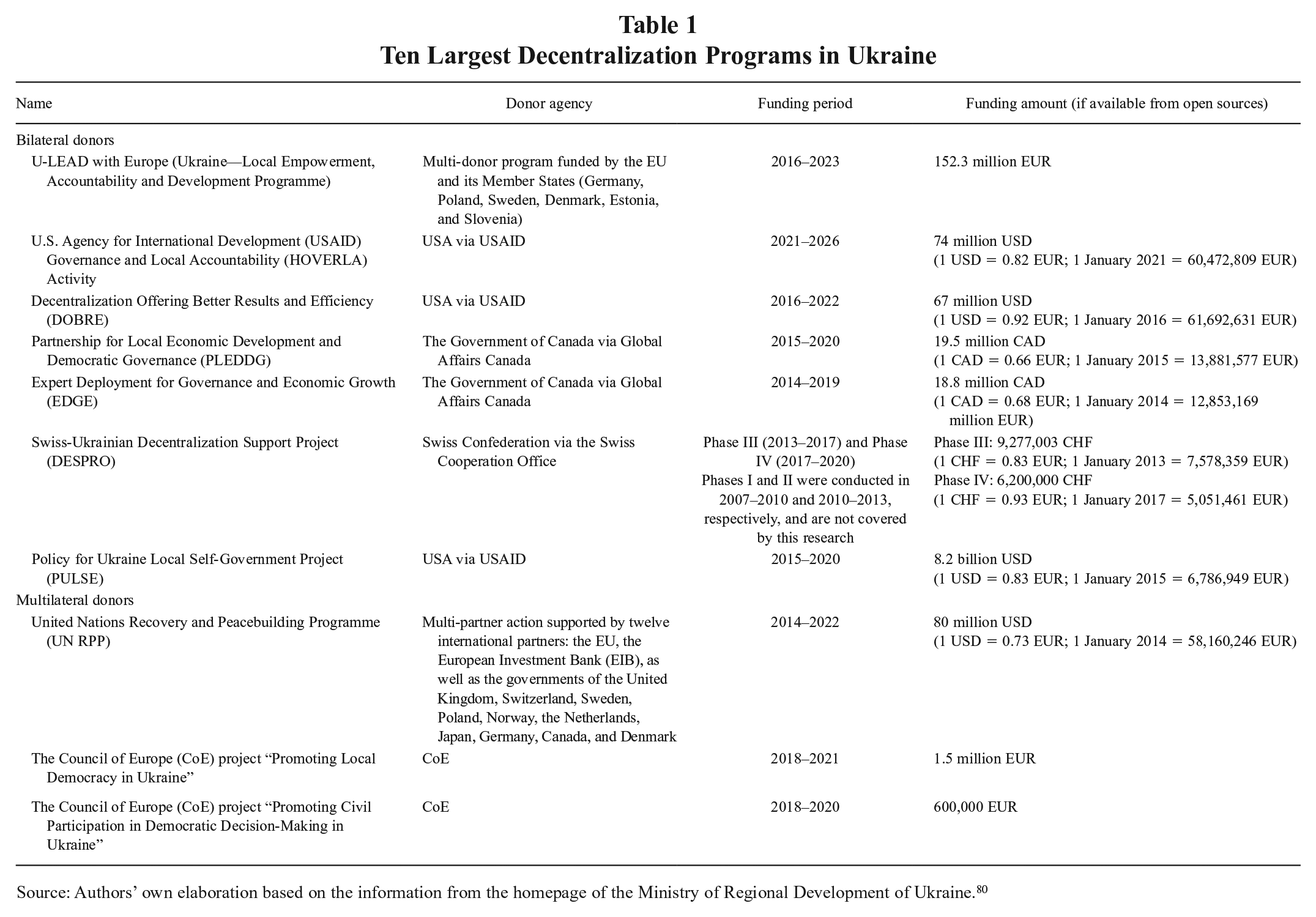
Source: Authors’ own elaboration based on the information from the homepage of the Ministry of Regional Development of Ukraine. 80
Working Groups under the Donor Decentralization Board
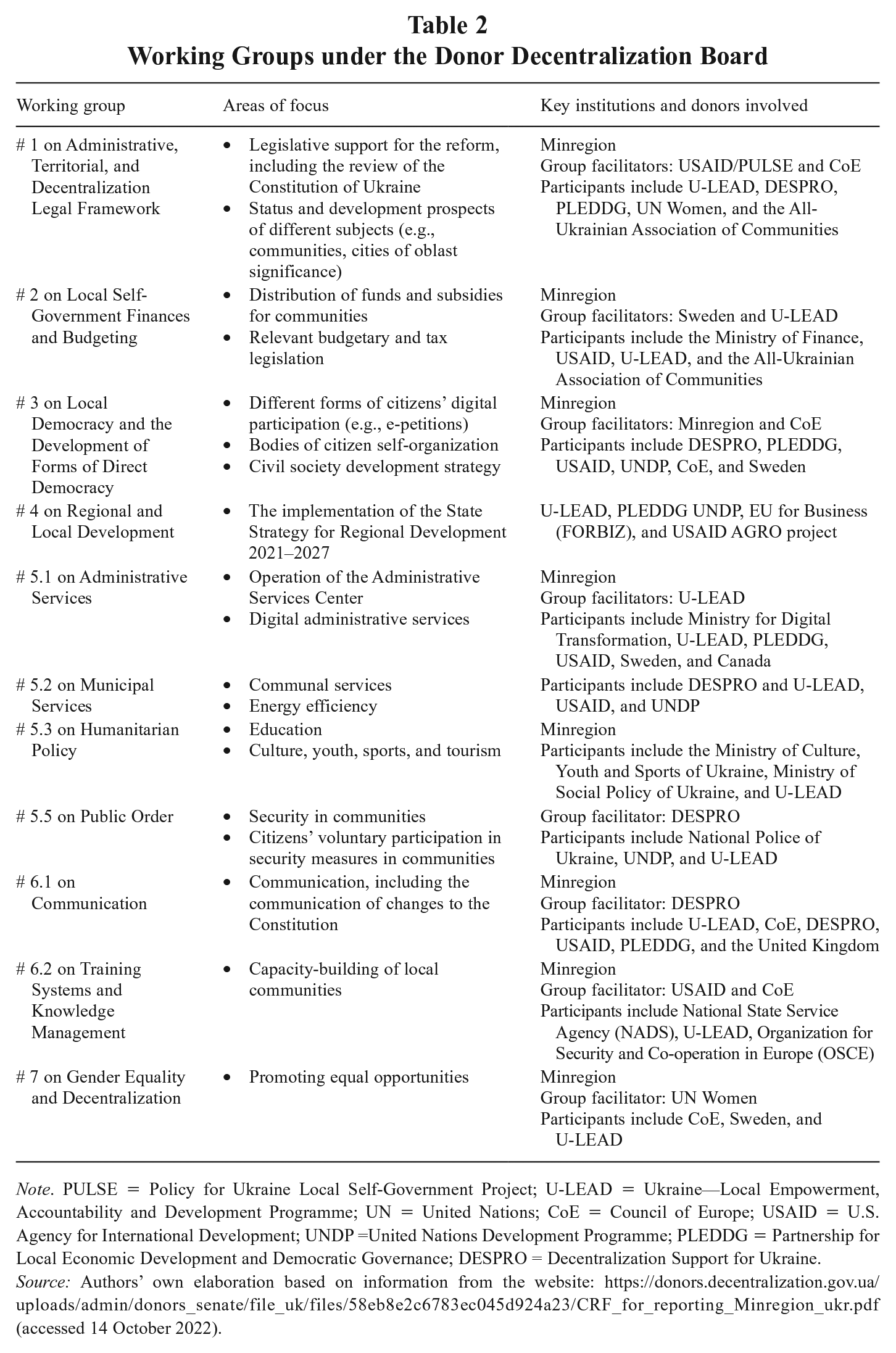
As Table 2 shows, neither of the working groups engaged with issues regarding the connection between decentralization and conflict resolution. The reluctance to link decentralization efforts with conflict is evident in the lack of involvement of the Ministry for Reintegration of Temporarily Occupied Territories (Ministry for Reintegration), a crucial institution (as well as other key actors dealing with the occupied territories). The Ministry for Reintegration was established by the cabinet in April 2016 to address all issues stemming from the temporary occupation of Crimea and certain areas of Donetsk and Luhansk. 81 Hence, the structure of the Donor Decentralization Board, including the lack of involvement of the Ministry for Reintegration, testifies to the fact that donors focus on decentralization as governance reform, rather than on a TSG solution to the conflict in eastern Ukraine.
This argument is further supported by the insight into the scope of the major decentralization support projects highlighted in Table 1. In this vein, the key focus of the majority of bilateral and multilateral support projects has been capacity-building for the newly created amalgamated communities, ensuring that they are able to fulfill their obligations. This is evidenced by three of the largest decentralization support projects in Ukraine, namely, the Ukraine—Local Empowerment, Accountability and Development Programme (U-LEAD) with Europe and the U.S. Agency for International Development (USAID)-funded Governance and Local Accountability Activity (HOVERLA) and Decentralization Offering Better Results and Efficiency (DOBRE), which focused on disseminating the best practices of local self-government among the communities and strengthening their capacity. U-LEAD is particularly known for launching the network of Administrative Service Centers 82 in amalgamated communities.
Moreover, HOVERLA, DOBRE, and various smaller projects (PLEDDG, DESPRO, CoE; see Table 1) have tended to focus on advancing local democracy and facilitating citizen engagement with local governance within amalgamated territorial communities. In addition, the Policy for Ukraine Local Self-Government Project (PULSE) program seeks to improve amalgamated communities’ access to transferred funds. Sectoral decentralization (e.g., health, education, and social services) is another frequent target for decentralization support. Given the cross-cutting nature of the decentralization reform and the fact that it is linked to numerous spheres, there is substantial interaction and cooperation between donor-funded decentralization-specific initiatives and other projects in the governance domain, such as the project “Gender-Oriented Budgeting” (GRB, 2014–2021, funded by Sweden) or “E-Governance for Accountability and Participation” (EGAP, funded by Switzerland). The ten largest donor-funded projects selected for this analysis also testify to the strong emphasis on technical issues related to decentralization (e.g., public service quality, e-governance) while avoiding politicized matters impacting the conflict. Only one of the ten donor projects studied had an explicit conflict link—the UNDP Ukraine’s Recovery and Peacebuilding Programme (UN RPP). 83
There are several possible explanations as to why international donors see decentralization as a way of advancing governance rather than a TSG solution: (1) decentralization was initially introduced by the Ukrainian authorities as a means to improve governance and strengthen social cohesion amid the political turmoil that followed Euromaidan, and donors followed this model; (2) although the Minsk I and II agreements provided for decentralization reforms, the politicization of the agreements and their subsequent stalemate prevented donors from supporting decentralization reform in the territories not controlled by the government of Ukraine; (3) the Minsk agreement stalemate and the Russian Federation’s narrative of Ukrainian federalization turned decentralization into a politicized topic, which increased the Ukrainian government’s and society’s skepticism toward Western donors’ support for TSG. As Western donors do not recognize the Donetsk and Luhansk Peoples’ Republics, any reform is limited to the government-controlled area. In addition, Russia’s external involvement in the conflict, despite not officially acknowledging its role, limited the international community’s activities in the conflict-affected areas to humanitarian assistance.
The Singular Case of TSG Support Linked to Conflict Resolution: Understanding UN RPP’s Activities in Ukraine
Bringing together twelve international partners over the period from 2015 to 2022, the UN RPP is the only large-scale international assistance program that has both addressed the needs of eastern Ukraine since the outbreak of the conflict in 2014 and linked those needs with decentralization. 84 The UN RPP involves four UN agencies (UNDP, UN Women, the UN Population Fund [UNFPA], and the UN Food and Agriculture Organization) and can be seen as a more neutral multilateral endeavor to address such sensitive issues than that of bilateral donors.
In contrast to bilateral decentralization support projects, UN RPP involved both Minregion and the Ministry for Reintegration (plus local administrations in six oblasts, the government-controlled areas of the Donetsk and Luhansk oblasts, Dnipropetrovsk, Zaporizhzhia, Kharkiv, and Zhytomyr). Its assistance focused on three components: (1) economic recovery and the restoration of critical infrastructure; (2) local governance and decentralization; and (3) community security and social cohesion.
85
While (1) and (2) primarily served to reduce the socioeconomic impact of the conflict (labor market, infrastructure, psychological rehabilitation), (2) aimed, in contrast, to use decentralization as a governance strategy to implement priorities (1) and (3). The substance of the UN RPP resembles that of other donor initiatives
Conclusion
New power-sharing and TSG arrangements represent a frequently used yet not unequivocally effective form of conflict resolution. Despite Ukraine’s decentralization-related obligations under the Minsk I and Minsk II agreements, donors supported decentralization in Ukraine as a strategy to promote better governance rather than resolve the conflict. A look at the structure of the Donor Decentralization Board and the substance of the largest donor-supported initiatives demonstrates that efforts focused on legislative reforms that support the amalgamation of communities, which increased their capacity. The link with conflict resolution has been weak. While the UN RPP has been the only major initiative relating decentralization to the conflict-affected regions, it in fact supported decentralization as a governance strategy within a conflict-affected setting, rather than as a TSG solution.
There are five reasons why decentralization has been supported as a governance strategy as opposed to a TSG solution. First, the government’s decentralization reform was initially introduced following the annexation of Crimea, but
Russia’s recognition of the so-called People’s Republics and its use of “protecting the Donbas people” argument as a
The Ukrainian case thus illustrates how decentralization can be used in a conflict context as a strategy to improve governance, rather than to solve the conflict. This leads us to make three analytical observations, which are important for further studies of decentralization in conflict management contexts and consideration of the use of proxies by alleged third parties in such conflicts for development cooperation purposes. First, our analysis of the decentralization–conflict management nexus in Ukraine reveals that, for a thorough analytical understanding of the intentions of international donors in supporting decentralization, we need to have a complete picture of such efforts and a nuanced understanding of their background, especially if they are being implemented in a conflict context. Hence, further interaction between studies of decentralization as a governance reform and its application as a conflict management tool is needed. As the conflict aspect is barely considered by the literature on decentralization as a governance strategy, more knowledge is needed to ensure better designed decentralization programs aimed at improving governance in conflict-affected contexts. Second, our study highlights the extent to which the use of proxies in a conflict by an alleged third party or the hybrid mixtures of interstate and intrastate conflicts influence the design of donor support, including the decision to use decentralization (or another TSG solution) as a means of conflict management. Third, the latter factor influences the “division of labor” among donors, with more politically sensitive issues potentially being addressed jointly and/or via multilateral organizations, which are perceived as being guided less by geostrategic ambitions than regional organizations or countries from within the same region.
Footnotes
Funding
ORCID iD
