







Abstract
Introduction
The relationship between Hungary and the European Union is a commonly discussed issue not only in Hungarian domestic public discourse but also in the international arena. As a result of the start of the Russo–Ukrainian war at the end of February 2022, Hungary’s foreign policy orientation emerged as one of the central issues in the campaign in the run-up to the parliamentary election held on 3 April 2022. 1 Whatever impact the war may have on the future of the European Union, an examination of Euroscepticism is very timely. Our research builds upon the classic conception of the phenomenon, which states that Euroscepticism is “the idea of contingent or qualified opposition, as well as incorporating outright and unqualified opposition to the process of European integration.” 2 Besides the classical referendum question (whether citizens support their country leaving the European Union), previous survey-based Euroscepticism research has measured various aspects of EU attitudes, such as European identity, respondents’ feelings, and assessment of the bloc and European integration. 3 However, it is less common to research EU attitudes by looking at preferences and knowledge about policy integration. An exception is the study of Clark and Hellwig, 4 but while they looked at policy-related integration preferences, their measurement of EU knowledge (based on Eurobarometer questions) concerned EU history and institutions. A novel approach of our study is that it offers an empirical examination of how Hungarian voters perceive the policy impact of the European Union. At the same time, we also study Hungarian public opinion’s perception of the limits of European integration.
To better understand Hungary’s relationship with the European Union, it is not sufficient to survey the Hungarian public’s preferences concerning European integration; we should also try to gauge public knowledge about the actual state of integration. The importance of examining knowledge about the European Union is also reinforced by the idea that the decision of the British public to quit the European Union (that is, the Brexit decision) is often explained by a lack of information in society and widespread political ignorance. In a book that gave rise to an intense public debate, Brennan argued that the Brexit referendum held in 2016 is a piece of evidence showing that voters are fundamentally uninformed and incapable of recognising what is in their own self-interest. 5 Indeed, knowledge in the United Kingdom about the European Union before the Brexit decision was in fact below the EU average. 6 At the same time, it is unclear what role the lack of knowledge about the European Union played among those voters who opted for the United Kingdom to leave the European Union. 7 Our review of the relevant academic literature offers examples of both positive 8 and negative correlation between knowledge about the European Union on pro-EU attitudes. 9 Based on the above, it is worthwhile to treat the examination of knowledge about European integration and related preferences as parts of a coherent whole. This is all the more necessary since research on knowledge about the European Union has been nearly completely absent from the scope of academic studies on Hungary. 10
In our research we are looking for the answers to three questions. What is Hungarian society’s level of knowledge about European integration and what factors determine this level of knowledge? What is the level of public support for Europeanising individual policy areas and how does that correlate with the actually prevailing level of integration in the given policy area? To what extent is support for policy integration determined by political affiliation and the level of knowledge about the European Union? A unique feature of this study is that we looked at nineteen different policy areas to gauge the knowledge and preferences of Hungarians concerning European integration. To this end, we designed our own questionnaire and the relevant survey was administered on a nationally representative sample of respondents. The groundwork for juxtaposing perceptions of integration with actual levels of integration was laid in a study by Bíró-Nagy and Laki, 11 in which the authors looked at the division of policy responsibilities between the European Union and Hungary, as well as the Europeanisation of individual policy areas, in the context of legislative output. Our results not only help us to attain a deeper understanding of Hungarian attitudes towards the European Union, but at the same time they contribute to the discourse on the legitimacy of European integration.
Theoretical Framework
Based on surveys conducted in the 2000s, European citizens’ awareness of their country’s national policies was higher than their level of knowledge about the European Union. 12 Several studies have shown that media consumption on EU affairs increases knowledge about the European Union. 13 When it comes to ideologically neutral test questions, studies looking at the levels of knowledge in society about the European Union in the context of the Brexit referendum mostly did not find major differences between voters who opted for Leave and Remain, respectively, 14 and the differences that were actually detected were rather slight. 15 There was also a pertinent study on the subject in Hungary: Lengyel and Blaskó showed that the levels of objective and subjective information were both more likely to increase support for EU accession. 16 Although our research on Hungarians’ knowledge about the European Union is fundamentally exploratory, our study simultaneously tests a relevant descriptive hypothesis.
In the absence of pre-existing empirical evidence, our first hypothesis primarily relies on logical deductive conclusions. What emerges from the study of Lengyel and Blaskó is that Hungarian society was largely ill-informed about the European Union before accession. 17 Only a quarter of Hungarians had heard about the EU passport (26%), and a similarly low percentage of respondents was able to name twelve EU member states (27%). It also needs to be noted, however, that the share of correct answers was significantly higher with respect to the remaining questions. Thus, for example, 88 per cent knew that Hungary had asked to join the European Union and 78 per cent had heard about the euro. The Eurobarometer survey of 2015 offers a more up-to-date picture. Based on that survey, Hungarians fell into the mid-range of European countries with respect to their knowledge of the European Union: slightly fewer than half proffered the right answers to all three test questions. 18 However, we assume that the nineteen-question survey we drew up to assess the level of information in society about public policy integration was more challenging than the above-mentioned general questions.
Our second hypothesis is partially based on the first hypothesis. We assume that the actual level of integration in individual policy areas would have an impact only on the relevant preferences of the Hungarian public if citizens were actually generally aware of the prevailing level of integration. Nevertheless, the direction of the causal relationship may actually be the inverse if we imagine European integration as a responsive process that successfully channels European public opinion. If that were the case, the underlying logic would be that it is not public opinion that is shaped by the actual level of integration but that public opinion shapes the prevailing level of integration. In other words, integration deepens in those policy areas where European public opinion has already evinced an openness to such a deepening. This assumption is also supported by De Bruycker’s study,
19
in which the author uses a time series analysis to show EU policy decisions are preceded by a growth in the public support for such policies—but only when these decisions were politicised or addressed by civil society. At the same time, however, De Bruycker also found a negative feedback effect: once certain policy decisions were made, the level of support for such policies among Europeans tends to decline based on public opinion surveys. Put differently, while EU policy decisions tend to enjoy
Based on the theory of partisan bias, which has received widespread empirical support, individuals will often adjust their opinion to reflect their political loyalties. 20 In other words, we would expect people to be more likely to become EU supporters or Eurosceptics if the leaders of their respective political camps openly espoused such positions. Since 2010 Fidesz has unequivocally held a Eurosceptic position. Based on data from Chapel Hill, since 2010 Fidesz’s position has decisively shifted towards an anti-integration stance. 21 According to Hargitai, 22 Fidesz’s Eurosceptic position has manifested itself on the issues of the creation of the European Public Prosecutor’s Office and the Energy Union; in the areas of immigration, labour, and fiscal policy, as well as the Hungarian government’s foreign policy towards China and Russia. Hargitai argues that at the rhetorical level Fidesz attacks the European Union on three fronts: (1) mass migration; (2) opposition to deepening integration based on the claim that the “bureaucratic elite” does not represent the people and that further integration would imply a renunciation of national sovereignty and (3) calls for an internal reform of the European Union. In contrast to Fidesz’s Euroscepticism, the opposition parties are staunchly pro-European Union—by endorsing the idea of a United States of Europe, the Democratic Coalition goes as far as to push for an outright federalist concept. 23 Among the opposition parties, Jobbik was the only one that had previously held strong Eurosceptic views. However, within the span of a decade the party’s position shifted massively, from burning EU flags all the way to illustrating their 2019 EP election manifesto with images of the European Union’s “founding fathers” and committing themselves to the EU Wage Union Citizens’ Initiative. 24 While Jobbik moved to the political centre, a new party, Our Homeland Movement (“Mi Hazánk Mozgalom”), emerged on the far right, representing a strong nativist and Eurosceptic position. 25 The support for Our Homeland has risen since our data collection and the party was elected to the Hungarian Parliament in April 2022. We included “Our Homeland support” as a distinct category in our analyses, but we do not discuss it because of the low number of observations (this group consists of less than 1% of our sample).
In international comparison, opposition to the European Union is not characteristic of right-wing parties alone; it is typical of extremists on both sides of the political spectrum. Nevertheless, a hardline Euroscepticism narrowly understood—that is, an unconditional rejection of the European Union—tends to be typical of far-right parties, which often demand that their respective countries quit the European Union entirely or, at the very least, that the policy competencies of the member states be shored up. Far-left parties, by contrast, which tend to call for an internal reform of the European Union (e.g., a deepening of social policy integration), are typically more likely to be characterised by a stance that can be described as “euro-critical.” 26 This phenomenon is also manifested at the level of individual voters. Based on an analysis of European Social Survey data from 2009 and 2014, Van Elsas et al. 27 found that dissatisfaction with the European Union was primarily typical of far-left respondents, while opposition to strengthening the European Union was clearly a phenomenon associated with the political right. Based on these findings, we assume that an ideologically right-wing position in Hungary would be accompanied by a rejection of the Europeanisation of individual policy areas. The characteristic arrangement of the Hungarian party system as described above, namely the dichotomous structure that pits the strongly pro-EU position of the opposition parties against the Eurosceptic position of Fidesz, also bolsters this hypothesis. Put differently, the parties’ positions and their rhetoric could lead Hungarian voters to the conclusion that being pro-European Union is a left-wing stance, while a sovereigntist position is a right-wing stance.
Data, Methods, and Variables
Data Collection
Our analysis is based on data collected in the framework of a personal interview survey commissioned by the Centre for Social Sciences and performed by Závecz Research between 8 August 2021 and 19 August 2021. 28 The 1,000 persons interviewed in-person as part of the survey were selected to make up a representative sample of the Hungarian adult population based on age, gender, educational attainment, and type of settlement. The questionnaire used in the survey is available in the Online Appendix.
EU Knowledge and Perceived Sovereignty
EU general knowledge
Although the focus of our research was to gauge the respondents’ knowledge and preferences about integration in individual policy areas, as a point of reference we also included a variable that measured “general knowledge about the European Union.” We measured this variable based on standard questions used in survey research. 29 Respondents were given three statements that they had to label as either true or false:
“The members of the European Parliament are directly elected by the citizens of each member state.”
“Ursula von der Leyen is the president of the European Commission.”
“Switzerland is a member of the European Union.”
The second statement in the test of the general knowledge about the European Union was added by us in lieu of the standard question in the Eurobarometer research, which says “the European Union has twenty-seven or twenty-eight member states” (the specific number varied based on the time when the questions were administered). We decided to leave this question out based on the assumption that the departure of the United Kingdom from the European Union might make many respondents uncertain. “EU general knowledge” can take any value between 0 and 3, and a respondent’s total score indicates the number of correct answers provided (a refusal to answer any of the statements in this portion of the survey was coded as a 0 in the calculation of the overall score). In our test of the general level of knowledge about the European Union, the share of accurate answers exceeded two thirds for all three questions (see Figure 1).

The distribution of answers to questions concerning general knowledge about the European Union
However, the picture becomes more nuanced when we look at the distribution of responses after collating all three questions to assess the overall level of the respondents’ general knowledge about the European Union (Figure 2). This reveals that there are far fewer respondents who knew the correct answers to all three questions: only 37 per cent of respondents got all them right. While Fidesz voters’ knowledge of the European Union was average as compared to the public overall, opposition voters knew more than the average and those without partisan affiliation tended to know less. The most spectacular pattern emerged based on educational attainment: the level of average knowledge about the European Union tends to increase in demographics with higher levels of education.

The distribution of general knowledge about the European Union (three questions, number of correct responses)
EU policy knowledge
We used a nineteen-question test to survey the level of knowledge in Hungarian society about the Europeanisation of individual policy areas (hereafter referred to as “EU policy knowledge”). Respondents were asked to assess whether individual policy areas were controlled by the member states, were in the exclusive competence of the European Union, or the two players shared control. Respondents were asked the following question:
In your assessment, how much of an impact does the European Union have on various policy areas in Hungary? In your opinion, who decides policy matters in the areas listed below: the Hungarian legislature, the European Union, or the two of them together?
The policy areas selected were those specified by the Comparative Agendas Project. 30 For each response on a policy area, we examined whether the answer selected by the respondent actually matched the objective division of responsibilities between the member states and the European Union.
In the event that the respondent’s selection was in line with the actual division of responsibilities, we coded the answer as correct, while any of the three other options (including a refusal to answer) were labelled as erroneous. Upon the separate examination of all nineteen areas, we created a comprehensive index called “EU policy knowledge.” This variable indicates the number of correct answers, that is, it can take any value between 0 and 19. We also used this indicator to create a dichotomous variable, for which we divided respondents into either of two groups: those who provided a correct answer to the actual division of policy competences in fewer than ten cases, and those who responded accurately about the actual level of integration with respect to ten or more policy areas. We tested our first hypothesis by examining the distribution of this binary variable of knowledge about the European Union.
A decisive majority of respondents (65%) failed to correctly identify the prevailing level of EU integration in at least ten policy areas (Figure 3). In a majority of the policy areas we surveyed, barely over a third of the respondents (35%) were able to correctly identify the respective level of competence of the European Union and the member states. In other words, we confirmed our first hypothesis, which posits that the majority of Hungarians do not have an accurate perception of the level of EU integration. Those with a low level of awareness of policy integration were in a majority in all political and demographic groups, and there were only modest differences between the various groups. Looking at the detailed breakdown, it is worth pointing out that, as we move towards larger municipal units, the share of those who answered the majority of the questions about policy integration correctly declines.

The distribution of policy knowledge about the European Union (dichotomous variable)
These demographic patterns are not consistent with the distribution of general EU knowledge. The discrepancy between the two knowledge tests and the counterintuitive demographic patterns of the distribution of EU policy knowledge is worth further investigation. One possible explanation is that our policy knowledge test might not measure informed knowledge of policy integration, but that perception of the division of competencies with the European Union is shaped by other factors, such as respondents’ desires about European integration. In other words, respondents may perceive the state of policy integration in line with how they want it to be. This presumption is examined further in the next section, but first we show to what extent Hungarians are aware of the prevailing level of integration in each policy area (Figure 4).
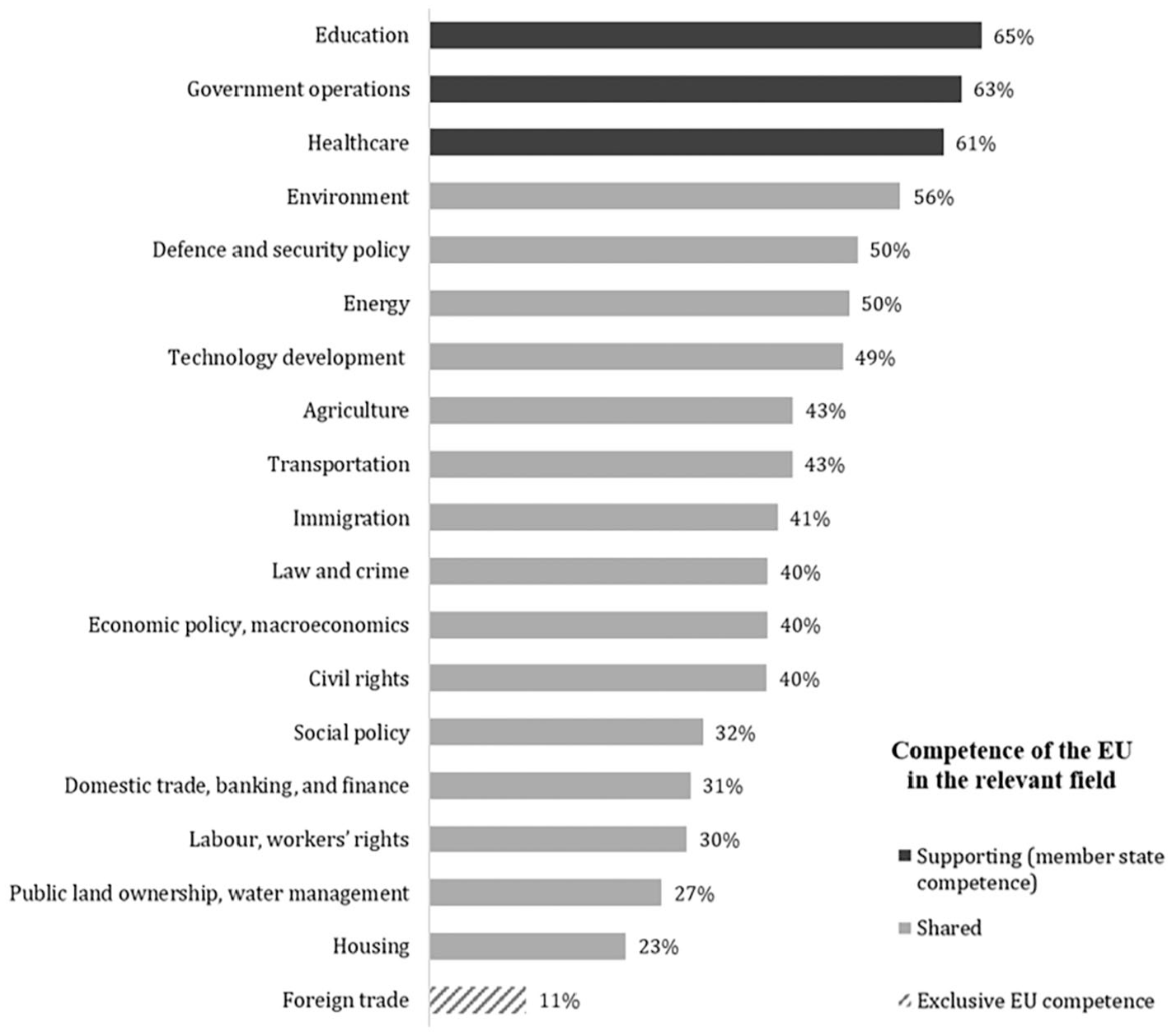
The share of respondents who were able to correctly identify the European Union’s scope of competence in the given policy area
On the whole, respondents tended to be most accurate in correctly identifying the level of EU integration in those areas that member states are free to regulate themselves, while the European Union intervenes only in a supporting capacity. Education policy (65%), government operations (63%), and health care (61%) are among these policy areas.
With respect to the five policy areas where competence is shared (social policy; domestic trade, banking, and finance; workers’ rights and labour; and public land ownership and water management), less than a third of all respondents were aware of the prevailing level of integration. Among the policy areas we selected, foreign trade was the only one where the European Union wields exclusive competence, and this was simultaneously also the area where the fewest respondents were aware of the prevailing level of integration—only every tenth respondent (11%) assessed it correctly.
When it comes to foreign trade, the low level of accurate answers may be attributable to the fact that, on the whole, respondents were less likely to assume that there are any policy areas within the exclusive competence of the European Union. The share of respondents who assumed that the European Union was solely competent to regulate the given policy area was low in all the areas we surveyed (with the share of such answers ranging between a low of 4% and a high of 13%), and foreign trade was no exception, even though among the areas listed this was in fact the only one where the European Union does have an exclusive competence. The respondents’ strikingly high accuracy in the case of education (65%), health care (61%), and government operations (63%) is owing to the fact that a significant portion (12%) of them assumed that member states are exclusively competent to regulate all the policy areas we inquired about—and this happened to be true for the aforementioned three areas, which are in fact exclusively governed by the member states.
Perceived level of sovereignty
In reviewing the distribution of the levels of policy knowledge about the European Union, we found that respondents’ test results were more likely to be driven by their desires concerning integration than actual knowledge thereof. It followed from our assumptions about wishful thinking that we did not limit our analysis to an examination of the respondents’ actual knowledge of policy based on the knowledge test (i.e., the scores attained by respondents), but also tried to gauge their general perception of the policy influence of the European Union. We operationalised the variable called “perceived level of sovereignty” by counting the number of policy areas that the respondent assumed to be under the exclusive control of member states. Just like the variable concerning EU policy knowledge, this variable, too, could assume discrete values between 0 and 19.
Figure 5 presents the distribution of answers in which the respondents indicated that the given policy area was exclusively regulated by the member states. The share of the two extreme values stands out: the share of those who thought that member states did not wield exclusive competence in any policy area (12%) was identical with the share of those who thought that all policy areas were within the exclusive competence of the Hungarian legislature (12%). We looked separately at each of the various subgroups we found by disaggregating the respondents’ preferences concerning integration. The distribution of the answers of respondents who preferred greater levels of integration was skewed to the right, which means that this group’s perceived level of sovereignty is lower. The distribution of the answers of respondents who tend to oppose further integration was skewed to the left, which indicates a higher level of perceived sovereignty.
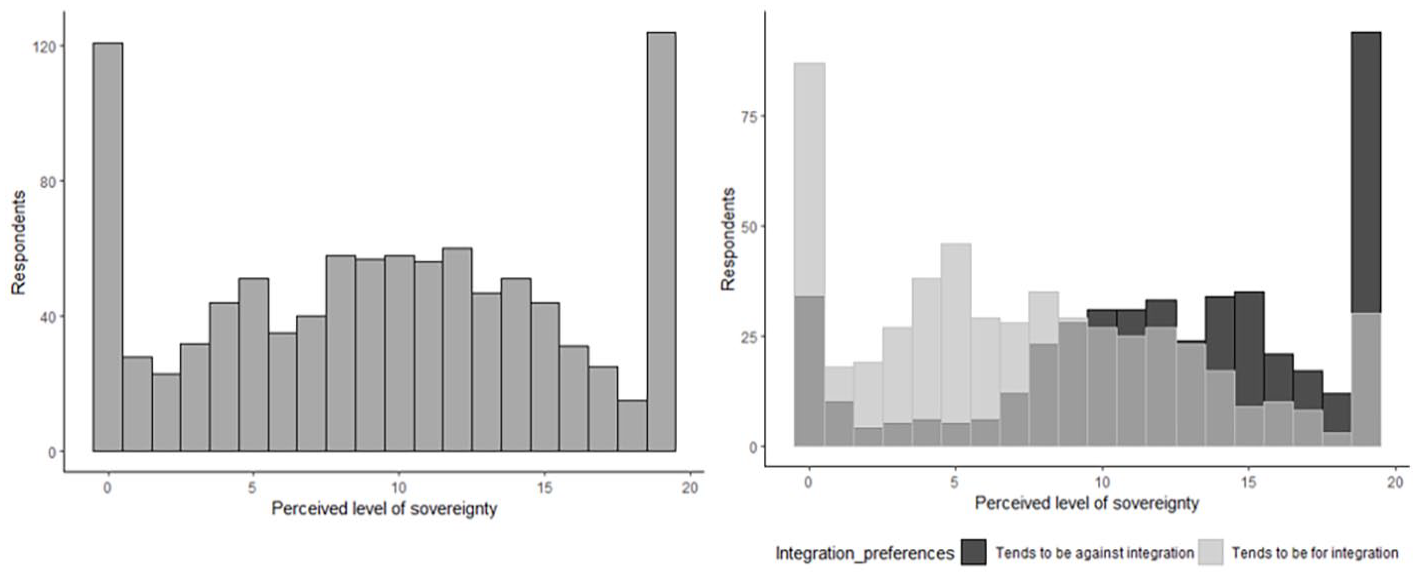
The distribution of the perceived level of sovereignty (histogram). General distribution and distribution of subgroups based on preferences concerning the desired level of integration
Preferences Concerning Policy Integration
We surveyed voter preferences concerning the desired level of integration in individual policy areas (hereinafter referred to as integration preferences) by using another bloc of nineteen questions. Once again, respondents were asked to react to the same nineteen policy areas as the ones we previously introduced in the knowledge test. However, in this bloc respondents were not asked to indicate who the dominant actor was in terms of policy-making; they were asked instead to tell us who the competent actor should be for the given policy area. The general introductory question preceding the listing of individual policy areas was the following:
We will now ask you about the same policy areas as before. However, this time we want to ask you about your preferences. In your opinion, who should ideally be in charge of the following policy areas: should the policies in the given area be decided by Hungary alone, jointly with the EU, or would you completely delegate them into the EU’s scope of competence?
As we did before, we randomised the order in which the individual policy areas were listed.
First, we examined the distribution of preferences concerning deeper integration in each policy area (Table 1). There are eight policy areas where the absolute majority of Hungarians espouses a sovereigntist position (i.e. they would prefer member states to wield exclusive policy control), while in another nine policy areas those with a pro-integration view (i.e., those who want the given policy area to be either a shared or an exclusive EU competency) are in a majority.
OLS Regressions, Dependent Variables: Level of General and Policy Knowledge about the European Union, Perceived Level of Sovereignty a

Source: Authors’ calculations based on polling data by Závecz Research, August 2021.
Note: Standard errors in parentheses. OLS = ordinary least squares.
EU policy knowledge level: denotes the respondent’s number of correct answers on the “EU policy knowledge test” (0–19 points). EU general knowledge level: denotes the respondent’s number of correct answers on the “EU general knowledge test” (0–3 points). Perceived level of sovereignty: denotes how many policy areas the respondent assumed to be under exclusive member state control.
The category of “No preferred party” does not include the voters of Our Homeland, the Hungarian Two-Tailed Dog Party, or respondents who planned to vote for “Other party” lists. We included the answers of these respondents in the analysis, but on account of the low number of observations, we did not include the relevant results in the table above.
Denotes how many of the total of nineteen policy areas we mentioned respondents want to be exclusively regulated by the member states.
An absolute majority of respondents believe that the regulation of housing (64%), public land ownership and water management (64%), domestic trade, banking and finance (58%), education (58%), government operations (57%), labour (54%), social policy (51%), and agriculture (50%) should be exclusively in the competence of member states. It is worth noting that when it comes to immigration policy, the share of those who want the European Union to have some degree of say in Hungary’s immigration policy (47%) is almost as high as the proportion of respondents who oppose this (49%). The respective share of sovereigntists and integration supporters is similarly balanced when it comes to health care (49% vs. 48%). The supporters of greater policy integration were in an absolute majority with respect to the environment (67%), technological development (63%), energy (62%), foreign trade (61%), security (60%), transportation (54%), law and crime (53%), and civil rights (51%). However, a decisive majority of respondents who advocate greater policy integration in the given areas preferred competencies to be shared between the European Union and the member states, with only a small fraction (between 2% and 8%, depending on the policy area) of Hungarian respondents calling for the European Union to be equipped with an exclusive competency in the given policy areas.
In addition to presenting the distribution of responses, Table 1 also features the European Union’s actual level of competence in the given policy area and highlights whether this meshes with the preferences of the relative majority of respondents. The number of policy areas where the preferences of the majority and the actual scope of EU competence are roughly in sync is almost identical with the number of policy areas where there is a pronounced gap between the two—the preferences of the majority and the actual reality are aligned in nine policy areas and they differ substantially in ten areas. The gap between the preferences and the actual reality—where such a gap exists—always stems from the fact that a relative majority would prefer a lower level of integration than the one that actually prevails. A relative majority of Hungarians would relegate a significant portion of the policy areas (nine out of fifteen) where a shared competence prevails currently into the member state’s exclusive control. Furthermore, with respect to foreign trade, an absolute majority (57%) would prefer a shared competency as opposed to the actual reality of exclusive EU competency in that policy area.
Major Independent Variables
In our first set of models (Models 1–6), we used political preferences (partisan affiliation and self-placement on the left–right spectrum) and major demographic variables, as well as the respondents’ preferred level of sovereignty, to predict the relevant dependent variables. “Preferred level of sovereignty” was calculated based on a question discussed above in the section entitled “Preferences concerning integration.” This variable indicates how many of the nineteen distinct policy areas the given respondent wants to see in the exclusive competence of member states. In our second set of models, we used a continuous and a categorical measure of the level of EU integration of different policies (Models 7 and 8) and the aforementioned political preferences (Models 9 and 10). The distribution of our major independent variables within our sample and the correlation matrix of the continuous, ordinal and dichotomous variables can be found in the Appendix (Tables A1 and A2).
Statistical Analysis
Analysing EU Knowledge and Perceived Sovereignty: Exploratory Regression Analyses
We performed a regression analysis to find out which factors exert the greatest impact on Hungarians’ general and policy-specific EU knowledge as well as the perceived level of sovereignty. To this end, we ran the regression models described in the equations below. 31
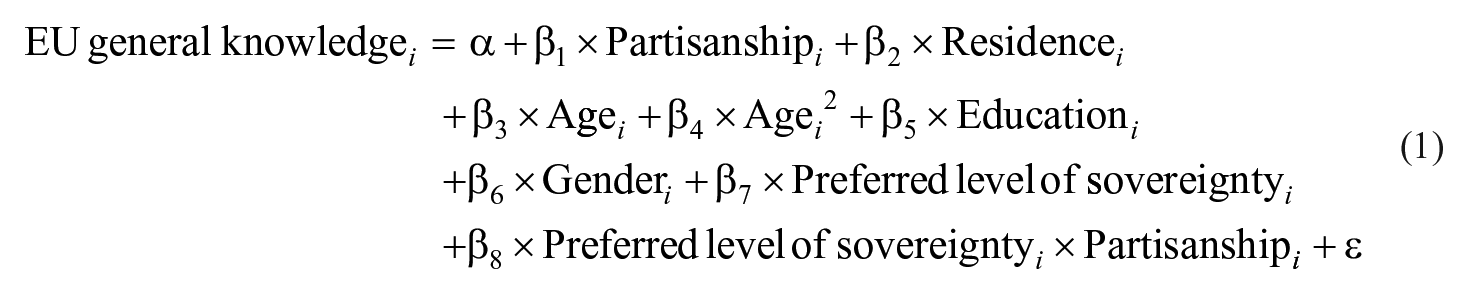


Table 2 presents the results of our analysis, seeking to identify the variables that determine the level of general knowledge about the European Union, the level of knowledge about EU policy integration, and the perceived level of member state sovereignty. Political self-identification, the type of municipality in which respondents reside, their educational attainment, and their preferred level of sovereignty were all variables that had a significant effect on the dependent variables.
The European Union’s Policy Competences and Hungarians’ Preferences Concerning the Latter

Source: Authors’ calculations based on polling data by Závecz Research, August 2021.
Note: Bold and italicised values show the proportion of those categories that have a relative majority regarding the integration preferences of a given policy.
Fidesz voters displayed a significantly lower level of general knowledge about the European Union than opposition supporters, even though the supporters of the government party knew more than opposition voters about the level of integration in the policy areas we examined. The higher level of policy awareness among government party supporters is explained by their lower level of perceived member state sovereignty as compared to opposition supporters, who tended to assume that the member states wield a greater influence in the policy areas we looked at. In other words, opposition voters substantially underestimate the actual level of EU integration, and as a result the level of sovereignty perceived by Fidesz voters is closer to the prevailing distribution of competencies between the European Union and the member states. Among those without a party preference, the level of general knowledge about the European Union was also below average, and their perceived level of sovereignty was also lower than that of opposition voters. The respondents’ self-placement on the left-to-right ideological spectrum had a significant impact only on their level of knowledge about policy integration. A one-point shift on the 10-point left-to-right scale was correlated with a 0.25-point increase in the number of accurate answers about the control over individual policy areas.
Sovereigntist attitudes were significantly and negatively linked to both indicators measuring knowledge about the European Union. At the same time, sovereigntist attitudes had a substantially greater impact on perceived sovereignty than on the respondents’ levels of knowledge about the European Union, be it policy-specific or general. Our assumptions about perceptions being driven by desires is also supported by the observation that a rise in the level of preferred sovereignty moves in sync with a substantial increase in the level of perceived sovereignty. For each additional policy area that respondents wanted to see under member state control, they were likely to perceive three to four (0.34–0.37) more areas to be under the exclusive control of member states. In other words, as compared to an extremely pro-integration respondent, an extremely sovereigntist respondent believed that the number of policy areas in which the European Union has no regulatory competence was six or seven points higher.
At first glance it appears paradoxical that being pro-Fidesz and harbouring sovereigntist attitudes would lead to antithetical impacts on the levels of policy knowledge and perceived sovereignty, respectively. That is why all our models also looked at the interaction between the political variables and the preferred levels of sovereignty. The interaction between individuals’ pro-government outlook and their preferred level of sovereignty was significant in all models. We illustrate these interaction effects in Figure 6. The figure shows that among the respondents who support greater integration, Fidesz voters tend to have a lower level of general knowledge of the European Union and a higher level of policy knowledge about the European Union, and they also perceive the country’s level of sovereignty to be lower than opposition voters do. At the same time, it is also obvious that the level of policy knowledge and the perceived level of sovereignty are primarily driven by sovereigntist attitudes—the effect of political affiliation is secondary in this context.

The estimated value of the level of EU knowledge and perceived level of sovereignty, broken down by groups based on party preferences, as a function of the preferred level of sovereignty
We also examined the interaction between right-wing and sovereigntist attitudes (Figure 7). Figure 7 also shows that among those with a pro-integration attitude, right-wing sympathies have a slightly negative effect on the general level of knowledge about the European Union, while in the case of sovereigntists a right-wing political preference has a slightly positive effect on the level of knowledge about the European Union. When we examine the effect of a right-wing political preference on the level of policy knowledge, we find that as sovereigntist attitudes become more pronounced, the positive effect of right-wing preferences on the level of policy knowledge recedes. In other words, we found that the more right-wing pro-integration respondents were, the more likely they were to be aware of the actual level of integration across policy areas. However, this interaction variable is not statistically significant when we examine the effects on the perceived level of sovereignty. At the same time, our figures show that the impact of right-wing preferences on policy knowledge and the perceived level of sovereignty is clearly symmetrical. In other words, it is reasonable to assume that the relatively high level of policy knowledge of right-wing pro-integrationist respondents is partly the result of their generally lower assumptions concerning the prevailing level of sovereignty (even if the latter difference is not statistically significant).

The estimated average marginal effect of right-wing political attitudes on the level of knowledge about the European Union and the perceived level of sovereignty, as a function of the preferred level of sovereignty
Analysing Preferences Concerning Integration: Hypothesis-Testing Regression Analyses
We tested our hypotheses about the preferences concerning integration using a multilevel logistic regression, which is recommended for this type of data.
32
Since each respondent appears several times in the database (each row can be identified by respondent and policy area evaluated), we clustered standard errors by respondents. The equations below describe the models we applied in testing the hypothesis. We used all the models to predict the probability of a given respondent’s support for further integration. In the equations below, the
The relationship between preferences concerning EU integration and the state of actual integration
Our second hypothesis—that is, the posited independence between the level of integration in each policy area and the preferences of Hungarians concerning integration in the given policy area—was tested based on the models described in Equations 7 and 8. For both models, we predicted the probability of a respondent being pro-integration based on the prevailing level of integration in the given policy area. First, we included the level of actual integration as a categorical variable in the analysis (member state vs. shared vs. EU competence). In the next step, we used an alternative continuous indicator that captured the share of laws with EU origins among the totality of Hungarian legislative acts adopted to regulate the given policy area. This ratio refers to the bills adopted by the Hungarian National Assembly between 2004 and 2018, and the source of the data is a study by Bíró-Nagy and Laki. 33


Table 3 presents the results of the model that examines the posited independence between being pro-integration and the level of actual integration (Hypothesis 2). Our findings ran counter to our hypotheses: both indicators of EU integration showed that a higher level of integration increases the likelihood that a respondent supports integration. To facilitate the interpretation of the data, we also estimated the average marginal effects of the variables we examined in addition to the multilevel logistic regression coefficients. In the case of the policy areas in which the European Union and the member states share competence, respondents were 8 percentage points more likely to believe that the European Union should have a say in the given policy area as compared to those policy areas that are actually under exclusive member state control. In the area that is exclusively controlled by the European Union (foreign trade was the only such policy area in our survey), respondents were 21 percentage points more likely to say that the European Union should have a say in the given area. The share of laws with an EU origin also had a significant positive effect. For every 10-percentage-point increase in the share of laws with an EU origin in a policy area, we found a 2-percentage point higher chance of respondents’ supporting the Europeanisation of the given policy area.
Multilevel Logistic Regressions, Dependent Variable: Support for Policy Integration a ; Independent Variable: Actual Level of Policy Integration

Source: Authors’ calculations based on polling data by Závecz Research, August 2021.
Note: Standard errors in parentheses, clustered by respondents. Coeff. = coefficients; AME = average marginal effect; EU = European Union.
The dependent variable takes a value of 1 if respondents want the European Union to be solely competent to regulate the given policy area or prefers the policy competence to be shared between the European Union and the member states, and it takes on a value of 0 if they would prefer to see it in the exclusive control of the member states.
Based on the laws adopted by the Hungarian National Assembly between 2004 and 2018. The percentage ratios have been converted to a scale from zero to ten, and hence an AME indicates the change in probability associated with a 10 percentage point change in the share of laws with EU origin.
This relationship, which runs counter to our assumptions, can be illustrated in a more straightforward way by the examination of the aggregate data. In Figure 8 we sought to capture whether the previously demonstrated positive relationship between the actual level of Europeanisation in individual policy areas (the share of bills with EU origins as a percentage of all the bills adopted by the National Assembly) and the support for the Europeanisation of the given policy area also prevails. The figure captures the correlation, although the correlation coefficient (.17) is rather low. One reason is that foreign trade is a massive outlier, as the share of laws with an EU origin in this policy area is very low despite the fact that its regulation is an exclusive EU competence. In other words, in the case of foreign trade the share of laws with an EU origin may be a misleading indicator. If we leave this policy area out of the analysis, the correlation value increases substantially (.40).

The level of policy integration and support for integration
The effect of political preferences on preferences concerning the Europeanisation of public policy
We tested our hypotheses concerning the relationship between political affiliation and preferences concerning integration (Hypotheses 3 and 4) using the models described in Equations 9 and 10. To predict the probability of the respondent being pro-integration, we first used party preferences and then the respondents’ self-assessment of their ideological preferences on an ideological spectrum from left to right, where 1 was the farthest left and 10 was the farthest right. In running these models, we also controlled for the type of policy area being evaluated.


Table 4 examines whether being pro-government or right-wing does in fact reduce the likelihood of being pro-integration (Hypothesis 3/Model 9 for the pro-government hypothesis, and Hypothesis 4/Model 10 for the right-wing hypothesis). The results confirm our hypotheses. Government party supporters are 29 percentage points less likely than opposition voters to support integration in individual policy areas. Our analysis also found that those without partisan affiliation are also 20 percentage points less likely to be pro-integration. The impact of one’s position on the left-to-right ideological axis is nearly linear. Any shift by one point to the right on the left–right scale from 1 to 10 makes it 3 percentage points less likely that a respondent will want Brussels to have a say in any given policy area.
Multilevel Logistic Regression, Dependent Variable: Support for Policy Integration a

Source: Authors’ calculations based on polling data by Závecz Research, August 2021.
Note: Standard errors in parentheses, clustered by respondent. Coeff. = coefficients; AME = average marginal effect.
The dependent variable takes on a value of 1 when a respondent wants to see the given policy area as either falling into the European Union’s scope of competence or being shared between the European Union and the member states, and it takes on a value of 0 if the respondent wants it to be controlled exclusively by the member states.
The category of “No party preference” does not include the voters of Our Homeland, the Hungarian Two-Tailed Dog Party, or respondents who planned to vote for “Other party” lists. Although we included the answers of these respondents in the analysis, due to the low number of observations we did not include the relevant results in the table above.
Missing Observations and Alternative Model Specifications
To allow for the direct comparison of our models measuring the effect of pro-government partisanship and right-wing attitudes, respectively, we excluded the missing observations (those who refused to identify their position on the left-to-right spectrum) in Models 2, 4, 6 and 10 from Models 1, 3, 5 and 9 as well. This narrowing of the sample did not induce significant changes, and the results of the analysis based on the total number of observations for the models in which we ultimately relied on the reduced number of observations are available in the Online Appendix. We also tested the reliability of our model by examining the effects above using other analytical methods (simple logistic regressions) as well as models augmented by further control variables. These alternative model specifications delivered results similar to the effects we discuss below. The aforementioned complementary analyses are also available in the Online Appendix of our study.
Conclusion and Discussion
In our research examining the perceptions of the policy impact of EU membership, we used two different tests of knowledge about the European Union to assess what portion of Hungarian society may be considered well-informed about European integration. We found that slightly over a third of all respondents did well on either of the two tests. Over a third of the respondents, 37 per cent, answered correctly all three introductory-level questions about the European Union. The share of respondents who correctly identified the actual division of policy competence between the European Union and the member states in at least half of the nineteen policy areas we asked about was very similar (35%). In other words, a majority of Hungarians are not properly informed about the policy areas in which the European Union has an actual scope of competence to influence policies in Hungary. This was true of all political and demographic segments. Nevertheless, educational attainment clearly had an impact on the level of general knowledge about the European Union.
We also observed substantial differences with respect to the impact of political preferences regarding our measures of knowledge about the European Union. Fidesz supporters have a significantly lower level of general knowledge about the European Union than opposition supporters, but the reverse is true when it comes to policy knowledge. The reason for the latter is that our knowledge test measuring how aware Hungarians are the division of competencies between the member states and the European Union is influenced by the perceived level of sovereignty, which in our opinion is more of an impression than actual knowledge. The supporters of the governing party perceive that the prevailing scope of the member states’ policy sovereignty is narrower than it is in reality. Put differently, opposition voters substantially underestimate the level of Europeanisation in the various policy areas we examined. Fidesz voters believe fewer policy areas to be under the control of member states than opposition supporters, and this perception hews closer to the actual division of powers between the European Union and the member states. Our multivariate linear regression analyses also highlight the differences between the various political groups. At the same time, the perceived level of sovereignty even more strongly correlates with sovereigntist attitudes. In other words, wishful thinking is widespread: the average number of policy areas in which respondents believed that the European Union has no sway was six or seven higher among those who hold extremely sovereigntist views as compared to those who are extremely pro-integration. Differences based on partisan affiliation were especially pronounced among the supporters of EU integration. It was more typical of Fidesz supporters who are not hostile to European integration to perceive Hungary’s level of national sovereignty to be lower as compared to opposition voters who are pro-European Union (and hence these Fidesz supporters tended to be more accurate in gauging the European Union’s actual level of influence on Hungarian policy processes). A possible explanation is that “pro-European Union” government supporters are more satisfied with several issues (as a result of cognitive dissonance reduction), including the current level of European integration.
The results confirm our hypothesis about the effect of the respondents’ self-identification as pro-government or right-wing on their preferences concerning further integration. On average, Fidesz voters were 29 percentage points less likely than opposition supporters to be pro-integration with respect to the various policy areas we examined. The impact of the respondents’ self-placement on the left-to-right spectrum was also unequivocal: every point by which respondents placed themselves farther on the right of this spectrum reduced the chances of them supporting the idea that the European Union should have a greater say in a given policy area by 3 percentage points.
It is also important to note that the preferences of Hungarians concerning the Europeanisation of individual policy areas are not independent of the actual level of integration in the individual policy areas. What this means is that in those areas where we found the highest share of laws with EU origins since Hungary’s EU accession, there was also more support for the European Union’s policy influence. The dominant causal explanation is not immediately apparent. Do the preferences of Hungarians reflect European public opinion and does integration actually deepen in those policy areas where people evince a greater willingness to support such integration? Or does public support for deepening integration simply track actually deepening integration? These could be vital questions to investigate in future research on the subject. Whatever the answers might be, the positive and significant relationship between the actual and preferred level of integration can serve as an unexpected source of legitimacy for the Europeanisation of policies.
The high level of public support for Hungary’s EU membership is a widely known fact; the share of those who support membership in the European Union is several times higher than the percentage of those who would prefer Hungary to leave the European Union. Nevertheless, our study suggests that there may be serious limits to the support for further integration in Hungarian society. As far as the preferred level of policy decision-making is concerned, there is strong support in society for a policy of national sovereignty. An absolute majority of Hungarians held sovereigntist views with regard to eight of the nineteen policy areas we examined (i.e., they wanted these areas to be under the exclusive control of the member states), while in the case of another nine policy areas those who prefer greater integration (i.e., those who would prefer the given policy areas to be either under the joint control of the member states and the European Union—shared competence—or under the exclusive control of the European Union) were in the majority. It is further worth highlighting the fact that only a small fraction of Hungarian society would relegate policy decisions into the exclusive competence of the European Union: in none of the policy areas did the supporters of exclusive EU competence make up more than 10 per cent of all respondents. Over 50 per cent of the respondents said that they want housing, land ownership, agriculture, education, labour, and social policy to be controlled by the member states alone. By contrast, those who want deeper integration were in a clear majority in the context of the policy areas of environment, energy, security, and law enforcement, among others. A survey from 2019 also bolsters the idea that this may be a steadfastly enduring attitude in Hungarian society, since in the context of these four questions the pro-integration views were already in a majority back then. 34
To examine the limits of European integration in the Hungarian domestic context, we also looked at the European Union’s actual scope of competence in a given policy area and whether it was in alignment with the preferences of the relative majority of the Hungarian public. The preferences of the relative majorities of the respondents diverged roughly to similar degrees across the various policy areas. There was a gap between the preferences of the relative majority and the actual scope of the European Union’s competence in roughly the same number of policy areas as the number of areas where the preferences of the relative majority and reality largely overlapped. In the policy areas where such a gap prevailed between the European Union’s actual level of competence and the public’s desired level of EU control, this was owed to the fact that the relative majority would prefer a lower level of integration than the level of control actually wielded by the European Union.
Although we found surprising sources of legitimacy for policy integration, the gap between the preferences of the public and the actual distribution of policy competencies between the European Union and the member states represents a legitimacy deficit. Our findings about the low level of knowledge about the European Union, the desire-driven public perceptions of policy integration and strong partisan effects suggest that EU attitudes are vulnerable to elite persuasion. These conclusions suggest that the debates about the future of the European Union—which are likely to become more intense in the coming years—could further polarise Hungarian public opinion in the future. That is because when the underlying question is not whether Hungary should remain an EU member state but whether we need more European integration or more national sovereignty, Hungarian society is actually far more divided.
Research Data
sj-xlsx-1-eep-10.1177_08883254231196317 – for Perceptions of the European Union’s Policy Impact: Europeanisation of Public Attitudes in Hungary
sj-xlsx-1-eep-10.1177_08883254231196317 for Perceptions of the European Union’s Policy Impact: Europeanisation of Public Attitudes in Hungary by András Bíró-Nagy and Áron József Szászi in East European Politics and Societies
Footnotes
Funding
ORCID iD

Availability of data and codes
.Supplemental material
Supplementary Material
Please find the following supplemental material available below.
For Open Access articles published under a Creative Commons License, all supplemental material carries the same license as the article it is associated with.
For non-Open Access articles published, all supplemental material carries a non-exclusive license, and permission requests for re-use of supplemental material or any part of supplemental material shall be sent directly to the copyright owner as specified in the copyright notice associated with the article.
