







Abstract
Introduction
The continued transition towards digital donations represents a pivotal change to the fundraising landscape. U.K. donors provide over half of their donations online (Enthuse, 2024), with direct debit now a more common means of donation than cash (Charities Aid Foundation, 2023). The pandemic and associated reduction in cash transactions resulted in donors becoming more comfortable making small donations digitally (Giving, 2023), with digital crowdfunding platforms JustGiving and GoFundMe responsible for over £2bn of donations in 2023. Despite widespread concern that charities are not suitably prepared for digital fundraising (Charities Aid Foundation, 2022), the phenomenon ‘still has not received the attention it deserves from scholars’ (Koksal et al., 2022, p. 1).
In an increasingly competitive and economically uncertain environment, understanding donor behaviour – specifically why, where and how they donate – is more critical than ever. Theoretically, we are most knowledgeable about why people give. Research has extensively addressed the spectrum of donation drivers ranging from warm-glow effects to social recognition and tax benefits (as surmised by Bekkers & Wiepking, 2011, and Kumar & Chakrabarti, 2023). Recent years have witnessed a growth in our understanding of where people give (charitable choice: Hart & Robson, 2021). The primary knowledge deficit surrounds how people give. Prospective donors are faced with a plethora of options ranging from the traditional collection box through to mobile payments, yet empirical work has yet to ascertain actual donation channel preferences. It is this notable void in the literature we seek to address in this paper.
The principles of market segmentation – identifying clusters of customers based upon shared characteristics (Tynan & Drayton, 1997) – offers fundraisers a means of efficiently reaching revenue targets. While empirical studies have clustered donors using various segmentation criteria (Rupp et al., 2014), to our knowledge none have done so based upon donation channels. In the for-profit literature academics have identified distinct clusters that vary in their usage of digital and non-digital channels (e.g., Alt et al., 2021; Kondo & Okubo, 2022). An exploration of channel segmentation in a charitable giving context would simultaneously enhance our theoretical understanding of donation behaviour and provide fundraising managers with a more holistic insight into prospective donors.
This study aims to ascertain if prospective donors can be clustered based on their preferred digital and non-digital donation channels. In addition to behavioural data such as respondent’s recent donation patterns and cause preferences, we also capture attitudes respondent’s overarching trust of the third sector (Chapman et al., 2021), social value, which describes ‘the utility derived from the product’s ability to acquire prestige or enhance social status’ (Chell & Mortimer, 2014, p. 146), and donor discomfort, a state of dissonance experienced when solicited (Flynn & Lake, 2008). These constructs all appear pertinent to the digital/non-digital donation channel distinction.
This study draws upon underpinning theory from both marketing and nonprofit fields. First, the Segmentation, Targeting and Positioning (STP) Model first introduced by Smith (1956) forms a basis for this work, as the resultant donor segments can act as a starting point for more cost-efficient fundraising. Second, the study addresses calls for empirical investigation into the recently conceived Charitable Triad Theory, which articulates that pro-social behaviour is a product of the interrelationships between the donor, fundraiser and end beneficiary (Chapman et al., 2022). Our study design applies this notion to the realm of digital giving, and captures various insights on the donor themselves, the fundraiser via their donation channels and, through our inclusion of 18 charitable causes, the beneficiary.
This article first summarises our existing understanding of donor segmentation, followed by a discussion of digital giving. From here we outline the quantitative design that results in the emergence and definition of four distinct donor clusters. The paper closes with reflections on how the findings enhance our theoretical understanding of digital giving and the practical implications for charitable marketers.
Donor Segmentation
Sargeant and Shang (2010) asserted the three core benefits of donor segmentation as providing a heightened understanding of your audience, increasing efficiency and tailoring solicitations by segment. Like traditional consumers, donors cannot be treated as a single homogeneous group (Veríssimo et al., 2017). Once segmentation is undertaken, ‘segments that are substantial, sustainable, and accessible can then be targeted by social marketers in the development of promotional and marketing campaigns’ (Daellenbach et al., 2018, p. 418). A systematic review of 53 nonprofit stakeholder segmentation studies by Rupp et al. (2014) uncovered four categories of clustering data; socio-demographic, behavioural, psychographic and values-based. Fundraisers may find demographic data easiest to obtain; however, research suggests such data is at best an inconsistent predictor of segment membership (e.g., Kolhede & Gomez-Arias, 2022). Whereas some work has demonstrated that age, education and socio-economic grouping are associated with increased giving (Srnka et al., 2003; Van Slyke et al., 2007), studies elsewhere has been far less conclusive (Shelley & Polonsky, 2002). As such it has been recommended that segmentation goes beyond demographic factors to better understand the donor marketplace (Schlegelmilch & Tynan, 1989). In the current study we retain some interest in demographic factors given their relationship with digital literacy (Office for National Statistics, 2022).
Elsewhere, academics have sought to segment donors via behavioural data, often based on the RFM framework which captures donation recency, frequency and monetary value. This may provide a data-driven means of prioritising donors (Boenigk & Scherhag, 2014), but its usefulness is naturally restricted to existing supporters (Walker & Nowlin, 2021). This approach was applied to alumni university donations by Durango-Cohen et al (2013), who observed that 80% of their dataset belonged to three segments which collectively accounted for only 28% of donations. Similarly, Hsu et al. (2021) identified five alumni clusters, with those giving the highest amounts displaying the lowest donation frequency.
Commensurate with the argument that marketers need to go beyond observable criteria to truly ‘get inside the audience’s head’ (Andreasen & Kotler, 2008, p. 149), research has also clustered donors based on psychographic and values-based factors. For example, Kolhede and Gomez-Arias (2022) segmented donors based on their motivations, including their personal sense of affiliation with a charity and their wider interest in particular types of charitable cause. Similarly, Wood et al. (2010) segmented fundraisers (as opposed to donors) at charity sport events based on their level of identification with the sport and the cause, with Kleinschafer et al. (2011) concluding that identification was an equally important segmentation criteria in the arts. In Australia, de Vries et al. (2015) created seven donor segments based on attitudes towards charity, particularly perceptions of trust and efficiency. Such studies add further nuance to our understanding of donor segmentation, but their reliance on purely latent variables that are difficult for nonprofits to capture limits their ability to influence fundraising practice.
Our review of donor segmentation work has identified only one attempt to integrate donation channels into the clustering process. Robson and Hart (2019) were primarily concerned with the role of political attitudes and national identity in explaining charitable preferences, but did also capture respondent’s propensity to give via cash, direct debits, charity store donations and digital methods. Their eventual six clusters did report statistically significant differences in preferred donation channels; a group termed the ‘Educated Liberals’ were broadly multichannel in their donation preferences, but several other clusters were most comfortable donating cash or unwanted goods via charity stores. Specific to digital giving, the closest study identified was based on Taiwanese digital donation data by Hsu et al. (2021). However, their resultant clusters were based on RFM analysis and demographic data, and as such did not provide insights on actual donation channels. Similarly. Lim and Wang (2023) interrogated donation data from crowdfunding websites, anchoring their resultant clusters on donation frequency and value, while Zheng (2020) focused on mobile donations and discovered that over 60% of respondents belonged to a cluster who were aware of mobile donation channels but had not previously used them.
In contrast to the nonprofit sector, channel-focused segmentation work in retail contexts is more common. Work in this realm has usually resulted in the emergence of segments who are averse to using digital channels (e.g., ‘store-focused customers’ from Nakano & Kondo, 2018; ‘mature fully offliners’ from Alt et al., 2021), or segments who have a more multichannel outlook (e.g., ‘multichannel enthusiasts’ from Kondo & Okubo, 2022; ‘extreme on- and offline deal hunters’ from Valentini et al., 2020). Collectively, such studies appear more likely to identify ‘offline only’ rather than ‘online only’ segments. Our empirical work will consequently apply these multichannel principles to the context of charitable giving, as donor segmentation work which captures various channels may lead to a more holistic understanding of donors (Lim & Wang, 2023).
Digital Giving
Academic interest in how digital technology could benefit nonprofits kickstarted when Allen et al. (1997) published ‘Fundraising on the Internet’, heralding an instant and cost-effective means of boosting donor contributions. Initially referred to as e-philanthropy, digital was pitched as being most effective when combined with more traditional fundraising techniques (Hart, 2002). The potential of digital donations was first observed in practice in the wake of the 9/11 New York terrorist attacks, when the American Red Cross received more donations via website than telephone (Waters, 2007). Early academic interest was focused on how a charity’s website could encourage impulse donations (Bennett, 2009) and donor relationship development (Olsen et al., 2001). Since Shier and Handy (2012) concluded that the factors influencing digital donations were distinct from their offline equivalent, more contemporary work has explored the specifics of charity website design (e.g., Bataoui & Boch, 2023).
Perhaps the most pervasive thread within digital giving research is the interplay between sponsorship, social media and crowdfunding. Facebook, X (formerly Twitter) and Instagram are almost universally employed by U.S. charities (Charity Digital, 2023) as they drive trust, satisfaction and subsequently donations across charities of all sizes (Bhati & McDonnell, 2020; Bilgin & Kethüda, 2022; Feng et al., 2017). Content and interactivity from charities is not perceived as invasive by social media users (Tian et al., 2021), and charities can use the strong connections people feel to their cause to leverage online advocacy across social networks (Chell et al., 2024). Although economic crises are typically associated with decreased donations, Martin and Schlereth (2024) demonstrated this was not applicable to all donation channels, with social media peer-to-peer fundraising witnessing an upsurge during the pandemic.
Donation-based crowdfunding, where investors expect no monetary return from their donation (Y. M. Li et al., 2020), requires creation of a fundraising campaign on a suitable platform and promotion via social media (Dehdashti et al., 2022). Such campaigns can be established by beneficiaries who wish to collect donations directly for personal use, representing a form of disintermediation (MacQuillin et al., 2023), or by individual fundraisers undertaking challenges to support a registered charity. In such cases peer-to-peer fundraising is dependent on the centrality of the fundraiser in social media networks (Priante et al., 2022). Online charity advocacy is deemed a socially acceptable activity (Chell et al., 2024) which can generate peer pressure among social neighbours. This may induce giving (Jiao et al., 2021) but can lead to slacktivism, where social media users indicate their support for a cause but do not donate (Wallace et al., 2017).
Mobile marketing offers charities two particular opportunities. First, many prospective donors will use smartphones to access the digital channels discussed previously. Second, mobile marketing represents a promising channel in its own right, specifically through mobile applications and SMS texts. SMS has facilitated multiple high profile ‘text-to-give’ fundraising campaigns (Linos et al., 2021) that are often combined with telethons and other offline channels. Despite its undoubted potential, Chung and Hair (2021) cautioned that donors viewing charitable solicitations via smartphone report lower mood and levels of donation. Hock et al. (2024) concluded that people were more likely to donate on PCs rather than via mobile, a phenomenon they termed the ‘mobile giving gap’. It appears that simply adding mobile to the existing fundraising mix will not guarantee increased donations.
The Current Study
While the majority of donor segmentation studies have favoured an a-priori approach (Rupp et al., 2014), the process of initial clustering followed by post hoc assessment of cluster differences is a robust approach when researching donors (Boenigk & Scherhag, 2014; Kolhede & Gomez-Arias, 2022). This post hoc method of cluster analysis is advantageous when seeking to cluster individuals based on multivariate profiles capturing attitudes and behaviours (Green, 1977, p. 64). This is particularly apposite when the researcher is unsure as to the number of segments that may exist in the dataset, and represents the most powerful means of segment formation and targeting in the social marketing field (Kazbare et al., 2010). Reflecting our desire to segment donors based on their preferred digital/non-digital donation channels, our survey utilised seven items to conduct an initial hierarchical cluster analysis to ascertain a likely number of emerging clusters.
Principally, our survey captured donation intention across a range of digital and non-digital channels. Conscious that many respondents may not distinguish between certain digital giving channels or devices – for example, a charity website versus donating on a third-party platform – we simplified our list of potential channels to ensure audience understanding. For digital giving we selected websites, which includes both charity-owned webpages or third-party sites such as JustGiving or DonorsChoose; social media, given that 87% of all charities use some form of social media (Charity Digital, 2023); and SMS text-to-give donations, which generate over £35m per year for charities (Phone-paid Services Authority, 2023). Our non-digital channels involved physical proximity between donor and fundraiser and the transfer of physical currency (coins and/or notes). This led to the inclusion of cash donations such as street collectors and entering raffles. While we acknowledge these could be expanded by distinguishing between cash versus card street donations and online versus offline raffle entries, these were not included to ensure a distinction between digital and non-digital channels was evident to respondents. Finally, we included direct debits which theoretically straddle the digital/non-digital border, provide insights into regular giving and are used to support both national and international charities (Robson & Hart, 2021).
We also identified three constructs that are potentially relevant to the digital/non-digital charitable giving dimension. First, we chose to assess charitable trust. Much as brand trust represents a crucial determinant of online purchases in more traditional consumer settings (e.g., Harrigan et al., 2021), charitable trust is a critical pre-cursor for both donor intention (Ha et al., 2022) and retention (Kumar & Chakrabarti, 2023). Recent work has highlighted that the key to enhanced trust in charities lies in their perceived transparency (Dethier et al., 2024). We focus specifically on what Chapman et al. (2021) term sectoral trust, which captures levels of confidence in the third sector as a whole. This was chosen because even isolated online charity scams have the potential to reduce trust in donating to charities more broadly (Chen et al., 2021).
The charitable giving literature is replete with studies assessing individual motivations for pro-social behaviour, emphasising that donors ascertain value from supporting charitable causes (McGrath, 1997). Here, we focused on social value, a specific dimension of donor value that refers to issues of reputation (Luo & Gao, 2023). This is defined as ‘the utility derived from the product’s ability to acquire prestige or enhance social status’ (Chell & Mortimer, 2014, p. 5) and is pertinent to the current study as such value may present in distinct ways. For example, when making a cash donation a donor may receive immediate interpersonal recognition from a fundraiser. While this may not occur when making a donation digitally, the potential for others to become aware of a donation via social media may bring with it broader reputational benefits.
Finally, we included donor discomfort, which refers to the potential awkwardness experienced by donors when asked to make a donation. Feelings of anxiousness (Hepworth et al., 2021) and embarrassment (Zhou et al., 2020) stemming from solicitations can be welfare-decreasing for givers (DellaVigna et al., 2012) and result in people only donating through a sense of obligation (Flynn & Lake, 2008). Indeed, Chapman et al. (2024) recently uncovered that channels using interpersonal interaction to recruit donors saw significantly lower levels of donation after the first year. Donor discomfort appears pertinent here because the level of direct contact between fundraiser and donor, as well as the latter’s ability to ‘avoid the ask’ (Andreoni et al., 2017), vary across donation channels.
Study Design
An online survey was deemed the most appropriate means of gathering sufficient data to facilitate meaningful segment formation. Our instrument was structured as follows, with the majority of items anchored on a 7-point scale whereby 7 =
Part 2 included pre-existing batteries of items assessing charitable attitudes. Charitable sectoral trust was operationalised through five items created by Sargeant et al. (2006). For social value, four items from Sweeney and Soutar’s (2001) consumer value scale, since adapted to a charitable context by Chell and Mortimer (2014), were included alongside items assessing donor discomfort from Flynn and Lake (2008) and Zhou et al. (2020). Part 3 focused on demographic data and media preferences (which may influence charitable giving: Martin, 2013). The full survey can be found as a Supplementary File.
Procedure
A pilot survey was conducted in December 2023 (
Invitations were sent to registered users of the Cint Exchange inviting them to take part in the study. This process lasted 3 weeks until a sufficient number of responses had been received, allowing us to reach a nationally representative sample based on age, gender and socio-economic grouping.
Findings
Data from 626 respondents were collected in February 2024. A demographic overview of our sample can be found in Table 1, which includes comparisons with UK Census data from the Office for National Statistics (2022). Our gender breakdown is virtually identical to the census data, and both age and salary follow a very similar distribution, acknowledging that our sample excluded those under 18 and a small number of respondents declined to indicate their salary range.
Sample Overview.

UK Census Age Data includes 21.1% aged under 18.
Our respondents broadly reflect national level trends in charitable giving. In the 3 months prior to taking the survey, 74% reported making a financial donation to charity, marginally higher than the 71% who made a donation over the first 3 months of 2024 (Enthuse, 2024). However, the amount donated across the sample was modest. Almost 30% of respondents declared donating up to £10 over the past 3 months. Just over half of respondents (53.5%) indicated some level of sectoral trust, consistent with Charities Aid Foundation (2023) data.
An overview of our sample’s donation behaviour and preferences can be found in Table 2, showing that non-digital donation channels (raffles and cash) were preferred overall. Pearson correlations indicate that such non-digital channels had weak correlations with amount donated over the past 3 months and with regular giving. In contrast, direct debit and website donations were most strongly correlated with recent donation amount and regular giving. Website donations were strongly correlated with text (0.63,
Overall Sample Donation Preferences (n = 626).

Donation channels were assessed on a 7-point scale where 7 =
Cluster Analysis
Our initial hierarchical cluster analysis was based on how much money an individual had donated to charity in the preceding 3 months and their propensity to donate across six channels – cash, raffles, websites, social media, text giving and direct debit. Visual interpretation of the resultant dendrogram suggested the existence of four distinct clusters. At this stage an additional k-means cluster analysis was conducted. This is an iterative, centroid-based method designed to generate distinct clusters (Tabianan et al., 2022). K-means is a form of ‘exclusive’ clustering meaning respondents can only be placed within a single cluster, critical for fundraisers wishing to use segmentation as a means of personalising future solicitations. The K-means approach is especially useful when handling large amounts of data and a likely number of clusters has been identified (Kuo et al., 2002). Based on our hierarchical cluster analysis the k-value was set to four, resulting in the formation of clusters as outlined in Table 3. The segment names were created based on the core characteristics of each group.
Cluster Definition.

Three-month donation was assessed on a 7-point scale where 7 =
Table 3 demonstrates the mean scores for each cluster, first for the donation channels included in the initial hierarchical cluster analysis, then the additional constructs included in our post hoc testing. Where necessary Cronbach’s Alpha was calculated for multi-item constructs to ensure suitable internal reliability (see Table 4). The segment with the highest inclination to use five of our six selected donation channels was the Multichannel Benefactors. However, the segment that donated the largest amount of money in the preceding 3 months was the Committed Digital Immigrants, who also showed the highest propensity to donate via direct debit. Unsurprisingly, these two clusters also demonstrated the highest levels of sectoral trust. The other clusters, Charitable Sceptics and Spare Change Helpers, had donated significantly less in the preceding 3 months and reported lower levels of sectoral trust. Both groups showed a strong aversion to digital donation channels and direct debits.
Construct Overview (n = 626).

All items were assessed on a 7-point scale where 7 =
In the following section, we will provide a more in-depth review of each emerging cluster, reporting on a series of post hoc one-way ANOVA tests. To be included in our subsequent discussion, variables were required to demonstrate significant cluster association at the 1% significance level (
Segment 1: Multichannel Benefactors (n = 232)
Our first and largest cluster, accounting for 37% of our sample, includes those with the most positive attitudes to the full spectrum of charitable causes and the strongest preferences towards digital donation channels. Over the preceding 3 months they had typically donated £11 to 20, are the most likely group to sponsor a friend (
The segment displayed preferences for children’s (
Multichannel Benefactors represent the youngest cluster, with 33% aged 35 to 44 and a further 24% aged 25 to 34. They are both the second highest earning segment with a modal salary range of £30,000 to £40,000, and the second most educated, with over a third having either a degree or higher degree. This segment is also the most engaged with current affairs, using a combination of websites (
Segment 2: Charitable Sceptics (n = 92)
Our smallest segment represents arguably the least promising prospects for charitable fundraisers. They report the lowest average donation in the preceding 3 months (£1–5) with 73% of respondents making no donation. They are the least likely segment to use either digital or non-digital donation channels or to sponsor a friend (
In stark contrast to the Multichannel Benefactors, this segment reported negative preferences for all 18 charitable causes, from animal welfare (
This segment was the least likely to follow current affairs, with a preference shown for television (
Segment 3: Committed Digital Immigrants (n = 115)
Our third cluster represents our most generous group, with a typical donation of £31 to £50 over the past 3 months. Every member of this segment donated to some extent, and 31% donated over £50. This segment represents an interesting juxtaposition. They demonstrate a clear preference for using offline donation mechanisms and direct debits over social media and SMS, however display notable positivity towards digital donation channels. This group may therefore have an inherent preference for non-digital channels, but a willingness to migrate to digital donation channels where necessary.
They report moderate willingness to sponsor friends (
This group reports the highest level of trust in charities (
Segment 4: Spare Change Helpers (n = 187)
Our final cluster share the same offline donation preferences as Committed Digital Immigrants but are far more reserved in terms of their actual donations. They typically donated £6 to £10 in the past 3 months and show a strong predilection for one-off forms of giving such as cash and entering raffles, although they are also somewhat positively inclined to sponsor a friend (
The group appears to hold relatively passive attitudes towards charitable giving overall. Both their most preferred (health,
This was the oldest segment identified in the analysis, with 49% aged between 45 and 64 and a further 16% aged 65+. The group typically had the second lowest salary (25% earned £20,000–30,000 and 17% under £10,000) which possibly captures those of pensionable age. There was an interesting bi-polar distribution in terms of highest qualifications; while the modal response was GCSE-level (30%) almost a quarter (23%) are qualified to degree level.
Discussion
Our donor segmentation is distinct from many owing to its combination of socio-demographic, behavioural, psychographic and values-based data (Rupp et al., 2014), which collectively paint a vivid picture of the digital donation landscape. The results demonstrate that charitable donors can indeed be segmented based upon their preferred donation channels. This represents a notable addition to the donor segmentation literature and provides insights into the interplay between digital and non-digital donations. Whilst two of our segments (Multichannel Benefactors and Committed Digital Immigrants) display willingness to donate using either option, the others (Charitable Sceptics and Spare Change Helpers) show lower levels of charitable support overall. This aligns with wider multichannel shopper research which has generally identified clusters of ‘offline-only’ and ‘multichannel’ consumers, but not an ‘online-only’ equivalent (Nakano & Kondo, 2018; Valentini et al., 2020). Here, we extend this work by demonstrating that a similar set of channel preferences exist in the field of charitable giving.
The promising news for those working in fundraising is that the two segments who indicated the strongest preference towards digital channels were also the youngest, most educated, had the highest average donations and are most likely to engage in regular giving. Furthermore, these segments constitute a sizable proportion of our overall sample (55%), which is likely to increase in size over time as members of generation Z – who seek close connections with charitable causes (Konstantinou & Jones, 2022) – become financially independent. This indicates the existence of a sizable and growing audience that can be cultivated over time via multiple channels. Those segments with lower propensity to donate digitally are broadly less generous but ought not to be entirely dismissed, particularly Spare Change Helpers given their number and openness to traditional forms of giving.
Our research extends the digital/non-digital donation distinction by exploring specific donation channels. Donating via websites was the preferred digital channel across all segments, although preferences towards this channel varied significantly between groups. An interesting distinction between SMS giving and social media also emerged. Our more digitally inclined segments prefer making a donation via SMS, whereas the less engaged preferred doing so via social media. This could be explained by high social media penetration and usage of certain mobile payment plans – for example, someone using a pay-as-you-go agreement cannot defer payment of a text donation until their next bill. In the offline realm, cash donations were preferred over entering competitions across all segments, although the distinction was least noticeable among Charitable Sceptics who may be attracted to raffles given the potential tangible benefits. For all but the Committed Digital Immigrants, donations via direct debit was one of the least preferred options, suggesting that fundraisers have work to do if they wish to encourage regular giving.
Another core contribution of the work is how segments may differ by constructs such as charitable sectoral trust, social value and donor discomfort. Our two most digitally engaged segments reported the highest levels of social value when making a donation, which may reflect the fact that many digital donations (e.g., crowdfunding via social media) are visible to their wider network and represent a permanent record of their generosity. However, such conspicuous donation behaviour (Grace & Griffin, 2009) may or may not reflect an actual donation (Wallace et al., 2017). The same segments report higher levels of trust in charities, which may again explain their willingness to donate digitally while others may be more apprehensive (Chen et al., 2021). The segment which reported the least positive attitudes to donating across channels also displayed the lowest levels of donor discomfort. Here, their limited income and associated economic challenges may act as a barrier to any sense of moral obligation to donate (Flynn & Lake, 2008).
It is also useful to reflect on areas where segments tended to converge. There was notable consistency across segments concerning preferred types of charitable causes (particularly between Multichannel Benefactors and Spare Change Helpers), suggesting that no type of charitable cause is exclusively aligned with either digital or non-digital donation channels. This is a surprising outcome considering recent work from Chapman et al. (2023) which observed notable distinctions in charitable cause preferences based on demographic variables such as age and gender. The data also highlighted causes that were deemed least attractive across respondents – typically religion, politics and refugees/asylum seekers – and emerging preferences towards more contemporary causes such as mental health, addiction and homelessness, a source of encouragement for fundraisers of traditionally stigmatised causes (e.g., Body & Breeze, 2021; Okamoto & Peterson, 2022). This finding enhances our understanding of the interplay between donors, fundraisers and beneficiaries as illustrated by the Charitable Triad Theory (Chapman et al., 2022), demonstrating that perceived beneficiary worthiness may shift over time. Second, no differences were observed between segments based on media consumption. It may be that those averse to donating digitally are otherwise active online, suggesting that where an individual hears about a cause does not necessarily affect the channel through which they may eventually donate.
Managerial Implications
Whereas many donor segmentation studies focusing on latent variables are difficult for fundraisers to implement in practice, segmentation by donation channel represents a more viable alternative. Nonprofit organisations can employ our approach to interrogate their existing donor database and ascertain if an individual’s preferred channel of donation is related to donation value, frequency and other forms of engagement. This would be of particular value to those charities with a combination of online and offline donation channels, however smaller charities with purely offline donation channels may wish to ascertain if differences exist between direct debit, cash, competition and event attending donors. Such insights can also be utilised to identify ‘lookalike’ prospects, who can then be targeted via the donation channels most likely to resonate with them.
We have utilised insights from our dataset to create donor personas for each of our segments (see Figures 1–4). These capture the key demographic and behavioural characteristics of each cluster, and allow us to make recommendations on how they may be most effectively targeted in terms of both communication channel and messaging.
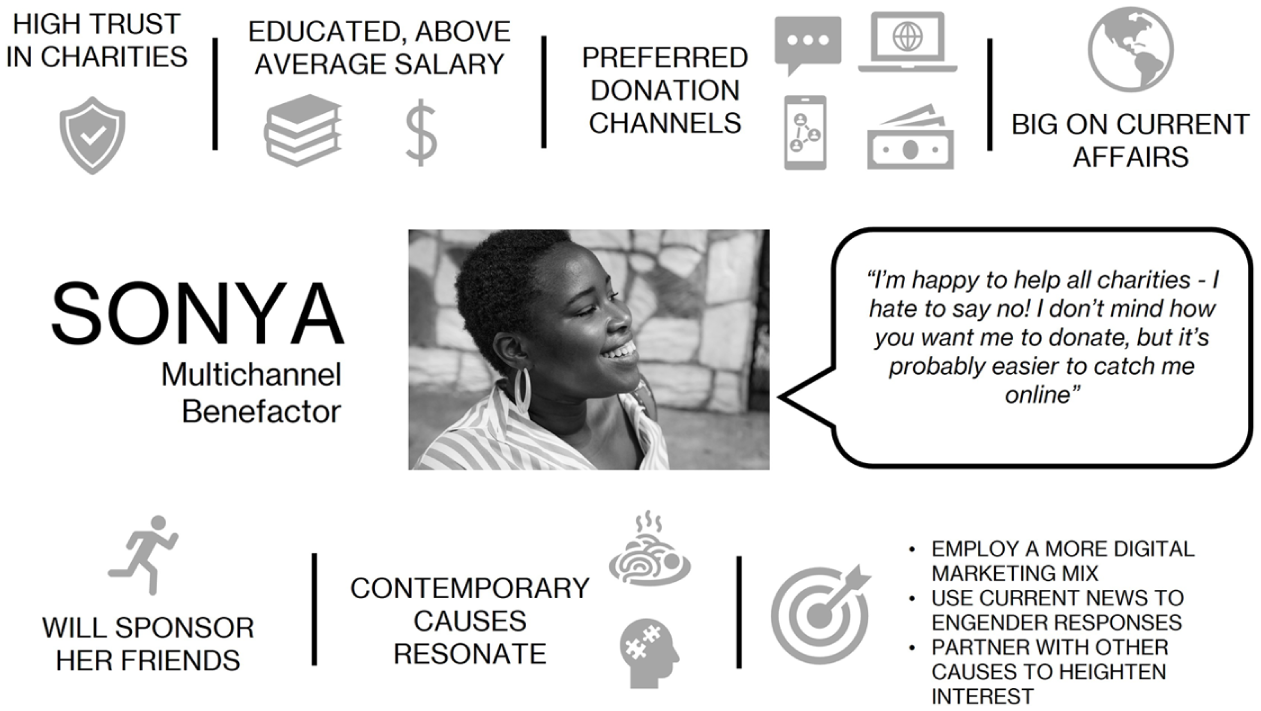
Multichannel Benefactor Donor Persona.

Charitable Sceptic Donor Persona.

Committed Digital Immigrant Donor Persona.

Spare Change Helper Donor Persona.
Our aggregate data suggests that charities should, at least temporarily, exercise some caution regarding the allocation of resources to digital giving channels, echoing the findings specific to virtual reality technology, which Martingano et al. (2023) found may increase donor empathy but not donations. Even our most digitally engaged donor segment are equally content giving cash, with over two thirds of our sample showing a clear preference for offline forms of giving. This may suggest that while digital channels offer a suitable means of learning about a charity’s work, donors may engage in webrooming (Kang, 2018) by eventually making a donation offline. Of course, that is not to say that charities ought to limit their interest in digital donation channels. Given their cost-effective nature, fundraisers may wish to ‘nudge’ existing donors online where feasible, which may in turn increase their donor value should they sign up for direct debit giving. Long-term charities ought to prepare for the emergence of generation Z in the modern workforce, their subsequent spending power and limited use of physical currency. This may result in a growth of the Multichannel Benefactor segment, but with increasingly pro-digital, cash-averse giving preferences.
Looking at specific segments, Multichannel Benefactors and Committed Digital Immigrants show relative comfort with both digital and non-digital giving, so offering them a choice of channels appears logical. However, as ongoing forms of giving are more likely to be established digitally, fundraisers may wish to gently nudge such donors towards their website as repeatedly stumbling across the same charity’s collection box is unlikely. Cash-collecting channels like raffles and competitions remain important, particularly for Spare Change Helpers. The challenge here is encouraging them to increase their donation levels to ensure this sort of technique remains financially viable, a challenging proposition given their modest levels of income.
Conclusion
In summation, our study indicates that donors can be effectively segmented based on their preferred donation channels, extending our understanding of donor segmentation in a digital context. Much like everyday consumer settings, segments appear to capture either offline only donors who demonstrate clear aversion to donating digitally, or hybrid donors who appear comfortable giving across both digital and non-digital realms. Our segments appear to be largely consistent in their preferred charitable causes, although some are notably more likely to donate and more trusting of the sector than others. Overall, our nationally representative sample displays an ongoing preference for donating cash, a noteworthy finding given the ongoing discourse around an increasingly cashless society.
These findings pose complex dilemmas for fundraisers when deciding on an optimal digital/non-digital fundraising mix that attracts digitally savvy segments while not alienating more traditional supporters. We encourage fundraisers to apply our methodology to their existing donor databases to further appreciate the extent to which channel preferences can uncover distinct giving segments.
Of course, the digital giving landscape continues to evolve. Street collectors utilising card readers blurs the line between digital and non-digital giving (Charity Digital, 2024) and crypto-giving continues to offer donors greater control over how their contributions are utilised (Howson, 2021). Charities can expect digital channels to become increasingly important as the social media–dependent Gen
Supplemental Material
sj-docx-1-nvs-10.1177_08997640251401571 – Supplemental material for Multichannel Philanthropists Versus Cash Contributors: Segmenting Charitable Donors in the Digital Age
Supplemental material, sj-docx-1-nvs-10.1177_08997640251401571 for Multichannel Philanthropists Versus Cash Contributors: Segmenting Charitable Donors in the Digital Age by David J. Hart and M. Sinan Gonul in Nonprofit and Voluntary Sector Quarterly
Supplemental Material
sj-docx-2-nvs-10.1177_08997640251401571 – Supplemental material for Multichannel Philanthropists Versus Cash Contributors: Segmenting Charitable Donors in the Digital Age
Supplemental material, sj-docx-2-nvs-10.1177_08997640251401571 for Multichannel Philanthropists Versus Cash Contributors: Segmenting Charitable Donors in the Digital Age by David J. Hart and M. Sinan Gonul in Nonprofit and Voluntary Sector Quarterly
Footnotes
ORCID iDs

Funding
Declaration of Conflicting Interests
Data Availability Statement
Discipline
Supplemental Material
Author Biographies
References
Supplementary Material
Please find the following supplemental material available below.
For Open Access articles published under a Creative Commons License, all supplemental material carries the same license as the article it is associated with.
For non-Open Access articles published, all supplemental material carries a non-exclusive license, and permission requests for re-use of supplemental material or any part of supplemental material shall be sent directly to the copyright owner as specified in the copyright notice associated with the article.
