







Abstract
Autism is broadly categorised as affecting social communication, emotional awareness, and sensory processing (Milner et al., 2019). However, as delineated by Thompson et al. (2003, p. 351), “most of what we believe we know about autism is actually about males with autism.” The pervasive gender bias and near-total invisibility of women in early-era autism research has perpetuated a male-dominant narrative, which excludes women from understandings of autism that are developed and shared in lay society (Haney, 2016; Krahn & Fenton, 2012). Informed by an incomplete narrative, lay constructions of autistic women may contribute to the intersectional marginalisation of this group on multiple axes of difference (i.e., gender, disability; Crenshaw, 1991; Saxe, 2017). We acknowledge the socially constructed nature of gender. In our study, we focus on cisgender women and use the term “women” to refer to this group. Respectfully, we use identity-first language (Botha et al., 2023).
Some observable traits of autism are unique to women. For example, in comparison to autistic men, autistic women may show more motivation to achieve social inclusion (Lockwood Estrin et al., 2021) and a higher tendency for internalising behaviours (such as depression or anxiety) than externalising behaviours (such as conduct problems; Bargiela et al., 2016). They are also more likely to camouflage autism, and prolonged efforts to blend in with neurotypical peers can lead to poor mental health and loss of sense of identity (Cage & Troxell-Whitman, 2019; Driver & Chester, 2021). The autistic identity of women who persistently camouflage can go unrecognised by lay people, which can silently perpetuate the notion that their masked behaviour is socioculturally desirable, thus obstructing autistic women from accessing support to address or mitigate poor well-being (Dean et al., 2017; Hull et al., 2020).
Hence, how lay people construct autistic women may impact their quality of life and support-seeking behaviours. Despite the growing amount of autism research, some studies indicate that general knowledge is lacking about the characteristics and experiences of autistic people (Jones et al., 2021; Kuzminski et al., 2019). This gap is amplified in relation to autistic women. For example, over three quarters of respondents in one study were unaware of the inequities these women face in gaining recognition and diagnosis (Jones et al., 2021). Additionally, first impressions and implicit association testing have suggested that negative perceptions about autism are sometimes concealed behind self-reported positive attitudes (Cage & Burton, 2019; Dickter et al., 2020).
Qualitative accounts further hold a mirror up to the society autistic women live in. Some women have shared their experiences of alienation through frequent occurrences of their emotions and behaviours being misconstrued by others (Davidson, 2007; Milner et al., 2019; Seers & Hogg, 2021). For some, to live as a woman who is accepting of her autistic characteristics and experiences conflicts with the societal pressure to perform within the assigned gendered norms and hegemonic ideals (Bargiela et al., 2016; Seers & Hogg, 2023). Many women experience social sanctioning despite their motivation to gain meaningful connections and employ social coping mechanisms to achieve inclusion (Cridland et al., 2014; Han et al., 2022; Lockwood Estrin et al., 2021; Milner et al., 2019). These accounts exemplify the salient challenges that can arise from how others construct autistic women.
In making sense of this group, lay people may draw upon sociohistorical constructions relating to autism, women, and (dis)ability (Bargiela et al., 2016; Lester & O’Reilly, 2021; Moore et al., 2024). Academic research provides a foundation of knowledge which can shape downstream social constructions of autism (Lester & O’Reilly, 2021). Gender theorists have highlighted that “male-brain” conceptualisations of autism in research have led to characteristics of autism being socioculturally coded as masculine (Davidson, 2007; Saxe, 2017). Historically, autism has been framed as a medical problem whereby autistic characteristics deviate from normal and ought to be “fixed” (Haney, 2016; Lester & O’Reilly, 2021). The ableist notion that the autistic individual has a deficit or abnormal functioning is problematic, particularly for women (Gould, 2017). Intersectionality theory posits that identities are “culturally mediated constructs implicated in relations of power, privilege and oppression” (Liasidou, 2013, p. 300). This group's perceived “deficits” are exaggerated by the intersection of their two marginalised identities: being an autistic individual, which is a minority group within a largely neurotypical population, and secondly, being a woman, the nondominant gender within the autistic population (Seers & Hogg, 2023). Despite knowing some of the barriers autistic women face, the limited existing research has seldom focused on how shared understandings among lay people can create or reinforce these barriers (Gould, 2017; Moore et al., 2022; Seers & Hogg, 2021). As such, understanding lay constructions can guide actions to minimise the disadvantages faced by these women, which are already greater than those faced by neurotypical people and autistic men (Saxe, 2017). Responding to this knowledge gap, our study is the first to use vignette methodology to explore the question, “How do people living in Australia construct autistic women?”
Theoretical perspective
Our study is underpinned by an intersectional feminist framework and guided by a social constructionist epistemology that theorises language as intricately intertwined with subjective human experience (Willig, 2008). A social constructionist lens can be used to understand how systems of meaning—or discourses—about women, autism, and disability are developed and shared (Lester & O’Reilly, 2021; Saxe, 2017). Individually held constructions reflect social realities and discourses about phenomena that people draw upon in making sense of their own experiences and realities (Burr, 1995). An explicitly feminist constructionist approach further interrogates how certain gendered social understandings and rhetoric become privileged over others (Clarke, 2000; Frith, 1998; Wilkinson & Kitzinger, 2003). Hence, social constructionism provides a means to analyse social understandings of autistic women and explore how such understandings are situated within male-dominant discourses of autism, hegemonic ideals of womanhood, and medicalised understandings of disability (Lester & O’Reilly, 2021; Saxe, 2017).
Within this broad social constructionist frame, we use an intersectional feminist lens to highlight and challenge how language is used in lay society in ways that constrain and enable autistic women's overlapping and interconnected social identities (e.g., gender, disability, race, class), as well as to explore the effects of dominant discourses (Frith, 1998; Grzanka, 2020; Saxe, 2017).
Methods
Data collection
Ethics approval was granted by Monash Human Research Ethics Committee (MUHREC/35120) in August 2022. Purposive sampling was used to recruit participants living in Australia, proficient in English, and not identifying as autistic. No participation incentive was offered. The first author (MR) recruited participants via an invitation posted on social media, and data were collected via the Qualtrics survey platform. Participants consented by clicking “agree” to the explanatory statement detailing their rights to confidentiality and withdrawal from research. Prospective participants were screened via a question about autism diagnosis, and those who qualified for participation (i.e., not identifying as autistic) proceeded to answer demographic questions (viz., age, gender, location, education, and employment status). Participants were then asked about their prior knowledge and experience of autism to contextualise the sample further.
A stand-alone vignette was used to collect data. Vignette methods have been valuable in other explorations of lay perceptions of marginalised groups (Gray et al., 2017; Timmons et al., 2024), however, is a novel approach in research with autistic women. The development of the vignette was guided by processes outlined by researchers specialising in stand-alone vignette methods (Gray et al., 2017) and vignettes used in research relating to autistic girls (Whitlock et al., 2020). Participants read a novel, empirically derived vignette that was six sentences long. It depicted a fictional autistic woman, Sophie, in her workplace and was purposefully ambiguous about her personality and relationships, which allowed respondents to make their own interpretations. Participants were asked to spend 10 minutes in total responding in writing to five open-ended questions about the vignette (which appear further below).
No ethical concerns were associated with the study since participants responded to a hypothetical situation rather than drawing on their personal experiences. Nevertheless, to minimise any risk of harm, the contact details for support services were provided so participants could seek more information or debrief if needed. Before data collection, we piloted the vignette and open-ended questions with four postgraduate university students, who gave feedback via open-text Qualtrics responses.
Vignette and questions
Sophie is a 25-year-old woman who lives with autism. A few months ago, she began a new job in an office as a data analyst and is excelling at the technical parts of her job. Sophie has appeared to be adapting well to the job and feels competent and happy at work. However, her colleagues have noticed that Sophie avoids spending lunch in the break room and does not seem interested in small talk. When Sophie chats, it is about work projects. Her boss recently called an unscheduled meeting for her team in the middle of the day, and this made Sophie visibly stressed. Sophie abruptly left the meeting, even though the boss was delivering good news about a recent work project.
Question 1: How do you imagine Sophie's life in terms of her personality, interests, friendships, and relationships?
Question 2: How do you think Sophie is feeling in this situation, and why?
Question 3: How do you imagine Sophie's colleagues understand her?
Question 4: How do you imagine people might respond to Sophie outside of work?
Question 5: Can you imagine yourself having a friendship with Sophie? Why/why not?
Participants
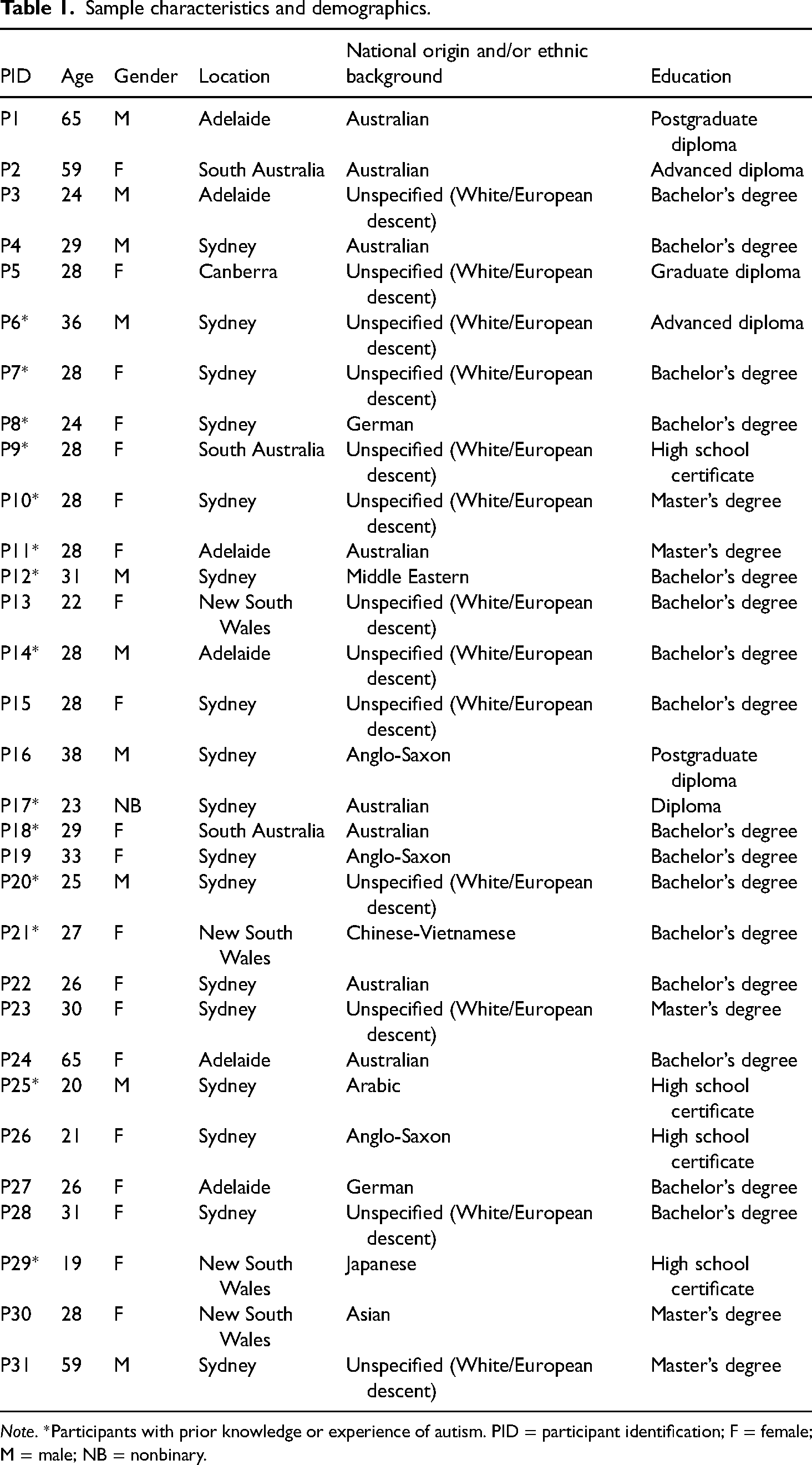
Thirty-one participants aged between 19 and 65 years (
Sample characteristics and demographics.
Data analysis
Constructionist thematic analysis was used to analyse the responses, following Braun and Clarke's (2006, 2019) flexible six-step process and using their recommendations for reflexive methodological coherency (Braun & Clarke, 2023). We oscillated between repeated readings of the data and performing the analysis in a nonlinear fashion. In this way, all the data were actively engaged with and equally attended to (Braun & Clarke, 2006). We took an inductive approach, assigning descriptive codes to semantic and latent data. We built our themes on the patterns of language use we noticed and produced a meaning-based interpretive story about the data (Braun & Clarke, 2023). This is an established analytical approach in autism research (Seers & Hogg, 2021), gender identity research (Clarke & Braun, 2009), and vignette methodology (Terry et al., 2017).
Reflexivity
Only through deep engagement with constructionist epistemology can one attend to the liminal space between language, meaning, and personal experience (Braun & Clarke, 2023; Willig, 2008). Our identities in relation to this research were amplified when identifying thematic patterns and generating themes. As cisgender women, we related to the data in a way that may not be possible for a male-identified researcher. However, as neurotypical individuals, we grappled with the power that was inherent to our outsider-looking-in position. We acknowledge the role we played in the creation of this research, including our active linguistic and interpretive decision-making (Braun & Clarke, 2023; Lazard & McAvoy, 2020). To navigate the ethical burden of creating knowledge that honoured the data without perpetuating stereotypes about those with different identities, we engaged in reflexive journalling and sought advice from autistic women on the dissemination of our findings.
Findings and discussion
Three themes were developed which reflect interrelated social constructions of autistic women: (1) Misunderstood: Gendered understandings of autism; (2) Excluded: Acceptance as onerous; and (3) Othered: Autistic differences as needing to be learned. Existing social discourse relating to autism, women, and disability were drawn upon to make sense of the character. Each question yielded, on average, 43-word responses, with respondents either assuming the position of the character's colleague or conveying their perception of how a hypothetical colleague may respond. Regardless of this position, colleagues were generally assumed to be neurotypical and to have a limited understanding of autistic women.
Theme 1. Misunderstood: Gendered understandings of autism
Theme 1 captured the gendered lens through which the vignette character, Sophie, was constructed as a woman and an autistic individual. In relation to her autism, respondents ascribed gendered traits to Sophie. For instance: “Sophie lives an orderly life, sticking to routines, focusing on set tasks and not venturing out of her comfort zone. She may prefer individuals who are direct in their communication style” (Participant [P] 24).
In this extract, Sophie's preference for direct communication is generally associated with men. As this quote shows, the traits primarily used in respondents’ descriptions of Sophie were those historically socioculturally coded as masculine, according to gender theorists (Davidson, 2007; Moore et al., 2022; Saxe, 2017). Consequently, how respondents understood Sophie as a woman who ought to exhibit “feminine” traits conflicted with the underlying male-dominant constructions of her and her autism. Sophie was implicitly positioned by respondents as an individual who did not fit the preconceived moulds of “autism” or “woman,” as shown in the following extract. I think it's possible that [Sophie's colleagues] have a negative perception of her, as women are often expected to be social and friendly, even in the workplace. Sophie might not be actively unfriendly, but her avoidance of socialising may come across as rude to those that expect differently of her. (P13)
Given that women are often considered sociable and empathetic, respondents depicted Sophie's behaviour as being perceived as socially undesirable, as exemplified here. Despite being masculinised in her autism, respondents suggested that Sophie may be implicitly judged by her colleagues for her perceived inadequacies in her identity as a woman, as described below. I’m sure many of Sophie's colleagues are confused by her behaviour and do not understand her. Many may not have even considered she might have autism as that is more commonly thought to only affect males. It would be very easy for Sophie to be labelled “strange” or “difficult” or for her colleagues to even avoid her as much as possible. (P29*)
The social sanctioning by colleagues described here suggests that Sophie is implicitly blamed for her apparent inability to perform multiple identities. Attempts to make sense of Sophie may relate to the sustained influence of the historical, male-brain discourse on social constructions of autistic women. Consequently, the expectation that the character (Sophie) would perform androcentric autism is juxtaposed with hegemonic gendered expectations (Davidson, 2007; Moore et al., 2024; Saxe, 2017).
These findings contextualise qualitative studies in which autistic women have attributed being misunderstood to conflicting gendered expectations in their personal and professional lives (Cridland et al., 2014; Milner et al., 2019; Moore et al., 2022). The positioning of Sophie as not performing her identities as expected is implicated with camouflaging behaviours and points to reasons women might mask their autism in attempts to “fit in” with neurotypical society, especially in the workplace. Despite the adverse impact that prolonged camouflaging can have on health, narratives of autistic women suggest masking as a way to relieve the tension provoked by these confounding expectations of their dual identities (Driver & Chester, 2021; Hull et al., 2020). The findings highlight the double bind that autistic women are faced with as a direct consequence of how they are understood and misunderstood by the lay public.
Theme 2. Acceptance as onerous
Theme 2 reflected the labour perceived to be involved in others’ acceptance of the character, Sophie. This was often conveyed by respondents who did not report prior knowledge or experience of autism. Respondents commonly portrayed Sophie as needing special accommodations in social contexts that required her assumed neurotypical colleagues to develop an appreciation for her nonnormative ways of interacting. The respondents emphasised Sophie's perceived deficits and the challenges when considering friendship, as the following extract exemplifies. I honestly don’t know if I would be able to accommodate her needs in a friendship (depending on what they are). Similarly, I’m unsure that we would be able to have an equal relationship in terms of accommodating both of my and her needs within a friendship. (P26)
This respondent constructed befriending Sophie as a demanding undertaking and, resultantly, Sophie is positioned as being excluded before being considered for friendship. The description of having to “accommodate her needs” implies that socially including Sophie may be deemed onerous by her colleagues, as other respondents also suggested. For instance, one participant wrote, “[Sophie] might be seen as hard to get through to … I assume they [Sophie's colleagues] wouldn’t make much time for her outside of work hours” (P28). In this short extract, colleagues’ acceptance of Sophie is constructed as effortful, leading to social exclusion.
Accordingly, in respondents’ accounts, the presumed deficits attributed to Sophie's autism are construed as limiting the depth of social connection that she is considered capable of, as well as her colleagues’ willingness to build a connection with her. This rationale for Sophie's social exclusion is illustrated below. I think people use small talk as a tool to connect and break barriers. Sophie's inability to engage in small talk may deter her colleagues from wanting to converse with her … I think I could maintain a surface level “work friendship” with Sophie, however, I would not be able to sustain a meaningful relationship outside of the office. (P19)
This quote positions both Sophie's colleagues and the respondent as unable (“not … able”) to meaningfully engage with Sophie. Rather than their unwillingness, impatience, or intolerance, this situation is attributed to “Sophie's inability,” drawing on a deficit discourse of disability. This inherent deficit is thus rendered the cause of Sophie's social exclusion. Correspondingly, respondents also considered that Sophie's colleagues would need empathetic or charitable qualities to be able to accept her, for instance stating, “The nicer colleagues might be inclined to focus on her work details and keep her engaged in conversations around the work content” (P2). In this comment, acceptance of Sophie in a social context is depicted as requiring special empathetic efforts by her kind (“nicer”) colleagues, suggesting that some might go out of their way to engage Sophie as a kindness to her. However, the focus is on superficial inclusion at work, not meaningful social inclusion—which Sophie is presumed incapable of. This echoes P19's (above) reference to “a surface level work friendship” and not “a meaningful relationship” beyond the workplace. In this way, discursively placing a spotlight on Sophie's deficits and additional needs, respondents implicitly “problematised” her autism. Such constructions of Sophie ultimately preclude her from attaining social acceptance and genuine social inclusion. Overall, Sophie's functionality was constructed within the context of an “able” community, which underscored her perceived social deficits in relation to the ableist norm. She was positioned as being laborious to engage with because of her assumed different social needs, which were depicted as requiring additional time, energy, and even generosity to accommodate.
This theme draws on a medicalising, deficit-based discourse rooted in the medical model of disability in which deviations from “normal” functioning are pinpointed as problems (Grue, 2011; Lester & O’Reilly, 2021). In this discourse, the onus is placed on the perceived “abnormal” individual to correct their deficit to fit the wider socioenvironmental context. Further, the presumed neurotypical colleagues’ implicit intolerance for neurodiverse differences captures a familiar interactional mismatch between autistic and neurotypical people known as the “double empathy” problem, whereby individuals have greater empathy for social needs similar to their own, rather than those which are different (Milton et al., 2022). In line with this phenomenon, the findings suggest that shared understandings that stem from deficit discourse and neuronormative workplace standards bar autistic women from gaining social inclusion among their neurotypical peers.
Other qualitative research conducted in Australia (Seers & Hogg, 2021) and the United Kingdom (Bargiela et al., 2016; Milner et al., 2019) includes women's accounts that speak to the experience of social repudiation. Autistic women are often highly motivated to connect with others (Milner et al., 2019), which may intensify the negative experience and subsequent health repercussions of being socially excluded.
Theme 3. Othered: Autistic differences as needing to be learned
Theme 3 explored the problematic othering of Sophie. Respondents implied that accepting Sophie was only possible if her colleagues had special knowledge about autism, positioning her outside the normative in-group, as suggested in the following extract. [How Sophie is understood] depends on the knowledge [that Sophie's colleagues] have about autism. Some may think she acts a little strangely or out of the normal, but there are others who may recognise/be familiar with her behaviour. If her colleagues are neurotypical and don’t know anyone with autism, they may not understand her behaviour at all. (P17*)
Here, Sophie is constructed as someone with whom her peers are required to “learn” how to engage because of her apparently strange or abnormal behaviour. This suggests that understanding is key to tolerance (but not necessarily acceptance), drawing on a liberal discourse of tolerance. The implication is that spontaneous or effortless interaction may not be possible. Rather, additional labour, by gaining an understanding of her different preferences and needs, is required to engage with Sophie. This could also potentially excuse her colleagues’ intolerance, by positioning them as ignorant rather than wilfully intolerant of difference.
Sophie's preferences within relationships, which were attributed to her autism, were perceived to require special knowledge on the part of her colleagues. For example, one respondent wrote: “I would try to get to know Sophie but on her terms … I can imagine myself trying to make friends but I think I would find it hard to understand her needs” (P12*). This respondent self-positions as willing to “try” to befriend Sophie but depicts doing so as “hard” owing to Sophie's different and unknown “needs.”
Despite good intent, the language used by respondents when attempting to connect with Sophie emphasised her perceived differences from the dominant in-group and instead served to reinforce her social deficits. As captured in the following quote, respondents made comparisons to neuronormative functioning, positioning her as the deficient other. Many people are likely to feel uncomfortable around Sophie because she likely does not adhere to many social norms, but this could be overcome by making an effort to understand Sophie, how her mind works and that she is simply different to them, rather than being strange or difficult. (P6*)
Here, Sophie is positioned as deviating from “social norms.” The acknowledgement of social interactions as governed by certain conventions potentially highlights the social origin of some of the difficulty, as per a liberal tolerance discourse, which allows her to be depicted as “different … rather than strange or difficult.” Nevertheless, interacting with Sophie is still described as “an effort,” requiring benevolence and labour on the part of “normal” people who can and do “adhere to … social norms.” This extract demonstrates how implicit comparisons drawn between Sophie and her neurotypical peers resulted in the repeated othering of Sophie, through a perceived need to learn her nonnormative ways of relating to others.
The character was discursively positioned at the intersection of her multiple identities, being a woman and an autistic individual. Sophie's multiple identities increased the perceived “learning” that was required to know and accept her, which compounded the othering of the character. In attempting to make sense of Sophie's unknown otherness, respondents implicitly relegated her to an out-group of inferior social value, regardless of their prior knowledge or experience of autism. Constructions of Sophie as “suffering” in her autism, onerous in her perceived needs, and in need of charitable efforts from her colleagues, exemplified how social constructions can compromise the autonomy, agency, and power afforded to autistic women. For this group, the combination of their marginalised identities creates a unique and conflated experience of oppression, unlike one of the identities in isolation (Crenshaw, 1991; Liasidou, 2013). In contrast, autistic men can often still benefit from male privilege despite being bound by medicalised constructions of disability and autism (Saxe, 2017).
This study's findings build upon qualitative accounts of autistic women who have lived the consequences of their twice-othered identities and described the resulting ostracisation. In these narratives, these women have expressed how navigating both ableist and gendered expectations has led to feelings of failure, demonstrating the impacts of their systemically disenfranchised identities and underscoring their risk of poor mental health (Kanfiszer et al., 2017; Kelly et al., 2022; Moore et al., 2022). As such, the pervasive and prevailing influence of patriarchal and ableist discourse on the social constructions of this group can strip autistic women of their agency and inhibit them from playing an active role in shaping the way they are understood by lay people. Addressing lay misconceptions about these women may impact their well-being and support-seeking behaviours by fostering a safer environment in which they live and work.
Conclusion
This study is the first to systematically explore lay constructions of autistic women. Socially constructed ideas of this group are bound by entrenched male-dominant, medicalised, and gendered discourses, and exemplify the intersectional disadvantage they face as a result of their dual minority identities (Bargiela et al., 2016; Krahn & Fenton, 2012; Lester & O’Reilly, 2021). The findings contribute a novel perspective on the society in which autistic women live and lend credence to qualitative accounts from the women themselves. In doing so, this research makes more space for autism in intersectional feminist literature, drawing attention to how the language used in lay society can sustain dominant power structures and oppression through social discourse (Frith, 1998; Grzanka, 2020; Saxe, 2017). With scant attention paid to autistic women in previous literature, we hope to empower through knowledge and provoke reflection to recentre “a position of humility in the face of difference” (Milton et al., 2022, p. 1902). Here lies an opportunity to educate and shift the lay vernacular to acknowledge and honour autistic women without shoehorning this group into preconceived identity ideals.
This study was strengthened by the qualitative approach, novel vignette methodology, and the underpinning social constructionist epistemology. This enabled rich exploration of constructions by treating textual extracts as exemplars of social discourse (Burr, 1995). Interpretative depth was also achieved by making sense of the data through an intersectional feminist lens. As Smith (2018) argues, the transferability of research is possible when findings can illuminate patterns of oppression among individuals with more than one marginalised identity. We focused on cisgender women, but the findings may indicate social constructions about other minority groups, including gender-diverse autistic people and neuroqueer identities (Egner, 2019).
One notable limitation of this study was the use of person-first language (women with autism) in the vignette and questions, which may have primed less favourable responses and constructions about autistic women, compared to if identity-first language had been used. Future research materials should reflect identity-first language to examine social constructions of autistic women. During the later research stages, we consulted autistic women about the interpretive implications of linguistic priming in research, in line with reflexive feminist research practices (Braun & Clarke, 2006, 2023). It is paramount that autistic women are consulted at earlier research stages in similar future studies, particularly about vignette content, questions, language preferences, and interpretation (Fletcher-Watson et al., 2019). This is especially important in view of reducing the impact of the “double empathy” problem in research, promulgating stereotypes, and given the scarcity of research relating to autistic women which researchers can draw upon for design materials (Botha & Cage, 2022; Milton et al., 2022). Inclusive, person-centred, and codesign approaches are important to enhance credibility and ensure the voices of autistic women are recognised in emerging research.
A second limitation was the workplace context of the vignette, which may have elicited situation-dependent constructions. Future studies of this nature ought to depict nonworkplace contexts given that social constructions of autistic women may differ within a friendship group or on a romantic date. Nonetheless, the findings demonstrate the need to build lay knowledge about autistic women, given that social constructions of this group can perpetuate the disadvantages they face.
Footnotes
Acknowledgements
Declaration of conflicting interests
Funding
ORCID iDs
